

Connect with us

NewsBeat

At least 132 killed in Colombia’s largest earthquake in years

Published

on

Residents dig through the debris of a collapsed building after an earthquake, in Cali, Colombia

At least 132 people are dead and a state of emergency has been declared after Colombia was hit by one of its largest earthquakes in years.

The death toll is likely to rise, with more feared trapped under collapsed buildings.

The magnitude 7.4 quake struck at 07:34 (12:34 GMT) at a depth of 103km (64 miles) in Chocó province, the country’s geological service said. It was felt across an enormous area, stretching for hundreds of miles across western Colombia.

Many of the deaths have been concentrated in the city of Pereira, in Colombia’s coffee-growing region, with surrounding cities and the Valle del Cauca region also hit hard.

Advertisement

The epicentre of the quake was near the village of San José del Palmar, in Chocó province, but local mayor León Fabio Marín Moncada said that there had miraculously been no deaths or injuries – despite the roads in and out being damaged.

More than 480 people were injured in the quakes, Colombia’s Association of Capital Cities wrote in a statement update on Monday.

About 55km (34 miles) from the epicenter of the earthquake, the city of Pereira saw some of the worst damage.

Videos verified by the BBC show at least one building collapsing in Plaza Bolívar, the city’s main square, with scattered debris and dust across the open space where many people had gathered.

Advertisement

Local authorities have reported at least 40 people dead in the city’s metropolitan area, with 65 collapsed buildings. People are believed to be trapped in 15 of them.

A curfew is in place in some parts of the city until 05:00 local time on Tuesday.

Thirty-two buildings collapsed in Cali, located about 160km south of Pereira and about 200km from the epicentre.

Dan Cutler, 29, is from London but has been in Colombia for about two months as part of a big trip with his partner, and is currently in Cali.

Advertisement

Being woken by the earthquake, he told the BBC: “I’ve never experienced anything like it.”

“We sprinted outside in our pyjamas. There’s no major structural damage to the hotel, but there are surface cracks in the walls, and paint and plaster have peeled off,” he says.

There were also reports of deaths in Manizales, Quibdó, Medellín, across the Chocó and Valle del Cauca regions.

Source link

Advertisement
Continue Reading
Click to comment

You must be logged in to post a comment Login

Leave a Reply

NewsBeat

Two charged with preventing lawful burial after child’s body found at home

Published

on

Two charged with preventing lawful burial after child’s body found at home

The body of a child has been discovered at an address in Southend, Essex Police have said.

Officers attended an address in Kenway on August 7 after receiving reports from social services raising concerns for the welfare of a child.

The body was found, and a man and a woman were subsequently arrested, the force said.

Sophie Dean, 31, of Kenway, and James Thorpe, 32, of Shoeburyness, have since been charged with preventing a lawful and decent burial of a dead body between July 3, 2025 and August 6, 2026.

Advertisement

Thorpe has also been charged with obstruction of a constable in the execution of their duty, the police added.

The pair appeared at Southend-on-Sea Magistrates’ Court on Monday and were remanded in custody to next appear at Basildon Crown Court on September 7.

The force said the investigation into the child’s death will continue to be led by detectives from its crime and public protection command.

“We would also encourage anyone with information that could assist us and who has not yet spoken to us to please come forward and do so quoting investigation number 42/125225/26,” it added.

Advertisement

Source link

Continue Reading

NewsBeat

Woman locked up and starved for 25 years after falling for the wrong man

Published

on

Daily Record

WARNING: DISTRESSING CONTENT ‘The air was so unbreathable, the odour given off by the room was so rank, that it was impossible for us to stay any longer to proceed with our investigation’

In a heartbreaking discovery a woman was found in a nauseating “crust made from excrement” after her family locked her in the attic for loving the wrong man.

Advertisement

Police Commissioner Bucheton made the horrifying discovery in the rafters of the aristocratic Monnier family’s grand home.

He was alerted to a problem through a letter claiming a “half-starved” woman had been held against her will for over 25 years in a room with “unbreathable” air it smelled so bad.

On the evening of May 23 1901, Bucheton knocked on their door expecting to find nothing as the Monniers were a well-to-do French family, according to the New York Times.

However, Bucheton persisted and spoke to Louise who had survived her husband Emile’s passing. The couple were well regarded, charitable and sociable.

Advertisement

The couple had a son, Marcel, a law school graduate. They also had Blanche who was described as “very gentle and good-natured”. Blanche had stunned society in her youth with her beauty attracting many young bachelors.

Tragically, under the veneer of lavish parties and social engagements, Blanche was deeply troubled. She had a fraught history of eating disorders and a difficult relationship with her overbearing mother.

However, Blanche had not been seen in 25 years. When Blanche was still in her mid-20s, she vanished without a trace.

Advertisement

The family had publicly voiced their deep concern and grief for their supposedly missing daughter. Blanche’s friends assumed she had fled to begin a new life in Paris, escaping her conservative family.

But the police stumbled on a sickening truth. Commissioner Bucheton and his officers arrived at the Monnier household, feeling unwelcome in the home as they searched each room and made their way upstairs where they found a padlocked door.

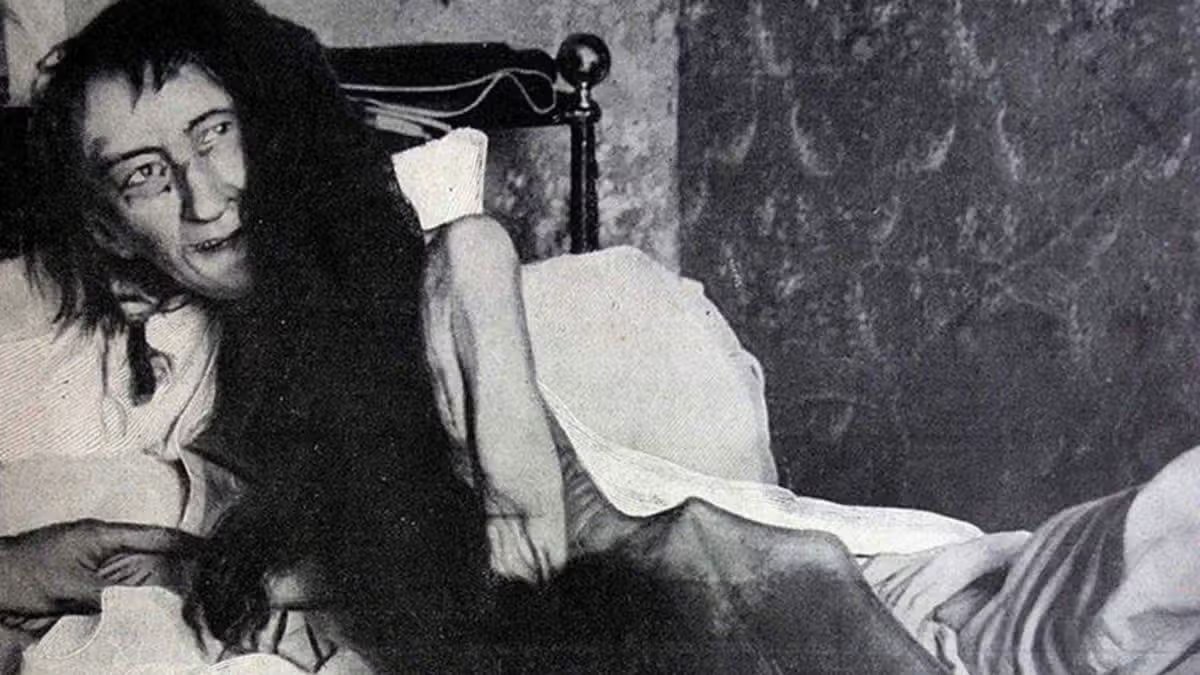
On opening it they found an emaciated woman in her early 50s, lying in her own filth. Her skeletal, unclothed body was moments away from becoming a corpse and weighed just 25kg. She was only fed scraps for decades.

Officers said the smell was so foul they could not stay in the room. One officer said: “The unfortunate woman was lying completely naked on a rotten straw mattress.

“All around her was formed a sort of crust made from excrement, fragments of meat, vegetables, fish, and rotten bread. We also saw oyster shells and bugs running across Mademoiselle Monnier’s bed. The air was so unbreathable, the odour given off by the room was so rank, that it was impossible for us to stay any longer to proceed with our investigation.”

Following a confession from her mother, Louise, it became clear she had imprisoned her daughter for falling in love with what she deemed to be the wrong man.

The Monniers believed Blanche would marry a fellow member of the French elite. However, she had set her heart on a penniless lawyer who was considered completely inappropriate by her family.

Advertisement

The New York Times article published on 9 June 1901 said: “Time passed, and Blanche was no longer young. The attorney she so loved died in 1885.

“During all that time, the girl was confined in the lonely room, fed with scraps from the mother’s table, when she received any food at all. Her only companions were the rats that gathered to eat the hard crusts that she threw upon the floor. Not a ray of light penetrated her dungeon, and what she suffered can only be surmised.”

The case provoked considerable public outrage, with an angry crowd gathering outside the Monnier’s home. Blanche’s mother, Louise, was taken into custody but passed away just 15 days after her daughter was freed.

Advertisement

Her brother Marcel was initially handed a 15-month prison sentence — a mere fraction of what his sister had endured — but was he was cleared after claiming that Blanche could have chosen to leave at any point.

Blanche, was so traumatised she was unable to return to her previous vibrant social life as her physical and mental health withered away in her time locked up.

She spent the following 12 years of her life at a psychiatric hospital in Bois, where she passed away in 1913. She is remembered by the sorrowful nickname, La Séquestrée de Poitiers – The Confined Woman of Poitiers. The identity of the letter writer was never been revealed.

Source link

Advertisement
Continue Reading

NewsBeat

How does Sir Rod’s grass stay so green? Stewart’s mini golf course is an oasis during record-breaking drought

Published

on

Sir Rod Stewart¿s Grade II-listed mansion has very green gardens despite the dry weather

Advertisement

Millions of gardens across the drought-hit country have turned brown in recent months due to the relentlessly hot and dry weather.

But the grass is still very much alive outside Sir Rod Stewart‘s Grade II-listed mansion as he has maintained his piece of England’s green and pleasant land in Essex.

Aerial photographs show the land around the 81-year-old singer’s 18th-century property, which he bought for £4.65million in 2013, is still extremely green.

His ten-bedroom home opens out onto a range of sprawling gardens and includes a mini golf course with a fairway, two bunkers and a lush putting green.

Advertisement

There is also an artificial football pitch with a 20-space car park which Sir Rod had installed at the property before moving in with wife Penny Lancaster in 2016.

Sir Rod’s property is supplied by Affinity Water which introduced a hosepipe ban across its central region including Essex on July 17 due to the weather conditions.

Eight other water companies have brought in bans which mean customers are legally banned from using hosepipes to water gardens or wash cars, patios or boats.

There is no evidence Sir Rod has breached a ban, given there are many workarounds for watering grass such as using a watering can. He may also have an exemption.

Advertisement

Sir Rod Stewart’s Grade II-listed mansion has very green gardens despite the dry weather

Sir Rod's mini golf course features a fairway, two bunkers and a lush putting green

Sir Rod’s mini golf course features a fairway, two bunkers and a lush putting green

The property in Essex has an artificial football pitch with a 20-space car park

The property in Essex has an artificial football pitch with a 20-space car park

Advertisement
Sir Rod's ten-bedroom home opens out onto a range of sprawling gardens

Sir Rod’s ten-bedroom home opens out onto a range of sprawling gardens

The 81-year-old singer bought the 18th-century property for £4.65million in 2013

The 81-year-old singer bought the 18th-century property for £4.65million in 2013

Advertisement

Drought has been declared for all of Wales and almost three-quarters of England – and a sixth heatwave of the year is on the way later this week with 36C highs. 

Back in August 2006, Sir Rod risked a £1,000 fine when he was caught flouting the hosepipe ban at his previous £6million property Copped Hall, in Epping Forest.

His spokesman said he was using an underground irrigation system, but Sir Rod’s then-provider Three Valleys Water confirmed this was prohibited under the ban.

Sir Rod later told the Mirror that November: ‘This summer has caused a lot of trouble as it didn’t rain for months. Every garden was burnt, every flower dried out.

Advertisement

‘Water was rationed, watering was banned. Only my football pitch was a beautiful, lush green. Because, naturally, I continued to water it.’

After being warned about a fine, Sir Rod said: ‘I’ll take that on board if it happens. For me there’s hardly anything more beautiful than to walk across my tended grass.’

He sold Copped Hall for £4million in 2019. Sir Rod’s representative was contacted for comment by the Daily Mail yesterday. Affinity Water declined to comment.

Advertisement

Advertisement

Source link

Continue Reading

NewsBeat

Seaham bridleway remains closed, says public notice

Published

on

Seaham bridleway remains closed, says public notice

A 630-metre stretch of Public Rights of Way Bridleway No.1, Seaham Parish, will remain temporarily closed until March 31, 2028, or until works are completed.

This closure, which began on February 6, 2026, is due to preparation and electric cable installation works, according to a notice from the County Council of Durham.

The bridleway runs south and north-west from its start point at the A1018, the roundabout north of Seaham Grange Industrial Estate.

Advertisement
  • For more notices affecting YOUR area, visit our Public Notice Portal – Public Notices from The Northern Echo ( publicnoticeportal.uk ). More information on this application can be found here.

An alternative route has been made available for traffic.

This begins from the north-eastern side of the closure, from the footpath east of the A1018 roundabout, heading north and north-east onto National Cycle Route No.1 bridleway, and south-westerly to the south-western side of the closure, and vice versa.

The continuation of the closure was approved by the Secretary of State for Transport.

Source link

Advertisement
Continue Reading

NewsBeat

Can DNA from cave paintings tell us who the artists were?

Published

on

Can DNA from cave paintings tell us who the artists were?

Perhaps the most evocative windows into the minds of our ancient ancestors are the images they painted on the walls of caves – renderings known simply as rock art or cave paintings.

Rock art, which is found across the world, offers snapshots of human history, preserving representations of cultural traditions, symbolic communication and social identity. Common subjects include animals, hunting scenes and hand stencils – thought to have been made by blowing pigment over the artist’s hand.

Scientists have wrestled with basic questions about the origins of rock art such as: what was used to produce it, when was it made, and who made it?

Now, a recent study of cave art from Spain and Portugal has shown that ancient human DNA can be recovered directly from the cave walls. We may therefore be edging closer to answering “who made it?”

Advertisement

Using this technique to link a specific painting to an ancient artist may be a step too far. But there are still important things it can tell us about the past.

Previously, researchers had made considerable progress in answering the “what” and “when” questions. Scientists can analyse what pigments are preserved in rock art using techniques such as X-ray fluorescence spectroscopy, which allows them to identify materials such as red ochre and charcoal.

Scientists can also estimate the age of the art using techniques such as carbon-14 dating, carried out on minute quantities of organic material, to determine when rock art was created.

For example, in 2026, researchers reported that a stencil of a human hand had been found in Southeast Sulawesi, Indonesia. The researchers used a laser to bore a microscopic hole and collect samples from a fine layer of calcium carbonate that had formed over the painting.

Advertisement

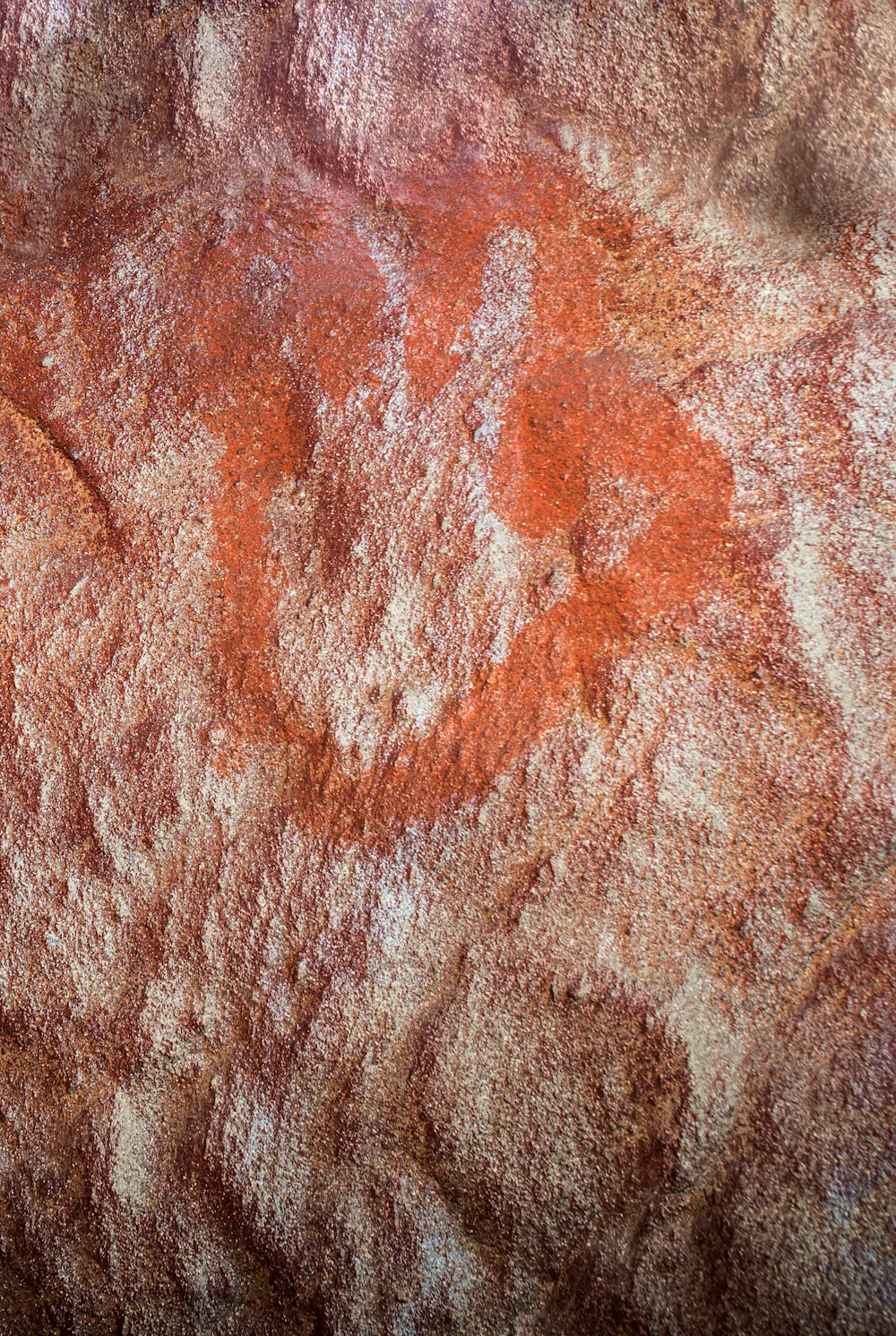
The research team then measured the degradation of radioactive uranium contained in these mineral deposits to assign a minimum age to the painting of 67,800 years – making it the world’s oldest known minimum date for cave art.

The age of this art fits within a period when modern humans (Homo sapiens) are thought to have migrated through the area. But the wider Indonesian archipelago was previously home to other human species, such as Homo erectus and Homo floresiensis (nicknamed “the Hobbits”), which complicates matters significantly.

Between the more visible images is the faint, red outline of a hand. Scientists have dated this rock art from Liang Metanduno on Muna Island, Indonesia, to 67,800 years ago.
Maxime Aubert (Nature)

While the stylistic and technical complexity of the art suggests authorship by Homo sapiens, we have no way to be certain who made it.

Advertisement

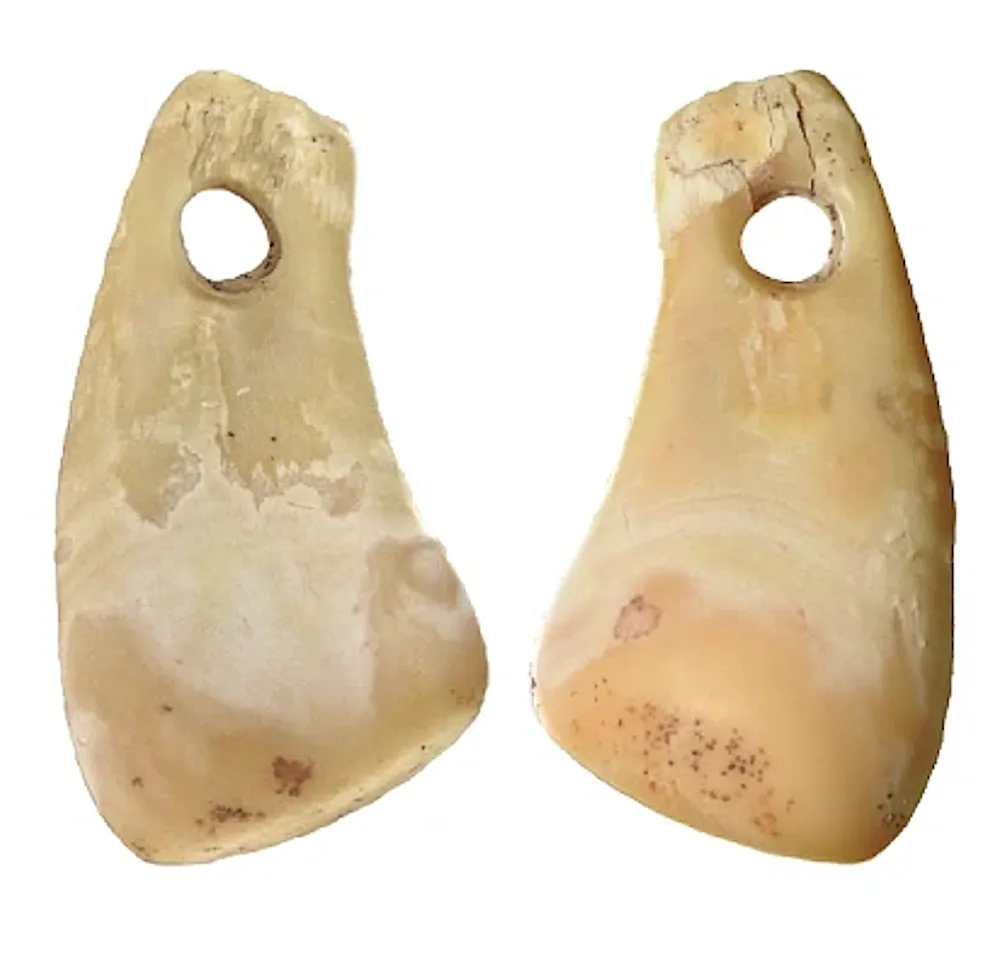
Identifying a human linked to a prehistoric item has an established methodology. For example, in 2023, researchers recovered ancient DNA from a deer-tooth pendant found in Denisova cave, southern Siberia.

Analysis of the genetic sequence showed that the pendant was probably worn by a 25,000-year-old woman belonging to an ancient population known as Ancient North Eurasians, who lived across Siberia in Palaeolithic times.

Such discoveries transform otherwise anonymous objects into evidence of real people, giving us an intriguing glimpse into the lives of our prehistoric ancestors.

New genetic reservoirs

Advertisement
A deer-tooth pendant from Denisova Cave in Russia

This deer-tooth pendant from Denisova Cave in Russia yielded DNA from its ancient wearer.
Essel, et al. Nature (2023), CC BY-NC-SA

In the latest cave art study, scientists systematically sampled both painted and unpainted surfaces of cave walls at 11 sites across Spain and Portugal. Remarkably, they recovered ancient human DNA directly from the walls, demonstrating for the first time that these surfaces can act as reservoirs for genetic information.

Some of these cave wall samples were shown, through both genetic analysis and the archaeological context, to be at least 4,000 years old.

In two of the samples from Covarón cave in northern Spain, human DNA was sufficiently preserved to be identified as belonging to ancient western hunter-gatherers. These were populations that lived across much of Europe during Late Palaeolithic and Mesolithic times.

One of the samples from a pigmented part of a cave wall, in Escoural cave, Portugal, also yielded traces of ancient DNA, but it was not as well preserved as other samples.

Nevertheless, the research establishes a powerful new methodological framework and proof of concept. It raises the tantalising prospect of studying not only the images left behind, but also the communities of people who made them.

Advertisement

However, applying this technique successfully to identify the artist of specific ancient rock art is incredibly unlikely.

Only one of the pigmented samples from the Spanish and Portuguese cave sites yielded ancient DNA. It was retrieved from Escoural cave in Portugal.
Bossoms Mesa, et al. (2026), CC BY-NC-SA

This research could, though, potentially resolve one of the most contentious debates in archaeology. This concerns a 66,700-year-old hand stencil discovered within Maltravieso cave in Extremadura, western Spain.

This controversial stencil appears to predate the arrival of modern humans in Europe. Some researchers have therefore argued that Neanderthals, not Homo sapiens, made the art.

Finding DNA from either species in this location, at similar times to the creation of the rock art, could offer a potential route for resolving the debate. But this too is much more difficult than it might seem.

Advertisement

Easy transfer

The presence of human DNA does not prove who created the rock art. DNA is easily transferred – actions as simple as breathing can transfer someone’s genetic material to a location or object. This is why DNA recovered from a knife cannot definitively conclude who committed a stabbing in a forensic case.

Hand stencil in Maltravieso cave

Maltravieso cave in Extremadura, Spain, is full of hand stencils, some of which may have been made by Neanderthals.
WH_Pics

DNA establishes the association of someone with an item or location, not the actions they carried out during the deposition of their genetic material. Environmental activities such as rain can also transfer human DNA to these spaces, making it extremely difficult to identify a single person at a location.

Additional DNA can be deposited at very different times to when the painting was produced – by both modern and ancient humans. The potential for contamination is incredibly high, making it difficult to establish who may have been at a given location at a specific time.

Nonetheless, scientists can use this new research to explore important prehistoric questions such as the hominin species, population groups and sexes of those who entered specific cave systems, and their migration routes across landscapes.

Advertisement

In the general sense, we can also begin to connect prehistoric art with the people who created and lived with it.

Behind each rock-art hand stencil or hunting scene is evidence of a real person who, while separated from us by tens of thousands of years, felt the need to communicate their creativity – as we do today. Techniques such as this offer a vital opportunity to understand more thoroughly the human experience via our similarities with ancient people.

Source link

Advertisement
Continue Reading

NewsBeat

‘we have nowhere to go with our complaints’

Published

on

‘we have nowhere to go with our complaints’

US Customs and Border Protection (CBP) recently issued its first-ever “withhold release” orders on garments made in Jordan. These orders, issued on June 23 with immediate effect, bar shipments from two factories run by Jordan-based clothes manufacturer Needle Craft from entering the US market.

The case can be traced to the 2023 suicides of two young Bangladeshi women working in clothing factories in Jordan’s Ad-Dhulayl industrial zone. In response, UK-based workers’ rights organisation Labour Behind the Label launched an investigation with the i newspaper.

Their findings drew international attention to allegations of forced labour in the two factories – and helped prompt the CBP to launch its inquiry. Needle Craft has not publicly responded to the allegations.

Major US brands sourcing from Needle Craft, most notably Columbia Sportswear and Under Armour, have announced they will address the issues raised directly with their supplier.

Advertisement

The Needle Craft case is not an isolated instance of alleged abuse. Rather, it is symptomatic of a labour regime in Jordan that is sustained by the exploitation of predominantly female migrant workers.

A map of Jordan’s largest industrial zones for clothing production.
David Lagarde (2024), CC BY-NC-ND

A recent report I co-authored with urban researchers Ahmed Zaazaa and Heba Zakarnah documents workers’ everyday experiences of restricted mobility, dormitory life and deteriorating health in Jordan’s clothing production zones – from Aqaba in the south to Al-Hassan in the north.

The workers’ stories, annotated maps and drawings brought together in our report reveal how employer control and the relentless rhythms of global clothing production permeate every aspect of their lives.

Advertisement

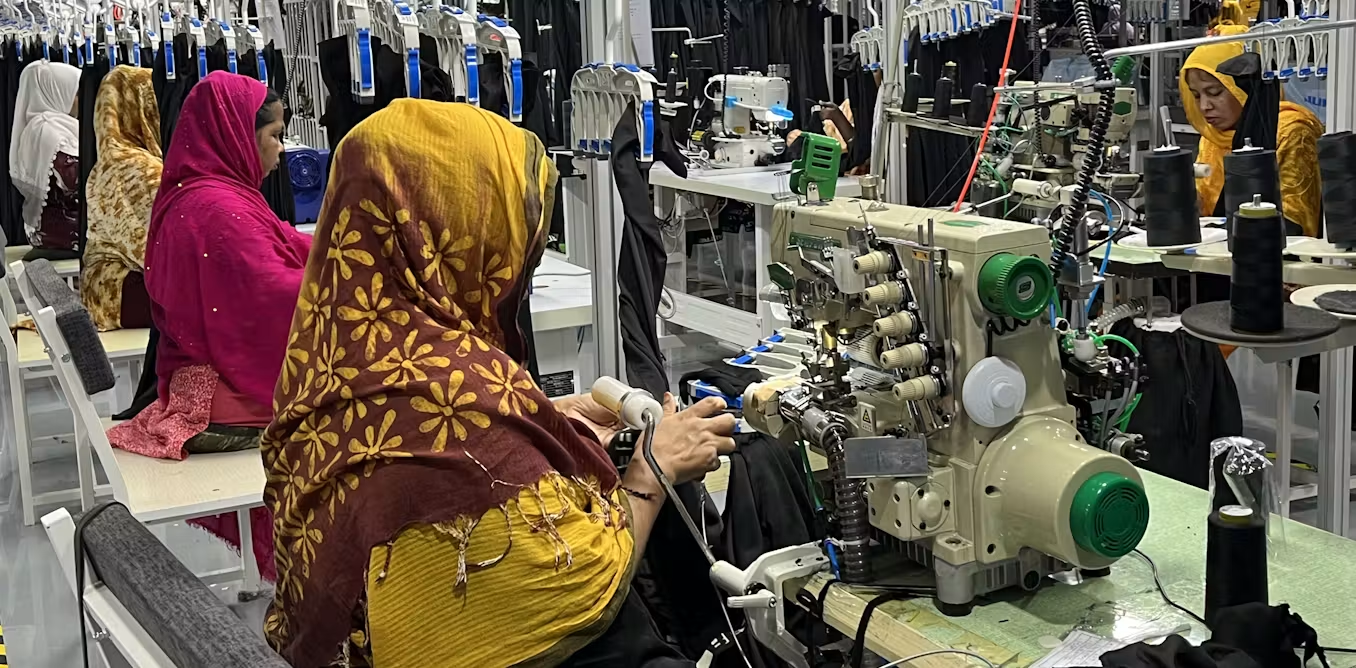
During peak production periods, migrant workers routinely work 12- to 14-hour days, with overtime often exceeding the legal limit of two hours per day. Strict production targets dictate every movement, limiting even toilet breaks.

When shifts finally end, workers return to employer-run dormitories adjacent to the factories. There, overcrowded living conditions and inadequate infrastructure turn everyday tasks into a struggle, as Lakmini, a 23-year-old Sri Lankan worker, explained:

When we finally arrive at the dormitory, we have to fight for hot water, for a stove to cook a quick meal, or simply for a moment of quiet in rooms shared by eight workers. Sometimes I don’t know what is more exhausting: the factory, with its noise and dust, or the dormitory, with its terrible smell, constant arguments and endless queues.

Top view of a women’s dormitory room, based on workers’ free-hand drawings.

Top view of a women’s dormitory room, based on workers’ free-hand drawings.
Heba Zakarnah (2024), CC BY-NC-ND

Jordan’s export-oriented clothing industry emerged in the late 1990s. Under the Qualifying Industrial Zones agreement, the existing US-Israeli free trade agreement was extended to 13 designated industrial zones in Jordan.

These zones had been introduced as a form of commercial diplomacy in the wake of the 1994 Jordan-Israel peace treaty, with the goal of fostering cross-border economic cooperation and creating employment opportunities in Jordan.

Advertisement

Yet the significant commercial advantage of quota- and duty-free access to the US market motivated transnational, largely Asia-headquartered garment manufacturers to relocate parts of their production facilities to Jordan.

To ensure the productivity and flexibility demanded by global clothing brands, these producers began sourcing labour from South and Southeast Asia – particularly from countries with established garment industries and an experienced workforce.

Factories deliberately maintain a mixed-nationality workforce to impede worker solidarity. Preference is given to young women with limited formal education, who are considered easier to discipline and more likely to accept excessive overtime. Currently, young Bangladeshi women make up the largest group of workers in Jordan’s clothing industry.

Advertisement
A flow chart showing the origin of migrant workers in Jordan's garment factories.

Most workers in Jordan’s garment factories come from Bangladesh.
David Lagarde (2024), CC BY-NC-ND

Living in employer-controlled industrial enclaves makes migrant workers available around the clock. Jordan’s restrictive kafala (sponsorship) system also ties migrant workers’ residency and work permits to a single employer. This makes it almost impossible to change jobs.

Taslima, a 26-year-old Bangladeshi worker who fled her factory because of abusive working conditions, described the consequences:

As soon as you leave your employer, you lose any right to stay in Jordan. My employer filed a complaint against me, so I cannot leave the country without paying a fine. I don’t want to return to Bangladesh, but the verbal and physical abuse in the factory became unbearable.

Taslima’s story is far from exceptional. The kafala system pushes workers into irregular status and informal employment, while compelling many others to endure coercive conditions until they complete their contracts. These dynamics have been documented for more than two decades.

Already in 2006, the US-based National Labor Committee exposed practices of forced labour in Jordan’s garment industry. This prompted the International Labour Organization (ILO) to establish the Better Work Jordan programme to strengthen factory oversight.

This has improved compliance in some aspects such as transnational recruitment practices. But our report shows the structural foundations of Jordan’s migrant labour regime have remained largely untouched.

Advertisement

Jordan’s authoritarian political context compounds workers’ vulnerabilities. Freedom of association and assembly are tightly restricted, while the only recognised trade union for garment workers is politically co-opted and often aligned with employers.

This leaves workers without effective avenues to defend their rights or articulate grievances, and explains why garment workers remain excluded from Jordan’s national minimum wage and health insurance systems.

Migrant workers walk back to their dormitories in Al-Hassan industrial zone
Migrant workers walk back to their dormitories in Al-Hassan industrial zone, northern Jordan.
Katharina Grüneisl (2025), CC BY-NC-ND

The CBP’s “withhold release” orders come at a moment when the research, testimony and worker organisation needed to document labour rights abuses are increasingly under threat. Tightening political repression, combined with the withdrawal of US funding for workers’ rights monitoring and advocacy, have closed the last independent spaces available to migrant workers in Jordan.

As one Indian worker reflected on the closure of the ILO-supported community centre in the Al-Hassan industrial zone:

It’s not only that we’ve lost a place to socialise. The real problem is that our employers know we have nowhere to go with our complaints. They use the difficult economic situation in the country to scare us into accepting forced overtime, withheld wages and terrible living conditions.

Source link

Advertisement
Continue Reading

NewsBeat

Coronation Street’s Idris Nazir star details ‘surreal’ moment at Alton Towers after ITV soap debut

Published

on

Manchester Evening News

Actor Junade Khan has opened up about his time so far as Idris Nazir in ITV’s Corrie

Coronation Street star Junade Khan has said it was ‘surreal’ to be recognised during a trip to Alton Towers following his debut in the long-running show.

Advertisement

It was back in May that the actor arrived in Weatherfield as Idris Nazir. But as fans may already be aware, it wasn’t the first time Junade had ever appeared in the ITV soap, which is filmed in Salford.

Junade, also known for roles in Game of Thrones, Hollyoaks and Waking the Dead, actually appeared in Corrie before, for two episodes back in September 2008 as Saj, a short-term boyfriend of Rosie Webster.

Click here to sign up for more Coronation Street updates in our newsletter

But his return to the street in May saw him taking on the role of Idris, who at the time was said to be the cousin of long-standing character Alya Nazir. However, he has since dropped a family bombshell and confirmed to Alya that he’s her uncle. He revealed that Yasmeen Nazir’s husband, Sharif, had an affair with his mother, and therefore he’s her late father Kal’s half-brother.

Advertisement

Making his arrival, Idris made quite the impression as he strolled into Speed Daal and forced two inappropriate customers to pay up, supporting Leanne Battersby and Brody Michaelis, who were struggling to get through to them. It didn’t take long for Leanne to fall for Idris’ charms, while Brody has also been taken under his wing, but with dodgy consequences.

And Idris’ appearance in Weatherfield has changed things for Junade. Asked about the public’s reaction: “I try to stay away from reading comments online, but I was actually surprised by how quickly people recognised me.

“It happened after just the first episode! I went to Alton Towers, wearing a hat and sunglasses, and people still came up to me. It was surreal. Even though he’s not the most likeable character right now, I’m confident that as people see more dimensions to him and find the humour in him, they’ll start to warm to him.”

Speaking about Idris as a character, now that he’s had months in the new role, the soap star shared: “I’m absolutely loving the character. He’s really developed over the last month or so; something has just clicked. I’m understanding him much better now and getting to grips with the style of Coronation Street.

“It’s a delicate balance—it can’t be too subtle like in some dramas, it has to be a bit heightened, but still grounded in realism. I’ve started to truly embrace the character. He’s brilliant because he has so many dimensions. While he isn’t liked by everyone, there is a lot of vulnerability there, especially in his relationships with Leanne, Sam, Brody, and Alya.”

As for Brody, with Corrie fans worried that Idris is taking the troubled teen down a dark path, Junade added: “It depends on how you look at it. He does like Brody,he’s a funny lad, but he doesn’t trust him with big business decisions because he lets himself down with alcohol and maturity.

“He uses him for the ‘dirty jobs’ while keeping him on board. In a way, he’s trying to step into a father figure role to guide him away from ending up like his dad, Mick. He’s telling him that in the real world, you have to be tough to get where you want to be. It’s perhaps not the best advice, but Idris believes he is more intelligent than Mick and is trying to save Brody from that path.”

Advertisement

Source link

Continue Reading

NewsBeat

Anne Hathaway, 43, hits back at trolls who claim she is FAKING her pregnancy… after she was roasted over ‘ridiculous’ maternity outfit

Published

on

Anne Hathaway is laughing off rumors that she's feigning her third pregnancy

Anne Hathaway is laughing off rumors that she’s pretending to be pregnant. 

On Monday, the 43-year-old actress took to Instagram to subtly address claims that her baby bump is ‘fake,’ after a ‘ridiculous’ maternity outfit she wore on Sunday went viral. 

She sassily wrote in the caption of a behind-the-scenes video montage, ‘Fake hair, real bump. Enjoy The @endofoakstreet Block Party chaos with me as my outfit literally melts in the heat!!’

In the footage, the Oscar-winner is being attended to by a glam squad, including a stylist seen securing a hairpiece to volumize her flowing ponytail as she admits: ‘It’s not my hair.’

Advertisement

Hathaway attended the Los Angeles premiere of her latest film The End of Oak Street over the weekend, where she bared her midriff after announcing earlier this summer that she and husband Adam Shulman are expecting baby number three.

Fans went wild on TikTok, with a slew of comments accusing her of wearing a prosthetic bump.

Anne Hathaway is laughing off rumors that she’s feigning her third pregnancy

Advertisement
The 43-year-old actress sassily wrote in the caption of an Instagram video, 'Fake hair, real bump'

The 43-year-old actress sassily wrote in the caption of an Instagram video, ‘Fake hair, real bump’

‘Why does it look fake?’ asked one internet user, with the comment collecting nearly 6,000 likes.

Another person added, ‘It does look fake. There’s body makeup on it.’

Others came to Hathaway’s defense, explaining her stomach looks different than other pregnant women’s because she’s in great shape.

Advertisement

‘It looks different because she was already fit and probably continues to work out, so she is all muscle and baby!’ said one fan.

And someone else commented on the star’s Instagram post, ‘The fact that other women were questioning her literal pregnant belly because “mine didn’t look like that” is so strange to me.’ 

The Princess Diaries actress was previously trolled for modeling a custom baby blue high-low Prabal Gurung halter top made of silk and boasting a floor-grazing train.

She teamed the midriff-baring look with low-rise jeans from La Ligne’s Jenny. 

Advertisement

One critic wrote online that the outfit ‘looks ridiculous,’ another shared, ‘This one is so wrong, sorry,’ and a third exclaimed, ‘Jeans? JEANS?! That dazzling top deserves a better companion.’

After Hathaway's latest promotional appearance on Sunday, fans went wild on TikTok, with a slew of comments accusing her of wearing a prosthetic bump

After Hathaway’s latest promotional appearance on Sunday, fans went wild on TikTok, with a slew of comments accusing her of wearing a prosthetic bump

In the footage, she's being attended to by a glam squad, including a stylist seen securing a hairpiece to volumize her flowing ponytail as she admits: 'It's not my hair'

In the footage, she’s being attended to by a glam squad, including a stylist seen securing a hairpiece to volumize her flowing ponytail as she admits: ‘It’s not my hair’

Hathaway hit headlines earlier this summer when she announced she was expecting her third child at the age of 43.  

Advertisement

Hathaway shares sons Jonathan, 10, and Jack, six, with Shulman, whom she wed in 2012. 

While appearing on Late Night with Seth Meyers in July, she got candid about her pregnancy.

‘I mean, we knew what we were doing, but we were so shocked it worked!’ she said about finding out she was with child. 

‘We were so shocked it went this way,’ the actress echoed about her and her husband’s surprise at their baby news.

Advertisement

She described the pregnancy as a ‘buzzer beater.’ 

And remarking on becoming pregnant in her 40s, she recently told Access Hollywood: ‘There’s always hope until there’s not, but when you get to a certain age, that hope looks like 1% to 2%.

 ‘So we just decided to see where life took us, with a very, very healthy, realistic expectation, which was very low.’

Hathaway shared, ‘We’re overjoyed because we just know from personal experience that not everybody gets this, and certainly not when you want it – sometimes not ever.’

Advertisement

Source link

Continue Reading

NewsBeat

EastEnders spoilers for next week: Sad Denise news, Craig targets Amy and Penny in danger

Published

on

Daily Mirror
EastEnders spoilers for next week: Sad Denise news, Craig targets Amy and Penny in danger – The Mirror

At Reach and across our entities we and our partners use information collected through cookies and other identifiers from your device to improve experience on our site, analyse how it is used and to show personalised advertising. You can opt out of the sale or sharing of your data, at any time clicking the “Do Not Sell or Share my Data” button at the bottom of the webpage. Please note that your preferences are browser specific. Use of our website and any of our services represents your acceptance of the use of cookies and consent to the practices described in our Privacy Notice and Terms and Conditions.

Source link

Advertisement
Continue Reading

NewsBeat

Kadir Karababa’s exhibition uses music to reimagine home

Published

on

Kadir Karababa’s exhibition uses music to reimagine home

Home is often imagined as a physical structure or a fixed point on a map, something stable that we can locate and return to. Yet our earliest experiences of home are rarely so concrete. They are shaped by memory, sensation and emotion, held in fragments of sound, smell, language and feeling.

One Song, a socially engaged arts project by London-based artist Kadir Karababa, is currently on show at The Art House, a creative hub of artist studios, galleries and community workshop spaces in Wakefield, West Yorkshire.

Over the past few months, Karababa led a series of workshops with women based in the city with personal experience of migration or of seeking sanctuary. The project is inspired by Karababa’s grandmother and the songs shared by the women in his family.

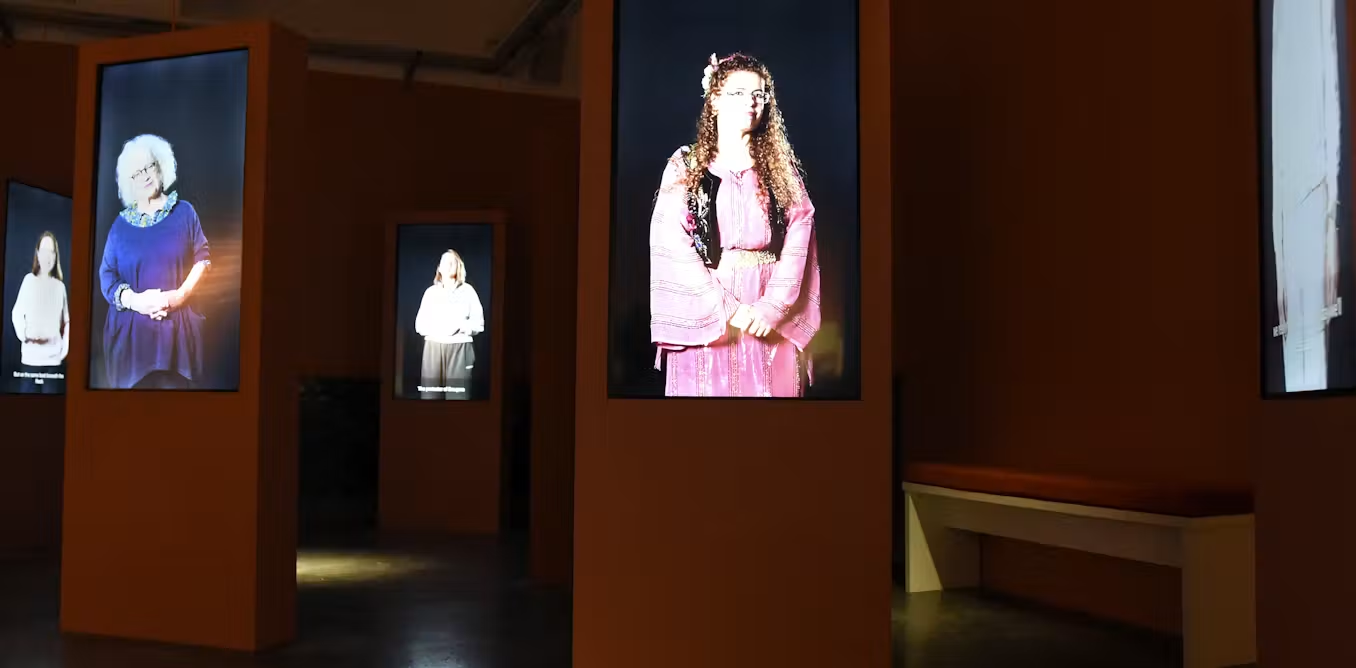
The workshops involved music and singing, and each was followed by a shared meal. Workshop participants were then invited to share and record a song which transported them to the place they first called home. These recordings form part of an installation. Each woman and her chosen song appear in a video on a series of monoliths with built-in screens. The songs play continuously, with women sometimes singing alone, sometimes overlapping in a chorus of voices and languages. At times the women pause, as if listening. A call and response.

Advertisement
The monoliths featuring singing women.

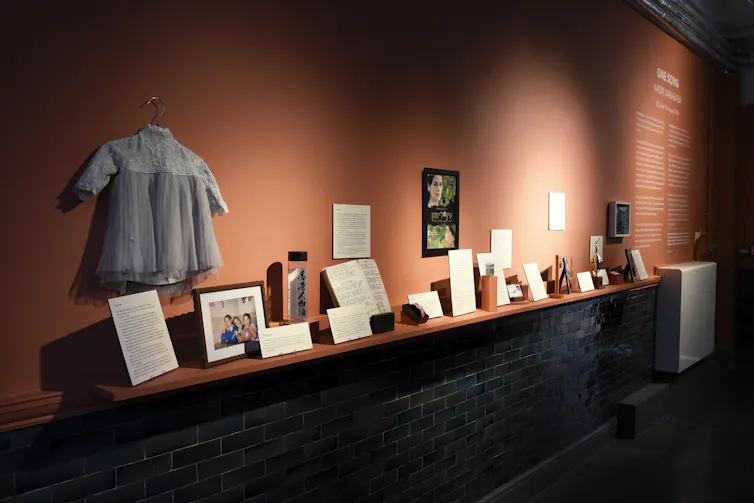
The monoliths are accompanied by a shelf*collection?* of objects, each one brought in by the participants. These everyday objects include photographs, a watch, a child’s dress and a film poster. On display with the objects are short testimonies from the women, describing the story of the song and object they have chosen to share.

Music, song, voice here all dislocate notions of home and belonging from static ideas of place. Instead visitors are moved to think of home as something relational and shared. As ephemeral, embodied and collectively imagined.

Stories of migration through song

In the exhibition’s wall text, Karababa explains that he wants this work to offer a dialogue which reflects the deep complexities of the world. It also speaks to his own family story of migration which echoes in the songs he heard his grandmother sing when he was a child.

Advertisement

Being in the exhibition space and hearing the different voices and songs is a highly affective experience. Participating in the workshops and being part of the installation offers an opportunity to share something that might not have been previously shared. It is also something that participants do not take on lightly. Offering something – a memory, a trace, a distant place and time – of this kind is inherently intimate. For participants, their sharing is an act of both hospitality and generosity.

The project and exhibition resonate personally for the two of us, as researchers and practitioners in socially engaged arts and participatory research. For Jessica this resonance is highly personal. One of the participants in the Wakefield-based strand of the project is her mother, Anne, who shares a Malagasy lullaby from her childhood in Madagascar.

The object she chose to display is a well-thumbed exercise book in which, as a child in the 1950s and 1960s, she wrote down the words to every song she knew. Etched on each page in fountain pen and biro are French and Malagasy songs, including hymns. The lullaby she shared – Etsy babeko razandriko izany – which translates as “let me carry you on my back my little brother”, is among the many she diligently recorded in her book over a period of eight years.

Objects on display in the exhibition including clothing and books.
Objects on display in the exhibition.

Jessica’s research explores people’s experiences of creativity in everyday contexts, often with arts-based approaches. The exhibition, therefore, and dialogue between the artist and participants, brought to light aspects of family history which had previously not been explored. She learnt something new about what home might be for her mother, in her memory.

Advertisement

Jessica’s mother wanted to be able to share something important, and to explore how, in sharing it, it might be preserved. It offered a chance for intergenerational dialogue, as well as for her mother to share something about her childhood in a language which she rarely now has the chance to speak. For both authors of this review, it also gave insights into what it’s like to participate in socially engaged arts projects and share experiences in relation to place and time.

The exhibition also asks important questions about categories and how we designate them. Who is a migrant, and at what stage are people recognised as such? Whose experiences are audible – and whose experiences matter? Each song and testimony offers a sense of being connected to multiple places. Collectively, the songs ask whether we only recognise how home feels when we are in a different place.

Louise’s recent artistic project, If Walls Could Talk, funded by Arts Council England, also explored these ideas by researching the history and stories that Chinese wallpaper holds for migrants, using participatory and interpretative practice. In her research she worked with students and community members with experiences of migration to the UK from mainland China, Hong Kong, Taiwan and Singapore. Through arts-based workshops and discussions centred around food and recipes, the project complicated ideas of language and national identity and opened up new dialogues about home and belonging.

These conversations have never been more important than now, with participatory arts and research opening up spaces which invite us to share and learn from each other. One Song therefore reiterates that ideas of home are wholly individual; as much a feeling as a location.

Advertisement

One Song is at The Art House in Wakefield until August 31.
After this, it will be at Fabrica in Brighton from October 9 to October 28.

Source link

Advertisement
Continue Reading

Trending

Copyright © 2025