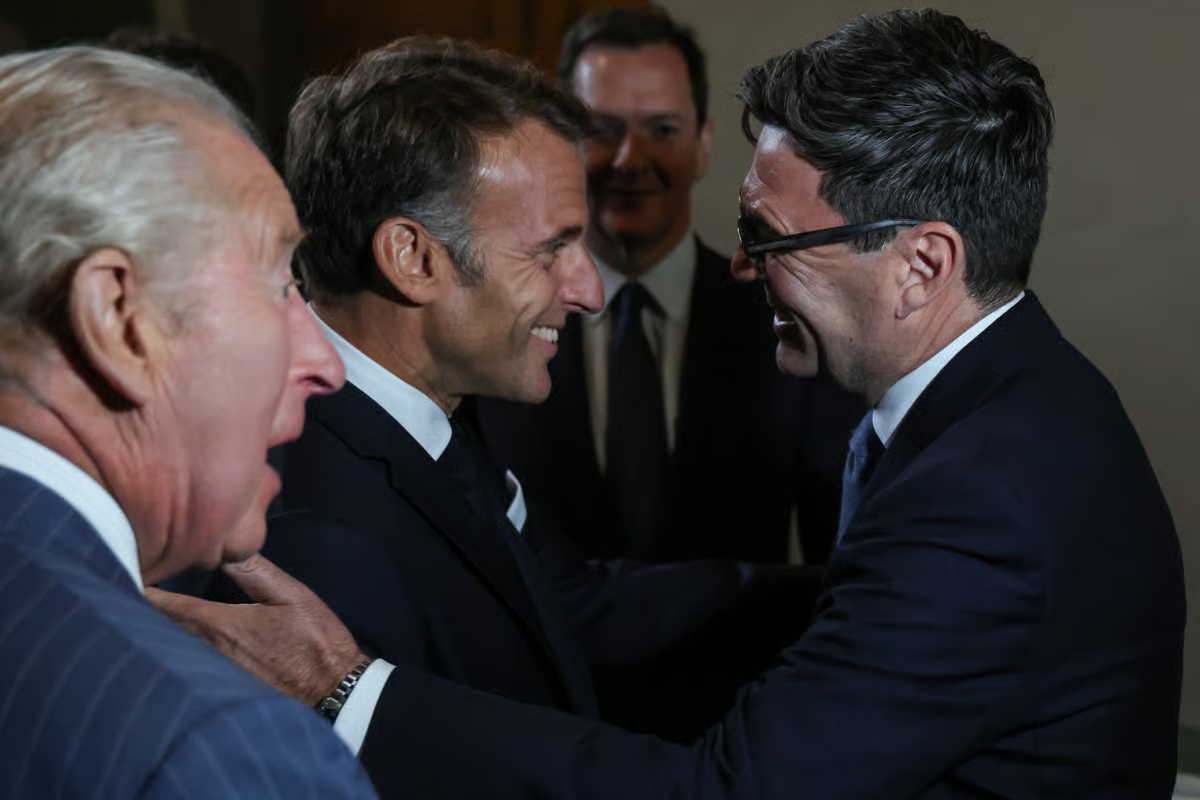
“Indeed, it is thanks to the certainty you have always had – and which I very much share – that we are here this evening in order that the tapestry should be seen, in London, for the benefit of the peoples of both our countries: the best possible symbol of that ‘entente amicale’, of which we have both spoken so fondly.”
A 64-year-old man died in hospital after he was found injured at a property in Fauldhouse.
21:36, 02 Sep 2026Updated 21:40, 02 Sep 2026
A man has been arrested and charged in connection with a death in a West Lothian village earlier this year.
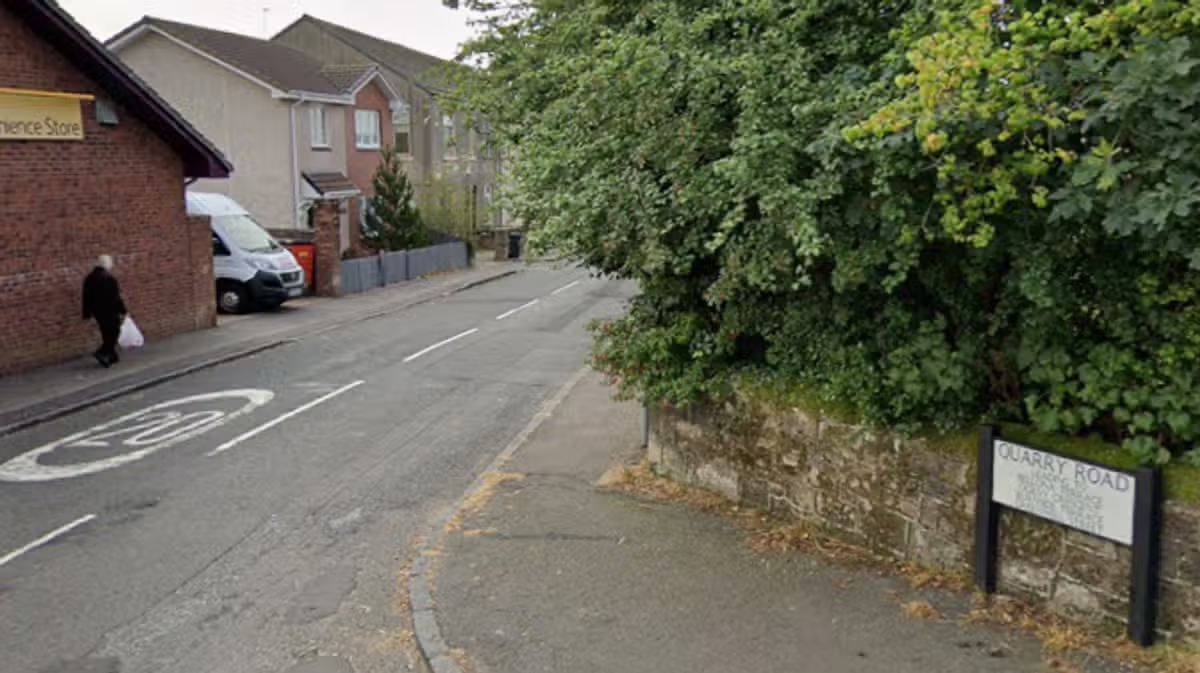
Police were called to a property on Quarry Road in Fauldhouse at around 10.20am on Tuesday, February 3, after reports that a 64-year-old man had been found injured. Emergency services attended and the man was taken to hospital where he later died.
Seven months on, a 60-year-old man has now been arrested and charged in connection with his death. He is due to appear at Livingston Sheriff Court on Thursday, September 3.
Advertisement
A Police Scotland spokesperson said: “A 60-year-old man has been arrested and charged in connection with the death of a 64-year-old man in Fauldhouse, West Lothian. Around 10.20am on Tuesday, February 3, 2026, police were made aware of a man found injured at a property on Quarry Road.
“Emergency services attended and the 64-year-old was taken to hospital where he later died. The 60-year-old is due to appear at Livingston Sheriff Court on Thursday, September 3.”
Get more Daily Record exclusives by signing up for free to Google’s preferred sources. Click HERE.
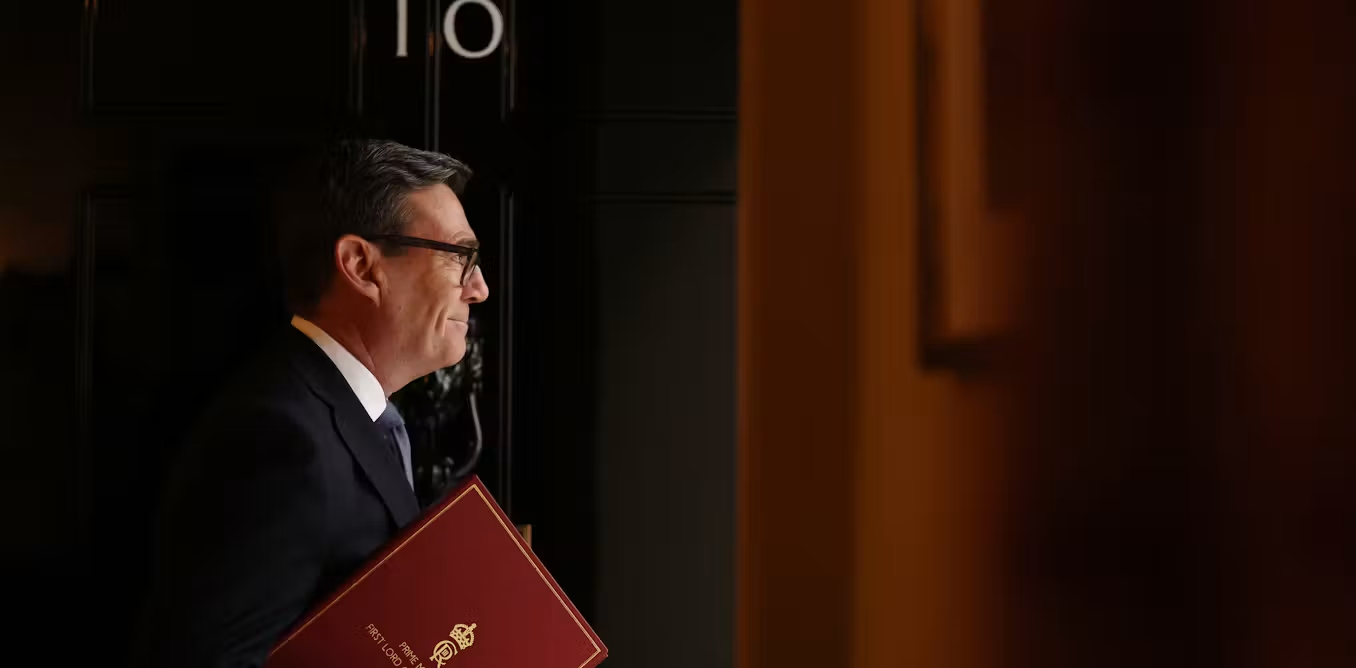
For Andy Burnham, walking into the bear pit that is Prime Minister’s Questions, it must have been hard to stay calm. His audience was a room of closely packed MPs, some hostile, some friendly – all very loud – many wanting to make a mark.
And the full audience for PMQs extends far beyond the MPs in the chamber. Prime ministers are thinking about the media, external groups, foreign governments, voters and financial markets. The reactions of any of these matter. The PM has the dual worry of dealing with opposition questions while also demonstrating his or her worth to the party members sitting behind them. Backbenchers can signal a lack of confidence through quietness or just not turning up.
It is no wonder that preparing for PMQs is, in itself, demanding. Alastair Campbell, who advised Tony Blair when he was opposition leader and in the early days of the New Labour government, is clear about just what it took. Preparation can take hours. Nerves don’t disappear. And it doesn’t appear to have got any easier in recent years.
Burnham is, of course, new to this. And unlike many in his position, he hasn’t had a chance to rehearse as opposition leader. He was wise to spend part of Tuesday’s return to parliament on a statement and a lengthy question-and-answer session. It gave him a warm-up for the main event.
Advertisement
After Keir Starmer was ousted as prime minister, Labour MPs will be willing Burnham to show that he can succeed. So how did he do in his first PMQs, and what can we glean from it?
Restraint?
This was not a “full-blooded” PMQs. Burham chose not to mount attacks where others might have. A question from Reform UK’s Danny Kruger, for example, could have led to a reply focusing on the party’s reported problems. That it did not, may mean Burnham wants to move away from such attacks – or that he considers Reform less significant than it has been in recent years.
Burnham’s jibes at the Conservatives were not fierce either. He merely criticised past statements made by Tory leader Kemi Badenoch and her shadow cabinet and sought to associate them with the economic failings of past governments. Prime Minister’s Questions is an adversarial event and it will be worth watching whether more obvious hostilities develop in future.
Sharper exchanges in turn end up generating sharper questions, so PMQs could move from point-scoring debate to abusive exchange. But Burnham may have some way to go to match David Cameron, who was identified by researchers as the rudest prime minister at PMQs.
Advertisement
At length
Speaker Lindsay Hoyle warned that Burnham’s long answers may cause the session to overrun. Burnham clearly wanted to spend time on each answer, but this can be a blessing and a curse for a PM. Longer answers mean you can say everything you want. But sometimes the short, sharp reply is most effective at putting your opponent off their stride. The prime minister may have to learn brevity.
Into the bear pit. House of Commons, CC BY-NC-ND
Moving on
One of the tricks of dealing with difficult subjects is the “bridge”. That is, taking the topic and linking to something else that you actually do want to talk about. Burnham showed some ability here, linking at one point from a question about public spending to the needs of young people not in education, employment or training (Neets).
His bridge from the Bayeux Tapestry and French president Emmanuel Macron to small boat crossings didn’t work, however. He is clearly a bit rusty in the use of this technique.
Advertisement
Are you listening?
Badenoch was keen to paint the PM as someone who won’t answer questions about spending, and as such as a PM who leans towards more tax and more spend. This may be the beginning of a strategy to frame him as vague and unwilling to commit to specific action in the face of obvious problems. Once an idea like this takes root, it is very hard to shift.
But neither Badenoch nor Burnham has the proper measure of the other yet, and it will take a few more outings before there is a sense of how successful this strategy may prove.
The right man for the job?
As Burnham did not ascend to Downing Street immediately after a run of other roles in parliament, or after a general election, he needed to make his experience clear. He name-checked things he had achieved or initiated, specifically in Greater Manchester, as a way of underlining his credentials.
These references, plus the use of “I”, were designed to demonstrate his ability to get things done, rather like the way it is used in job interviews. Using “I” instead of “my government” or “we” also demonstrates engagement with the topic.
Advertisement
Play nicely
During some replies, Burnham touched on cross-party working, and made an on-the-spot pledge to meet Cornish MPs (not all of whom are Labour) for talks. Offering cross-party working can remove the sting from an attack and make the prime minister seem reasonable. This appears to be a feature of Burnham’s approach and it will be interesting to see if it develops into genuine cooperation with at least some other parties.
Prime ministers often say they want to change aspects of PMQs. Burnham himself has indicated that he wants a different, less Punch-and-Judy tone. Back in 1997, Tony Blair made the move from two shorter sessions a week to one longer one. Blair said he wanted a more considered approach, with more questions and more answers. Whether prime ministers get what they want, of course, is not entirely down to them. They may get the last word, but they don’t control the cast.
Multiple victims, including two police officers, have been involved in a shooting in downtown Minneapolis, according to city officials.
Minneapolis police rushed to the Loring Park neighborhood Wednesday afternoon in response to the shooting as city officials warned people on social media to avoid the area.
Minnesota Governor Tim Walz said his public safety team was also responding to the shooting.
“State officials are on the ground to support local law enforcement and we will share more information as it becomes available,” the Democrat wrote on X Wednesday evening.
Advertisement
Multiple victims, including two police officers, have been involved in a shooting in downtown Minneapolis, according to city officials (Google Earth)
In a follow-up post, Walz said he was “grateful to law enforcement actively working to ensure the safety of our neighbors in Downtown Minneapolis this afternoon.
The Duke and Duchess of Sussex and their children returned to the UK in August
Husna Anjum Senior Reporter and Nick Lester (Press Association US Editor in Washington DC)
21:38, 02 Sep 2026Updated 21:38, 02 Sep 2026
Donald Trump reveals ‘what he would have done’ in reaction to Harry and Meghan’s return to the UK. The president believes the couple had treated the monarchy with “great disrespect” and if he was in the royal family he “would not have taken them back”.
The Duke and Duchess of Sussex and their children, Prince Archie and Princess Lilibet, returned to the UK last week to begin a new life after six years living in the US. The family is said to be settling in the UK for an “extended period” of time amid speculation as to how long they will stay and where they will live.
Advertisement
The Cotswolds being suggested as the most likely destination.
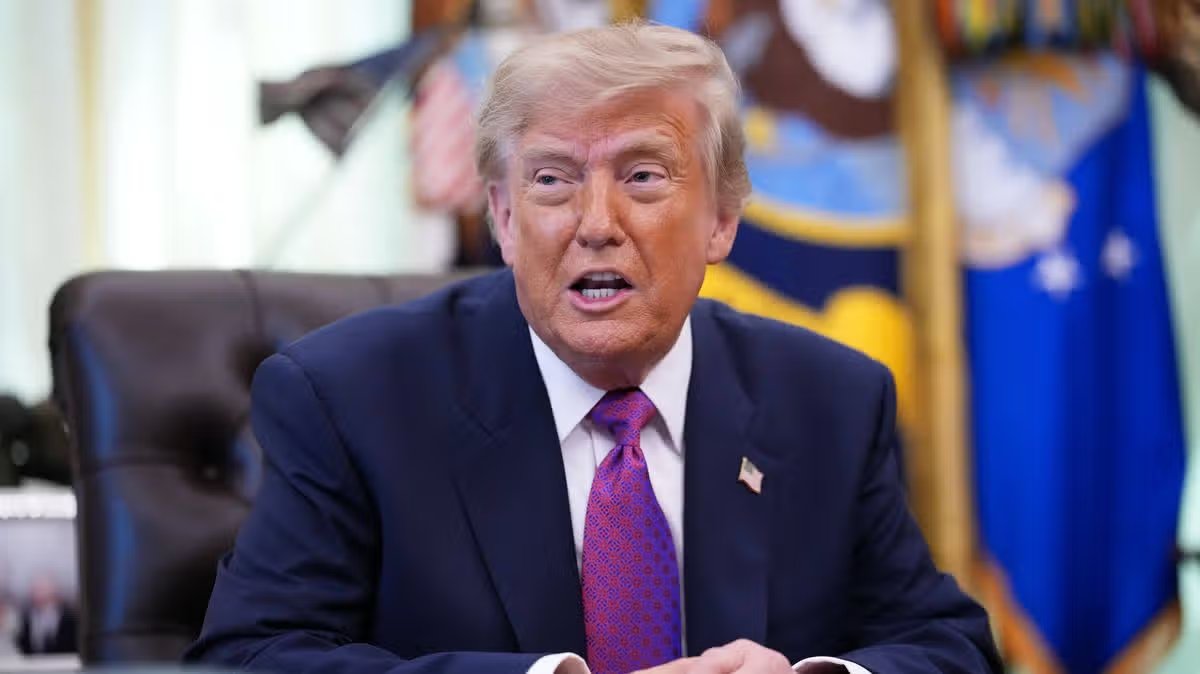
Asked in the White House about his reaction to the departure from the US of Harry and Meghan, Mr Trump said: “I’m happy about it. I was not a fan.”
He added: “I had a very good relationship with the Queen. Really good. I got to know her very well.
“A really good relationship with King Charles. I knew him as Prince Charles and King Charles. I’ve known him for a long time. He’s great, great guy.
“And I thought they treated the royal family with great disrespect. I didn’t like it.
“I didn’t like the way she acted. I thought she was terribly disrespectful to the Queen, to King Charles.
“I wouldn’t have taken them back. If I were in the royal family I would not have taken him back.”
Advertisement
Harry and Meghan, who are remaining as non-working royals, quit the monarchy six years ago, relocating to the US from where they criticised members of the royal family and the institution.
The Sussexes’ dramatic U-turn was revealed last month, but the pair have yet to speak publicly about their plans.
Many questions remain unanswered, including whether taxpayers will foot the bill for their security.
Harry, a former soldier who served in Afghanistan, wrote to Home Secretary Shabana Mahmood last month asking her to take a personal role in determining if his family receive close police protection.
Advertisement
Prime Minister Andy Burnham would previously not be drawn on Harry and Meghan’s security arrangements in the UK, saying the funding for it was a “private matter”.
Harry had insisted it was too dangerous to bring his wife and children to the UK with the security he was entitled to post-Megxit.
It is understood there have been at least six threats or plots concerning the duke from the Taliban, al Qaida or their supporters since 2007.
Last year, he lost a legal battle against the Home Office over the security arrangements for him and his family while in the UK, after his level of protection changed when he stopped being a working royal.
Advertisement
Harry has argued he faces a greater risk than his late mother, with “additional layers of racism and extremism”.
Ensure our latest stories always appear at the top of your Google Search by making us a Preferred Source. Click here to activate or add us as your Preferred Source in your Google search settings.
Brian Barry-Murphy has addressed Cardiff City’s failed transfer plans and the theory he was not backed, before reflecting on defeat at QPR
Brian Barry-Murphy has insisted he felt “nothing but great backing” from Cardiff City despite the club failing to bring in the striker and winger it had hoped to sign before Tuesday night’s transfer deadline.
Advertisement
A theory had emerged among supporters that the Cardiff manager had not been adequately backed by the board, with the Bluebirds ultimately ending the window without adding the attacking reinforcements that had been on their agenda.
But Barry-Murphy was emphatic when asked whether a lack of backing had been responsible for Cardiff’s failure to complete those deals.
“No, we had a clear idea who we wanted to bring into the club,” he said. “We never felt anything but great backing from the club, but it wasn’t possible.”
The Bluebirds had hoped to emerge from deadline day with a striker and winger added to their squad, but neither deal materialised. Less than 24 hours later, they produced their poorest display of the campaign as Rumarn Burrell’s double condemned them to defeat at Loftus Road.
Asked about the transfer business for the first time since the window closed, Barry-Murphy was keen to draw a line under it.
“I don’t really. My focus since last night is obviously on the game and I remained focused on that,” he said. “It’s in the past and there’s nothing I can do now.”
He acknowledged, however, that he had expected Cardiff to bring players in and explained why he had been selective rather than willing to add players simply to increase his numbers.
Advertisement
“I thought we would be able to bring players in, but it wasn’t the case,” he said.
“I would always respond to our supporters with the truth. We had an idea of what players we wanted to bring in, it wasn’t possible.
“I think we still have a lot of very talented young players, very talented young Welsh players predominantly, and any player that we do want to bring into the club always has to be with the intention of improving the squad and team.
“If that’s not possible then I’m not a great believer in bringing in players just for the sake of it.”
Advertisement
That stance will be tested after a night when Cardiff looked short of the attacking quality required to hurt QPR.
Barry-Murphy admitted his side simply failed to reach the standards they have set themselves this season, with their lack of intensity and technical quality proving costly.
“Yeah, a very disappointing match for me,” he said. “I think we didn’t quite have the level technically that we normally have, but disappointed to concede the goal we did and try as hard as we did in the second half, we couldn’t get it back.”
Advertisement
QPR repeatedly exposed Cardiff when they gave the ball away, with Burrell opening the scoring before doubling the advantage early in the second half.
“We knew they would be on the counter-attack when we gave the ball away and to play the way we want to play, you have to be good technically,” Barry-Murphy said.
“But in the first half, our intensity wasn’t where it would normally be and as such we gave the ball away in dangerous situations and in the second half that continued.”
Perry Ng’s spectacular 25-yard strike gave Cardiff hope, but they could not find an equaliser despite a late push.
Advertisement
Barry-Murphy acknowledged the number of chances Cardiff conceded was a concern, but insisted his players could not be afraid to play in the manner he demands.
“The players can’t be afraid to play, we’ve played many successful phases like that, but tonight we weren’t quite at our best technically like I said when we gave the ball away,” he said.
“We suffered as a consequence. You saw how good we were in the second half when we got the ball wide and created good chances, but not enough.”
The result means Cardiff now have to respond quickly, with Portsmouth waiting at Fratton Park on Saturday.
Barry-Murphy knows another step up in performance will be required.
“We need to improve, we need to play better,” he said. “We’re not naïve, we know parts of our game weren’t at the level we would need to win games and keep you out of a really good team, and so are Portsmouth, so we have to be at our best.
“I have full belief in the players. I think we’ll do really well, but setbacks are part of the journey.”
Andrew Garfield once advocated for a gay Spider-Man and 13 years later, he still believes that the comic superhero could ‘like boys.’
The British actor doubled down on his theory that the Marvel character is an inclusive one.
‘I just still believe that anyone can be in that suit,’ he said in an interview with Entertainment Weekly.
‘That’s the point of why it’s such a kind of universally beloved character…. because you don’t see skin color, you don’t see gender, you don’t see sexuality. Anyone can project themselves into that suit,’ he explained.
Advertisement
Garfield, 43, played the role of Peter Parker and his alter-ego in 2012’s The Amazing Spider-Man and again in the 2014 sequel.
The success of the movies catapulted him into the top tier of actors in demand in Hollywood.
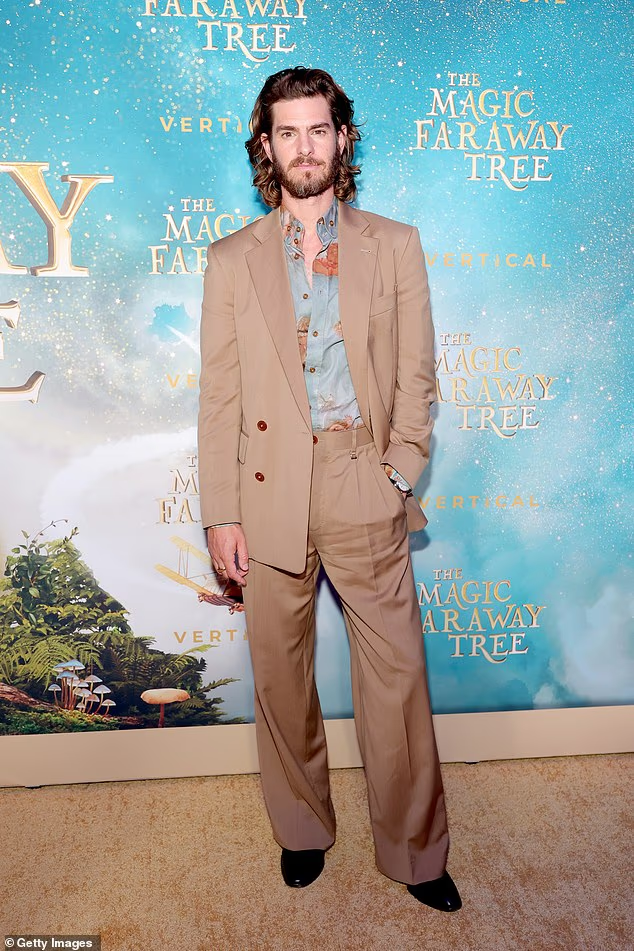
Andrew Garfield is standing by his 2013 call for a gay Spider-Man saying that he still believes the Marvel superhero is beloved by fans because he is an inclusive character. Above, in July
Advertisement
‘I just still believe that anyone can be in that suit,’ he told Entertainment Weekly. ‘Because you don’t see skin color, you don’t see gender, you don’t see sexuality.’ Above, Garfield in The Amazing Spider-Man 2 in 2017
He characterized his initial call for a gay Spider-Man in 2013 as ‘an exercise in rebellion’ and said he ‘felt passionate about it’ at the time.
‘I like the idea of a place where everyone is being honored and everyone is being included, and it was just a kind of act of saying, ‘Well, why not?’ And you’ll be telling on yourself if you have a strong opinion either way,’ he said.
Garfield, who is currently promoting his new historical drama The Uprising, left the Spider-Man franchise when Marvel re-booted it to align with their slate of Avengers movies and cast Tom Holland in the role.
Advertisement
Back in 2013, he revealed to Entertainment Weekly that he’d gone so far as to have a discussion with The Amazing Spider-Man producer Matt Tolmach about gender-swapping Peter Parker’s love-interest Mary-Jane.
‘Why can’t we discover that Peter is exploring his sexuality?’ he told the publication at the time.
‘It’s hardly even groundbreaking! … So why can’t he be gay? Why can’t he be into boys?’
Back in 2013, he revealed he’d gone so far as to have a discussion with The Amazing Spider-Man producer Matt Tolmach about gender-swapping Peter Parker’s love-interest Mary-Jane. Above, with co-star Emma Stone in Paris in 2014
Advertisement
‘Why can’t we discover that Peter is exploring his sexuality?’ he told EW at the time. ‘It’s hardly even groundbreaking! … So why can’t he be gay? Why can’t he be into boys?’
He even suggested that his replacement as the superhero in a queer Spider-Man movie could be then rising star Michael B Jordan who found fame on TV series The Wire.
‘He’s so charismatic and talented. It’d be even better—we’d have interracial bisexuality!’ Garfield mused.
While he cast his final web in a Spidey movie 12 years ago, he did get the chance to wear the web-themed suit one more time in 2021’s Spider-Man: No Way Home.
Advertisement
He and previous Spider-Man star Tobey Maguire teamed up with Holland in the MCU’s third movie in which the multiverse is broken open and characters from alternate realities arrive in Pater Parker’s universe.
Garfield is currently promoting his new historical drama The Uprising which opens in theaters on September 10
In 2023, Holland revealed that the trio had maintained contact since filming that reunion he’s in a special group chat with Garfield and Maguire ever since they all played Peter Parker together in the 2021 multi-verse flick.
‘We have this amazing bond as three people who have been through something that is so unique that we really are like brothers,’ the 29-year-old Englishman gushed to THR Magazine.
Advertisement
‘We have a great group chat and we catch up every now and then. It’s called the Spider-Boys.’
Share or comment on this article:
Andrew Garfield doubles down on his call for a gay Spider-Man: ‘Anyone can be in that suit’
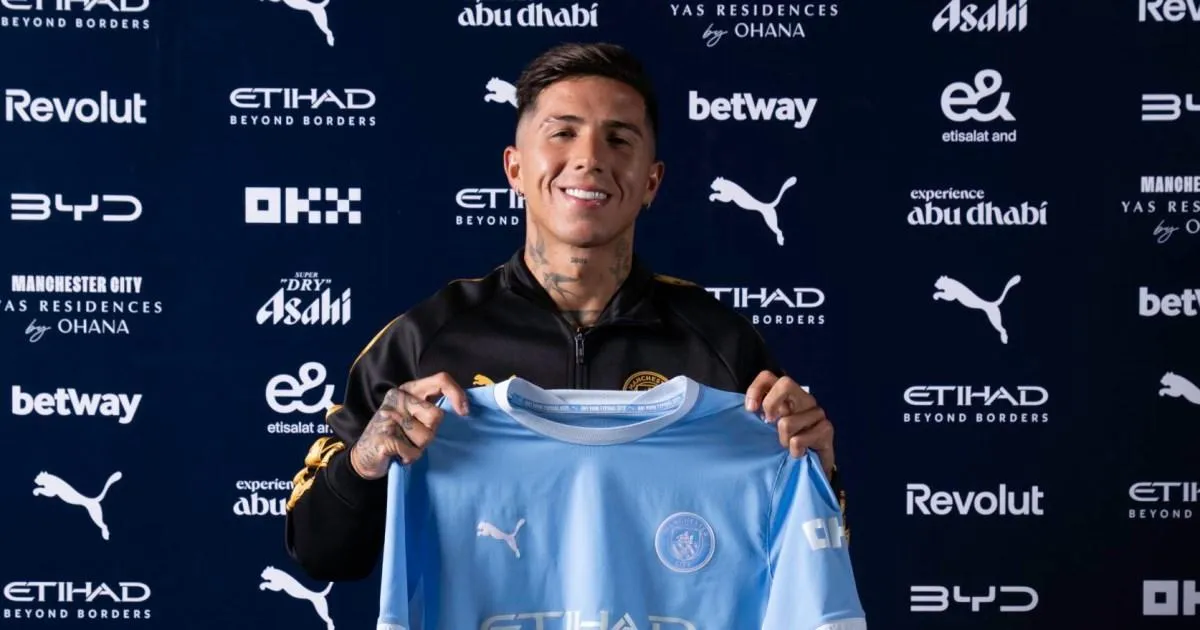
Enzo Fernandez joined Man City in a £125m deal from Chelsea on deadline day (Manchester City FC)
You know what’s fun? Tight games of football with a couple of nice goals.
Interspersed with plenty of creative passages of play until the team you support wins and you go for a lovely pint. Or, actually, battering the other lot 5-1, who cares about the quality then?
You know what’s not? Contracts, painstaking negations to make the rich richer, sub-clauses, arithmetic.
The transfer window is closed. Resources have been moved between Premier League teams and fans of every club are a bit annoyed except, perhaps, Ipswich? (Write in).
Advertisement
Exclusive Premier League previews
Get ahead of the start of the season with our weekly football newsletter. Sign up now for free.
One of my friends (big up Tim Spiers at The Athletic) got the unenviable task of ranking (and justifying the rank) of every transfer made into a Premier League club this window. All 155 of them, only half of which, you’ll be amazed to know, have been made by Manchester City and Tottenham.
Advertisement
Tim is largely joking but the point is this fairly arbitrary ranking reflects what fans are trying to do in every argument about transfers across social media and in real life all the time. More to the point, much of this goes on before any signing has even kicked a ball for the club.
Hull City spent more money this window than 36-time Italian champions Juventus (Getty)
The belief you can make this make sense is kind of the point of the transfer window for the fan. It’s not real.
These aren’t real sums of money, the players aren’t real people, you can’t form accurate opinions on it because who knows? The variables are infinite and team chemistry is an art.
This feeling of throwing your hands up and enjoying the ride makes sense as a fan, because the angst you feel has zero impact. You might as well get exercised, have a pop, believe yourself all-knowing, because why not?
Ask Metro
Advertisement
Use AI to go deeper into the stories you care about – powered by Metro and trusted publications.
But that same energy seems at times to be driving recruitment strategies at our clubs. The summer 2026 obsession has been with the Premier League-proven player. As I’m sure you get, it just means buying a guy from one of the other teams in the league, not anything more significant like actually having proven yourself in the Premier League.
History may report it went like this. Premier League clubs set up scouting departments, bought occasional flops from various other leagues and then thought, okay here’s one way of removing an unknown variable: just buy the players belonging to the clubs with lower resources in the league than you. Call it a reverse-Moneyball, if you will.
Advertisement
Premier League top 10 most-expensive deals this summer
(Getty)
Enzo Fernandez – Chelsea to Man City – £125m
Morgan Rogers – Aston Villa to Chelsea – £117m
Elliot Anderson – Nottingham Forest to Man City – £116m
Bradley Barcola – PSG to Liverpool – £106m
Sandro Tonali – Newcastle to Tottenham – £92.5m
Mateus Fernandes – West Ham to Tottenham – £85m
Ayyoub Bouaddi – Lille to Manchester City – £81.4m
Bruno Guimaraes – Newcastle to Arsenal – £75m
Savinho – Manchester City to Tottenham – £75m
Carlos Baleba – Brighton to Manchester United – £70m
And here we are where Enzo Fernandez becomes a £100 million-plus player on two separate occasions. I am old enough to remember when £100m was a fee reserved for once-in-a-generation talents like Kylian Mbappe.
The sums of money involved in all of this are obviously gross. That’s one reason I think I’m sitting here considering them only as units that compare with each other, rather than, say, what the analysts themselves might make at a Premier League club. Or, worse still, people doing real work in hospitals or schools in the UK.
There is one market that can be used to draw useful comparisons, though, without making ourselves sick and that’s with other top-tier leagues in Europe – the Premier League’s competitors for Champions League and Europa League spots.
Newly promoted Hull, who came up by winning the Championship play-off final (so in absolute terms the lowest-ranked team starting this season’s Premier League) spent more money this window than 36-time Italian champions Juventus, current Serie A title holders Inter, Bayern Munich and Atletico Madrid.
Advertisement
Celebratory-sounding posts after the window slammed shut confirmed the top flight had again broken the all-time summer transfer record, with half a billion spent on deadline day alone. This paints the £3.49bn spent as symbolic of us plucky Brits overwhelming the footballing product of other nations with our unparalleled canniness and grit. But, in reality, flooding one corner of European football with money doesn’t seem smart for its future.
Looking at these sums alerted me to something I’d missed. I had spent the last few seasons enjoying the fact smaller English clubs were lately going up against traditional European football superpowers. It felt like an underdog story when Crystal Palace won the Conference League.
But looking at the numbers this window you come to realise it is not. Nearly all European clubs are now underdogs to anyone in the Premier League and that’s not good news for anyone with a dog in that fight.
A federal judge has blocked Donald Trump’s administration from enforcing his latest executive orders targeting birthright citizenship after the president lost a landmark Supreme Court case challenging his attempt to unilaterally redefine who gets to be a citizen.
Trump signed executive orders last month taking aim at children who were born to employees of foreign governments as well as the children of mothers who are accused of lying about their intentions for visiting the country while pregnant. The orders also seeks to block citizenship to children whose parents are accused of being “alien enemies,” as well as newborns in U.S. territories.
Lawsuits were swiftly filed, including a challenge on behalf of babies who would be deprived citizenship under Trump’s original 2025 order. Lawyers asked a judge to block Trump’s latest orders to ensure their clients would retain their citizenship under the new rules.
Maryland District Judge Deborah Boardman, an appointee of Democratic President Joe Biden, noted that the question before her is not whether Trump’s new “carveouts” to birthright citizenship are constitutional but whether the plaintiffs suing to stop the orders are entitled to protections against it.
Advertisement
“The answer to that question is yes,” she wrote Wednesday. Trump’s latest efforts are “almost certainly unconstitutional” as applied to the Supreme Court’s decision, which has “already decided that the children in the class are citizens at birth,” according to Boardman.
“This Court must, once again, preliminarily enjoin enforcement of the President’s most recent attempt to strip the right to citizenship from them,” she wrote.
The judge stressed that the language in Trump’s latest order does not indicate whether it applies retroactively.
Trump’s initial order indicated that it applied only to children who were born 30 days after it went into effect, or on February 19, 2025.
Advertisement
His latest order, however, “says nothing like that,” according to Boardman.
She argued that “the only fair reading of the plain language” of Trump’s executive order is that it applies to any babies born after February 19, 2025, putting thousands of babies in legal limbo.
The 14th Amendment’s citizenship clause plainly states that “all persons born or naturalized in the United States, and subject to the jurisdiction thereof, are citizens of the United States and of the state wherein they reside.”
But in an executive order signed on his first day in office, Trump sought to unilaterally redefine that amendment to state that babies born on U.S. soil would be denied citizenship at birth if their mother was “unlawfully present” or had “lawful but temporary” status, and if the father “was not a United States citizen or lawful permanent resident at the time of said person’s birth.”
Advertisement
A divided ruling from the nation’s high court in June determined that children born in the U.S. to parents “unlawfully or temporarily present” are indeed “subject to the jurisdiction” of the U.S. and thus citizens at birth.
One parent claimed multiple children were turned away on their first day
22:35, 02 Sep 2026Updated 22:49, 02 Sep 2026
A school has defended its strict uniform policy after pupils were reportedly turned away on their first day of term for wearing skirts that sat “a couple of inches” above the knee.
Parents claimed that students at Denton Community Academy were refused entry on Wednesday despite wearing garments purchased through an approved uniform supplier, according to the Manchester Evening News.
One father, who asked not to be named, said he had spent a “fortune” equipping his two daughters for the new school year, only for them to be denied access to lessons over the length of their skirts.
Advertisement
“They were ringing us saying they weren’t allowed to enter the school. The skirts they had on were not rolled at all and fell a couple of inches above the knee, if that”, one parent, who did not wish to be named, told the M.E.N.
“It was throwing it down with rain and there were 40 or 50 kids standing outside, not allowed in. They were soaking wet and some were crying.”
The father told the publication that other parents also went to collect their children, while his two daughters spent the rest of the day at home and missed their first day back.
Advertisement
Northern Education Trust, which runs Denton Community Academy, defended the decision, adding that parents have been reminded of the uniform expectation several times ahead of the new academic year, describing the policies as being applied “consistently” and “fairly”.
“Denton Community Academy is committed to maintaining the high standards that have driven significant improvements in our students’ educational outcomes”, the trust said.
“The academy is the most improved secondary school in Tameside and is now the highest-performing non-selective secondary school in the borough. We are incredibly proud of our students and the high expectations that have driven this improvement.”
Families were reportedly reminded of the expectations on May 6, May 18, July 16 and August 20, the trust claimed, adding, “We cannot comment on individual cases, but we strongly encourage parents with any concerns to speak directly to the academy.
Advertisement
“We will always work with families to resolve issues, and believe that direct conversation with the school, rather than through the media, is the most constructive way to do that.”
The parent said he had since returned to TopMarks Schoolwear in Ashton, where he claimed the longest skirts available were around 20 inches, which would still not fall below his daughters’ knees.
He also pointed to a photograph in the uniform section of the academy’s website, which he said showed a female pupil wearing a skirt several inches above the knee.
Ensure our latest stories always appear at the top of your Google Search by making us a Preferred Source. Click here to activate or add us as your Preferred Source in your Google search settings.
Advertisement
“This is not an army camp. They’re treating them like soldiers, but they are children, they need an education. It feels like punishment.”
Denton Community Academy’s website says its uniform policy is intended to “set an appropriate tone for education”. It says the uniform provides “a sense of belonging and identity for all students”, while also being “comfortable” and allowing pupils to be themselves.
The policy also prohibits make-up, hoodies and jewellery, as well as “writing on hands or arms for any reason”.
It states: “We do not exclude students for wearing jewellery, having mobile phones or any other breaches of this policy. We will, however, always ask students to rectify the issue that we have raised. These are reasonable requests.”
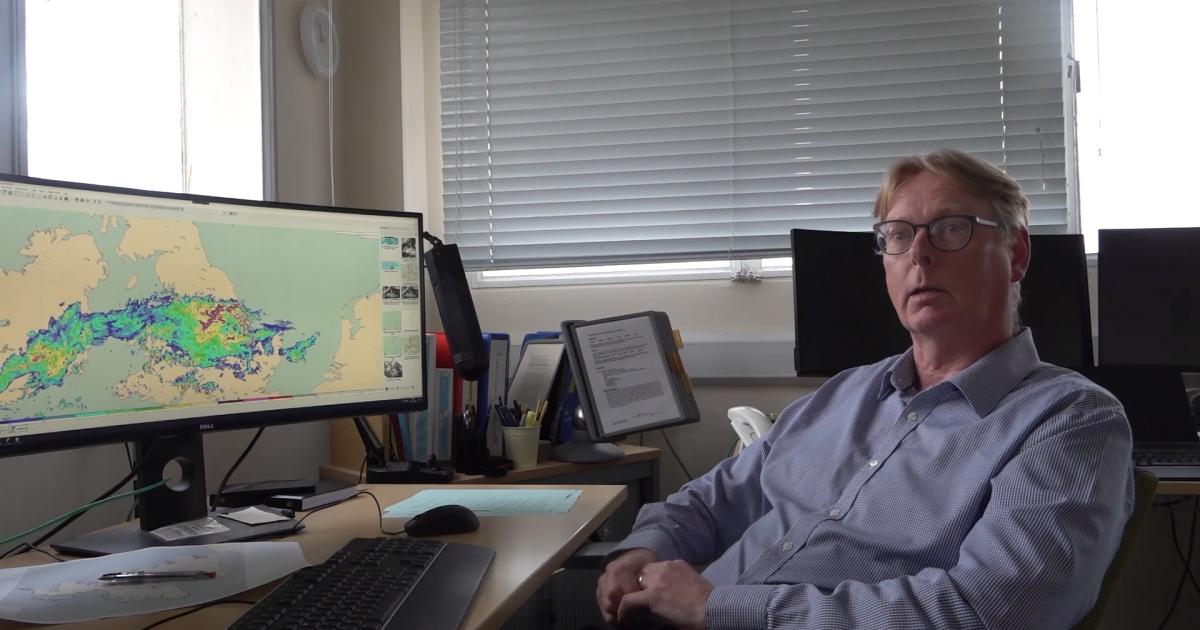
Bill Shiel Dods, who performs a similar role in 2026 to what Stagg was doing in 1944, said it was like “Disneyland” for a forecaster when he worked as an extra on the new movie Pressure, which centres on his predecessor’s advice about the timing of the Normandy Landings.
Mr Shiel Dods said he fully understands the pressure Stagg was under when his advice on the likely weather in the Channel was crucial to General Eisenhower’s decision-making for the invasion.
“Hopefully, I will never be in that situation where I have the fate of thousands and thousands of soldiers and airmen on the line,” he told the Press Association.
Advertisement
Mr Shiel Dods said: “There’s a scene in the film where (Stagg) is briefing the Joint Chiefs of Staff, and (General Bernard) Montgomery says ‘not good enough’, because Montgomery wants to get off and start the invasion as soon as possible and not delay because of weather.
“I’m not going to say I’ve been anywhere near the level of pressure that Stagg was under, but I’ve had to brief aircrew, and they haven’t been always been thrilled with the message I’m passing to them.
“And you do get pushed back as to how confident you are in the forecast, and where could it go wrong.
“Those questions are bread and butter to us, really.”
Advertisement
Mr Shiel Dods has been with the Met Office for more than 40 years, and a forecaster at RAF Leeming, since 1993.
With his team, he provides detailed weather information for the flight crews flying out of the base, near Northallerton, as well as others across the north of England.
Asked what Stagg would have made of the technological differences between 1944 and 2026, Mr Shiel Dods said: “I think his head would have exploded.”
He said the biggest differences are the use of satellite imagery and live radar data.
Advertisement
He said: “The level of detail we have now is head-and-shoulders above.
“I’m sure Stagg would have killed to have this amount of data available to him.”
Read next:
Mr Shiel Dods said: “The technology we use is vastly different, but I think essentially we are doing the same job that my predecessors were doing in World War Two, which is providing advice and support to our military users so they can operate safely and make the most of their often limited resources.”
Advertisement
He is very familiar with what information Stagg was working with 82 years ago, and said that “history’s proved him right”.
“Fortunately, Stagg was right and Eisenhower, in his wisdom, followed the British guidance rather than American because I think, otherwise, it could have been quite a bit poorer for the outcome of the war,” he said.
Mr Shiel Dods has a small part in the movie, as a meteorological assistant working in the office, which came about because he is one of the few forecasters still working who was trained to draw weather charts by hand.
When he first heard they were making it, he told colleagues: “It’d be great if they’re looking for a gin-soaked old forecaster to play a part.”
Advertisement
He said: “And then, quite by chance, a few weeks later, I got a message from one of my colleagues saying they were looking for people with experience of drawing up charts.
“Obviously, when I started in the Met Office in 1984, this was what I was doing on a day-to-day basis.
“So I sent off an email to the production company and said, ‘This is my background. Would you be interested?’, and they got back almost straight away.”
He said he was “blown away” by the set.
Advertisement
Mr Shiel Dods said: “It felt totally authentic.
“I went into the forecast room on the first day, and I knew it was going to be good, but I was blown away by the level of detail.
“It was like Disneyland for a Met forecaster.”
He said: “It was a thrill just to be in the forecast room because it took me back to when I started my career, but also to see Oscar-winning and Bafta-winning actors was quite exciting.”




















































You must be logged in to post a comment Login