Nearly two-thirds of young men watch so-called ‘masculinity’ influencers, according to The Children’s Society (Picture: Shutterstock/Body Stock)
The manosphere is driving a surge in misogyny in schools, with teenage boys refusing to acknowledge female teachers or even mix with girls in their class.
Earlier this year, teaching union NASUWT warned that a ‘masculinity crisis is brewing’ after nearly a quarter of female teachers reported being subjected to misogynistic abuse in the classroom.
That figure has continuously risen over the past four years. Some teachers described feeling ‘humiliated’ and ‘demeaned’ after being ignored by male pupils.
It is something charity founders and filmmakers Alex Williams and Dwayne Gumbs have witnessed first-hand alongside their team on visits to schools to try and tackle those harmful ideologies head-on.
Advertisement
Through their charity Diverse Voices, the London-based pair use their skills to find creative ways to encourage young people from vulnerable communities to express themselves on sensitive topics.
Over the past 16 years, their workshops have been delivered to 40,000 pupils at more than 100 schools up and down the country.
Their work has exposed how harmful views capable of leading to violence against women and girls can be formed at an alarmingly young age.
Children’s views are increasingly being shaped online and in the playground, where they spend most of their time during the week.
Advertisement
Alex tells Metro: ‘We have seen as social media and the online world has developed, that young people have more access to information.
‘The scary part is, who is providing that information? What attitudes are being adopted from the influencers that they are engaging with online?’
Charity founders and filmmakers Alex Williams (left) and Dwayne Gumbs (right) (Picture: Diverse Voices)
This Is Not Right
On November 25, 2024 Metro launched This Is Not Right, a campaign to address the relentless epidemic of violence against women.
With the help of our partners at Women’s Aid, This Is Not Right aims to shine a light on the sheer scale of this national emergency.
Advertisement
You can find more articles here, and if you want to share your story with us, you can send us an email at vaw@metro.co.uk.
Read more:
Advertisement
Nearly two-thirds of young men watch so-called ‘masculinity’ influencers, according to The Children’s Society.
Manosphere content exposes them to negative attitudes towards women and girls – objectifying them, dehumanising them and portraying them as inferior.
The manosphere is a loose network of digital forums and groups claiming to address men’s struggles.
But it often promotes harmful views of women and girls, while misrepresenting men as the oppressed victims of feminism.
Advertisement
‘A really big change I’ve noticed is the separation between boys and girls,’ Alex says of the workshops.
‘10 years ago, if you said in a classroom, “Guys, let’s get into groups”, there would be mixed groups.
‘Now if you say it, the boys will be on one side, and the girls will be on one side, and when you actually encourage mixing these groups, they are out of their comfort zone.
Over the past 16 years, their workshops have been delivered to 40,000 pupils at more than 100 schools up and down the country (Picture: Diverse Voices)
‘But we see that as an important thing to do because it’s not about singling out any gender around this education – it is about shared attitudes, boys who can become potential perpetrators but also girls knowing what shouldn’t be normalised as attitudes and actually being able to have that conversation in mixed groups.
‘But I think that just seeing that separation is something which, especially over the last three years, is something which has really changed.
Advertisement
‘It’s the culture that they’re exposed to online, the fact that boys are consuming a certain type of media and listening to a certain type of influencer and I guess not being exposed to the views of girls and women.
‘Taking that a step further, we’ve had male students who refuse to take instruction from female members of staff. Like, literally stonewall, “I’m not listening, I can’t hear you, I can’t see you”.
‘And yet, a male voice would say something a minute later, and they would react.
‘So, that takes that kind of classroom separation to the next level, where it actually impacts their behaviour and how they engage with teaching staff.’
Advertisement
Dwayne adds: ‘If they’re grouping together in these mini ecosystems around people they feel comfortable having these conversations with, then that just fuels the transfer of misinformation and ignorant views.
‘An important part of what we are really trying to do is to open the conversation up and create an environment where the majority of the learning comes from peer-to-peer conversations, as opposed to us lecturing them about what’s right and what’s wrong.’
To do that, Alex and Dwayne have created short films that feature within a learning portal tailored for both primary and secondary school audiences.
After an initial icebreaker task to encourage everyone to feel comfortable sharing their views, the groups are shown a short film tailored to their ages.
Advertisement
‘Manosphere’ content exposes boys to negative attitudes towards women – objectifying, dehumanising and portraying them as inferior (Picture: Shutterstock/New Africa)
It is accompanied by a discussion on the issues it depicts, including relationships and pressure to have sex, consent, intimate image abuse, self-image and controlling and coercive behaviour.
The young people are asked whether the behaviour shown is ‘acceptable’, ‘unacceptable’ or ‘questionable’.
‘Seeing that through the lens of the film, you really see a lot of bright eyes kind of going, “Ah”, whereas they wouldn’t feel comfortable talking about these things if we were questioning them on what they are doing themselves,’ Alex says.
‘But actually having these characters as a focal point gives them the freedom to say their opinions.’
The conversation is then opened up to feedback on what was discussed in the groups to the whole class, before staff explain healthy approaches and laws surrounding the topic.
Advertisement
‘We’re really empowering them to kind of take ownership of having these discussions, empowering them to feel that their voice is valid and heard,’ Dwayne says.
‘Really, it’s just about facilitating the conversation in a way where a light could be shone on healthy views and opinions that are aired by the students, and really be used to kind of make the point, as opposed to it come directly from the adult in the room.’
The charity also enables schools to continue lessons using resources it has created.
Dwayne says: ‘It’s not an expectation that one conversation is going to change people’s opinions. But it’s continuing that conversation over a period of time and also opening the doors for young people to feel that they can have these conversations with their teachers, with the adults around them, regardless of whether it’s within a program of learning or not.’
Advertisement
Alex says: ‘By the end of that program, they haven’t just been spoken to by a classroom teacher or by us – they’ve actually engaged, interacted, and are now in control of changing the outcomes, which then empowers them to do the same thing in their own lives.
‘We have great results and we have evidence that changes happen. Beyond just those lessons, we have teachers reporting that they overhear the conversations even continuing in the playground.’
The pair emphasise the important role men can play in tackling violence against women and girls.
‘A lot of what we’re actually asking boys to unlearn, they are learning from men,’ Alex says.
Advertisement
‘So, that just puts the responsibility on us as men to actually be positive role models and to affect change.’
For more information on the charity Diverse Voices’ and their resources you can visit https://www.diversevoices.co.uk/or email info@diversevoices.co.uk
Richard Locker vanished on January 4, 2024, and police found his car the next day on Mill Lane in Torquay – but his body was not found for more than two years
The remains of a man who disappeared two years ago have been discovered close to where his car was found at the time.
Advertisement
Richard Locker, from Paignton in Devon, went missing on January 4, 2024. He was last seen on a street in Torquay, four miles away.
Officers found his car parked on Mill Lane in Torquay the following day. Now, his stepdaughter has confirmed that his remains were found at a property on Mill Lane last month – more than two years after he vanished, according to Devon Live.
His stepdaughter Nicola confirmed the news in a social media post on Tuesday evening, September 1, saying “finally after all this time, we have found you”.
Nicola said they never “stopped looking for him” and that the past two years had been filled with “wondering and pain of not knowing” whether he was safe.
Advertisement
In a post within the Finding Richard Locker Facebook group, Nicola wrote: “After two years, seven months and 27 days of wondering where you were… we finally know.
“We wanted you home, we wanted answers, and more than anything, we wanted another chance to see you, hear your voice and tell you how much you are loved.
“But amongst all of the heartbreak, there is a tiny piece of peace in finally knowing where you are.
Advertisement
“You have never been forgotten, Rich. Not for one single day.”
Richard left his Paignton home in his car on January 4, 2024. His vehicle was discovered the next day on Mill Lane, Torquay, during police searches, yet Richard himself was nowhere to be found.
Police confirmed the death is not being treated as suspicious. A statement released by Devon and Cornwall Police read: “Formal identification is yet to take place, but the family of a man reported missing in 2024 has been informed of this development.
“His death is not being treated as suspicious, and a file is being prepared for the coroner.”
RCPCH officer for mental health Dr Sam Jones said there was a lack of wider mental health care and, in particular, crisis support available in many parts of the country that meant these vulnerable children and young people were not getting the help they needed.
“Behind every one of these figures is a child or young person in distress and a family who didn’t know where lese to turn.
“Emergency departments are a vital safety net, but they were never designed to be a place where children in mental health crisis wait for days at time.
“This is a national crisis that will only get worse without urgent intervention.”
Advertisement
She said alongside greater investment in children’s mental health services, staff from key agencies across health, social care and education needed better training in helping children who are struggling with their mental health.
Dr Mark Buchanan, of the Royal College of Emergency Medicine, said children and young people facing a mental health crisis were ending up in A&E by “default”.
“They deserve care within systems and settings that are designed to meet their needs.”
Gemma Byrne, of the mental health charity Mind, said: “A&E can be a frightening environment for anyone in mental health crisis, let alone a child. Making them spend more than 12 hours there is simply unacceptable.
Advertisement
She said children were not getting the support they need early enough.
“The current system, where many mental health services only provide support when young people are considered ‘unwell enough’ to qualify, clearly isn’t working.”
She said expanding the network of young future hubs, which bring together a range of support covering mental health, employment, sports and volunteering, was a crucial step.
The government is planning to publish a new mental health strategy later in the summer.
“No child should have to reach crisis point before getting the support they need,” he added.
Claire Evans, of Anna Freud, a mental health charity for children, young people and families, said the figures were deeply concerning.
“The new mental health strategy must place children at its heart, creating the conditions for lifelong positive mental health and accelerating investment in accessible, community-based support.”
A bus crash at a tourist hotspot in Egypt has killed 16 people and left 28 others injured.
The accident happened this morning on the Dahab-Nuweibaa road on South Sinai’s eastern coast, the health ministry said.
Twenty ambulances attended the crash to provide medical care to those injured, while authorities are yet to confirm what caused the collision.
The area is a popular tourist destination, known for its marine biodiversity, natural beauty and mountain hiking trails.
Advertisement
Egyptian Health Minister Khaled Abdel Ghaffar said all measures are being taken ‘to provide the highest level of medical care to the injured’.
A spokesperson for the ministry said: ‘As soon as the report was received, the central operations room was activated, and 20 ambulances were directed to the scene of the accident to evacuate the injured and provide first aid.’
Car crashes are common in Egypt, and are often blamed on reckless driving, poor maintenance and uneven law enforcement.
Last year, nearly 6,000 people died in road accidents across the country, according to Egypt’s state statistics agency.
Advertisement
Last month, 15 people were killed and 32 injured in a road accident in Egypt’s Ismailia Governorate.
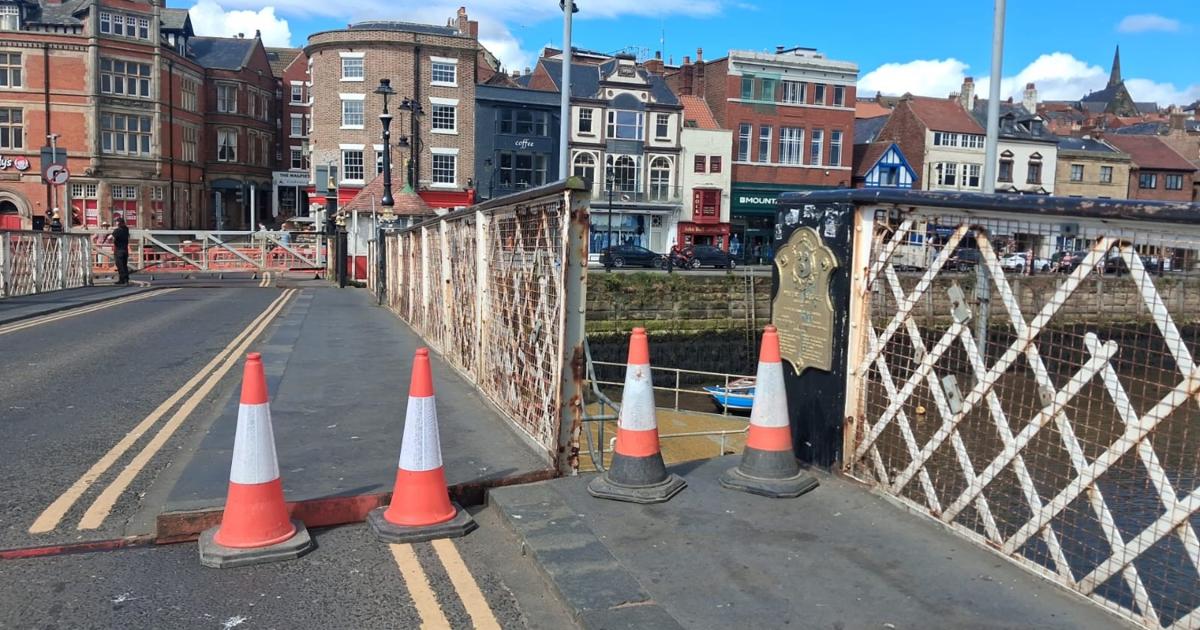
The accident happened this morning on the road between the popular towns of Dahab and Nuweiba on South Sinai’s eastern coast
Advertisement
Share or comment on this article:
Bus crash in Egypt tourist hotspot kills 16 people and leaves 28 injured
The Met Office predicted “unsettled” September conditions with rain and wind
Ethan Blackshaw Deputy Publishing Lead (Mirror) and Husna Anjum Senior Live News Reporter
21:09, 01 Sep 2026
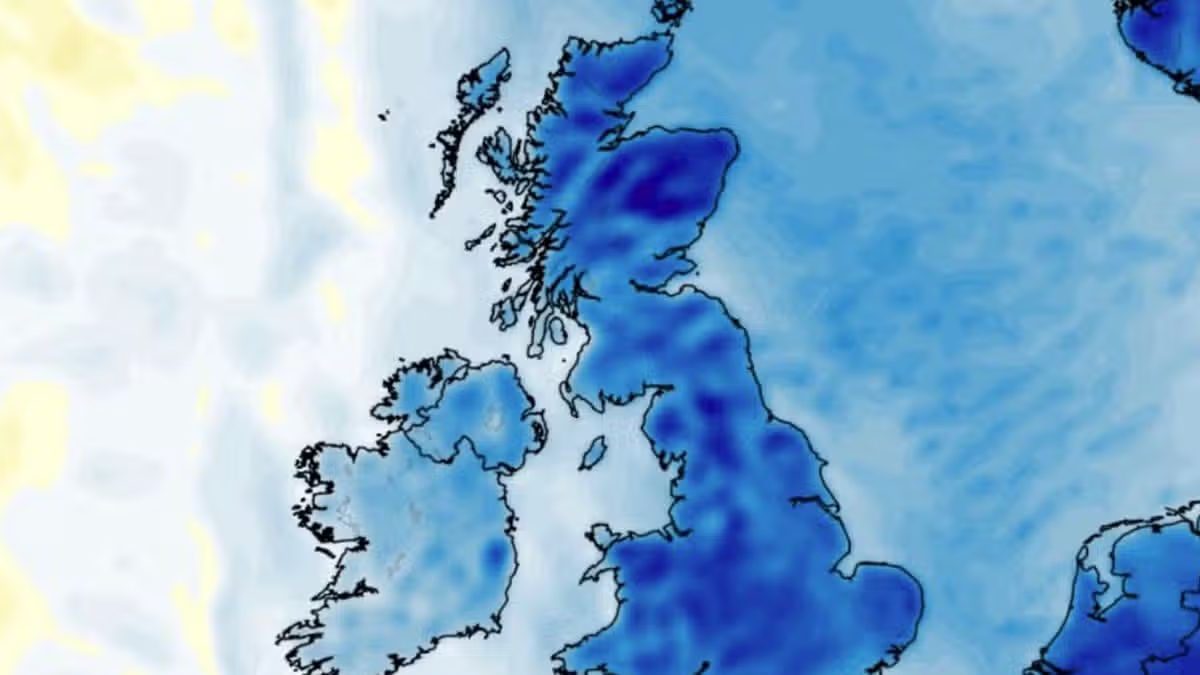
Ireland, Scotland and some parts of the UK could drop to 1C due to a cold snap that has been forecast this month. Temperatures look set to plunge from September 11, with the GFS weather model showing highs of just 11-12C around southern and eastern coasts at around midday.
Meanwhile 9C is coming in the Midlands and Northern Ireland, and lows of 2C on the cards in parts of Scotland. The Mirror reports by 6pm on September 11, the data shows highs of just 15C in the south-east – well below what is expected for this time of year – with afternoon temperatures remaining below 10C in Wales, northern England, Northern Ireland and Scotland.
Advertisement
Further cool conditions should follow on September 12, with temperatures dropping to just 1C in parts of northern England and Scotland. Every single county could see temperatures below 10C at midday, the data suggests.
The maps show temperatures peaking at just 13C in the south-east at around 6pm on September 12, with the Midlands reaching 11C, 12C in Northern Ireland and 10C in Scotland.
Similar conditions are expected on September 13 too, with the GFS model once again showing single-digit temperatures across the country at midday – with London at just 7C. Afternoon highs may reach just 14, with the warmest conditions expected in Northern Ireland and the south-west.
Temperature anomaly maps for this period show the UK shaded in areas of dark blue. This indicates that temperatures are expected to drop well below the seasonal average.
Advertisement
The Met Office anticipates “unsettled” conditions for the first half of September, with rain in northern and western regions and drier spells in the south and east.
The Met Office forecast for September 5 to 14 states: “An unsettled period is likely, with many places seeing showers or longer spells of rain at times. Rain is expected to be most frequent across northern and western areas, while the south and east are more likely to see longer, drier spells. There is also the potential for some strong and gusty winds, particularly in the northwest.”
The BBC forecast for September 7 to 13 says conditions should soon turn “cooler”, with “wet and windy or showery weather” on the cards.
It states: “Atlantic weather systems should continue to dominate conditions into the second week of September, with low pressure and frontal systems tracking near or across the UK, so further periods of wet and windy or showery weather look most likely.
Advertisement
“Short-lived drier and sunnier spells should occur in-between, especially in the southern and eastern UK where conditions may be less wet overall than the north and west.”
Want to see more of the stories you love from Belfast Live? Making us your preferred source on Google means you’ll get more of our exclusives… To add Belfast Live as a preferred source, simply click here.
“We are creating a modern and vibrant retail destination which we believe will drive Ballymena back to the top of the list of must-visit retail destinations”
A Co Antrim shopping centre has announced “another significant milestone” in its transformation.
Advertisement
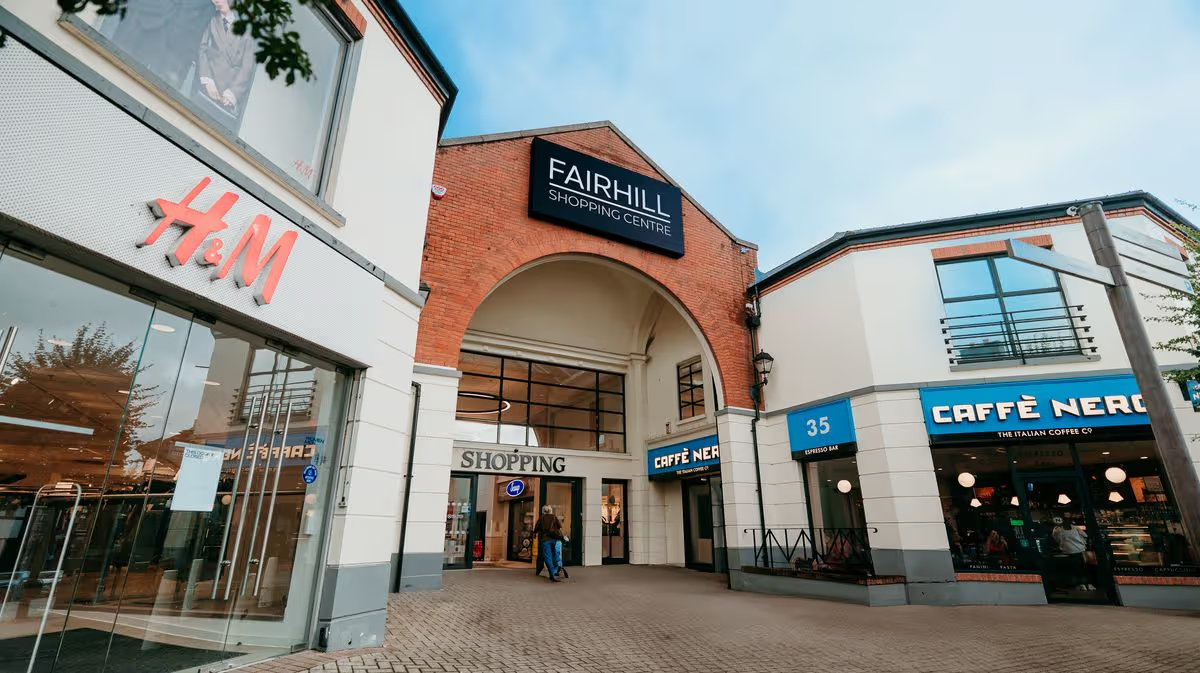
Fairhill Shopping Centre in Ballymena has revealed that current tenant JD Sports will be relocating to a newly formed retail space in “prominent corner location” within the centre.
The new JD Sports 12,300 sq. ft store, located beside the newly opened Primark, will occupy a highly visible position within Fairhill, and owners say it will create an impressive new retail destination for one of the UK and Ireland’s best-known sports-fashion retailers.
A spokesperson said: “The relocation will provide JD Sports with a significantly enhanced trading environment and an opportunity to showcase its extensive range of leading footwear, sportswear and fashion brands in a modern new format.
“JD Sports is renowned for its strong portfolio of global sports and lifestyle brands and its ability to combine sports performance with contemporary streetwear and fashion.
Advertisement
“With a loyal customer base and broad appeal across a range of age groups, the retailer will further strengthen Fairhill’s fashion, footwear and leisure offering.”
Back in 2021, Magmel (Ballymena) Limited bought over the Fairhill Shopping Centre in the heart of Ballymena town – since then, the company has embarked on a £10million transformation project.
From a fresh rebrand to an internal revamp of the storefronts and mall to building a new 26,100-square-foot unit for Primark, owner Ryan Walker said the new JD Sports will add to their mission to revive Ballymena’s status as a leading retail destination.
Advertisement
Ryan Walker from Magmel ( Ballymena ) Limited said: “We are very pleased to have secured JD Sports for this impressive new store at the heart of Fairhill.
“JD is an exceptional retailer and a fantastic fit for Fairhill, and their relocation to such a prominent corner position within the centre represents a significant step towards seeing the centre fully occupied with prime retailers.
“The new store will provide JD Sports with an excellent platform to showcase its leading range of sportswear, footwear and fashion brands, while creating an exciting new retail destination for our customers.
“We are now seeing the positive impact from our investment in the Centre and this announcement demonstrates the confidence that leading retailers have in Fairhill and Ballymena.
Advertisement
“We are creating a modern and vibrant retail destination which we believe will drive Ballymena back to the top of the list of must-visit retail destinations.”
Sixteen people were killed and 28 injured in a bus accident in eastern Egypt on Wednesday, local authorities said.
Egypt’s health ministry said the incident occurred on the Dahab-Nuweibaa road in South Sinai, on an area along the Red Sea coast that is popular with tourists.
According to the AFP news agency, 20 ambulances rushed to the scene of the accident in a popular diving area on the country’s eastern coast.
The nationalities of those who died have not yet been released.
Advertisement
Last month, 15 people were killed and 32 injured in a road accident in Egypt’s Ismailia governorate.
A flight attendant has explained the aeroplane exit row requirements and who is not allowed to sit there – and it’s about much more than extra legroom on a flight
Getting an exit-row seat with extra legroom for free can feel like a major win, but imagine paying for it and then being told you’re not actually allowed to sit there? It would feel like a real blow. But a TUI flight attendant has explained that there are quite a few people who aren’t allowed to sit in an exit row.
Advertisement
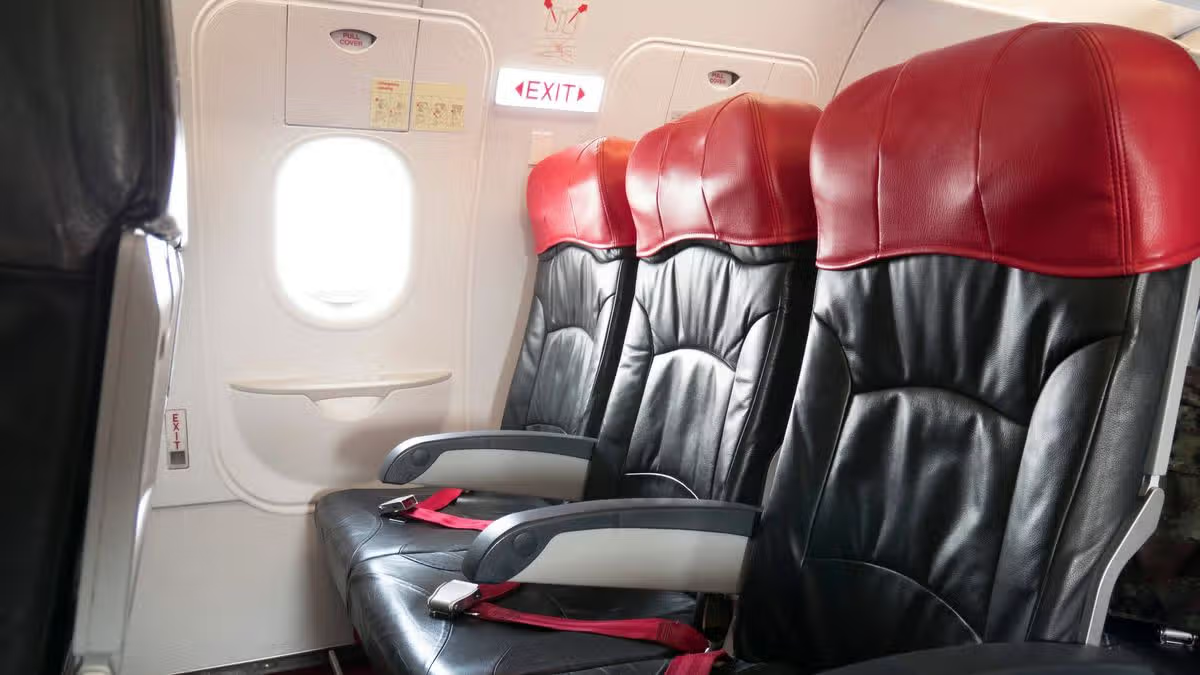
An exit row isn’t simply a nice upgrade offering additional legroom throughout your journey – it actually fulfils a far more critical function should your aircraft encounter any difficulties. In reality, passengers seated in an exit row may be required to assist the crew if necessary, and before departure is complete, the cabin crew will discuss this responsibility with you to ensure you’re comfortable with it.
Miva, a flight attendant, stated: “An emergency exit seat is not just a seat with extra legroom. In an evacuation, the passenger sitting there may need to assess the situation outside, open the exit, direct other passengers and help the crew.”
Fortunately, it’s extremely uncommon that a passenger would genuinely need to provide assistance, but you must be prepared to do so should the cabin crew require your help.
This explains why there’s a specific list of travellers who aren’t permitted to occupy exit row seats, as they wouldn’t be capable of providing support during a real emergency.
Advertisement
Who cannot sit in an exit row?
Children aren’t permitted to sit in the exit row. Each airline maintains different policies regarding the minimum age requirement for passengers allowed to occupy these seats.
Adults travelling with an infant or child in their care are also prohibited from sitting in the exit row.
Anyone with restricted mobility or with an injury cannot be seated there, nor can anyone unable to comprehend the instructions provided to them.
Passengers who are incapable of operating the exit mechanism cannot be seated there. Similarly, people who are uncomfortable with or incapable of assisting during an emergency situation are also excluded, as these seats serve a specific safety purpose.
Advertisement
Miva explained: “The reason is simple: every second counts during an evacuation. The person sitting at the emergency exit must be physically and mentally capable, willing to act immediately and able to help other passengers leave the aircraft safely.
Content cannot be displayed without consent
“The cabin crew can move someone to another seat if they believe that person is unsuitable. Exact requirements may differ between airlines.”
In the comments section, some readers expressed confusion, questioning: “Then why charge extra to sit there for the extra leg room? Should be giving us money for being willing to help.”
Another contributor clarified: “Children, pregnant women, people with disabilities, elderly. Because in case of an emergency, you will have to help open/help passengers off, which is also why the floor must be clear at all times.”
Advertisement
A further commenter highlighted an additional restriction: “People who need a seatbelt extended can’t sit there either because the extender could trip people on the way out the emergency exit.”
WARNING: GRAPHIC CONTENT Lawrence Brewer was one of three men who carried out the brutal hate crime murder of James Byrd Junior and was executed in Texas for the crime – but not before one final harrowing act
He was a brutal killer who claimed the life of a man simply because of the colour of his skin.
Advertisement
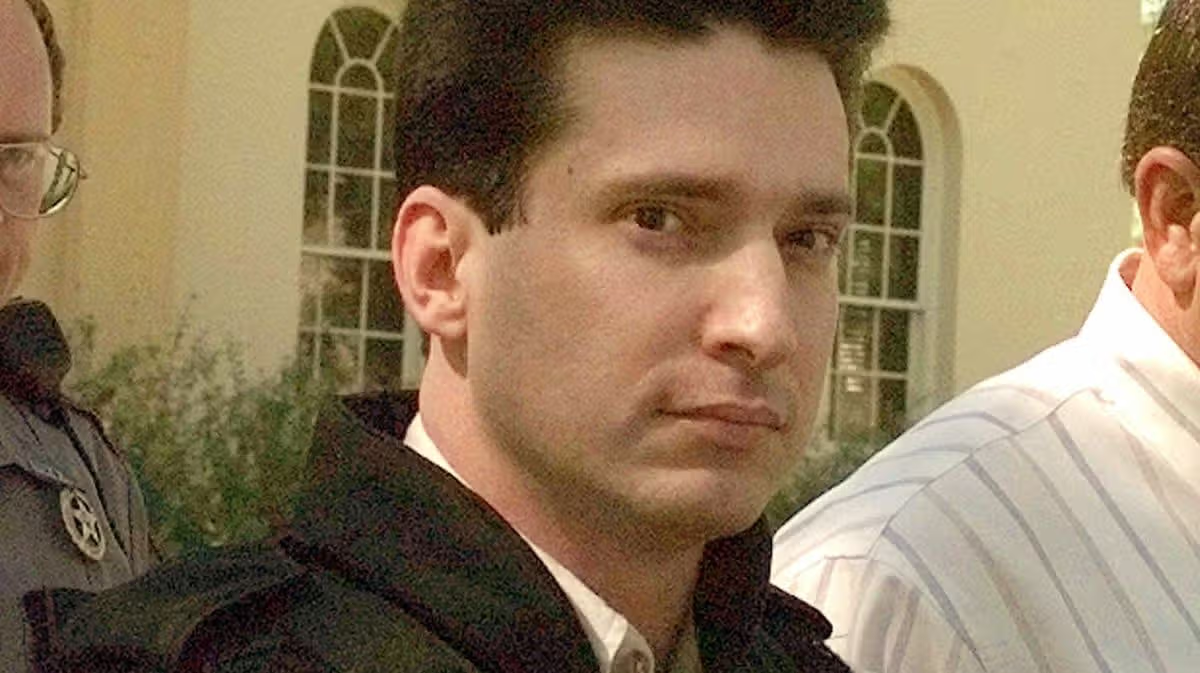
Lawrence Brewer was one of three men, along with Shawn Berry and John King, who launched a savage and harrowing attack on James Byrd Junior.
The victim was 49 when he was brutally murdered by the three men, two of them who were white supremacists, in Jasper, Texas in 1998. On June 7, James had accepted a lift from Shawn Berry, who was just 22 at the time. In the car with him were Brewer, then 31, and King, then 23.
Berry knew James as they both lived in the town but instead of taking him home the three men carried out an act of such violence it was leave the whole country appalled.
Taking James out of town and to a remote country road, they savagely beat him before tying a chain to his ankles and to the back of their pickup truck. Then then dragged him behind the truck for three miles. Brewer claims he slit James’ throat before the hellish journey began but horrifying forensic evidence showed the victim had been desperately trying to keep his head off the ground as he was dragged along.
Advertisement
It is thought he only succumbed to his injuries about half-way through the journey when his right arm and head were severed when his body hit a culvert. In addition, almost all of his ribs were fractured. When his head was discovered his brain and skull were still in tact, which lead forensic experts to believe he was still conscious as he was being dragged behind the pickup truck.
His killers then dumped his torso in front of a Black cemetery and heartlessly left the scene to head to a BBQ. James’ body wasn’t discovered until the following morning by a passing motorist. Close by police discovered a wrench with the word ‘Berry’ written on it and a lighter with the word ‘Possum’ written on it, which was King’s nickname while he was in prison.
Chillingly, officers discovered James’ remains in 81 locations and the harrowing killing was quickly labelled a hate crime and the FBI were called in to help with the investigation.
Advertisement
All three killers, Berry, Brewer and King, were arrested, tried and convicted for James’ murder, with King and Brewer sentenced to death while King was ordered to spend the rest of his life in prison.
Before Brewer’s execution on September 21, 2011, he requested a lavish final meal. He asked for two chicken fried steaks, a triple-meat bacon cheeseburger, fried okra, a pound of barbecue, three fajitas, a meat lover’s pizza, a pint of ice cream and a slab of peanut butter fudge with crushed peanuts.
However, he had one final chilling act to commit. After being presented with his final meal on earth, the brutal killer refused to eat a single mouthful. The act changed everything for those waiting to be executed on Texas’ death row – no last meal would ever be offered again.
Advertisement
Senator John Whitmire, chairman of the Senate criminal justice committee, said afterwards: “It is extremely inappropriate to give a person sentenced to death such a privilege.”
Instead inmates on the day before their death will now be served the same as all other inmates. After the ruling was passed, Whitmire said: “It’s long overdue. This old boy last night, enough is enough. We’re fixing to execute the guy and maybe it makes the system feel good about what they’re fixing to do. Kind of hypocritical, you reckon? Mr Byrd didn’t get to choose his last meal. The whole deal is so illogical.”
King was executed on April 24, 2019, while Brewer remains behind bars. He spends 23 hours per day in a cell measuring 8 by 6 feet, with one hour for exercise.
Advertisement
In an incredible act of forgiveness Ross Byrd, James Byrd’s only son, is now involved in Murder Victims’ Families for Reconciliation, an organisation opposed to capital punishment and he even campaigned to spare the lives of the men who had killed his father.
That was damp and underwhelming. The moment had come for Andy Burnham to make his Commons debut as prime minister. The dreaded hour could be dodged no more.
He wandered in at 3.34pm, looking at the floor. For a few minutes he had to wait in a throng of greasers near the front bench.
Education Secretary Lucy Powell fussed over him, removing lint from the back of his jacket. Louise Haigh, First Minister, stood alongside, rigid. Is it possible lame Lucy makes Ms Haigh itch with annoyance?
Mr Burnham did not have enough room to stand squarely. In the scrum he had to reach his left arm backwards to grab the Speaker’s chair for balance. He angled his whole body away from the bench he was about to occupy. The posture reeked of reluctance.
Advertisement
Eventually Foreign Office questions ended. Ms Haigh urged forward her hesitant protege, a farmer prodding her goat through a gate.
Other MPs would normally scatter out of a PM’s way but Mr Burnham found his path blocked by Ed Miliband and even by young Hamish Falconer. The PM ceded the ground to them. It was not, somehow, what one expected from the new skipper of our destinies.
At 3.38pm he began a statement entitled ‘Direction of Government’. It started well. He coughed up proper but restrained words of respect for Sir Keir Starmer, whose decision to quit as an MP had been announced earlier, to the ululations and breast-beating of a grieving nation.
Advertisement
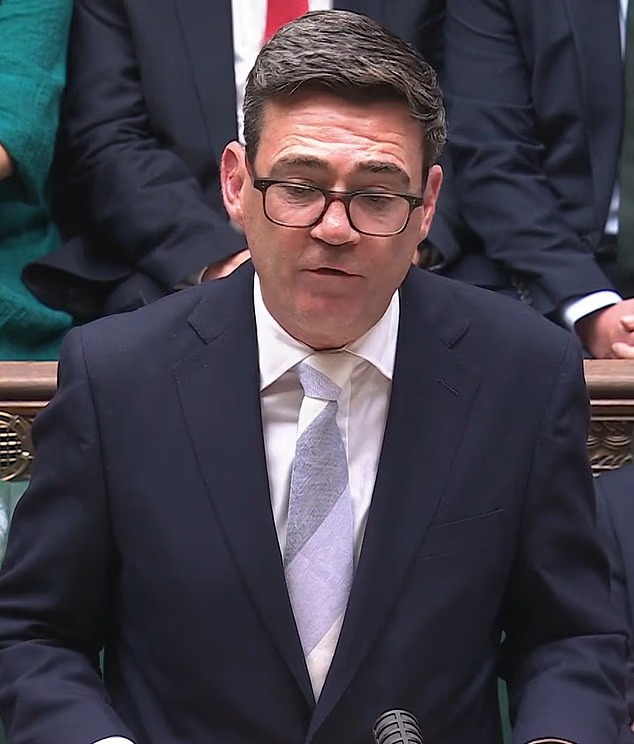
Andy Burnham addressing the House as he made his Commons debut as prime minister this afternoon
As Mr Burnham burbled on about Sir Keir’s ‘lifetime of public service’, Labour MPs watched closely. They had cheered his arrival but not excessively so.
Soon he was on to Ukraine, asserting that Britain would continue to support Kyiv against Russia. His voice strengthened and I thought, briefly, ‘ooh, this could be rather good’.
That little frisson soon faded. Before long the energy levels dropped, the delivery became staccato – almost like a computerised railway announcement, with random emphasis on certain words – and the content was drab.
Advertisement
We learned how thrilled he was recently to meet the Lib Dem leader of Cornwall council. The new No 10 North operation was apparently going to help Cornwall, even though it is in the south-west of England. Part of the new focus on mayors was going to be new ‘visitor levies’. A new tax. Just what we need.
Such was the level of fascination on the Labour benches by now that three Labour backbenchers, Wrexham’s Andrew Ranger, Truro’s Jayne Kirkham and Calder Valley’s Josh Fenton-Glynn, were mucking about at the far end of the chamber, laughing with each other and paying sparse interest to their new leader.
It would be wrong to say that he had lost the House but he was not wowing it. The performance was not electric. It was adequate. Better than the nasal knight’s was. But it felt provincial. It did not tingle as it should. As it must. We may have another bore on our hands.
He was soon enthusing about Theresa May and promising to ‘develop the triple helix approach to economics by entwining business, academia and government’. The House: ‘Eh?’
Advertisement
Here he was on his first parliamentary outing as PM, the one day he could be sure the House and the country would give him a friendly hearing, and he was blithering on about some triple helix. Was it a move from gymnastics?
MPs squinted in puzzlement. Mr Burnham himself was soon peering, as he repeatedly removed his spectacles. This made his eyelashes more noticeable but his speech even fuzzier.
The new Chancellor, John Healey sported a wound on his bald pate. Mr Healey was man-spreading like a champ. Pensions Secretary Pat McFadden had his legs tightly crossed, v. Kenneth Williams.
Equalities minister Bridget Phillipson, sacked from Education, looked even crosser than normal. The new power-scowler is Ms Haigh. She has a sharklike intensity to her, an air of cruelty that her boss entirely lacks. Prime ministers are seldom this spongy.
Advertisement
Share or comment on this article:
QUENTIN LETTS: This was Burnham’s big moment and he blithered on about some ‘triple helix’. MPs squinted in puzzlement…
















































You must be logged in to post a comment Login