While many of us will be brushing the correct number of times a day, it’s the way in which we brush that might be causing problems.
Some dental experts have shared what this is and what you can do instead to keep your teeth and gums healthy.
Brushing too hard can cause your teeth to become yellow and your gums to recede (Image: Getty Images)
Dentists warn against brushing your teeth too hard
Several dental experts have said that brushing your teeth too hard will cause issues over time.
Dr Jas Sagoo, director of leading general and cosmetic dentists Perfect Smile Spa, said that the “wrong technique can do more harm than many people realise”.
Advertisement
He added: “Brushing too hard is a common mistake and it can cause the white enamel, the outer layer of the teeth, to wear away.
“When this happens, the inner layer of dentin is exposed, which is a tone of yellow, and so the tooth becomes duller in appearance.”
The Oral Health Foundation also backs this up, saying it can cause gums to recede and make your teeth sensitive.
They add: “If your gums are sore or your teeth feel sensitive, it may be a sign you are brushing too hard.
Advertisement
“Speak to your dental team if you are unsure.”
What brushing technique should you use?
Dr Jas shared that there is a gentler method he recommends for brushing to keep your teeth and gums healthy.
He said: “A good technique is to tilt your brush at a 45-degree angle, gently going tooth-to-tooth to ensure the whole surface is covered, and brushing against the gumline to free any trapped particles.
“Using a soft-bristled brush or an electric toothbrush may bring you the best results and try to be firm without putting too much pressure on the teeth.
Advertisement
Recommended reading:
“It’s also advisable to change your toothbrush every three months, or before that if you see visible signs of fraying.”
The Oral Health Foundation also suggested using an electric toothbrush, as many of them have pressure sensors that warn you if you are brushing too firmly.
They also recommend avoiding sawing motions and holding the toothbrush lightly so that the bristles do the work.
Advertisement
Do you prefer to use a manual or an electric toothbrush? Let us know in the comments.
A mum traded her ‘trackies and trainers’ for gowns and swimsuits to be crowned Mrs Galaxy UK. Gemma Pritchard, 45, from Llanrug, Gwynedd, is a martial arts instructor who is more commonly found on the training mats.
She holds a 5th degree Black Belt in Karate and Kickboxing, along with a Blue Belt in Gracie Jiu Jitsu, and works full-time as a martial arts instructor at her own academy. Her familiarity with beauty pageants stems from her daughters Erin and Efa-Hâf.
However, she chose to push herself out of her comfort zone and enter Mrs Galaxy UK. Read the biggest stories in Wales first by signing up to our daily newsletter here
Advertisement
The bold move paid dividends as she triumphed over competitors from across Britain to be crowned Mrs Galaxy UK. Gemma and the remaining UK Galaxy Queens will be flying to the USA to take part in the Galaxy International Pageant.
Gemma said: “After 11 years as a dedicated pageant mum, I stepped into the spotlight myself.”, reports North Wales Live.
“In the competition I had an interview, provided a portfolio of the community work I have done and it also included a stage competition of three rounds, fashion wear, swimwear and evening wear.”
She added: “I have been a pageant mum for 11 years where both my daughters have also previously been Galaxy Queens so I decided to follow in their footsteps. It’s usually the other way round!.
Advertisement
“My daughter Efa-Hâf was Junior Miss Galaxy 2023 and my eldest daughter Erin Pritchard was Teen Galaxy 2025.
“I am a martial artist by day, so at 45 I decided to step out of my comfort zone and do something different.
“Taking part was really empowering, doing something totally different to my every day, I was nervous but thought ‘I’m here, lets go for it’.
“Winning was a shock, and even more so when I won all the scoring rounds too, so I felt overwhelmed but extremely proud, I just kept looking at my daughters who I think were just as shocked as me.
Advertisement
“Being on stage all glammed up in elegant wear was nice as it’s completely different to my everyday life on the martial arts mats where I’m in my trackies and trainers, no makeup and hair tied back.
“It’s most definitely built my confidence.”
Get daily breaking news updates on your phone by joining our WhatsApp community here. We occasionally treat members to special offers, promotions and ads from us and our partners. See our Privacy Notice.
After exchanging early breaks, neither player was really able to impose themselves on the match with both having to work hard at times to hold serve.
However, in the tie-break, Sinner upped his first serves and after squandering the first of two set points, an Alcaraz double fault gave him the initiative in the match.
Sinner started the second set sluggishly and had to come from 15-40 down in his opening service game before Alcaraz broke to go 2-1 ahead and hold for 3-1.
But the Italian managed to stay in the match as Alcaraz failed to dominate his service games, taking a 4-3 lead to put the pressure on his 22-year-old opponent, who had won 10 of their 16 previous encounters.
Advertisement
Another shaky service game from the Spaniard gave Sinner another break point, and from there he made no mistake, quickly wrapping up his 27th ATP Tour victory.
The GB News presenter shared an Instagram update after being rushed to hospital on Tuesday
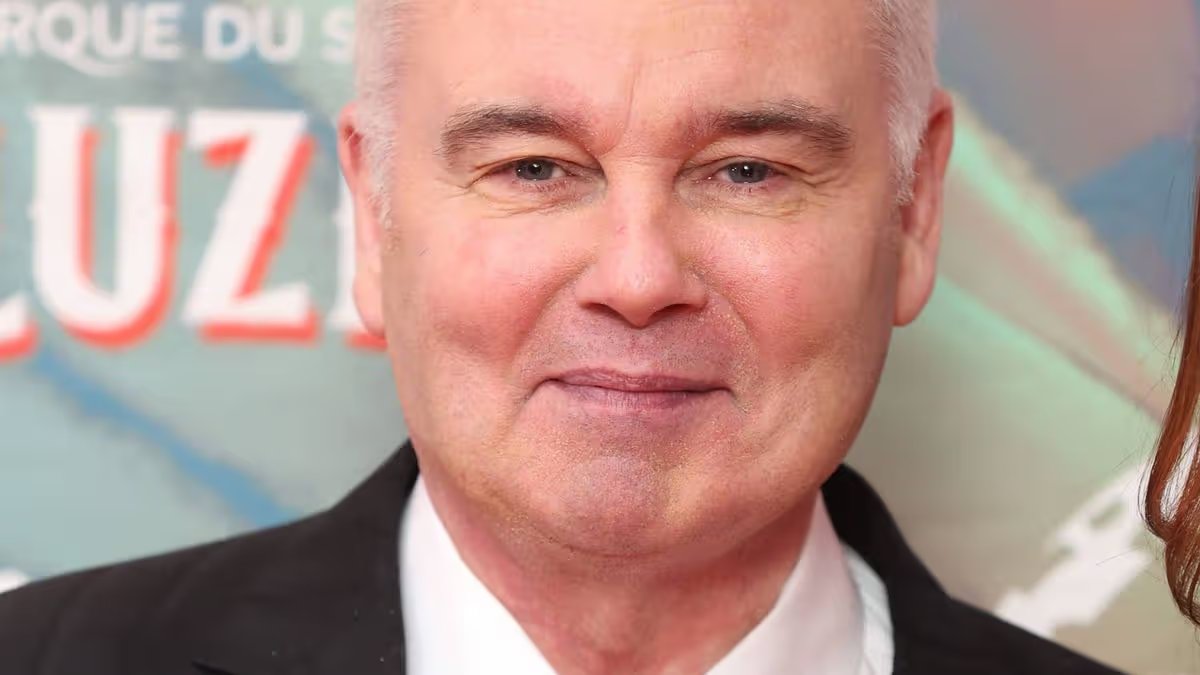
Television presenter Eamonn Holmes has broken his silence following a stroke that saw him hospitalised on Tuesday. The 66-year-old broadcaster, who remains in recovery, has now addressed the health emergency publicly.
Advertisement
Taking to Instagram, he shared a touching photograph of his granddaughters holding up a handmade card bearing the words “get well soom”.
The presenter playfully referenced the endearing spelling error in his caption, writing: “Got this first thing this morning, from my two lovely granddaughters,” and “So now doing my best to get well SOOM!!”
Supporters flooded the comments section with messages of encouragement. One follower shared their experience, saying: “Get Well Soon…my Husband had a stroke over a year ago…he’s back to work and enjoying life again, with a few little changes, but we will take that. Speedy recovery.”
Advertisement
A second commented: “Eamonn … The little things like this mean the most in life .. get your self well soom as the gorgeous girls say.” While another wrote: “Eamonn, Your lovely granddaughters, with their get well messages, will give you strength to aid your recovery x”, reports the Mirror.
The post follows an earlier update from his son regarding his father’s progress. Declan Holmes, 37, issued a statement on the family’s behalf.
Expressing gratitude for the outpouring of support, he provided reassurance about his father’s medical status. The broadcaster’s son stated: “I just wanted to share a quick message to say we hugely appreciate all the messages, it means a lot to us as a family.
Advertisement
“What happened came as a real shock, but dad is doing OK given the circumstances and we’re taking it one step at a time. For now, we’re focused on him and keeping things steady around him.”
He continued: “We’d really value a bit of privacy as we navigate it, and what lies ahead, but thank you again for the support as it means so much to dad and the rest of the family.”
GB News confirmed on Saturday that Holmes had experienced a stroke. The network stated the presenter is receiving hospital care at present.
In an official statement, the broadcaster revealed: “Eamonn was taken ill last week and it was later confirmed he had suffered a stroke. He is currently responding well to treatment. Eamonn has asked for privacy as he focuses on getting better.”
Advertisement
Following the announcement, his co-presenter Ellie Costello expressed her concern: “Thinking of you Eamonn and wishing you a speedy recovery.” Meanwhile, Alex Armstrong, who will cover presenting duties during Eamonn’s absence, commented: “Thinking of you Eamonn Holmes. Such a shock to all of us. You’re sorely missed. Get better soon.”
Holmes had been scheduled to return to GB News Breakfast the following week for his programme alongside Ellie Costello. The duo normally present from Monday through Wednesday, though Alex will now deputise for the experienced broadcaster.
GB News Chief Executive Angelos Frangopoulos issued a statement after Holmes’s medical situation became public knowledge, saying: “Eamonn is a loved member of the GB News family, and we’re with him every step of the way as he recovers.” Taking to Instagram on Friday evening, Eamonn’s partner Katie Alexander shared her thoughts on the week, without referencing Eamonn’s health. In her post, she said: “What a week. Prayer, a little visit to church to have a word with the good Lord himself, prayer each day.” This was posted the day before details of Eamonn’s medical situation emerged.
Eamonn and Katie’s relationship started following his separation from his estranged wife Ruth Langsford. The couple, who had been married for 14 years, parted ways in 2024 and are now going through divorce proceedings. It’s understood that Ruth is receiving updates about her former husband’s health through their son Jack.
The former RAF servicewoman was last seen at her Cambridgeshire home in November 1993, but there have been no traces of her since
There are many cases of murders or missing people that have been left cold for many years. Over the last few decades, there have been cases left with no trace of investigation across Cambridgeshire.
Advertisement
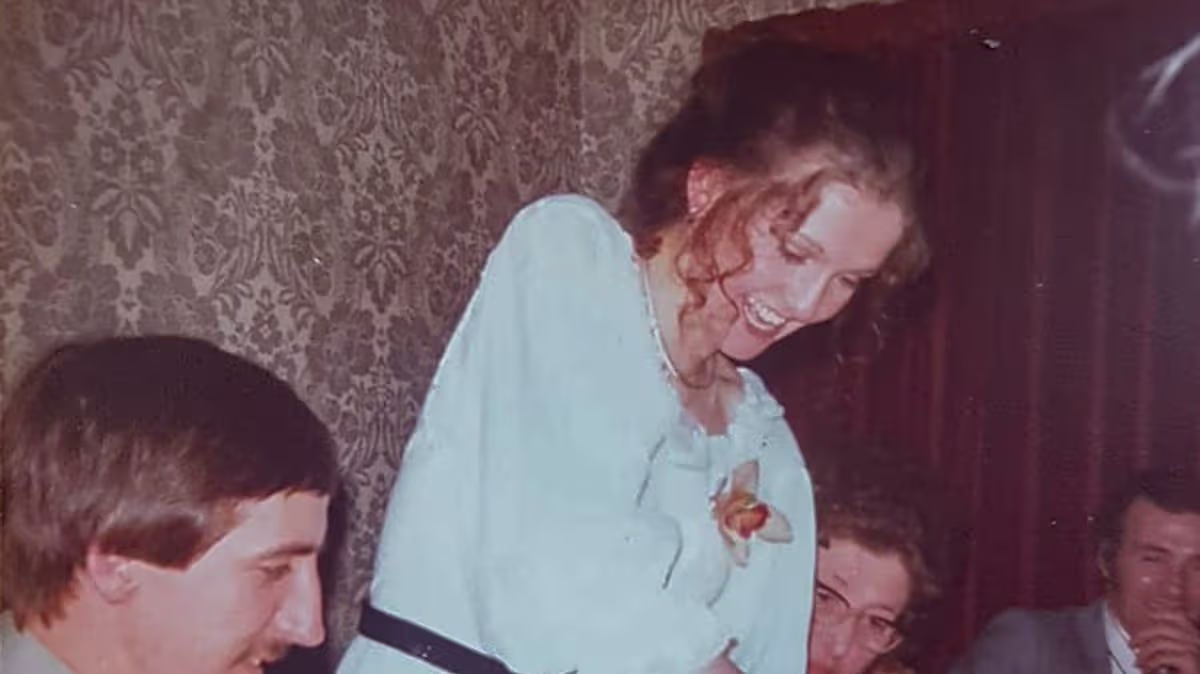
A case left as a mystery for over three decades is the disappearance of Davina McMillan from Godmanchester. The former RAF servicewoman, aged 36 at the time, was last seen alive at her home in Godmanchester on November 25, 1993.
It was believed she went to Germany to look for work. When there was no sign of her, she was reported missing by her brother, Gary Coulson, on December 27.
Since then, there has been no trace of her. At the time when she was last seen at her home, she lived with her four-year-old daughter Rebecca. Davina’s family said she would have never left her beloved daughter.
In 2020, Gary claimed that he had been told by a cold case detective that Davina’s case had changed from a missing person’s investigation to a murder investigation. At the time, he appealed to the public to share any vital information with Cambridgeshire Police.
Advertisement
Gary told The Mirror in 2020: “I hope more people will come forward to help the investigation. Even after all this time it could only take one key witness to crack the case.
“Losing Davina still hurts as much now as it did then. I have a daughter who is a ringer for my sister and every time I see her it makes me think of her.
“I’m desperate for the case to be solved. I’ll never stop fighting to find out what happened.”
Masters Sunday is upon us once more, with the 2026 edition of golf’s prestigious first major of the year set for a typically thrilling conclusion at Augusta.
World No2 McIlroy made a mess of Amen Corner during a rollercoaster day and wound up shooting a one-over 73, which was only good enough to see him head into round four tied at the top of the leaderboard.
He shares the lead on 11-under with Players Championship winner Cameron Young, who was eight shots off McIlroy to begin Saturday but came roaring into contention with a magnificent seven-under 65.
Advertisement
Also hitting a seven-under 65 on Saturday was a certain Scottie Scheffler, who is in the mix at four shots adrift along with Haotong Li.
Where to watch the Masters
TV channel: As ever at the Masters, the amount of action shown on television is restricted by tournament organisers.
But that is slightly relaxed over the weekend, with main fourth-round coverage getting underway in the UK on Sky Sports Golf from 4:30pm BST on Sunday.
Advertisement
Sky Sports Main Event also picks things up at 6:45pm until the finish, after the Premier League showdown between Chelsea and Manchester City at Stamford Bridge.
Sky Sports+ has coverage of featured holes from 4:45pm, focusing on the notorious Amen Corner – holes 11, 12 and 13.
Live stream: Sky Sports subscribers can also follow the finale to the 2026 Masters live online via the Sky Go app.
The airline, which is primarily based at Leeds Bradford Airport (LBA) said it is “aware of adverse weather conditions” currently affecting the Portuguese region of Madeira, specifically in its capital, Funchal.
In recent days, Portugal has seen heavy rain and thunderstorms, which resulted in yellow weather warnings for all mainland districts.
In a statement this afternoon, Jet2 shared: “We are aware of adverse weather conditions currently affecting Madeira (Funchal).
Now’s the time to book your seats!
When they’re gone, they’re gone… so get them booked now ✈️
“Our UK Based Operations Team are working hard to minimise any disruption to flight to and from Madeira (Funchal).”
The UK air carrier urged customers to find out if their flight has been affected by entering their flight number on the arrivals and departures section of its website, for the most up to date information.
Advertisement
It added: “We have credited your boarding passes with €10 each towards some light refreshments.
“If you are currently delayed in Madeira (Funchal) and are awaiting confirmation of your new flight times back to the UK, please refer to the communications we have sent to you via SMS & Email for confirmation of your new flight date and time.
“Information will also be included regarding check-in opening times for your new flight.
“Safety is our number one priority and we’re sorry if you’re affected by any flight disruption during this period.
Advertisement
“We appreciate your patience and understanding at this time.”
Full list of delayed Jet2 flights from Madeira to UK departing today
Jet2 has informed its passengers of the below delayed flights, now expected to depart on Sunday (local time):
LS3624 Bournemouth via London Stansted – 8.25pm
LS1226 Birmingham – 8.35pm
LS736 Edinburgh via Leeds Bradford – 9.25pm
Visit the Jet2 website (a link to which can be found above) to find out more information about possible flight delays.
Jet2 announces brand-new flight route to La Palma
Earlier this month, Jet2 marked the launch of its brand-new route to La Palma, after the first flight departed from Manchester Airport on April 3.
Has your Jet2 flight been cancelled this week? (Image: GORDON ZAMMIT/Getty)
The full flight signalled the start of Jet2 operating flights and holidays to La Palma for summer 2026 – its fifth destination in the Canary Islands.
Advertisement
As a result of the new flying programme, Jet2 now has two weekly services (Monday and Friday) on sale year-round from Manchester Airport to La Palma.
In addition to this, holidaymakers from London, Essex and the Southeast will also be able to experience La Palma’s subtropical landscape, natural beauty and culture from November 6 this year, as Jet2 will offer weekly Friday flights to the Canary Island from London Stansted Airport from this date.
Emirates confirms it is operating a ‘reduced flight schedule’
The latest travel news from Jet2 comes as the Dubai-based Emirates airline has warned UK travellers it is currently operating a “reduced flight schedule” to more than 100 destinations, after the US and Iran reached a two-week ceasefire.
Advertisement
In a statement on Friday (April 10) Emirates said: “Following the partial reopening of regional airspace, Emirates is operating a reduced flight schedule.
“You can check our latest flight schedules for upcoming flights and book seats to travel.
“We continue to monitor the situation, and we will develop our operational schedule accordingly.
“We would like to thank you for your understanding and patience.
Advertisement
“The safety and security of our passengers and crew remain our highest priority and will not be compromised.”
Have you got a flight booked with Jet2 that’s been disrupted or delayed? Let us know in the comments below.
We have compiled a list of four hidden gems in Cambridgeshire just waiting to be explored
With the warmer months upon us, many people will be looking to make a list of places to branch out and explore this summer. We are so lucky to have a county filled with numerous pretty villages offering unique attributes, fun days out, and intriguing history.
Advertisement
The Imperial War Museum in Duxford, Oliver Cromwell’s House in Ely, and Fitzwilliam Museum in Cambridge are all fun-filled days out in Cambridgeshire. However, for many who have lived and explored Cambridgeshire for many years, you may have visited these well-known places time and time again.
There is so much more to this county than the most famous attractions. There are also so many small, lesser-known villages with cute cottages, hidden history, and gorgeous houses. To help you narrow down your search of places to visit this summer, we have compiled a list of four hidden gems in Cambridgeshire.
Hemingford Gre
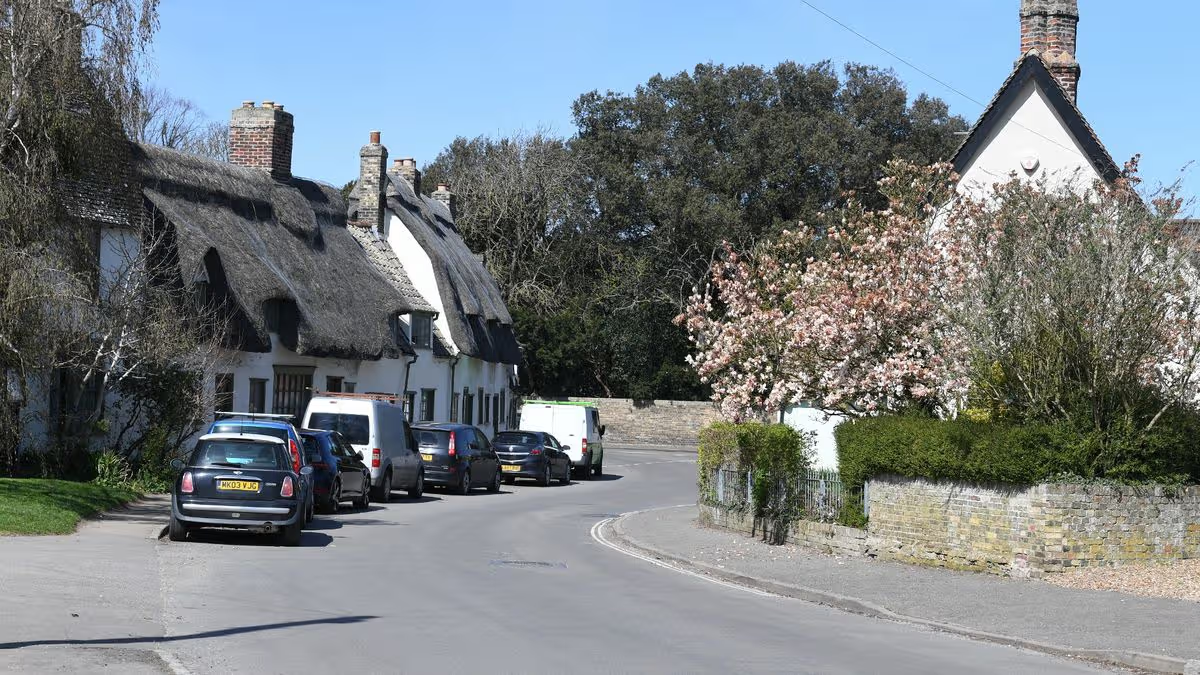
This picturesque village, Hemingford Grey, located east of Huntingdon is home to one of the oldest continuously-inhabited houses in Britain called The Manor. The pretty village features a lovely meadow that pops with colour.
Advertisement
Sitting against the banks of the River Great Ouse, this village is arguably known best for its stunning thatched cottages and countryside walks. Visitors can enjoy a delightful lunch at the charming pub – The Cock – which offers a varied selection of food and drink as well as dining pods in the outside area ideal for the summer.
Doddington
Doddington sits around halfway between Chatteris and March. It is home to a war memorial and a lovely plant life. Doddington has its own horticultural society and two independent garden centres.
Debatably the busiest time for this village is during the first weekend of July when it hosts their annual vibrant carnival dating back over a hundred years.
Bourn
Perhaps the most popular feature in this village, is for having one of the oldest windmills in England. Bourn is a petite village located in South Cambridgeshire. It is filled with properties considered ‘chocolate box’ houses and extensive countryside.
It is home to Cambridge Country Club offering endless facilities for a relaxing day. It is no wonder this village has been recognised as one of the best places to live in Cambridgeshire by Muddy Stilettos.
Grantchester
Nestled beside the River Cam sits Grantchester, home to an array of characterful cottages, tree-lined streets, a medieval church, several pubs, and arguably the most riveting – a tea garden known for its previous famous guests.
Advertisement
The Church of St Andrews & St Mary is not just filled with history, but also features in the ITV drama ‘Grantchester’. Although it’s a small village, it has four pubs called The Red Lion, The Grantchester Green Man, The Blue Ball Inn, and The Rupert Brooke.
Better yet, The Orchard Tea Garden, offering delectable items including scones and homemade cakes, has seen a few notable faces over the years. This includes English poet, Rupert Brooke, Virginia Woolf, philosophers Bertrand Russell, and Ludwig Wittgenstein.
As the world famous Settle to Carlisle line celebrates 150 years of service, the Mirror joined the 1 m passengers expected this year.
150th anniversary of Settle to Carlisle line
It is widely lauded as one of the best train journeys in the world, and is just about to celebrate its 150th anniversary.
A huge public outcry and an appeal that raised £3m saved it from closure in the 1980s.
The Settle to Carlisle line survived and remains one of the most scenic in the country, crossing the Pennine Hills, the Yorkshire Dales and Cumbria’s Eden Valley.
It celebrates 150 years since its first rail passenger journey with a series of events including a steam train service.
Advertisement
The Mirror joined some of the 1 million passengers expected to travel on the route this year.
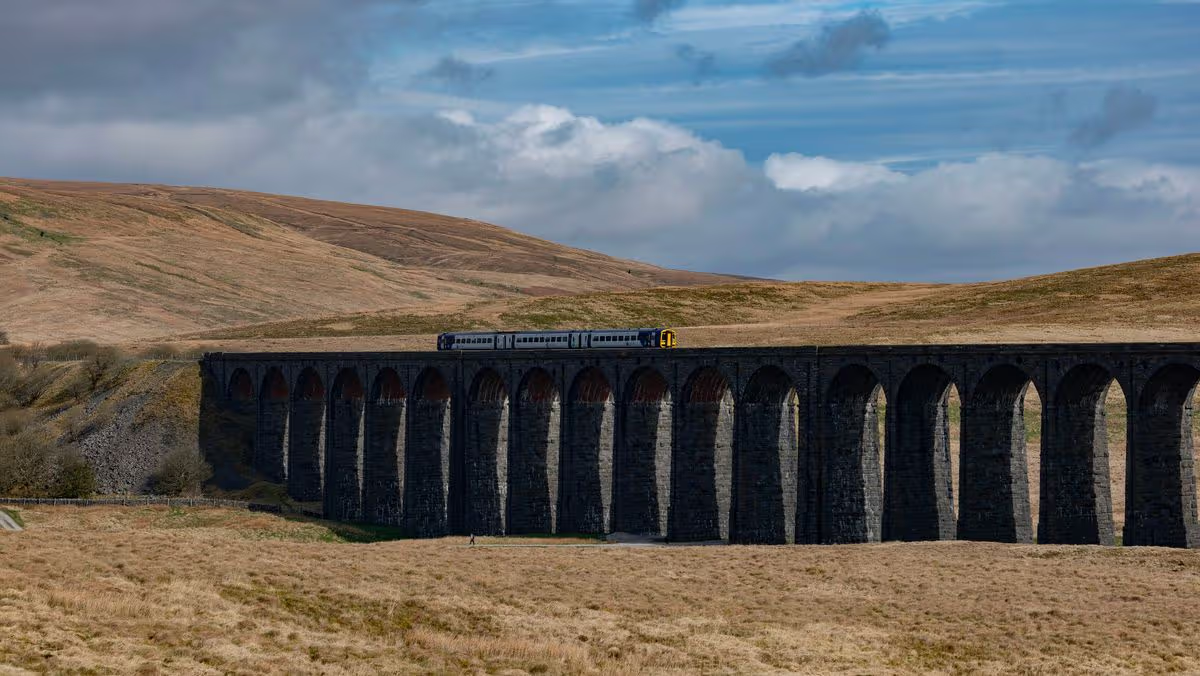
It was wet, wild and stormy as we ventured south from Carlisle to the Ribblehead Viaduct.
Its magnificent 400m arches are 400 meters (1,300 ft) long. A huge workforce of 6,000 men – 2,300 specifically on the Viaduct – built it between 1870 and 1875.
You can imagine the conditions they faced during winter on the wide open moorland surrounding the giant structure.
The navvies who died are buried in the cemetery at Chapel-le-Dale. Even in the pouring rain, the path passing under its 24 arches remains busy with hikers and cyclists.
Advertisement
You must take a short break during your train journey to see the viaduct in all its glory.
From your train seat, you have a breathtaking backdrop of rolling countryside.
Wind bent the trees on the distant hills. The stations are straight out of a 1930s black-and-white film.
Advertisement
“I say that is my office window,” said Yvonne Harland, 52, a Carlisle-based conductor on the route.
“It is absolutely stunning. Many passengers are hikers and dog lovers heading outdoors.
“It does not matter if you are in the valleys around Dent or the Ribblehead Viaduct.
“It is a tonic. You have to get off the train to see the viaduct; otherwise, you only catch a glimpse.
Advertisement
“The Three Peaks are just beautiful too. No disrespect to people who work in an office, but it takes some beating.
“I was in education for 20 years, and I fancied a change.”
Regular passenger Robin Gilder, 83, a retired ITV newsman, remembers the campaign to save the line in the 1980s.
Advertisement
Now he enjoys bringing along his grandson Finley Doran, 12, for days out. “I use it regularly now,” he said. “Especially since I retired.
“They had a dog sign the petition to save the railway and there is a statue to him at Garsdale station.
“There was huge public outcry when they announced they were closing this line.
“They raised millions of pounds to keep it open. So I think we should use it as much as we can.”
Advertisement
Finley, tucking into some sweets and pop, added: “I have been on about twenty times now. We use it all the time.”
For Scottish pharmacist Amy Robertson, it is her maiden journey. The 28-year-old is heading to Leeds to see a former friend with the misty hills rolling by her window.
“It does remind me of Scotland,” she said. “This is really lovely and you get some really nice views when you go up to the north of Scotland around Fort William.
Advertisement
“The weather may not be very good, but the countryside is beautiful.”
Northern recorded 995,000 passenger journeys on the line in 2025, the highest number since the Covid-19 pandemic.
But demand is expected to rise this year. Commercial and customer director Alex Hornby said he was confident passenger numbers would hit 1m.
“Customers can enjoy miles of breathtaking scenery, which changes throughout the year, and there are plenty of opportunities to get off and explore,” he said.
Advertisement
The Settle to Carlisle section of the line was completed in 1875; freight trains ran for a year before passenger trains were introduced on May 1, 1876.
The Settle Carlisle Railway Development Company will run a chartered steam train between Carlisle and York on May 23.
Karen Morley-Chesworth, their community rail officer, told the Mirror: “The Lonely Planet said it was in the Top 10 most scenic railway journeys in Europe.
“So it brings in many tourists and serves local people all year round. It runs down the backbone of Britain through Cumbria, Yorkshire and the Pennines.
Advertisement
“But it is the beauty of it that stays with you; every station takes you back in time, and the history of the line still fascinates people. It remains important to communities all along the route.”
Northern is set to offer £1.50 tickets to customers travelling on the route to mark the milestone.
Thousands of workers contributed to its complex construction, which includes 14 tunnels and more than 20 viaducts along its 72 miles (116km) of track.
In 1983, British Rail announced plans to close the line to passengers amid concerns about the cost of repairing the Ribblehead Viaduct. But £3m was spent between 1988 and 1991 to bring it back into use.
Advertisement
The Settle Carlisle Railway Development Company’s chairman, Pete Myers, said the company was working with communities along the line to mark the “special anniversary year.”
He said: “The Settle to Carlisle line is unique, connecting communities from Yorkshire through to Cumbria, and also providing a sustainable and beautiful way for visitors to explore the Yorkshire Dales, Westmorland Dales and Lake District.”
Crystal Palace came from a goal down to beat Newcastle and add to growing pressure on Eddie Howe. William Osula had given Newcastle the lead in the first half after an excellent passing move but they wilted after the introduction of Jean-Philippe Mateta and Ismaila Sarr from the Palace bench. Mateta scored twice and Newcastle seemed intimidated by his presence.
Howe will not have many better chances than this to quieten discussions about his future. Newcastle seemed in charge after taking the lead against a Palace team clearly prioritising their European campaign. Yet a position of strength was squandered, raising another period of uncomfortable questions about Newcastle’s direction of travel.
Something fundamental has shifted in Howe’s team, from upward-trajectory upstarts to tired under-deliverers. A can-do attitude has become can’t. They had chances to add to William Osula’s opening goal, Osula himself spurning the best early in the second half. His replacement, Nick Woltemade, was placid when attacking a cross when he should have been attacking it with fury.
Advertisement
Mateta was the opposite, a menace with his application and intelligent centre-forward play. Sarr added attacking composure allayed with speed of thought which the game had been lacking and the two combined for the equaliser, Sarr benefitting from Tino Livramento missing a cross before chipping it up for Mateta to head in. A penalty, awarded for the softest of shirt-pulls on Jefferson Lerma by Sven Botman, was thundered in by Mateta.
It was a largely untidy game, with the tone set with the opening kick-off, when Sandro Tonali took a long run-up and duly found touch around the Palace 22. The resulting line-out was the most exciting moment of the opening half hour.
This was Palace’s first Premier League game for almost a month due to the international break and rescheduled fixtures against teams still in domestic cup competitions. They would rather be anywhere than here in this competition, with just three home league wins all season and only one in their last 10.
Their season is now all about the Europa Conference League and the increasing possibility of a third trophy in two years under Oliver Glasner. No, you would not usually count the Community Shield but an exception can be made for Palace.
Advertisement
Mateta, Sarr and Adam Wharton arrived with 25 minutes left, delaying recognition that Palace would need more than their second string to trouble an increasingly composed Newcastle defence. From then, the wobbles crept in and previously steady performances evaporated. There was no surprise that Palace equalised but their winner was harsh on the visitors.
Red flags for Howe or just a bad run? Six games of their season remain to find out either way.













![Young Thug - Money On Money (feat. Future) [Official Video]](https://wordupnews.com/wp-content/uploads/2026/04/1776012320_maxresdefault-80x80.jpg)









































You must be logged in to post a comment Login