It was while she was in hiding after recovering from the sixth attempt on her life, that the activist Juma Xipaia got a call asking if she would agree to be the subject of a documentary. The first female chief of the Middle Xingu region of the Brazilian Amazon, Xipaia was well known in Brazil for her passionate attempts to protect her indigenous community from the effects of deforestation, illegal gold-mining and – in particular – the catastrophic environmental consequences of the $11 billion Belo Monte hydroelectric dam project, a wildly ambitious and destructive endeavour that has affected livelihoods, fish stocks, ecosystems and biodiversity, with legal challenges still ongoing today.
Thirty-four-year-old Xipaia’s outspoken resistance and exposure of corruption relating to the dam’s construction led to the threats on her life. The last attempt was by poisoning, via a food delivery company, which resulted in her being on a ventilator with 70 per cent organ failure. She was on the verge of death, when, she says, she had a dream that she was given a choice – to take the easy path of dying, or the difficult path of coming back, and because she’s a fighter, that’s the one she chose. And a week later she walked out of the hospital.
Leonardo DiCaprio described the activist as one of the most incredible people he’d ever met
Advertisement
Credit: Lalo de Almeida/Folhapress, FSP
Like many activists representing indigenous communities she walked a tightrope between protecting the interests and traditions of her people, and not being perceived as standing in the way of progress in terms of the economic development that benefits Brazil as a whole, a paradox that was defined when President Lula da Silva regained power in 2023, and brought Xipaia into government.
Richard Ladkani, a film director who has made vibrant environmental documentaries such as The Ivory Game (about poaching) and Sea of Shadows (marine activists), was the man who called her. It was 2019, when Brazil was still under the brutal rule of Jair Bolsonaro and destruction of the Amazon was at its peak – an area of rainforest the size of Belgium was burned during his presidency, and thousands of illegal goldmines flourished, contaminating the forest, polluting the river with mercury (mercury is used to bind gold) and bringing crime and disruption to previously pristine areas.
Advertisement
Film-maker Richard Ladkani in the Brazilian Amazon
Credit: Courtesy of Malaika Pictures
“All summer long we had seen these dramatic apocalyptic images,” says Ladkani. “And I was posing for photos at the premiere of Sea of Shadows, with [executive producers] Leo DiCaprio and Jane Goodall, when Leo leaned over and whispered, ‘So Richard, what’s next?’
Advertisement
“And I said, ‘We’ve got to do something about the Amazon.’”
DiCaprio came onboard as producer, and Goodall as an ambassador. Ladkani knew he had to find a powerful central figure to provide human and emotional context, someone who would be the voice of the Amazon. He drew up a list of possible candidates, until the Brazilian journalist Eliane Brum told him “do not make a decision until you have spoken to Juma Xipaia – when she speaks, the world listens. She can silence a whole room with her energy.”
‘For a long time I had been seen as a soldier, an army of one’
Advertisement
Right now, in a small restaurant in New York, Xipaia is not really in the mood to talk. It is February, and it’s snowing, and Ladkani, Xipaia and her husband, Hugo Loss, are here to publicise the resulting documentary, Yanuni – which took six years to make – at a screening attended by UN representatives and Brazilian diplomats. The recent news about Trump’s exploits in Venezuela has shaken them all and, more specifically, Juma has had a bad experience with American food which doesn’t really agree with her. She is a little reticent at first, but soon opens up with the help of an interpreter, and explains to me what it meant to be a cacique (chief), and how she was selected.
Indigenous leader Juma Xipaia and her husband Hugo Loss in the city of Aracaju, Brazil
Credit: Lalo de Almeida/Folhapress, FSP
Advertisement
“I never chose to be a cacique,” she says, “but I couldn’t stay quiet in the face of exploitation of my people – there was violence, and women being harassed and raped.” She is referring to the collateral damage that importing thousands of workers to build a dam inevitably brings. “Usually the role of cacique is given to the oldest male in the community – my dad and my uncles and my brother were all caciques, but the elders knew that they could trust me never to negotiate our rights with corporations or politicians, never to compromise. For a long time I had been seen as a soldier, an army of one. I accepted the position for two years, with the goal of strengthening on our territories and bringing sovereignty to our people.”
Xipaia was born in 1991 and had an idyllic childhood, she says, growing up in Tucumã, a small indigenous community along the Iriri River, about 250 miles west of the city of Altamira. They lived in wooden houses and ate fruit and nuts from the forest and fish from the river, and in 2006 she moved to Altamira for her education. But threats were encroaching her community, with land opened up for mining and farming, and in 2011, a licence was granted to construct the Belo Monte Dam, to stop up parts of the Xingu River, one of the most species-rich areas of the Amazon.
Aged just 21, Xipaia spoke out against the dam at a public hearing, but despite lawsuits, protest from indigenous people and large sections of society, construction went ahead. Xipaia attended law school in Altamira and studied plans put forward by Norte Energia, the company that built Belo Monte, helping to expose corruption that was going on within. In 2015, at the age of 24, she became a cacique, the first female leader of her people. Other communities had been bought off by Norte Energia with gifts of stoves, fridges, TVs.
In November 2019, she led a protest of angry Brazilian landowners and farmers to disrupt the Amazon: Center of the World international conference in Altamira. But by now she had become a target, and by the time Ladkani called her she had survived six attempts on her life, including her car being rammed with children in the back, and a threat to kidnap her son. She went into hiding for a year and she didn’t want to talk to anyone.
Advertisement
“She thought, the only way I’m going to survive is if I stop talking, because when I talk, people want to kill me,” Ladkani says. But she was finally convinced to take a call from him, and from the first moment, he says, he knew he had found the voice for his film. “Her poetry is the thing that stands out – the way she can describe emotions and feelings and put things into context, I felt it was unique. And when she told me the story of how she almost died because of the poisoning, I was in tears.
“I told her I wanted her to be the voice in the film and also offered her the role of producer. Because I knew nothing of indigenous life and I needed her to lead the way.”
An aerial view of the Belo Monte hydroelectric dam in Altamira
Advertisement
Credit: CARLOS FABAL
It was a struggle from the word go. Xipaia was not happy about a translator being involved because of security reasons; she couldn’t trust anyone. So Ladkani, who is Austrian, took intensive lessons in Portuguese and within six months was fluent. “It was a key thing to show that I meant business and took her concerns very seriously,” he tells me.
Advertisement
The security budget for the film was huge, they needed the best, most experienced people: safe houses, secure drivers. And the arrangements had to extend for a year after filming was completed – a total of seven years. “Leo was extremely important here because he raised the first third of the budget, and this encouraged other philanthropists to be part of it.”
Filming began in 2020. There was no script and Ladkani didn’t know what he was going to get from it, just that he needed to tell the story of the pillaging of the Amazon via Xipaia’s voice.
And in the end it was a wild ride: it started with Xipaia leading protests against Bolsonaro, but after Lula was elected in 2023, he established a Ministry for Indigenous Rights, of which Xipaia was made state secretary, implementing a series of bills for the protection of the forest and employing lawyers, biologists and engineers to combat the destruction of the Amazon.
Juma Xipata and Leonardo DiCaprio at the Yanuni Premiere during the 2025 Tribeca Festival in New York City.
Advertisement
Credit: John Nacion/Getty Images for Tribeca Festival
The film documents her move from her village to set up home in Brasilia with her son; getting together with her husband Hugo Loss, head of special operations for Ibama (the Brazilian Institute of Renewable and Natural Resources), an elite outfit conducting raids on illegal mines; and the birth of their first child, who was called Yanuni.
It was a lengthy, exciting journey, an improvisation which resulted in thousands of hours of film. “I just had to go with the unpredictable. The strength of any documentary is when unforeseen things happen, because a twist in direction is the greatest thing of any film structure.
Advertisement
“And we had that multiple times. I had chosen a woman to be the voice of the Amazon and two years later she became the second most powerful woman in the Indigenous Ministry – I get goosebumps now at the sheer luck. That was the first twist, and then Hugo enters her life, who happens to be this charismatic soldier of an elite force who would take me to the frontline of the Amazon resistance, and then Juma becomes pregnant and gives birth to Yanuni. Holy s**t. If I had written that as a script, everyone would have thrown it out as complete fiction.”
‘I said, how dangerous is it? And he said, “Well, the risk of you dying is 50 per cent”’
Leo DiCaprio was a producer on the film (rather than his usual role of executive producer), which meant he was far more involved. “He not only provided the money, but he gave me meaningful support throughout the production,” says Ladkani. In November 2021 DiCaprio attended Cop 26 in Glasgow, where he met Xipaia for the first time. “That meeting was spectacular – Leo posted a picture of the two of them together and said that she was one of the most incredible people he’d ever met.” The resulting attention helped to protect Xipaia, because a public profile is to some extent a safeguard. “There she is next to DiCaprio, so she’s not just a voiceless indigenous person from somewhere in the Amazon.”
Advertisement
There were many technical challenges. Because of security, Ladkani couldn’t film in the normal way, with lighting and a crew. “I had a second cinematographer, a brilliant guy from Brazil, called Fábio Nascimento, and I took him with me when I could – but that was only 30 per cent of the time. The rest I shot alone. I downsized my gear and basically shot the film with a DSLR, like a photo camera, so I looked like a tourist. To an outsider, I was just a white gringo taking pictures.” Xipaia had a hidden microphone beneath her shirt. If Ladkani was ever confronted, he claimed to be a YouTuber.
“Security demanded that we shot the film incognito, and that became its strength, because I was embedded within the family to the extent that they stopped noticing me,” says Ladkani.
An illegal gold-mining ship destroyed by Ibama in the Brazilian Amazon – it is dangerous work, with agents risking serious injury and even their lives
Advertisement
Credit: Courtesy of Malaika Pictures
Hugo Loss’s job involved protecting indigenous communities and flying over the forest and rivers of the Amazon routing out illegal goldmines, dredgers and excavators. His small team lands, arrests the miners and sets fire to all the expensive equipment, which is too bulky to confiscate. In the film we see massive plumes of thick black smoke rising above the forest. Penalties for environmental crime are insubstantial, but, says Loss, “It’s not for President Lula to change those things, it’s Congress, and it’s hard to change the law. But destroying the equipment is a real deterrent, because the machines are expensive, so it’s a risky investment.”
Advertisement
An illegal gold mine in the Brazilian Amazon
Credit: Courtesy of Malaika Pictures
Loss and Xipaia met when her village was attacked in 2020 by illegal goldminers; she was in Altamira, a two-day boat ride away. She put out a cry for help on social media and Loss, who was also in Altamira, saw it and responded right away. He picked Xipaia up in a helicopter and asked her to take him to the exact location of the miners’ dredger. The attackers spotted them and ran, but Ibama were able to seize their boat and secure the area. “He saved her village and her people and her parents from an immediate attack and they fell in love and have been together ever since,” says Ladkani.
Advertisement
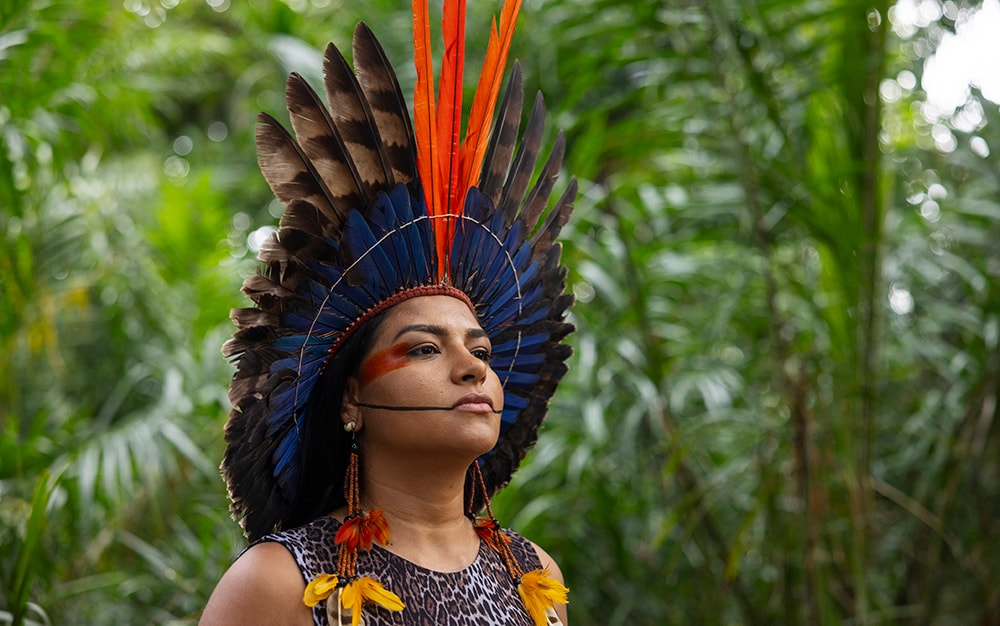
“I’m usually very shy about these things but from the first time I saw her in the helicopter I couldn’t stop thinking about her,” admits Loss. “Three months later I was doing an Ibama operation on land to remove some illegal loggers and I saw a hawk’s nest and I took a picture of it and sent it to her,” says Loss.
“It’s the bird whose feather I wear in my headdress,” interrupts Xipaia, shyly. She admits that she had first met Loss before the helicopter ride, at a meeting, but he was leaving as she arrived. “He shook my hand and I made eye contact with him and something told me – I can’t really explain what – that he was going to be my husband.”
Loss holds a Master’s degree in social anthropology from the University of Brasília and is one of Ibama’s most experienced field agents, yet he spent a good part of his career sidelined by Bolsonaro, who had no interest in protecting the environment. In February 2023, under Lula, he was appointed Ibama’s coordinator of enforcement.
Loss has taken part in hundreds of operations. His job is a dangerous one. We watch him flying helicopters over swathes of forest to spot mines, or patrolling the rivers looking for dredgers. Recently one of his team was killed in an ambush, another got burns over 60 per cent of his body.
Advertisement
Hugo Loss, Xipaia’s husband, on a mission to destroy illegal mining equipment for Ibama, Brazil’s government enforcement agency
Ladkani asked to accompany Loss on a raid. “Hugo told me, it’s too dangerous, the risk of you dying is too high. It’s a small team, and you would be taking the place of a soldier on the helicopter so we would be down one security man, which means our job is much harder, and by the way, if we get into a gun fight, we are not your bodyguards, we are there to finish a job. You would have to save yourself.
“I said, how dangerous is it? And he said, ‘Well, the risk of you dying is 50 per cent.’ I laughed – and then I realised he wasn’t joking.
Advertisement
Film-maker Richard Ladkani in the Brazilian Amazon
Credit: Courtesy of Malaika Pictures
“Of course I had to think about that – I have a wife and two daughters. My wife and I discussed it. She grew up in a war zone in Beirut, so she understands threats, and how you can mitigate risks as well. She is also the producer of this film. We have had a long journey together – making conflict zone films like Sea of Shadows and The Ivory Game was no joke. But this one felt like a different level because of the 50 per cent quote.” He smiles.”‘I did hostile-environment training and we augmented the security to a degree where I felt it wasn’t 50 per cent any more.”
Advertisement
An illegal airbase in the Brazilian Amazon being destroyed
Credit: Courtesy of Malaika Pictures
So Ladkani joined the team, and the resulting episode is terrifying: they are patrolling the river when they find a huge illegal dredger, used for gold mining. They board the dredger, its crew of illegal miners are put in a small boat and dispatched, and Loss’s team set fire to it. Attempting to get away, they realise their boat is still attached to the dredger by a chain, and they have only moments before an oxygen tank below the deck of the dredger explodes. Loss has to shoot the chain, but he has to hit it while it is taut, or the bullet would glance off. “The oxygen tank is steel and if it had exploded we would have been killed by the fragments if we were within 100 metres of that boat – and we were six metres away. It was Hugo who shot the chain – it took 50 shots at least. When Juma saw that footage she broke down and sobbed,” says Ladkani.
Advertisement
Do you like your job? I ask Loss.
He smiles. “Yes I do.”
Back in the 1970s, when two major roads were originally carved into the Amazon rainforest, of which 60 per cent is in Brazil, it opened it up for settlers to devastating effects – the population of the Brazilian Amazon quadrupled and millions of acres of trees were cut down for timber or land clearance and farming, and the rivers became polluted. Thousands of garimpeiros (prospectors) arrived, bringing disease, destruction and violence.
Indigenous people from the Mura tribe in a deforested area inside the Amazon rainforest near Humaita, Amazonas State, Brazil
Advertisement
Credit: Ueslei Marcelino/REUTERS
Despite the protected reserves created by Lula during his first tenure (2003 to 2011), when Bolsonaro took over, he vowed that he would not demarcate a single millimetre of Indigenous land.
There was reason to be hopeful when Lula was re-elected in 2023, especially when he created the Ministry for Indigenous People. But it was an uphill struggle, and Xipaia left the post of State Secretary after about two years, and retired to her territory, where she still is. “She realised that it would be years, if not decades, before change could happen and she felt that her power was with activism from the front lines rather than being in an office in the city,” says Ladkani. “And what really hurt was her children having to grow up in the city and not having the connection to nature that she had.”
Advertisement
Smoke from illegal fires lit by farmers rises in Manaquiri, Amazonas state
Credit: MICHAEL DANTAS
Advertisement
There has been a lot of progress, Juma says, compared to the Bolsonaro years “when it was genocide”. “It is hard to quantify all the changes because even though there was a change in the administration, it is important to understand that the government structure is very colonialist, no matter who is in power, and everything takes time. I entered the ministry when it was just being born.
“It was hard working in an office every day and not spending time with my children, and my son Tuppak [eight] told me that he wanted to go back to the forest, he was having a hard time at school in the city. I did not want to rob my son of that kind of childhood – being in the territory and getting his knowledge from the forest.”
I ask Loss and Xipaia if, with the way things are now, they are more inclined to hope or despair. “Most of the time I don’t think about the future,” says Loss. “I just focus on doing my work, one operation at a time.”
Advertisement
A wildfire consumes land deforested by cattle farmers near Novo Progresso, Para state, Brazil
Credit: MICHAEL DANTAS/AFP via Getty Images
Xipaia thinks. “It depends where I am. When I’m in the forest with my family, there is immense fulfilment which is hard to explain; it gives me the hope and energy to keep wanting to protect it, and I want the whole world to get to know it.
Advertisement
“When I walk through the forest and harvest food there with my family and my people, it reminds me of what my ancestors were doing. The innocence of children, the idea of clean water, food without toxins – this gives me hope.”
“I don’t feel despair,” says Ladkani. “I feel like we’re in a war. There are plenty of good people fighting back, and that gives me hope. And there are lives on the line that we need to care about, which is the indigenous people, who are the frontline of our defence. They are defending nature for us so we need to make sure that they are heard and seen and respected. And we hope that the film puts a human face to that.
“We can’t pretend that destroying the biggest ecosystem on the planet is OK. If we lose the Amazon, we all lose.”
It was a draw that the visitors simply did not deserve. Alvaro Arbeloa and his Cottagers can feel robbed of what would have been their first Premier League victory of the campaign, but in the end, this is what United do, no matter who is in charge. They churn out results. Just how sustainable this can be, remains to be seen.
The past: Harry Maguire
AFP/Getty
Same old story for Man United
Advertisement
Just taking a glance at the United lineup ahead of kick-off would make you do a double take on the date and year you were in.
Harry Maguire at centre-back? We have seen it before. Luke Shaw at left-back? We have seen it before. Bruno Fernandes’ Hollywood switches out to Marcus Rashford, desperately trying his one trick of cutting inside and shooting with his right foot? You get the picture.
You could go as far as to say we have seen the current state of United’s dugout before as well, when Ole Gunnar Solskjaer was installed as the club’s permanent head coach after a stellar interim spell that got the vibes back intact.
But here, the vibes were on the floor. The visitors did not look up for this fight, where they were outpowered, outran, and outbattled across every third of the pitch.
Advertisement
Look at Gonzalo Garcia’s terrier-like runs into the channels, looking to spin Maguire and exploit the England international’s lack of pace. Look at Josh King, demanding the ball between the lines at every opportunity so he could create. Look at Alex Iwobi, smelling blood and fear every time he got near Diogo Dalot.
This is a side that flourishes on the counter-attack, and that has been their problem no matter who is in the dugout. Sir Alex Ferguson would have watched on from the directors’ box in disbelief at the lack of identity.
Struggles: Kobbie Mainoo
Getty
Midfield problems still unsolved
Advertisement
This summer was all about rebuilding the engine room, but even after all the money spent, it was evident that United still have not replaced Casemiro.
Youri Tielemans and Kobbie Mainoo were far too pedestrian in possession, when what United were crying out for was incisive passes into the pockets where Fernandes and Cunha love to operate. The one time they played the ball into Cunha’s feet, the Brazilian span on a sixpence and forced a smart stop from Bernd Leno.
The other outstanding issue in centre-field was the pivot’s lack of defensive awareness. Too many times King, who buzzed about with some fervour, was afforded every inch of space that he craved, and it was his initial burst down the right that led to the hosts’ goal.
He ran off Tielemans and Mainoo as if they didn’t know he was there, while the United duo found themselves outrun and overpowered by the physical Shea Charles and Sander Berge.
Advertisement
This would have been a perfect time to introduce summer signing Carlos Baleba, who was not handed his long-awaited debut despite being named to a United squad for the first time. The Cameroonian could have freed up one of the two – or substitute Mason Mount – to maraud further forward and add extra thrust to United’s attacking moves. Alas, he was not brought on, and that is on Carrick.
Not good enough: Diogo Dalot
Getty
United and INEOS’ transfer strategy has been clear in the last two summer windows.
First, fix the attack. Check, perhaps lacking a left winger.
Advertisement
Second, fix the midfield. Again, a job half-done.
Next year, it will be to sort out the defensive unit. But this performance highlighted just how urgently this squad needs its surgery.
Dalot was a clear weak link at right-back, and it will baffle many as to how he was given the full 90 minutes, while Noussair Mazraoui sat on the bench. If Carrick does not trust the Moroccan, a right-sided full-back has to be an immediate priority.
Luke Shaw was sturdy at left-back on his return, but replacing him with Patrick Dorgu, who is limited as a winger let alone an overlapping wing-back, is not the answer. Newcastle’s Lewis Hall was heavily courted, and should have been signed now. Waiting for the ‘perfect time’ to sign players is what is holding this side back, and is what will keep them plateauing into mediocrity.
German Chancellor Friedrich Merz suffered a bruising electoral setback in two state elections on Sunday, including a historic defeat for his party to the anti-migrant AfD, but vowed to press ahead with potentially painful reforms.
Projections by public broadcaster ARD on Sunday night indicated that Merz’s center-right Christian Democratic Union, or CDU, came in with just 5% in Mecklenburg-Western Pomerania – the lowest result since World War II for the party in any state.
The anti-migration, Russia-friendly Alternative for Germany Party, or AfD, made significant gains. The projections were based on exit polls and partial counting for ARD television.
Merz acknowledged his party’s result as a ‘disaster,’ but struck a defiant note, rejecting any retreat from his government’s reform agenda.
Advertisement
He argued that Germany’s economic and political problems made difficult and potentially unpopular reforms more urgent, not less so, and pledged to press ahead.
‘What needs to be done now requires backbone, steadfastness, and patience,’ Merz said in a statement shortly after the exit polls were announced on public television.
‘I will demonstrate these qualities as chairman of the CDU and, above all, as chancellor of our country.’
In Berlin, projections showed the CDU was to come in second with 19.1%, behind the Left party at 25.3%, according to ARD.
Advertisement
Chancellor Friedrich Merz has scheduled a crisis meeting as results are announced
Voters enter a polling station in Schwerin during regional elections in the northeastern federal state of Mecklenburg-Western Pomerania on Sunday
Ulrich Siegmund, hard-Right Alternative for Germany (AfD)’s main candidate in the Saxony-Anhalt state election, gestures as he addresses supporters at the AfD’s election party following Saxony-Anhalt’s state elections in Magdeburg, eastern Germany, on September 6
Advertisement
Voters cast their ballots at a polling station in the Charlottenburg district during state elections in Berlin, Germany on September 20, 2026
Merz’s authority was already damaged by CDU’s stinging defeat to AfD in the September 6 election in the small eastern state of Saxony-Anhalt.
That result shocked many Germans who had believed their country had developed an immunity to nationalism and assertions of racial superiority after confronting the horrors of its Nazi past through education and laws to outlaw persecution.
On Sunday, AfD also made big gains in both states. In Mecklenburg-Western Pomerania, it garnered 37.9% of the vote, and in Berlin it achieved 16.2%, according to ARD. But it was nowhere close to being able to form a regional government.
Advertisement
AfD’s national co-leader, Tino Chrupalla, told ZDF television that ‘the chancellor’s statement today really was more than feeble – he announced that he’d carry on as before, instead of finally drawing the consequences and resigning.’
However, in an apparent reference to the hard-Right party, Merz said that his government’s reforms would be ‘the antidote to the poison of authoritarianism, which is penetrating ever deeper into our society as the fascination with authoritarianism grows.’
The government’s reforms include cuts to income tax for low- and middle-income families, an overhaul of the creaking pension system and a reduction of Germany’s stifling bureaucracy.
Merz, 70, became Germany’s leader 16 months ago with promises to turn around an economy that has barely grown in years. But he has failed to lift a sullen national mood and become deeply unpopular.
Advertisement
The strong showing of AfD in the Saxony-Anhalt election, where it has the best chance yet of forming the country’s first hard-Right regional government since World War II, had further weakened the chancellor’s standing on the national level as well.
In the past two weeks, there had been calls, even from within his own party, for him to be replaced as chancellor, although no top-level allies have called publicly for his departure, and many warned against ‘personnel debates.’
Philipp Amthor, a prominent CDU figure from Mecklenburg-Western Pomerania who now manages relations between the federal and state governments at the chancellery, said Sunday night that one problem in the campaign had been ‘the difficult personnel discussions’ of recent weeks – an apparent reference to the speculation about Merz.
‘It is good and right for these personnel discussions not to be continued now,’ he said.
Not many people will know this famous Cambridge building featured in the film
Hollywood has been knocking on Cambridge’s door for many years – and that’s no surprise with some iconic sights on offer in the city. The city has featured in some big blockbusters such as The Theory of Everything in 2014, following the life of scientist Sir Stephen Hawking.
Advertisement
Trinity College featured in 2015’s The Man Who Knew Infinity, and Cambridge has also featured in 2018’s Red Joan, starring Judi Dench. One popular film that people may not know Cambridge appears in is a Disney film starring Johnny Depp.
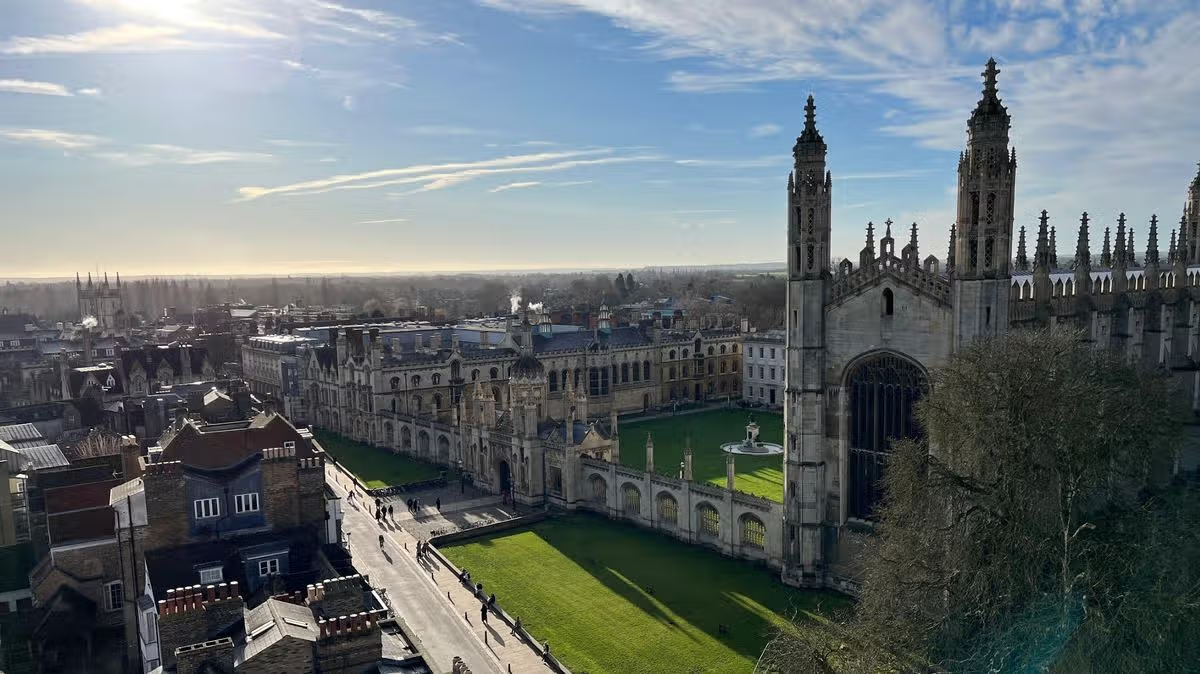
This is of course is the iconic Pirates of the Caribbean, where Depp plays the funny, yet clumsy Jack Sparrow. Part of the fourth instalment of the pirate franchise, Pirates of the Caribbean: On Stranger Tides, was filmed at the famous King’s College in Cambridge.
The Cambridge college is one of the most recognisable in the city, as it features in the famous Backs. Many people would have seen the college’s chapel while on a punting tour of Cambridge.
While On Strangers Tides was also filmed in Hawaii and California, filming took place in the United Kingdom for 106 days. King’s College portrayed 1750’s London in some scenes of the film. Sadly, it’s unknown if Depp actually visited Cambridge during filming.
Advertisement
Other UK locations featured in On Stranger Tides include Hampton Court Palace and the Old Royal Naval College in Greenwich.
As well as Pirates of the Caribbean, King’s College has lit up the silver screen in other films. It played the part of St John’s College in Oppenheimer, starring Cillian Murphy, and the college chapel was in the 1981 Chariots of Fire.
Ed Sheeran says his family has ‘abandoned’ him and that he’s ‘found out who his friends are’ amid the Israel-Palestine controversy that has threatened his tour.
Macklemore was removed from Ed’s tour after US stadium owner Robert Kraft accused him of hate speech during previous support slots in which the rapper called for a ‘free Palestine‘.
But Kraft, who is Jewish, banned him from performing at his Gillette Stadium near Boston, sparking an Israel-Palestine row that has left Sheeran feeling ‘abandoned’ by his family.
Advertisement
The singer struggled to hold back tears on stage last night as he apologised to fans for his handling of the controversy that has threatened to wreck his tour.
He told fans in Philadelphia he wasn’t sure if upcoming dates would go ahead amid the backlash and threats of a boycott against the decision to drop opener Macklemore over the rapper’s support for Palestine.
Sheeran said he had ‘found out who his friends are’, adding: ‘I cannot hide how I feel… any more.’
The singer admitted to making ‘mistakes’ in his handling of the situation and backtracked on his previous vow not to bring politics to his show as he called the situation in Gaza ‘catastrophic and unjustifiable’ and Hamas’s October 7 attacks ‘horrific’.
Advertisement
A visibly emotional Ed Sheeran teared up on stage last night as he apologised for his handling of the Israel controversy that has engulfed his new tour
Ed Sheeran has made his stance clear on the Israel-Palestine conflict after his Loop Tour fell apart amid Macklemore’s ‘Free Palestine’ comments
It comes as the concert was swarmed by pro-Palestine protestors before he took the stage
Advertisement
In his first stage appearance since the Loop tour was plunged into turmoil, the 35-year-old father of two said he ‘never wanted to be an activist musician’ but the fierce criticism meant he has had to ‘take and make difficult decisions’.
He said: ‘I really didn’t know whether this tour would be carrying on. In these situations, you really find out who your friends are and it’s been a weird week. I just feel like it happened very quickly.
‘In the back of my mind, I saw the ticket sales for this gig and I didn’t see cancellations, I saw people buying tickets for this gig.
‘Everyone’s telling me to cancel and I’m feeling all of my friends and family and people I know abandon me.
Advertisement
‘I look at the end of the week and I see 50,000 people who haven’t abandoned me. People will say what they want, but I am doing this for you. I love you. I love this.’
Sheeran said his heart had been broken ‘by the scale of devastation and loss of lives’ and became emotional as he told a cheering crowd: ‘I’m so grateful you are here with me tonight.’
He apologised and became visibly emotional again at the end of the show for bringing politics to his concert – something he had vowed not to do.
Sheeran said at the end of the night: ‘The one thing that I would like to apologise for is the first bit of the show where it wasn’t about music and I had to talk.
Advertisement
Join the discussion
Should Ed have kept politics out of his concerts?
Sheeran returned to the stage in Philadelphia on Saturday night for the first time since 43-year-old Macklemore, real name Benjamin Haggerty, was axed from the tour (pictured together in 2013)
‘I understand that people have children here and I understand that families didn’t buy a ticket to hear that first bit of the show, but that was something I felt like I needed to say.’
Advertisement
Sheeran had previously said that ‘those who come to my shows do not expect a political forum’.
The gig at the Lincoln Financial Field marked the first time the star returned to the stage since the rapper Macklemore was dropped as his opening act after taking a vocal stance in favour of a ‘Free Palestine‘.
In a solemn speech at the start of the concert, Sheeran said: ‘I have tried in my career not to be a political commentator of any kind because I want my music and shows to be about unity and not division, about humanity and not politics. But this is a humanitarian issue and I cannot hide how I feel about it anymore.’
‘What happened in Israel at Nova music festival on October 7 was horrific and compounded centuries of Jewish pain.
Advertisement
‘What is happening in Gaza is catastrophic and unjustifiable and disproportionate,’ Sheeran said in a video captured and shared online by a concertgoer.
‘My heart has been broken by the scale of devastation and loss of civilians’ lives, of children’s lives, and the systemic injustice we’re seeing unfold in the West Bank cannot be overlooked,’ he declared.
Sheeran told the audience that he plans to ‘continue my current tour’ despite each of his openers dropping out in solidarity with Macklemore.
Finneas, Billie Eilish’s brother, pulled out of his scheduled appearances in upcoming tour dates, stating that ‘artists must not be silenced when they speak up for the oppressed’
Advertisement
Activists demanded freedom for Palestine as they gathered outside of Lincoln Financial Field on Saturday night
By the end of the show, Sheeran broke down into tears, telling fans: ‘I’m so grateful. The world is a scary place right now. America is a scary place right now. This gives hope. This gives hope.’
The crowd broke out in applause as Sheeran appeared deeply moved.
‘My shows are about this,’ he said. ‘They are about people coming together that don’t know each other, that have different beliefs. They’re about unity. They’re about love. They’re about family.’
Advertisement
As fans cheered, Sheeran vowed that the controversy would not stop him from performing.
‘You’re jumping around like maniacs with each other and having fun,’ he said. ‘And I will never stop doing this. I will never stop doing this. I love doing this so much.’
It came after Macklemore said Sheeran had spoken to Robert Kraft, who owns Gillette Stadium in Massachusetts through his holding company, the Kraft Group.
‘Ed told me that Kraft said I would not be allowed to perform in his stadium. Ed also told me that Kraft had rallied some of the other stadium owners and collectively they gave him an ultimatum: if Macklemore stays on the tour, you will not be allowed to play in our venues,’ he wrote.
Advertisement
On Tuesday, Sheeran released his own statement on Instagram, saying it wasn’t his decision to remove Macklemore from the tour, but rather the promoter’s.
‘I would never let down the fans who had made plans, nor would I abandon the touring crew and the other support acts and musicians who rely on me for work and to make a living,’ the British singer-songwriter added.
Sheeran said in the lengthy statement that he has ‘personal views on this devastating conflict’, but made the choice ‘not to speak publicly’.
In a furious post on Facebook, he said: ‘Finally it’s all coming out! I’m ashamed of my cousin Ed and what he’s done.
‘Finally the world and all his fans see through him. He’s not a good person, I don’t like his music so I can’t say he’s even a good artist.’
Advertisement
Billie Eilish’s brother, Finneas, pulled out of his scheduled appearances in upcoming tour dates, stating that ‘artists must not be silenced when they speak up for the oppressed’.
Tour openers including Aaron Rowe and the band Lukas Graham, along with Sheeran’s long-time backing folk band Beoga, also withdrew from the endeavour.
In his address to fans on Saturday, Sheeran stated: ‘I’ve had to take and make difficult decisions, and I am making mistakes, and I’m so, so sorry.’
He said: ‘I don’t want to disappoint fans and I’ve never wanted to be an activist musician. But this has put me in the middle of an important and passionate argument about freedom of speech in the most complex political issue on the planet.’
Advertisement
The pop star continued: ‘Our concerts have always been a safe space for everyone, and that matters hugely to me. Honouring my commitment to my fans is also completely central to who I am and that is why I’m here tonight, on my own, and continuing my own tour.’
He went on to say: ‘I am deeply worried about the idea that venues pre-approved content performance. This happens in so many places that I’ve gone around the world, but it should never happen in the free world.’
You could easily walk past and just think it was a normal terraced home
Cambridge is one of Britain’s tourist hotspot, with lots of different places for people to visit. The university colleges are a top choice, but there are also a wide range of museums.
Advertisement
These attractions are not hard to miss, but there is one Cambridge attraction that’s hidden in plain sight. Walking down Gwydir Street, people will be faced with terraced houses.
What some people might not know is there is a museum hidden with one of these terraced houses. This is the David Parr House.
This “ordinary Cambridge terraced house” was home to Victorian working class artist David Parr and his family for more than 125 years. The house is a “rare survival of arts and crafts workmanship in a modest domestic setting, layered with 20th century social history”, as stated on the David Parr website.
David Parr worked for a Cambridge firm of artworkers known as F.R. Leach & Sons. He hand-painted houses and churches.
In 1886, he bought 186 Gwydir Street and decorated the home over the next 40 years. He decorated it by lamps and candlelight in the style of grand interiors he decorated through work.
When he died in 1927, his home was passed down to his granddaughter Elsie Palmer. She lived in it for over 85 years. Today, the house is open to the public for people to visit.
There are a range of guided tours, workshops and events held at the house. If people want to visit, it costs £15 for people to visit without a guided tour, and £20 with a guided tour.
Advertisement
The house is open on Thursdays, Fridays and Saturdays from 10am until 5pm.
Beyond Brighton pier, several dinghies were having a glorious day, scudding over the waves.
Things were a touch bumpy, too, inside the grim concrete conference centre where the Lib Dems had gathered. The head of Devon County Council gave his opinion of party leader Sir Ed Davey – and it was not pretty.
Sir Ed had ‘allowed other parties to go steaming past us,’ griped Devon’s Julian Brazil. ‘We seem to be peripheral. We’re lacking ambition, we’re lacking courage, we’re not saying things that people can relate to.’
Welcome to conference!
Advertisement
Have the ineffably patient Lib Dems finally twigged that 60-year-old Sir Ed is a bit of a fool?
After the conference’s three-hour lunch interval – three hours, and they don’t even drink – Sir Ed did a question-and-answer session chaired by former Radio 4 journalist Carolyn Quinn. She raised Mr Brazil’s fears that the party was ‘sleep-walking into irrelevance’ under him.
Sir Ed, whose whole strategy is built on sucking up to Labour in the hope that he might become deputy prime minister in a future coalition, did not particularly want to slag off the Government, writes Quentin Letts
Advertisement
Sleep-walking into inaudibility, too. Sir Ed’s microphone was not working properly.
A tech bod had to creep on stage to pass him a hand-held mic which didn’t pop.
Once Sir Ed could be heard, he replied that he had known Mr Brazil for years, the unspoken suggestion being that Mr Brazil had always been a difficult beggar. Davey called him ‘a good local councillor’.
Translation: Stick to Devon issues, matey, or I’ll encourage your local colleagues to boot you out of your job. This was heard in silence by a hall that was not full.
Advertisement
Guest interviewers at party conferences are not expected to be especially rigorous, but Quinn did not give Sir Ed an easy time. She brought up Labour’s rumoured plan to impose the mansion tax on houses worth a mere £1.5million and noted that Sir Ed’s constituents in prosperous Kingston upon Thames would be ‘very interested’ in that.
Sir Ed, whose whole strategy is built on sucking up to Labour in the hope that he might become deputy prime minister in a future coalition, did not particularly want to slag off the Government. He therefore resorted to moaning about Brexit. That drew, as it always does from Lib Dems, a few warbly cheers.
Quinn upbraided Sir Ed for retreating into comfort territory and instead asked him if he wanted to keep the pensions triple lock. He did, but an apparent majority of hands in the hall did not agree with him. Oops. This was becoming awkward.
Sir Ed, pain corrugating his forehead, said it was plainly a ‘controversial matter’. You could sense the snowy ancients in the hall thinking: ‘He’s a stodgy bore and not even a stodgy bore who agrees with us. Councillor Brazil has a point.’
Advertisement
Other Lib Dem grandees, if one can use that noun, had sniffed this simmering dissent.
Daisy Cooper MP gave the morning’s main speech and she was dementedly energetic, throwing her arms around, striding about the stage, flashing her gnashers, bouncing up and down, shaking her shoulders as if at a disco, and more.
It was not so much a political speech as a Zumba routine. Has gabble-prone Cooper, who radiates all the gravity of a TV gameshow’s scoreboard operator, worked out that a leadership election may soon arise?
Little Josh Babarinde MP, the party’s president, was also making himself very obvious, striding about the conference centre with a floppy-haired assistant in tow.
Advertisement
Wasp-waisted Mr Babarinde came over all macho and said: ‘We’ve got to flip the table over and rise up!’
My, my, such bar-brawl talk from one so weedy. He looks as if he could barely flip a beer mat.
Ms Cooper, like Sir Ed, kept talking about dismantling Brexit. It’s their go-to response when they have nothing else to say.
She managed to get through her ‘keynote’ speech on the economy without mentioning welfare spending or defence budgets.
Advertisement
Instead, she bellowed about reducing regulation on businesses. That would be a splendid idea, no doubt, but the Lib Dems have seldom seen a regulation they did not like.
Two stars from Call the Midwife and House of the Dragon are partnering up on the stage for a lavish new production at The Lowry theatre of a classic musical that’s been hailed as a ‘cocktail of romance and charm’.
Fresh from a record-breaking summer season at London’s Barbican Theatre, High Society has been hailed as a ‘glittering’ new take on the popular 1956 film of the same name, originally starring Bing Crosby and Grace Kelly.
The musical follows an Oyster Bay socialite who plans to wed a pretentious executive when her ex-husband returns onto the scene. It will star Helen George, who plays Trixie Franklin in Call The Midwife, and Freddie Fox, who currently stars as Gwayne Hightower in Game of Thrones prequel House of the Dragon, in the lead roles.
Click here for the latest on Manchester’s food & drink scene, gigs and more in our CityLife newsletter
Advertisement
The musical, which features classic Cole Porter songs including Who Wants To Be A Millionaire, Let’s Misbehave, and You’re Sensational, will be performed at The Lowry on a two-week run from September 22 to October 3 (tickets here), and Helen and Freddie both say taking part in the show is a moment they’ve both been longing for.
“I grew up listening to all the greats like Ella Fitzgerald and Frank Sinatra singing those wonderful Cole Porter melodies,” Helen explains. “Doing this show is really special for me because this is the music that I grew up with and sang along to.”
“I’ve been building up to this since the age of four when I saw my first musical at the National Theatre,” Freddie says as he recalls seeing Guys and Dolls on the stage at a young age. “I absolutely loved it, I learned all the words to all the songs and I sang them to anyone who would listen for a good few years afterwards.
“It’s what started my obsession with musicals and I later became besotted with Cabaret and The Producers, so finally getting to star in one now on stage is the realisation of a boyhood fantasy.”
In the production, Helen, who previously appeared on Strictly Come Dancing back in 2015, takes on the role of Tracy Lord, who the actress describes as being a bit of a ‘White Lotus’ level of appeal to her.
“She’s a very interesting character,” she explains. “One of my first questions was ‘Why would we care about her?’, because on paper she’s got it all. She lives in this fantastic house and there’s so much wealth behind her, but ultimately it’s a story about human relations and Tracy is trying to control her life in the best way that she can.
Advertisement
“It’s a bit like The White Lotus because everybody’s in this world of wealth and fabulousness, and how can we relate to that? But actually we can’t take our eyes off them and there are really relatable themes about love and pain amidst all the fun and fantastic songs.”
Helen adds: “I think what’s interesting about her is that she’s a divorced woman in 1951, which is rare and actually quite brave. It’s interesting to explore the fact that she’s free and independent and only needs a man for love, not money.”
Freddie, meanwhile, will play the sharp-eyed tabloid reporter Mike Connor, who is constantly hunting for scandal and heads to the Oyster Bay house for hopes of his next big scoop. “He’d like to think of himself as a socialist, but he’s probably more of a champagne socialist, to be honest,” Fox laughs.
Advertisement
“He’s a sort of middle-class intellectual and a very good writer, but he has only ever written one book that nobody read, so he has to make money as a journalist – which is something that he hates doing but it pays the bills.
“When he arrives at this fancy-schmancy house in Oyster Bay he’s thinking ‘These people are going to be completely ghastly’ and decides that he wants to hate them all on principle, but then he gets lured by the high society spell.”
Asked if he has any comparable features to the role of Mike, Freddie laughs again as he says: “Well, apart from being slightly left-wing and liking champagne, not really!”
Advertisement
The show comes at a special time of year for Helen, who would normally be on set filming Call The Midwife. However, following its recent 15th series, bosses of the popular BBC show confirmed it was on a hiatus but reassured fans it had not been cancelled. Helen says she is sure she will be back on the show soon enough.
“It’s weird not seeing my friends in the cast [right now],” the actress explains. “Call the Midwife is always going to be a part of me and I hope in my future as well. I’m hoping that my time as Trixie hasn’t come to an end just yet.”
Both Freddie and Helen say the fact that High Society is touring the country following its run in London is essential for audiences across the country to be able to get the same offering and level of shows as those living in the capital.
Advertisement
“Without getting on my soapbox, I think touring productions are so important,” she stresses. “I grew up in Birmingham and I saw so many wonderful touring shows, and that’s what made me want to do what I do now.”
Freddie adds: “Taking a show out of London is what it’s all about for me. Theatre should be for absolutely everybody and I think now more than ever – as we face a kind of technological revolution, the effects of which we can’t quite predict, what with AI and the like – theatre is more important to us than perhaps it ever has been in our history.
“Taking a show on tour and giving people a great night out is just one brick in that enormous wall.”
With a book by Arthur Kopit, High Society will feature a multi award-winning creative team behind it, including renowned director Rachel Kavanaugh and Mamma Mia! choreographer Anthony Van Laast. It will also feature gorgeous costumes designed by Jon Morrell, which is something Freddie is especially excited about.
Advertisement
“The costumes are extraordinary and audiences will leave the theatre feeling like no expense has been spared on making it a truly massive musical extravaganza,” he states.
Both performers say they are excited to get onto the Salford Quays stage for the adaptation of High Society, and say they expect it to be a real slice of very-much-needed escapism for audiences right now.
Helen said: “I come out of the theatre, then I listen to the news and think ‘Oh God, I’m so glad that I’m doing High Society, not something that’s sad or political in any way’.
Advertisement
“This is exactly the sort of show that we need right now, and I think that theatre really comes into its prime when the world feels uncertain – especially with a musical that’s as much fun and as lively and joyful as this one.”
High Society will be at The Lowry from September 22 to October 3. Helen George will not appear in the September 25 and 26 shows. Tickets here.
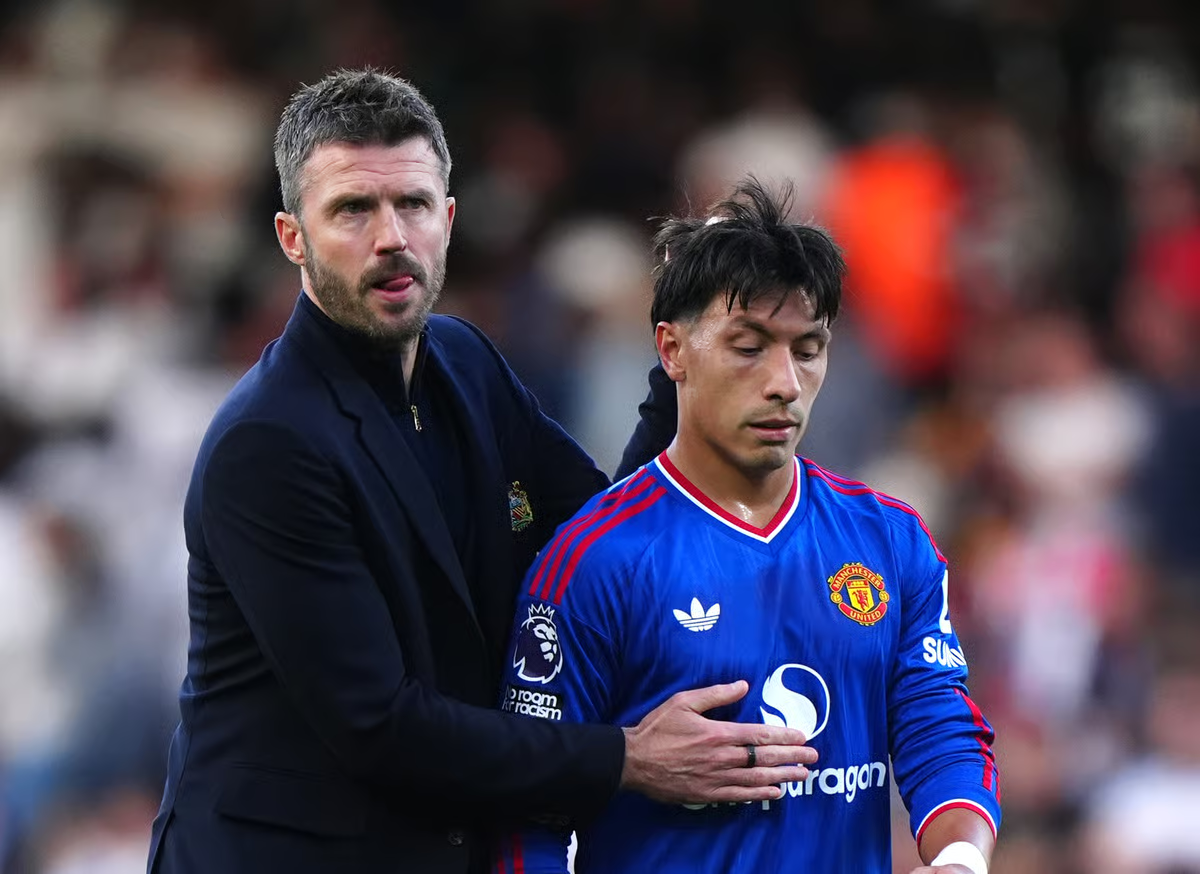
Carrick, who is feeling the heat after a winless run of four games, welcomed back Luke Shaw from injury at left-back after the England international’s spell out with a thigh problem, while summer signing Carlos Baleba was amongst the substitutes for the first time since his move from Brighton, having arrived at Old Trafford with a pre-existing ankle issue.
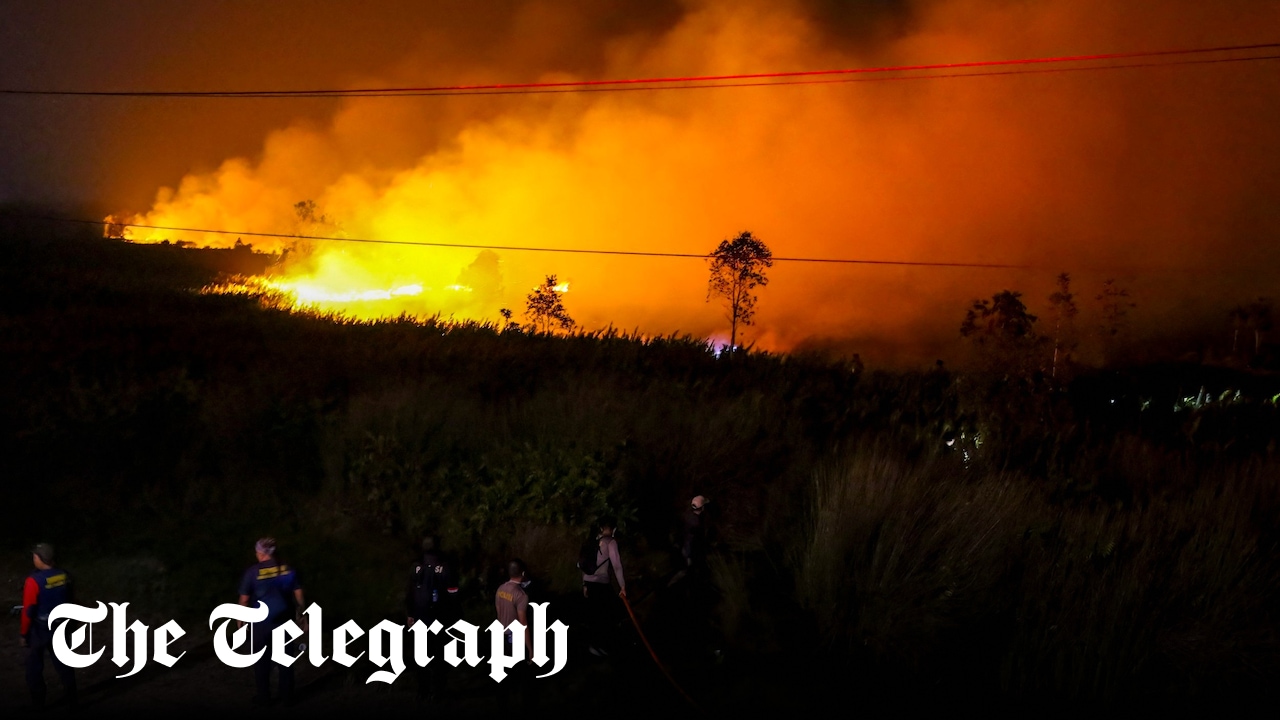
Indonesia is home to about 36 per cent of the world’s tropical peatlands, and the degradation and draining of these landscapes has worsened the situation. When parched, the peatlands can burn for weeks, releasing more toxic fine particulate matter and carbon than tropical forest fires.
The El Niño, which typically brings hotter, drier weather to Southeast Asia, has exacerbated the situation.
“Indonesia is only about three weeks into its fire season, but we’re seeing fire activity track sharply upward, similar to 2015,” Robert Field, a Columbia University researcher, told NASA Earth Observatory. “The strong El Niño is making the dry season drier over the fire-prone parts of the country and exacerbating burning.”
Advertisement
On Thursday, the World Meteorological Organization (WMO) warned there was almost a 100 per cent chance the weather phenomenon will continue through to February – the strongest level of certainty it has ever given in an El Nino/La Nina update.
“If this trajectory continues, it may be stronger than anything since our monitoring began – so literally off the charts we have used for the past four decades,” Celeste Saulo, the WMO Secretary-General, told reporters in Geneva.
Associate Editor Tom Bryant falls in love with the charismatic five new Strictly professionals – who reveal all about joining the biggest show on TV
Following the biggest shake-up of Strictly’s professional line-up in years, five new dancers have been thrust into the limelight. And after spending time with all of them, I suspect that winning over viewers will be the easiest routine they learn all year.
Advertisement
There is 22-year-old Ukrainian Aleksandra Isaeva – a hilarious force of nature who her new colleagues describe as “a firework”. Then there is fiercely bright South African Lethabo Monametsi, 23, deep-thinking Italian Cristian Priori, 34, and laid-back Canadian Mark Karmalita, 23, whose new colleagues already predict will become something of a Strictly heartthrob.
And for 21-year-old Brit dancer Maddie Ingoldsby, who is paired with Love Island’s Cach Mercer, joining the show is a lovely full-circle moment.
“Shirley [Ballas] used to actually be my teacher,” Maddie laughs. “It’ll be like going back to when I was younger.”
Head judge Shirley has coached many of the pros over the years, and Maddie knows from experience exactly how demanding she can be. “She’s like my strict dance mum… I’ll just be trying to get it perfect for her,” she admits.
Advertisement
Viewers will instantly warm to Maddie. But the Bournemouth dancer still seems slightly bemused that any of this is actually happening – and reveals that she initially ignored the email from producers asking to meet her.
“I thought it was spam… I didn’t think it was real,” she smiles. “It’s very weird. I don’t believe it’s real right now. “I’m, like, ‘Oh, am I really going to be on TV tomorrow night?’”
Maddie’s CV suggests she has little reason to be daunted. She is a UK National Ballroom Champion and eight-time Amateur 10-Dance World Champion who has also been crowned World Rising Star and Under-21 World Ballroom Champion. The others arrive with equally formidable dance backgrounds.
Advertisement
Aleksandra is a multiple Ukrainian National Latin Champion, and is ranked among the world’s top 21 Latin dancers. Her dance partner Cristian is a four-time Italian Latin Champion, while Canadian Mark is a two-time National Latin Champion.
Lethabo, meanwhile, is an undefeated South African Latin Champion – and also has a Bachelor of Arts degree with a Law major from the University of the Witwatersrand. “She is super smart… any interview with her should be at least three hours long as she is so knowledgeable,” Aleksandra says.
Lethabo also says that when she got the call from Strictly, she had to swear her family to secrecy and “there were tears, including from myself”. She first fell in love with dance after watching the South African version of Strictly Come Dancing.
Lethabo says: “My dance journey started because of Strictly, and then to come all these years later and find myself entering Strictly, it was just… ‘I can’t believe this is happening’.”
Advertisement
Cristian and Aleksandra both teach at a dance studio in Italy and had to sneakily arrange replacements without telling their students where they were going. Cristian says: “We had to keep it secret from them ‘til the last moment before we did a call with everyone. They were delighted for us, and gave us a cake with our picture and Strictly on. It was very moving.”
Mark had been teaching in Toronto and found himself having similarly mysterious conversations. “I had to keep it, like, ‘Guys, I have to leave, but I can’t tell you where and why’,” he says. “Everyone was trying to guess. Then when the news came out, it all made sense.”
There is one thing Mark’s fellow newcomers think he may be rather less prepared for, though. “When we go to Blackpool, all the girls will be screaming his name,” Aleksandra laughs, calling him “the cutest boy”. And Cristian agrees, joking: “I think he will steal the hearts not just of teenagers, but also all the mums of England.”
Advertisement
Mark, who is paired with Olympian Tabby Stoecker, is rather more bashful about the prospect of becoming a sex symbol, though. “I don’t want to say that’s going to happen,” he laughs.
“I appreciate the compliment, but I don’t know. I’m just going to try to be the best version of myself. Whatever happens, happens.”
The five newbies have already had their first taste of the showbiz world, joining the rest of the Strictly cast at the National Television Awards as the show picked up another prize. But anyone thinking they stayed up celebrating into the wee small hours would be mistaken.
“We didn’t join the party because the day after it was a very early morning call at the studios and we had to record,” Cristian says.
Advertisement
But Mark adds: “I actually got to meet Gordon Ramsay. I thought that was really epic.” And for Aleksandra, Strictly also gives her a platform to talk about where she comes from. She says: “Ukraine is everything to me: it’s my identity, my blood, my DNA. For four years, we haven’t had much good news, but I’m so grateful to be able to share my love for dance while also sharing the Ukrainian roots and the place I come from.”
All five dancers are also prepared for the inevitable moment Craig Revel Horwood delivers one of his less-than-complimentary verdicts.
“The competitive dance world can be cutthroat,” Lethabo says. “You get accustomed to learning to take criticism and learning to take any form of feedback and understanding that it’s not personal.”
Maddie agrees. “I’ll always take it…even if it’s grumpy and grouchy, and Craig saying, ‘That was awful, darling’.”
Advertisement
And if viewers want an idea of quite how excited the newcomers are, Aleksandra probably sums it up best. “Imagine how planet Earth was created,” she said. “This is bigger.”






















































You must be logged in to post a comment Login