

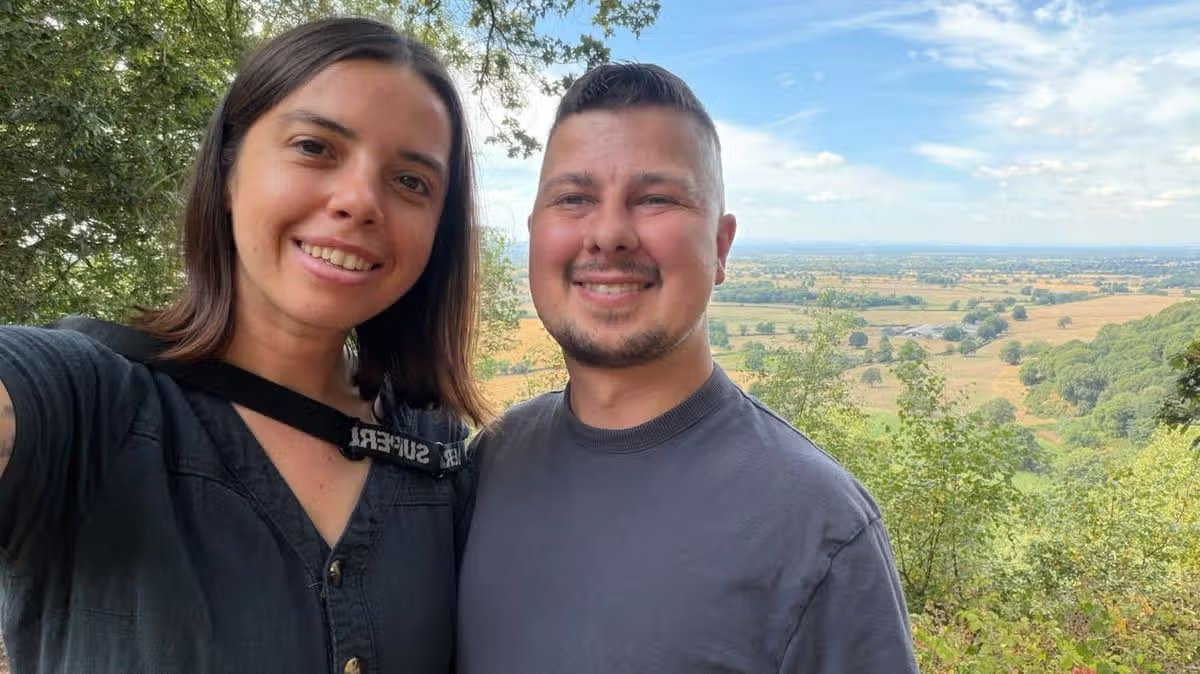
An oncologist told the couple that had they not returned to hospital when they did, Joshua Smith may not have survived another two or three months
A Welsh woman says her husband’s agonising headaches and unusual symptoms were initially “dismissed” by doctors, before a scan revealed a 4.5cm brain tumour. Now, as Joshua Smith battles aggressive glioblastoma, the couple from Wrexham are campaigning for better access to clinical trials and treatment in Wales.
2026 was meant to be their year. After meeting on a dating app a decade ago, building a life together, getting married in Scotland and spending weekends exploring Wales in their newly renovated camper van, Kelly and Joshua Smith were ready for their next chapter. They had their two dogs. They had their home. Next they wanted to start a family.
“This time last year, I was looking forward to the possibility of having a family,” Kelly, 33, said. “Having a little baby. But our plans were turned upside down.”
In January, 34-year-old Joshua started to experience strange symptoms. It started as something of a brain fog. Feeling spaced out. Then came a strange tingling sensation down the left side of his body. But, things took a real turn when he developed a migraine so severe that he told Kelly it felt as though “his head was going to explode”. It lasted for 10 days.
“We went away in our camper van one night during those ten days and he was literally crying because of the pain,” she recalled. “That’s when I knew – something is seriously not right here.”
Kelly, who is a nurse, pushed Joshua to see his GP; however they were reassured that there was nothing seriously wrong.
“I remember saying there were red flags,” she said. “Josh hadn’t been to the GP since 2009, and for him to have 10 days of migraines just wasn’t normal.”
Kelly flagged these concerns to the doctor, pushed for blood tests and said they would seek private medical care if they had to. Instead, Joshua was referred to an optician.
The checks came back clear but Joshua’s pain did not. The migraines continued.
And then they became unbearable.
“He just kept saying his head was going to explode,” Kelly said. “Then while he was in work, he phoned me and said he didn’t feel right so I said – ‘That’s it. We have to go to A&E.’”
At hospital, Joshua was assessed and given morphine before being sent home, according to Kelly, with advice to return if his condition became worse. But in the early hours of Saturday morning, Kelly’s instincts told her they needed to go back.
“By 3am, I just knew something wasn’t right,” she said. “I can’t explain it. I think, being a nurse myself, it was just instinct. Josh even tried to go to work, but I said: ‘No, we’re going back.’”
This time, doctors carried out further tests, including a CT scan.
However, nothing could have prepared them for what that scan had found. “They pulled us into a room as a family and told us they had found a 4.5cm mass on his brain.”
In an instant, the future they had been planning seemed to disappear.
Joshua struggled to comprehend what he was being shown. “I think Josh thought it was just a smudge on the screen,” Kelly said. “He asked if doctors were sure they had the right person.”
But Kelly knew immediately that the scan was showing an abnormality.
Following this, Joshua remained in hospital and they were lifted up by the possibility that the mass was not cancerous. “They told us it wasn’t cancer, they thought it was some kind of infection,” Kelly claimed. “That gave us hope.”
But that hope lasted just 24 hours. The following day, the couple were given devastating news.
“They came to us and said, ‘We are sorry – it looks like glioblastoma.’ We were like, ‘What’s that?’,” she recalled. “That’s when they said ‘glioblastoma is an aggressive brain tumour….with not a great outcome’.”
Glioblastoma is a grade 4 brain tumour that tends to grow quickly and infiltrate surrounding brain tissue. Even following treatment, it can return.
For Joshua and Kelly, the word itself was almost impossible to process. “To hear that after being told that it was likely not cancer… that was devastating,” Kelly said. “It felt like we’d been lifted up and then completely crushed.”
The couple knew only one person who had publicly spoken about having glioblastoma – Tom Parker, the singer from The Wanted, who died from the disease in 2022.
“You never think it’s going to be one of your own,” Kelly said. “That something like this could happen to you.”
Despite the gravity of the diagnosis, the couple powered forward – with Joshua determined to remain positive about the situation. They travelled to The Walton Centre to meet a surgeon, where Joshua was given three options. They could leave the tumour where it was. They could take a biopsy. Or they could attempt to remove as much of it as possible.
They chose the third option.
Joshua signed consent forms acknowledging the risks of major brain surgery – including death, paralysis and the possibility that he could be left significantly changed afterwards.
The operation was scheduled for Tuesday, February 24.
“It was a rollercoaster,” Kelly said. “One week we didn’t even know he had this in his head – the next he was having major brain surgery.”
The operation lasted around two to three hours, with surgeons removing approximately 95% of the tumour, according to Kelly. However, in the middle of one of the darkest periods of their lives, came a moment of unexpected normality.
Kelly had returned home to let their dogs out when her phone rang. It was the theatre nurse. Joshua had woken up… and he wanted KFC.
“He was demanding a KFC… a bargain bucket,” Kelly said with a laugh. “I had to get one of them on speed dial.”
Within three days, Joshua was home; for Kelly, seeing him walking and talking so soon after brain surgery was extraordinary. “It’s incredible that someone can have brain surgery and be up, walking and talking within 24 hours,” she said. “But in a weird way, I also think that almost makes it harder to process, because everything feels so normal when it’s not.”
But Joshua had made his position clear from the beginning.
“He said he will never give up,” Kelly said. “He has always been strong in that. He’s very brave.”
This mindset would be crucial in the period that followed, as Joshua began six weeks of intensive chemotherapy and radiotherapy at Glan Clwyd Hospital in April.
Every day meant a journey of around an hour from home, with radiotherapy sessions just 15 minutes at a time. Kelly arranged appointments in the morning to make sure Joshua had to get out of bed and keep moving, even on days when treatment made doing so difficult.
“He did amazing, to be honest,” she said. “He showed up every day.”
But then came one of the most terrifying moments of the journey. Joshua was at home when he told Kelly he didn’t feel right. The next moment, he was staring at her.
“I said ‘Josh, can you talk to me?’ And then he just went into this seizure,” Kelly shared. “That was the most frightened I had been – I thought I was going to lose him.
“I put him into the recovery position but he was in the seizure for 12 minutes. He went to A&E after that, but was discharged the next day and went for radiotherapy again. It was like a vicious cycle.”
During this, the couple began looking at clinical trials and Joshua was put forward for a treatment called Optune, available in Clatterbridge, England. But there was a condition: he needed a stable scan to be eligible.
After completing radiotherapy and chemotherapy, Joshua underwent an MRI, however the scan showed slight progression; meaning he could not enter the trial.
“It was devastating to learn that,” Kelly said. “You get your hopes up and it feels like all that we’ve had is bad news.”
Joshua was transferred back to Glan Clwyd, where he underwent two further cycles of chemotherapy. Then another scan brought more difficult news.
There had been further progression. Stay informed on the latest health news by signing up to our newsletter here
“It was one thing after the other but then we were told about another a trial… this time in Cambridge. We had a meeting with the specialists based there and they went through the side effects of this trial – one of the major effects being, Josh could lose all of his vision.”
This side effect – paired with the fact that the couple would have to drive three hours there and three hours back, four days a week – led them to decide against it.
“It wouldn’t have been a good quality of life,” Kelly said.
As a result, Joshua is now having even stronger chemotherapy treatment – however if this does not work, the couple may have exhausted the options available to them through the NHS.
“We have explored alll treatments on the NHS and they wouldn’t be able to offer anything else, which is why we set up the GoFundMe page,” Kelly shared.
“I never thought we’d do something like that – we aren’t the type of people to ask others for money but we’d soon be having to look at going private or trials abroad which costs a stupid amount of money.”
The couple don’t know exactly what treatment might come next, but they want to be prepared. “If there comes a time soon where we have to look elsewhere, at least we know that the money is there to do that,” she added. The GoFundMe can be found here.
Researching clinical trials, genomic testing and treatment options, also made the couple increasingly aware of what they believe are gaps in access to treatment and research opportunities for patients in Wales.
“When Josh found out he had further progression, he said, ‘Even if it’s not for me, I would like change for the future and help families in the future who may have to go through this,’” Kelly said. “So he has put all his efforts into trying to make a change.”
The couple began working with Brain Tumour Research and became involved with its work around brain tumour treatment and research in Wales.
Among the priorities highlighted in the charity’s Welsh manifesto are increasing access to clinical trials, making trials available more widely across Wales and improving access to genomic testing.
Indeed, Joshua has undergone genomic testing himself, and Kelly believes the results have influenced which trials have been open to him. “If that was given to everybody, that would make things so much easier,” she said.
This week, Kelly and Joshua were invited to the Senedd with Brain Tumour Research to speak to a Senedd member about the issues they have experienced.
For them, it is another step in a campaign they never expected to be fighting.
“Trying to make a change is keeping Josh here,” she said. “I think it would be so easy for him to go into a downward spiral, but he’s choosing not to.”
For Kelly, Joshua’s story also carries a message for anyone who feels that something about their health is not right.
“Listen to your body,” she said. “We always say that if anybody feels something’s not right and they’re not themselves, then go to the GP or take yourself to A&E.”
Kelly says Joshua’s oncologist told them that, had they not returned to hospital when they did, he may not have survived another two or three months.
“That really puts things into perspective.”
But Kelly refuses to let a prognosis become the entirety of Joshua’s story.
“Accept the diagnosis, not the prognosis,” she added. “I say to Josh – I could go out tomorrow and get hit by a car. You never know what lies ahead. Just take every day as it comes and make it count… I say that to people who aren’t even going through what Josh is.”
And that is what they are doing; they are still travelling when they can; they are still spending time with their dogs; they are still making plans where possible.
And they are still holding onto the ordinary moments that existed before the diagnosis.
The support from family, friends, colleagues and strangers has also become a source of strength. One woman even gave the couple tickets to watch Wrexham play – something Kelly says has been one of Joshua’s biggest wishes.
“Honestly, everyone’s kindness has blown us away,” she said. “We have been so lucky to have amazing people around us, from our family to our work family to strangers. Thank you to everyone who has supported and donated to the page. It has been overwhelming, and meant the absolute world.”
The future they imagined at the beginning of the year may look very different now but Joshua’s fight has not stopped. Neither has Kelly’s.
And alongside the treatment, the fundraising and the campaign for change, there is still the life they are determined to live, one day at a time.
“Joshua’s story is still being written,” Kelly said. “And we’re holding onto every bit of positivity we can.”
For more information on the Brain Tumour Charity, click here. To donate to Josh’s GoFundMe, click here.
















































You must be logged in to post a comment Login