DVLA update on ‘invisible’ number plates evading speed cameras – key details | Wales Online
Need to know
The Department for Transport has issued a new update on the plates
(Image: stocknshares via Getty Images)
What you need to know as DVLA struggles to tackle number plates crisis
The Department for Transport has revealed that just 13 DVLA staff are tasked with monitoring nearly 35,000 number plate suppliers amid a growing crisis with ‘ghost plates’ that help criminals evade detection.
A parliamentary report found that as many as one in 15 vehicles on British roads have altered, non-compliant plates that are invisible to police Automatic Number Plate Recognition systems.
The All Party Parliamentary Group for Transport warned that “the UK’s outdated and poorly regulated number plate system has created a vast and rapidly growing crisis that enables criminals and organised crime groups to operate undetected on our road network.”
A former police officer told the BBC that ghost plates have been used by people linked to “violence against young women and girls, people smuggling, drug smuggling and other forms of organised criminality.”
The Royal College of Policing noted that vehicles with ghost plates “were found to be involved in armed robberies and burglaries, used by sex offenders or involved in road traffic collisions.”
Councils are now introducing new technology to combat the problem, with enforcement officers being provided with specially developed cameras designed to detect the elusive plates.
Drivers caught using these illegal plates could face a £100 fine as authorities crack down on what experts describe as a ‘staggeringly simple’ system to fool.
Mike Carr, 58, from Northallerton, was diagnosed with an inoperable brain tumour after doctors initially blamed his symptoms on a trapped nerve.
As he awaits another scan, friends and family are raising money and awareness with Hadley’s support.
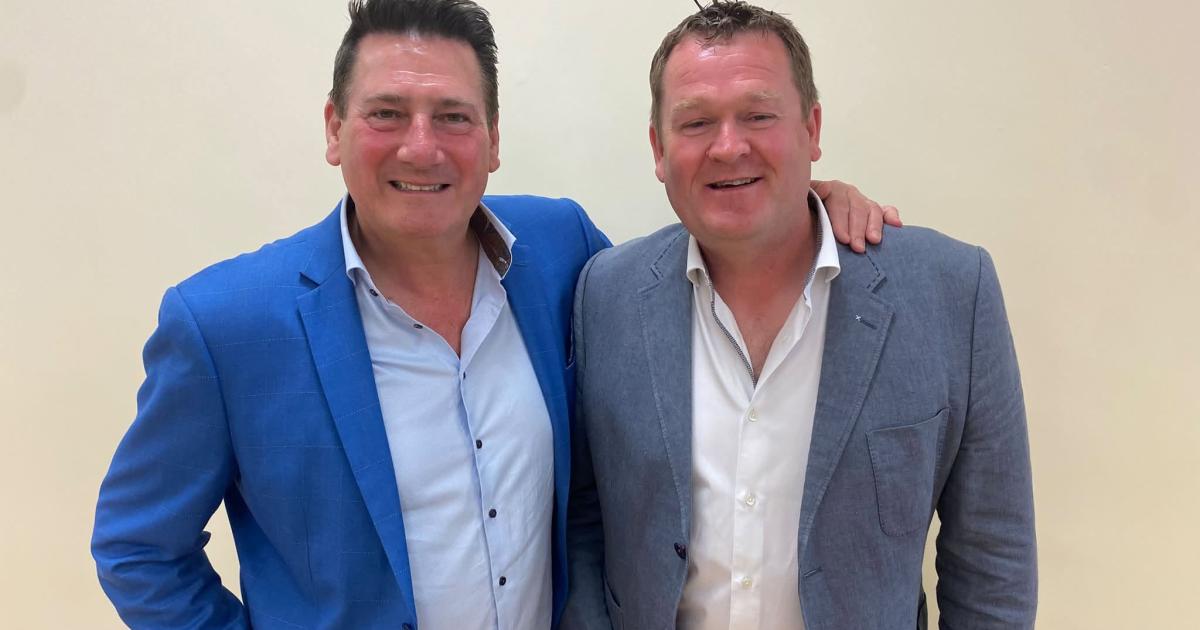
Mr Carr has followed the singer since 1983 and says his lifelong passion began when they met after a 1998 concert at Tall Trees in Yarm.
Mike Carr and Tony Hadley. (Image: MIKE CARR)
He said: “I ended up sat at a bar with him after the gig and that became my new hobby.
Advertisement
“I’ve been all around the country all my adult life watching him sing in front of crowds of 50 people or brilliant sold-out shows at the O2. It’s been an important part of my life.
“When I was diagnosed with my illness, I reached out to him to help with this event and I was one of the few people he couldn’t say no to.”
(Image: MIKE CARR)
Mr Carr’s symptoms began at home in December last year.
He said: “I went to make a cup of tea and my right elbow froze and my hand started shaking.
Advertisement
“I went to the doctor the next day and they sent me to physio. I had three sessions and they diagnosed it as a trapped nerve.
“In the new year, after we thought we’d fixed it, it happened again.
“I made another appointment to go to the physio but then I had a really violent attack when I visited my mum in her care home.
“My brother took me to hospital and three hours later I was told it was a brain tumour.”
Advertisement
The diagnosis came as a shock.
“It wasn’t something I was expecting,” he said. “It absolutely threw me.
“The cancer I have is the most aggressive form of cancer and people usually only live for 12 to 18 months.
“There is a small minority of people who can live for another five years.
Advertisement
“There is hope.”
Mike is determined to stay positive.
He said: “We’re putting a positive spin on it and fighting the good fight and keep fighting.
“I’m very blessed. I’ve got lots of good people around me to help raise money and awareness.”
Advertisement
(Image: MIKE CARR)
The fundraising show takes place at The Forum in Northallerton tomorrow, Wednesday, September 23.
Doors open at 6.30pm and Tony Hadley takes the stage at 7.45pm.
Tickets cost £75 and organisers say only a handful remain.
The fundraiser is expected to draw fans and supporters from across the region while raising vital funds and awareness for people living with brain tumours.
“It’s about raising awareness as much as anything,” he said. “The support I’ve had has been incredible.”
Welsh rugby may be going through a difficult period, but there is a growing emphasis on investing in the pathway and developing the stars who could shape its future.
With the 2026/27 United Rugby Championship season getting under way this weekend, a new generation of Welsh talent will be looking to make its mark.
Here are the 20 Welsh players aged 21 and under to watch this season.
20. Alfie Prygodzicz
The 18-year-old backrower was outstanding for Wales U18s in the U18s Six Nations Festival in April.
Advertisement
Prygodzicz is a powerful carrier who is extremely physical while also effective at the breakdown.
He is a player both Cardiff and the Wales age-grade coaches are excited by.
The Bristol Bears academy lock enjoyed a fine season for Wales U20s.
Advertisement
Williams is an excellent lineout forward and is extremely athletic.
He will have to bide his time at Bristol but he has a big future ahead of him.
18. Evan Minto
The 20-year-old backrower has been a model of consistency for Wales U20s over the past couple of seasons.
Minto had his fair share of senior minutes in the URC for the Dragons last season and is highly-rated at Rodney Parade.
Advertisement
17. Caio James
The Gloucester openside is extremely effective at the breakdown and an expert at winning turnovers.
James has a lot of dog about him, while he is also very comfortable in the wide channels.
16. Luke Evans
The Exeter Chiefs lock has been impressive for Wales U20s this season.
At 6ft 8in and 117kg Evans puts himself about and is the enforcer of the Wales U20s pack.
Advertisement
15. Sam Scott
The Bristol Bears tighthead has long been regarded as a player of considerable promise, but opportunities have been hard to come by in the Gallagher Prem.
Cardiff are keen to bring Scott back to Wales for the 2027-28 season and, with quality tightheads in short supply in Welsh rugby, there is a growing sense that he needs to make his breakthrough.
14. Ioan Jones
Wales great Liam Williams has previously singled out Scarlets full-back Jones as a player with promise.
The former England U20s international is strong under the high ball and is a dangerous counter attacker.
Advertisement
13. Josh Morse
The 21-year-old farmer is a powerful scrummager and an explosive ball carrier.
Morse impressed off the bench for the Scarlets last season but is expected to play more of a senior role this time around.
12. Ioan Emanuel
Emanuel was outstanding for Wales U20s with his scrummaging, and his ability to make post-contact metres with ball in hand earned him rave reviews.
He has found game-time tough to come by at Bath and has joined Cardiff on loan.
11. Harry Beddall
The former Wales U20s captain wears his heart on his sleeve and has a huge work rate.
Beddall may not be the biggest openside around but he has impressed for the Dragons.
Advertisement
10. Tom Howe
The 18-year-old Cardiff hooker is a serious prospect.
Howe was outstanding for Wales U20s last season and has the potential to break into the Cardiff senior team sooner rather than later.
9. Carwyn Leggatt-Jones
The 18-year-old outside-half is one of the most naturally gifted rugby player in Wales.
Advertisement
Leggatt-Jones has so much time on the ball and is an x-factor player worth getting excited about.
8. Will Evans
The powerful second-row missed most of last season through injury but returned for the U20s World Championship and made a big impression.
Evans is a powerful carrier who does much of the unseen dirty work.
He has attended the previous two alignment camps with the senior national team.
Advertisement
7. Lewis Edwards
The Ospreys full-back excelled at the U20s World Championship this summer and was also invited to the senior squad’s alignment camp.
Edwards is strong under the high ball, hits strong angles in attack and is a talented footballer.
This should be his breakthrough season with the Ospreys.
6. Macs Page
The 21-year-old endured a difficult first half of last season, just months after earning his first call-up to the Wales senior squad.
But he rediscovered his form as the campaign progressed, and the talented utility back has continued to impress during pre-season with the Scarlets.
5. Tom Bowen
The Wales U20s wing has taken the URC by storm since making his Cardiff debut.
Bowen has bags of pace and is lethal when put into space. He will be a key player for Cardiff this season.
Advertisement
4. Steffan Emanuel
The Wales U20s co-captain is a very talented footballer who makes good decisions under pressure.
Emanuel has also been invited into the senior men’s alignment camps and the talented centre should have a bigger role to play for Cardiff this season.
3. Deian Gwynne
The Gloucester backrower led from the front for Wales U20s last season.
Gwynne is an excellent captain and a strong ball carrier who gets through a mountain of work.
Advertisement
He is a dark horse to make the senior World Cup squad in 2027.
2. Morgan Morse
The Ospreys back-rower announced himself on the professional stage with a spectacular long-range try against Cardiff at the Brewery Field on New Year’s Day 2024, a score that quickly went viral.
Morse has since been capped by Wales, but he lost his place in the Ospreys starting XV last season. His potential remains considerable, however, and this is a pivotal year if he is to force his way into Wales’ World Cup squad.
1. Kane James
The Exeter Chiefs backrower made his Wales debut this summer after representing England at U20s level.
He has been outstanding for Exeter in the Prem Cup in recent weeks and this will be a big season for the 21-year-old.
James is an explosive carrier with the perfect blend of athleticism and explosive power.
Vogue Williams showed off her washboard abs in a black crop top on Instagram on Tuesday, just three weeks after giving birth to her fourth child.
The Irish TV presenter, 40, welcomed her fourth child son Remy earlier this month with husband Spencer Matthews.
The couple are also parents to Theodore, eight, Gigi, six, and Otto, four.
And in a new update, Vogue revealed she is back to work as she shared a video ahead of a photoshoot.
Advertisement
The star looked incredible as she showed off her abs in the black crop top from Subu and wore a pair of cool khaki cropped cargo trousers.
Styling her blonde tresses in voluminous waves, Vogue elevated her frame in a pair of black flip flop heels.
Showing off her outfit, she said: ‘This top I’ve been waiting to wear from Subu, it’s an Australian brand and these trousers and shoes.
‘I don’t know if my shoes will be in but sometimes I feel like they’re not for the bigger footed girl but I’m going to wear them anyway.’
Advertisement
Vogue Williams showed off her washboard abs in a black crop top on Instagram on Tuesday, just three weeks after giving birth to her fourth child
The Irish TV presenter, 40, welcomed her fourth child son Remy earlier this month with husband Spencer Matthews
It comes after Spencer admitted that he has been sleeping in the spare room since the birth of his fourth child with Vogue.
Advertisement
Nine days after Remy’s birth Spencer co-hosted the latest episode of his friend Jamie Laing’s NewlyParents podcast and has spoken about how he and Vogue have been navigating life as parents of four.
‘I’m not complaining, but we are in that lovely bubble with three other young kids in a rental house because we’re building, so to be honest the bubble feels a bit disturbed there’s a lot going on,’ Spencer confessed.
‘Vogue and I both in our own ways feel a bit lonely at the moment,’ he added, explaining that he misses one-on-one time with his wife as he is currently sleeping in the spare room because ‘for us both to have broken sleep is unhelpful to the rest of the family flow’.
‘We don’t sleep next to each other. I’m out. I’m working. Vogue’s more at home at the moment. I come home in the evening and we might have an hour together,’ he continued.
Advertisement
‘We’ll eat something and maybe put something on TV, but she’s tired and so am I. So, she goes to bed separately to me.’
‘I don’t really like sleeping separately to her. We like being next to each other. Even if you’re not communicating, you’re together. At the moment it feels a bit fractured. It sort of feels like you’ve fallen out because you’re staying in [another] room.’
Jamie, who welcomed his first child, son Ziggy with his wife Sophie Habboo last year, agreed that he too has struggled with ‘not being a couple’ since becoming a dad.
‘That’s a very real thought that I have quite a lot of the time,’ Spencer told his friend. ‘Eight years ago we had no kids, now we have four kids.’
Advertisement
‘So your life, whether you like it or not, is all about the kids… Any freedom that you enjoy as a, dare I say, successful couple that should be able to just do stuff, you kind of can’t.’
When Jamie mentioned that on the rare occasion he and Sophie have enjoyed a date he finds himself constantly thinking about his son, Spencer disagreed, insisting ‘I can spend time away from the kids to be honest!’
‘Look I love my kids. In the same breath, I can easily spend time away from my kids. And I think I think that’s normal, isn’t it?’
Join the discussion
Advertisement
Is there too much pressure on new mums to “bounce back” and look perfect after childbirth?
And in a new update, Vogue revealed she is back to work as she shared a video ahead of a photoshoot
The star looked incredible as she showed off her abs in the black crop top from Subu and wore a pair of cool khaki cropped cargo trousers
The couple are also parents to Theodore, eight, Gigi, six, and Otto, four
Advertisement
‘I was a kid, I don’t remember my dad, right? And that’s not a dig at my dad. My dad would just be working. He’d be gone when I woke up and he’d come home after I went to sleep. So, he wasn’t there as much.’
‘I loved my dad and we have an amazing relationship, but he probably never once fed me a bottle, never cooked for me, never changed me, never did anything that modern day fathers do and enjoy doing with their with their wives and partners.’
‘I think in many ways the roles were probably more defined whether it be right or wrong back then, right? Whereas there’s a lot of juggling now.’
Spencer explained how with the help of their nanny he is ‘in charge’ of his three older children in the mornings, cooking breakfast and doing the school run whilst Vogue prioritises feeding their newborn and catching up on her sleep after the night feeds.
Advertisement
Whilst he admitted his patience is often tested by the hectic mornings with his three older kids, he insisted his wife ‘has got the hardest job’, admitting ‘I would really struggle with having the baby on me all of the time.’
Just days after the birth of Remy, Spencer was back racing as he crossed the line at London’s The Big Half half marathon.
Speaking in an interview after the race he said: ‘Running completely changed my life. It gives me something outside of work and family to strive towards and chip away at.
‘I think for me, who spent a lot of their adult life like a little bit lost and without purpose, it’s really helpful to me to have this kind of structure in my life.
Advertisement
‘And there’s nothing more satisfying than feeling proud of yourself. It’s a really underrated feeling.
‘So you know, I feel proud of myself today. But I love chipping away at the goal. It means a lot to me, and it’s completely transformed my life.’
Lionel Richie’s next three concernts with Earth, Wind & Fire have been cancelled after the musician was taken back to hospital
Singer Lionel Richie is set to miss more tour dates after returning to hospital. The 77-year-old All Night Long star recently had a procedure to treat atrial fibrillation.
Advertisement
The condition is where the upper chambers of the heart beat irregularly. This is the third time in less than three months that Lionel has been taken to hospital with heart issues, the Mirror reports.
The next three dates of Lionel’s tour with the band Earth, Wind & Fire have now been cancelled. A representative for the star told Variety: “Lionel underwent a common procedure for Atrial fibrillation (AFib). The doctor said everything went perfectly.”
They added: “Lionel is doing great but will take some time off and will be back on stage soon.”
Ensure our latest stories always appear at the top of your Google Search by making us a Preferred Source. Click here to activate or add us as your Preferred Source in your Google search settings.
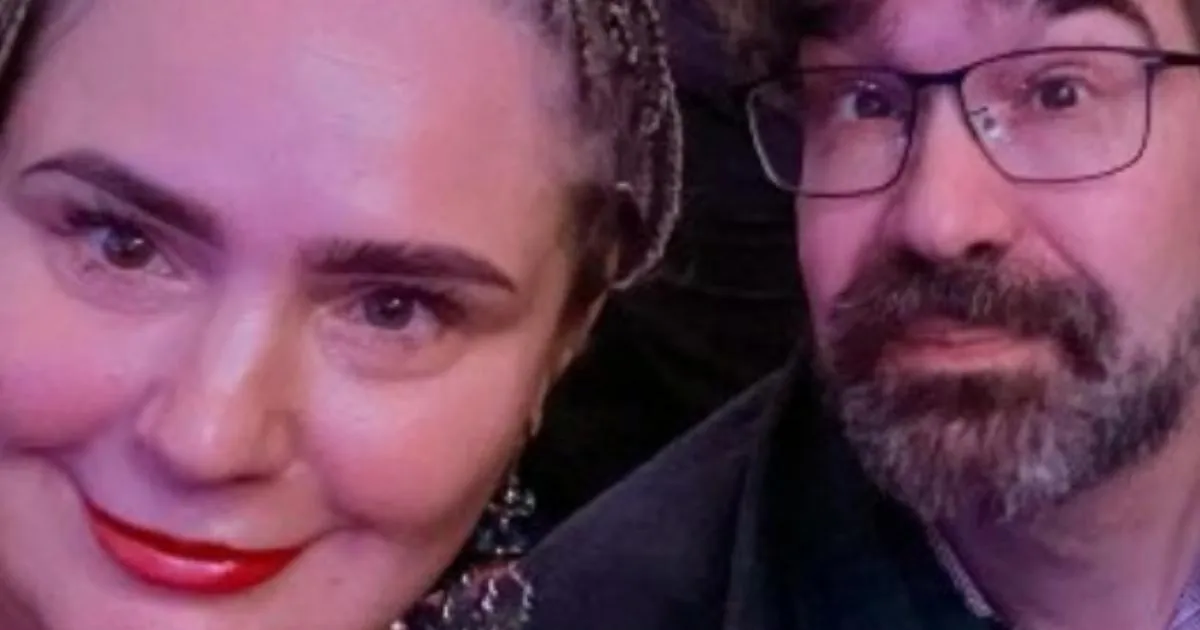
Joanna Cierpka and her boyfreind Henrik Slotsaa who was found stabbe dto death in his central London flat (Picture: Central News)
A woman accused of stabbing her boyfriend to death had sent explicit messages to waiter while on holiday in Greece, a court has heard.
Joanna Cierpka, 51, allegedly murdered Henrik Slotsaa in March after he told her on her birthday that he had met someone else at London’s Citibank office in Canary Wharf, where he worked, the Old Bailey has heard.
On Tuesday, jurors heard a series of messages she exchanged with a restaurant worker she called her ‘sweet boy’ the summer of 2025.
In the Viber exchange, she appeared to be discussing an arrangement to meet with Dennis Leftakis after his shift.
Advertisement
When Cierpka suggested he might need rest ‘instead of depressing old woman’, Mr Leftakis responded: ‘No don’t say that’ and told her he wanted to kiss and hug her.
The next morning, she messaged to ask how he was feeling, saying: ‘Hope I did not drain you dead.’
He replied: ‘Alive, not dead but alive.’
After picking up Mr Slotsaa at the airport later that day, she messaged Mr Leftakis again, saying: ‘Still feel you on and in me.’
Advertisement
Before Mr Slotsaa joined her in Greece, Cierpka had referred to him as ‘my Viking’ in separate WhatsApp messages, the court was told.
Mr Slotsaa, 52, was found dead at his home in Elephant and Castle last March
Cierpka was arrested after police found the 52-year-old’s body at their home in Elephant and Castle, south London, on March 15 2026, following welfare concerns.
Prosecutor Danny Robinson KC told jurors about internet searches found on Cierpka’s phone in the days before Mr Slotsaa’s body was discovered.
On February 19, Cierpka’s phone was also used to search for the phrase ‘I don’t want to live anymore, how to end it’, jurors were told.
Latest London news
To get the latest news from the capital, visit Metro’sLondon news hub.
Advertisement
On March 8, there were searches for ‘which artery bleeds the fastest’ and how to find the aorta, femoral and carotid arteries.
The following day, Cierpka’s phone was used to look up the ‘highest penalty in the UK’, the court was told.
Polish national Cierpka has pleaded not guilty to murder, but she says she is guilty of manslaughter by reason of her diminished responsibility.
Aimee O’Shaughnessy, had struck up a friendship with Henrik Slotsaa, 52, in the months before his death (Picture: Central News)
The court has heard how Cierpka was made redundant, which affected her self-confidence, and she had previously received treatment and medication for depression.
At the conclusion of the prosecution case, the Old Bailey trial was adjourned until Wednesday.
French cities are fighting the growing threat of diseases like dengue, chikungunya and Zika in mainland Europe by releasing millions of sterile male Asian tiger mosquitoes.
Terratis, a new company in the southern city of Montpellier, is breeding infertile males on an industrial scale as a long-term solution to the rapid spread of the disease-carrying insects.
The sterile males are bred at a factory in the southern city of Montpellier and then released in urban hot zones where the mosquitoes are most prevalent. After they have mated, females reproduce only empty eggs for the remainder of their lives.
Advertisement
“By using this technique, the mosquitoes will have no descendants and then, in theory, we can reduce the population with each generation,” said Clelia Oliva, the founder of Terratis.
“We are confident of being able to achieve a reduction of between 70 and 90 per cent in the towns in which we are releasing the sterile mosquitoes.”
As Dr John Gibbs, who gave crucial evidence against Lucy Letby, suggests a retrial could be “the most appropriate thing for everyone”, the Mirror hears from Dr Susan Gilby, who successfully sued the Countess of Chester for unfair dismissal
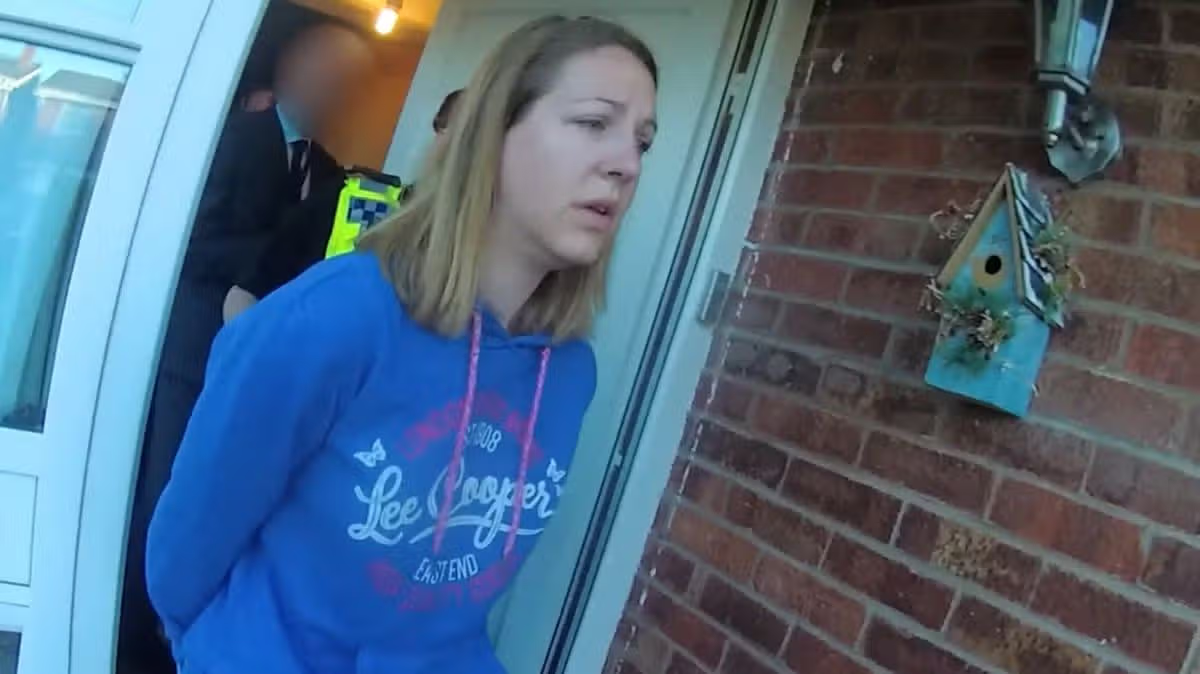
On the morning of July 3, 2018, Lucy Letby was arrested at her Chester home on suspicion of eight counts of murder and six counts of attempted murder of vulnerable newborns.
Advertisement
Suspicions had been raised over the neonatal nurse as early as September 2015, when Countess of Chester Hospital staff began to notice a disturbing correlation between infant deaths and Letby’s shift patterns.
As the death toll rose, the connection became impossible to ignore. For months, dread filled the hospital corridors, but, as the Thirwall Inquiry would later determine, senior managers were slow to react, delaying urgent meetings for which medics pleaded.
Had Letby been removed from her duties in October 2015, when concerns were first raised, twin babies O and P may not have died in June 2016. It wasn’t until June 29, 2016, that Letby was finally removed from frontline duties.
Mere weeks after Letby’s first arrest, Dr Susan Gilby joined the Countess of Chester as medical director and deputy chief executive. As Dr Gilby would later testify during the inquiry, having reviewed theJune 2016 CQC report, she’d expected to “go into a high-performing organisation”.
Ahead of her start date, Dr Gilby was “brought up to speed” on some of the unfolding issues. She told the Mirror: “I was aware that there had been many unexplained and unexpected deaths and collapses on the unit in 2015/16, and I was aware that there were some relationship problems between the paediatrician consultants and the executive team, and that the chair was trying to improve relations between those two groups.”
The Thirwall Inquiry would later refer to this division as a “gulf”. Consultants were forced to apologise to Letby, and management even threatened to report whistleblowers to the General Medical Council (GMC).
Dr Gilby, appointed following the retirement of Mr Ian Harvey, was informed of Letby’s arrest shortly before the announcement. The staff reaction was unexpected. She recalled: “I thought I would find a team who were very distressed by this turn of events, as I said in my Thirwall statement. But in fact, I found that three weeks after the arrest, they were very entrenched in their view that nothing would come of this.”
Considering why this might have been case, Dr Gilby reflected: “I’ve no idea why they thought that. It seemed that they’d just not been professionally curious enough about why babies were collapsing and dying unexpectedly and in an unexplained manner on their unit.
“[…] If you have repeated cardiovascular collapses and death, and you can’t explain them, and they weren’t expected, that just doesn’t happen in clinical practice.”
Dr Gilby spent three hours, alongside Dr Brearey, analysing the timeline of each incident. She also read consultant questions submitted to Mr Chambers, telling the inquiry how she could “see the anguish coming off the page”, and how she’d noticed her predecessor’s “very defensive” response.
She continued: “It was important that I listened to the paediatricians and looked at all of the documents I had at my disposal myself, because I was being asked to deal with the paediatricians, and also to arrange the mediation. I met with Dr Brearey, and it was minutes into that conversation that I realised that the executive team had got this very wrong. I absolutely did expect at some point that there would be charges. I didn’t know when that would be.”
It was, as Dr Gilby emphasised, a “complicated case”, with each incident requiring a separate investigation. Three days after her first arrest, Letby was released. She was rearrested and rereleased on June 10, 2019, at her parents’ Hereford home. The third time, on November 10, 2020, Letby was charged with eight counts of murder plus 10 counts of attempted murder, and denied bail.
By this point, Dr Gilby explained, “virtually all of the previous senior leadership team had moved on”, but she was able to inform them “out of courtesy”. Dr Gilby said: “Those who were still in the organisation were devastated. There was nobody in the senior leadership team who believed that this was the wrong thing to happen.
“They were distressed, and absolutely were looking at themselves in terms of, ‘Could we have known about this? Should we have known, and did we actually know?’ There was also a lot of concern about supporting the staff who were witnesses, and who had to be interviewed multiple times by the police, and were now going to have to give evidence as witnesses in a criminal court.
“There was a lot of horror for the parents in particular, and just wondering what they were going through. It’s unimaginable, really. There was nobody that I spoke to, including very senior people, board members, who felt that there was any issue with the charges that had been brought, other than could they have done something sooner to prevent this.”
Letby, now 36, was convicted of killing seven babies and attempting to murder seven more, and was given 15 whole-life orders. Since 2015-16, there has been just one death at the neonatal unit, in September 2019. For her colleagues, the long-term impact has been profound. Some have reported suffering post-traumatic stress disorder (PTSD), as well as severe depression and anxiety.
In December 2022, Dr Gilby resigned, filing a claim for constructive unfair dismissal, after she’d made allegations of bullying and harassment against the trust’s chairman, Ian Haythornthwaite. Dr Gilby told a tribunal how one Trust director, Ros Fallon, had taken her to the pub that October, telling her it was “time for you to go”, adding, “If you don’t agree to go, we will start a process against you.”
While Dr Gilby was offered a payoff to walk away, this was under the condition that she drop any allegations. Having previously raised concerns at work without issue, Dr Gilby told us: “It was a shock to me, to be honest, to find that in Chester there was not a history of openness when listening to people who were raising concerns.
“It was an even bigger shock to me when, as a chief executive who was medically qualified with a background of being a medical director in three organisations and a consultant in critical care and anesthesia, that when I raised concerns that the behaviors of the chair and others on the board were putting patients at risk and were putting staff, including myself, at risk, that… it wasn’t just that we weren’t listened to. I was asked to keep quiet and offered a bribe to do so.”
Dr Gilby was awarded £1.4 million in damages after it was ruled she’d been wrongly dismissed, and Haythornthwaite resigned. Looking back at her time on the Countess, Dr Gilby’s thoughts remain with the families of the victims, some of whom have been left with lifelong injuries. The money, she notes, could have been better spent on patient care.
She remarked: “I really am concerned that in the higher echelons of the NHS, right at the very top, there isn’t necessarily always the openness and willingness to accept that there might be a problem that we would expect, and then that cascades its way down into some organisations.”
This comes as Dr John Gibbs, one of three consultants whose evidence helped convict Letby, told The Sun he holds “a very small concern that there may not have been any deliberate harm done”, arguing that a retrial could be “the most appropriate thing for everyone”.
Regarding this suggested retrial, Dr Gilby commented: “The convictions are sound, in my view. There are other cases that she could have been convicted of. The appeal, she’s been convicted by two juries. The people who are best placed to investigate unexplained, unexpected deaths are the police, and they did that. The people who are best placed to present the evidence are the Prosecution Service, and the people best placed to make a judgment are the jury and the judge. And then the appeal court. And as far as I’m concerned, that’s what’s happened, and I’m not in a position, and neither is anybody else, to go behind that.”
Do you have a story to share? Email me at julia.banim@reachplc.com
Even as the rollout of the 5G network continues around the world, the race to design and build the sixth generation of mobile infrastructure has begun.
The new, global 6G network represents a fundamental shift in what a mobile network is built to do. Where previous generations were designed primarily as pipelines for transporting data between devices, 6G’s ambition is to treat the network as an intelligent system.
This means it is designed to be “AI native”, with artificial intelligence at its core from the outset. An example is integrated sensing and communication: radio waves that also act like radar sensors, detecting movement without the need for cameras. Real-time data collection and connectivity will be another important application in the management of largely automated urban environments.
The problem is that someone has to create 6G first – and pick up the bill. And this next technological cycle is inheriting many unresolved issues from 5G, in a technology landscape fractured by geopolitical tensions and public scepticism.
Advertisement
The development of 6G relies on a global conversation shaped by institutions such as the UN’s International Telecommunication Union (ITU) and the 3rd Generation Partnership Project (3GPP), a global collaboration of telecommunications standards organisations. Together, they have established the official 6G rollout plan, with the aim of creating the first technical standards by 2028. This would lay the groundwork for the release of the first 6G commercial networks around 2030.
As telecommunications shift from physical hardware to cloud software and AI, traditional mobile operators will find themselves reliant on the tech giants – in particular, massive cloud providers such as Amazon and Google – for storage capacity and data processing they cannot build themselves.
Yet this convergence raises some important questions. Can national infrastructure remain sovereign and secure when running on foreign cloud platforms? And how easily can governments cooperate across borders when the digital infrastructure underpinning their societies is controlled by a handful of private corporations?
A new 6G alliance
In late July, the US government announced a new 24-country 6G coalition, including the UK and 15 other European countries, India, Canada, Australia, Korea and Japan. Its stated purpose is to counteract the Chinese digital infrastructure industry under the banner of “6G leadership and security”.
Advertisement
This announcement takes the politics of 6G to a new geopolitical scale. This US-led bloc says it envisages 6G as the engine and heart of “technological competitiveness, economic prosperity and national security”.
These were, primarily, the lack of a coordinated industrial policy, and underestimation of the complexity of the agreements that underpin this global network. Such missteps gave China a headstart on hardware, enabling its companies to dominate 5G patents and be the first to market a lot of 5G equipment.
Video: NTD News.
The newly established 6G coalition has already set goals to solidify connections among governments, industry and academia within a few months. These links should evolve into a comprehensive strategy to support a secure global 6G network for the long term.
Advertisement
A key moment in this story will come in October 2027 – in Shanghai, China, of all places. At the ITU’s World Radiocommunication Conference 2027, governments will negotiate on how to allocate the multi-layered radio wave spectrum required for 6G. This should lay the foundations for infrastructure standardisation the following year.
But for the UK and Europe, this represents a serious dilemma. They do not possess the industrial scale to fully replace Chinese infrastructure. But they also fear escalating dependence on US big tech with the advent of 6G.
Europe’s dilemma
The EU’s flagship initiative Hexa-X and successor Hexa-X-II, funded by Nordic mobile giants Nokia and Ericsson, was conceived as a blueprint for a European 6G to tackle these issues. The primary aim is to produce technologies that can operate autonomously, outside both US and Chinese hardware and software.
Local UK mobile operators are still decommissioning legacy 2G and 3G infrastructure, and are close to decommissioning traditional telephone landlines. They are also striving to reap the benefits of the 5G network. It is not easy for the UK to assert leadership in mobile networks abroad while wrestling with all these issues at home.
Right now, the core values of the 6G technology that will define the next decade are already being decided. Future AI-native networks will come with a higher energy bill, so one key challenge is how to minimise energy consumption and maintain a path towards a sustainable technology.
Deploying new infrastructure also risks reigniting the intense public anxieties seen during the 5G rollout. Fears about electromagnetic radiation and surveillance quickly escalated into conspiracy theories linked to a history of health concerns about wireless technologies, and the tendency to exclude citizens from infrastructure design and deployment.
Getting 6G right demands a broader approach to building this new global network – as most participants agree. Including citizens in this process could be a powerful tool, demonstrating from the outset that infrastructure is never just a technical or engineering endeavour. It is also a political and social issue that will shape all our futures.
Former Manchester United star Alejandro Garnacho only joined Aston Villa from Chelsea in the summer but the forward could potentially be on the move once again, with clubs already eyeing him
But Garnacho, 22, has been limited to just 31 minutes of action so far this season, and has not even come off the bench in any of Villa’s last three games.
His switch to Villa Park will become permanent for a fee of around £43million should certain conditions be met. But that already appears unlikely.
According to Mail Online, clubs in La Liga are watching Garnacho’s situation. The forward was actually born in Madrid and had a spell with Atletico Madrid’s academy before his switch to Manchester United.
Asked recently what Garnacho needs to do to earn an opportunity with the club, Villa boss Unai Emery said: “Continue working. Work, work, train, work.
“When he can have minutes to play, try to play well. He is progressing, but we have players in front of him now. George Hemmings is playing fantastic. Alysson is also understanding things well and is giving us things I want. [Ibrahim] Mbaye also responded well.
“We want a competitive team and players to compete in the style we have. Garnacho is a little bit behind because of some circumstances we had in pre-season. It is time to be patient for the time he needs.”
Having been left out of the latest Argentina squad, he will now join Villa on a mid-season training camp in Spain, where he will certainly hope to catch Emery’s eye.
He netted eight goals in 43 appearances for Chelsea across his debut campaign but just one of those came in the Premier League. New boss Xabi Alonso made it clear that he had little future at Stamford Bridge ahead of his move to Villa. Garnacho has just under six years remaining on his current contract at Stamford Bridge.
Villa have a just under three-week wait for their next Premier League game which is set to come against Brentford on October 10. They will then take on Fenerbahce in their first Champions League home game of the campaign.
Advertisement
Join our new WhatsApp community and receive your daily dose of MirrorFootball content. We also treat our community members to special offers, promotions, and adverts from us and our partners. If you don’t like our community, you can check out any time you like. If you’re curious, you can read our Privacy Notice.
She spent three years and £50,000 fighting her local council for the right to walk through her own back gate.
But after winning a legal battle against Derbyshire County Council over access to her home, Helene Ball now has a fresh fight on her hands after giant concrete ‘Lego’ blocks were dumped outside her property.
The retired teacher, 81, accused the council of pettiness after it put the 2ft blocks along a narrow wall near her home after her legal victory.
She first took action against the council after discovering one morning in April 2023 that a metal fence had been cemented over a 98cm gap in her rear garden wall.
Advertisement
The gap leads into an adjoining council-owned car park, but Mrs Ball, who has lived at the house in Matlock since 1967, said she and her family had used the route unopposed for more than 40 years.
Mrs Ball argued that her continued access amounted to prescriptive rights to access the route and a judge later ruled in her favour – with the access now being added to the deed for the land.
The council was also ordered by the courts to pay Mrs Ball’s costs of around £50,000 and to ensure her pedestrian and vehicular access is not impeded again.
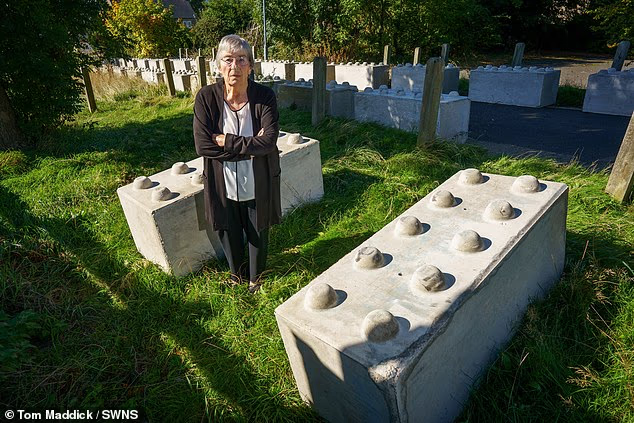
But Mrs Ball was shocked to then discover 54 huge ‘Lego-style’ blocks placed outside her home.
Advertisement
The 2ft-high bricks line the narrow road behind her property and the grass verge alongside her garden wall.
Helene Ball, who won a £50,000 battle with council chiefs over access to her home is facing a fresh fight after giant ‘Lego’ blocks were dumped outside
The 54 concrete bricks line the street outside Mrs Ball’s home in Matlock, Derbyshire
Advertisement
Derbyshire County Council admitted it had been ‘unreasonable’ to erect the original green fence at the centre of the dispute
Mrs Ball, who has two grown-up children and four grandchildren, said: ‘It’s just so petty of the council to do this after they lost the case, but they have been spiteful from the start.
‘The judge said I had a right of access by foot and by car to the rear of my house.
‘However, the council have made it impossible to drive a car up the road and turn round, it’s ridiculous.’
Advertisement
The fence panel was installed two weeks after the second anniversary of the death of Mrs Ball’s husband, Brian, and was viewed as a ‘completely unnecessary act of aggression’ by her family.
The gap led to a car park which residents were allowed to use at weekend but it closed three years ago while the council tried to sell the land for houses.
The court ruling from Judge Robert Brown said legal representation from the council was ‘surprisingly combative’ given its ‘limited evidence’ and ‘unsubstantiated assertions’.
Judge Brown found parts of the legal representation for the council ‘totally irrelevant’, ‘most unhelpful’ and even described the litigation as ‘pugnacious’.
Advertisement
Now, Mrs Ball is preparing for another legal battle to force the council to remove the blocks.
Her son David, 50, who has been carrying out legal work on behalf of his mother, said: ‘The council have not acted in the spirit of the law.
‘Our legal team are investigating whether the council are interfering with access to my mum’s home.
‘Basically my mum won her case but the council have made it impossible for her to use the access road which she has used since she moved here in the 1960s.’
Advertisement
The fence which started the three-year legal dispute about access
The 2ft-high bricks line the narrow road behind her property and the grass verge alongside her garden wall.
Derbyshire County Council admitted it had been ‘unreasonable’ to erect the original green fence at the centre of the dispute.
A spokesman said: ‘It would not be appropriate to comment further on matters that have been considered by the court other than that the council has a duty to safeguard its legal interests in public assets, including land that it owns and manages on behalf of residents.
Advertisement
‘Where issues arise concerning council-owned land or access rights, the council has a responsibility to consider the matter carefully and, where appropriate, defend any action.
‘Its actions are always guided by its statutory duties.’
The installation of the fence and legal challenge started under the previous Conservative-controlled councl, but the continuation and final tribunal court hearing took place under Reform UK control.


























































You must be logged in to post a comment Login