Connect with us
DAPA Banner

NewsBeat

Family slam evil killer over sick TikTok prison videos taunting dead victims

Published

on

Daily Record

Ben McCulloch – son of Scottish gangland boss Brian McCulloch – was filmed partying with other out-of-control prisoners.

Mark McGivern at HMP Addiewell as families demand action over prison cell parties

A grieving family have demanded a crackdown on killers trolling from behind bars after being sickened by jail TikTok videos.

The mother and sisters of slain Stephen Quigley are pleading for a new law to hammer gloating criminals after the Record revealed a series of videos filmed inside crisis-hit Addiewell nick.

Advertisement

Katie Quigley has told of her pain as she watched killer Ben McCulloch – son of Scottish gangland boss Brian McCulloch – party with other out-of-control prisoners in a video that was put on TikTok.

Along with daughters Catrina, 33, and Margaret, 37, she is pleading for a crackdown on the toxic masculinity and macho lawlessness that they claim the Scottish Prison Service seems unable to keep under control.

The recent TikTok video from McCulloch – featuring violence, bullying and drugs – glorified the 24-hour party life he and pals, stripped to the waist, claim to be living the high life at HMP Addiewell, in West Lothian.

That video followed an earlier shameful Instagram post that emerged from HMP Shotts, where bully McCulloch, 31, and murderer pal Ross Fisher were photographed. A caption on the post openly mocked the men they killed – saying “They’re deed and we’re no – hahah.”

Advertisement

It is understood that McCulloch has been prosecuted for abuse of smuggled mobile phones – and received “concurrent” sentences, which added zero time to his sentence.

Katie Quigley, whose demand for a clampdown is being backed by MSP Paul O’Kane, said: “I cannot put into words just how hurtful it was to see this man’s face on a photo, with a caption on it referring to the death of my son and the fact his killer is doing ‘easy time’.

“Ben McCulloch killed my boy, who was meant to be his best friend. His lawyer told the court that he was full or remorse but he has not one shred of remorse. If he did, how could he be posting videos about having 24 hour parties?

Advertisement

“And what punishment has he received? We were told by the SPS he was given concurrent sentences, which is no punishment and no deterrent at all.”

Katie, from Neilston, Renfrewshire, said she would like Scottish ministers to pass a specific law that ensures extra time behind bars for any prisoner who uses a mobile phone to create video content that cause torment for the family of victims.

She said: “I had to identify my dead son and that awful day will stay with me for as long as I am alive. Is it too much to ask for prisons to stop these gangsters reminding the families of all the people they have killed or victimised that they are running the jails?

“I really does look from the videos that things are out of control. How can you have a cell that is full of drunk men having a party inside, taking videos, somehow getting an internet connection to post all their horrible footage?

Advertisement

“It just breaks my heart to think of the lack of remorse that is evident in every one of those videos.”

Stephen’s sister Catrina, 33, said the family has been forced to endure a “life sentence” after their loss in 2021.

McCulloch, now 31, was jailed for nine-and-a-half years for knifing Stephen before leaving him to die on a pavement outside Paisley’s Royal Alexandra Hospital in Paisley.

Advertisement

The High Court in Glasgow heard that Stephen would have lived if McCulloch had taken him to A and E.

Catrina said: “Stephen was best mates with Ben and they were on good terms before he killed him. His lawyer bleated in court about his remorse but his behaviour in prison is a disgrace.

“We need to stop the flood of phones into prisons and we need to give proper punishments to those who are torturing families like ours from inside jails.

“As it stands there is no deterrent. Vulnerable young men are looking at these prisoners like role models and thinking they can get in with the mob while doing easy time in jail themselves.”

Advertisement

The Daily Record told recently how Ben McCulloch and other cons at HMP Addiewell were raving in their cells, posting videos that appeared to show men out of their heads on drugs and prison hooch.

The apparent lads party videos were captions with claim that prison time is easy and a 24 hour party.

Further videos emerged from top security HMP Shotts and Barlinnie, where a growing craze appears to be emerging for young prisoners to brag about the fun times they are enjoying behind bars.

Advertisement

And the Quigley family had previously been outraged at the Instagarm content that featured McCulloch with killer Ross Fisher, 34 – who was one of a gang of four who were jailed for the gangland murder of Kenny Reilly in Maryhill, Glasgow, in 2018.

Ben McCulloch’s dad Brian, now 55, was a ringleader in a multi-million-pound drug plot that was cracked after a police surveillance sting.

In 2009 the High Court in Glasgow heard how McCulloch plotted with other gangsters.

Due to the bugging of McCulloch’s BMW, police raided properties in Glasgow, Paisley and Clydebank, recovering drugs with a street value of £9million, along with firearms and almost £500,000 in cash.

A ring of steel was thrown around the High Court in Glasgow ahead of their sentencing hearing, amid fears of an escape bid from the gang.

Officers from the tactical firearms unit, armed with sub-machine guns, stalked the court building while the police helicopter circled above.

The police operation, codenamed Operation Lockdown, ran from August 2007 to February 2009, involved up to 100 officers on any given day and cost an estimated £2.7million. Brian McCulloch got 10 years for his leading role in the gang.

Advertisement

Labour MSP Paul O’Kane said Scotland needs an overhaul of the way it deals with the taunting that comes from inside prisons on illicit videos.

He claimed that his plea for action on the Quigleys’ case had been fobbed off by justice minister Angela Constance when he raised it in a letter.

O’Kane said: “I have been supporting the Quigley family for some time and I know how shocked the whole community in Neilston was at Stephen’s killing. It is horrific that the family’s pain is being compounded by the action of those found guilty in prison.”

Advertisement

“It is clear that the SNP Government take a soft touch approach and have not acted to get a grip of the situation within our prisons – with mobile phones being smuggled in and so called parties taking place in prison wings which are being filmed for social media”

“My pleas to Angela Constance have fallen on deaf ears and this is heartbreaking for the family”

“We clearly need a new Government in Scotland to take decisive action on securing our prison estate and looking at the whole issue of punishments for taunting victims of crime from behind bars.”

A Scottish Prison Service spokesperson said: “We understand the lasting impact this kind of offending has on families and the significant distress such videos can cause.

“Our staff work hard to keep prisons safe and secure, using all available technology and intelligence to prevent illicit items, including mobile phones, entering our establishments.

“While we do not comment on individuals, we continue to work with Police Scotland, and other partners, to take action against those who attempt to breach our security.”

The Scottish Government is currently restricted in statements that might be made on future policy.

Advertisement

A previous statement stated: “This is an operational matter for the SPS which uses a range of technology and intelligence to stop illicit items reaching our prisons.

“As previously announced in 2026-2027, we are investing just over £1billion in our prisons to support frontline staff.”

Get more Daily Record exclusives by signing up for free to Google’s preferred sources. Click HERE.


Source link

Advertisement
Continue Reading
Click to comment

You must be logged in to post a comment Login

Leave a Reply

NewsBeat

Clear market uncertainty despite latest Trump attempt too soothe concerns | Money News

Published

on

Traders at Hana Bank in Seoul, South Korea. Pic: Jintak Han/ZUMA Press Wire/Shutterstock

The latest attempt by Donald Trump to ease uncertainty over the US and Israel’s war on Iran has only heightened investor concerns.

The US president’s primetime address, saying American forces could leave Iran in two to three weeks, while threatening to strike Iranian electric plants “extremely hard”, has caused the fallen oil price to jump again.

Money blog: Top chef shares most underrated ingredient

A barrel of benchmark Brent crude oil is now up more than 7% at $107.50 since his comments, having fallen below $100 yesterday. Oil prices impact the cost of petrol and diesel, home heating oil and prices throughout the economy.

Advertisement

It was a similar story with the UK wholesale gas price, which rose more than 6% following Mr Trump’s statements. British electricity prices are still tethered to wholesale gas costs.

Asian stock markets were also in the red, with Korea’s Kospi and Japan’s Nikkei indices posting big falls of more than 4.5% and 2.3%, respectively.


Oil prices rise after Trump speech

Advertisement

The crux of the worry is of a 1970s-era energy crisis due to the month-long disruption to shipping in the key oil and gas shipping route, the Strait of Hormuz.

More than a fifth of the world’s oil and liquified natural gas (LNG) is typically transported through the channel but for the last month, it’s been too dangerous and expensive for most tankers to pass.

Iran has attacked many ships making the journey and insurance companies have hiked premiums.

Advertisement

That’s meant shipments not getting through from major petrostates of the Gulf, oil and gas storage filling up and energy producers powering down.

Oil and gas production is not easily switched on and off, meaning resuming supply will not be a speedy process.

Impact in the UK

As the dollar rose amid continued uncertainty, sterling fell. Before Mr Trump’s announcement, a pound bought $1.33, which dropped to $1.32 this morning. A pound now buys slightly over €1.15, down from €1.16 on Wednesday afternoon.

Advertisement

That means buying dollar-priced goods, such as oil, becomes even more expensive than yesterday.

And after strong rises on Wednesday, the UK’s flagship stock index, the FTSE 100 of the most valuable London Stock Exchange companies, shed 0.6%.

Home heating oil prices have remained at more than double pre-Iran war levels, while motoring organisation the RAC said UK petrol and diesel prices in March jumped more than in any previous single month.

Even if the war were to end in a few weeks the membership body for food and drink manufacturers, the Food and Drink Federation, said estimates food inflation will rise to at least 9% by the end of the year.

Advertisement

Latest effort to calm markets

The overnight address by Mr Trump was just the latest in a line of attempts to assuage fears of investors and his voters over the duration and cost of living impact of the war.

In the first week of the war, he said the US Navy could escort ships through the Strait of Hormuz.


Advertisement

Trump’s Iran address: Clarity or confusion? Watch Mark Stone’s analysis

After this did not materialise, the Trump administration lifted sanctions on Russian oil so Indian refineries could begin processing the fossil fuel.

Persistently higher oil prices were not lowered by Mr Trump’s repeated statements that many of his objectives had been attained and the war would conclude soon.

Advertisement

His suggestion that US troops could seize the major Iranian outlet for oil exports, Kharg Island, also did not move the needle on oil.

Advertisement

Source link

Continue Reading

NewsBeat

Is yo-yo dieting bad for you? Here’s what the latest research shows

Published

on

Is yo-yo dieting bad for you? Here’s what the latest research shows

The only thing harder than losing weight is keeping it off. Many people who lose weight find themselves stuck in the cycle of “yo-yo dieting” – losing weight and gaining it all (and sometimes more) back again.

Research on yo-yo dieting has long indicated it can be harmful for your health. But a recent paper has now suggested yo-yo dieting might not be as unhealthy as we’ve been led to believe.

This recent paper, published in BMC Medicine, presents the findings of two separate weight loss trials that were conducted five years apart.

The first trial (trial 1) looked at 278 participants who were overweight or obese. Participants were randomised to follow either a low-fat or low-carb Mediterranean diet – either with or without exercise. All participants lost a comparable amount of weight at the end of the 18-month trial. But those who incorporated exercise achieved the biggest decrease in visceral fat (a dangerous type of fat that is stored around the organs).

Advertisement

The second trial (trial 2) was conducted five years later. Similar to trial 1, the 294 participants followed a Mediterrean-style diet for 18 months. But this time, one group ate a diet very high in polyphenol-rich foods (naturally-occurring plant compounds which have been linked to health benefits such as lower risk of chronic disease). The second group ate a normal Mediterranean diet, while the third group followed normal healthy diet guidelines.

While both Mediterrnanean diet groups lost weight and saw improvements in their overall health, the polyphenol group lost more visceral fat.

A unique aspect of trial 2 was that it included around 80 participants from trial 1. Some of these participants weighed more than they did at the start of the first trial. Such weight recidivism is common following weight loss. This is due to various biological and physiological functions that reduce metabolism and increase hunger, causing people to regain weight and store fat.

The authors compared the people who rejoined the research project against their health and weight status at the start of trial 1. They assessed body weight and other aspects of health – including body fat and blood sugar levels. Despite the re-joiners weighing around the same (if not more) than they did at the start of trial 1, they had lower levels of abdominal fat and visceral fat five years later.

Advertisement

Their metabolic health was also better than it was at the start of the first trial, based their blood lipid (fat) levels, cardiovascular health and blood sugar control.

On the surface, this appears to be good news – suggesting participants retained some of the health benefits of the weight they lost the first time around, despite regaining the weight.

Yet, the results suggest that the very adaptations which helped the re-joiners stay healthy despite regaining weight could potentially have repercussions later. To understand why this is the case requires a grasp of how the body responds to a calorie deficit.

Weight loss and body fat

Our fat stores (known as adipose tissue) serve as our main energy (calorie) buffer when there’s no food to provide that fuel. These stores are sacrificed to cover the energy shortfall, causing fat cells to shrink. Visceral fat is the first to go, followed by the more beneficial fat cell stores.

Advertisement

But when people stop dieting, the body puts priority on regaining lost fat. Indeed, our body replenishes fat stores far more quickly than it does muscle or protein stores. More importantly, in response to this shrinkage, the body compensates by making more fat cells. It does this to help the body better cope the next time there’s a fuel crisis.

The body responds to weight loss by creating more fat cells.
Spectral-Design/ Shutterstock

So dieting literally makes you fatter in the long run. But thankfully, this will most likely be healthier subcutaneous fat (in the hips, thighs, buttocks and torso) instead of around the organs as harmful visceral fat.

So even though you’ll be carrying excess weight, you’ll experience fewer of the metabolic issues caused by unwanted visceral fat – such as insulin resistance and high cholesterol, which elevate your risk of cardiovascular disease and diabetes.

But with the higher capacity to store fat comes the risk of overshooting your original weight. This may also have implications for yo-yo dieting.

Advertisement

The weight loss cycle

In the paper, the re-joiners who took part in trial 2 did manage to lose weight again. But, on average, they lost slightly less than the trial’s first-timers. That said, when all of the participants from trial 2 were followed up five years later, the re-joiners from trial 1 had regained less, too. They had also retained more of the health benefits of losing weight.

Taking stock of the whole weight-loss journey, it appears that those who regained weight and then joined trial 2 are at a comparable place at the end of ten years to those who just did trial 1.

But there are a few caveats to the trial’s findings.

First, the paper only examined body fat. It didn’t provide any information on lean tissue (such as muscle). This is important, as when we lose weight we lose both fat and muscle. Given muscle’s importance for a healthy metabolism, a lack of muscle could result in even greater weight gain.

Advertisement


À lire aussi :
Weight loss: why you don’t just lose fat when you’re on a diet


It’s also not clear whether regaining weight changes the nature of muscle tissue. There are two key types of muscle fibre. Type 1 is smaller and more efficient at burning fat. Type 2 is larger, faster and more powerful – important for explosive exercise.

If an overall loss of muscle results in muscle fibres changing from type 1 to type 2, this could increase risk of health problems – including sarcopenic obesity and earlier onset of age-related health issues associated with muscle loss.

Overall, the paper shows us that weight loss is still beneficial for your health – even if it requires a few attempts to get to your goal weight. But to avoid potentially gaining more weight the second time around, it’s key to establish good diet and lifestyle changes that are sustainable long-term.

Advertisement

Source link

Continue Reading

NewsBeat

Strictly legend comments on ‘unexpected moment’ with pro dancer amid showbiz praise

Published

on

Manchester Evening News

Arlene Phillips, a former judge on the hit BBC One dance show, was among the showbiz stars supporting Johannes Radebe

A former Strictly Come Dancing legend has described a moment with one of the show’s current professional dancers as ‘unexpected’ amid an outpouring of love and praise.

Advertisement

Arlene Phillips, a former judge on the hit BBC One dance show, was among the showbiz stars supporting Johannes Radebe and the cast of Kinky Boots at a special Gala performance of the Olivier, Tony and Grammy award-winning musical, in support of international charity, WaterAid.

The professional dancer, who is a fan-favourite among viewers of Strictly, is making his West End debut as he reprises the fabulous role of drag queen Lola and he and his co-star Matt Cardle, as well as their fellow Kinky Boots cast, were supported by a number of famous faces on the night, including a host of Strictly professionals and former contestants, including a number Johannes’ former partners.

Johannes has since taken to Instagram with a string of videos and pictures from the special night in the theatre, and simply told his followers: “Heart is full! [heart emoji] @kinkyboots_uk #westend.”

Among the clips was one of Johannes with the cast on the red carpet, in which he could be seen lifting a smiling Arlene up in front of the cameras. She commented on the post, explaining: “The most unexpected moment ever. One moment i was saying congratulations and good bye to the brilliant JoJo and the next second he threw me up in the air me up in the air.”

And the moment caught the eye of Ted Lasso star Hannah Waddingham, who was quick to respond to the post: “@arlenephillips getting the love and respect she DESERRRRRRVES @johannesradebe you’re wonderful!”

Meanwhile, Johannes was also being flooded with love and support, as Strictly co-star Vito Coppola gushed: “Just saying: you are AMAZING!!! Keep smashing [it]. Love you Jojo.” His former celebrity dance partner Annabel Croft added: “You were born to play this role and I’ve never witnessed energy quite like that on stage. Quite sensational and the show is spectacular !! Loved every minute and so proud.”

Source link

Advertisement
Continue Reading

NewsBeat

Man dies as Storm Erminio batters Greece with planes grounded and red weather alerts

Published

on

Daily Record

One man has died near Athens as Storm Erminio brings severe weather, floods and Saharan dust turning skies red across Greece with flights disrupted on Crete

A man has lost his life as ferocious gale-force winds and flooding from Storm Erminio battered Greece – while a Saharan dust storm transformed skies to a crimson hue.

The victim was discovered beneath a vehicle in the Nea Makri countryside near Athens this morning, fire services confirmed, after reportedly venturing outside his apartment and being swept away by the extreme conditions.

Advertisement

Storm Erminio has left streets submerged and forced the closure of several schools. Air travel has been disrupted on Crete following an African dust storm that filled the atmosphere, casting an eerie red-orange glow across the sky.

The national weather service EMY has issued a red alert and is predicting further “severe weather” today across most of Greece “with prolonged and intense rain and thunderstorms, and possibly localised hailstorms.”

Red alerts have been declared for eastern Peloponnese, Central Greece, Evia, Thessaly, the Sporades Islands, Attica, and the Dodecanese, reports the Mirror.

An orange warning has also been issued for the Cyclades and the eastern Aegean islands. Temperatures are set to plummet to 9C inland, 11C along coastal areas and 5C in the highest mountainous regions.

Advertisement

Ensure our latest stories always appear at the top of your Google Search by making us a Preferred Source. Click here to activate or add us as your Preferred Source in your Google search settings.

A red warning remains in effect for Crete, particularly in western and southern areas, from midday until late Thursday evening. Three flights bound for Iraklio were forced to divert, state news agency ANA reported.

Aircraft were grounded at Heraklion’s principal airport in Crete on Wednesday, with at least two flights compelled to reroute after visibility plummeted to approximately 1,000 metres, a level deemed unsafe for landing. A British Airways flight from London was diverted to Corfu, while a SKY Express service from Brussels was redirected to Athens. The thick dust cloud lingering over Crete continues to disrupt air travel across the island.

Advertisement

On the ground, dramatic incidents were reported, including a powerful tornado flipping a lorry in the coastal region of Pachia Ammos as it was set to load agricultural exports.

In Ierapetra, enormous waves crashed into the first houses along the old town due to strong southerly winds creating hazardous coastal conditions. Officials anticipate the dust wave will start to dissipate later today.

The dusty conditions have been exacerbated by Storm Erminio, a potent weather system bringing heavy rain, thunderstorms and robust winds across Greece.

Source link

Advertisement
Continue Reading

NewsBeat

Boat Race gets reality star revamp to attract new audiences

Published

on

Boat Race gets reality star revamp to attract new audiences

The historic Boat Race is set to embrace a new era of relatability as it moves to Channel 4, with organisers hoping reality television stars and deeper insights into athletes’ lives will draw in fresh audiences.

The five-year broadcast deal, announced in October, initially raised concerns among some who viewed the departure from long-standing hosts the BBC as a worrying sign for the 197-year-old British tradition.

However, those in charge see the shift as a prime opportunity to captivate new viewers with a revamped broadcast, while still catering to its traditional fanbase.

Olympic bronze medallist and Oxford women’s president Heidi Long told the Press Association: “It’s a big change, but so much in the world of media is changing. I don’t think it necessarily is a good thing or a bad thing, but I think it’s a change.

Advertisement

“One of the fun opportunities that we’ve had working with Channel 4 is unlocking (our personalities), and so much about sport is the athletes and the people taking part in it.”

Channel 4 has enlisted former Made in Chelsea star Jamie Laing to join Saturday’s broadcast team, alongside seasoned presenter Clare Balding and Boat Race hosting newcomer Ade Adepitan.

Jamie Laing will be part of Channel 4’s coverage
Jamie Laing will be part of Channel 4’s coverage (Channel 4)

Adepitan commented: “When it comes to the Boat Race, it can feel quite intriguing, quite enigmatic, something that’s far off from people. I think what Channel 4 want to do is open it up. If (Channel 4) can do what we’ve done with the Paralympics to the Boat Race, the sky’s the limit, literally.”

Media production managing director Phil Sibson revealed that the broadcast will incorporate “relatable comparisons” to other sports, clever “visual props”, and exclusive footage of the crews enjoying outings away from their academic institutions.

Boat Race chair Siobhan Cassidy added: “Maybe (people) don’t know everything there is about the Boat Race, and actually they’re young people that are really relatable. They’re working really hard.

Advertisement

“Everyone here will have earned their place at Oxford and Cambridge based on academic ability only; they just happen to be incredibly hard-working and dedicated rowers at the same time.”

Yet, this push for relatability has its inherent limitations. This year marks the second of luxury brand Chanel’s title sponsorship, and many of the student-athletes’ stories are far from ordinary.

Oxford men’s stroke Harry Geffen has represented Great Britain at under-23 level, including last year’s world championships. Meanwhile, Carys Earl, in the Cambridge women’s four seat, balances two daily training sessions with demanding medical studies.

Earl, who hopes to achieve a personal hat-trick in the light blue boat, has delivered babies before joining her crew and, on at least one occasion, left a surgical theatre at 3am to make training two hours later.

Advertisement

She affirmed: “It’s hard work, it’s full on, and sleep is not something you get to do very often, but it’s incredible the opportunities that I’m given, and I want to make the very most of it.”

Source link

Continue Reading

NewsBeat

Alleged Bondi Beach gunman loses bid to suppress his family’s identities | World News

Published

on

A court sketch depicts alleged Bondi Beach gunman Naveed Akram appearing via video link in February. File pic: AAP/AP

A terror suspect accused of killing 15 people in a shooting spree on Bondi Beach has lost a bid to protect the identities of family members.

Naveed Akram allegedly opened fire on ‌a Jewish Hanukkah celebration in Sydney, Australia, in December in an attack which police say was inspired by Islamic State.

His dad, Sajid, who police say was also involved in the shooting, was shot dead by police at the scene.

Akram is facing 59 charges over the attack, including 15 counts of murder and one count of committing a terrorist act.

Advertisement

The 24-year-old had sought a 40-year anonymity order to prevent the publication of the names or photographs of his mother, brother and sister as well as their addresses and places of work and school over concerns for their safety.


From February: Alleged Bondi gunman in court

Advertisement

Akram’s bid was opposed by a number of Australian media groups, who argued the proposed order would prevent proper reporting of the case.

Judge Hugh Donnelly ruled in favour of the media, and said that the principle ⁠of open justice was fundamental to ⁠the trial.

He said that suppression orders “should only be made in exceptional circumstances”.

Judge Donnelly added: “This case has caused unprecedented public interest, anger, outrage and ‌grief.”

Advertisement
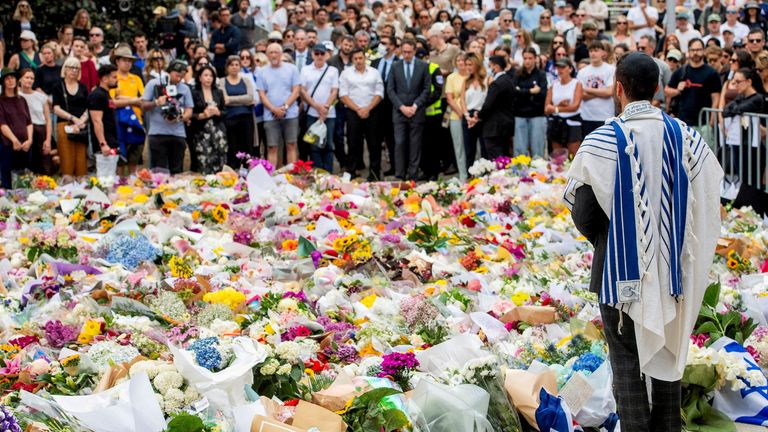
A member of the Jewish community stands at a floral memorial in honour of the victims of the mass shooting in December. Pic: Reuters
Image:
A member of the Jewish community stands at a floral memorial in honour of the victims of the mass shooting in December. Pic: Reuters

Akram’s driving licence, showing his home address, had been widely circulated online after the shooting, while his mother gave an interview to a local newspaper after the shooting, the court heard.

Social media platforms and overseas publications, would have been exempt from any order preventing publication of their identities, so it would have been ineffective in any case, Judge Donnelly added.

Read more from Sky News:
Dwindling diesel and jet fuel supplies in EU
Moment US journalist is kidnapped in Iraq

“This case is exceptional by virtue of the sheer ⁠magnitude and intensity of commentary on social media,” he said.

Akram, speaking via a video link, spoke only to confirm that he could hear the proceedings.

Advertisement

Richard Wilson, Akram’s barrister, told the court that he did not plan to appeal the decision.

The Bondi attack is regarded as Australia’s worst terror attack and biggest mass shooting since 1996.

It prompted the Australian parliament to strengthen gun control and hate speech laws, and a government-backed inquiry into antisemitism and social cohesion in the country was launched in the wake of the atrocity.

That inquiry is expected to report its findings by December this year.

Advertisement

Source link

Continue Reading

NewsBeat

Face of man who threatened police officer with knife during chase

Published

on

Cambridgeshire Live

The man was fleeing police after a suspected drug deal took place

A man who threatened a police officer with a knife during a chase has been jailed. Ricky Green, 42, attempted to flee from police on October 7, 2025, when officers suspected a drug deal was taking place in Searle Street, Cambridge.

Advertisement

During a police chase, Green pulled a knife from his pocked and approached one of the officers in a threatening manner. The 42-year-old was then arrested and a search revealed he was carrying 24 wraps of heroine and 63 wraps of cocaine.

These had a combined street value of around £900. He also had £80 in cash.

Green, of Victoria Road, Cambridge, was found guilty of possession with intent to supply cocaine and heroin. He also pleaded guilty to possession of a pointed article and threatening with a pointed article in a public place.

At Huntingdon Law Courts on Friday (March 27), he was sentenced to three years and nine months in prison. Detective Constable Henry Marshall, who investigated, said: “Green’s behaviour that night posed a serious risk to both our officers and the public.

Advertisement

“Threatening an officer with a knife is completely unacceptable and the sentenced handed down reflects the gravity of his actions. We are committed to removing dangerous individuals who deal harmful drugs and carry weapons from our streets.”

Do you want more of the latest Cambridgeshire news as it comes in from across the county? Sign up to our dedicated newsletter to make sure you never miss a big story from Cambridge or anywhere else in the county. You can also sign up to our dedicated Traffic and Crime newsletters for the latest updates on the topics you are most interested in.

Source link

Advertisement
Continue Reading

NewsBeat

Iran war deals a heavy blow to Iraq’s oil-dependent economy

Published

on

Iran war deals a heavy blow to Iraq's oil-dependent economy

BASRA, Iraq (AP) — Iraqi oil fields once alive with the buzz of workers are nearly deserted. Ports that pulsed with the churn of cargo have fallen still, the din of commerce replaced by the soft rhythm of waves.

A month after the war in Iran started, workers at ports and oil fields in the province of Basra, where almost all of Iraq’s crude is produced and exported, have grown accustomed to rockets streaking across the sky, aimed at U.S. air bases and other strategic facilities.

The war, which began with U.S.-Israeli strikes, is dealing a heavy blow to Iraq’s economy. Iraq relies on oil revenues for roughly 90% of its budget, and most of its oil is exported through the Strait of Hormuz, the narrow mouth of the Persian Gulf where Iran has effectively stopped cargo traffic during the conflict. The war also has led to a sharp reduction in the volume of imported goods reaching southern Iraq’s ports, while attacks have halted traffic at the border it shares with Iran.

Unlike other countries in the Middle East touched by the war, Iraq hosts both entrenched Iran-aligned forces and significant U.S. interests, leaving it exposed to attacks from both sides. Since the war started, oil production in southern Iraq, where Basra is located, has fallen by more than 70% and the volume of imported goods reaching the country’s ports has been cut in half. Drone and missile attacks have targeted American companies and military bases. Iran’s allied Iraqi militias also have struck oil fields and energy infrastructure. Many foreign workers have left.

Advertisement

The Iraqi government should have enough funds to get through mid-May without new oil sales, according to experts, but then it will have to borrow money.

“After that, the government would resort to issuing bonds,” said Ahmed Tabaqchali, an expert in Iraq’s economy. “But not without consequences.”

Oil production suspended

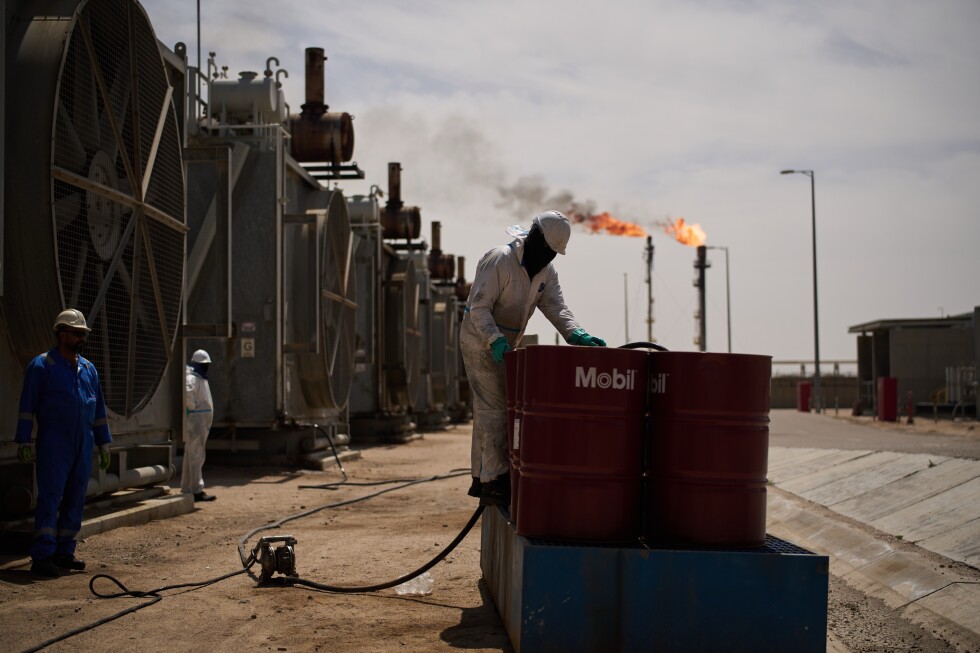
Across southern Iraq, the closure of the Strait of Hormuz has prompted oil fields to scale back production and focus on domestic needs, while oil prices around the globe have risen. Basra’s Zubair oil field, once producing around 400,000 barrels per day, has seen output drop to roughly 250,000, officials said.

Iran has offered assurances that Iraqi crude can safely transit the strait, said Bassem Abdul Karim, the head of the state-run Basra Oil Company, which oversees production in the province. However, because Iraq lacks its own tanker fleet and depends on chartered vessels, shipments ultimately hinge on whether tanker owners are willing to accept the heightened risks of making the journey. Most are not.

Advertisement

At a degassing station in Zubair, where crude is processed, production has also slowed dramatically. “It’s quiet now because of the reductions,” said chief engineer Ammar Hashim. “Of course we are worried.”

The downturn in Zubair reflects a broader decline in Basra. Output has dropped from 3.1 million barrels per day to roughly 900,000 across the province, according to Abdul Karim.

“Exports are currently completely halted. At the moment, we are considering alternative loading areas, but none are fully operational,” he told The Associated Press.

That morning, a drone crashed in the Majnoon oil field north of Basra without detonating. A security official said it’s an increasingly common occurrence, adding that the drone was likely headed toward U.S. bases in Kuwait. Production at the field has been suspended due to the frequency of these events. The official spoke on condition of anonymity because he was not permitted to speak to news media.

Advertisement

Hundreds of employees from American, British, Italian, French and other international oil companies have left Iraq due to the war. The departures accelerated after a March 6 drone strike hit the Burjisiya complex in Basra, a key logistics hub for Iraq’s oil industry used by numerous companies. The attack targeted U.S. oil services company KBR, striking its chemical storage facility.

Another drone struck the British-Petroleum operated Rumaila oil field, prompting some foreign workers there to leave, said Abdul Karim. The field is still operating, he said. On Wednesday, multiple drones attacked a fuel warehouse linked to BP in northern Iraq.

Efforts to reroute Iraq’s oil face major constraints: The country doesn’t have the capacity to boost exports via its northern pipeline, and trucking through Jordan and Syria is costly and inefficient, said Abdul Karim.

Shipping lanes closed

Umm Qasr, Iraq’s primary deep-water port, was once so noisy with imported cargo that it could give you a headache, workers there said.

Advertisement

Now, with the Strait of Hormuz closed, large mother ships bringing shipments to Iraq can no longer get to the port. Instead, they dock in the United Arab Emirates, where the cargo is carried by trucks and then smaller ships to get to Umm Qasr, a costly workaround.

The port’s jetties are running well below their former capacity, with volumes halved by the war, according to port director Mohammed Tahir Fadhil.

When the AP visited, just one cargo ship from the U.A.E. had docked.

The threat to shipping lanes escalated after Iran destroyed two tankers on March 11 in Iraqi waters, the Marshall Islands-flagged Safesea Vishnu and the Malta-flagged Zefyros.

Advertisement

“Today, our only gateway for goods is the United Arab Emirates,” said Farhan Fartousi, director of the Iraqi Ports Company.

Trade disrupted

On Sunday morning, Haidar Abdul-Samad, deputy director of Basra’s Shalamcha border crossing with Iran, was on the phone with an Iranian official, complaining about electricity cuts that had halted trade, urging a quick resolution. The power cuts followed an airstrike that hit the Iranian side of the crossing.

Such disruptions, local officials say, have become routine.

Before the war, the crossing saw constant movement, reflecting strong familial and commercial ties between Iranians and Iraqis in the area. It is also a key transit point for traders and pilgrims heading to Shiite holy sites in central Iraq.

Advertisement

That morning, trucks were backed up for miles.

“Priority is given to food supplies to prevent price increases,” Abdul-Samad said. “Passenger movement is not at the same level as before; activity has declined due to the war in Iran.”

Once electricity was restored, 30-year-old Iranian trader Atefa Al-Fatlawi arrived with her husband and young son. She buys goods at lower prices in Basra to sell back home.

“We are scared because of the bombings,” she said. “Shalamcha was targeted. Today, there were no transport vehicles at the garage because of the attack.”

Advertisement

Source link

Advertisement
Continue Reading

NewsBeat

How Sweden’s communal laundries shield renters from rising energy bills

Published

on

How Sweden’s communal laundries shield renters from rising energy bills

People in many parts of the world are worried about rocketing energy bills as the conflict in the Gulf continues. But for the majority of renters in Sweden’s apartment blocks, this is not so much of an immediate concern.

Part of the reason for this is that many buildings have communal laundries where washing machines and dryers (as well as water and heating) are provided and the cost is included in the rent.

In Sweden, nearly one third of all water and energy is consumed domestically, with two thirds of this through activities relating to cleanliness. Electricity for washing and drying clothes also accounts for a substantial share of residential electricity use.

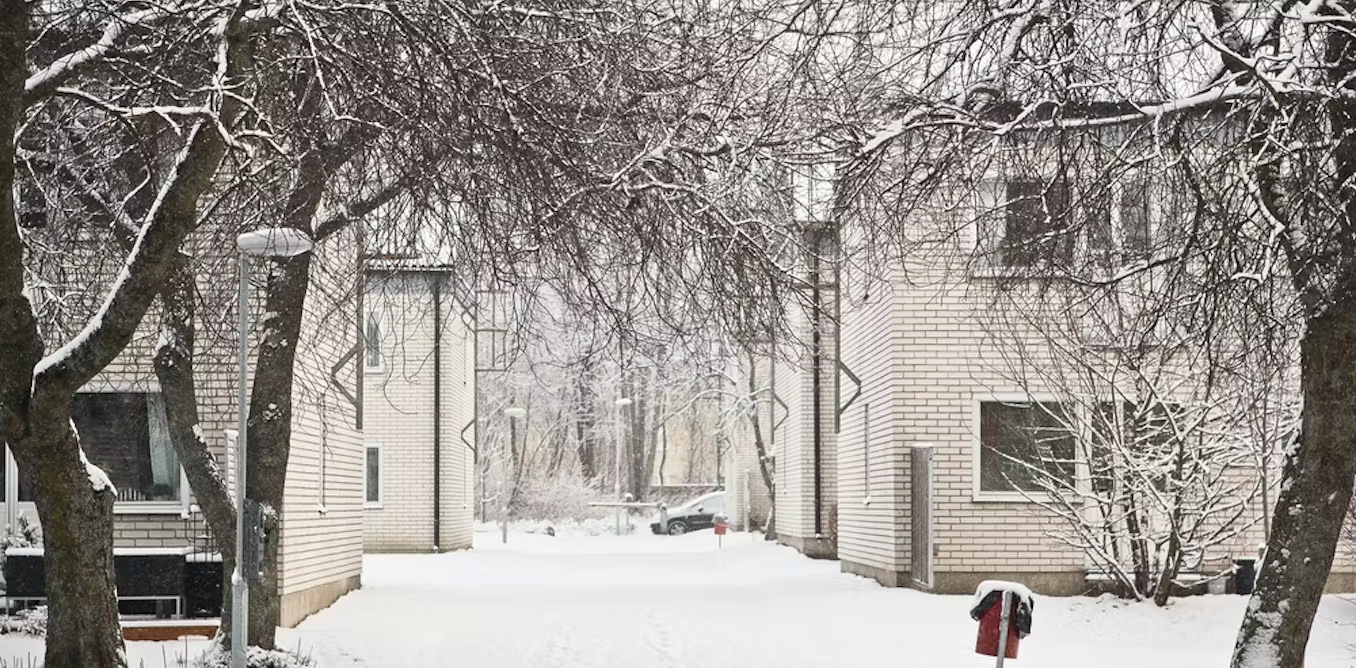
Communal laundries are one of Sweden’s environmental success stories. They began as part of the post-war million homes project, when modern apartment blocks were equipped with shared tvättstugor (laundry rooms) instead of individual residents having to buy their own machines. These rooms usually have a handful of semi-industrial washing machines, dryers and drying rooms serving an entire building. Access is through a communal booking system, and use is free to residents of the building.

Advertisement

I live in the Swedish city of Lund. Since I met my husband 11 years ago he’s been the go-to person for laundry, and takes the loads down to the communal room. For our family, using this facility is convenient because someone else takes care of maintenance and servicing of the machines and we don’t pay extra for washing clothes. It’s all included in the housing association fee, which is negotiated for the building annually.

Tvättstugor rose to prominence during the Swedish government’s widespread building programme of the 1960s and 1970s, as part of a commitment to improving living conditions and creating a fairer society.

Clean running water, reasonably priced central heating and access to a laundry were part of a broader social project: raising living standards collectively, through shared infrastructure. This often meant that shared facilities such as laundry rooms and heating were included in the rent at no extra cost. This means that many people living in apartment blocks dotted around many Swedish cities don’t have to worry about too much about hikes in energy costs for washing, or heating, if, as expected, household energy prices rise this summer, due to the conflict in the Gulf.

Around 51% of Sweden’s housing is in these apartment blocks (2.3 million homes). And a survey of tenants in Sweden in 2020 found that around 53% have access to the tvättstuga.

Advertisement

How communal laundries save resources

If each household in Sweden had its own appliances, the material stock of machines – and future waste – would escalate quickly. A tvättstuga, by contrast, can serve dozens of residences with just a few semi-industrial machines that are built to last, maintained professionally and replaced strategically. It is a denser, leaner way of organising cleanliness.

Shared laundry spaces change how often we wash. Interviews and time-use data suggest that people with easy access to their own machine tend to wash more frequently, with smaller loads. If the washing machine is in the next room and energy and water are relatively cheap, it is tempting to wash “just in case”, or to avoid the minor inconvenience of airing clothes or dabbing away a single stain. When you have to book a slot, carry clothes down to the basement and work within a fixed time window, the calculation shifts. People batch their washing, fill machines properly and think twice before throwing something in after a single wear.

Communal laundries also make technological improvement easier. Upgrading a handful of machines in a shared space is far more straightforward than relying on hundreds of individual households to replace old appliances. Shared infrastructure can be a powerful lever: change the system once, and many people benefit.

But tvättstugor are also social spaces. Where I live the laundry room doubles as a small community centre. There’s a children’s book swap, a noticeboard with local events, and a steady trickle of neighbourly encounters. My husband has his gang of dads that he sees there every Sunday. They chat while folding, sharing tips about laundry liquid and life. Negotiations over booking times, cleaning lint filters and wiping benches are not always idyllic – there are passive-aggressive notes and the odd conflict – but they are also a form of everyday democracy. We learn, in a very concrete way, how to share resources, negotiate conflict, respect common rules and live together.

Advertisement
Two dads folding the washing in the author’s communal laundry area.
Tullia Jack, CC BY

Despite the environmental and social benefits, communal laundries are disappearing from new housing schemes. Many municipal housing companies are not including tvättstugor in new builds. This is a shame because it’s not possible to solve the energy crisis individually.

We need shared infrastructures – from tvättstugor to public transport to district heating (a centralised heating system that distributes heat to a range of buildings). Sweden shows how these facilities can work in practice: these shared laundry rooms spread costs, reduce waste and nudge people towards sufficiency. Just as importantly, they give us a reason to meet, compromise and practice our negotiation skills. This can help us build the solidarity needed to tackle the climate crisis.

Source link

Advertisement
Continue Reading

NewsBeat

‘Manchester United need the training’ Armagh star dismisses training camp row

Published

on

Belfast Live

Liverpool fan and former Northern Ireland under-19 soccer star Oisin Conaty couldn’t resist a dig after the Carton House misunderstanding

Oisín Conaty has poured cold water on claims of a training ground stand-off between Armagh and Manchester United – insisting the whole thing “never happened”.

Advertisement

Rumours gathered pace online earlier this week, suggesting both teams were due to use Carton House at the same time, with Armagh allegedly forced to step aside as the pitches were lined out for soccer instead of GAA.

But Conaty, who was a talented soccer player himself and represented Northern Ireland at under-19 level, says the reality was far less dramatic.

“The pitches weren’t lined out, so we just went back up the road and we trained in Armagh,” he explained.

“It was a Saturday and Sunday, no big deal. We got three good sessions in and we’re happy with the weekend.

Advertisement

“I saw it coming out yesterday, a few tweets, but it didn’t affect us.”

Rather than any clash with the Premier League giants, Armagh simply adjusted their plans – with no disruption to their preparations.

“Everything was the same – the meetings, the trainings, everything,” Conaty added.

“We got two good sessions in and another walk-through session. It was perfect.”

Advertisement

The Orchard County ultimately lost nothing from the change of venue – aside from a night away.

“We got the same number of training sessions in Armagh that we would have done in Carton House,” he said.

“The only difference was we slept in our own beds.”

And while the supposed run-in with Manchester United never materialised, Conaty couldn’t resist a cheeky dig – especially given his footballing loyalties.

Advertisement

“If United were there, I’m a Liverpool man, so there could have been a bit of a stand-off,” he joked.

“United need the result, don’t they?

“They need the training in the last few years they’ve been going through.”

* Oisin Conaty is an AIB ambassador ahead of the 2026 GAA Championship

Advertisement

Click here to sign up to our sport newsletter, bringing you the latest sports news, headlines and top stories

Source link

Continue Reading

Trending

Copyright © 2025