Connect with us
DAPA Banner
DAPA Coin
DAPA
COIN PAYMENT ASSET
PRIVACY · BLOCKDAG · HOMOMORPHIC ENCRYPTION · RUST
ElGamal Encrypted MINE DAPA
🚫 GENESIS SOLD OUT
DAPAPAY COMING

NewsBeat

Fire appliance damaged as crew comes under attack from stone throwing thugs

Published

on

Belfast Live

‘We are there to help the public’

Youths who pelted firefighters with stones after they were called out caused so much damage a fire appliance was temporarily withdrawn from frontline duty.

The incident took place on Friday evening, May 22, in the Colin Glen Forest Park area of West Belfast.

NIFRS said they received the call-out at 7.32pm this evening and personnel responded to assist.

Advertisement

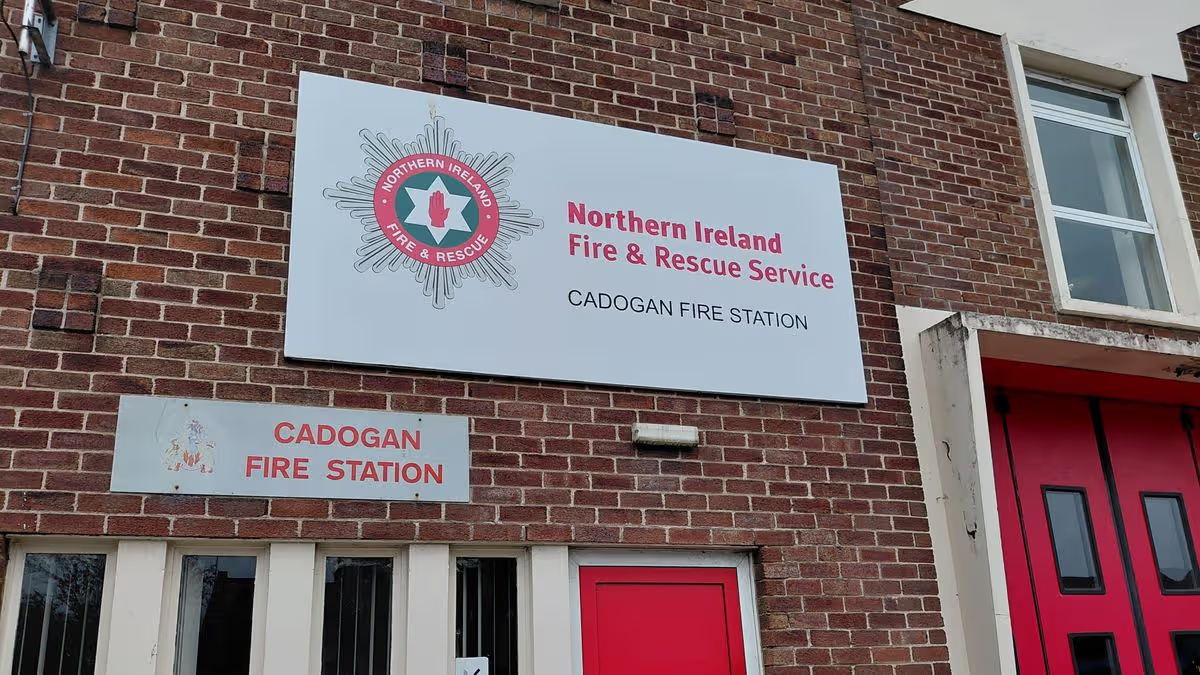
A statement from the Northern Ireland Fire Service said: “Fire crews were called out to rubbish on fire at Colin Glen Forest Park where they came under attack from youths throwing rocks. A fire appliance from Cadogan fire station was damaged during the incident and unable to respond to other calls for assistance until it was repaired.”

READ MORE: Parents and pupils urged to be vigilant after student social media hackedREAD MORE: £300,000 in cocaine transported across border using Dublin-based crime gang

A spokesman from the NIFRS said: “There was damage to the appliance which resulted in the front windscreen being broken. This meant that the appliance was unable to respond to further incidents until it was repaired.

“We want to highlight that firefighters are there to assist the public and we wish to appeal to the community to please provide assistance to crews as that we are there to help them.”

Advertisement

For all the latest news, visit the Belfast Live homepage here and sign up to our daily newsletter here.

Source link

Continue Reading
Click to comment

You must be logged in to post a comment Login

Leave a Reply

NewsBeat

City of York Council cracks down on blue badge misuse

Published

on

City of York Council cracks down on blue badge misuse

Two potential instances of misuse were identified and are now under investigation, the council said.

Cllr Katie Lomas, the council’s executive member for equality and inclusion and with portfolio for fraud, said it is “committed to ensuring that these badges are used legitimately and uphold the rights of the 7,200 York residents who hold blue badges”.

Council and fraud officers carried out the blue badge checks last Thursday (May 14).

Advertisement

Read next:


It came during the latest day of action, with 598 blue badges checked since the crackdown started in May 2023 and 17 potential instances of misuse identified in York.

Cllr Lomas said: “Days of action like this benefit disabled motorists by helping to stamp out blue badge fraud and misuse.

“It’s encouraging to see this relatively low level of suspected misuse.

Advertisement

“It suggests that people parking in the city centre are largely respecting this scheme and that genuine blue badge holders are more likely to be able to find the accessible parking they need.”

Source link

Advertisement
Continue Reading

NewsBeat

EasyJet plane forced to land after ‘power bank was charging in luggage’

Published

on

Wales Online

The airline said they diverted due to the fire risk adding ‘safety is our highest priority’

An EasyJet flight was forced to land when a passenger revealed their power bank was charging in luggage. The aeroplane was heading from Egypt to Luton before diverting to Rome at 11.30pm on Tuesday (May 19).

According to reports, word got round that a woman told a stewardess about her power bank, and the flight was diverted due to fire risks Irish Mirror reports.

Advertisement

EasyJet told The Sun: “Flight EZY2618 from Hurghada to Luton on May 19 diverted to Rome Fiumicino as the crew were informed a power bank was charging in luggage. The captain then diverted as a precaution in line with safety regulations.

“Safety is our highest priority. We would like to apologise to all passengers for any inconvenience.”

Passengers were put up in hotels or slept in the terminal as the carrier’s next Rome to Luton flight was 2pm on Wednesday, according to reports.

Ensure our latest news and sport headlines always appear at the top of your Google Search by making us a Preferred Source. Click here to activate or add us as Preferred Source.

Advertisement

Source link

Continue Reading

NewsBeat

Oldham Road pub on fire as emergency services tackle blaze

Published

on

Manchester Evening News

Emergency services are on the scene after the fire erupted at a landmark former pub in Oldham

Firefighters rushed to a fire at a landmark former pub in Oldham tonight (Friday). Crews were called to the now-derelict Weavers Arms building, on Oldham Road in Failsworth, shortly before 6.40pm.

Three fire engines were pictured at the scene. Pictures show crews using an aerial platform to douse water on the building from above.

Firefighting efforts contuinued for several hours into the night, Greater Manchester Fire and Rescue Service (GMFRS) said.

Advertisement

Click here to get the biggest stories straight to your inbox in our Daily Newsletter

A spokesperson said: “Shortly after 6.38pm this evening (Friday 22 May), three fire engines from Manchester Central, Hollins and Phillips Park fire stations were called to reports of a derelict building fire on Oldham Road in Failsworth, Manchester.

“Crews arrived quickly at the scene. Firefighters wearing breathing apparatus are using hose reels, two jets, and a turntable ladder to extinguish the fire.”

Advertisement

There are not believed to be have any reports of any injuries. The pub is said to have ceased trading in 2011.

Source link

Continue Reading

NewsBeat

Man City in talks to sign Chelsea star after Enzo Maresca request | Football

Published

on

Man City in talks to sign Chelsea star after Enzo Maresca request | Football

Close Overlay

In The Mixer’s World Cup special

Get previews of every single team at the World Cup sent directly to your inbox, featuring the players to look out for, games you shouldn’t miss and Metro’s big England predictions.

Source link

Advertisement
Continue Reading

NewsBeat

Trump applies Venezuela playbook to Cuba, but results may differ

Published

on

Trump applies Venezuela playbook to Cuba, but results may differ

WASHINGTON (AP) — The Trump administration’s strategy against Cuba is looking a lot like the playbook for Venezuela: An oil blockade, a growing U.S. military presence, federal charges and repeated threats of intervention.

But similar pressure campaigns do not equal similar results, experts say, even if President Donald Trump has often warned that “Cuba is next.”

“President Trump viewed the Venezuelan intervention as a fantastic success,” said Brian Finucane, a senior adviser with the International Crisis Group and a former State Department lawyer. “And he’s sought to replicate the Venezuela model elsewhere, including in Iran. But obviously, Cuba, like Iran, is a very different country than Venezuela.”

If the U.S. were to depose Cuba’s leadership, there is no obvious successor who would work with the Trump administration, Finucane said. That is unlike Venezuela, where the U.S. captured leader Nicolás Maduro in January and his second in command, Delcy Rodríguez, stepped in with U.S. approval and remains in power.

Advertisement

Cuban officials, who were not authorized to comment publicly and spoke on condition of anonymity, say “there is no Delcy in Cuba.”

The number of American forces in the Caribbean Sea now is also smaller and far less foreboding than the massive military buildup off Venezuela’s coast in the months ahead of Maduro’s ouster, Finucane said. Plus, an indictment against a 94-year-old former Cuban leader — Raúl Castro — is less impactful than charging Venezuela’s sitting president with drug trafficking and using that to justify his capture.

Here are some of the similarities and differences between the U.S. pressure campaigns against Venezuela and Cuba:

Trump has threatened military action

Like other conflicts, Trump began to lay the groundwork for U.S. intervention in Venezuela — and the possibility for Cuba — with escalating threats months before military action took place.

Advertisement

He has warned the leaders of the Caribbean countries to either get in line or face American might. Weeks before the audacious military operation that plucked Maduro from power, Trump stood with his top national security advisers in Florida and made what would be one of his last public threats to the autocratic leader.

“If he wants to do something, if he plays tough, it’ll be the last time he’ll ever be able to play tough,” Trump said in December. Just after Maduro was whisked to the U.S. to face trial, Trump shifted his focus to other countries in the region, namely Cuba, as being next on his list.

“Cuba is ready to fall. Cuba looks like it’s ready to fall. I don’t know if they’re going to hold out,” he told reporters on Jan. 5.

He went on to threaten tariffs on any country that sells or supplies oil to Cuba and said the U.S. might have “the honor of taking Cuba” following military operations in Venezuela and Iran.

Advertisement

On Thursday, he repeated his threats, calling Cuba “a failed country.”

“Other presidents have looked at this for 50, 60 years, doing something,” Trump said. “And, it looks like I’ll be the one that does it.”

US squeezes countries with oil embargoes

U.S. oil embargoes on Cuba and Venezuela have been designed to have the same impact: Putting intense pressure on ruling elites — but push diametrically opposite means to achieve those goals.

With Venezuela, the Trump administration was targeting the country’s oil exports, aiming to starve the Maduro government of revenue. After Maduro’s ouster, the focus shifted to denying Venezuela the ability to export oil to certain countries — primarily Cuba, from which it did not receive cash payments — and forcing it to agree to U.S. conditions for such shipments.

Advertisement

Much of Venezuela’s crude is now or will soon be sent through U.S. refineries.

With Cuba, the embargo is aimed at starving the energy-strapped country of oil imports, although the U.S. has allowed some limited shipments to arrive on the island, which recently declared it had run out of reserves. The oil embargo, an extension of the broader U.S. blockade on Cuba in place for decades, has made it far more difficult for the government to provide electricity and gasoline to its citizens.

The measures could go too far, Finucane said, and prompt many Cubans to head 90 miles north for Florida in makeshift boats as many did in the 1990s.

“President Trump especially cares about immigration. And if they push too hard on Cuba and destabilize the island, there’s the possibility of some kind of a refugee crisis,” he said.

Advertisement

US brings charges against figures in power

The Justice Department had charged Maduro with narco-terrorism conspiracy and other counts during Trump’s first term in 2020.

The case was used to justify capturing Maduro, who is now in New York awaiting trial and has pleaded not guilty. The move changed Venezuela’s relationship with the United States, which has allowed the sale of previously sanctioned Venezuelan oil to U.S. companies and on global markets, a massive shift after largely blocking dealings with Venezuela’s government and its oil sector for years.

The immediate aim of the indictment against Castro over the 1996 shootdown of civilian planes flown by Miami-based exiles is to take another step up the ladder of escalation in the Trump administration’s pressure campaign, said William LeoGrande, a professor specializing in Latin American politics at American University in Washington.

But he said that capturing Castro following charges that include murder and destruction of an airplane would not change the operations of the Cuban government.

Advertisement

Castro “still has influence and the leadership seeks his opinion on major decisions, but he is not running the government on a day-to-day basis,” LeoGrande said.

Building up a US military footprint in the region

In the months before Maduro was captured, the U.S. dispatched a fleet of warships to the waters near Venezuela in what became its largest military buildup in Latin America in generations.

The nation’s most advanced warship, the USS Gerald R. Ford aircraft carrier, was notably rerouted from Europe to join in the operation. Three amphibious assault ships carried around 2,000 Marines as well as helicopters and Osprey aircraft.

U.S. forces spent months attacking small boats accused of smuggling drugs in the Caribbean and eastern Pacific Ocean — and still are carrying out those strikes — while fighter jets flew over the Gulf of Venezuela.

Advertisement

The actual mission to capture Maduro involved more than 150 aircraft launched across the Western Hemisphere.

The U.S. military now has a smaller force in the Caribbean Sea, which still includes two amphibious assault ships with Marines onboard. It touted the arrival of the USS Nimitz aircraft carrier and accompanying warships on the same day the charges against Castro were announced this week.

But the Nimitz is on its last ever tour, taking part in maritime exercises in the region, before being decommissioned.

“They’re very different situations, and it’s very difficult to see similar outcomes,” Finucane said. “A snatch-and-grab raid against Raúl Castro or someone who’s actually in a leadership position doesn’t seem like it’s going to have the same outcome in Cuba as in Venezuela.”

Advertisement

___

Associated Press writer Andrea Rodríguez in Havana contributed to this report.

Advertisement

Source link

Continue Reading

NewsBeat

Poached apricots with star anise and vanilla recipe

Published

on

Poached apricots with star anise and vanilla recipe

The key here is not to overcook the apricots. They can become tender very quickly and must keep their shape. It’s amazing how many flavours work well with them – try this with cardamom and a splash of orange-flower water, or a pinch of saffron, replacing some of the sugar with honey. Herbs are good too, especially lavender or basil.

Requires infusing, cooling and chilling time

Source link

Advertisement
Continue Reading

NewsBeat

Education bosses ‘focused on improvement’ over Whitby School concerns

Published

on

Ripon Grammar School to reopen tomorrow after gas leak

​Parents in Whitby have been told that “sustained improvement and positive outcomes” are the focus for Whitby School after its application to convert to academy status with the Wonder Learning Partnership was not supported.

​At a recent meeting in Whitby, attended by more than 60 parents, students, and local leaders, many said they were “immensely disappointed” and felt “back at square one” over the decision.

​​It follows the controversial amalgamation of Eskdale School and Caedmon College Whitby – despite intense campaigning against the plan by many parents – which was approved by North Yorkshire Council and saw the creation of Whitby School in 2024.

Advertisement

​Speaking at a full meeting of NYC, Cllr Neil Swannick said: “The chair of the board of governors of Whitby School has recently written to parents, carers, and students to inform them that the application for Whitby School to convert to academy status with the Wonder Learning Partnership has not been supported by the Department for Education.

​“Bearing in mind that this unexpected decision follows a difficult period of amalgamation of two secondary schools in Whitby, would the executive member please inform me as the Whitby Streonshalh division councillor, and the many people in Whitby and the surrounding areas who are likely to be affected, what is the ‘plan B’?

​“In particular, what additional support and resources will be made available to the school governors and leadership?”

Cllr Annabel Wilkinson, executive member for education, said: “As you noted, the DfE did not support the academy conversion to the Wonder Learning Trust Partnership due to reasons of geographical coherence.

Advertisement

​“As a maintained school, Whitby School benefits from a comprehensive programme of school improvement support, including monitoring and challenge provided by the local authority team, in addition to support through partnership organisations.”

​At the full meeting of the council on Wednesday, May 20, she added: “The school improvement team is working closely with the governors and school leaders to ensure that the school improvement support is closely aligned to the school’s current priorities.

​“Our shared focus remains on securing sustained improvement and positive outcomes for pupils through arrangements that are coherent, proportionate, and sustainable.

​“I have spoken to the head teacher and the governors of the school, and I would really like to thank them and the staff for the sterling work they are doing as champions for Whitby and for the pupils of the school. Because, as some of you know, being governors yourselves, it’s a very demanding role, especially in today’s world.

Advertisement

​“So, I’d like to thank them, and we will continue to work closely with them, and I am going to visit the school as well to reassure them.”

Source link

Advertisement
Continue Reading

NewsBeat

How London, Paris and New York coped in the heatwaves of the past

Published

on

How London, Paris and New York coped in the heatwaves of the past

Paris, London and New York are more often associated with culture, finance and history than with dangerous heat. Yet each summer all three are increasingly exposed to extreme temperatures they were never designed to withstand.

Like many dense urban areas, they amplify heat through what is known as the “urban heat island effect”. This reflects the way that warmth is trapped in concrete, asphalt and glass, turning hot days into hazardous ones.

With skyscrapers made of glass and steel, roadways encased in cement and blocks of residential apartments, New York traps heat like few other metropolitan centres. In fact, the city has one of the highest urban heat island effects in the United States, a measurement of thermal difference between urban and rural areas. Heat kills more than 500 New Yorkers every year, a grim statistic that exacerbates inequalities along the lines of race and class.

Cricket fans struggle in the heat at Lord’s in London.
PA Images

While many people escape to the seaside or countryside to find relief, others remain in cities where the heat can be harder to avoid and more difficult to endure. Yet these uneven experiences of urban heat are not new. In cities such as London, Paris and New York, coping with hot summers has long been shaped by inequality.

Advertisement

Across the 19th and 20th centuries, urban residents developed a range of strategies to manage extreme heat in densely built environments. Our research for the Melting Metropolis project examines everyday experiences of heat. Here are some of the ways people have coped with these conditions in the past and what they reveal about living with heat in the city.

London

For most historic urbanites, escaping the confines of their home provided the greatest relief from the heat. In the mid-20th century, some Londoners escaped to the roof of their apartment building to catch the cooling breezes that swirled above the city’s streets.

For many others, since the 19th century, public spaces have provided the greatest respite from heat in their homes. Londoners turned to the shade provided by trees in nearby parks, paddled in water fountains or went for cooling dips in lidos and ponds.


À lire aussi :
A brief history of British lidos – and new hope for their return to glory

Advertisement

Historic urbanites have also tried to cope with the heat at home. In contrast to those who sought relief from the heat in public spaces, wealthier Londoners used money and technology to keep cool. In the 19th century they purchased imported ice from Norway or employed servants to operate fans.

Paris

In the heatwaves of the 19th century, Parisians also headed out in search of relief. Like Londoners, they made extensive use of the parks that urban planners embedded into the fabric of the city during the late 19th-century Haussmann-era redesign. But it was not only dense greenery that provided respite from the heat: the trees planted along the avenues of the city offered shelter from the rays of the sun on hot summer days.

A young girl in Paris leaning on a public water fountain in 1921 while a bottle fills under the spout.
Edward Roth

Although the Seine held great potential for cooling down, bathing in its waters was banned in the middle of the 19th century. Despite the official ban, photographic records show that some Parisians in search of freshness broke the law and took the plunge.


À lire aussi :
For a century, it’s been illegal to swim in the Seine. Will Paris’s clean-up make the river safe for Olympic swimmers?


To keep cool indoors, the more privileged 19th-century Parisians used ice imported from northern regions or collected locally during the winter and stored in ice houses until temperatures rose. Ice remained a luxury item until the late 1870s, when technological developments allowing ice to be made artificially lowered its cost and widened its accessibility.

Advertisement

Daily life in Paris – including in the summer – had undergone thorough transformations by the middle of the 20th century. Air conditioning began to gain momentum but some traditional ways to cool down have remained at the core of summer life: crowds continue to swarm café terraces, the banks of the Seine stay packed with people, 19th-century water fountains are still used to refill water bottles.

Children cool down with a giant block of ice in New York
Children cool down with a giant block of ice in New York circa 1910.
Niday Picture Library

New York

In the 19th century, the tenements of New York City were filled with people sleeping on roofs, sweating on fire escapes, and avoiding the sweltering indoors. The wealthy simply fled the city for countryside estates. Newspapers called these seasonal migrants “heat refugees”.

When seeking outdoor relief, most 19th-century New Yorkers headed to the beach – the city is an island, after all. But by the 20th century, they were also planing block parties with plenty of ice from corner store bodegas. On occasion, they also cracked open fire hydrants – a relief strategy that has become a classic trope of New York City summers.

A family in old fashioned long bathing suits sit in the sea
A family in bathing suits at the edge of the water at Long Beach, New York in 1898.
Old Paper Studios

Future heat waves

For as long as episodes of extreme heat in cities have affected urban life, urbanites have developed ways to cope. Today, cities are taking heat more seriously when they look to the future and working towards adaptation strategies. The disastrous heatwave of 2003 served as a wake-up call in Paris, which implemented a heat plan the following year and continues to work on ways to make the city more liveable in the summer.

Central to New York’s climate resilience plans, air conditioning has become a political battleground in activists’ fight for a “right to cooling” (a bundle of legislation championed by local environmental justice organisations).

Though it can compound the problem of climate change, technologically aided cooling keeps people alive as we all find ways to weather the intensifying heat. In May 2026, the UK’s Climate Change Committee declared that the British way of life is under threat from heat.

Advertisement

In June, London will launch its heat plan for the capital, a first step in supporting the city and its residents to live better with extreme heat.

The climate crisis has a communications problem. How do we tell stories that move people – not just to fear the future, but to imagine and build a better one? This article is part of Climate Storytelling, a series exploring how arts and science can join forces to spark understanding, hope and action.

Source link

Advertisement
Continue Reading

NewsBeat

Scot missing in Turkey after travelling for surgery ‘found safe and well’

Published

on

Daily Record

Damian Carroll, 36, from Rosyth in Fife, has reportedly been found safe and well.

A missing Scot who vanished in Turkey after travelling to the country for surgery has reportedly been found safe and well.

Advertisement

Damian Carroll, 36, from Rosyth in Fife, vanished on Saturday, May 16.

His phone had remained off, however, STV News reports that Damian was traced on Friday, May 22.

Damian vanished after disappearing from a hospital in Izmir.

At the time, he did not make his flight home to Scotland.

Advertisement

It’s understood he has since flown back to the UK.

His partner Chyvonne Petch previously said: “I’m very concerned. I’m crying all the time. I just don’t know where he is. He hasn’t been online or anything. I’ve been constantly checking but there is nothing. He is a very vulnerable man. I’m worried that he might be hurt, I just can’t stop crying.”

An FCDO spokesperson said: “We are supporting the family of a British man in Turkey.”

Get more Daily Record exclusives by signing up for free to Google’s preferred sources. Click HERE.

Advertisement

Source link

Continue Reading

NewsBeat

Barry teens racist murder sentences to be referred to Court of Appeal

Published

on

Barry teens racist murder sentences to be referred to Court of Appeal

Mr Justice Griffiths called Staniforth a “very dangerous young person indeed” and told the 16-year-old he “instigated a deliberate, unprovoked, sustained, violent racist attack”, adding he was “old enough to know that to cause serious injury on a stranger because of his race was wrong”.

Source link

Continue Reading

Trending

Copyright © 2025