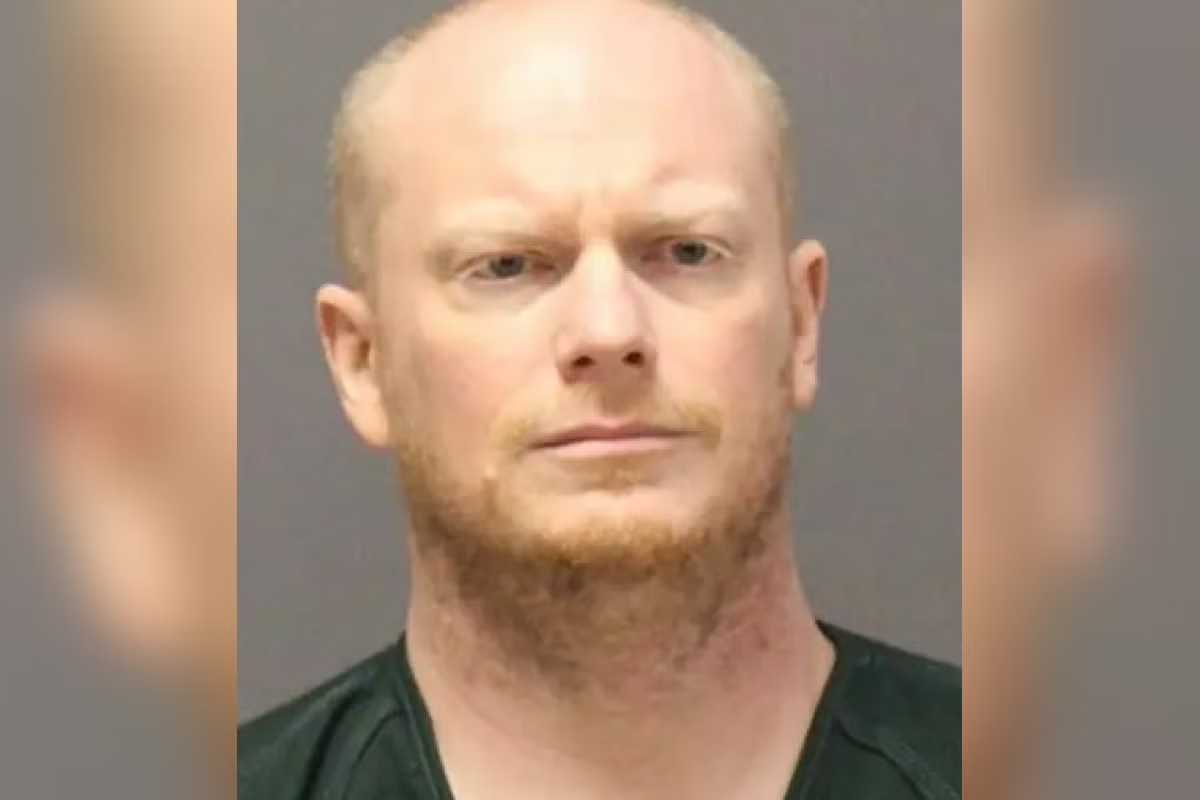
A former firefighter who allegedly drove eight hours armed with a cache of weapons was “ready for war” and intended to kill his ex-girlfriend’s family after she ended their relationship, prosecutors said at a hearing Friday.
Brian J. Lanzim, 37, was ordered held in the Ocean County Jail pending trial after Judge Pamela M. Snyder called the allegations “extremely concerning” and “extremely violent in nature.”
Authorities say Lanzim drove from Bangor, Maine, to South Toms River on April 29 with guns, ammunition and a bulletproof vest after learning his ex-girlfriend, who is also the mother of his two children, had filed for a temporary restraining order against him.
“He was ready for war,” Assistant Prosecutor Mara Brater said during the hearing. “He armed himself with two firearms. He armed himself with a bulletproof vest. He had 15 large capacity magazines in his trunk.”
Advertisement
Prosecutors allege Lanzim intended to kill or seriously harm his ex-girlfriend’s family in an effort to gain custody of their children.
Brian J. Lanzim, 37, is accused of driving eight hours from Maine to NJ armed with guns, ammunition and a bulletproof vest after his girlfriend ended their relationship (Ocean County Corrections)
“His goal was not simply to hurt the victims, but his children’s mother’s family so he could obtain full custody of his children,” Brater told the court.
According to prosecutors, Lanzim arrived at the Dover Road home shortly after 9:40 p.m. but the intended victims had already fled the home and called police. Lanzim drove his vehicle toward responding officers, who ordered him to stop and drop his weapon, but he refused.
Officers opened fire, striking Lanzim in the hand and pelvis. He was transported to Jersey Shore University Medical Center before being moved to the Ocean County Jail.
In court on Friday, Judge Pamela M. Snyder read several alleged threats Lanzim made before arriving at the family’s home. One read: “If your father is there I’m going to take him out,” adding that Lanzim allegedly threatened to render him “pulseless in the driveway.”
Advertisement
Another was about their children: “If I can’t have you no one can,” and “If you stand between me and my kids I’m going to do what I need to do.”
Defense attorney Marissa Koerner argued Lanzim was suffering a severe mental health crisis triggered by the breakup and longstanding bipolar disorder.
“‘I f***ing lost her, man. Tell her and the boys I love them,’” Koerner read from the affidavit during the hearing. “He loves his family.”
Koerner argued the incident “almost seemed like a death by suicide by cop,” claiming Lanzim wore body armor to “force a kill shot to the head.” She said he had been receiving psychiatric treatment in Maine.
Advertisement
Lanzim, who spent 18 years working as a firefighter and EMT in Ocean County, moved to Maine in September 2025 for a job with Brinks Security, according to testimony during the hearing. Prosecutors said he lost the job in March and had been “spiraling out of control” afterward.
Lanzim is charged with three counts of attempted murder, home invasion burglary, terroristic threats, unlawful use of body armor, weapons offenses and 22 counts related to possession of large-capacity ammunition magazines.
“And I feel extremely lucky, and I said this from the beginning, to find somebody at the club that you can lean into at any level. Knowing that he’s going to respond. Knowing that his heart is in the right place. Knowing that everything he does comes from certain values, certain education, certain principles.
Since it began with US-Israeli airstrikes in late February, the Iranwar has grounded tens of thousands of flights and pushed jet fuel to its highest price in years. Europe‘s jet fuel inventories have fallen 50 per cent, and Goldman Sachs warned this week that stocks could drop below the International Energy Agency’s (IEA) critical 23-day shortage threshold in June – with the UK identified as most at risk.
Many airlines are facing a financial crunch as a result, with jet fuel averaging $181 a barrel globally, roughly double its pre-war level. Lufthansa has axed 20,000 flights through October. Spirit Airlines collapsed after a government bailout fell through. American Airlines faces $4bn more in fuel costs this year, and Delta is looking at a $2bn spike in the second quarter alone.
The crisis has brought renewed attention to the hunt for other fuel sources, and there is one in particular that the industry has been talking about for years but is yet to deploy at scale. Known as sustainable aviation fuel, or SAF, it is typically made from used cooking oil, agricultural waste, and captured carbon. But how close are we to actually flying planes with it?
SAF currently makes up just 0.7 per cent of global kerosene consumption, according to the International Air Transport Association. Around two million tonnes were produced last year. The IEA’s net zero scenario requires at least 250 million tonnes of SAF annually by 2050, while some think-tanks say we should be targeting closer to 500 million tonnes by that date.
Advertisement
The most accessible feedstock – and the one most people imagine when they think of sustainable jet fuel – is used cooking oil. Almost all SAF currently in use is made from it. But the global supply of waste cooking oil is finite.
“While it’s difficult to assess exactly how much could be available, the figures you can find in the literature is something around 20 million tonnes maximum,” says Frédérique Rigal, co-author of a study published earlier this year on how aviation can decarbonise and move to sustainable fuels. Whichever projection you go by, that’s a small fraction of what is required by 2050.
The next generation of SAF – made from woody waste, agricultural residues and fermented alcohol – is more scalable but not yet commercially deployed at meaningful volumes.
Rigal admits there are some “hard limitations” on how quickly SAF production can be scaled up, partly because it requires large amounts of land, and partly because existing producers are mostly geared towards making fuel for cars not planes.
Advertisement
But she says the biggest problem of all is the fact that airlines themselves are not committing to buy SAF in advance. “Airlines are not moving quickly enough and are not giving enough offtake promises to these projects so that they can be realised,” she says.
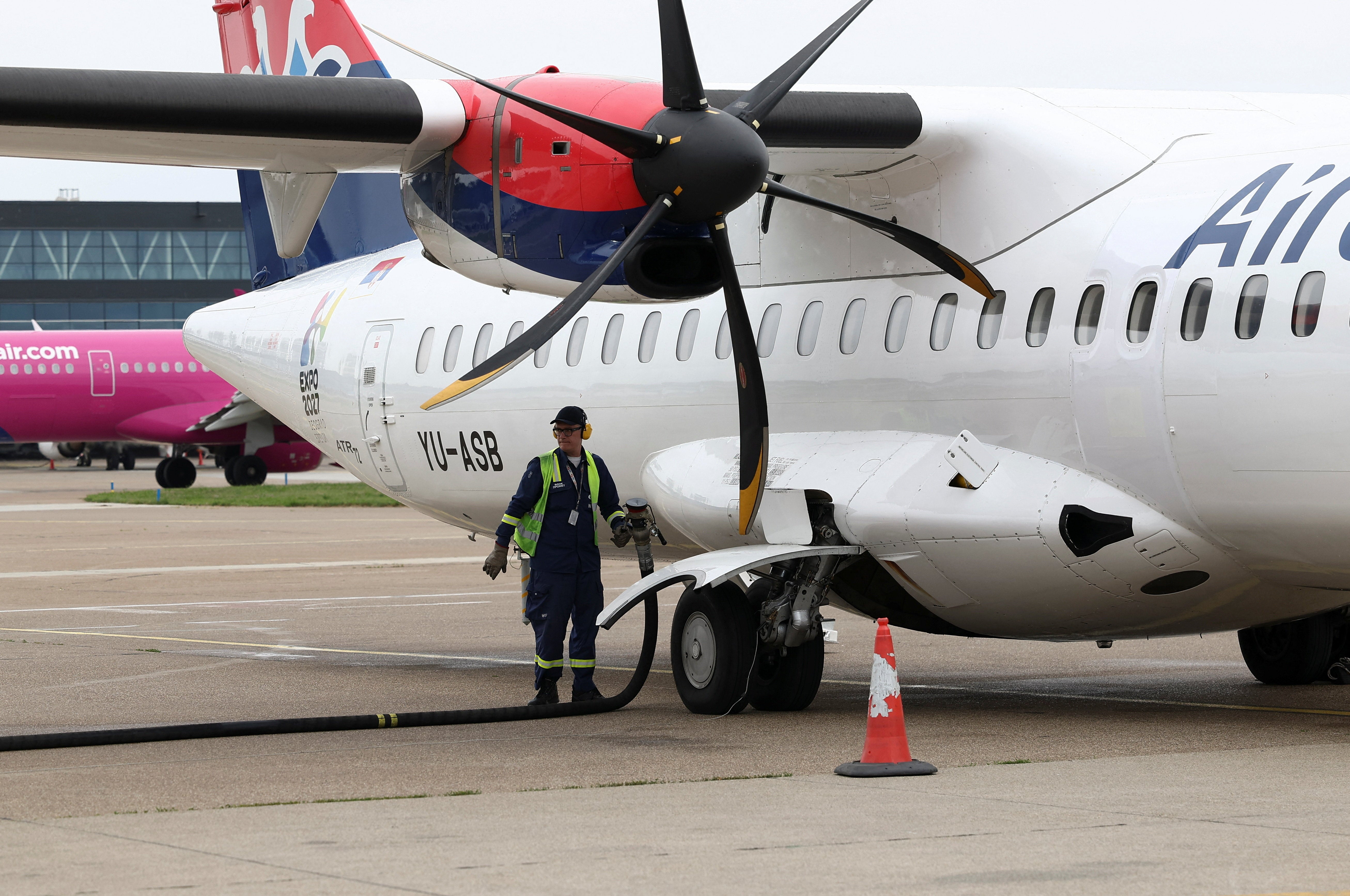
A worker refuels a plane at Belgrade Nikola Tesla airport as airports across Central and Eastern Europe are bracing for potential jet fuel shortages and flight disruptions linked to the Middle East crisis, in Belgrade, Serbia (Reuters)
Instead of looking to new alternatives, the short-term response from airlines to the shortage has come from conventional sources. US refiners have stepped up production, with exports of jet fuel to Europe surging more than 400 per cent to 94,000 barrels per day in April compared to February, according to Kpler data. The European Commission has launched a programme called AccelerateEU, which includes measures to optimise jet fuel distribution between EU member states.
But supply chain bottlenecks will persist for months even if a peace deal is reached, analysts warn. And the dominoes are falling across regions. South Korea, which supplies more than 80 per cent of the US West Coast’s jet fuel imports, has lost crucial crude from the Middle East, threatening West Coast supply.
Another alternative fuel is called electro-SAF or e-SAF, which uses green electricity to combine captured carbon with hydrogen produced from water electrolysis, creating a synthetic kerosene. There is no hard upper limit on how much e-SAF can be produced, but Rigal says it is constrained by investment and industrial capacity, not feedstock. It remains expensive, and the technology is still maturing.
The EU and UK have set mandates requiring airlines to blend increasing proportions of SAF into their fuel, with e-SAF submandates starting at 1.2 per cent in 2030. But airlines have been calling for those targets to be pushed back, citing a lack of available supply.
Advertisement
The producers say that’s not the case. In a collective letter to the European Commission, e-SAF developers said they “firmly disagreed” with airlines’ assessment, stating that “a significant number of eSAF projects are currently under development across Europe” and that “many of these projects are progressing towards final investment decision and are designed to deliver volumes within the ReFuelEU timeframe”.
Mahesh Roy, programme director for SAF at the Green Finance Institute, said the current crisis has begun to shift the conversation around these fuels. SAF mandates in the UK and EU have been almost entirely couched in the language of the climate crisis and sustainability. The Strait of Hormuz blockade has reframed them as a question of energy security and sovereignty.
“The energy trilemma was what they used to talk about – energy security, energy sustainability, and energy affordability,” Roy says. “Now you can see that security and price are really driving what people are thinking about.” The crisis has not changed what SAF is, he said, but it has changed who is asking about it and why.
Airlines that had already secured SAF supply agreements before the crisis are now quietly benefiting, because SAF supply chains do not run through the Middle East.
Advertisement
“The imperative has always been there, and now we’re just being reminded that finding better technologies to do things isn’t just about global warming, even though that’s a very good reason to do it in the first place,” Roy says.
The financial pressure on airlines to move faster on SAF is growing, regardless of the current crisis. Global airline compliance costs under environmental policies – SAF blending mandates, EU and UK emissions trading systems, and the UN’s Corsia carbon offsetting scheme – are set to nearly quadruple to $48 billion by 2035, up 256 per cent from 2026, according to BloombergNEF research published this week.
Roy says the doubling of jet fuel prices had already changed the terms of the debate. “All of jet fuel is going up by this amount due to this conflict,” he said.
“Those fluctuations can’t be guaranteed not to happen again anytime soon. That reframes it – is this just something in the realm of net zero, or is it also something that can help reduce the cost and energy security burden placed on economies that rely on fossil fuel imports?”
Advertisement
First Minister John Swinney holds a hydrogen cell during a visit to Glasgow airport (Getty)
European carriers face the heaviest burden. Ryanair’s unit operating costs are projected to rise 38 per cent from environmental policies alone by 2035, pushing the airline’s margin per available seat-kilometre into negative territory. Airlines are likely to pass higher costs onto passengers, reduce capacity, or reroute long-haul flights from European hubs to avoid the highest compliance costs – a shift that could itself increase emissions by lengthening journey distances.
The investment required to close the supply gap is staggering. According to the ATAG Waypoint 2050 report, total cumulative capital expenditure for new renewable fuel plants over 2020-2050 ranges from $4.2 trillion to $8.1 trillion, depending on SAF yield assumptions. For context, total global oil and gas capital expenditure over the entire period from 2014 to 2021 was also $4.2 trillion.
Can any of this respond to the current crisis? No, experts say. However, the direction of the travel is clear.
“It’s probably something more like four or five years” before the projects currently in development begin producing meaningful volumes, Roy says.
“If you think that the Russian invasion of Ukraine was four years ago, and then if there was another similar shock in about four years’ time, those projects that are being planned now – if they can get off the ground and be properly supported – then yeah, that would shift,” he says.
It’s understood many of the young people in attendance travelled from further afield
22:56, 09 May 2026Updated 23:01, 09 May 2026
Police have attended scenes of disorder in East Belfast as crowds of young people gathered in the area. Videos from the scene show crowds of young people gathering in the Connswater area on Saturday night, May 9.
The incident developed at CS Lewis Square following the annual East Belfast Protestant Boys parade. However, it’s understood many of the young people in attendance travelled from further afield, and were not involved in the parade.
It follows ongoing incidents of young people travelling to the area in recent weeks for arranged fights and anti-social behaviour. Many of these incidents have been centred around the derelict Connswater Shopping Centre.
Speaking to Belfast Live, local DUP councillor Ruth Brooks said: “The trouble involving a small minority at CS Lewis Square should not take away from what was otherwise a successful and well-supported East Belfast Protestant Boys parade.
“There have been ongoing issues with detached youth who travel to East Belfast for the purposes of stirring up trouble and disorder. This is becoming an increasing challenge and has caused issues for residents, youth workers, local communities and, tonight, for parade organisers and those attending responsibly.
“The overwhelming majority of those attending tonight’s parade came to enjoy the occasion responsibly and support a long-standing cultural event within the community.”
Advertisement
Last month, four young people were detained by police at the former Connswater Shopping Centre for anti-social behaviour and criminal damage after entering the derelict site.
At the time, police said they were aware of ongoing issues with anti-social behaviour in the area. PSNI Neighbourhood Inspector Dawson said: “Young people who choose to engage in anti-social behaviour must understand it is unacceptable and must stop.
“People have a right to live in peace and to feel safe in their communities. Officers continue to work alongside partner agencies, local representatives and the community to find collaborative and proactive solutions to address the problem.
“Parents and guardians must speak to their young people about where they are and who they are with and also warn them of the dangers of getting involved in behaviour which could result in injuring themselves, others, or ultimately, a criminal record.”
Steven Crichton said he wouldn’t have survived the summer after his graduation if it wasn’t for his local foodbank
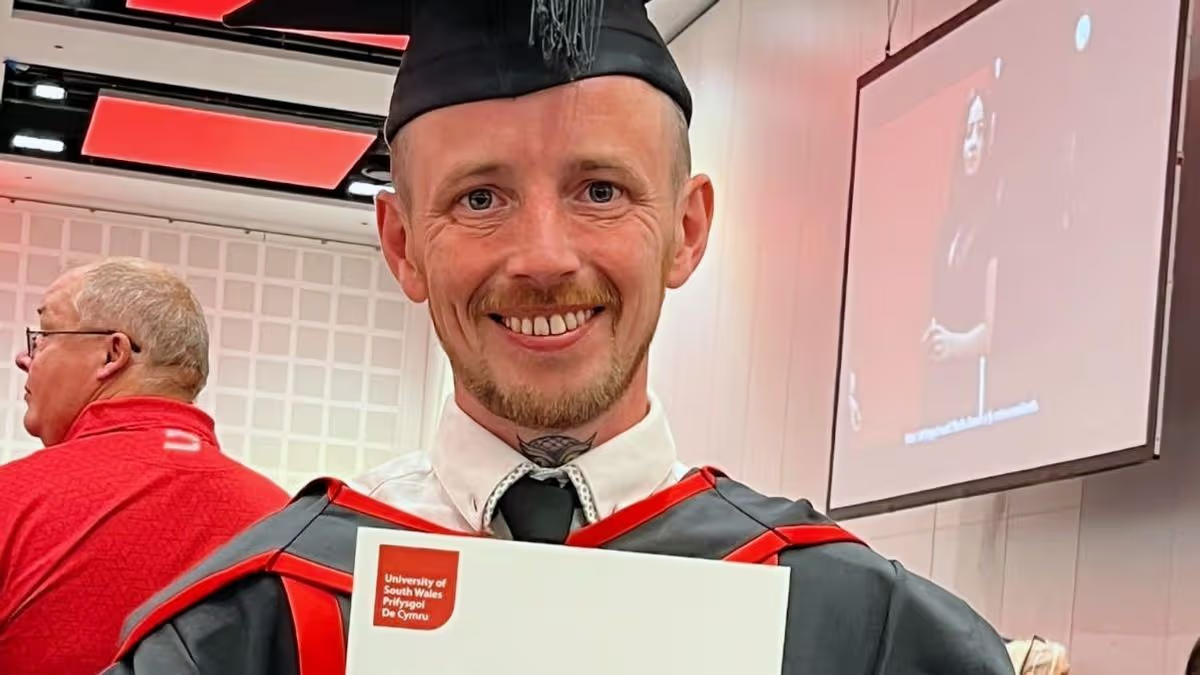
A father-of-four has told of he wouldn’t have survived the summer holidays without using a foodbank after he was left in limbo between graduating and getting a job.
Advertisement
Steven Crichton, 41, from Llantwit Fardre, had to turn to a foodbank almost immediately after finishing his four-year degree.
On the day of his graduation he couldn’t afford to have a proper breakfast or go for a swanky meal to celebrate – instead he was scratching his head about how he’d feed his children when they broke up for the summer holidays three days later.
Growing up Steven experienced a tough childhood – he lost his dad to suicide aged six and years of drug problems followed in his later teens. Following a family breakdown in his late 30s he went to therapy and said the experience completely empowered him.
At the time he was working for the Autism Directory charity but he began studying counselling skillls at night school in Coleg y Cymoedd alongside his job.
Advertisement
Having spent two years studying he then took voluntary redundancy just before the Covid-19 pandemic so he could go to university to study with the intention of becoming a counsellor.
Steven was enrolled at the University of South Wales (USW) onto their psychology with counselling course. He spent four years studying, including a foundation year. For the biggest stories in Wales first sign up to our daily newsletter here.
While he was studying he met his partner and they got engaged at their graduation in 2024. As they reached the end of their studies, and with four kids between them, they quickly realised their last student loan payment in April wasn’t enough to keep them going until they got a job.
Advertisement
Although his partner had been promised a job it was dependent on her graduating which left them scrambling about how they would fulfil mortgage payments and put food on the table.
Steven said: “We found that we graduated July 15, our kids finished school on July 18, and we were just broke. It went from being: ‘Should we take them to Aberystwyth or Carmarthen this summer?’ to: ‘How are we going to get through the first week of the summer holidays?’.
“That’s the kind of dire straights we got into. We were doing all the things we should do but the transition between part-time work and full-time education to having to go straight into full-time work is non-existent.”
As soon as graduation day passed Steven got straight on the phone to get universal credit because they hadn’t been able to apply for benefits before graduating. He was told there was a five-to-six-week waiting period before you get your first payment.
He said: “We got our first payment come through on August 28 and we had to survive for six weeks of summer with four kids and literally no money in the bank. We were living on borrowed time until we managed to get through to September.”
After grappling with whether to go to his local foodbank due to initial feelings of shame Steven went to a Trussell foodbank.
He said: “The foodbank wasn’t just a lifeline. We’d have had to send our kids to family and friends houses to get the children to eat without it.”
Advertisement
Steven said the foodbank were unbelievable and that after one visit their cupboards were filled for a week with some stuff lasting months.
“We were sitting there knowing we would be okay in the long term but we didn’t know how we’d survive for six weeks. Mortgage companies don’t take goodwill as a payment.
“I was the first person in my family to go to university so there was this expectation that I’d be given this magic piece of paper and I’d be driving around in a Bentley the next week. I still felt very proud at my graduation but when you have all this going on in the background it’s tough.”
Since his graduation USW has helped Steven start his own counselling business, Silence Speaks, where he does walking therapy, one-to-one therapy, and counselling for couples. Alongside this he also works with Trussell to help improve the experience of people accessing foodbanks.
He is keen to stress people don’t need to feel shame about going to a foodbank. He added: “These are some of the most passionate, empathetic, caring, considerate people you can get.”
Jo Harry, network lead for Wales at Trussell, is calling on the next Welsh Government to commit to tackling hunger and hardship.
“People coming to our foodbanks tell us they are sitting in the dark to save electricity and parents are skipping meals to feed their children.
Advertisement
“Hunger in Wales isn’t about food – it’s about people not being able to afford the essentials. Foodbanks can be a lifeline – but they’re not the long-term solution. They shouldn’t have to exist. Our social security system should, at the very least, cover the cost of essentials we all need to get by like food, bills, and toiletries.
“That’s why Trussell is calling on the next Welsh Government to commit to an essentials guarantee in Universal Credit, which would ensure support never falls below a minimum level and ends the need for foodbanks for good.”
Trump says ceasefire still in place despite trading Hormuz strikes with Tehran ‘lunatics’
Iran has warned it would launch a “heavy assault” on US assets in the Middle East if there are further attacks on ships, as President Donald Trump said he “expects to hear very soon” from the Iranians about a ceasefire agreement.
Trump says Washington is waiting for Tehran to respond to a proposal on ending the war.
“I’m getting a letter supposedly tonight,” the US president told reporters. “So we’ll see how that goes.”
With negotiations hanging in the balance, the US and Iran continue to engage in hostilities.
Advertisement
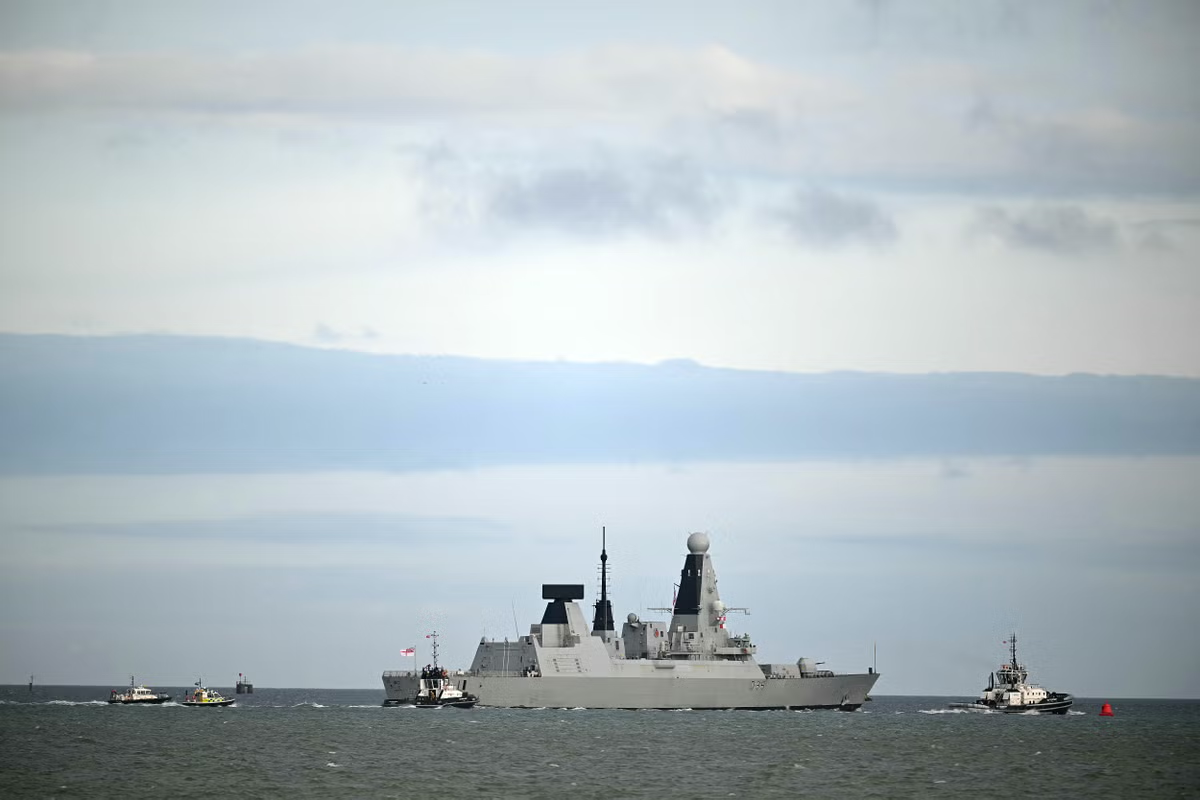
Meanwhile, the UK is redeploying the HMS Dragon to the Middle East ahead of a possible international mission to safeguard shipping in the Strait of Hormuz. As part of a proposed UK and French-led defensive mission, the warship will “pre-position” in the region, ready to contribute once hostilities between Iran and US-Israeli forces end.
The US Navy struck two Iranian-flagged oil tankers on Friday accused of breaking the American blockade, after US and Iranian forces exchanged fire overnight on Thursday. Iran has accused the US of violating the ongoing ceasefire, which President Trump insists is still holding.
In a post on X earlier in the day, Iran’s foreign minister Abbas Araghchi accused the US of consistently opting for a “reckless military adventure” every time a “diplomatic solution is on the table”.
Advertisement
Recap: Iran can withstand Trump’s blockade for months, says US intelligence
New analysis by the CIA suggests that the Islamic Republic may be more resilient than expected and could withstand the economic pain of the blockade until later this year.
Adam Withnall10 May 2026 03:49
Iranians urged to limit electricity and gas
Iran’s President Masoud Pezeshkian urged Iranians to limit electricity and gas after a US blockade interrupted the flow of shipments to Iran, state media reported.
Advertisement
“In the current situation, we must prevent pressure on the country’s energy grid through public participation and consumption management,” Pezeshkian said.
Andrea Cavallier10 May 2026 02:45
Qatari prime minister meets with Witkoff, Rubio
The Qatari prime minister met with Steve Witkoff and Secretary of State Marco Rubio on Saturday, CBS News reported.
Advertisement
A State Department spokesperson later confirmed Rubio’s meeting with the prime minister, saying in a statement that they “discussed U.S. support for Qatar’s defense, and the importance of continued close coordination to deter threats and promote stability and security across the Middle East.”
Andrea Cavallier10 May 2026 02:15
Iran threatens to target U.S. sites in Middle East
The Iranian Revolutionary Guards threatened to target U.S. sites in the Middle East if Iran’s tankers come under fire, Iranian media reported.
Advertisement
“Any attack on Iranian tankers and commercial vessels will result in a heavy attack on one of the American centers in the region and enemy ships,” the Guards said.
Andrea Cavallier10 May 2026 01:33
Trump ends 7-hour hiatus from Truth Social with flurry of posts of AI Iran war pictures and golf tournament on TV
After a roughly seven-hour lull on Truth Social Saturday, President Donald Trump resurfaced with a burst of over a dozen posts featuring AI-generated Iran war images and golf tournament snapshots.
Advertisement
His account had been inactive through most of the morning and early afternoon, but at 3:51 p.m., the 79-year-old Republican shared an artificial image showing drones marked with Iranian flags plunging into the sea, describing them as “dropping like butterflies.”
Moments later, he followed up with another fabricated visual depicting a U.S. warship firing laser beams into the sky, triggering explosions. The caption read: “Bye Bye, Drones.”
Trump then shifted his focus to criticizing his Democratic predecessors — Joe Biden and Barack Obama — appearing to fault them for not taking military action against Iran.
A split-screen graphic showed a destroyed Iranian naval fleet under the label “Trump,” contrasted with intact vessels under “Obama/Biden,” echoing Trump’s statement last month that U.S. forces had sunk 159 Iranian ships.
Advertisement
Andrea Cavallier10 May 2026 00:10
Israel set up a military outpost in the Iraqi desert – report
Israel set up a clandestine military outpost in the Iraqi desert to support its air campaign against Iran and launched airstrikes against Iraqi troops who nearly discovered it, the Wall Street Journal reported on Saturday, citing people familiar with the matter including US officials.
Israel built the installation, which housed special forces and served as a logistical hub for the Israeli air force, with the knowledge of the US just before the start of the US-Israeli war against Iran, the newspaper said. It also included search-and-rescue teams positioned to assist any downed Israeli pilots, the Journal said.
Advertisement
There was no immediate response from the Israeli prime minister’s office to a Reuters request for comment.
The base was almost discovered in early March after Iraqi state media said a local shepherd reported unusual military activity, including helicopter movements in the area.
Iraqi troops were dispatched to investigate, but Israeli forces used airstrikes to keep them at a distance and prevent the site from being discovered, the paper said, citing one of the sources.
Alex Ross9 May 2026 23:11
Advertisement
Three Israeli drone strikes hit vehicles near Beirut, killing four
Three Israeli drone strikes on vehicles just south of Beirut on Saturday killed four people while a series of airstrikes on southern Lebanon killed at least 13, including a man and his 12-year-old daughter, state media and the Health Ministry said.
The three drone strikes south of Beirut marked another escalation since a ceasefire between Israel and Hezbollah went into effect on April 17.
Both Israel and Hezbollah have continued their daily attacks despite the truce.
Advertisement
On Wednesday night, Israel’s air force carried out an airstrike on a southern suburb in which Israel said it killed a senior Hezbollah military official. It was the first strike near the capital since the ceasefire was reached.
Two of the strikes on Saturday took place on the highway linking Beirut with the southern port city of Sidon in which several people were wounded, while the third happened on a road leading to Lebanon’s Chouf region killing three, the state-run National News Agency said.
Alex Ross9 May 2026 22:12
Advertisement
Relative calm on Saturday as Trump waits on Iran
A state of relative calm prevailed around the Strait of Hormuz on Saturday, after days of sporadic flare-ups, as the United States waited for Iran’s response to its latest proposals to end more than two months of fighting and begin peace talks.
US Secretary of State Marco Rubio said on Friday that Washington expected a response within hours. But a day later, there was no sign of movement from Tehran on the proposal, which would formally end the war before talks on more contentious issues, including Iran’s nuclear program.
A Qatari liquefied natural gas tanker was sailing toward the strait on Saturday en route to Pakistan, according to LSEG shipping data, in a move sources said was approved by Iran to build confidence with Qatar and with Pakistan, a mediator in the war.
If completed, it would mark the first transit of a Qatari LNG vessel through the strait since the conflict started.
Advertisement
With Donald Trump due to begin a visit to China next week, there has been mounting pressure to draw a line under the war, which has thrown energy markets into turmoil and posed a growing threat to the world economy.
Alex Ross9 May 2026 21:21
Putin: ‘I want Iran conflict to end soon’
Russian President Vladimir Putin said on Saturday that he hoped that the Iran conflict would end as soon as possible but that if it did not then everyone would lose out.
Advertisement
Alex Ross9 May 2026 20:20
US imposes sanctions on companies it accuses of aiding Iran’s weapons sector
The US Treasury on Friday announced sanctions against 10 individuals and companies, including several in China and Hong Kong, over accusations they aided Iran’s efforts to secure weapons and the raw materials needed to build its Shahed drones and ballistic missiles.
The Treasury move, first reported by Reuters, comes days before Donald Trump plans to travel to China for a meeting with President Xi Jinping and as efforts to end the war with Iran have stalled.
Advertisement
In a statement, the Treasury said it remained ready to take economic action against Iran’s military industrial base to prevent Tehran from reconstituting its production capacity.
The Treasury said it was also prepared to act against any foreign company supporting illicit Iranian commerce, including airlines, and could impose secondary sanctions on foreign financial institutions that aid Iran’s efforts, including those connected to China’s independent “teapot” oil refineries.
Brett Erickson, managing principal at Obsidian Risk Advisors, said the Treasury’s actions were aimed at cracking down on Iran’s ability to threaten ships operating in the Strait of Hormuz and regional allies.
Saturday Night Live UK’s cold open featured Peter Serafinowicz in a guest cameo as Nigel Farage, spoofing the Reform UK leader as Prime Minister in 2046 following the party’s sweeping local election wins.
Paige Ingram and Carla Feric Press Association Entertainment Reporter
03:53, 10 May 2026
Shaun Of The Dead actor Peter Serafinowicz made a surprise appearance playing Reform UK leader Nigel Farage as prime minister in an SNL UK sketch set in the year 2046.
The comedy programme kicked off on Saturday evening with a political skit depicting Mr Farage occupying Number 10, pulling pints at his desk while US President Donald Trump has seized control as the nation’s king.
The sketch took aim at the party’s landslide victories during this week’s local council and Scottish and Welsh elections. It began with ‘Mr Farage’ recording a personalised 120th birthday message for much-loved naturalist Sir David Attenborough, before Conservative party leader Kemi Badenoch (Ayoade Bamgboye) appeared as his deputy.
“Big news day, Prime Minister. Thanks to our deportations, the population of London is finally down to single fingers,” she said, drawing uproarious laughter from Mr Farage.
Taking a swipe at the continuing tensions between the US and Iran, she went on: “One last thing, King Trump assures us he has almost negotiated a ceasefire over the Strait of Hormuz.”
Advertisement
Mr Farage responds: “Phew, for a minute there, it felt like we were on the brink of World War Four.”
The pair jest that since their parties joined forces, they have been “unstoppable”, drawing a comparison to the spreading hantavirus, referencing the outbreak that has dominated news coverage in recent days. After checking the weather forecast – which shows London engulfed in flames, satirising climate change – the pair head out for a stroll before Sir Keir Starmer and Angela Rayner emerge from behind a bookshelf, which turns out to be a time machine.
The former deputy leader, portrayed by Celeste Dring, warns Sir Keir (George Fouracres) that unless he allows her to run the government, “this future will come to pass”, to which he replies he will “seize every moment” as Prime Minister.
When Mr Farage returns to the office accompanied by Mrs Badenoch, he queries who Sir Keir is, declaring himself the “big chungus” of the “great United Kingdom and the middle part of Wales”.
Advertisement
They warn they’ll have the Labour party leaders removed from the building by security guards, but Mrs Badenoch jokes: “We deported security.”
The sketch concluded with Al Nash emerging through the prime ministerial time machine portal dressed as Sir Winston Churchill to launch the show, leading into Ted Lasso star Hannah Waddingham’s opening monologue.
The award-winning actress made light of the “glamorous characters” she has portrayed throughout her career, before displaying pictures of less flattering parts such as her “sexy little turn as the shame nun” in hit TV series Game Of Thrones.
Throughout the episode, Waddingham took part in numerous sketches alongside the show’s inaugural cast, and was accompanied by Stargazing singer Myles Smith as the musical guest. The programme also marked Sir David’s landmark 100th birthday in its weekend news segment, with hosts Ania Magliano and Paddy Young sitting down to interview a rhino (Hammed Animashaun) for their take on the much-loved broadcaster.
The skit descended into mayhem when Sir David (Fouracres) burst onto the scene to grapple with the wild beast after it dared to criticise him.
The Sky Original production is filmed live in London, featuring a rotating guest host each week alongside the show’s regular cast, which comprises actor Hammed Animashaun and comedian Ania Magliano.
SNL UK returns to Sky and Now TV on May 16 for its series finale, with Sex Education star Ncuti Gatwa taking the hosting duties, accompanied by musical guest Holly Humberstone.
Advertisement
Saturday Night Live UK is available to watch on Sky and Now TV on Saturdays at 10pm.
Having arrived an hour later than the champion to the venue because of Manchester traffic, Dubois made a brisk, business-like ringwalk.
Wardley, in his first appearance since being upgraded to world champion, soaked in the atmosphere with a leisurely entrance. Draped in an Ipswich Town Football Club robe, he was greeted by a warm reception from the 18,000-strong crowd.
With a combined record of 42 wins – 40 coming by knockout – there was palpable anticipation inside the arena, and Wardley stayed true to his promise to bring the action early as Dubois immediately hit the canvas after a flush right hand.
Dubois winked to his corner but looked shell-shocked. He wrestled Wardley to the ground as both fighters swung for the hills.
Advertisement
Many expected Dubois to impose himself early before Wardley could settle. Considered the better technical boxer, he regrouped and landed a right in the second.
Momentum swung again in the third when Wardley, who looked sharp with his overhand right and uppercuts, sent Dubois wobbling. Dubois took a knee and survived the count before firing back with a right hand that rocked Wardley.
The fighters and fans struggled to catch a breath as trainer Don Charles urged Dubois to lean on his jab, and he followed that instruction to take control of proceedings.
Dubois’ left eye was swollen, but Wardley’s face looked a mess as Dubois set up his attacks with a left jab before landing his biggest shots in the fourth and the sixth.
Advertisement
Wardley, who was working in recruitment a decade ago, showed an extraordinary chin and heart as he refused to go down despite his legs trembling and blood pouring down his face.
Most would likely have been withdrawn by their corner, but Wardley has built a reputation on dramatic comebacks. This time, however, it felt different.
The doctor inspected Wardley’s injuries before the eighth round and allowed him to continue.
By the ninth, the referee looked ready to intervene as Wardley continued to absorb heavy punishment and the contest became increasingly difficult to watch.
Advertisement
Doctors again allowed Wardley to continue before the 10th and when the stoppage finally arrived in the 11th, there was almost a sense of relief.
A sensational fight had reached its conclusion.
Warren – a veteran of 45 years in the sport – described it as “the best heavyweight fight” he has ever promoted.
University of York students contributed more than 90,000 hours of volunteering to the City during the 2024/25 academic year, with an estimated economic value of over £1.1 million.
More than 2,000 students took part in volunteering schemes, supporting refugees, providing tutoring to disadvantaged children, and running food donation programmes.
The impact was celebrated at the Student Community and Volunteering Awards, held at Merchant Taylors’ Hall on May 7 and attended by city leaders and University leaders.
Advertisement
Professor Kiran Trehan, pro-vice-chancellor for enterprise, partnerships and engagement, said: “At York, promoting the public good isn’t just an aspiration — it’s who we are.
“Tonight reminded us why.
“Hearing our students speak with such passion, purpose and conviction about the difference they’re making in the wider community was inspiring and humbling.
“The extraordinary hours they give, and the lives they touch in return, are a testament to a generation that doesn’t just imagine a better world, they go out and build it.”
Advertisement
From tackling health and education inequalities to addressing loneliness and homelessness, student-led schemes are making a difference across York.
One team received recognition for their work on the Patchwork Kitchen Project, supporting refugee and migrant women from Ukraine and Hong Kong.
Run by York City of Sanctuary, the project offered English language support through group cooking sessions, giving participants the opportunity to share recipes and stories.
It concluded with the creation of a community cookbook.
Advertisement
A spokesman for York City of Sanctuary said: “The students offered invaluable assistance to the ESOL teacher.
“Their input in developing the cookbook was essential: this project simply would not have got off the ground without their help.”
Another standout volunteer was third-year archaeology student Amy, who was nominated by the River Foss Society.
As part of York’s Sustainability Clinic, she contributed to a plant biodiversity study along the river.
Advertisement
The society described the work as a valuable starting point for more detailed future studies.
The All Should Eat project, led by students, was also praised for collecting 900 non-perishable food items to support a local community centre and donating to The Hygiene Bank York.
Professor Matt Matravers, chairman of the university’s community volunteering committee, said: “University of York students have an impressive and longstanding tradition of volunteering and participating in community-engaged activities, and we are delighted by the number of students who continue to give their time to support the wider community.
“The University is, as always, immensely proud of the contribution our students make to the City of York and beyond.”
Advertisement
Community Engaged Learning is now part of 12 academic modules, involving more than 700 students and 65 organisations across York and the wider region.
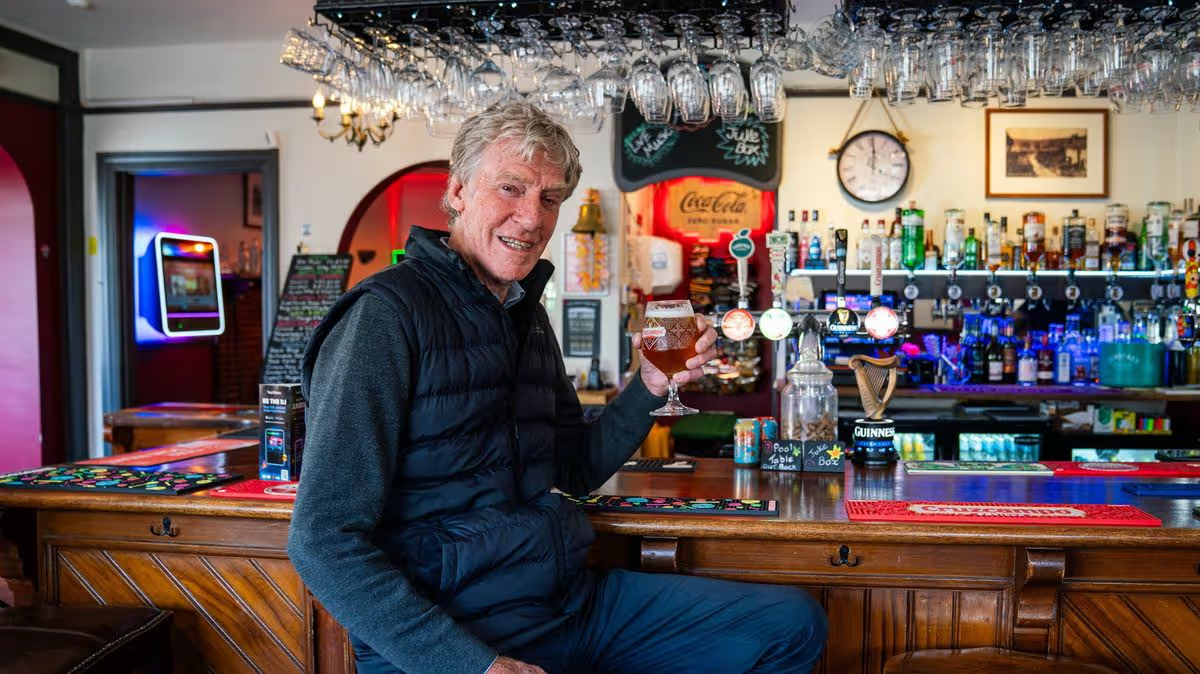
Peter Manfield, 73, just couldn’t bear the thought of losing his local village 100-year-old pub.
Filipa Gaspar and Maxine Denton, SWNS
20:16, 09 May 2026
A man who didn’t want to lose his favourite pub re-mortgaged his home to buy it and stop it shutting down. Peter Manfield, 73, could not bear the thought of losing his village local pub, so took out the loan against his house to keep the boozer going.
At the heart of the community for 100 years, The Dog and Donkey in Devon, has lived through much history during World War Two and seen an array of different landlords.
Advertisement
But making the decision to buy it did not come lightly, Mr Manfield explained, as he felt he had to give it a go or risk always living with the regret of it becoming a block of flats.
Mr Manfield said he did not have enough money to buy the pub outright, so he re-mortgaged his house and did it up as much as he could.
Although Mr Manfield, a music teacher and musician, didn’t want to disclose his personal finances, public records show the pub was sold in 2023 for around £270,000.
He said: “We obviously didn’t have enough money to buy a pub so we re-mortgaged our house to buy the pub and technically do it up as much as we could.
“It’s a lovely pub and it’s 100 year old this year and it also saw the Second World War through. It’s a beautiful building and there’s nothing else in the village apart from the village hall.
“To lose its heart would’ve been catastrophic in my opinion and you’ve got nowhere to go.”
Mr Manfield added: “If we didn’t buy it and it was sold it could be made into a block of flats, who knows? And then what have you got?
Advertisement
“You haven’t got history, that history of 100 years is gone and there’s no bringing it back. Of all that history and all that people that have come in here, the old landlords and if you look outside there’s a plaque that it’s the original plaque. This is an original building and we intend to keep this as a traditional English pub that it’s quite unique.”
Mr Manfield, who moved to the village in 1997, explained that the landlord was struggling and he was going to have to get rid of the pub. He added that it could possibly be changed into a block of flats or even be knocked down.
“I am not a big drinker, I might come down once a fortnight or once in 10 days and particularly if I have been working or playing somewhere then I come back and have a drink on the way through just to relax,” Mr Manfield explained.
Advertisement
“It’s just a lovely old building and it is a bit like when it’s gone it’s gone and it was just unacceptable to let it go without a fight. That’s the reason why we borrowed the money on the house to keep the pub.”
He explained that he doesn’t feel like he is the owner of the pub, but instead the keeper.
“I am just keeping it to make sure that it survives,” he added.
Apart from wanting to save the pub for the community, he wanted its story to remain alive. He said: “The bar is very wide and the reason is during the Second World War, G.I.s used to come down for a drink and they used to jump over the bar and try to snog the barmaid.
Advertisement
“The landlord had the bar made wider so they couldn’t jump across. It’s got an original fireplace and an original tiled floor. We would lose all that and what for?”
He added: “There’s also skittle teams here that come in, we have all sorts of people that use the pub for meetings, dog walkers, and the ethos was to keep it a traditional pub.
“It’s not a restaurant that most have become with a pub, this is a pub that does pub food. It’s a traditional pub that in my opinion we had to keep and there was no other way I don’t think.”
Mr Manfield met the current landlord Mark Loftin when he was cutting his hair, and he told him he was thinking about buying a pub. The second time they met, Mr Loftin told him he wouldn’t mind giving it a go as a landlord.
Advertisement
Mr Manfield said: “He’s never run a pub before which is brilliant in many ways before he’s got no baggage and I’d never owned a pub. Without the landlord this pub wouldn’t be here – very lucky to have found him.”
Mr Loftin took the lease over on February 1 2024. He added: “This was an amazing opportunity and something to be involved with, especially with Pete.
“Our values and belief systems basically align and that’s what’s important – wanting to keep the pub, keeping it traditional, not turning it into a gastro pub and that’s what we are doing.”
The community response has been positive, explained Mr Manfield, who added that they have been lucky that their pub is thriving.
Advertisement
He said: “Community response has been very good. We are extremely lucky in this pub to have an amazing landlord and his family is just wonderful.
“It’s a traditional English pub doing traditional English things. We have been very lucky. Many pubs are struggling and closing – this pub is surviving.”
Locals have taken to social media to thank Mr Manfield for buying the pub. One said: “Just moved into Knowle Village, great to have a friendly convenient Local!”
A second said: “Pete has always been a legend”. A third added: “Wishing you good luck in your new venture.” Another said: “It’s a great pub with friendly staff. Never had a bad meal here and plenty of it. Nice pub garden too.”
Advertisement
Get more Daily Record exclusives by signing up for free to Google’s preferred sources. Click HERE.
He added: “Spain’s authorities have prepared a careful, step-by-step plan: passengers will be ferried ashore at the industrial port of Granadilla, far from residential areas, in sealed, guarded vehicles, through a completely cordoned-off corridor, and repatriated directly to their home countries.”


















































You must be logged in to post a comment Login