Connect with us
DAPA Banner

NewsBeat

George Orwell called for a new way of thinking about science

Published

on

George Orwell called for a new way of thinking about science

In October 1945, George Orwell responded to a letter from Mr J. Stewart Cook in the leftwing weekly newspaper Tribune calling for more science education.

The call can hardly have come as a surprise. War had brought science and engineering to the fore – from the Spitfire fighter plane and radar to Bletchley Park’s codebreakers – and now that war was over, many thought it was time to build a brave new world. Science had won the war; the view was that it should build the peace.

Only the week before, in the same newspaper, Orwell had warned of the dangers posed by the atomic bomb. He was not a pacifist – far from it. But he started off by saying how likely it was that the world would “be blown to pieces by it within the next five years”, and ended with a stark warning against big science.

The bigger and more scientific the weapons, Orwell argued, the bigger and more authoritarian the state. And the bigger and more authoritarian the states that held those weapons, the greater the likelihood that an unstable stand-off between them would run and run, until the unthinkable happened.

Advertisement

Given this scenario, which he was the first to call a “cold war”, Orwell wanted to know exactly what Mr Cook meant by asking for more science education: did he want more scientists in laboratories, or did he want more people in general trained to think more scientifically?

If it was a call for more scientists in lab coats, Orwell pondered whether there was any plausible reason for expecting it to be in the public interest. Chemists might think so, clearly, but what about the rest of us? Why more chemists over more historians, say, or more writers, or philosophers, or economists?

In Orwell’s view, scientists at war had shown themselves to be just as self-interested, just as nationalist, just as Nazi, and just as politically illiterate and mistaken as everybody else. A few million more was not going to make things better – and maybe worse.

He wrote: “The fact is that a mere training in one or more of the exact sciences, even combined with very high gifts, is no guarantee of a humane or sceptical outlook. The physicists of half a dozen great nations, all feverishly working away at the atom bomb, are a demonstration of this.”

Advertisement

On the other hand, more science as a way of thinking had Orwell’s full support. In his Tribune response (republished in the third volume of his collected essays), he defined this as “a rational, sceptical, experimental habit of mind”.

Only, Orwell averred, you don’t have to be a scientist to think like this. And away from the test tubes and reactors, a scientist might not think like this. An illiterate peasant could be just as rational, just as sceptical and just as experimental, in his own domain at least. Yet no one, least of all a fellow of the Royal Society, was going to call him a “scientist”.

The whole argument, Orwell feared, might end up dropping the notion of more scientific thinking across the population, and “simply boil down to” more physics, less literature, and a narrowing of thought all round.

Orwell leaves it there. Not very profound, you might think, but in the best Orwellian manner, designed to catch your sleeve and make you think.

Advertisement

The blessings of science

When he was at Eton, Orwell wrote a short story for the school magazine called A Peep into the Future. In it, a mad professor takes over the school to impose a reign of terror based on the “blessings of science”.

Until, that is, one Sunday morning in chapel, a mighty proletarian woman – “massive hands on her hips” – comes striding down the aisle to take a swipe that relieves the professor of his dignity and his position. “A good smackin’ is what you want,” she said. And a good smackin’ is what he got. “He was never seen again … the reign of science was at an end.”

There might be shades of Big Brother in this schoolboy story, except that Orwell’s novel Nineteen Eighty-Four, published in 1949, is not about the reign of science but a reign of terror devoted to the complete eradication of science.

The whole point of the ruling party “Ingsoc” (a left-fascist totalitarian regime) is the destruction of the concept of objective truth, discoverable in nature. Instead of experimentation, there is only manipulation. Instead of reasoning, there is only fear. Instead of facts, there are only lies. It is axiomatic that two plus two equals five and always will, so long as the party says so.

Advertisement

Winston Smith’s interrogator, an intelligent man by most other measures, tells Winston that he (the interrogator) could identify as a soap bubble if he wanted to, and float off. And nobody was going to say he couldn’t. Winston tries and has his brain reprogrammed for the effort.

In Nineteen Eighty-Four, the ruling party Ingsoc seeks to destroy of the concept of objective truth.
TCD/Prod.DB/Alamy

Seeing things ‘as they are’

Orwell’s fiction was more concerned with essences than probabilities. As for his non-fiction, although he rarely invoked statistics or empirical research, he operated as near to the general scientific method as possible, given the human condition.

Getting it right, seeing things “as they are”, was one of his four reasons for writing. Orwell is forever at pains to establish the facts, to reason in plain sight, to show due caution, and to experiment in the only way politico-literary criticism can experiment – by imagining the alternatives.

Advertisement

With or without Donald Trump, there are always alternative facts, and writers must search them out. Thomas Hobbes’s view of man in a state of nature is not the same as fellow philosopher Jean-Jacques Rousseau’s, and the facts are legion on both sides.

Orwell’s personal library contained a few popular science volumes but was mainly literary. He adhered to the scientific method like the “illiterate peasant” he was at heart – a man who was at his happiest in his garden, eyeing the weather and measuring the soil by instinct and experience.

Let Orwell find a problem, and he would bring the full width of his reasoning to bear. But in the end, words are an art not a science, and there are no rules except a pitch for the truth.

This article includes references to books included for editorial reasons, and links to bookshop.org. If you click a link and go on to buy something from bookshop.org, The Conversation UK may earn a commission.

Advertisement

Source link

Continue Reading
Click to comment

You must be logged in to post a comment Login

Leave a Reply

NewsBeat

Motorcyclist ‘lost control’ before crashing into barrier, inquest hears

Published

on

Cambridgeshire Live

A motorcyclist “lost control” before crashing into a safety barrier along a Cambridgeshire road, an inquest into his death has heard. Emergency services were called to a crash on the A1307 near Swavesey at around 5.10pm on August 29, 2025.

The crash involved a grey Porsche 911 and motorcycle. The motorcyclist, 35-year-old Christopher Millard from Warboys, died after the crash.

Coroner Elizabeth Gray told the court today (Friday, April 17) at Vantage House in Huntingdon, that a post-mortem concluded that Chris died of “multiple traumatic injuries due to a road traffic collision”.

Advertisement

A CT scan revealed that Chris suffered “severe blunt trauma to the head”, as well as fractures including to his spine. A police report read out to the court stated that Chris and the driver of the Porsche were travelling westbound on the A1307 on the day of the crash.

The court heard how Chris’s motorcycle “attempted to overtake” the Porsche, and crashed into the front of the car. Chris then “lost control” and crashed into a safety barrier. Witness statements read out stated that they believe Chris was travelling at around 90mph, with the Porsche travelling at a “slower speed”.

One witness said the Porsche and motorbike were being driven “aggressively”, and when they were travelling next to each other, they were “closer than normal”. The court heard that there were no defects with either the Porsche or motorbike, and the Porsche driver and Chris were “not under the influence”.

In her conclusion, Coroner Gray said that both vehicles were travelling at “high speeds” in the lead up to the crash. However, she said Chris “lost control” of the motorbike before crashing into the barrier, but it was an “unknown reason” why he lost control.

Advertisement

Coroner Gray added that he may have “misjudged” the speed of the Porsche or the distance when overtaking the vehicle. Before the inquest was heard, Chris’s partner shared a few words about the 35-year-old.

She said Chris was a “shadow of a person” when she first met him, but he had “built his life up”. She added that he was “happy” and they had planned to marry. She said: “It’s really sad his life was cut short”.

At the time of the crash, Cambridgeshire Police arrested a 46-year-old man from South Cambridgeshire on suspicion of causing death by dangerous driving. He was then released on bail.

A police spokesperson confirmed that the man arrested had his “bail cancelled” and there was “no further police action” needed.

Advertisement

Source link

Continue Reading

NewsBeat

Review: Waiting for Godot, Octagon Theatre, Bolton

Published

on

Review: Waiting for Godot, Octagon Theatre, Bolton

Theatre should always provoke emotion in an audience but thus far, via various incarnations, the only ones Samuel Beckett’s play has stirred up in me have been confusion, annoyance, apathy and worst of all boredom.

At best I’ve been underwhelmed, at worst left totally baffled as to why it is regularly cited as a classic.

Matthew Kelly as Estragon and George Costigan, Vladimir, in Waiting for Godot (Picture: Mihaela Bodlovic)

So it was with some trepidation that I approached the Octagon.

As the tramps Vladimir and Estragon, George Costigan and Matthew Kelly deliver something of an acting masterclass as two ageing gentlemen of the road awaiting the arrival of the mysterious Godot.

Advertisement

Who he is and what they expect from him is never revealed, but they feel compelled to return to the same spot every day in the hope he will turn up.

Theirs is a bleak existence, it is a life without purpose. So they bicker, they jest, they tease and they insult each other – basically to pass the time.

Matthew Kelly as Estragon and George Costigan, Vladimir, in Waiting for Godot (Picture: Mihaela Bodlovic)

Of the pair, Costigan’s Vladimir is the more optimistic, certainly the more energised. He has a wicked twinkle in his eye at times, dreaming up ways of keeping his road companion amused. But old age has left him with a dodgy prostate and in his quieter moments he’s prone to reflect on the purpose of it all.

Matthew Kelly as Estragon in Waiting for Godot (Picture: Mihaela Bodlovic)

Matthew Kelly’s Estragon is the more world weary. His boots hurt him, he craves sleep and his memory is failing him. He’s the more childlike of the two; a shrunken bear of a man prone to tantrums and also wondering what is the point.

Advertisement

In real life the actors have been friends for years and that closeness adds an extra dimension to their performance. And it’s here the secret to Waiting for Godot lies. These two central characters hold the piece together. It’s their relationship which is essential to the piece.

It was a joy to watch two such accomplished actors go about their craft. Their timing, their physical comedy and their ability to instantly shift from bravado to bewilderment was riveting; a hat swapping scene was worthy of the greats of the silent cinema.

In previous productions I’ve seen, the pair have simply come across as a nihilistic version of the Chuckle Brothers. But in this world bereft of hope, you could sense the love the two characters share for each other. They are both flawed, failing and cast adrift by an uncaring world and unable to cope without one another.

George Costigan, Vladimir, and Matthew Kelly as Estragon with Pozzo played by Gbolahan Obisesan in Waiting for Godot (Picture: Mihaela Bodlovic)

Into the pair’s miserable world comes Pozzo, played by Gbolahan Obisesan. He’s a riot of colour in a monochrome landscape; a loud, swaggering bully of a character dragging his slave Lucky behind him.

Advertisement

Honestly. I still don’t really know what he symbolises or why he’s there; other than to give Vladimir and Estragon something to talk about.

But it’s a very strong performance; his return in the second half having suddenly become blind, perhaps indicating that even the mighty can fall.

Michael Hodgson as Lucky in Waiting for Godot (Picture: Mihaela Bodlovic)

Michael Hodgson as Lucky was genuinely unnerving. A giant rope around his neck leaving painful looking sores, his posture and primeval yelps proved really disturbing. Then his lengthy, surreal monologue, as well as being a real feat of memory, just added to the other worldliness of it all.

The simple stage setting, with some great lighting, helped to build the claustrophobic atmosphere of Vladimir’s and Estragon’s bleak world.

Advertisement

Without wishing to attract the ire of Beckett scholars, I still think there’s an element of Emperor’s New Clothes about the whole thing.

But as far as this production was concerned, it was a privilege to witness the performances of Messrs Corrigan and Kelly. That ladies and gentlemen is how to act, how to hold an audience, how to move an audience – and all in a play in which nothing really happens.

Until May 2. Details from www.octagonbolton.co.uk

Advertisement

Source link

Continue Reading

NewsBeat

‘Trendy’ Spanish fashion store to open at Metrocentre

Published

on

'Trendy' Spanish fashion store to open at Metrocentre

Lefties, part of the Inditex group which owns Zara, Bershka and Stradivarius, will open a flagship store at the Metrocentre later this year.

The store will be one of the brand’s first three in Britain and its only branch in the North East.

Ben Cox, director of the asset managers of Metrocentre, said: “We’re proud to confirm that Lefties are the latest exciting new entrant to commit to Metrocentre.

“As one of the first Lefties stores in the UK, this is another major endorsement of Metrocentre as a key location for international brands investing in UK retail.

Advertisement

“Lefties’ trend-savvy offer will be a compelling addition to our retail mix, and this signing, once again, reflects the dominance and appeal of our scheme to both national and international retailers.

It is a fashion and homeware brand. (Image: LEFTIES)

“With our consistent footfall, extensive catchment, and quality retail offer, we continue to stand out as the leading destination in the region.”

The new store will open in Town Square, where the Red and Green Malls meet.

It will join Metrocentre’s growing list of fashion brands, including Urban Outfitters, Mango, and Hollister, which will open this summer.

Advertisement

Lefties will offer collections for women, men, teens, children, babies, and newborns, along with accessories, footwear, and homeware.

Inditex’s Bershka is also set to open its first North East store at Metrocentre later this year.

Metrocentre reported a 4.8 per cent increase in fashion category sales in the first quarter of 2026 compared to the same period last year.

Womenswear sales rose by 9.2 per cent during the same period.

Advertisement

Will you visit the new store?

Source link

Advertisement
Continue Reading

NewsBeat

Households with lavender in their garden urged to take 1 action in April

Published

on

Wales Online

Gardening expert Michael Griffiths has shared an essential five-minute lavender task do in mid to late spring if the plant is looking untidy or frost-damaged

Throughout British gardens, lavender is only beginning to emerge from its winter dormancy, and in numerous outdoor spaces, it still appears far from its summer glory. A touch of careful attention now can make a significant difference when cultivating lavender, enabling the plants to maintain their form and appear purposeful rather than weary or woody once summer comes around.

One task that gardeners ought to undertake with their lavender now is pruning, particularly if they’ve overlooked pruning the plant in late summer last year.

Advertisement

Speaking on his gardening TikTok account @themichaelgriffiths, Michael explained: “If you missed pruning your lavender in late summer, or it’s looking untidy or frost-damaged, now in mid to late spring, when this new growth appears, is the perfect time to prune.”

Lavender ranks as the most under-pruned plant in Britain, with people fearful of cutting into the brown wood. With this concern in mind, Michael has demonstrated the “right way” to prune lavender during this period of the year.

Content cannot be displayed without consent

The gardening expert emphasised one crucial rule to observe when undertaking this job – you can prune lavender as vigorously as you wish, provided you’re not cutting into old wood and you retain some new growth below the cutting point.

Michael observed that it’s straightforward to distinguish between the old wood, which appears brown with almost white foliage, and the new growth, which displays a bright green colour at this time of year.

Advertisement

The gardening expert advised that pruning should be carried out just above the old wood, ensuring that a small amount of the new growth remains intact.

For anyone who mistakenly cuts into the old wood, Michael cautioned that this section “may not regrow” and “you could lose the plant”, so when uncertain, it’s best to stay above the new growth.

It’s important to note that severely pruning your lavender may lead to reduced flowering and a postponed blooming period.

British springs tend to be briefer and cooler, meaning a plant that undergoes hard pruning in April has limited time to recover before the flowering season begins.

Advertisement

As the UK moves into summer, it’s worthwhile deadheading your lavender. Removing the spent flower stalks following the initial flush of blooms in late June will promote a more robust second flowering in late summer.

While not absolutely necessary, as the seed heads have their own appeal if you choose to leave them, for particular varieties it does create a marked improvement to the August display.

Source link

Advertisement
Continue Reading

NewsBeat

NATO fighter jets scramble as Russian aircrafts detected near 3 European countries

Published

on

Daily Record

As many as six Russian planes were spotted near Lithuania, Latvia and Estonia

NATO fighter jets were reportedly scrambled after six Russian planes were seen near three Baltic states.

A French crew spotted the supposed threat as Russian jets were seen over the Baltic Sea, near Lithuania, Latvia, and Estonia.

Advertisement

French military then shared footage of four NATO Rafale B fighters tracking a Su-30SM fighter alongside a Russian Il-20M electronic intelligence aircraft. Analysts have suggested these aircraft may have been equipped with Kh-31P or Kh-31PM anti-radiation missiles, which is typically used to engage radar and air defence systems.

It is reported the four Rafale B fighters were deployed as part of an “enhanced Air Policing Mission”. The operations were carried out from Šiauliai Air Base in Lithuania, the base where France is heading up NATO’s air policing efforts, The Mirror reported.

During these operations, the French Rafales reportedly used Thales Talios targeting pods.

Although mainly designed for attack missions, these systems possess long-range visual identification capabilities. This allows would be pilots to safely assess potential threats remotely. These operations are part of NATO’s Baltic Air Policing mission, which aims to guarantee the integrity of Baltic airspace.

Advertisement

Earlier today (April 17), there were also reports of a Russian drone breaching the airspace of a NATO country during an overnight bombardment targeting Ukraine. Romania’s Defence Ministry said its air defences identified two targets in the border area of Tulcea county during attacks on Ukrainian civilian infrastructure, one of which entered its airspace.

The ministry said in a statement: “One of the targets entered the airspace of our country, the radar contact with it being lost 16 km southeast of Chilia Veche over an uninhabited area.

We strongly condemn the actions of the Russian Federation that endanger regional security, constituting a serious violation of the norms of international law.”

A team has been sent to investigate the area following the alert, which began just after midnight local time on Friday and ended at 2.48am. Tulcea is directly across the border from the Ukrainian port of Izmail, which has been a target for Russian attacks, and is bordered by the River Danube

Advertisement

Source link

Continue Reading

NewsBeat

DUP leader accuses other parties of ‘making it worse’ for struggling families

Published

on

Belfast Live

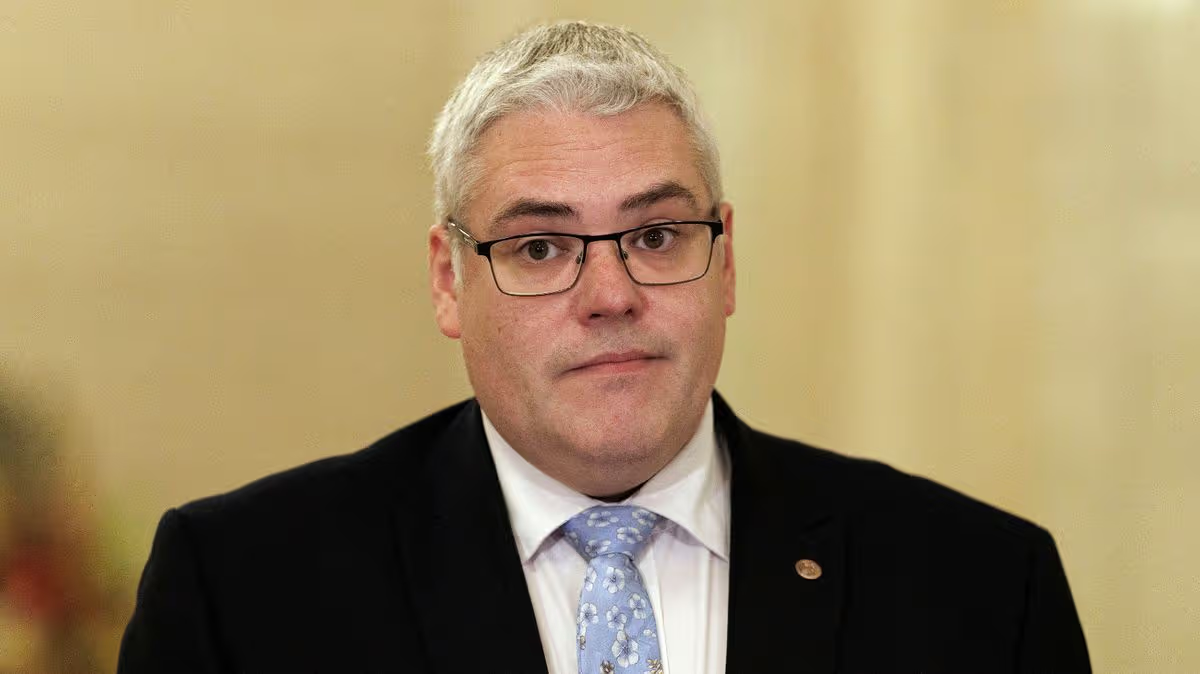
In his weekly email to party members, Mr Robinson said people in Northern Ireland are “being squeezed from every direction”.

DUP leader Gavin Robinson has said other parties in the powersharing Executive are “making it worse” for people who are struggling to deal with the cost-of-living crisis.

Advertisement

Mr Robinson accused Sinn Fein, the Alliance and Ulster Unionist parties of “gesture politics” and of backing proposals when the “financial consequences are unresolved”.

In his weekly email to party members, Mr Robinson said people in Northern Ireland are “being squeezed from every direction”.

He added: “Some of those in power are making it worse.”

The powersharing Executive met this week and announced a support package for some households which use home heating oil.

Advertisement

Ministers pledged £19.2 million to go with £17 million already set aside for the scheme from the UK Government.

The scheme will see up to 340,000 lower-income households receiving a £100 payment to go towards their heating oil bills.

Mr Robinson said this was “delivery” from his party colleague, Communities Minister Gordon Lyons.

The DUP leader then referenced the Holiday Hunger Bill, which aims to support children in receipt of free school meals financially during holidays, which passed its second stage at the Northern Ireland Assembly.

Advertisement

He said: “At the Assembly this week, parties backed a proposal to provide free school meal payments over the summer holidays carrying a price tag of over £20 million this year, rising to more than £30 million annually – with no credible answer to one basic question: where does the money come from?”

He added: “Because the answer is uncomfortable. That money comes out of the education budget.

“It means fewer resources in classrooms, reduced support for children with special needs, and cuts to frontline services.

“That is the trade-off, and too many parties simply refuse to say it out loud.”

Advertisement

Mr Robinson said the “same is happening” with support for net zero emissions targets.

He said: “Sinn Féin, Alliance and the Ulster Unionist Party have backed both the summer meals proposals and refused to face up to net zero realities – knowing full well the financial consequences are unresolved.

“They want the headlines, they want the social media clips.

“But when the bills arrive, it will not be their politicians who pay them, it will be the families, farmers and small businesses already struggling to get by.

Advertisement

“That is gesture politics and it has a real cost.”

The DUP leader said if parties wanted to spend more they should “say where the money comes from”.

He said: “If you cannot answer that question, you have no business casting the vote.”

For all the latest news, visit the Belfast Live homepage here and sign up to our daily newsletter here.

Source link

Continue Reading

NewsBeat

Manchester Piccadilly trains to halt for urgent repairs

Published

on

Manchester Piccadilly trains to halt for urgent repairs

The wiring above the railway at Manchester Piccadilly Station was damaged on Thursday morning (April 16) and engineering teams worked through the night to assess and repair the damage.

Network Rail have said that due to the complexity of the problem, repairs will need to be completed in a block starting Saturday night and running until Sunday morning.

An amended timetable will be in place until 11pm on Saturday night (April 18) and, after then, no trains will run out of Manchester Piccadilly – including platforms 13 and 14.

Advertisement

Instead, an amended timetable will be in place at other central Manchester stations and services in and out of Piccadilly will start again at 11am on Sunday morning (April 19).

Passengers have been urged to check with their train operators before travelling, particularly with big sporting events taking place, including the Manchester Marathon and Manchester City vs Arsenal on Sunday. 

Network Rail’s North West route director, Chris Wright, said: “I am sorry to our passengers who have been impacted by the damage to our overhead wires outside Piccadilly.

“The damage was sustained over a large area in a complicated location on the railway. Our engineers have worked tirelessly to fix the issue, and we worked closely with train operators to offer an amended timetable today, which will continue into Saturday.

Advertisement

“We are carrying out a full repair on Saturday night. To do this, we need to close the line into Manchester Piccadilly between 11pm on Saturday and 11am on Sunday. Please, if you are planning to travel into Manchester by rail on Sunday morning, plan your journey in advance and allow extra travel time.”

Simon Turner, Head of Operational Readiness at Avanti West Coast, said: “We’ll be operating a significantly reduced timetable between Manchester Piccadilly and London Euston on Saturday 18 April due to the ongoing issues with the overhead electric wires. These services are expected to be extremely busy, and we strongly advise customers to check before they travel.

“We’re continuing to work with Network Rail and industry partners to help customers get to their destinations via alternative routes. We’d like to thank customers for their patience and remind anyone whose journey is delayed by 15 minutes or more to claim Delay Repay compensation.”

For up-to-date travel information and detail on alternative travel please check ww.nationalrail.co.uk.

Advertisement

Source link

Continue Reading

NewsBeat

Charlie Kirk suspect calls for courthouse camera ban ‘for fair trial’

Published

on

Daily Record

Prosecutors intend to seek the death penalty for Tyler Robinson should he be convicted.

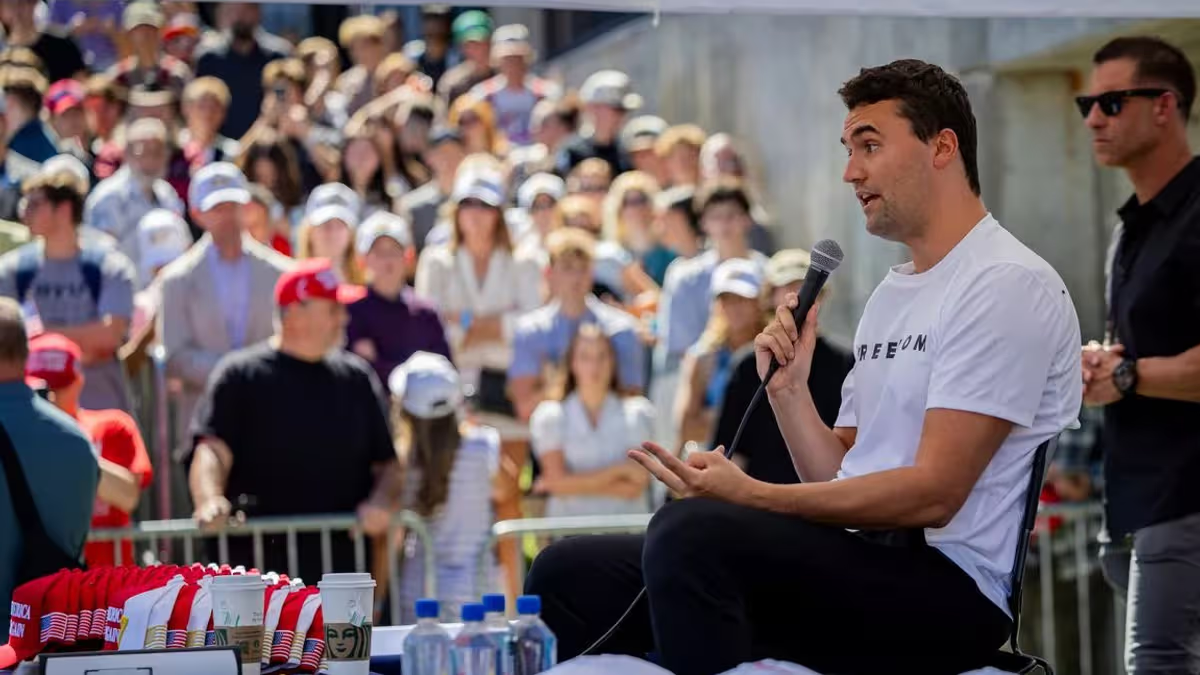
The man accused of killing Charlie Kirk wants a judge to ban cameras from the courtroom and says live broadcasts of the prosecution are violating his right to a fair trial. Tyler Robinson was back in state court in Utah on Friday as his lawyers asked to delay his May preliminary hearing and pressed their claims that biased coverage is tainting potential jurors in his aggravated murder case.

Among numerous examples cited was a New York Post story they say suggested Robinson confessed to Mr Kirk’s killing during a courtroom conversation on December 11, in his first appearance after being charged. The conversation with his lawyers was inaudible, but the story cited a “lip reading analysis” to support its claim that Robinson said: “I think about the shooting daily.”

“The predominant purpose being served by the live stream coverage has not been the educational reporting of the court proceedings, but rather advertising profit, sensationalism, political agendas, and, most prominently, the vilification of Mr Robinson,” his lawyers wrote in their request to bar cameras. Prosecutors intend to seek the death penalty for Robinson should he be convicted in the September 10 shooting of the conservative activist, who was addressing a crowd of thousands on the Utah Valley University campus in Orem.

Advertisement

Robinson, who turned 23 on Thursday, has not yet entered a plea. A trial date has not been set. Media organisations, prosecutors and Mr Kirk’s widow, Erika Kirk, want the court to allow cameras.

They argue the best way to guard against the misinformation and conspiracy theories that concern Robinson’s defence team is to make the process transparent. Yet livestreaming by media outlets already has tested the patience of Judge Tony Graf.

During the December hearing, Judge Graf temporarily stopped the livestream after it showed the defendant’s shackles in violation of a courtroom decorum order. A January hearing was interrupted when Robinson’s lawyers said close-up shots of Robinson being livestreamed by a local television station could again lead to claims based on lip reading.

Advertisement

That, too, was a violation of Judge Graf’s decorum order. The judge ordered the camera operator not to film Robinson for the remainder of the hearing.

In recent hearings and again on Friday, pool cameras for the media were stationed at the rear of the courtroom, behind Robinson. The judge also made camera operators come before him to acknowledge they understand the rules.

Mike Judd, a lawyer for a coalition of media organisations including The Associated Press fighting to preserve access, said the judge has so far focused on whether his rules inside the courtroom are being followed, not what the media is saying outside court.

Advertisement

“The court can do all of that in order to try to control what gets fed into that media ecosystem,” Mr Judd said. “You reduce the likelihood of somebody publishing things that you think may be of potentially biasing concern later on.”

Advertisement

The preliminary hearing scheduled for May is for prosecutors to show they have enough evidence to proceed to trial. Authorities have said DNA consistent with Robinson’s was found on the trigger of the rifle, the fired cartridge casing, two unfired cartridges and a towel used to wrap the rifle.

But the defence argued on Friday it cannot move forward with the hearing until law enforcement agencies turn over more details about their DNA analysis of evidence.

Prosecutors responded that they have sufficient proof beyond DNA to tie Robinson to Mr Kirk’s killing. That includes surveillance video of Robinson near the university from the morning of the shooting wearing the same clothes as when he turned himself in.

Robinson left a handwritten note for his partner confessing to the crime before it happened, and also confessed to friends on the chatroom platform Discord, prosecutors said.

Rescheduling the preliminary hearing could delay the proceedings six months, Deputy Utah County Attorney Ryan McBride said.

“Justice delayed is justice denied,” he added.

Get more Daily Record exclusives by signing up for free to Google’s preferred sources. Click HERE

Advertisement

Source link

Continue Reading

NewsBeat

Big change as dog law ‘extended to roads and paths’

Published

on

Daily Mirror

Dog owners are being warned about a major dog law change that could see them hit with unlimited fines

Dog owners are being alerted about a significant legal change that could result in them facing unlimited fines. The Dogs (Protection of Livestock) (Amendment) Act 2025 officially took effect on March 18, 2026, introducing some of the most substantial updates to countryside regulations in decades.

Advertisement

The alert comes as extended daylight hours and milder temperatures encourage more people to venture outdoors for walks. Under the new legislation, which is applicable in England and Wales, the previous £1,000 maximum penalty has been scrapped, meaning courts can now impose unlimited fines on owners whose dogs are discovered to have worried livestock.

Crucially, “livestock worrying” doesn’t simply mean an attack; it encompasses chasing animals or causing them fear or stress, even without any physical injury. Simultaneously, police have been granted enhanced powers to investigate incidents.

Officers can now seize and detain dogs suspected of involvement, enter premises with a warrant and gather evidence, including obtaining DNA samples or mouth impressions to assist in identifying the dog responsible. For numerous owners, it’s a development that feels considerably more severe than previously.

Michael Nelson, from Kennel Store, said: “A lot of people still think this law only applies if a dog actually attacks or injures an animal, but that’s not the case. Even something as simple as chasing livestock can be enough.

“Owners often say their dog is friendly and wouldn’t hurt anything and that might be true in most situations. But around livestock, instinct can take over very quickly, and that’s where problems start.”

Major dog law change means roads and paths now included

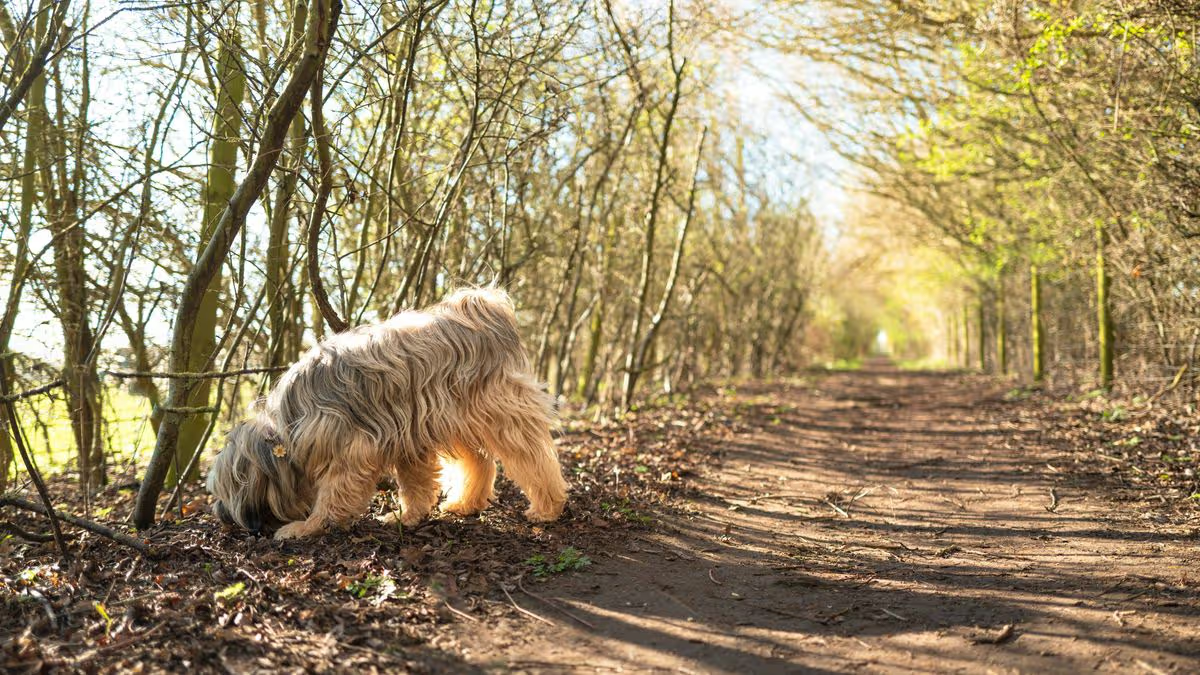
One of the most significant changes catching people by surprise is where the law now applies. Previously concentrated on agricultural land, the revised legislation now covers incidents occurring on roads, paths and public rights of way near livestock, not just within fields.

Michael explained: “That’s a big change that hasn’t really cut through yet. You don’t actually have to be walking through a field anymore. If your dog reacts to animals from a nearby path or road, you could still be in trouble.”

Advertisement

The law has also been amended to reflect the genuine impact these incidents can have. Livestock don’t need to be physically injured for an offence to occur; stress alone can cause serious harm, including miscarriage or long-term health issues.

Michael added: “From a distance, it can look harmless, a dog running or barking, but for the animals involved, it’s a completely different story. They can panic, run, and injure themselves very easily.”

He also cautioned that once an incident occurs, the consequences can escalate rapidly: “People don’t always realise how serious it can become. You could be dealing with police involvement, your dog being taken away while it’s investigated and potentially a very significant fine.”

Advertisement

Courts can also order owners to cover the costs associated with seizing and caring for a detained dog, adding to the financial impact.

Michael said: “If you’re anywhere near livestock, the safest thing you can do is keep your dog on a lead. It’s not about whether your dog is well-trained or friendly. It’s about understanding that in the wrong moment, any dog can react.”

Source link

Advertisement
Continue Reading

NewsBeat

Starmer faces ‘judgement day’ and ‘Breakthrough in the Strait’

Published

on

Starmer faces 'judgement day' and 'Breakthrough in the Strait'
The headline on the front page of the FT Weekend reads: "Starmer digs in over vetting fiasco."

The FT Weekend says the PM “digs in” as he faces accusations from Conservative leader Kemi Badenoch of lying to save his job. Elsewhere, the paper reports that oil prices have tumbled after the US and Iran declared the Strait of Hormuz open for shipping. Iran’s foreign minister said the critical waterway would be “completely open” for commercial ships for the remainder of the two-week ceasefire, which ends next Tuesday.

Source link

Continue Reading

Trending

Copyright © 2025