“He said to me, ‘Gran, why didn’t I go after them?’ and I replied, ‘Because, they would have killed you’.”
A vulnerable grandmother says she has been left terrified to attend football matches again after allegedly being punched by a thug Celtic fan before their dramatic clash with Motherwell.
Advertisement
Patricia Stafford, was heading towards Fir Park with her grandson on Wednesday evening when horror unfolded before kick-off. Celtic would go on to snatch a dramatic 3-2 victory thanks to a last-minute penalty from Iheanacho but the 72-year-old from Ayr says the match was overshadowed by a shocking attack that left her bruised, shaken and suffering flashbacks.
The lifelong Motherwell supporter claims she was assaulted after a gang of youths who targeted her grandson for wearing a club scarf. The attack is alleged to have taken place on Knowtop Avenue outside of the gate to the John Hunter stand.
She said: “I go to Motherwell games with my grandson. We parked outside the ground early. We were walking to our gate.
Advertisement
“A lot of Celtic fans were around, then all of a sudden a group of six or seven in their late teens appeared.
“One of them jumped out of the crowd and grabbed my grandson’s scarf. He pulled him towards him.
“My instinct was to scream and when I did this, the Celtic fan threw a right hook and punched me right on the chin.
“He took his scarf and ran away.
Advertisement
“I have no idea why this happened. My grandson is not an ultra. He goes to the games with me and we sit together.
“He was totally defenceless when it happened.
“He said to me, ‘Gran, why didn’t I go after them?’ and I replied, ‘Because, they would have killed you’.
“They would have. They were in a big group and all of them would have gotten a kick into him.
Advertisement
“I always thought because he was with me, that he was safe. It’s really scary.”
The stunned gran, who was comforted by a passing group of Hoops fans following the alleged beating, says there were no officers nearby when it happened. Police Scotland has since launched a probe into the incident.
She said: “There were no police around because they were all up at the away section.
Advertisement
“An off-duty policewoman from Bellshill witnessed the full thing.
“She followed the boy to the away end. She went to officers there and pointed the boy out to them because she recognised the hole on the back of his trousers.
“The police told her they couldn’t do anything about it.
“I am just so disappointed in the police, they could have grabbed him and stopped him.”
Advertisement
Patricia, who was told by later told by officers that they would check CCTV in the area, says the ordeal has left her deeply traumatised.
She said: “It was so shocking and I was left shaken. The first aid checked on me but my face was all numb.
“The numbness started to disappear as the game went on and my neck started to ache and my back was sore. It was too much for me and we had to leave because I was in too much pain. We missed the last two goals.
“When I got home, I told my husband what had happened after he noticed the bruising on my face.
“I was so calm telling him but the minute I went to my bed, it all came flooding back to me.
Advertisement
“Every time I had a moment to think, I was having flashbacks. It was horrible and I was getting so upset.”
The gran has even considered giving up going to the football altogether after the incident.
She said: “After it happened, I asked my son, ‘Should I cancel my season ticket?’. He said, ‘Why should you?
“You’ve been going for years’. I ended up renewing my season ticket because I can’t let them win.”
Advertisement
But ahead of Motherwell’s away clash against Hibs at Easter Road on Saturday, Patricia admits she is now filled with dread.
She said: “My grandson and I have tickets for the Hibs away game on Saturday.
“When we purchased them, we thought it would be a lovely day out going to watch Motherwell via the train. Now I’m panicking and I don’t want to go.
“I tried to sort a seat on a supporters bus but they were all sold out. I feel vulnerable going myself and would feel safer in numbers.”
Advertisement
A Police Scotland spokesperson said: “On the evening of Wednesday, 13 May, 2026, police received a report of an assault in the Knowtop Avenue area of Motherwell. Enquiries into the incident are ongoing.”
Motherwell and Celtic were approached for comment.
Get more Daily Record exclusives by signing up for free to Google’s preferred sources. Click HERE
PORTLAND, Maine (AP) — This election year is déjà vu for Sen. Susan Collins — the Maine Republican is running for reelection as Democrats pin their hopes on a new candidate to defeat her. Last time, it was state lawmaker Sara Gideon. This time, it’s combat veteran and oyster farmer Graham Platner.
But Collins has proven to be a hard target for Democrats over the years — even for candidates without the baggage of Platner, who has faced criticism for his relationships with women, inflammatory online posts and a previous tattoo recognized as a Nazi symbol. Collins is seeking her sixth term with sky-high name recognition, a record-breaking run of consecutive Senate votes and a history of bringing back federal funding for her state for years.
She is also the rare Republican who sometimes can boost her own popularity back home by keeping her distance from President Donald Trump, and she has perfected that delicate dance even as his tightening grip on the party has cost two of her Senate Republican colleagues their reelection.
Sens. John Cornyn of Texas and Bill Cassidy of Louisiana lost their primaries when facing Trump-endorsed opponents. But despite the president’s complaints about Collins, he did not campaign against her. Years of practice have made her adept at staying close — but not too close — to the president when it is politically advantageous, and moving away when showing an independent streak is helpful.
Advertisement
“She’s shown time and time again where her state’s electorate is. She understands what’s too far, she understands where she needs to be,” said political consultant Matt Mackowiak, who worked for Cornyn’s failed reelection campaign. Trump endorsed Cornyn’s opponent, Texas Attorney General Ken Paxton.
The road to Senate control goes through Maine
The Democrats need to flip four seats to take control of the Senate in November and hope that Trump’s falling approval ratings and the war in Iran — as well as its subsequent effect on oil prices and the economy — could buoy their chances. Maine is among the top targets, along with Alaska, Ohio and North Carolina.
Platner wants to make the case that Collins isn’t as independent of Trump as her reputation suggests — repeatedly noting that she allowed his Supreme Court nominations to go through, which in 2022 led to the overturning of Roe v. Wade, a landmark 1973 decision that legalized abortion, among other major issues.
“Susan Collins may have started her career decades ago in Washington with good intentions, but she has become just as spineless and corrupt as the establishment she now serves,” Platner said at a victory party on Tuesday.
Advertisement
Platner supporters are ready for change, said John Keenan, of Sullivan, Maine.
“I think Maine has grown tired of the same old system,” he said. “And putting youth into the campaign, with new instead of a rubber stamp, is very refreshing.”
Trump has often criticized Collins — but not lately
Even as she faces Platner in November, Collins may have to stay wary of Trump. The president has spent years singling her out for daring to occasionally defy him on some issues.
However, he’s refrained from doing so more recently — especially as Collins failed to draw a credible challenger and cruised to a Republican primary victory.
Advertisement
The White House declined to comment. Political advisers close to Trump, however, said the president understands how critical it is that Republicans maintain control of Congress after November, which requires accommodating Collins. Trump understands the need to avoid a Republican wipeout like 2018’s “blue wave” midterms that saw Democrats flip the House and derail much of the last two years of his first-term plans.
“Senator Susan Collins represents the people of Maine first and foremost and has proven herself to be a dedicated public servant,” said Republican National Committee spokesperson Kristen Cianci in a statement.
Collins spokesperson Blake Kernan said the senator “has worked with five different Presidents throughout her Senate tenure, and has never agreed with any of them on every issue.”
“When she agrees with an effort, she will support it; when she disagrees, she does not hesitate to speak up for what she believes is the right outcome for Maine and for America,” Kernan said in a statement.
Advertisement
Other Republicans ran into trouble with Trump
That didn’t work out for some Republican senators.
Cornyn was among his party’s top voices, rising through the ranks after joining the Senate in 2002. Paxton trounced him in a runoff race days after Trump endorsed the attorney general.
In office since 2015, Cassidy voted to convict Trump during his impeachment trial after the U.S. Capitol siege on Jan. 6, 2021. He lost his primary to Trump-endorsed state Rep. Julia Letlow.
Maine figures to be a more competitive race in November — as evidenced by Trump recently refraining from singling out Collins. That’s despite her voting last week with Democrats to block the nearly $1.8 billion fund the president wanted to create to benefit allies that he claims were unfairly targeted by law enforcement.
Advertisement
“She’s always down in the polls and she survives,” Trump conceded when asked about Collins in an interview with the New York Post last week.
Collins defeated Gideon, the Maine House speaker, by almost 9 points in 2020, the same year that Biden beat Trump by a similar margin in the state.
Mackowiak said “there’s just no pathway to a MAGA senator from Maine.”
“It does appear that the Trump political operation is soberly analyzing the electoral environment in Maine and really kind of follows her lead as it relates to that state and that race, particularly this cycle,” he said.
Advertisement
Maine Republicans are ‘a bit more pragmatic’
Chuck Ellis, a Republican from Westbrook who runs a digital marketing company, said Collins’ reluctance to move in lockstep with Trump can be a plus.
Although there are some “hard-line” voters who may disapprove, Ellis said, “ultimately a lot of your conservatives, your Republicans, are people who are a bit more pragmatic.”
After Collins opposed the White House’s signature tax cut and spending package last year, and voted against a proposal to claw back $9 billion in foreign aid and public media funding, the president complained about her on social media.
“Republicans, when in doubt, vote the exact opposite of Senator Susan Collins,” he wrote.
Advertisement
Then, in January, Trump lashed out at the “stupidity” of Collins and four other Senate Republicans who joined Democrats to start a debate over restricting the president’s use of force in Venezuela.
She later received a profanity-laced call from Trump.
White House may keep a further distance from Collins’ race
As chair of the powerful Senate Appropriations Committee, Collins last week cast her 10,000th Senate vote in a row, setting a record.
“She has been able to do and show that ‘I am bringing money and resources from the federal government to Maine to help Maine,’” Ellis said.
Advertisement
The president is unlikely to travel to Maine ahead of November despite visiting other states with key Senate races, like Iowa and Michigan. He could even campaign personally for Paxton.
Vice President JD Vance has been to Maine, where he promoted his anti-fraud task force. Collins didn’t attend Vance’s speech in Bangor last month where he acknowledged the senator’s distance from the Trump administration.
“If she was as partisan as I sometimes wish that she was,” Vance said, “she would not be a good fit for the people of Maine.”
A man in his 40s and an 11-year-old boy were taken to hospital in Hyde, Tameside, after emergency services rushed to Carter Street amid reports of a suspected accidental poisoning involving an unknown substance.
10:24, 10 Jun 2026Updated 10:24, 10 Jun 2026
A man and boy have been rushed to hospital after a suspected poisoning.
Officers are looking into whether the pair, Tameside, Greater Manchester, were ‘accidentally poisoned’. Emergency services descended on Carter Street in Flowery Field, Hyde, on Tuesday evening (June 9).
Greater Manchester Police says it received a call regarding concerns for the pair’s welfare at 8.10pm. The incident involved an ‘unknown substance’, according to Greater Manchester Fire and Rescue Service (GMFRS), reports the Manchester Evening News.
Advertisement
Police, paramedics and firefighters attended as part of a major emergency response. A man in his 40s and an 11-year-old boy were taken to hospital from the scene.
It’s understood officers are treating the incident as a potential accidental poisoning.
A GMFRS spokesperson added: “At around 8.25pm on Tuesday, June 9 2026, a number of appliances from Greater Manchester Fire and Rescue Service attended an incident at Carter Street, Hyde.
“The incident involved two casualties affected by an unknown substance. Fire crews made the scene safe and remained at scene just over two hours.”
Police asked people to “remain calm” as masked men took to the streets to riot
Homes and cars have been set on fire as violent protests take place across Belfast following a stabbing in the city on Monday night. Stephen Ogilvie, who is in his 40’s, remains in serious condition in hospital with injuries to his eye, face and back after the knife attack.
Advertisement
A 30-year-old Sudanese man has been charged with attempted murder, possession of an article with blade or point in a public place and threats to kill after the incident at around 10.30pm on Monday, June 8.
Police in Northern Ireland have asked the public to “remain calm, act responsibly, and avoid any activity that could place themselves or others at risk” after a night of rioting across Belfast. Don’t miss a court report by signing upto our crime newsletter here
Groups of masked men were seen kicking in doors and setting fires to properties and vehicles as they were heard shouting “foreigners out” due to the ethnicity of the man charged being revealed.
Assistant chief constable of the Police Service of Northern Ireland, Ryan Henderson said on Tuesday evening: “Sporadic pockets of disorder have broken out in a number of locations across Northern Ireland this evening, including incidents in which a number of vehicles have been set on fire.
“We are urging everyone to remain calm, act responsibly, and avoid any activity that could place themselves or others at risk. Officers are on the ground, working alongside partner agencies, responding to incidents as they arise and helping to keep people safe.
“We are again appealing for calm and ask all voices of influence within local communities to encourage peaceful protest and discourage any involvement in violence or disorder.”
Police were made aware of numerous social media posts initiating protests spread widely across Northern Ireland.
Anti-migrant groups have been reported as being the instigators of the protests, calling for people to take to the streets of Belfast overnight.
On Tuesday, ACC Henderson said: “Throughout today we have been liaising with senior counter-terrorism officials. Due to the nature of the attack, at the stage we have no information to suggest this was terrorist-related. However, we are still at the early stages of our investigation.
Advertisement
“This brutal attack will understandably have sent shockwaves through the community. I want to reassure all our communities, safety is our priority and we are currently engaging with local representatives and residents to provide reassurance and support.”
The 30-year-old man charged with attempted murder is due to appear at Belfast Magistrates’ Court today, Wednesday June 10.
Get daily breaking news updates on your phone by joining our WhatsApp community here. We occasionally treat members to special offers, promotions and ads from us and our partners. See our Privacy Notice
The First Minister slammed demonstrations in Glasgow, Edinburgh and Ayr last night as “unacceptable”.
10:01, 10 Jun 2026Updated 10:09, 10 Jun 2026
John Swinney has called on Scots to stand against “racism, hatred and intimidation” after a violent knife attack in Belfast sparked angry protests last night.
Police Scotland was forced to deploy dozens of officers last night as demonstrations in Glasgow, Edinburgh and Ayr turned ugly.
But the most shocking scenes were witnessed in the Northern Irish capital where witnesses described homes and cars belonging to black people were deliberately set on fire by mobs.
Advertisement
Rioting broke out in Belfast following an “attempted beheading” which saw a 30-year-old male Sudanese national charged with attempted murder.
In a post on social media, Swinney said: “The scenes we saw in Glasgow, Edinburgh and Ayr last night are unacceptable.
“Scotland is a welcoming nation and those who choose to make their lives here are valued members of our communities.
“Racism, hatred and intimidation have no place in Scotland. We must stand against it.”
Advertisement
We’ll be bringing you the very latest updates, pictures and video on this breaking news story.
The struggle was initially put down to a milk allergy
08:41, 10 Jun 2026Updated 08:50, 10 Jun 2026
A baby whose feeding struggles were originally put down to a milk allergy was later diagnosed with a one-in-a-million genetic condition. Emma Law, 26, from Ely, Cambridgeshire, struggled to feed her daughter Rosie and when she lost weight doctors thought she had reflux and a cow’s milk allergy.
But when Rosie continued to regress – losing her smile and strength – she was rushed to hospital at six-months-old. Doctors eventually discovered Rosie has a rare mitochondrial disease linked to the EARS2 gene called COXPD12, which affects the body’s ability to produce energy and can damage the brain and nervous system.
The seven-month-old is now fed through a nasogastric tube because of severe swallowing difficulties and has hypertonia, a condition affecting muscle function and movement. Her prognosis remains unknown.
Advertisement
Mum Emma told Talk to the Press: “She stopped smiling and her head started losing strength. She was like a new born again. Then she stopped feeding for 24 hours, so I took her to A&E and demanded they did more tests. Being told your little one might not make it was the most heart breaking thing.”
Emma first noticed something was wrong shortly after Rosie was born because she struggled to latch during feeds. As the months went on, feeding became increasingly difficult and Rosie lost a significant amount of weight, dropping two centile lines between December and January.
Doctors initially believed she had reflux and a cow’s milk allergy and switched her to a specialised formula. Although the change appeared to help for a short period, Rosie’s symptoms soon returned.
Advertisement
Emma also became worried that her daughter was not developing like other babies her age. She said: “I would put her down on her play mat and she would just scream. If she wasn’t crying, she was just looking at objects. In terms of movement, she wasn’t really doing anything.”
Rosie’s condition then deteriorated further. She stopped smiling, became weaker and was unable to hold her head up. Following her admission to hospital in April, doctors identified concerns with her muscle tone and swallowing ability.
She was fitted with a nasogastric feeding tube and underwent a series of tests. An MRI scan revealed extensive abnormalities in the white matter of her brain.
Advertisement
Emma said doctors explained that areas of the brain tissue had begun to deteriorate, prompting suspicion of a serious genetic condition. Further genetic testing on Rosie and her parents confirmed a diagnosis of COXPD12, a mitochondrial disease related to the EARS2 gene.
The condition is extremely rare, with only a small number of cases recorded worldwide. Rosie also has elevated levels of lactic acid in her brain and body, placing her at risk of metabolic acidosis.
Doctors have told the family the condition could stabilise or improve, but there have also been cases where affected children died before the age of two. Emma and her husband Harry, 27, a project manager, are now fundraising to access specialist therapies, future clinical trials and additional support that could improve Rosie’s quality of life.
Advertisement
The couple recently moved back to Cambridgeshire from Worcestershire to be closer to family as they navigate Rosie’s care. Despite the uncertainty surrounding her future, Emma says her daughter continues to amaze her every day.
She said: “She is so strong. She wakes up every day trying to smile even though she struggles to do so much. She has her own little personality and every obstacle she comes across, she conquers.
“I can’t even think of the thought of losing her, I am trying to keep it together but it is so hard. She is amazing and I am so proud to be her mum.”
BEIRUT (AP) — As Israeli warplanes pounded Beirut’s southern suburbs last March and residents fled in panic, one man found his opportunity. Amid the chaos, he slipped out of his imprisonment in a Hezbollah cell and made his way to the green hills overlooking the Lebanese capital.
There, in the posh diplomatic quarter of Baabda, he disappeared inside the gates of the Ukrainian Embassy.
Where he is now is a mystery, tangled up in an ongoing spy game as Hezbollah attempts to root out Israeli intelligence operatives that have infiltrated the militant group.
The man identified by Lebanese officials as Khaled al-Aydi is said to be a Palestinian refugee from Syria who also holds Ukrainian citizenship. He had been detained by Hezbollah in the Beirut suburbs and accused by Lebanese officials of being part of a thwarted Israeli intelligence plot to carry out bombings and assassinations.
Advertisement
Details of al-Aydi’s escape and a Lebanese military court’s case against him were provided by three judicial officials and two senior security officials in Lebanon who spoke on condition of anonymity because they were not authorized to comment publicly. A senior political official in Hezbollah also provided details.
Al-Aydi’s disappearance could have political implications for the Lebanese government, which has largely remained silent about the case.
If evidence were to emerge that al-Aydi escaped Lebanon with help from the government, it could inflame tensions with Hezbollah’s largely Shiite Muslim base. The government already faces scrutiny for directly negotiating with Israel, which has been engaged in fierce fighting with Hezbollah since the early days of the Iran war.
The Ukrainian embassy asked Lebanese authorities in March to facilitate al-Aydi’s departure from the country after he escaped Hezbollah detention, according to a Lebanese government document obtained by The Associated Press. But Lebanon’s General Security agency refused, saying a judicial warrant for his arrest had been issued in September 2025, according to the document.
Advertisement
Israel’s Mossad intelligence agency declined to comment. Ukraine’s Foreign Ministry also declined comment.
Advertisement
Sign up for Morning Wire:
Our flagship newsletter breaks down the biggest headlines of the day.
A Ukrainian official with knowledge of the case said al-Aydi is not in the Ukrainian Embassy or its compound in Lebanon. The official, who spoke on condition of anonymity because of the sensitivity of the situation, would not say where al-Aydi is — and out of concern for the security of Ukraine’s embassy and its personnel, would not say whether al-Aydi was ever in the embassy, or whether Ukraine helped him escape.
Advertisement
Israel’s intelligence networks
Using human and high-tech surveillance, Israel has cultivated far-reaching intelligence networks in Lebanon. That has helped it carry out dramatic operations against Hezbollah.
In the most elaborate example, Israel infiltrated Hezbollah’s supply chain and sent the Iran-backed militant group thousands of booby-trapped pagers and walkie-talkies. Israel remotely detonated the devices in September 2024, killing at least 37 people. Days later, Israeli airstrikes killed Hezbollah’s longtime leader, Hassan Nasrallah, while he was hiding in a heavily fortified bunker.
Even before that, Israel’s intelligence within Hezbollah allowed it to hit the group’s senior leaders and field commanders “with relative ease,” said Nicholas Blanford, an expert on the militant group at the Atlantic Council.
Since the 2024 Israel-Hezbollah war, Hezbollah and Lebanese authorities have cracked down on alleged spy networks. About 50 people have been convicted and are serving sentences, while others remain under investigation, the judicial officials said.
Advertisement
“We were successful in detecting many spy networks, and the state was also successful in this matter,” Hezbollah political official Wafiq Safa, said. But “the Israelis are always working to recruit young Lebanese people from all communities.”
Al-Aydi doesn’t fit the profile of other alleged spies
Many alleged spy networks have involved current or former Hezbollah members or individuals with family ties to the group.
Al-Aydi, in contrast, was an outsider. He had Ukrainian citizenship through his mother, according to the Lebanese government document AP obtained. It is not known how he was allegedly recruited by Israel.
Hundreds of thousands of Syrians came to Lebanon for refuge during Syria’s 14-year civil war. But Al-Aydi entered the country in August 2025 on a flight from Ethiopia, one of the Lebanese security officials said.
Advertisement
While Hezbollah began in the 1980s as a small guerrilla operation fighting Israel’s occupation of southern Lebanon, it greatly expanded after its 2006 war with Israel, making it “easier for the Israelis to penetrate,” Blanford said. The group’s entry into the Syrian civil war further exposed it, as recruitment standards were lowered, he said.
Lebanon’s economic crisis also aided Israel’s recruitment efforts, Blanford said.
Cases filed in Lebanon’s military court describe operatives being paid between $2,500 and $20,000 to provide intelligence on Hezbollah weapons depots and political offices. Many of the alleged agents were recruited by Israeli handlers through social media, judicial officials said.
One high-profile case was Mohammad Hadi Saleh, a singer and prominent religious performer within circles connected to Hezbollah. He was arrested in May 2025 and charged with providing the Mossad with maps and coordinates of key Hezbollah sites later struck in Israeli operations. He is in jail awaiting trial.
Advertisement
“It’s ironic that they (Hezbollah) were spending a lot of time accusing their opponents of being Israeli spies, and it turns out that the spies were actually from within the organization and its support base,” said Mohanad Hage Ali, a senior fellow at the Malcolm H. Kerr Carnegie Middle East Center in Beirut.
Recruitment efforts continue. During the latest war, Israel has dropped leaflets over Lebanon with QR codes that, according to the Lebanese army, direct people to an Israeli military unit tasked with recruiting agents.
Al-Aydi is thought to have fled the country
Lebanon’s General Security said in October it had broken up a network planning bombings and assassinations in Lebanon, including an operation meant to target events for the one-year commemoration of Nasrallah’s death. Authorities discovered a motorcycle rigged with explosives and a car modified to hold explosives, security and judicial officials said.
Al-Aydi and six others, all Lebanese, were charged. One of the six also escaped, and the others are in a Lebanese jail awaiting trial, the judicial officials said. Only al-Aydi was being held by Hezbollah, likely because he was seen as a high-value catch.
Advertisement
The military court alleges the operation was orchestrated by a Mossad handler living in Germany who communicated with others through encrypted applications. The court sent a summons to the Ukrainian embassy that went unanswered.
Safa said there was an unsuccessful attempt to smuggle al-Aydi out of Lebanon to Syria. He did not elaborate.
The two senior Lebanese security officials said al-Aydi is believed to have left the country. It was not clear whether he crossed into Syria, where officials said they had no information about him.
Alleged spy’s disappearance raises political tensions
Relations between the Lebanese government and Hezbollah are at a low point. The government was angered by the militant group’s unilateral decision to enter another war with Israel, while Hezbollah is furious the government has chosen to negotiate a ceasefire and potentially wider security and political agreement directly with Israel.
Advertisement
Al-Aydi’s escape could exacerbate tensions and put the Lebanese state in a difficult situation.
If Lebanese authorities refused to let al-Aydi leave the country, the U.S. and Ukraine were “well-positioned to exert significant pressure” to secure his release, Hage Ali said. On the other hand, if the state is seen to have let al-Aydi escape, it would face “public anger, predominantly among Lebanese Shia” sympathetic to Hezbollah, which could use that emotion to inflame internal tensions, he said.
——
Associated Press writers Samya Kullab in Kyiv, Ukraine, and Josef Federman in Jerusalem, contributed to this report.
Three other residents managed to get out by climbing onto a flat roof at the rear of the property on the first floor. The blaze was determined to be accidental and is thought to have been sparked by a lithium battery failure in an e-bike that was charging when the fire broke out. The bikes had also obstructed the doors to their flat, leaving windows as their sole escape route.
Advertisement
The London Fire Brigade has revealed it has responded to a fire ‘involving an e-bike or e-scooter on average every other day’, necessitating fresh warnings and guidance, reports MyLondon.
A London Fire Brigade spokesperson stated: “The fire blocked the residents’ main escape route, preventing them from exiting the flat. As a result, they were forced to evacuate the building through bedroom windows.
“This incident highlights why you should always ensure your escape route is clear and why we recommend never storing an e-bike or e-scooter on your means of escape, such as a hallway or by your front door. We’ve seen the devastating consequences of what can happen when an exit is blocked by an e-scooter fire. Instead, keep it in a room where you can shut a door, contain the fire and call 999.
Advertisement
Ensure our latest stories always appear at the top of your Google Search by making us a Preferred Source. Click here to activate or add us as your Preferred Source in your Google search settings.
“This incident also highlights the importance of working smoke alarms and heat detection. Smoke alarms give the earliest possible warning when a fire starts, and we would urge everyone to make sure they have one fitted in every room where a fire can start, except kitchens or bathrooms, where heat alarms are more appropriate.
“In London, we have been attending a fire, on average every other day involving an e-bike or e-scooter. Last year, we saw a record number of fires [206] and this is why we urge those who own one of these vehicles, or are thinking about purchasing one, to take a look at our #ChargeSafe advice to help keep themselves and those around them safe.”
Sainsbury’s has launched a new Full on Fibre labelling scheme across more than 500 products as part of a wider effort to add thousands of tonnes of fibre and millions more portions of fruit and vegetables to UK diets by 2030.
The move comes amid growing concerns that only four per cent of UK adults consume enough fibre, according to the National Diet and Nutrition Survey.
Simon Roberts, chief executive of Sainsbury’s, said: “Healthy eating shouldn’t feel difficult or complex – but for many families, it does.
Advertisement
“We know lots of people want to eat well but tight budgets, busy lives and confusing advice can make this feel overwhelming.
“We want to change that.
“We’re going further to make healthy everyday essentials great value at Sainsbury’s – beginning with fibre, fruit and veg – and tackling the confusion so customers can eat well without having to think too hard about it.
“We’re aiming to take away the complexity so good food becomes simple for everyone.”
Advertisement
The average UK adult consumes just 19g of fibre per day, well below the Government’s daily recommended target of 30g.
Sainsbury’s is supporting its fibre push with summer deals on high-fibre foods like oranges, blackberries, and cherries.
A Sainsbury’s spokesperson said: “The national conversation about healthy eating risks becoming tangled in trends and jargon.
“From protein hacks to fibre fads, the noise is leaving many people feeling shut out.”
Despite most people claiming to understand what fibre is, Sainsbury’s research found that just 52 per cent of shoppers identify fruit as a source of fibre, while only 58 per cent recognise pulses as fibre-rich foods.
Advertisement
The supermarket’s new labelling includes high-fibre products on its Aldi Price Match or Nectar Price schemes, such as oats, beans, and broccoli.
It will also appear on new items launching this summer, including by Sainsbury’s Mediterranean Style Veg Burgers and Spiced Mixed Nuts & Seeds with Apple Granola.
Anna Taylor, executive director of The Food Foundation, welcomed Sainsbury’s move.
Advertisement
She said: “Setting ambitions to grow sales of fruit, veg, beans and a focus on seasonal British produce is a key step we’d like all supermarkets to make.
“The focus on fibre is great to see and in line with Sainsbury’s pledge to increase bean sales as part of our Bang In Some Beans Campaign.”
The retailer is currently offering half-price cherries, which provide around three per cent of daily fibre per serving, alongside discounts on fine beans and oranges.
These and other high-fibre items will be promoted until 23rd June, as part of the campaign.
Advertisement
Sainsbury’s Full on Fibre initiative is part of its broader plan to make healthy eating more accessible and affordable for millions of people across the UK.
Which is your favourite supermarket? Let us know in the comments
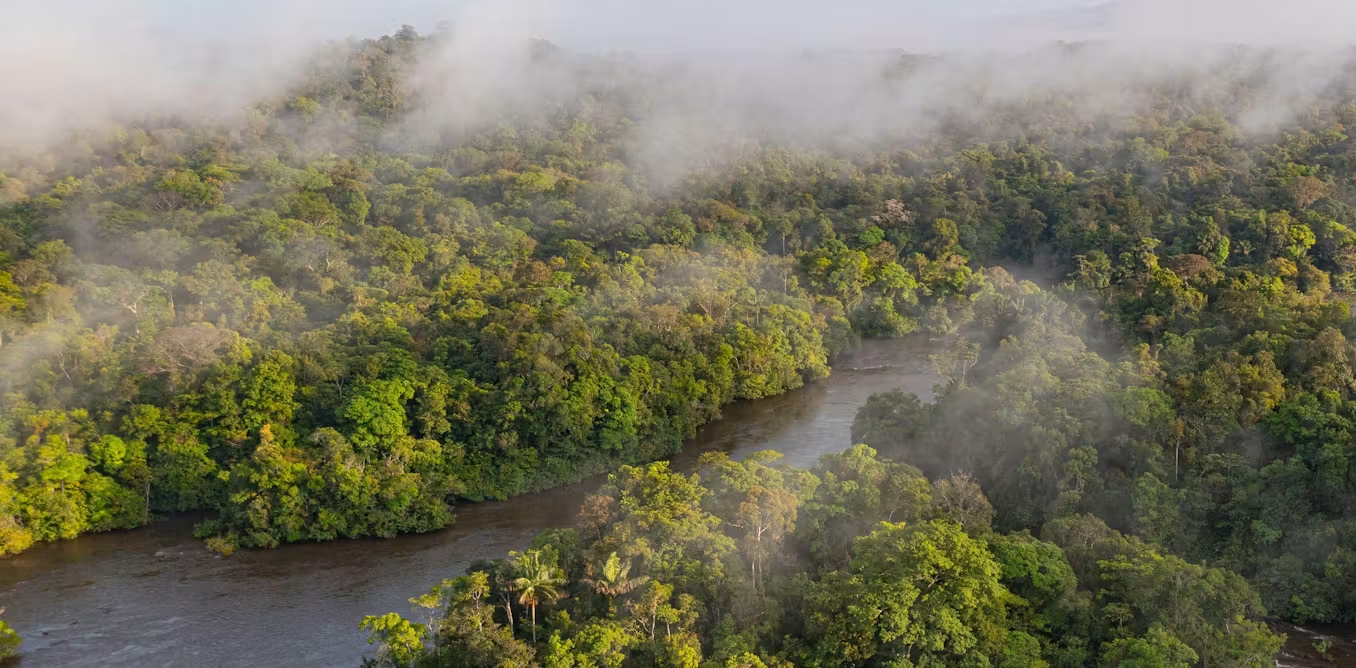
From the air, you see it only through the constant jolt, tilt and shudder of the low-flying Cessna aircraft. The landscape of the Llanos de Moxos, northern Bolivia, appears as a disconnected patchwork of open grassland savannahs, forest islands and lakes.
It feels random, almost unreadable. Only gradually does the pattern resolve itself: raised causeways or paths fanning out to link the forest islands, and a dense, scattered web of canals threading the terrain. Slowly you realise it’s a structured network of intersecting lines, enclosures and roads – the imprint of past human design.
Aerial view of Llanos de Moxos. Jose Iriarte, CC BY-SA
If you stand on the open savannah, there is almost nothing to see of this ancient network. The horizon feels open, with fires in the distance from local people burning pastures and clearing forest as dry season begins. The old geometry is still faintly perceptible, but you have to know how to look.
Advertisement
Step into the patches of forest and the canopy closes in. The earth softens underfoot and mosquitoes descend in relentless swarms. The sweat on your neck thickens into a humid film, carrying the familiar scent of suncream and the sharper, chemical note of DEET.
In the uneven light between the trees, the landscape dissolves into subtle rises and depressions. Against the rhythmic swish of machetes as our guides cut through the vegetation, your mind tries to piece together the fragments of structures into something coherent. Flying overhead doesn’t reveal anything about this forest area in the way that it does with the savannah. But fortunately recent advances in technology have transformed what we are able to see.
Surveying in the dense Amazon rainforest. Jose Iriarte, CC BY-SA
Archaeological explorations in this part of the world have been completely changed by lidar in the past couple of decades. Lidar maps an area from a plane or drone by bouncing rapid laser pulses off the Earth’s surface. Some of these pulses penetrate the forest canopy, reach the ground and reflect back to the sensor.
By measuring the return time, the system can generate highly precise three-dimensional models of the terrain. This allows you to strip away the camouflage of vegetation, making it possible to see what lies below the Amazonian forest for the first time.
Advertisement
It reveals the ancient Llanos de Moxos as not simply a collection of settlements, but an entire urbanised landscape. A large part in the south-east of this region belonged to the Casarabe culture, which dominated between around AD500 and 1400. It extends across 20,000km², which is roughly the size of New Jersey in the US.
The Casarabe organised into a hierarchy of four different sizes of settlements (those forest islands mentioned above). The biggest ones – the primary settlements – were as large as 3km² or 300 hectares. That’s enough space for over 400 football pitches, suggesting that they could have accommodated substantial numbers of people.
Welcome to our series on the great mysteries of archaeology. Viking explorers, Amazonian cities, artefacts from before civilisation. Archaeology may be all about the past, but it’s constantly shifting with every scientific discovery. This series will dig into some of the most fascinating debates in the field today.
Advertisement
These settlements connect along the raised causeways to smaller secondary and tertiary sites a number of kilometres away, all of which were permanently inhabited as opposed to empty ceremonial hubs. A fourth tier consists of groups of isolated mounds located out in the pampas, which likely correspond to dwelling areas occupied by farmers who would have worked the fields.
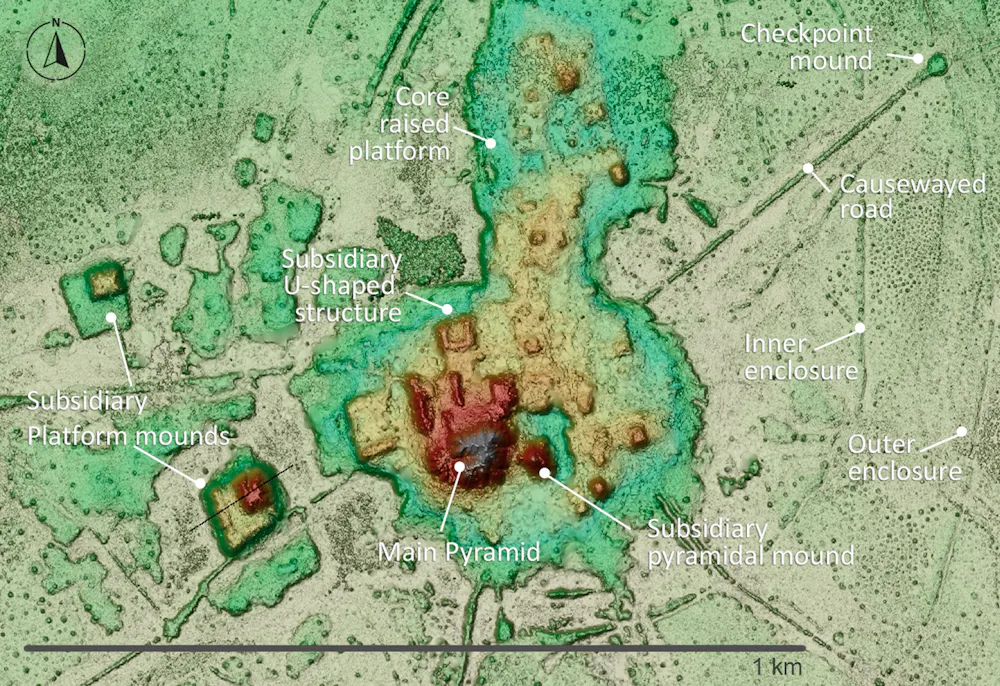
It’s not possible to show a lidar image of these four different types of sites interconnecting because they are too far apart for the resolution available, but the image below of a primary settlement known as Loma Cotoca shows the kinds of things we are now documenting.
It features some very impressive civic-ceremonial architecture: conical pyramids over 20 metres tall and U-shaped structures that may have acted as areas for public gatherings for speeches or ceremonies. These were built on top of man-made platforms rising as much as five metres off the ground and extending over 20 hectares. To be clear, this is all still hiding under the forest, but the lidar data reveals the shape, height and layout of what lies below.
The volume of earth moved to create this architecture would have rivalled – and in some cases exceeded – that of well known Andean monuments such as Akapana a few hundred miles to the south-west on the other side of the Andes. Akapana was the epicentre of the Tiwanaku empire that dominated the southern Andes between about AD600 and 1000.
Advertisement
Akapana pyramid in Tiahuanaco o Tiwanaku, Bolivia. Wikimedia, CC BY-SA
Yet where monuments like Akapana were surrounded by classic, compact bounded cities with thousands of inhabitants, the Casarabe equivalent was completely different. This was dispersed, low-density living amid extensive green space – a form of tropical urbanism that challenges longstanding assumptions about this area as sparsely populated and only lightly modified. It invites comparison with other low-density tropical urban landscapes such as the Maya in central America and the Angkor in latter day Cambodia.
Equally important is the coherence of the Casarabe system. The settlements are rarely isolated, part of a tightly connected network with shared water-management systems. It was clearly all planned and coordinated, designed not only as living spaces but for integrating the population across the region.
We can see that the Casarabe were sustained by drained-field agriculture: the canals were dug to make the land viable for planting during the wet season. The most prominent crop was maize, but there was a remarkable diversity of other produce. This was all embedded within a landscape that was engineered through reservoirs and farm ponds, which helped the Casarabe sustain cultivation and maintain access to water through the dry season in this extremely seasonal environment.
Also very noticeable is the fact that all the major architectural features and burial sites are oriented north-north-west. This suggests these people may have been led by cosmology, with important celestial bodies or regions of the night sky serving as symbolic reference points – hinting at a world where infrastructure, settlement and belief were inseparable.
Advertisement
Rethinking the Amazon
The Casarabe culture covered much less than 1% of Amazonia, which is the whole tropical interior of South America, spanning close to half of the entire continent. For much of the 20th century, this vast area was viewed by archaeologists as an environment that was limiting for human existence.
Poor soils, scarce game, extreme El Niño floods and droughts, and the challenges of tropical disease were all thought to constrain human populations to small, wandering groups living off the land as best they could. Large, settled societies – let alone towns or cities – were considered unlikely, if not impossible.
This view began to shift in the late 20th century for several reasons. Archaeologists realised that Amazonian people had been domesticating a diversity of plants since the end of the Ice Age. They manufactured some of the earliest ceramics in the Americas, and also devised soils known as Amazonian Dark Earths, which combined charcoal, bone and waste materials with the existing poor-quality soil to make it fertile enough for widespread farming.
Specially engineered Amazonian soils unlocked widespread farming. Carlos Mora
It also became apparent that just like the Casarabe people, many other cultures across Amazonia had reclaimed vast expanses of seasonally flooded savannahs over several thousand years to create raised and drained field systems.
These discoveries were evidence of long-term settlement and landscape management far beyond what was previously thought possible. It meant Amazonia was not simply a backdrop to human activity; much of the landscape was shaped over the last 13 millennia by the people who lived there.
Enter lidar
Like lasers in the sky, lidar technology has accelerated this transformation in our understanding. The digital process feels near-magical, a “vegetation removal algorithm” that reveals the secrets below.
In practice, however, working with lidar in Amazonia is anything but straightforward. Running such a project here, as I have done, can feel like one of the greatest emotional rollercoasters in field archaeology. It’s all anticipation, frustration and sudden revelation – only comparable, perhaps, with shipwreck exploration.
Depending on what technology is available and most suitable for exploring a particular area, I’ve worked with lidar attached to drones, aeroplanes and helicopters. I’ve learned through trial and error that the technology is only as effective as the logistics and personalities behind it – above all on one occasion when we were trying to integrate a Hungarian lidar sensor with a Brazilian drone.
Advertisement
Above: the ‘Experimental’ drone; below: the moment it finally worked – the smiles in the control station say it all. Jose Iriarte, CC BY-SA
Lidar can perform beautifully one day and fail the next, depending on the equipment, weather, terrain, batteries, communications and the sheer difficulty of operating in remote Amazonian conditions.
Flights must be carefully planned in remote areas with limited infrastructure, where convective clouds, smoke from fires, wind and even vultures riding thermals can disrupt data acquisition. You have to arrange fuel in advance and improvise landings wherever a safe clearing can be found. Here’s our team refuelling a lidar helicopter in the football field of a small village in Acre state, western Brazil:
You also have to do constant troubleshooting with the technology, such as making sure it’s calibrated correctly and that the data from different flight paths all aligns. What appears in the final images as a seamless “removal” of the forest is, in reality, the product of improvisation, negotiation and persistence.
But given all these challenges, it makes the first successful images all the more powerful when they finally appear. The reward is that we’re finally finding the “lost civilisation” that explorers like Percy Fawcett were searching for a century ago, but by cajoling a drone rather than battering through jungle.
Incidentally, this technology also has important uses beyond archaeology. It can help people to locate and harvest crops like rubber or açaí palm fruits without having to clear so much rainforest. It is also used by pioneering projects such as Amazonia Revelada, which helps Indigenous and traditional people of the Amazon to prove their historic presence within an area to ward off modern commercial interests like loggers or farmers, while also protecting the living history and nature embedded in these landscapes.
Other lidar discoveries
Lidar surveys by French and Ecuadorian archaeologists have revealed that the Llanos de Moxos was certainly not the only example of large-scale, highly integrated society in Amazonia. The Upano Valley, which covers some 300-600km² on the mountainous forest of the Ecuadorian eastern flanks of the Andes, offers another striking example – this time from between about 500BC and AD600–700.
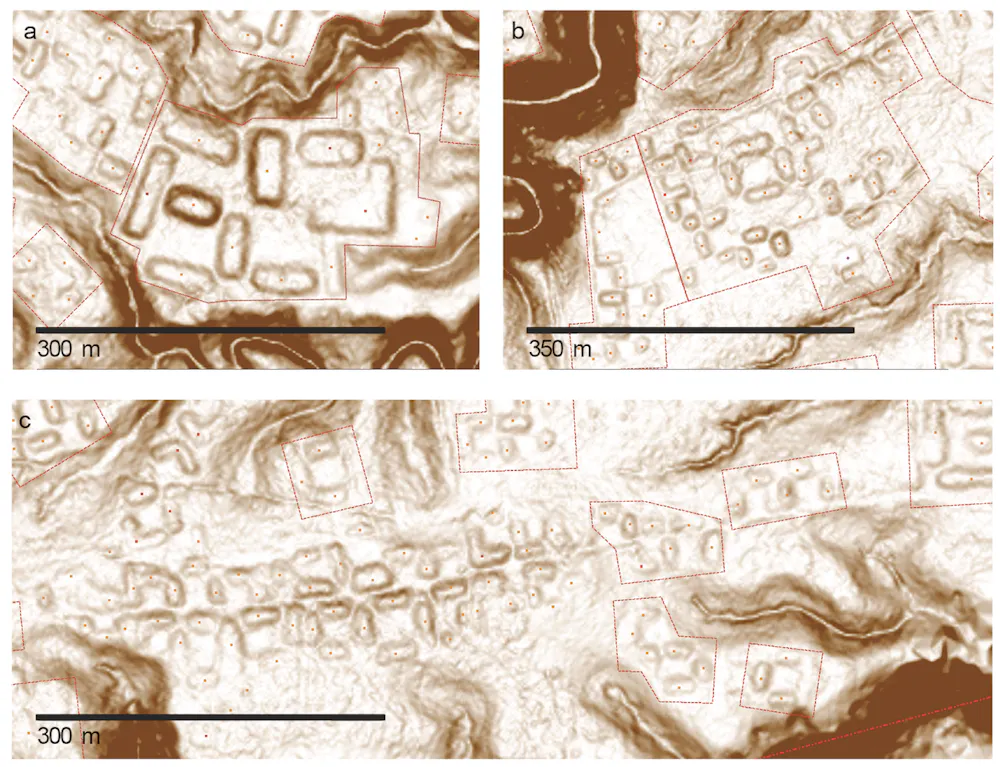
In Upano, archaeologists have been able to map a vast network of settlements connected by extensive road systems, with large platforms and clusters of buildings arranged in organised layouts across a broad area.
What stands out is not just the scale – thousands of structures – but the rigour of the planning. The settlements didn’t just grow randomly, but as part of a deliberate design: we see straight lines of flat-topped platforms laid out in repeating rows and connected by straight paths that cut cleanly across the landscape, as you can see below.
Lidar footage of settlements in the Upano Valley. Jose Iriarte, CC BY-SA
Again, this is not urbanism in the conventional sense of dense, continuous occupation. There would have been none of the vertical stacking of buildings that you’d get in European settlements, and there were also green spaces between platform complexes – much more like a forest city.
Like the Casarabe region, this is a distributed settlement pattern that is both open and highly structured, but the arrangement is much more compact. This reflects the limited flat space available on the upper terraces of the Upano River, which rise up to 100 metres above the surrounding landscape.
Advertisement
Elsewhere in Amazonia, we see more variations. In the Upper Xingu of central Brazil, interconnected settlements were arranged around a shared ceremonial and road network, again suggesting a regionally coordinated social world.
Further north, the Tairona people of the Sierra Nevada de Santa Marta in present-day Colombia built terraced stone towns in the mountains, linked by paved paths. This was a form of urbanism shaped entirely by the demands of steep, high-altitude terrain. Below is a lidar image of one area in this region, with the platforms that would have housed the settlements marked in yellow. Below that, you can see what the platforms look like.
Above: lidar image of settlements at Teyuna-Ciudad Perdida in yellow; below: an actual shot of the platforms that housed the settlements. Daniel Osorio, CC BY-SA
In western Amazonia, Acre adds another important variation. From around AD1–1000, people built large ditched enclosures, or geoglyphs, mainly in the south-eastern part of this region along the upper Purus River. These were square, circular, hexagonal or octagonal mounds, often 1-3 hectares in size, with ditches up to four metres deep. These were probably used as ceremonial gathering places rather than permanent settlements.
After about AD1000, these were followed by what we call circular mound villages, occupied until around AD 1650–1700. They featured rings of mounds around central plazas and straight roads radiating out like the rays of the Sun, often built to align with the four main compass points. These “Sun villages” were true settlements, and formed interconnected networks across the southern rim of Amazonia. You can see an example in the lidar image below.
Advertisement
Lidar image of circular mound village Dona Maria at Acre, Brazil. Jose Iriarte, CC BY-SA
Taken together, these discoveries fundamentally reshape our understanding of Amazonia. We now see a mosaic of managed landscapes, engineered environments and, in some cases, city-scale societies. What unites them is not a shared blueprint but a shared impulse: the organisation of people, space and movement across large landscapes in ways that were deliberate, durable and distinctly their own.
To stress, Amazonia was not uniformly dense or urban. It supported a diversity of types of settlements, from dispersed networks like Moxos to tighter grids like Upano, each of them adapted to local ecological conditions. They shared a low-density urbanism, in the sense of large, interconnected populations without the density of classic cities.
What we still don’t know
How were these societies organised politically and socially? How did they interact with variations in the climate and environment, ranging from the heavy rainfalls and droughts caused by El Niño to rivers forging new routes that could move them away from a settlement within a few generations?
What, if any, connections existed with mountain societies in the Andes? And perhaps most importantly, since both the Casarabe and Upano ceased to build monuments after 1492, what led to their transformation or decline before the arrival of Europeans?
Advertisement
There is active debate between archaeologists over whether these societies transformed because of environmental stress, internal political change, or shifts in things like trade routes or migration.
In the Llanos de Moxos, one possibility is that a prolonged period of climate change affected the Casarabe water-management systems that were so critical to feeding this thriving society. In the Upano Valley, volcanic eruptions and earthquakes may have disrupted settlements and agriculture, although it’s unclear whether that could have led to the area being abandoned.
It seems likely that as we uncover new things, it will reveal more and more integration between different societies. What we are seeing now in Amazonia is much like looking at a satellite image of a country at night: bright, isolated clusters of light – cities that appear disconnected. But as we continue to expand our coverage and fill in the gaps, I think this will change.
What now appear as isolated clusters may also resolve into extensive networks. For example a study across the southern rim of Amazonia has predicted that the kinds of settlement mounds that have been identified so far are likely to occur across about 400,000km², supporting an estimated regional population of roughly 500,000 to 1 million people in the era before the Europeans arrived.
Advertisement
Entire regions may emerge as previously unrecognised centres of population and landscape management. This could be particularly so for the Llanos de Moxos. The whole area covers as much as 200,000km², depending on where you draw the boundaries, stretching into Brazil and even Peru. It is often divided into several apparently distinct cultural regions — the Casarabe (aka the monumental mound region), and then two others called the platform ridge and zanjas (ditches) regions.
As lidar coverage expands and more archaeological work is conducted, we may begin to understand how these societies were economically specialised. We know, for example, that the fortified villages of the zanjas region had fish weirs spanning hundreds of miles that were capable of capturing vast quantities of migratory fish. The platform ridge region consisted of large drained fields, which could potentially produce surpluses of maize. It is conceivable that these belonged to a broader network that supported the more complex Casarabe centres.
Or perhaps – who knows – the relationships were more fluid and reciprocal. For now, the question remains open. But it is precisely this possibility of deep regional integration that lidar is beginning to bring into view. In time, we may even begin to identify Casarabe outposts scattered across the Llanos de Moxos.
What happens next
There’s still a huge amount to be done with lidar. Vast areas, particularly in the Ecuadorian and Peruvian Amazon – remain unexplored. One recent study suggested that there could be more than 10,000 more urban structures of the kind I’ve been describing still hidden throughout Amazonia, all of them dating from pre-European times.
Advertisement
Looking ahead 20 years, it is likely that our map of Amazonia will look very different. One promising technology is satellite-based lidar systems, which could provide broader, though less detailed, datasets across large areas. Advances in machine learning are also beginning to help us identify archaeological features within massive datasets, speeding up a labour-intensive process.
Against this, there are time pressures in some places. Llanos de Moxos, for instance, is unfortunately in rapid transition. The very ground that holds the traces of ancient networks is being transformed by mechanised agriculture and large-scale terraforming for rice cultivation and pastures.
We also need to keep reminding ourselves that lidar is only the first step. What really matters is how it’s brought together with other lines of evidence. Most sites discovered by lidar have yet to be excavated, so we’ll have to do much of that, looking for everything from bones and plants to ceramics and weapons.
So far, most excavation has been in the Casarabe area of the Llanos de Moxos. The reason, for instance, that we know the culture lived primarily on maize was through the discovery of over 60 human skeletons, which underwent carbon isotope analysis. The same research paper also analysed excavated duck bones to show that the Casarabe were feeding them maize too, suggesting animal domestication in a continent that was not generally known for it.
Advertisement
Another fascinating Casarabe find is a single buried skeleton who may have been a leader, because he had a collar of jaguar teeth around his neck. He was also wearing ear pieces made of armadillo shell, studded with mottled blue stones called sodalite – it’s not clear what these were for.
Male burial in Loma Salvatierra, Llanos de Moxos, shows: a) plate of cooper; b) earpieces with pearls of sodalite and armadillo shell; c) a collar of jaguar teeth; d) shell beads; e) bracelet of shell. Heiko Prümers/Jose Iriarte, CC BY-SA
We’ll also need to obtain more precise dates for key events using techniques like radiocarbon dating, and more pinpoint accurate environmental data to help support theories about ancient changes to the climate – as opposed to the wider regional information we’ve tended to rely on until now. Lake sediments are great environmental archives, preserving evidence of things like vegetation change and landscape disturbance.
Also important is comparing genetic data from excavated bones with people who live in these areas today – in dialogue and collaboration with local communities whose histories, memories and knowledge are essential to understanding these landscapes.
It’s all a question of how lidar is brought together with all this other evidence. The most convincing reconstructions will come from the convergence of all of these. One further major challenge ahead, however, will be to bridge the gap between scientific reconstructions and how past peoples understood and inhabited their world. Archaeology is increasingly rich in data, but we have to relate it to lived experience.
Advertisement
That is no easy feat, but it is essential if we are to move from mapping past worlds to understanding them. Crucially, Amazonia – with its rich, still-vibrant Indigenous societies and ethnographic record – offers an exceptional opportunity to do this, providing rare continuities through which to anchor and critically engage our interpretations of the past.
Lessons for today
My own sense is that we will move towards a view of Amazonia not as an exception, in line with the old view that the people lived within an untouched paradise, but as part of a broader pattern of human-environment interaction. The rainforest will be understood not only as a biological system, but as a historical one – shaped, in part, by the people who lived within it.
This does not mean the Amazonian people who simply lived “in harmony” with nature; the evidence points to something more interesting. Although Amazonian societies developed complex, and at times intensive, forms of land use, the evidence consistently shows that they often did so while maintaining continuous forest cover. Far from the large-scale deforestation that we might assume was necessary for such elaborate forms of human life, their practices created mosaics of managed forest, gardens, orchards, wetlands and settlement areas.
We know partly from lake sediment data that people enriched the forests with species that provided food, building materials, medicines and other resources, from açaí and cacao to palms, cinchona and copaiba. The fact that some of these species endure today suggests that past land use left lasting ecological legacies.
Advertisement
Amazonian açaí is one of numerous species that are not prevalent by accident. Guentermanaus
In the context of today’s climate crisis, the long-term balance that these people achieved offers a powerful lesson: it is possible to sustain complex societies without destroying the forest, if land use is guided by principles that integrate ecological knowledge, cultural values and a commitment to the continuity of the living landscape.
What lies beneath the Amazon is not just a hidden past. It is a reminder that even the most seemingly untouched landscapes can carry deep histories, waiting – sometimes just beneath our feet – to be revealed.
This article features references to books that have been included for editorial reasons, and may contain links to bookshop.org. If you click on one of the links and go on to buy something from bookshop.org The Conversation UK may earn a commission.
To hear about new Insights articles, join the hundreds of thousands of people who value The Conversation’s evidence-based news. Subscribe to our newsletter.
The professional dancer recently announced his plans to leave the hit BBC One dance show after 10 years
Gorka Marquez has shared the reason he turned down getting a chance to say his own goodbye to Strictly Come Dancing while on a UK tour linked to the popular programme.
Advertisement
The professional dancer recently announced his plans to leave the hit BBC One dance show after 10 years. He made the announcement on Instagram at the end of April, saying he will “forever be thankful” for his time on the dancing competition, but it is time to “hang up my dance shoes”.
The news came after Gorka stepped back from competing in Strictly’s 2025 series with a celebrity dance partner and instead returned to a judging role on the Spanish version of Strictly, Bailando con las Estrellas, a position he first took on in 2024.
But before his official exit, Gorka joined fellow pro Luba Mushtuk, who is also leaving the beloved show after 10 years, and a number of their fellow Strictly stars on the Strictly The Professionals tour, which headed to Salford’s Lowry last month, before finishing in Blackpool on May 30.
During their last show, tears flowed as Gorka and Luba shared an emotional embrace on stage, marking the end of their time on Strictly. Fans shared clips on social media from the final performance, which saw the pair being supported by their co-stars as they shed tears.
Advertisement
But Gorka has now been asked why he didn’t get his own moment in the live show to say goodbye, while Luba gave a tear-jerking speech. Speaking on their podcast, Lost in Translation, Gorka’s fiancée Gemma Atkinson read out a message from a listener which said: “Great show! I’m gutted they didn’t allow you to say goodbye like Luba, but I want to wish you all the best for the future.”
Gemma then commented: “That’s funny you’ve said that because you [Gorka] said to me before the tour started, ‘They’ve asked me if I want to do a goodbye thing…’” Gorka then interjected: “I said no!” Gemma continued: “He said no. He said, ‘I’m not dying! I’m just not coming back.’ You chose not to do that.”
Gorka then explained: “I’m not saying goodbye because I don’t want to say goodbye, I just want to celebrate. For me, I put it this way, Strictly doesn’t start until August, I’m still in Strictly. I’m still part of the team so I just want to celebrate and dance like one of the team. I don’t want to make it about me and be like, ‘Oh, I’m leaving… be sad!’”
Advertisement
Gemma commented: “Goodbye for me solidifies it. It’s just see you soon.” Gorka then cheekily teased: “Who knows, you might be getting sat in that chair in a couple of years!”

























































You must be logged in to post a comment Login