Connect with us
DAPA Banner
DAPA Coin
DAPA
COIN PAYMENT ASSET
PRIVACY · BLOCKDAG · HOMOMORPHIC ENCRYPTION · RUST
ElGamal Encrypted MINE DAPA
🚫 GENESIS SOLD OUT
DAPAPAY COMING

NewsBeat

has a 550-year-old medical case been solved?

Published

on

has a 550-year-old medical case been solved?

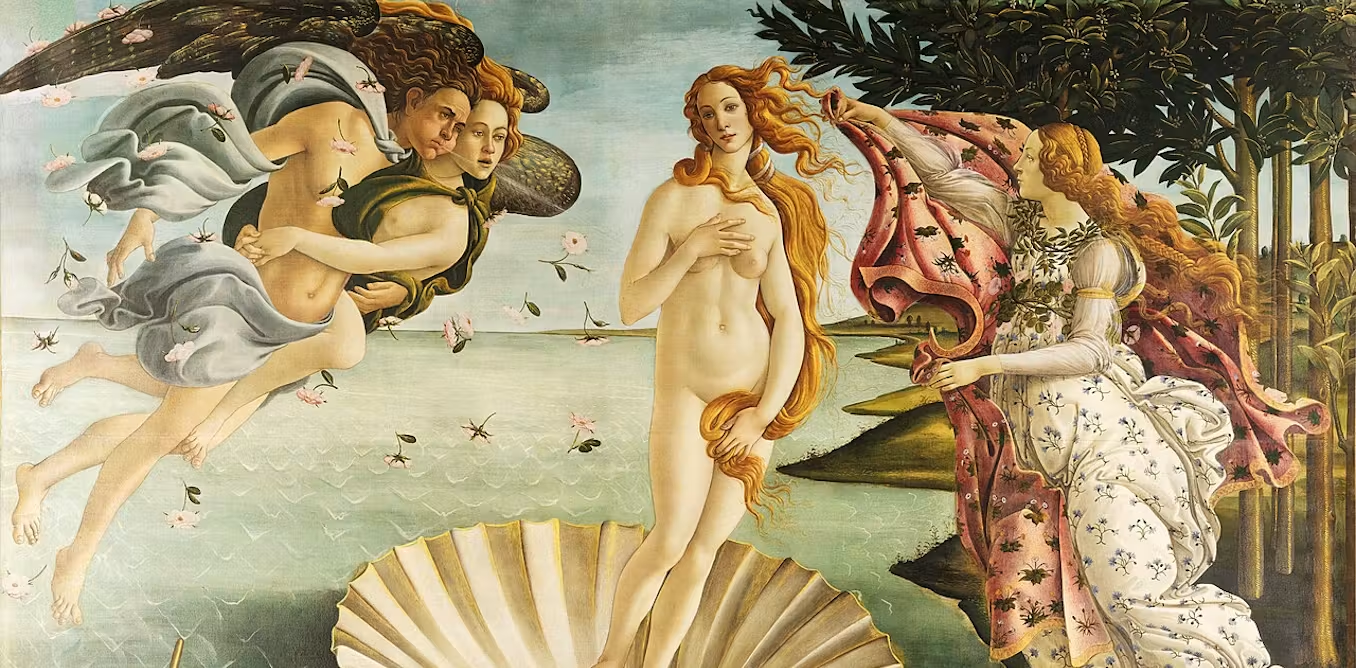
Simonetta Vespucci is probably one of the most painted women of the Italian Renaissance. Sandro Botticelli is widely believed to have used her as his model for Venus, and she appears, transformed and idealised, across several of his most famous works.

She died in 1476, aged just 23. For centuries, historians have assumed tuberculosis was to blame – it was common, it was often fatal, and it fitted the pattern of a young woman fading quickly.

In 2019, my colleagues and I proposed a different explanation. We examined the portraits attributed to Botticelli alongside written descriptions from the period, looking for whether the same woman’s face changed in ways that might reflect an underlying illness.

What we found was a gradual shift in her features across multiple paintings – subtle changes to the jaw, the brow, the soft tissue of the face. These are the kind of changes seen in patients with a pituitary adenoma, a tumour of the small gland at the base of the brain that controls hormone production.

Advertisement

Specifically, we suspected a tumour secreting both growth hormone and prolactin. Excess of these hormones can alter facial contours over time and, in some cases, cause unexpected lactation – and one allegorical figure in Botticelli’s work appears to depict exactly that symptom.

Botticelli’s muse, Simonetta Vespucci.
Wikimedia Commons, CC BY-SA

Our 2019 paper was cautious. We were not claiming proof – we were offering a plausible medical reading of the visual evidence, built by combining art history with clinical endocrinology.

Now, in a new paper published in Endocrinology, Diabetes and Metabolism, my team and I have gone further. We believe Simonetta’s death itself – sudden, rapid, and dramatic according to contemporary accounts – is consistent with a specific medical emergency: pituitary tumour apoplexy.

Apoplexy occurs when a pituitary tumour bleeds or rapidly swells. It typically causes a sudden and severe headache, loss of vision, confusion, and a swift decline as the body’s hormonal regulation collapses.

Advertisement

We argue that this would explain something that tuberculosis alone struggles to account for: how a previously healthy young woman went from apparent wellness to death within a short period. Chronic infections such as tuberculosis usually cause a slower, more visible decline.

Three strands of evidence

Our case rests on three strands of evidence. First, the physical changes visible across the portraits – Botticelli painted her several times, from the 1470s through to the posthumous Birth of Venus (1482–1485) – suggesting a tumour growing over months or years.

Second, the symptoms described in chronicles of her final illness (letters exchanged between Piero Vespucci and Lorenzo de’ Medici, describing her collapse at a ball and the headaches, hallucinations, vomiting and fever that followed), which align closely with the clinical presentation of apoplexy.

Third, two documented events in the months before her death – her collapse during vigorous dancing at a ball, and an alleged violent encounter with Alfonso II of Aragon, Duke of Calabria – that could plausibly have triggered a bleed or sudden tumour expansion.

Advertisement

None of this amounts to certainty. There is no tissue sample from 1476, no scan, no way to examine Simonetta directly – only paintings, letters, and clinical reasoning applied five centuries after the fact.

What we can say is that a tumour capable of slowly reshaping a person’s face is also capable, if it ruptures, of killing them quickly. Put together, the portraits and the historical record tell a more complete story than either can alone.

We hope this encourages both historians and medical professionals to look again at cases like Simonetta’s. Medical knowledge can sometimes answer questions that pure historical record cannot. And, in turn, historical puzzles can push medicine to think differently about how disease unfolds in the body over time.

Advertisement

Source link

Continue Reading
Click to comment

You must be logged in to post a comment Login

Leave a Reply

NewsBeat

Self Esteem’s powerful performance at York Museum Gardens

Published

on

Self Esteem's powerful performance at York Museum Gardens

Rebecca Lucy Taylor really believes in her material, which appears ripped from within her. Her candid accounts of what it feels like to be a modern woman, powerful but exhausted, desiring and often despairing, have a rare ability to turn individual experience into something universal. We saw that power in full force on Friday, which was thankfully a little cooler than the evening before.

Yet something seemed to be the matter when Taylor first walked on. Dressed in the same devotional costume she wears on her latest album, 2025’s A Complicated Woman, she had been crying and was still holding back sobs as the eight-strong choir began I Do And I Don’t Care.

Crowds at York Museum Gardens. (Image: Paul Rhodes)

We will never know, but Taylor talked a few times of this being a crazy day. She is clearly someone who feels deeply, and her audience responds to that. In a short time, there was a reassuring hand from one of her troupe, who then returned to singing beautifully and dancing with sometimes alarming intensity.

Taylor’s latest songs were driven more by message than melody. The voices, choreography and stark group formations made it theatrical, but they also operated like a musical family, and we were drawn in. It really worked, despite the sometimes dim lighting. But at least we had screens this year, positioned sensitively to the sides.

Advertisement

Recommended read:

Thousands flock to open-air gig as multi-platinum stars return to North Yorkshire


Redemption had already arrived – at least for the few – thanks to opener Joshua Idehen, a British-Nigerian poet and electronic artist whose work combines poetry, house music and messages of hope, resilience and renewal. He turned out to have a masterful command of the crowd. Believing in second chances, he gave us a better chance to engage our shoulders and get off on the right foot.

Like Self Esteem, his words mattered deeply too, and he brought many of the newcomers to tears. The groove was also important as the extra element to lift half-spoken, half-rapped words. There was something of Gil Scott-Heron in the combination of social observation, humour, poetry and rhythm, but Idehen is very much a man of his own time. His signature song, Mum Does The Washing, has grabbed a wider audience online, and while that number was surprisingly absent, we were also caught up in his world.

Advertisement

Above all, this was a night about connection. Female friends, mums and daughters, young families gathering around music while spending time close to those we loved. It made for a lovely, all-age atmosphere under a cloudless sky.

It was harder to get close to Moonchild Sanelly, the South African singer and self-styled “future ghetto punk” artist known for mixing electronic pop, dance music and South African rhythms with sexually candid, fiercely independent lyrics. She brought a more confrontational energy. With vivid green hair and a bold stage presence, she was defiant, spiky, frequently taking aim at former partners foolish enough to reject her, as on Demon.

There was plenty of indie-energy in third support act The Big Moon, a Mercury-nominated London indie-rock four-piece whose melodic guitar pop has expanded to take on motherhood, relationships, body change and, on their newest material, hearing loss. This was the only traditional band performance of the night and a clever shift in tone.

Their Museum Gardens set was a fascinating mixture. The songs had strong melodic foundations and choruses, underpinned by particularly impressive bass playing. There was even a singalong to Fatboy Slim’s Praise You.

Advertisement

Headliner Self Esteem was not polished. She said later that costume changes had been missed and her hair had not been done. The audience loved her more for this, not less.

She didn’t forget to make the evening fun and tuneful. Her numbers from Prioritise Pleasure were more danceable and got the crowd moving. Once the opening emotional storm had passed, the performance became looser and more playful.

Towards the end of her 90 minutes, Taylor spoke emotionally, not to seek praise, but to say thank you. She was met by a huge wave of applause and support. Like Adele, her troubles were our troubles.

After the nostalgic full house for Orchestral Manoeuvres In The Dark the night before, Self Esteem was a bolder programming choice by event promoters Futuresound: a younger, messier and more varied bill. The artists selected worked well together – for my money, more fun than, say, three and a half hours of Guns N’Roses.

Advertisement

This was music for people still working things out, performed by artists willing to open themselves up for us, on a striking, memorable Friday night spent with people we care about. It turns out it’s OK to just be together, the deep blue OK or not.

By Paul Rhodes

Source link

Advertisement
Continue Reading

NewsBeat

Murder probe is launched after bodies of two women and a man are found in Ballymena home

Published

on

Police on scene in the Old Cullybackey Road area of Ballymena, County Antrim, this afternoon

Advertisement

A murder probe has been launched after three bodies were found in a home in Ballymena.

The Police Service of Northern Ireland (PSNI) said it is investigating the circumstances after the trio were found dead on Monday morning in the Old Cullybackey Road area of the town in County Antrim.

A senior officer said there was no ‘ongoing risk’ to the public and police were not seeking anyone else in relation to the deaths. 

Mid & East Antrim District Commander, Superintendent William Calderwood, said: ‘The bodies of a male and two females were discovered at a home on the Old Cullybackey Road at around 9am this morning, Monday July 13.

Advertisement

‘The cause of death has not yet been formally established and post-mortem examinations will take place in due course.

‘As such, it would be inappropriate to comment further at this time, and I would ask that the public avoid speculation.’

He added: ‘However, I want to reassure the public that we do not believe that there is any ongoing risk, and at this stage we are not seeking anyone else in relation to the deaths.

‘Our thoughts this evening are very much with the family and friends of those who have died.’

Advertisement

Police on scene in the Old Cullybackey Road area of Ballymena, County Antrim, this afternoon

A PSNI spokesperson earlier said: ‘Police are investigating the circumstances after three people were found dead in the Old Cullybackey Road area of Ballymena this morning.

‘The three people were related and found inside the family home. There is no ongoing risk to the public. A further update will follow in due course.’

Advertisement

Officers were in the area from about 11am, with diversions put in place at the junctions of Innisowen Park and Cullybackey Road while investigations were carried out.

North Antrim MP Jim Allister described the deaths as a ‘tragedy causing great shock in the community’, saying relatives and friends of the family had ‘suffered huge loss’.

He told the Belfast Telegraph: ‘The police have confirmed to me there is no extant risk in the community and no further persons are being sought. More details will follow.’

Sinn Féin MLA Philip McGuigan added: ‘My immediate thoughts are with their wider family and friends. Their grief will be immeasurable right now.’

Advertisement

Alliance MLA Sian Mulholland added: ‘While details continue to emerge about this incident, it is clear there has been a tragedy.

‘The community in Ballymena is in shock already and my thoughts are with everyone affected by what will be an incredibly distressing time, particularly the family and friends of the deceased.

‘I have spoken to police, will need time to investigate this matter and I urge anyone with information on it to give it to them immediately.’

Advertisement

Advertisement

Source link

Continue Reading

NewsBeat

Woman arrested after objects thrown at parade in East Belfast

Published

on

Belfast Live

Police have said the the incident is not being treated as hate motivated.

A woman has been arrested after objects were thrown at a parade in East Belfast today.

The incident took place in the Beersbridge Road area of the city on Monday, July 13, when items were thrown at a parade that was passing through the area. Police have said videos of the incident have been circulating online.

A 42-year-old woman has since been arrested and remains in police custody at this time.

Advertisement

Police have said they are not treating it as “hate motivated”.

A PSNI spokesperson said: “A 42 year old woman was arrested on suspicion of common assault and public order offences, following reports of items thrown towards parade participants at the Beersbridge Road area of East Belfast on Monday 13 th July. She remains in police custody at this time.

“Police are aware of recordings of this incident circulating online and the incident is not being treated as hate motivated.

“Enquiries are continuing and police would appeal to anyone with any information in relation to this matter, to contact them on 101 quoting reference number 516 13/07/26.”

Advertisement

For all the latest news, visit the Belfast Live homepage here and sign up to our What’s On newsletter.

Source link

Continue Reading

NewsBeat

JK Rowling rape support centre brands Amnesty’s anti-rights accusation ‘deeply offensive’

Published

on

Harry Potter author JK Rowling founded Edinburgh-based rape support centre Beira¿s Place in 2022

Advertisement

JK Rowling’s women-only rape support centre has hit back after being branded an ‘anti-rights organisation’ by Amnesty International, describing the claim as ‘deeply offensive’.

Beira’s Place, the Edinburgh-based service founded by the Harry Potter author in 2022 to support female survivors of male violence, issued its first public response after Amnesty was forced to remove its report, A Growing Threat: The Anti-Rights Movement in the UK, due to the growing backlash.

The report had included Beira’s Place among more than 100 organisations it claimed were working against the rights of LGBT+ people, prompting criticism from several of those named.

Chief executive Lesley Johnston said Amnesty’s decision to include the centre was ‘inexplicable’. 

Advertisement

She said: ‘Beira’s Place was established in 2022 to address an unmet need for a single-sex support service for female survivors of male violence.

‘We are proud of our work and we know how much our service means to the women who have used it.

‘It is inexplicable that Beira’s Place has been listed as an “anti-rights organisation” in a report published last week by Amnesty International.

‘This is deeply offensive to Beira’s Place staff who work day in, day out to support survivors, and to the women who need and use our service.

Advertisement

Harry Potter author JK Rowling founded Edinburgh-based rape support centre Beira’s Place in 2022

Ms Johnston added: ‘We will continue to focus on the needs of the women who come to us and… we remain committed to a vision where women and girls can live in a world free of sexual violence.’ 

Beira’s Place provides support exclusively to biological women who have experienced sexual violence.

Advertisement

The centre was established by Ms Rowling after controversy surrounding the Edinburgh Rape Crisis Centre, where former chief executive Mridul Wadhwa said survivors who objected to being supported by a transgender woman should ‘reframe’ their trauma.

An Amnesty International report claimed the support centre was working against the rights of LGBT+ people

An Amnesty International report claimed the support centre was working against the rights of LGBT+ people

Ms Rowling said at the time there was an unmet need for a women-only service for victims of sexual violence.

Amnesty’s report said there had been a significant decline in LGBT+ rights across the UK and listed more than 100 organisations it called ‘anti-rights’, including Beira’s Place, For Women Scotland, Murray Blackburn Mackenzie, LGB Alliance and Labour Women’s Declaration.

Advertisement

Following widespread criticism, Amnesty removed the report from its website over the weekend pending an internal review.

Amnesty has not apologised for naming Beira’s Place. Instead, a spokesman said: ‘We regret that this briefing was uploaded to our website without going through the established internal review processes that are in place to ensure consistency, accuracy and alignment with Amnesty International UK’s positions. Its use of language does not reflect the position of Amnesty International UK, which is why it was promptly removed.’

Advertisement

Advertisement

Source link

Continue Reading

NewsBeat

Marshall Aerospace engineers could go on strike amid firm’s ‘uncertain future’

Published

on

Cambridgeshire Live

More than 200 engineers who maintain the Hercules aircraft could go on strike

Engineers who maintain the C-130 Hercules aircraft could go on strike. Marshall Aerospace, currently based at Cambridge Airport, announced earlier this year that its plans to relocate to Cranfield University’s site fell through as it was “no longer affordable”.

Advertisement

It then announced in May that it had plans to move to Merthyr Tydfil in South Wales, which could affect 158 employees. The Unite union announced on Monday (July 13) that around 250 members at Marshall Aerospace are balloting for strike action in a dispute over pay.

The workers considering strike action are engineers who maintain the C-130 Hercules aircraft and manufacture auxiliary fuel tanks for the Boeing P-8 Poseidon maritime patrol aircraft.

Unite regional officer Neil Moore said: “Quite frankly, Marshall Aerospace needs to treat these workers better if it doesn’t want to see disruptive strike action and an exodus of highly skilled employees to companies offering better pay and greater job security.

“That means putting forward a pay offer that recognises the value of this workforce and gives people a reason to stay. Unite remains available for negotiations at any time, and there is still every opportunity to resolve this dispute through meaningful talks.”

Advertisement

Workers rejected the company’s offer of a 4.5 per cent increase in pay offer. Since 2020, pay has fallen by around 16 per cent at Marshall Aerospace, according to the union.

The ballot to vote on strike action closes on July 21. Any strike action that takes place could have an impact on the support provided to allied military aircraft programmes, including the maintenance of the C-130 Hercules aircraft, Unite said.

Source link

Advertisement
Continue Reading

NewsBeat

The 16th century lesbian poet who could be Scotland’s answer to Gentleman Jack

Published

on

The 16th century lesbian poet who could be Scotland’s answer to Gentleman Jack

Marie Maitland, a 16th-century Scottish gentlewoman, has for centuries been recognised as the likely scribe of the Maitland Quarto. This important manuscript, now held in the Pepys Library of Magdalene College, Cambridge, is an anthology of Scottish poetry by members of the noble Maitland family and their associates.


Headline Press

Maitland’s name appears twice on the first leaf and is also found in a partial anagram in the opening sonnet (“maid ane immortall”). By way of emphasis the anagram is repeated beneath the poem.

In recent years, researchers have acknowledged the probability that Maitland not only copied and curated the manuscript, but that she also composed some of the poems.

Advertisement

This includes, most notably, Poem 49, a lyrical exploration of one woman’s desire for and commitment to another. This is an erotic as well as an emotional poem. At the end of the second stanza, the speaker submits to her lover:

Ye weild me holie at your will /

and raviss my affectioun.

In her new book With My Own Hand: The Secret Life of Marie Maitland, Scotland’s Sixteenth Century Sappho, historian and translator Ashley Douglas places an analysis of Poem 49 at the heart of her thoughtful and often speculative reconstruction of this early modern woman’s queer life.

Douglas contends that Maitland included within the manuscript two further sapphic poems: Poem 72, which she argues was written by Maitland’s unidentified married woman lover and Poem 89, composed by Maitland herself. Douglas suggests that the three poems, read together, tell the story of their relationship and its unhappy ending. Another verse, which may have been written either for Maitland by another woman or about herself, compares her to Sappho, the famous lesbian lyrical poet of ancient Greece.

Advertisement

Reclaiming lesbian history

Digging deep into the archives to find long overlooked records, Douglas discovered that Maitland was born in the late 1540s. She remained unmarried until after the death of her father, the courtier Sir Richard Maitland, which occurred when she was in her late thirties.

Up to this point, Maitland enjoyed considerable financial independence. Douglas convincingly argues that her father did all he could to ensure that this would be maintained after his death. This was likely a reward for her serving as his scribe after he lost his sight. Unfortunately, the plan didn’t work. When her brother John (the future Lord Chancellor of Scotland) became head of the household, for reasons of political and financial expediency, Maitland was quickly married off to a much younger man. She died just ten years later, possibly in childbirth.

According to Douglas, Maitland should be recognised as a “new Anne Lister”. Lauded as the “first modern lesbian”, Lister – a member of the Yorkshire landed gentry – enjoyed an unusually autonomous life in the first half of the 19th century.

Two pages of the Maitland Quarto Manuscript transcribed by Marie Maitland.
Pepys Library, Magdelene College, Cambridge

From her extensive diaries, which were partly written in her “crypt hand” code, we know Lister had multiple relationships with women. Indeed, she wrote explicitly about her sexual experiences, finding the terminology to describe them in the epigrams of the ancient Roman poet Martial and other sources. Maitland, on the other hand, wrote about love and desire, but not about sex itself.

In this respect, I would suggest, Maitland’s verses anticipate more closely the late 17th-century poetry of Katherine Philips and her circle, which depicts intensely amorous friendships between women in platonic terms.

Advertisement

Douglas, however, rejects describing the desire for women expressed in Maitland’s poetry in terms of friendship on the grounds that such labelling renders historical lesbianism invisible.

It is certainly the case that the burden of proof seems much higher when it comes to sexual relations between women. Without the sort of detailed firsthand accounts found uniquely in Lister’s diaries, or the vanishingly rare evidence from court cases or other official records, the default assumption is often that women in the past did not have sex with each other.

Painting of two women in a nude embrace
Tthe burden of proof seems much higher when it comes to sexual relations between women. Le Sommeil (The Sleepers) by Gustave Courbet (1866).
Musée des Beaux-Arts, Paris

This assumption is made even when the women are known to have shared a home (the British Museum, for example, is equivocal about the nature of the relationship between the Ladies of Llangollen, who famously eloped and lived together and even shared a bed). But what is perhaps most remarkable about Lister’s diaries is that they reveal that so many women in her social circle, whether they were single, married or widowed, had relationships – and sex – with her.

If we didn’t have Lister’s diaries, we simply wouldn’t know about this aspect of their personal lives. With this context in mind, the possibility that, two centuries earlier, the young Maitland had a sexual relationship with another woman, seems perfectly plausible.

Between 2019 and 2022, the television series Gentleman Jack portrayed Lister (played by Suranne Jones) as a highly intelligent, charismatic, sexually liberated and gender non-conforming lesbian in search of commitment in late Georgian England.

Advertisement

Douglas represents Maitland as Lister’s sapphic forebear – an educated, intellectual and self-determining woman who found (and, sadly, lost) her love, and much of her liberty, in the repressively patriarchal and conflict-riven environment of Reformation Scotland. In this respect at least, Maitland could be considered the new Gentleman Jack.

This article features references to books that have been included for editorial reasons, and may contain links to bookshop.org. If you click on one of the links and go on to buy something, The Conversation UK may earn a commission.

Source link

Advertisement
Continue Reading

NewsBeat

Silence falls over Ballymena as Twelfth celebrations overshadowed by family tragedy

Published

on

Belfast Live

The distant sound of marching bands echoed across the town as forensic officers worked behind the cordon where the bodies of three members of the same family had been discovered.

The unmistakable sound of Lambeg drums rolled across Ballymena as thousands of people made their way home from Twelfth celebrations in the blistering heat.

Advertisement

Just streets away, behind blue-and-white police tape on the Old Cullybackey Road, detectives continued their painstaking examination of a house where three members of the same family had been found dead.

The Twelfth parades had been held on Monday after 12th July fell on a Sunday, drawing crowds into the town from early morning. Yet as the festivities continued elsewhere, police remained at the scene of a tragedy that has left the local community reeling.

The only sounds on the cordoned-off streets were the occasional hum of police vehicles, officers speaking quietly among themselves and, every so often, the distant music of another marching band drifting across the rooftops of the detached properties before disappearing once again into stillness.

Throughout the afternoon, forensic officers could be seen making repeated journeys between the house and a waiting van as investigators continued to piece together what had happened.

Advertisement

Police officers maintained their positions in the sweltering heat as temperatures climbed under cloudless blue skies.

The cordon ended beside a nearby supermarket and filling station, one of the few places still busy on the bank holiday. Most shoppers collected what they needed before quietly heading on with their day. A handful paused briefly to look towards the police tape before moving on. Others emerged carrying bottles of water, handing them to officers who had spent hours standing guard in the summer sun.

For many in Ballymena, news of the deaths of the male and two females spread while locals were watching the Twelfth parades, as conversations that had begun with the day’s celebrations quickly turned to the tragedy unfolding only a short distance away.

North Antrim DUP MLA Paul Frew said the prevailing emotions were “shock and then sadness.”

Advertisement

“It is a day of celebration in the town,” he said. “The parade routes [were] filled with people celebrating the Twelfth. People are coming to terms with and only finding out about this tragedy on the parade route, talking to their neighbours, talking to the people beside them on the parade route, so it’s one of shock and then one of sadness.”

Mr Frew said the most important message from the police was that there was no wider risk to the public while detectives carried out their investigation.

Sinn Féin MLA Philip McGuigan described the deaths as “absolutely heartbreaking.”

“The local community are obviously and clearly in shock and devastated by what has happened here today,” he said.

Advertisement

“My condolences go out to the wider family, but also to the local community here who will be in absolute shock about the events that have happened here in Ballymena today.”

He urged people not to speculate while police established the circumstances surrounding the deaths.

“I don’t think it’s helpful to speculate about the tragic circumstances of this,” he said.

“I think it’s important to allow the police the time and space to do their investigation.”

Advertisement

TUV leader and North Antrim MP Jim Allister said the incident had shaken “a very settled part of Ballymena.”

“The sense of shock that such a thing would happen here is palpable,” he said.

“The day that’s in it, a lot of people are away coming back to discover what has happened, and it truly is very upsetting and very shocking.”

As the afternoon wore on, the music of the Twelfth continued to drift intermittently as a private ambulance removed the bodies from the scene. But on the Old Cullybackey Road, this bank holiday will be remembered not for sunshine or celebration, but for the profound silence that settled over a community coming to terms with an unimaginable loss.

Advertisement

For all the latest news, visit the Belfast Live homepage here and sign up to our daily newsletter here.

Source link

Continue Reading

NewsBeat

Ballymena: Murder inquiry after three family members found dead in house

Published

on

A wide shot showing the Old Cullybackey Road with police tape across it. Three silver cars and a white van are parked one behind the other on the left of the road while a blue Skoda is parked in the middle of the road. Two forensic officers in white forensic suits can be seen as well as a PSNI officer.

A murder investigation has been launched by police after three people were found dead in a house.

Supt William Calderwood said the bodies of a male and two females were found inside a home in the Cullybackey Road in Ballymena, County Antrim, at about 09:00 BST on Monday.

He said the cause of death had not been formally established and that post-mortem examinations would take place later.

He added that police did not believe there was an ongoing risk to the public and detectives are not seeking anyone else in relation to the deaths.

Advertisement

“Our thoughts this evening are very much with the family and friends of those who have died,” Calderwood said.

He appealed for people to avoid speculating about the incident.

North Antrim MP Jim Allister said the deaths had caused great shock in the community.

“Though details remain scant, clearly there are family and friends who have suffered huge loss,” the Traditional Unionist Voice leader said.

Advertisement

Sinn Féin assembly member Philip McGuigan said speculation about what had happened was not helpful.

He said anybody who could help police should come forward.

Ulster Unionist Party leader Jon Burrows said the entire town was devastated and police should be given “patience and time” to complete their investigation.

“The more information the police can get out the better, because there is a community in shock,” he said.

Advertisement

Alliance Party assembly member Sian Mulholland also urged anyone with information to contact the police and said her thoughts were with everyone affected.

Source link

Continue Reading

NewsBeat

York MP asks locals for Yorkshire words for accent debate

Published

on

York MP asks locals for Yorkshire words for accent debate

Westminster might not know what’s hit it when Luke Charters addresses his peers during a debate on regional accents on Wednesday.

The Labour MP for York Outer has taken to social media to issue a rallying cry to locals to send him their best Yorkshire phrases ahead of the debate so he is armed with a crowd-sourced glossary of the county’s finest words rather than the usual policy papers.

The Westminster Hall debate is on Regional accents and social mobility, and will be led by Jo Platt, MP for Leigh and Atherton who says her accent is as much a part of her identity as her values or politics.

Jo Platt MP is leading the debate on Wednesday on regional accents.York MP Luke Charters asks locals for Yorkshire words – Jo Platt MP is leading the debate on Wednesday on regional accents. (Image: Submitted)

Taking to Facebook, Mr Charters wrote: “I reckon Yorkshire has some of the best words and phrases going. So, what’s your favourite Yorkshire word or saying? Whether it’s “nowt”, “summat”, “ginnel”, “mardy”, “tha knows” or something a bit more obscure, stick it in the comments.

Advertisement

“I’m hoping to sneak as many as I can into my speech, so let’s show Parliament how Yorkshire really talks!”


Recommended reads:

Thousands flock to open-air gig as multi-platinum stars return to North Yorkshire

Remember York in 1966? Here’s how the city looked when England won the World Cup

Advertisement

How Sophia, 7, responded to her brother’s cancer diagnosis – and inspired a community


Within hours of his post, replies flooded in, including a mix of classics and possibly some lesser-known gems, from “Having a fuddle”, and ‘fettling’ to “nowt” and “summat”, “ginnel”, “mardy” and “tha knows”.

If Mr Charters follows through on his promise to include as many as possible, MPs could soon find themselves navigating a sentence that sounds more like a chat in a York pub than a Commons debate.

To help him out, we’re asking Press readers to give him their own favourite York and/or Yorkshire words and phrases – simply add them in the comments below (with an explanation if they’re particularly obscure!).

Advertisement

For York and Yorkshire folk, it’s more than just a bit of fun – it’s a chance to put regional identity front and centre, and remind Westminster that accents aren’t something to be smoothed out, but celebrated.

Whether Mr Charters manages to slip in a handful of phrases or delivers a full-blown Yorkshire-infused speech remains to be seen. One thing’s certain: if he pulls it off, Hansard could make for a particularly entertaining read.

A former Huntington School student, Mr Charters lives in his constituency with his wife and two children, and was elected in 2024, having first contested the seat in 2017.

Advertisement

Source link

Continue Reading

NewsBeat

World Cup LIVE: Harry Kane weighs in on England row as Gianni Infantino departs

Published

on

FIFA president Gianni Infantino looks on during the Quarter Final - FIFA World Cup 2026 match between Norway and England at Miami Stadium on July 11, 2026 in Miami Gardens, United States. (Photo by GSI/Icon Sport via Getty Images)

David Beckham has insisted wife Victoria was ‘celebrating inside’ after a clip of her muted reaction to England’s nail-biting World Cup quarter-final clash went viral. The ex-Three Lions captain and his children Romeo, 23, Cruz, 21, and Harper, 15, all went wild when Jude Bellingham fired home the equaliser against Norway.

But a photo of the moment showed unmoved Victoria, 52, still seated, expression-free with her chin resting on her hand. Fans turned it into an instant meme which swept round the world.

Stand-up comedian Jenny Johnson wrote online: “There’s nothing like cheering your heart out for England from home, then they cut to Victoria and we see that classic Posh Spice smile! It’s so infectious!’

“I used to think I got animated while watching sports, but Victoria blows my enthusiasm out of the water!

Advertisement

“Each time I see her I shout, ‘SPICE UP YOUR LIFE!!!!’ because her energy is electric!!!”

David, 51, fired back a string of crying laughing emojis. He wrote: “She was celebrating inside I promise her reactions were slightly slower than mine.”

Victoria did warm up to the energy inside Miami Stadium and was later seen getting into the spirit by clapping along as England won the match 2-1 after extra-time to set up tomorrow’s (wed) semi-final against Argentina.

The former Spice Girl has admitted she was not fan of football when she met David at a Manchester United match in 1997. Ever the doting wife, she ensured she attended every game she could but confessed she did not enjoy the sport because she did not feel ‘wanted’ when she was pitchside.

Advertisement

But she claims she had recently had a change of heart since David hung up his boots and set up his own club Inter Miami in the US. She told the Financial Times: “I never enjoyed watching football. I never felt necessarily wanted. I’m not saying this as in, poor me, but it was never the fun that it is now. Now, when we’re in Miami, I feel wanted. I’m friends with the families of the players.”

After England’s victory over Norway shared images in her socials including some of her hugging David. She wrote: “Special moment tonight in Miami with my family and for our country xxxx.”

(Image: Getty Images)

Source link

Advertisement
Continue Reading

Trending

Copyright © 2025