

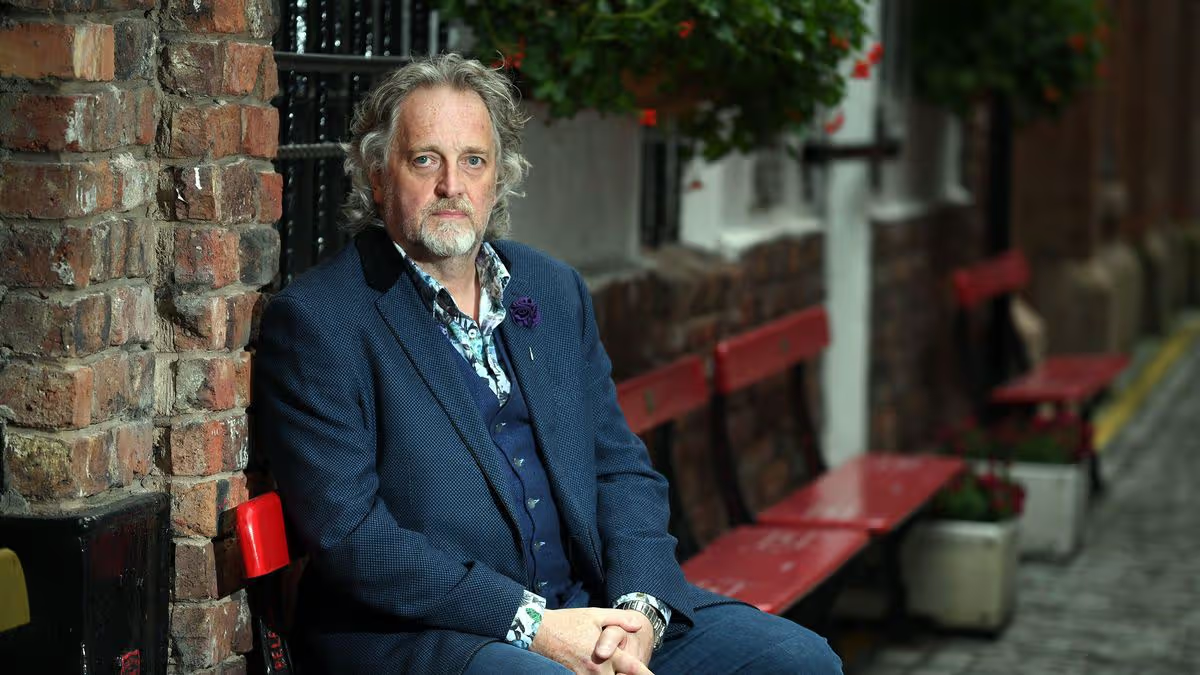
With almost four decades of working in hospitality under his belt, no one quite knows our local industry like Michael Stewart.
Director of Common Market, owner of a hospitality consultancy and training business and Belfast’s very first Night Czar, championing the city’s late-night economy, he explained passion has been the driving force for his long career.
From taking a risk returning home to manage a South Belfast bar to leading roles in some of the city’s most successful pubs, venues and clubs, Michael has seen the good, the bad and the ugly of what it means to work in hospitality in Northern Ireland.
READ MORE: From 1630 licence to modern nightlife complex: How White’s Tavern became an unstoppable Belfast powerhouseREAD MORE: Belfast night bus service a success but “if you don’t use it, you’ll lose it”
Speaking to Belfast Live, the Belfast-born businessman reflected on how the industry has changed over his 39 years in the game, the realities of operating a hospitality business in 2026 and enhancing Belfast’s status as a late-night city.
Four decades on the scene
Having moved to London to work in the 1980s, little did Michael know that a phone call from his friend Pim Dalm, owner of The Clandeboye Lodge, would change the trajectory of his life.
Croft Inns were looking for someone fresh to run Bob Cratchit’s on the Lisburn Road and Pim had put his name forward – after interviewing on a Monday, Michael had moved home to start his role as General Manager of the bar by the Saturday, and his love affair with hospitality offically began.
“I ran Bob Cratchit’s for ten years – the price of a pint was £1, spirits were £1, we were selling wine out of a 10-litre box on draft.
“Ten great years before I jumped ship to join Jaz Mooney. We opened The Fly and I ran it for two years before moving into head office with Jaz where he would say I ‘went on the rampage’,” he laughed.
“We developed Apartment, McHughs, Madison’s, Ryan’s and I was Head of Operations for another brilliant five years.”
Michael’s portfolio working on Belfast’s nightlife hotspots continued to grow and he was eventually headhunted by Ultimate Leisure, operators of Beach Club, and stepped into the world of nightclubs.
But his career “actually kicked off” when he was made redundant back in 2003, forcing him to reevaluate and eventually leading to the creation of The Bar Czar, his successful hospitality sector solutions, project management and training company.
“I’ve actually been self-employed longer than I was employed,” Michael added.
“There’s a cliche where a lot of people say everyone should work in hospitality. I don’t think it is a cliche – I think it is true.
“You should work in hospitality, whether you think you are good, bad or different, and that’s where you’ll really start to find yourself. When you are in hospitality, so many situations are thrown at you.
“Covid taught us how vulnerable we are but it also proved to me that you cannot replicate hospitality. It’s in our DNA – it’s face to face, it’s interaction. The good, the bad.
“If you work in hospitality, you take that away with you and I think it sets you up for life.”
‘Harder than ever’
Reflecting on his “life sentence” in the industry, which he was “so glad” to have fallen into back in 1987, he stressed that it is more difficult now than it ever was to operate in NI’s hospitality industry.
Michael explained: “So many things have changed since 1987. I will say this and I stand over it – back then, hospitality was fun. Now, it is hard.
“And everyone knows that.”
It is no secret that prices of pints are on the rise and the cost of a night out in Belfast is now being compared to that of London and Dublin.
Where people believe greedy publicans are to blame for a £7 pint in the city, Michael stressed that the hospitality rate system is “not fit for purpose” and both businesses and customers alike will suffer as a result.
“The rate system here for hospitality does not fit for everyone. You are taxed on turnover, not square footage, so that is a nightmare.
“And that is before you even open the doors – then you have electric, gas, minimum wage, marketing, insurance, water, sewage, VAT.
“Employees’ rights have changed for the better over the past 39 years, which I totally support, but what is difficult is the rate at which minimum wage is rising every year. It’s beyond inflation and beyond the cost base and a lot of venues have to suffer.
“There are so many things like this that people don’t understand that goes into hospitality but let me tell you this, a lot of people do understand because if they didn’t, hospitality wouldn’t exsist.”
While a night out in Belfast may be seen as much more of a luxury now than it was during his days at Bob Cratchit’s and he can appreciate that more people are enjoying a drink at home, he said it is the experience of a night out in a hospitality venue that cannot be replicated and this is what keeps the industry fighting through the tough times.
“Northern Ireland is resilient,” he said. “We came through The Troubles, we came through the dot-com crisis, we’ve come through I don’t know how many financial crashes and we are still here.
“We will always find our way out, we are resilient people and sometimes our way out is just to go out and have a bloody good time.”
Common Market – the new age of a night out
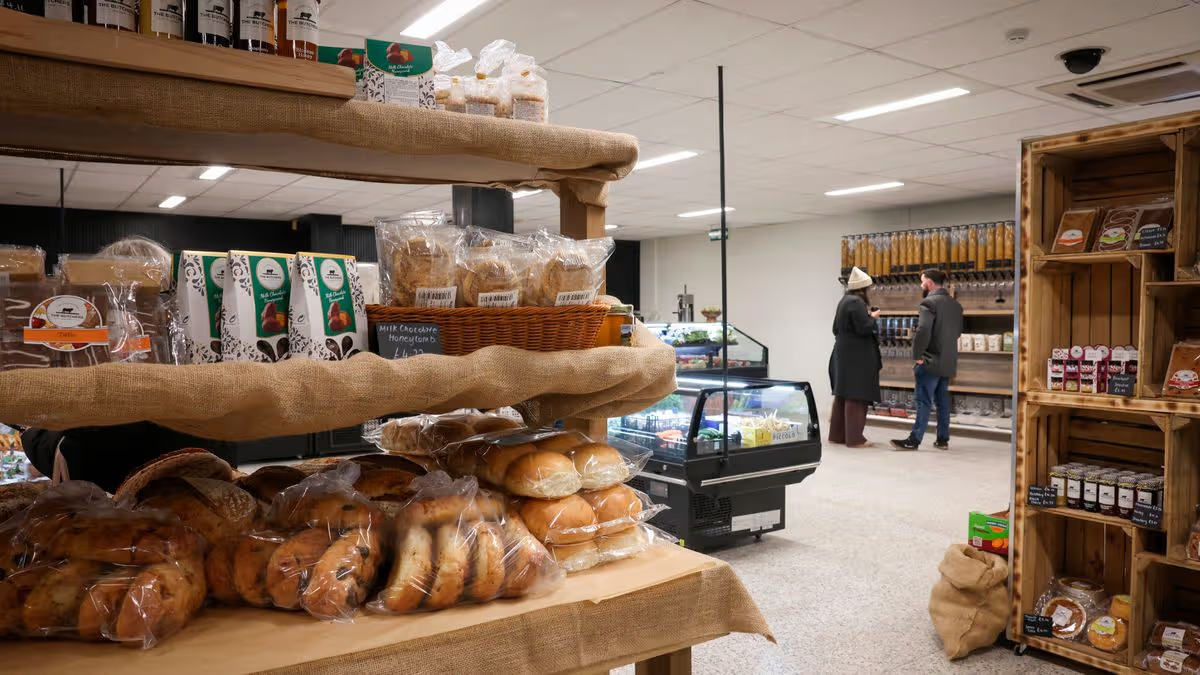
It was in the aftermath of the pandemic that Michael joined forces to open his newest hospitality venue, Common Market, in the Cathedral Quarter – a buzzy food and drink market that has launched some of the city’s most exciting food ventures.
“The way I sum it up is informal formality – people want that informality but they want the formality of good service, good standards, quality drinks and good value.
“People don’t want a cheap night, they want good value for money and Common Market is all about the experiential.
“You can get a drink if you want a drink, get food if you want food or you can come in, get nothing and enjoy the live music. It’s dog-friendly, child-friendly.”
When asked what has kept him in hospitality and constantly developing new things for Belfast’s food and drink scene, Michael said it comes down to one thing – passion.
An Ulster University alum, he regularly goes back to talk to hospitality and business students, sits on the board reviewing final year dissertations and engages with students in his role as Night Czar, all things he does on his own time because he is passionate about hospitality in Northern Ireland.
“You’ve got to have passion, stamina and enthusiasm. I’ve got enthusiam and loads of passion – maybe getting less stamina,” he laughed.
“But the passion, you either love it or you don’t. Even when it is hard, you have to love it.”
Late-night economy and hospitality
Michael was appointed as the city’s first Night Czar in 2024 in a bid to improve its night-time economy.
His two-year role, which has been extended for another year, focuses on enhancing, coordinating, and advocating for the city’s night-time strategy in terms of safety, transport, and business.
The Night Czar’s responsibilities include acting as the central point of contact for night-time services including hospitality, venues, transport and policing as well as advocacy and lobbying for statutory agencies.
When asked on a radio interview after his appointment why he would take up this honorary role for only £12k, he replied: “Well the fact I am doing it for that sort of money tells you I am not doing it for the money.
“I am doing it for the passion and wanting to make a difference.”
He started with four key objectives when he became Belfast’s Night Czar: develop and enhance late-night transport, advocating for an end to violence against women, reinstate Culture Night and a common-sense approach to pavement café licensing.
One of the biggest impacts on the hospitality trade and the safety of both customers and workers was a year-long pilot scheme for late-night travel to and from Belfast.
Late-night buses operate across 11 Translink Metro routes and four Ulsterbus routes on Friday and Saturday nights and with fares costing under £3, Michael is proud to have lobbied hard to achieve this scheme and offer a safe way home from a night out in the city.
With hopes to extend the scheme for another six months when the pilot ends, he stressed that it is a “use it or lose it ” situation, with the benefits to the economy, hospitality industry and safety of the nightlife scene in Belfast far too important to lose.
With over half his life spent serving the hospitality industry in Belfast, there is not a corner of it he hasn’t worked in, consulted on or enjoyed himself.
Violence, pandemics, financial crashes – he has worked through them all and seen Belfast fight back to rise through the ashes despite the continued set backs the industry faces.
“We are in uncertain times, just on a world stage, but I think it will come good again at some point. It will have effects for everybody in every walk of life.
“But as I said at the begining, we in Northern Ireland are a resilent bunch and I think we will come through it, probably battered and bruised, but we will come through it.
“People will still, in some shape or form, want to go out – no matter the price of a pint, the price of meal or entry to a club, they will still want to experience it because you cannot replace that social interaction that is in our DNA.
“Habits may change, but people will still want to work in hospitality.”
For all the latest news, visit the Belfast Live homepage here and sign up to our What’s On newsletter





































You must be logged in to post a comment Login