Connect with us

NewsBeat

I’m a money expert – this is the exact amount of pocket money YOU should be paying your child

Published

on

Daily Mirror

On average, parents give children £7.75 a week in pocket money – but knowing how much is right for you depends on your individual circumstances and the age of your child

I’ve spent nearly two decades writing about budgeting but now as a mum to three-year-old twins, I’ve realised how early learning about money can start.

Jack and Sienna are already learning about money. They love playing shop and even tapping my card to pay in shops.

Advertisement

But what they haven’t learned yet, is that tapping a card is not magic and money does run out. That’s why I think pocket money can help give children a safe way to practice making choices.

They can learn about saving up for something they really want or occasionally buying an item and deciding it wasn’t worth it. They may also understand what it feels like when money runs out.

On average, parents give children £7.75 a week, or £403 a year, in pocket money, according to new Confused.com research, based on 1,000 adults with kids aged four to 16. The average age for starting to pay pocket money is seven.

Advertisement

Deciding how much you pay your kids really depends on what you can afford. My starting point is to look at the money you have left after essential bills and set aside no more than around 2.5% of that for pocket money.

If your household has £1,000 left each month after rent or mortgage, energy, food, childcare, transport and other essentials, 2.5% is £25 a month – about £5.75 a week. You might round that down for a younger child or up for an older one who is expected to pay for more things themselves.

If £25 feels uncomfortable, pay less. If you have more than one child, decide what you can afford as a total family pocket-money pot before dividing it, rather than automatically multiplying the figure.

The exact amount for your family is the one you can pay consistently without dipping into an overdraft, using credit or cutting back on essentials. And if the affordable answer is 50p, £1 or nothing at all for now, that’s absolutely fine.

You can still teach kids important money lessons early on, using coins, a homemade chart or money received for birthdays. The lesson is more valuable than the size of the payment.

When should you start?

The survey found children begin receiving pocket money at seven and a half on average, with more than half starting between five and eight. I would not treat that as a deadline either.

Advertisement

A child is ready when they understand that money can be spent only once, can make a simple choice between two items and can wait at least a little while to save towards something. Some children will be ready earlier than others.

With younger children, physical coins can be easier to understand. They can see a jar filling up and watch the money disappear when they buy something.

As children get older, a bank account, prepaid card or app can teach them about balances and contactless spending – but parents should check fees, age limits, parental controls and cash withdrawal rules first.

I think linking pocket money payments to chores is a good idea for older children – but you need to be clear about what are normal household tasks linked to family life that they are expected to do, such as cleaning up after dinner.

Advertisement

Three-quarters of parents in the survey link at least some pocket money to household tasks. Whatever amount you choose, be clear about what it has to cover.

A five-year-old’s £2 might be entirely theirs to spend. A teenager’s larger allowance might need to cover lunches, travel, phone costs or going out.

Try to pay it on the same day each week or month and try to encourage them to save. Maybe you could even have separate piggy banks or jars for spending and saving.

Let them make mistakes like spending it all on sweets and while you might want to rescue them, don’t do it. They are learning a vital lesson.

Advertisement

Those are the skills I want Jack and Sienna to grow up with. I plan to start giving them a very small amount like 50p when they are five years old and then increase it as they become responsible for their own spending.

Pocket money should teach kids that money has limits but it would be silly to let it overstretch your own budget to pay it.


Source link

Advertisement
Continue Reading
Click to comment

You must be logged in to post a comment Login

Leave a Reply

NewsBeat

Reform UK calls for police to reopen probe into attack on Farage aide following Ann Widdecombe murder

Published

on

George Cottrell was 'jumped' outside his Chelsea property in the early hours and recalled being grabbed at by blue latex gloves as he fled on foot (Pictured: Mr Cottrell and Nigel Farage)

Advertisement

Reform UK wants the police to re-investigate an attempted robbery against an aide of Nigel Farage following Ann Widdecombe‘s murder.

Adviser George Cottrell was attacked outside his London home in April, days after Mr Farage revealed his house had been firebombed.

The timing of the incident, previously reported without naming Mr Cottrell, has raised suspicions in the party that it may be linked to the hate-fuelled attacks that culminated in Ms Widdecombe’s murder in July.

Mr Cottrell – ‘Posh’ George, as he is known – was ‘jumped’ outside his Chelsea property in the early hours and recalled being grabbed at by blue latex gloves as he fled on foot.

Advertisement

While the incident was reported as a stand-alone crime, the heightened fears about security have led to calls for the case to be reopened.

Reform aides also pointed to a profile about Mr Cottrell in Tatler the previous August which revealed Mr Farage was ‘often’ at his west London house, which could have made it an easy target for those hoping to do harm to the party leader.

The Metropolitan Police said the case remains closed, and that it had ‘carried out extensive enquiries’ but could not identify the suspects.

The statement suggested the case could be reopened ‘subject to further information coming to light’.

Advertisement

George Cottrell was ‘jumped’ outside his Chelsea property in the early hours and recalled being grabbed at by blue latex gloves as he fled on foot (Pictured: Mr Cottrell and Nigel Farage)

Ann Widdecombe was found dead at her home in Haytor on Dartmoor, Devon, on July 9

Ann Widdecombe was found dead at her home in Haytor on Dartmoor, Devon, on July 9

But last night a Reform source said the police may want to reconsider after announcing they are re-investigating Mr Farage’s firebombing.

Advertisement

They said: ‘In the current climate, it would seem strange to dismiss the possibility of a link between the incident involving George, the firebombing of Nigel’s house and murder of Ann Widdecombe. 

‘The police must keep an open mind, even if means re-opening George’s case.’

Counter-terror police confirmed they are reopening their probe into Mr Farage’s firebombing last year.

Mr Farage said: ‘It was an outright arson attempt. I wasn’t home at the time, but when I came back I found the damage.’ 

Advertisement

A spokesman for Counter-Terrorism Police yesterday said the investigation into Ms Widdecombe’s murder ‘remains ongoing’.

Advertisement

Source link

Advertisement
Continue Reading

NewsBeat

Viral prank videos led to social media influencer’s conviction

Published

on

Viral prank videos led to social media influencer's conviction

PHOENIX (AP) — A social media influencer known for posting viral videos of pranks has pleaded guilty to criminal impersonation in Arizona for posing as an employee of businesses in a Phoenix suburb and orchestrating brief but chaotic takeover attempts.

The outcome was welcomed by observers who said it could serve as a reminder to seekers of viral fame that stunts that cross the line legally can lead to serious ramifications.

Heston James Cobb, who posts as “Heston James,” was arrested in July 2025 after police in Tempe say he and others went into businesses posing as workers, entered employee-only areas and refused to leave when asked to do so. He entered his plea Friday.

In one video Cobb, wearing a Chipotle Mexican Grill shirt, told restaurant staff he was going to “clean house” before a group of men wearing dark shirts flooded into the eatery and ignored requests to leave. One man posing as an employee cleaned a tabletop with a mop.

Advertisement

Investigators said the videos had millions of views and potentially generated large amounts of income.

Vicki Lopez, an attorney representing Cobb, declined to comment Saturday. The Associated Press left a message with Cobb’s TikTok account seeking comment.

Steve Chucri, president of the Arizona Restaurant Association, said he hopes Cobb’s punishment is “severe” to deter copycats.

“There’s no place for it,” Chucri said. “That’s the last thing we need to put up with in the restaurant industry. The amount of money it takes to operate today is expensive.”

Advertisement

Chucri said the association does not offer any formal training or advice to restaurants on dealing with social media pranksters, and he hopes it does not come to that.

“We’re a society of civility,” Chucri said. “We shouldn’t have to.”

Matthew Pittman, a social media professor at the University of Tennessee in Knoxville, hopes the arrest will be a warning to influencers about boundaries when creating prank or satirical content.

Pittman said he and others who teach aspiring content creators generally stress that “real world norms and laws” extend into the digital world.

Advertisement

“So doing something that is illegal in real life would also be illegal on social, even if you are doing it for content,” he said. “This is a clear case of going beyond what the law allows.”

Among the recent cases he cited was an influencer in Long Island, New York, who was arrested last year after a series of pranks. They included videos of him going to eateries; pouring food such as raw eggs or beans over his head; and then running off, leaving the mess to be cleaned by others.

Advertisement

“Every few years a YouTuber, influencer or prank content creator goes a little too far, gets in trouble, and reminds the rest of us creators that digital actions can have real world consequences,” Pittman said.

Cara Hawkins-Jedlicka, a communications professor at Washington State University who teaches about content creation, said it’s not enough for influencers to stay within the law. They also need to have basic empathy.

“When is it pulling a prank, and when it is being cruel?” Hawkins-Jedlicka said. “Before anything else, this is truly kind of unkind. This influencer was really only thinking about himself and how can I take advantage of this community.”

___

Advertisement

Marcelo reported from New York.

Source link

Advertisement
Continue Reading

NewsBeat

First day at a new school: How to make friends

Published

on

First day at a new school: How to make friends

For students starting at a new school, the first day holds many questions: Will they see any familiar faces? Who will they sit with at lunch? Who will they play with at recess?

“I’m this much nervous,” said Iman Fair-Seldon, 5, holding her hands about 4 inches (10 centimeters) apart. Iman will start first grade next month at a new school in southern New Jersey, near Philadelphia. Despite the nerves, she said she is excited to make new friends.

Starting at a new school or making a big transition, such as moving from elementary school to middle school, can be challenging. Parents may want to help but aren’t always sure what to say or do. Here’s some advice from both grown-ups and the ultimate experts: kids who have gone through transition themselves.

Schedule playdates and go to birthday parties

Parents of young children have significant influence over where their children spend time and with whom, experts say. They can seek out activities that create opportunities for connection, such as parks, playgrounds and birthday parties, and decide when their children are ready for activities like sleepovers.

Advertisement

This article is part of AP’s Be Well coverage, focusing on wellness, fitness, diet and mental health. Read more Be Well.

“Initially, parents have a huge impact when it comes to the friends that children have,” said Dr. Asha Barber Sutton, a licensed marriage and family therapist and an associate dean of academic affairs at National University in San Diego. “More than we would like to believe, our actions as caregivers make a difference in terms of how children experience the world.”

Amira Fair, Iman’s mother, says she prefers to keep to herself, but she pushes past those feelings to help her daughter develop relationships. “I make it my business to exchange numbers and try to schedule monthly playdates,” she said. “One thing I tried to do, especially at her old school, was go to every single birthday function, say hi to the parents, get a present, see the family.”

Let kids navigate their own friendships

Parents can’t manage every friendship for their children, experts say. Instead, they can help children develop their own sense of what makes a good friend: Are they kind? Are they honest? Can you be yourself around them? Some difficult interactions can help children learn what they value in a friend and how to handle conflict, Sutton said.

Advertisement

Parents can also ask questions to help their children think about what they value in friendships: What qualities do you like in your friends? Who makes you feel comfortable being yourself? Those conversations can give children a framework for evaluating their own friendships when problems arise, experts say.

Jaiden Journet, a 14-year-old starting at a new high school in North Carolina, suggests parents ask their kids: “Have you found anything you have in common with anyone?”

Help kids get involved

Parents also can support their children through encouragement, especially if they are shy or anxious. Encouraging children to get involved in extracurricular activities or to try something new can help them meet people with similar interests.

Shia Watts, 16, says trying something new led her to some of her friends at Notre Dame High School in Sherman Oaks, California.

Advertisement

“Last year, I was part of theater production. I’d never done that before, but I met so many amazing people,” she said.

When Jamir Gonzalez transferred last year to Uncommon Camden Prep High School in New Jersey, he joined the baseball and debate teams.

“If you have any hobbies, find out if they have that at your school, and if they do, talk to the people that are there,” said Jamir, now a 16-year-old senior.

Once students find opportunities to connect, starting the conversation is the next step, experts say. Smiling, complimenting others and asking questions can help start a conversation and keep it going.

Advertisement

Iman, the New Jersey 5-year-old, remembers how she met her now “B-F-F-F-F-F.” It started with a compliment.

“I think I said, ‘I like your shirt,’ and then she said, ‘Thank you.’ And I said, ‘So what’s your name?’” she recalled.

Put down the cellphones — sometimes

Students may find it harder to start conversations when their peers are on their phones, wearing headphones or focused on screens. Experts say parents can encourage children, particularly teens, to put devices away at times so they can be more present and engaged with the people around them. One way to help: Stop texting your child at school, some teachers and experts say.

But being too harsh with older children’s tech limits can isolate them socially, Sutton said. Still, parents should talk with their teens about expectations around technology, social media and gaming, including knowing who kids are interacting with online.

Advertisement

Technology can also help children maintain friendships when circumstances separate them, Sutton said. “If you move away, it’s no longer like, ‘Hey, I moved out of state, and I can never see you,’ ” she said. “We have FaceTime, and we can still stay connected to friends in that way.”

Even one friendship counts

Feeling connected and having a sense of belonging at school can have an important effect on students’ well-being. If a student feels staff and peers at their school care about them, they are less likely to have poor mental health, use substances or be involved in violence, according to the Centers for Disease Control and Prevention, and they are more likely to have better grades and attendance.

But a student needn’t have a large friend group to feel connected. Even one relationship can make a meaningful difference, said Nicole Hockley, co-founder and CEO of Sandy Hook Promise, a nonprofit that focuses on gun violence prevention in schools.

“Even if you only have one really strong friendship or one strong trusted adult, one strong sense of belonging, that can be enough to really positively affect your well-being and your trajectory through school and life,” she said.

Advertisement

For students who are nervous about starting over, Hockley said, it can help to remember that other students may be looking for connection, too.

“There’s also someone else just like you in that same space who’s also saying, ‘I would like to meet someone. I’d like to make a friend,’ ” she said. “It can be intimidating, but it’s not hard once you practice it.”

___

This story has been updated to correct that Jamir Gonzalez joined the baseball team, not the basketball team.

Advertisement

___

The Associated Press’ education coverage receives financial support from multiple private foundations. AP is solely responsible for all content. Find AP’s standards for working with philanthropies, a list of supporters and funded coverage areas at AP.org.

Advertisement

Source link

Continue Reading

NewsBeat

Salmon will be tastier and juicier if you coat the fish in 1 simple ingredient cook loves

Published

on

Wales Online

A home cook says coating it in a simple ingredient before cooking transforms the fish into a sweet, savoury, umami dish that even salmon sceptics will enjoy.

Salmon makes an ideal weekday dinner option, being tasty, satisfying, and requiring minimal cooking effort. It’s wonderful served simply with vegetables or incorporated into a traybake or fish pie.

Advertisement

Yet, some people steer clear of salmon, finding the smell and taste somewhat unappealing. When not prepared properly, salmon can turn out bland and even dry, given it is considerably more delicate than most meats.

Bearing this in mind, home cook and recipe developer Ayeh Manfre from food blog Cooking with Ayeh has revealed her “favourite way” to make salmon “delicious” – and it hinges on one key ingredient.

She said, “I’m always looking at new ways of making it [salmon] taste not so ‘fishy’ – well, this miso-glazed salmon definitely ticks all the boxes. “It’s crazy easy to make with a simple same-day marinade and then pop in the oven until perfection. The star is the miso paste, which gives the salmon a delicious, savoury, and sweet umami flavour.”

What is miso paste?

Miso paste is a classic Japanese ingredient crafted from fermented soybeans, salt, and koji (a specific type of mould), sometimes including grains.

The fermentation process results in a rich and delightful flavour that balances saltiness with sweetness, packed with umami goodness.

There are three distinct varieties of miso: white miso, yellow miso, and red miso. Ayeh pointed out that she prefers white miso paste, which has a milder taste, compared to yellow or red miso; they have been fermented longer, so they have a stronger taste.

Miso is not only “tasty” but also “good for your gut health”, as it contains probiotics. The home cook said, “I love using miso in many of my recipes. If you haven’t experimented with it yet, now’s the time.”

Advertisement

How to make salmon tastier with miso paste

Ingredients (two servings)

  • Two salmon fillets
  • Two tablespoons of white miso paste
  • One tablespoon of salt-reduced soy sauce, or half a tablespoon of regular soy
  • One tablespoon of rice vinegar
  • Two teaspoons of honey
  • One teaspoon of sesame oil

Method

In a deep bowl, combine the miso marinade components, including the miso paste, soy sauce, honey, rice vinegar and sesame oil. Whisk together until smooth and lump-free.

Position the fish in the bowl with the salmon flesh facing downwards, ensuring it’s thoroughly coated. Allow to marinate for a minimum of 30 minutes, or up to two hours for optimal flavour. If marinating for two hours or during warmer weather, refrigerate.

Set the oven grill to 240C/220C Fan/Gas Mark 9 and remove the salmon from the refrigerator. Prepare a baking tray with tinfoil and lightly oil the surface to prevent sticking.

Arrange the salmon fillet with the skin facing down on the baking tray, reserving any remaining marinade from the bowl. Position the tray on the middle shelf of the oven and grill for six to nine minutes – timing depends on your preferred level of doneness.

Carefully take out from the oven and brush with some of the reserved marinade. Return the tray to the oven on an upper shelf nearer to the grill, and cook for an additional three minutes to achieve a golden caramelised finish. Monitor closely, as the miso marinade can char rapidly.

Advertisement

Ayeh suggests topping the salmon with sliced spring onions and sesame seeds and accompanying with rice and fresh or prepared vegetables.

Source link

Continue Reading

NewsBeat

Burnham agrees pay rise for train drivers after strike threats

Published

on

Daily Mirror

Train drivers are set to receive an above-inflation pay rise as agreed by Burnham who frequently travels up from the capital to work at No 10 North

Andy Burnham has agreed on a pay rise for train drivers including those operating the London-Manchester line used by the Prime Minister.

Advertisement

Train drivers are set to receive an above-inflation pay rise of 3.6%, following threats of strikes.

The wage deal between Avanti West Coast and the Aslef union is the first to be approved under the Prime Minister, who frequently travels up from the capital to work at No 10 North.

The company runs services from London to destinations including Glasgow, Manchester, Liverpool and Blackpool.

Advertisement

Aslef has secured time-and-a-half pay on Sundays, a single-year wage rise of 3.6% – 0.7% higher than the latest inflation rate – and up to £720 for turning up to work on a fifth day of the working week, as first reported by the Sunday Times.

It comes after the union announced plans at the end of June to ballot members in the following weeks on whether to launch strikes in a dispute over pay.

An Aslef spokesperson said on Saturday: “Our job is to enhance our members’ terms and conditions and this deal, struck with Avanti West Coast and approved by the DFTO (Department for Transport Operator), has been accepted.”

A Department for Transport spokesperson said: “This Government has prioritised resolving the rail union disputes, improving services for passengers and saving hundreds of millions in lost revenue to ease the burden on taxpayers.

Advertisement

“We are pleased to see Avanti West Coast work with Aslef to enable a fair and affordable settlement to keep Britain’s railways moving and prevent disruption for passengers.”

The Mirror has contacted Avanti West Coast.

Source link

Advertisement
Continue Reading

NewsBeat

Hong Kong bookstores are under threat following a string of arrests

Published

on

Hong Kong bookstores are under threat following a string of arrests

HONG KONG (AP) — Chinese university student Fleming Cheng found the political books he had only glimpsed online in a Hong Kong bookstore last year.

Before visiting Greenfield Book Store, Cheng had only managed to see the books’ covers online after bypassing Beijing’s internet censorship using a VPN. At the store, he picked up a title offering a critical account of China. He stood there devouring dozens of pages from another, about a pro-reform Chinese leader who fell from power for sympathizing with the protesters during the Tiananmen Square pro-democracy movement in 1989.

Cheng said he saw perspectives diverging from the mainland’s official narrative.

“A space of freedom,” he said.

Advertisement

Hong Kong’s independent bookstores, many of them tucked away from busy streets inside buildings, have long offered a refuge and a window to a freer world for some mainland Chinese readers seeking ideas suppressed at home.

But these spaces now are under threat following a wave of bookseller arrests over alleged sedition under a 2024 national security law. Critics say their plight reflected the city’s broader crackdown on dissent that began after Beijing imposed a separate 2020 security law. Authorities say the two laws are vital to stability.

Greenfield was one of four bookstores targeted by police in just four months. Although bail was granted, the 50-year-old shop in July announced it would close at the end of its lease. Another bookstore, Have A Nice Stay, set up by former journalists, had announced plans to shut down Sunday, citing “elusive red lines” and financial challenges, even before its booksellers were arrested on the same day as Greenfield’s.

“If the Hong Kong government desperately tries to bring every aspect of the city into close alignment with the mainland, or even to the point where the two become indistinguishable, that would be a tremendous loss for us mainlanders too,” Cheng said.

Advertisement

Booksellers under pressure

Hong Kong, a former British colony that returned to China in 1997, was once known for its freedoms of publication and expression.

But in 2015, bookseller Lam Wing-kee and four others affiliated with Causeway Bay Books disappeared. The store was known for selling politically sensitive titles. Lam later told reporters he was held by Chinese authorities, providing explosive details that contradicted official Chinese accounts. Gossipy books about Chinese politics soon dwindled on Hong Kong’s shelves.

After the 2020 security law, leading activists were arrested and civil society groups disbanded. Titles about the Tiananmen crackdown and works by pro-democracy politicians were pulled from public libraries. At the city’s annual book fair, some smaller book businesses were barred from exhibiting, and a pro-Beijing newspaper labeled an independent book fair a form of “soft resistance.”

Despite the pressure and increased official inspections, many pressed on, with some continuing to organize activities alongside selling books.

Advertisement

But the arrests hit Book Punch in March, Hunter Bookstore in June, and Greenfield and Have A Nice Stay in July. The authorities accused the booksellers of selling seditious publications, according to government statements and media reports.

Cautious booksellers say they struggle to interpret the rules

Authorities say statements with “seditious intention” to incite hatred against or the overthrow of the governments of China and Hong Kong are prohibited. But they have not specified the books they consider as “seditious,” leaving observers to find clues in news reports quoting anonymous sources.

Secretary for Security Chris Tang said the law is clear about what constitutes seditious intent and reiterated there would be no banned book list. He said booksellers should ensure the titles they sell do not harm national security, just as those selling food need to ensure the food won’t cause a stomach ache or be poisonous.

A bookseller, who spoke on condition of anonymity for fear of government retribution, said they struggled to judge what was seditious. Still, they became more cautious about whether to sell certain books on China’s modern politics. Their landlord was also reviewing whether to continue to rent the space to them after being harassed.

Advertisement

In an emailed reply, the government condemned any “smearing” and false remarks regarding the work in safeguarding national security. It said the security laws clearly stipulate that human rights, freedoms of speech and publication should be protected.

The offenses linked to seditious intention expressly protect expression of opinions or even criticism against government policies, it said.

Advertisement

Spaces for refuge and companionship

University student Iris Wang from neighboring Guangdong sensed tighter control over Hong Kong. To her, Hunter encouraged people to think, instead of just selling books like its mainland peers. She bought a postcard about being courageous and a manga there.

Some mainland readers also visit the stores for non-political reasons, such as for their niche books or simply for their calmness.

Hong Konger Brian Leung found companionship in independent bookstores, saying each had its own character. When arrests happened at the shops he visited, he said he felt something he cherished and that Hong Kong deserved was being rejected.

“Part of what I have grown used to in Hong Kong is lost again,” he said, adding that the bookshops have not “incited” him because readers can judge for themselves.

Advertisement

Concerns over Hong Kong’s access to Taiwanese books

In Taiwan, widely seen as the freest publishing hub for Chinese-language books, some publishers have filled the gap as restrictions deepened in Hong Kong after the 2020 security law took effect. Some readers fear one day Taiwan cannot send books to Hong Kong as freely as before.

Taiwan’s publishers released six times as many books about Hong Kong between 2020 and 2024 as in the previous five years, according to Cheng Tsu-Bang, a sociology professor at Tunghai University in Taiwan.

“The publication of books seems to have become a very important medium of communication between Taiwan and Hong Kong, or a medium of mutual support,” he said.

In July, Taiwan’s broadcaster FTV reported that a logistics firm stopped taking orders to ship books from Taiwan to Hong Kong bookstores under investigation. It also demanded a full book list before delivering to other Hong Kong premises, the report added.

Advertisement

One Hong Kong author who moved to Taiwan and has published books there is Lee, who spoke on condition of not using their full name out of fear of government retribution.

Lee has written about Hong Kong’s pro-democracy movement, saying the independent bookstores served as a bridge to bring works about Hong Kong to the city and connect diaspora writers to their home.

The writer compared the collapse of civil society to a boulder rolling downhill, crushing things in its path. Lee said bookstores were a small flower field where people could breathe and try to safeguard what remained.

“It’s now like being told very directly and cruelly that perhaps this borrowed time is coming to an end,” Lee said.

Advertisement

Source link

Advertisement
Continue Reading

NewsBeat

Ford Transit stolen from driveway in Selby overnight

Published

on

Ford Transit stolen from driveway in Selby overnight

As a subscriber, you are shown 80% less display advertising when reading our
articles.

Those ads you do see are predominantly from local businesses promoting local
services
.

These adverts enable local businesses to get in front of their target audience – the local
community
.

It is important that we continue to promote these adverts as our local businesses need
as much support as possible during these challenging times.

Advertisement

Source link

Advertisement
Continue Reading

NewsBeat

The secret visit to Moscow from the director of the CIA means there is something big happening… we just don’t know what. This is why I now fear Putin will fire a nuclear weapon… but not at a NATO ally: PHILIP INGRAM

Published

on

US intelligence has been hinting at Russia possibly planning a ¿limited incursion,¿ or at least plotting to test the West¿s red line of land invasion. Launch of a Russian Sarmat ballistic missile in 2022

As a former senior intelligence officer, I have learned to pay attention to the oddities, the small, unexplained details that make the hairs rise on the back of your neck. So when a US C-17 Globemaster was spotted flying from Latvia into Moscow last week, my curiosity was immediately piqued. When it emerged that the passenger was no routine diplomat but John Ratcliffe, the director of the CIA, I sat up properly.

CIA chiefs do not drop into Moscow for a fireside chat. The last comparable visit was by William Burns in November 2021, sent in a last-ditch attempt to warn Vladimir Putin off invading Ukraine. He failed.

That is why Ratcliffe’s sudden journey matters. In intelligence, unusual movement is rarely meaningless, and this one had ‘warning’ written all over it.

Ratcliffe’s chilling message to Putin? Keep your hands off the West, especially the Baltic states. US intelligence has been hinting at Russia possibly planning a ‘limited incursion,’ or at least plotting to test the West’s red line of land invasion.

Advertisement

At the same time, Russia is raging at the UK, warning that Britain is ‘playing with fire’ after Andy Burnham travelled to Kyiv to allow Ukraine to produce long-range Storm Shadow cruise missiles from British blueprints. Moscow talks of ‘catastrophic consequences’ and says it will strike our military installations – with a drone factory near RAF Mildenhall in Suffolk firmly in its crosshairs, as The Mail on Sunday reports today.

Finland has raised the alarm, warning that Putin is unleashing ‘hybrid attacks’ across Europe – explosive drone strikes, arson at European munitions plants and sabotaging critical infrastructure to cripple military aid to Ukraine. Poland is going a step further by training 400,000 Poles in the art of conflict survival.

Putin is getting increasingly desperate, and it is widely reported that he is planning to feed a staggering 600,000 new recruits into his frontline meat-grinder. Concern is growing that he may strike out at the West to deflect attention from his failures in Ukraine and the growing impact of Ukrainian strikes in Russia on the Russian people.

Advertisement

US intelligence has been hinting at Russia possibly planning a ‘limited incursion,’ or at least plotting to test the West’s red line of land invasion. Launch of a Russian Sarmat ballistic missile in 2022

My concern has grown with the lack of any substantive commentary from the Americans on Ratcliffe’s visit and the casual way in which Donald Trump downplayed its significance, calling it ‘semi-routine’ and ‘nothing unusual’.

Russia has been equally dismissive. The Kremlin says invasion warnings are ‘scare stories’.

Simple fact: This is not routine and it is highly unusual. Something is happening, we just don’t know what… yet. So does it mean British troops in Estonia could find themselves staring down the barrels of Russian tanks? No.

Advertisement

Putin may be reckless, brutal and desperate, but he is not yet suicidal. He does not have the troops, armoured vehicles or equipment to take on Nato in a war while his army is being chewed up in eastern Ukraine. No intelligence points to a Russian build-up on the Baltic frontier. No massing of armour. No field hospitals. No logistics surge.

So what are we likely to see? Russia is already at war with Europe, just not in a way most people recognise. Over the past year the Kremlin’s campaign has been ramping up, testing reactions, seeing how far it can push but not attacking in a conventional military way, rather in the grey zone – cut cables, jammed GPS, drones over military bases and critical infrastructure, railway sabotage, warehouse fires, cyber strikes and disinformation.

It is war by nuisance, intimidation and deniability: Cheap enough for Moscow to repeat, ambiguous enough to avoid a Nato military response, and serious enough to force European governments to divert troops, police, intelligence officers and money away from Ukraine and back into their own streets, ports, railways and skies.

Instead of relying solely on professional intelligence officers, Moscow is increasingly using proxies, criminals, extremists, migrants or disposable agents recruited online to set fires, photograph military logistics, damage railways, or plant devices.

Advertisement

Its attacks in Europe nearly tripled between 2023 and 2024. Putin likely feels he has got away with it and is emboldened to do more.

If he lacks troops for a conventional assault, could desperation drive him to the nuclear button? That question keeps intelligence chiefs awake. Western agencies monitor Russia’s nuclear forces with obsessive attention. Moscow’s Oreshnik intermediate-range ballistic missile, already used against Ukraine, could be fitted with a nuclear payload. The usual doomsday chorus insists Putin may reach for a tactical nuclear weapon on the Ukrainian front. I do not believe he will.

Moscow talks of ¿catastrophic consequences¿ and says it will strike our military installations ¿ with a drone factory near RAF Mildenhall in Suffolk firmly in its crosshairs, writes Philip Ingram

Moscow talks of ‘catastrophic consequences’ and says it will strike our military installations – with a drone factory near RAF Mildenhall in Suffolk firmly in its crosshairs, writes Philip Ingram

He understands the one thing nuclear theorists sometimes forget: Once you put a nuclear warhead on a battlefield missile, you are no longer playing at intimidation – you are gambling with Armageddon, and the political consequences would be enormous.

Advertisement

His allies China and India would recoil. The wavering states of the global south would edge away. He would look reckless and isolated.

Nato’s response would almost certainly be conventional, not nuclear – closing the skies over occupied Ukraine, smashing Russian forces in occupied territory and making clear that Moscow had crossed the ultimate red line. For Putin, this is not escalation dominance. It is lose-lose.

But Putin does have one nuclear card to play, and almost no one is talking about it. He could launch a tactical nuclear-armed missile at a remote part of Russia and call it a ‘test’. The message would be unmistakable: Kyiv could be next. Or Poland. Or Estonia.

It would be theatre, not war, but white-hot radioactive theatre designed to terrify Western capitals into doing exactly what he wants: Turning support for Ukraine into pressure on President Volodymyr Zelensky to accept peace at any price.

Advertisement

There would be next to no military reprisal from the West for a device detonated over Russia. More sanctions may follow, but Putin may calculate that they are worth the political mayhem a nuclear explosion would cause.

If it moves the dial on Ukraine in Putin’s favour, that would be sold as victory. For the West, it would be surrender dressed up as diplomacy. Let us hope that this was not the reason for Ratcliffe’s mercy dash to Moscow.

 Philip Ingram is a former colonel of the British Army.

Source link

Advertisement
Continue Reading

NewsBeat

Hong Kong’s independent bookstores, a refuge for Chinese readers, are under threat

Published

on

Hong Kong's independent bookstores, a refuge for Chinese readers, are under threat

Chinese university student Fleming Cheng found the political books he had only glimpsed online in a Hong Kong bookstore last year.

Before visiting Greenfield Book Store, Cheng had only managed to see the books’ covers online after bypassing Beijing‘s internet censorship using a VPN. At the store, he picked up a title offering a critical account of China. He stood there devouring dozens of pages from another, about a pro-reform Chinese leader who fell from power for sympathizing with the protesters during the Tiananmen Square pro-democracy movement in 1989.

Cheng said he saw perspectives diverging from the mainland’s official narrative.

“A space of freedom,” he said.

Advertisement

Hong Kong’s independent bookstores, many of them tucked away from busy streets inside buildings, have long offered a refuge and a window to a freer world for some mainland Chinese readers seeking ideas suppressed at home.

But these spaces now are under threat following a wave of bookseller arrests over alleged sedition under a 2024 national security law. Critics say their plight reflected the city’s broader crackdown on dissent that began after Beijing imposed a separate 2020 security law. Authorities say the two laws are vital to stability.

Greenfield was one of four bookstores targeted by police in just four months. Although bail was granted, the 50-year-old shop in July announced it would close at the end of its lease. Another bookstore, Have A Nice Stay, set up by former journalists, had announced plans to shut down Sunday, citing “elusive red lines” and financial challenges, even before its booksellers were arrested on the same day as Greenfield’s.

“If the Hong Kong government desperately tries to bring every aspect of the city into close alignment with the mainland, or even to the point where the two become indistinguishable, that would be a tremendous loss for us mainlanders too,” Cheng said.

Advertisement

Booksellers under pressure

Hong Kong, a former British colony that returned to China in 1997, was once known for its freedoms of publication and expression.

But in 2015, bookseller Lam Wing-kee and four others affiliated with Causeway Bay Books disappeared. The store was known for selling politically sensitive titles. Lam later told reporters he was held by Chinese authorities, providing explosive details that contradicted official Chinese accounts. Gossipy books about Chinese politics soon dwindled on Hong Kong’s shelves.

After the 2020 security law, leading activists were arrested and civil society groups disbanded. Titles about the Tiananmen crackdown and works by pro-democracy politicians were pulled from public libraries. At the city’s annual book fair, some smaller book businesses were barred from exhibiting, and a pro-Beijing newspaper labeled an independent book fair a form of “soft resistance.”

Advertisement

Despite the pressure and increased official inspections, many pressed on, with some continuing to organize activities alongside selling books.

But the arrests hit Book Punch in March, Hunter Bookstore in June, and Greenfield and Have A Nice Stay in July. The authorities accused the booksellers of selling seditious publications, according to government statements and media reports.

Cautious booksellers say they struggle to interpret the rules

Authorities say statements with “seditious intention” to incite hatred against or the overthrow of the governments of China and Hong Kong are prohibited. But they have not specified the books they consider as “seditious,” leaving observers to find clues in news reports quoting anonymous sources.

Advertisement

Secretary for Security Chris Tang said the law is clear about what constitutes seditious intent and reiterated there would be no banned book list. He said booksellers should ensure the titles they sell do not harm national security, just as those selling food need to ensure the food won’t cause a stomach ache or be poisonous.

A bookseller, who spoke on condition of anonymity for fear of government retribution, said they struggled to judge what was seditious. Still, they became more cautious about whether to sell certain books on China’s modern politics. Their landlord was also reviewing whether to continue to rent the space to them after being harassed.

In an emailed reply, the government condemned any “smearing” and false remarks regarding the work in safeguarding national security. It said the security laws clearly stipulate that human rights, freedoms of speech and publication should be protected.

The offenses linked to seditious intention expressly protect expression of opinions or even criticism against government policies, it said.

Advertisement

Spaces for refuge and companionship

University student Iris Wang from neighboring Guangdong sensed tighter control over Hong Kong. To her, Hunter encouraged people to think, instead of just selling books like its mainland peers. She bought a postcard about being courageous and a manga there.

Some mainland readers also visit the stores for non-political reasons, such as for their niche books or simply for their calmness.

Hong Konger Brian Leung found companionship in independent bookstores, saying each had its own character. When arrests happened at the shops he visited, he said he felt something he cherished and that Hong Kong deserved was being rejected.

Advertisement

“Part of what I have grown used to in Hong Kong is lost again,” he said, adding that the bookshops have not “incited” him because readers can judge for themselves.

Concerns over Hong Kong’s access to Taiwanese books

In Taiwan, widely seen as the freest publishing hub for Chinese-language books, some publishers have filled the gap as restrictions deepened in Hong Kong after the 2020 security law took effect. Some readers fear one day Taiwan cannot send books to Hong Kong as freely as before.

Taiwan’s publishers released six times as many books about Hong Kong between 2020 and 2024 as in the previous five years, according to Cheng Tsu-Bang, a sociology professor at Tunghai University in Taiwan.

Advertisement

“The publication of books seems to have become a very important medium of communication between Taiwan and Hong Kong, or a medium of mutual support,” he said.

In July, Taiwan’s broadcaster FTV reported that a logistics firm stopped taking orders to ship books from Taiwan to Hong Kong bookstores under investigation. It also demanded a full book list before delivering to other Hong Kong premises, the report added.

One Hong Kong author who moved to Taiwan and has published books there is Lee, who spoke on condition of not using their full name out of fear of government retribution.

Lee has written about Hong Kong’s pro-democracy movement, saying the independent bookstores served as a bridge to bring works about Hong Kong to the city and connect diaspora writers to their home.

Advertisement

The writer compared the collapse of civil society to a boulder rolling downhill, crushing things in its path. Lee said bookstores were a small flower field where people could breathe and try to safeguard what remained.

“It’s now like being told very directly and cruelly that perhaps this borrowed time is coming to an end,” Lee said.

Source link

Advertisement
Continue Reading

NewsBeat

Roger Federer brought to tears during his induction into International Tennis Hall of Fame

Published

on

Roger Federer brought to tears during his induction into International Tennis Hall of Fame

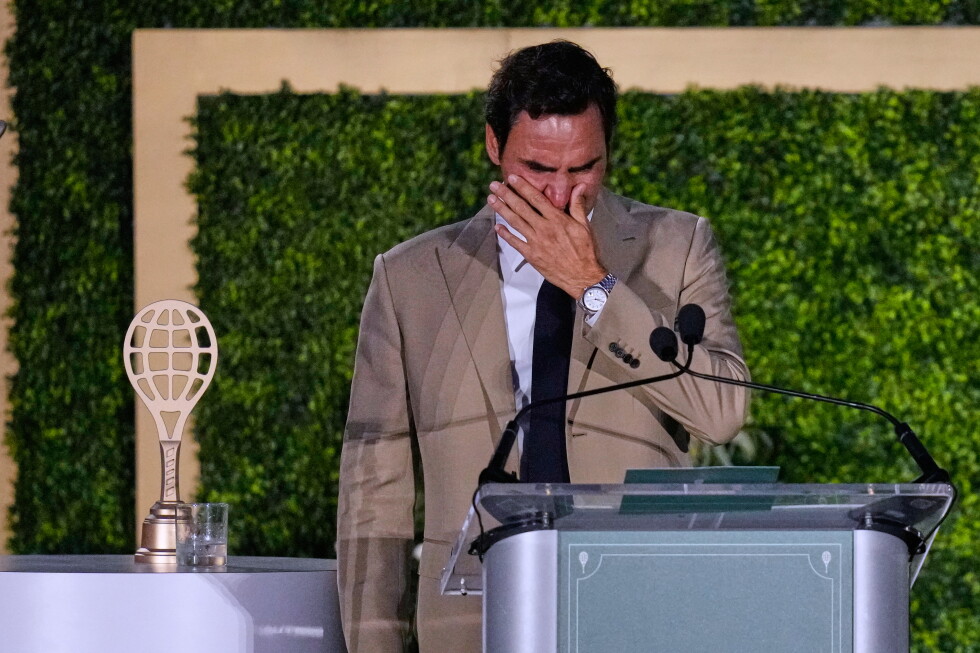
NEWPORT, R.I. (AP) — Roger Federer was brought to tears numerous times during his induction speech at the International Tennis Hall of Fame on Saturday.

As sunset crept in at Newport’s grass horseshoe court at the entrance of the Hall, the 45-year-old Federer, dressed in a tan suit, strolled up to the stage for his speech, kissed and hugged his wife, Mirka, who had just introduced him, and realized what a challenge it was going to be.

“Oh man,” were the first words from the first man ever to win 20 Grand Slam singles titles. “This is very high level and a tough act to follow.”

He joked: “I don’t know if you have been practicing secretly” before praising his wife’s presentation of the 274th Hall of Famer.

Advertisement

Federer was inducted along with Mary Carillo, a broadcaster and former player, who was presented by Hall of Famer Billy Jean King.

Federer, called the “Swiss Maestro” during the Hall’s first red-carpet show, which began on center court about 90 minutes before the start of the induction ceremony, told the crowd that he “was a little stressed to be honest.”

During his nearly 30-minute speech, Federer, who showed fluid movement and a quick approach to the net with a solid one-hand backhand that earned him a record 237 consecutive weeks as the world’s No. 1 player in the ATP rankings, chocked up a handful of times.

It began to get tough for him about halfway through, when he talked about his childhood hero, Stefan Edberg, when he said these are “happy tears.”

Advertisement

Then he was brought to tears again when he spoke about his longtime coach Severin Luthi, before he wanted to thank Mirka for helping him on his journey.

“Now the Mirka part,” he said, pausing before breaking into tears. “Oh gosh, this such a mess.”

He tried to joke, but the tears took over like a quick return at the net.

“I need tissues and sunglasses, everything to protect me right now,” he told the crowd, fighting back more tears.

Advertisement

But, like rallying in winning one of his five consecutive U.S. Open titles from 2004-08 or reaching 10 straight Slam finals, which he won eight, Federer closed by thanking the ball boys and encouraged players to keep taking the game new levels.

Federer, who celebrated his 45th birthday three weeks ago, won eight Wimbledon titles and is only one of eight men with a career Grand Slam. He captured six Australian Opens and one French Open, in 2009.

“I’m thrilled to have made the journey here,” he said. “It’s amazing to see yourself in a place like this. To immerse yourself in the history of the sport means a lot to me.”

Carillo, inducted as a contributor, is a member of the Sports Broadcasting Hall of Fame.

Advertisement

King said: “She has earned her spot in sports journalism and she has earned her spot in Newport.”

Carillo, 69, was touched standing in front of a handful of Hall of Famers.

“To walk through these gates here in the company of you people, that was beyond my dreams,” she said.

___

Advertisement

See AP’s full tennis coverage here

Source link

Advertisement
Continue Reading

Trending

Copyright © 2025