






The human cost of Israel and America’s air campaign on Iran is mounting, nowhere more painfully felt than in the children’s wards of its hospitals.
In the intensive care unit of one, four-year-old Anita lies in a coma with severe head injuries a few days after being pulled out of the rubble of her home when it was destroyed in an airstrike.
Her mother Zeiba was in torment, clutching her tiny hand and begging her to wake up. Doctors say she almost certainly never will.
Image: Zeiba holds the hand of four-year-old Anita
Later, I asked her if she had a message for Donald Trump about this war.
“Why did this happen to us?” she said, pausing to let out her tears.
Advertisement
“To innocent people, my innocent four-year-old girl, who was only going downstairs to come to me, why do it to ordinary people like us?
“We were sitting together at home, they have taken away our safety, our happiness, and the health of our children.”
Anita had been playing with her 14-year-old brother and was coming down the stairs, answering their mother’s call, when the missile came in.
Image: Anita’s 14-year-old brother
It was terrifying, he told us: “Suddenly, everywhere went black. I didn’t understand what happened next. I didn’t hear a sound, nothing… I thought I was dreaming.”
Israel and America are calling their airstrikes precision-targeted. The term often loses most of its meaning when you see the impact on the ground.
Advertisement
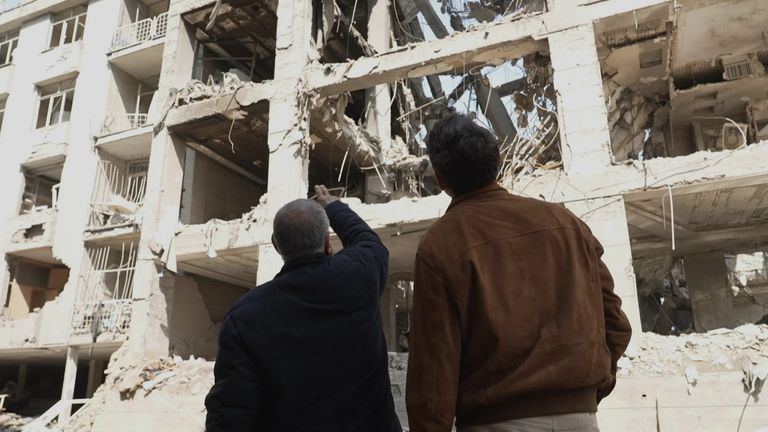
Civilians are being hurt in the air campaign here because some airstrikes are being used on targets in residential areas. That is abundantly clear in places like Resalat in eastern Tehran.
Here, missiles have devastated a huge area the size of a city block. There was a Basij or paramilitary security force base here, say residents, but civilian apartments too, many of them.
We could see the impact of several direct hits on two apartment blocks. We met Seyed Hossein Sane, whose daughter had been at home when the missiles struck mid-afternoon. He’d been at work.
Advertisement
35-year-old Seyedeh Farideh’s body was pulled out of the rubble and identified three days later.
Seyed had this message for the leader of whichever country sent the missiles: “I wish the same thing would happen to them that they would have to identify the body of their youth with their own hands. Them and their families.
“Same as what I did to the body of my daughter after three days, I wish that for whoever caused this.”
Advertisement
Image: Seyed Hossein Sane, whose daughter was at home when missiles struck
Israelis and Americans say their airstrikes are the best way of achieving their war aims, regime change among them.
But the longer they go on, the greater the human cost and anguish.
President Donald Trump said Sir Keir Starmer has made a “big mistake” in his response to US calls for support in the war with Iran as he suggested the “good” trade deal he struck with the UK “probably wasn’t appreciated”.
Mr Trump reiterated his criticism of Sir Keir’s stance on the conflict as he again accused him of not offering sufficient military backing. The president has called on allied nations to provide vessels to help open the Strait of Hormuz and has criticised Sir Keir for so far declining to commit the Royal Navy.
Advertisement
With the war now in a third week, oil prices remain above 100 US dollars (£75) per barrel as a result of Iran’s continued blockade of the Strait of Hormuz.
Get MEN Premium now for just £1 HERE – or get involved in our WhatsApp group by clicking HERE. And don’t miss out on our brilliant selection of newsletters HERE.
On Tuesday, Mr Trump posted on his Truth Social platform: “The United States has been informed by most of our Nato ‘allies’ that they don’t want to get involved with our military operation against the terrorist regime of Iran.”
He said he was “not surprised” because he had always considered Nato to be a “one-way street”.
Advertisement
“We will protect them, but they will do nothing for us, in particular, in a time of need,” he wrote.
He then added: “Because of the fact that we have had such military success, we no longer ‘need’, or desire, the Nato countries’ assistance — WE NEVER DID!”
And in the White House, Mr Trump said he “liked” the Prime Minister but felt “disappointed” with his recent position in regard to the conflict with Iran. He also described Sir Keir’s policies on both immigration and energy as a “disaster”.
Mr Trump, who was hosting Irish premier Micheal Martin in the White House on Tuesday to mark St Patrick’s Day, also told reporters he was looking forward to welcoming King Charles on his official state visit to the United States.
The president was asked by reporters in the Oval Office whether his relationship with Sir Keir has been damaged by the UK’s stance over the war in Iran.
“Well, he hasn’t been supportive, and I think it’s a big mistake,” replied Mr Trump.
“You know, they make a lot of money on trade with the United States. I went out of my way. As you know, they couldn’t make a deal with Biden, because they had no real administration to make a deal, Biden. But we made a deal. We made a good deal for them and, frankly, probably wasn’t appreciated.
Advertisement
“I do look forward to seeing the King. He’s going to be coming, as you know, very shortly, but, no, I was disappointed, because Keir was willing to send two aircraft carriers after we won, because essentially … there’s no threat for the aircraft carriers right now.
“And I said, ‘no, no, we want things sent before the war, not after the war is won’. So, yeah, I’m disappointed with Keir. I like him, I think he’s a nice man, but I’m disappointed.”
Mr Trump then repeated his assertion that “unfortunately Keir is no Winston Churchill”.
Advertisement
The president went on the claim that the Prime Minister “doesn’t produce”.
Mr Trump told reporters: “Even the aircraft carriers, he would only send them after we essentially won. I mean, he’s sending them when there are no planes left, when the missiles are down to like 8% of the missiles.”
Asked if he had confidence in the Prime Minister, Mr Trump said: “It’s not for me, it’s really for the people of the UK to have confidence.
“I mean, I’ve been very critical of Keir – and I did it in a friendly way – I said, if you don’t change your energy thing and get away from windmills and go back to oil and gas.
Advertisement
“You have something that no other country has, very few countries have anything like it: The North Sea. You have some of the greatest oil and oil deposits in the entire world. The North Sea, they don’t use it.”
Mr Trump added: “I think he’s a nice man, but I disagree with him on two things. Primarily his immigration policy is a disaster, and his energy policy is a disaster – and they’re about the biggest policies you can have.
“You’ve allowed millions and millions and millions of people to come into your country that shouldn’t be there. And, by the way, that’s all over Europe.”
During the Oval Office exchanges, Mr Trump also said he was “disappointed” with Nato, but that he was not currently rethinking his relationship with the alliance.
Advertisement
He said: “We help other countries and when they don’t help us, I mean, it’s certainly something that we should think about.”
Asked if he was afraid that a ground invasion of Iran would be a repeat of the US-Vietnam war, Mr Trump said: “I’m really not afraid of anything.”
Iran’s stranglehold on the Strait of Hormuz has become a key focus of international attention, with several ships in the area reportedly struck by projectiles or debris from intercepted missiles as Tehran seeks to exert economic pressure on the US.
There is one Dingle who has always kept themselves away from the lawbreaking antics of their family members in Emmerdale, but even they are about to move over to the dark side in Cain Dingle’s (Jeff Hordley) hour of need. Desperate times call for desperate measures.
The Tates have won the fight for Moira Dingle’s (Natalie J Robb) farm, but Joe Tate (Ned Porteous) isn’t done twisting the knife. Though he’s got what he wanted, he’s having too much fun to stop making everyone else’s life a misery.
Cain, meanwhile, is trying to get a Dingle farm up and running to distract himself from all that he’s lost and losing. But it’s falling at the first hurdle with Sam (James Hooton) struggling with this new task and Mackenzie (Lawrence Robb) and Matty (Ash Palmisciano) having to step in to help.
Advertisement
Joe continues taking pleasure in giving Cain bad news (Picture: ITV)
Cain then learns that Joe wants to sell the cows and is furious, especially when Mackenzie reasons that they can’t afford to keep the cows themselves. The nail in the coffin for Cain comes when Sam reveals he missed a meeting about the farm machinery, and Cain jumps straight to catastrophising that everything is over.
But there’s hope for Cain in the form of a hooded figure who wants to do their bit to save the family.
Advertisement
Robert and Aaron are shocked when a panicked Matty arrives to reveal that their herd has disappeared in the night. Joe furiously points the finger at Robert, who denies any involvement. Joe knows who to confront and grabs his wingman Graham Foster (Andrew Scarborough) to challenge the Dingles.
The Dingles are smug in responding that they had nothing to do with the theft, not realising that one of them did.
Graham and Joe go in search of the culprit (Picture: ITV)
The culprit is seen out on a country road rustling the cows, and it’s none other than Belle Dingle (Eden Taylor-Draper), who fancies herself as a bit of a cow rustler.
She’s played a blinder in saving the herd, but being a novice, she’s forgotten one major detail – Cain rings her to warn that the bull she’s nicked has been fitted with a tracker.
Joe and the police are closing in, how will the Dingles protect Belle?
Which countries possess nuclear weapons in 2026 – and exactly what is in their stockpiles? Read on for the complete list.
As tensions in the Middle East between the US-Israel alliance and Iran escalate daily, the genuine possibility of nuclear conflict weighs heavily on people’s minds.
Advertisement
Other ongoing conflicts including the Russia-Ukraine war, the Israel-Hamas confrontation, and military hostilities between Pakistan and Afghanistan create a volatile mix of dangerous military operations between nations where at least one side possesses nuclear capabilities.
In an era where knowledge is crucial, staying abreast of current developments is essential. So, for those wondering which nations possess exactly what nuclear arsenal, we’ve compiled the complete breakdown for you, reports the Express.
Countries possessing nuclear weapons in 2026
Russia
Advertisement
United States
China
France
United Kingdom
Advertisement
Pakistan
India
Israel
North Korea
Advertisement
What nuclear arsenal do these 9 nations hold
These nine nuclear-armed states possess an estimated 12,300 warheads collectively as of early 2026, with over 9,614 held in operational military stockpiles for deployment via missiles, ships, aircraft, and submarines according to the Federation of American Scientists’ (FAS) 2025 Status of World Nuclear Forces.
The remaining warheads have been decommissioned but remain largely intact whilst awaiting dismantlement. According to the Federation of American Scientists: “Of the 9,614 warheads in the military stockpiles, some 3,912 are deployed with operational forces (on missiles or bomber bases). Of those, approximately 2,100 US, Russian, British, and French warheads are on high alert, ready for use on short notice.”
This overall figure of 12,241 warheads represents a substantial decrease from the roughly 70,000 warheads held by nuclear-armed nations during the Cold War. However, the total is anticipated to increase steadily throughout the coming decade, with modern weapons being far more advanced than their Cold War predecessors.
Which country possesses exactly what
The precise number of nuclear weapons held by individual nations remains a tightly-guarded state secret, meaning these estimates carry “significant uncertainty” according to the FAS. These figures are also thought to have been compiled before the escalation of tensions involving the US-Israel and Iran conflict.
That said, Russia is believed to possess around 5,459 nuclear warheads, with 1,150 classified as retired – meaning they’ve been removed from the military stockpile but remain intact whilst awaiting dismantlement.
A further 2,591 nuclear warheads sit within the Kremlin’s military stockpile, indicating they’re earmarked for potential military deployment, whilst 1,718 are already strategically positioned – bringing the active nuclear arsenal total to 4,309.
The United States, on the other hand, maintains a total active arsenal of 3,700 nuclear warheads, with 1,670 strategically deployed, 100 non-strategically deployed, and 1,930 held in the military stockpile for potential deployment.
Advertisement
The US additionally holds 1,477 retired nuclear warheads – bringing their total nuclear warheads to 5,177. American nuclear weapons are stationed in five other countries – Turkey, Italy, Belgium, Germany and the Netherlands – as well as on home soil.
Combined, Russia and the United States hold an estimated 87% of the world’s entire inventory of nuclear weapons as of early 2026, and 83% of the stockpiled warheads available for military deployment.
No other nuclear-armed nations apart from Russia and the US currently deem it necessary to maintain more than a few hundred nuclear weapons for their national defence, though many are developing their nuclear capabilities and gradually expanding their arsenals.
China’s overall nuclear inventory is thought to total 600, comprising 576 warheads in reserve stockpile and 24 strategically deployed. It should be noted that most of the nine nuclear-armed nations offer little or no transparency regarding the true scale of their nuclear stockpiles.
France is believed to maintain an active stockpile of around 300 nuclear warheads as of 2026, with 280 strategically deployed, 10 held in reserve and 80 retired, bringing the overall estimated total to 370.
The United Kingdom is thought to possess a total nuclear arsenal of 225 warheads, of which 120 are strategically deployed whilst 105 remain in the reserve stockpile for potential military deployment.
India, Pakistan and Israel never signed up to the Non-Proliferation Treaty (NPT), whose aim is stated as: “Prevent the spread of nuclear weapons and weapons technology, to promote cooperation in the peaceful uses of nuclear energy and to further the goal of achieving nuclear disarmament and general and complete disarmament.”
Advertisement
North Korea, however, initially became a signatory to the NPT as a non-nuclear weapon state, before announcing its withdrawal from the treaty in 2003.
India is estimated to possess roughly 180 nuclear warheads, Pakistan holds 170, and North Korea has approximately 50. These figures are based on the quantity of fissile material – highly enriched plutonium and uranium – that each of these nuclear-armed nations is estimated to have produced.
The precise warhead totals for Israel and North Korea remain unconfirmed, though it is believed North Korea holds sufficient fissile material to construct at least “40-50 individual weapons”, whilst Israel has the “nuclear material for up to 200”.
According to the Arms Control Association: “North Korea likely possesses additional fissile material that is not weaponized, but there is a high degree of uncertainty surrounding these estimates.
Advertisement
“North Korea has uranium enrichment technology and a known uranium enrichment facility at Yongbyon. It likely operates additional covert uranium enrichment facilities at other locations.
North Korea has developed nuclear capable missiles of various ranges, including ICBMs (intercontinental ballistic missiles), and claims to have developed tactical nuclear warheads.”
While the worldwide stockpile of nuclear weapons is gradually decreasing, the rate of those reductions has slowed considerably compared to the past three decades.
French President Emmanuel Macron recently declared that his country would be expanding its nuclear arsenal, stating: “The next 50 years will be an era of nuclear weapons.” Macron also revealed the launch of France’s new nuclear-armed submarine in 2036, named The Invincible.
Advertisement
The total number of warheads held in global military stockpiles is rising, with China, North Korea, India, Pakistan, France, the United Kingdom, and quite possibly Russia, all thought to be steadily bolstering their existing arsenals.
The USA has rapidly depleted its nuclear weapons stockpile in its current war with Iran, including Tomahawk missiles, and it remains to be seen whether it adds more to its existing inventory.
US actor Sean Penn has been gifted an Oscar-shaped award made from war-damaged rail metal by Ukraine, after he skipped Sunday’s ceremony to visit the war-torn country.
Penn, 65, won his third Academy Award for his supporting actor role in political thriller One Battle Another but was absent from the ceremony.
In a video posted by Oleksandr Pertsovskyi, the CEO of Ukrainian Railways, Pertsovskyi tells Penn: “You’re missing Oscars… So we made this one. This is from the railcar that was damaged by the Russians”.
A long-time advocate for Ukraine, Penn has visited several times since the Kremlin launched its full-scale invasion of the country four years ago.
And with 2026 being the route’s 100th birthday, this year is the perfect time to discover what is now a cultural icon.
Here, we reveal how to do it well, with a guide that steers you towards an authentic Route 66 experience.
We explain how the road acquired legendary status, the diner in Chicago you should have breakfast at before setting off and the dangers of over-reliance on Google Maps for the journey.
Advertisement
Route 66 isn’t a race, and in the following section, we break down how much time to allow for the journey.
From there, it’s the not-to-be-missed sights that help make the trip so wonderfully eccentric, and some of the best motels to book into for a “good old days” vibe.
The finish comes at Santa Monica Pier, where there are a handful of rituals to undertake to mark the end of a road trip of a lifetime.
The birth of a legend
Advertisement
Route 66’s legendary status is partly thanks to the great American novelist John Steinbeck describing it as the ‘Mother Road’ (Getty Images)
Route 66 was commissioned in 1926 and by the time it was finished and fully paved in the late 1930s, it stretched 2,448 miles across Illinois, Missouri, Kansas, Oklahoma, Texas, New Mexico, Arizona, and California, from Chicago to Santa Monica — and it quickly attained legendary status, despite not even being the first long-distance highway, or the busiest.
The route’s journey to cultural icon began with hundreds of thousands of farmers from Oklahoma, Texas, Arkansas and Missouri using it to reach California in search of work, a plight immortalized in the great John Steinbeck’s powerful 1939 novel The Grapes of Wrath, in which he dubs Route 66 the “Mother Road.”
When car ownership exploded after the Second World War, Americans discovered en masse that this road of opportunity was also a journey of adventure that took them through bewitching desert landscapes and past neon-lit motels and diners that would come to symbolize classic road trip culture.
Advertisement
By the time the road was decommissioned in 1985 and replaced by the Interstate Highway System, it was ingrained in popular culture, featuring in songs such as Bobby Troup’s (Get Your Kicks on) Route 66, recorded by artists from Nat King Cole to the Rolling Stones, and making appearances in countless road trip movies.
Ironically, its death made it even more famous, with preservation movements emerging to maintain and restore motels, diners and roadside attractions that were now bypassed — today Route 66 is a patchwork of historic sections.
For many, the Route 66 road trip begins in Chicago with breakfast at Lou Mitchell’s restaurant and bakery on W. Jackson Boulevard, located near the official start of the route on Adam Street, close to the Art Institute of Chicago (Getty Images)
Chicago is the traditional launchpad — it’s the historic gateway to the west, and you’ll mostly have the sun behind you — and the ceremonial starting point is amid the skyscrapers of the Windy City’s downtown district, on Adams Street, near the Art Institute of Chicago.
There, you’ll find a modest brown-and-white “Begin Route 66” sign. However, before you drive past it, tradition dictates that you head to nearby Lou Mitchell’s restaurant and bakery on W. Jackson Boulevard, which has been serving breakfast to westbound road-trippers since 1923.
The menu is classic diner fare, from coffee and pancakes to omelets and corned beef hash. And while you wait for a table, the serving staff hand out complimentary donut holes and Milk Duds.
Advertisement
Once you set off, you’ll find yourself in another world in little more than an hour.
Great place to stay:Silversmith Hotel Chicago Downtown is just a three minute walk from the Route 66 and features rooms with mini-refrigerators, coffee makers and wifi.
The original Route 66 passes through the former gold mining town of Oatman in Arizona. You’ll be led to fascinating spots like this by following the ‘Historic Route 66’ signs (Getty Images)
Navigation-wise, it would be tempting to type “Route 66” into Google Maps and take it from there.

But that would be a major mistake. It’s worth laboring the point that Route 66 is no longer one long continuous highway, but a mishmash of surviving segments jammed in among newer highways. Some original sections are quite long and scenic, others last for just a few miles before disappearing (and sometimes making a comeback a bit further along).
Ask Google Maps for the route and you’ll likely end up driving along interstates 40, 44 and 55, which replaced large sections of Route 66, and miss some of the most fascinating roadside attractions.
Advertisement
The key is to follow the “Historic Route 66” signs, which will lead you to some of the most compelling sights and scenery.
The Parks in the Pines General Store and Deli stands along a quiet stretch of Route 66 between Williams and Flagstaff, its vintage 76 sign and weathered red storefront preserving the classic character of mid-century roadside travel in Northern Arizona (Getty Images)
Ideal: 14 days
Today, Route 66 isn’t a means to an economic end — it’s the main attraction, and driving at your leisure will mean you can fully savor its delights. The Goldilocks time frame? Two weeks, or 150-200 miles a day, if you’re committed to the entire Route 66 Chicago-Santa Monica pilgrimage.
A longer journey means ample time to explore roadside attractions, enjoy vintage motels, and have an extra round of pancakes at a classic diner.
Fair: 10 days
Advertisement
Ten days is a relatively popular timeframe, meaning a pace of around 240 miles a day.
However, some sightseeing will need to be sacrificed. One strategy could be to pick up the pace in the eastern section, then slow down and zero in on the more dramatic scenery offered by New Mexico, Arizona and California in the west.
Doable, but rushed: Seven days
A seven-day trip would mean a slow-fast-slow approach, with sections of interstate used to link the most compelling sights. Stops would need to be picked fairly carefully in advance.
Advertisement
Avoid: Four days or less
Shrinking the journey time to four days or less would reduce the drive to a grueling interstate highway marathon. If simply reaching the finish line is the objective, then note that the drive time is about 40 hours.
Cadillac Ranch, created in 1974 by the art group Ant Farm, features 10 classic Cadillacs buried nose-first in the ground. It’s a Route 66 must-visit (cadillac ranch texas)
Route 66’s irresistibly eccentric roadside culture doesn’t take long to emerge after leaving Chicago.
Around 90 minutes away is the town of Wilmington, home to the Gemini Giant, a 30-foot fiberglass astronaut holding a rocket, a variation of the “Muffler Man” figures used to advertise roadside businesses across America.
In the small town of Dwight, around 75 miles from Chicago is the beautifully preserved house-and-canopy-style Ambler’s Texaco Gas Station, which dates back to the 1930s.
Advertisement
Cadillac Ranch, just west of Amarillo in Texas, is mandatory. Created in 1974 by the art group Ant Farm, it features 10 classic Cadillacs buried nose-first in the ground at the same angle as the Great Pyramid of Giza. They’re covered in graffiti, and visitors are encouraged to leave their own spray-painted mark.
In Oklahoma, there’s the cheerful Blue Whale of Catoosa, an 80-foot-long bright blue concrete cetacean with a winning smile; and in Arizona you can pull up in the ghost town of Oatman, where burros wander the streets and “gunmen” stage Wild West shootouts.
Blue Swallow Motel, Tucumcari, New Mexico still retains a 1940s atmosphere, including a neon sign advertising ‘100% refrigerated air’ (Getty Images)
Skip the chains and book into independent motels to be rewarded with a much more authentic Route 66 experience. Family run motels sprung up in huge numbers during the road trip boom of the 1940s and 1950s and there are still a few beautifully preserved examples you can stay in for a taste of the “good old days.” Here are three of the most celebrated options:
Blue Swallow Motel, Tucumcari, New Mexico
The Blue Swallow Motel has been giving Mother Road travelers a comfortable place to rest since 1939, and its yesteryear charms have been beautifully preserved: the neon sign advertising “100% refrigerated air” still glows above it and the rooms contain 1940s-era rotary dial phones and vintage lamps. Rooms from $120.
Advertisement
Wigwam Motel, Holbrook, Arizona
Guests have been staying in the Wigwam Motel’s distinctive concrete teepees since the 1950s — and while the 15 units include mod cons such as wifi and satellite TV, the original handmade hickory furniture has been retained. Rooms from $105.
Boots Court Motel, Carthage, Missouri
When Boots Court Motel opened in 1939, guests paid $2.50 to stay in one of eight rooms completed in the “streamline moderne” architectural style. Each room came with a carport and the property proudly advertised a “radio in every room.” Today, there are 13 renovated rooms for Route 66-ers to stay in and a visitors center housed in the former gas station. Rooms from $79.
At Santa Monica Pier there is a sign marking the end of Route 66 (Getty Images)
Eight states and nearly 2,500 miles of tarmac later, you’ll arrive at Santa Monica Pier where you’ll find a sign that simply says “End of the Trail.”
Advertisement
It’s not the most celebratory piece of signage, but the exuberant surroundings, from street performers to the pier’s amusement park, make the occasion a fittingly jubilant one.
A popular ritual among road trippers is to take a selfie at the sign, then walk to the end of the pier and look back, inland, at the land mass that’s been tamed, before a dip of the toes in the Pacific Ocean.
Great place to stay:The Shore Hotel (rooms from $235) is directly across the road from the pier and offers rooms with balconies overlooking the beach.
Good to know: Parking around the pier is congested, and while there is a parking deck beneath the pier, it’s recommended to leave your car at the hotel and walk to the finish line.
Craft Social will launch at 24a Newmarket Street in Skipton on March 28.
Founded by Ilkley-based creatives Sophie and Becky, the café aims to encourage slow living, creativity, and screen-free connection through hands-on activities.
The pair said: “After seeing the joy our mobile workshops brought to people over the past year, opening Craft Social as a permanent space felt like the natural next step.
Craft Social, a new craft café founded by Ilkley-based creatives Sophie and Becky, will open on March 28 at 24a Newmarket Street in Skipton, North Yorkshire. (Image: Supplied)
“We wanted to create a calm, welcoming space where people can step away from busy life, get creative and leave feeling proud of what they’ve made.”
Advertisement
With backgrounds in illustration and design, the founders first launched Craft Social as a mobile craft workshop in 2024, running private creative events across Yorkshire.

Buoyed by a successful first year, they decided to create a permanent, community-focused venue.
The café will be screen-free, encouraging visitors to unplug and engage fully with hands-on creative activities.
Standard bookings and walk-ins are welcome, with visitors able to take part in crafts such as painting, beading, and spray painting.
Advertisement
Craft Social will also host regular in-house workshops, starting at £10 per person, and is available for private hire for special occasions from £15 per person.
Guests can also purchase pre-prepared craft kits from £5, designed for use at home and ideal for gifting.
The space will showcase work by local artists and offer them the opportunity to hire the venue and host their own events.
The founders hope the café will become a creative hub for the community.
Advertisement
Visitors will be able to enjoy baked treats and drinks from nearby suppliers as part of the café’s commitment to supporting local businesses.
A launch event will take place on March 28 from 1pm to 4pm, inviting the community to explore the refurbished space, enjoy complimentary drinks, and take part in creative activities.
The café will officially open on April 1 and will operate Wednesday to Saturday from 9.30am to 4pm.
If Arsenal beat Manchester City in the Carabao Cup final at Wembley on Sunday, expect the quadruple talk to be in overdrive by the time those two fixtures come around.
With the attack as fluent here as it has been in weeks and the defence typically secure, Arsenal have all the answers right now.
Mikel Arteta enjoys ideal night
Advertisement
Short of a 7-0 rout and the result wrapped up inside 20 minutes, this was close to a perfect night for Mikel Arteta.
Earlier in the evening, Sporting mounted a comeback against Bodo/Glimt to ensure there would be no quarter-final trip to the Arctic Circle and artificial surface to contend with.
Arteta, meanwhile, was able to make four changes with just over 20 minutes to go, shuffling his pack to suggest he had one eye on that Wembley clash.
Eze was taken off and so too Martin Zubimendi, with Christian Norgaard brought on for some rare minutes. Kai Havertz also got some game time as he looks to get up to full speed again.
Advertisement
Eze provides the X-factor
Eze was not signed to take the safe option. Arsenal have enough players to bring control, to play the percentage pass and maintain attacks.
They needed an X-factor player in the final third and Eze was brought in to bring that unpredictable spark. He did just that, with this perhaps his best performance in an Arsenal shirt away from the north London derbies.
There is nobody else in the Arsenal squad you would back as much to take the ball with his back to goal 25 yards out, swivel, and lash a strike into the top corner that cleanly.
Advertisement
That broke the deadlock and from there Arsenal did not look back. Eze provided those off-the-cuff moments throughout, one lovely flick round the corner to Viktor Gyokeres leading to a chance for Saka.
Saka and White deliver together again
Ben White was brought into the side, lining up at right-back behind Saka for the first time since the 3-2 Carabao Cup win over Chelsea in January.
Plenty has been made of Saka’s dip in form this season and in particular in recent weeks. The return of White, with whom he has formed such a strong partnership over the past few seasons, made a big impact.
Advertisement
The pair know each other’s games so well. Three or four times in the first half, White delayed a pass to Saka perfectly, playing it into his path just as the winger made a dart into space inside.
In the opening 45 minutes, Saka created four chances, at least double any other player on the pitch. White had three touches in the opposition box, behind only Saka and Leandro Trossard.
The partnership was not quite as potent after half-time and a tired White was replaced with 20 minutes remaining, but there was enough there to suggest the trusty duo could be used more often in the run-in.
HONG KONG (AP) — About 90 ships including oil tankers have crossed the Strait of Hormuz since the outset of the war with Iran and it is still exporting millions of barrels of oil at a time when the waterway has been effectively closed, according to maritime and trade data platforms.
Many of the vessels that passed through the strait were so-called “dark” transits evading Western government sanctions and oversight that likely have ties to Iran, maritime data firm Lloyd’s List Intelligence said. More recently, vessels with ties to India and Pakistan have also successfully crossed the strait as governments stepped up negotiations.
As crude prices spiked above $100 a barrel, U.S. President Donald Trump pressured allies and trade partners to send warships and reopen the strait, hoping to bring oil prices lower.
Most shipping traffic through the Strait of Hormuz, a waterway for global oil and gas transport that supplies roughly one-fifth of the world’s crude oil, has been halted since early March, after the war started. About 20 vessels have been attacked in the area.
Advertisement
However, Iran has still managed to export well above 16 million barrels of oil since the beginning of March, trade data and analytics platform Kpler estimated. Due to Western sanctions and associated risks, China has been the biggest buyer of Iranian oil.
There has been ”continued resilience” in Iran’s oil export volumes, said Kpler trade risk analyst Ana Subasic.
Iran has managed to profit from oil sales and also “preserve its own export artery” by using control over the chokepoint, said Kun Cao, client director at consulting firm Reddal.
Iran’s oil export data estimates are largely aligned with maritime traffic data.
Advertisement
At least 89 ships crossed the Strait of Hormuz between March 1 and 15 – including 16 oil tankers, according to Lloyd’s List Intelligence, down from roughly 100 to 135 vessel passages per day before the war. More than one-fifth of the 89 vessels were believed to be Iran-affiliated, while Chinese and Greece affiliated ships are among the rest, it said.
Other vessels also have been getting through.
The Pakistan-flagged crude oil tanker Karachi, controlled by the Pakistan National Shipping Corp., passed through the strait on Sunday, Lloyd’s List Intelligence said.
Shariq Amin, a spokesman at the Pakistan Port Trust, refused to confirm or deny which route the MT Karachi had used but he said the ship would soon safely reach Pakistan.
Advertisement
The India-flagged liquefied petroleum gas (LPG) carriers Shivalik and Nanda Devi, both owned by state-owned Shipping Corp. of India, also traveled through the strait around March 13 or 14, according to Lloyd’s List Intelligence. LPG is used as a primary cooking fuel by millions of Indian households.
India’s foreign minister, Subrahmanyam Jaishankar, told the Financial Times the two vessels’ were able to pass following talks with Iran. Iraq was also in talks with Iran to allow Iraqi oil tankers through the Strait of Hormuz, its state-run news agency reported.
Vessels may be transiting “with at least some level of diplomatic intervention,” said Richard Meade, editor-in-chief of Lloyd’s List. So, Iran may have “effectively created a safe corridor” with some ships passing close to the Iranian coast.
Some vessels near or in the strait were found to have declared themselves as China-linked or with all Chinese crew to reduce risks of being attacked, based on an earlier analysis on ship tracking platform MarineTraffic. Analysts believe they were taking advantage of China’s closer ties with Iran.
Advertisement
Oil prices have jumped more than 40% to above $100 per barrel since the Iran war began, and Iran has threatened it won’t allow “even a single liter of oil” destined for the U.S., and Israel and their allies to pass through.
To try to stabilize oil prices, the U.S. said it was allowing Iranian oil tankers to cross the strait. “The Iranian ships have been getting out already, and we’ve let that happen to supply the rest of the world,” Treasury Secretary Scott Bessent said in an interview with CNBC on Monday.
The U.S. bombed military sites on Kharg Island off the Iranian coast, which is key for Iran’s oil network and exports, but President Donald Trump said he had left its oil infrastructure alone for now.
The latest passages through the Strait of Hormuz show the strait was not simply “closed,” Cao said. “It is better understood as closed selectively against some traffic, while still functioning for Iranian exports and a narrow set of tolerated non-Iranian movements,” he said.
Advertisement
However, if Iran’s plan is to “inflict pain through higher energy prices, the number of tankers it allows through the Strait of Hormuz may be very limited,” Dutch bank ING’s strategists Warren Patterson and Ewa Manthey wrote in a research note.
___
Saaliq reported from New Delhi. AP Writer Munir Ahmed contributed from Islamabad, Pakistan.
A toddler dubbed the ‘Nostradamus baby’ has made chilling predictions in a viral TikTok video, including claims about simulation theory and a catastrophic tsunami called ‘The Flood 2.0’.
Emilia Randall GAU Writer
05:00, 18 Mar 2026
The ‘Nostradamus Baby’, a toddler who has provided some eerie insights into what lies ahead for the remainder of 2026, looks to take the crown from French mystic Nostradamus.
A clip reshared by NebruhTV on TikTok features a toddler being questioned about what he had just been saying. The youngster delivers some bone-chilling forecasts.
Advertisement
The boy stated: “I’m horrified.” He then launches into a disturbing explanation of a simulation conspiracy theory.
He stated: “I just don’t know that everybody living here thinks the earth is real. But it’s not actually real, because some scientists found out… there’s a glitch.”, reports the Mirror.
His mother asks: “So what is our life then?” He responds: “I don’t know. Maybe it’s just a computer… like a simulation. I feel like it’s a scientist testing little tiny people.
“They really thought reality was real down here… but little people like us aren’t actually real.”
Advertisement
The original Nostradamus was a 16th-century seer who predicted countless disturbing events yet to unfold. He composed his predictions in mysterious quatrains, which revealed the destiny of global happenings.
Many featured in his 1555 work ‘The Prophecies’, which included no fewer than 942 quatrains.
Yet, the Nostradamus baby communicates much more directly.
Advertisement
The other catastrophe he foresees is a massive flood. He stated: “There’s gonna be a tsunami… like 800 meters in the air. They call it The Flood 2.0. There’s gonna be sharks… great white sharks… when the flood comes.”
This bears similarity to Nostradamus forecasting Switzerland being drenched in blood.
Many have suggested this could be alluding to a flood.
Advertisement
This prophecy is particularly chilling – and can be connected to a specific location in the modern world. His foreboding verse reads: “Because of the favour that the city will show… the Ticino will overflow with blood…” Switzerland’s scenic Italian-speaking canton is facing a grim and bloody future.
The bloodshed could signal a major disaster, a plague ravaging the area, or some form of natural calamity. Sceptics point out that Nostradamus wrote his works in Middle French, deliberately employing vague Latin terminology.
Among Nostradamus’ more peculiar predictions, one passage reads: “The great swarm of bees will arise by the night ambush”. Some reckon this could come to pass next year as the passage aligns with the number 26.
Advertisement
However, it’s still uncertain what the bees might represent, as it appears unlikely that an enormous bee swarm could cause real damage through “ambush”.
A famous figure struck by lightning In the 26th verse of Century I, Nostradamus darkly foretells “the great man will be struck down in the day by a thunderbolt”. This important figure could span from royalty and world leaders to a prominent celebrity.
However, what remains certain is that this individual will be struck down by a bolt of lightning in broad daylight. Could we potentially witness a lightning strike at a red carpet event in 2026?
This fairytale run to the knockouts will have felt unlikely for Bodo/Glimt after failing to win their first six league phase games, meaning they were left needing results against Manchester City and Atletico to qualify for the play-offs.
And, against the odds, they provided them.
A 3-1 victory over Pep Guardiola’s men brought deserved attention and acclaim, but it was no one-off as Bodo overcame Atleti 2-1 in Madrid to claim a play-off spot.
Knutsen’s side lost to Spurs in the Europa League semi-finals last season, having become the first Norwegian side to reach the last four of a major European competition.
Advertisement
Key to their success has often been their ability to make their home games as tough as possible.
In the north of Norway, Bodo can often be bitterly cold, snowy and windy during the long winter months, with temperatures deep into minus figures.
The difficult weather conditions mean the team play on an artificial pitch made of plastic, something many sides used to playing on grass find difficult to deal with.
Those aspects, coupled with the players’ determination and strong belief in their ability, means many have left Bodo defeated.
Advertisement
They thrashed Jose Mourinho’s Roma 6-1 at home in the Conference League five years ago, while Celtic, Besiktas, Porto and Lazio have also been victims in recent years.
Bodo exit the Champions League having won their past three home games – seeing off Manchester City, Inter Milan and Sporting – and will look to their home record to serve them well once more when they next play European football.
You must be logged in to post a comment Login