
Crypto World
6 profitable AI crypto quant trading bots of 2026 offering lucrative options



Disclosure: This article does not represent investment advice. The content and materials featured on this page are for educational purposes only.
AI-powered quant trading bots lead crypto evolution in 2026, automating strategies and boosting efficiency.
Summary
- AI trading bots dominate 2026 crypto markets, automating strategies and driving passive income adoption
- BitsStrategy gains attention for high-frequency trading, using AI to capture rapid market fluctuations
- Automated quant trading tools rise as investors shift from manual trading to data-driven execution
The cryptocurrency market has continued to evolve in 2026, and AI-powered quant trading bots are now at the forefront of this transformation. These bots utilize cutting-edge artificial intelligence to analyze massive amounts of market data, execute trades with lightning speed, and maximize profit potential. For those looking to tap into crypto’s profit potential without the need for constant manual trading, these AI-driven bots can automate their trading strategies and generate passive income on their behalf.
In this article, we’ll highlight the 6 most profitable AI crypto quant trading bots of 2026, each offering innovative features and proven strategies that cater to a variety of trading needs.
Why turn to AI quant trading bots for profit?
AI trading bots bring several significant advantages to crypto traders:
- Data-Driven Precision: These bots make decisions based on vast amounts of real-time market data, ensuring that trades are backed by analysis rather than instinct.
- Round-the-Clock Trading: AI bots never rest, executing trades 24/7, and ensuring lucrative market movements are never missed out.
- Emotional Discipline: Bots make decisions based on logic and strategy, avoiding emotional biases that can often lead to costly trading mistakes.
- Ease of Use: With many bots requiring no technical skills, even beginners can take advantage of their profit-making potential.
Let’s explore the top 6 AI crypto quant trading bots that are delivering profitable results in 2026.
1. BitsStrategy: Mastering the art of high-frequency trading
Overview: BitsStrategy leads the pack with its specialized focus on high-frequency trading (HFT). Using AI, it can execute a large number of trades in a fraction of a second, capitalizing on minute price fluctuations for consistent profits.
Why it stands out:
- Optimized for high-frequency trades and rapid decision-making
- Continuously adapts to market conditions with real-time strategy adjustments
- Advanced risk management ensures minimal losses
Why choose BitsStrategy?
For traders who want to harness the power of high-frequency trading, BitsStrategy is unbeatable. Its speed and automation allow it to capitalize on even the smallest market movements, creating a reliable stream of income for users who don’t want to manually monitor every trade.
Click to visit and register to receive a free $10 real reward!
2. Pionex: Capitalizing on arbitrage opportunities
Overview: Pionex excels in arbitrage trading, where its AI bots track price differences between crypto exchanges and exploit these discrepancies for profit. This highly profitable strategy requires little input from the trader, making it perfect for those seeking a passive income stream.
Why it stands out:
- Built-in arbitrage bot that scans multiple exchanges for profitable gaps
- Seamless integration with crypto exchanges for instant trade execution
- Low fees and high liquidity ensure optimal profits
Why choose Pionex?
For those looking for a low-risk, high-return strategy, Pionex’s arbitrage trading bot allows them to take advantage of price differences across exchanges, offering a stable source of income with minimal involvement.
3. 3Commas: The portfolio powerhouse
Overview: 3Commas isn’t just a trading bot — it’s an entire portfolio management system that uses AI to manage multiple assets simultaneously. It combines powerful tools like Dollar-Cost Averaging (DCA) and Grid Trading to ensure consistent profits, even in volatile markets.
Why it stands out:
- Robust portfolio management tools that automatically balance investments
- DCA and Grid bots for steady, long-term profit generation
- Multi-exchange support and seamless integration across platforms
Why Choose 3Commas?
3Commas is the go-to platform for portfolio management, making it ideal for traders who want to automate their strategies across multiple exchanges while maintaining a diversified portfolio. The AI tools are designed for long-term success, ensuring a reliable source of passive income.
4. Cryptohopper: Tailoring trading strategy
Overview: Cryptohopper offers the ultimate in customizability. This platform allows users to create personalized trading strategies while still leveraging the power of AI. Whether they are a beginner or a pro, Cryptohopper adapts to their needs with its easy-to-use interface and powerful optimization tools.
Why it stands out:
- Customizable AI strategies for a personalized trading experience
- AI-powered optimization of existing strategies to improve performance
- Access to a strategy marketplace to purchase or sell pre-built strategies
Why choose cryptohopper?
If anyone wants to customize their trading strategy while benefiting from AI-powered execution, Cryptohopper provides the perfect blend of control and automation. It’s ideal for traders who want to experiment with their own strategies and leverage AI to maximize profits.
5. TradeSanta: Simplifying crypto trading for beginners
Overview: TradeSanta is designed for those who want simplicity in their trading experience. Its intuitive platform allows users to set up pre-defined strategies like Grid Trading and DCA, making it ideal for beginners who want to profit without getting into complex setups.
Why it stands out:
- Pre-set strategies such as Grid Trading and DCA for beginners
- Cloud-based interface, accessible from any device
- Minimal setup required with automated execution
Why choose TradeSanta?
TradeSanta is perfect for beginners who want to start trading without dealing with complicated configurations. With its easy-to-use interface and pre-set strategies, it makes earning passive income from crypto trading as simple as clicking a button.
6. Coinrule: No-code strategy building
Overview: Coinrule’s standout feature is its no-code strategy builder, allowing users to create personalized AI trading strategies without any technical expertise. The platform’s intuitive interface is accessible to both novice and experienced traders.
Why it stands out:
- No-code strategy builder allows for fully customized trading strategies
- Real-time AI-powered execution of personalized plans
- Backtesting features to test strategies before going live
Why choose Coinrule?
For those who want to create their own tailored trading strategies but don’t have coding skills, Coinrule makes it easy to build and automate their trading plans. It’s perfect for those who want to take a more hands-on approach to their crypto trading while benefiting from AI-powered execution.
Conclusion
These 6 most profitable AI crypto quant trading bots of 2026 offer a range of strategies, from high-frequency trading to arbitrage and portfolio management, ensuring that there is a solution for every type of trader. Whether someone is a seasoned professional or a beginner just starting out, these bots provide the tools and automation needed to profit from the dynamic crypto market.
- BitsStrategy offers high-frequency trading for rapid profits.
- Pionex specializes in arbitrage opportunities across exchanges.
- 3Commas provides a comprehensive portfolio management system.
- Cryptohopper allows for customizable AI strategies.
- TradeSanta simplifies trading for beginners.
- Coinrule enables personalized strategies without coding.
By leveraging these AI trading bots, anyone can automate their trading, reduce risk, and increase profitability in 2026’s fast-moving cryptocurrency market. Choose the bot that best fits a particular trading style and start profiting today!
Disclosure: This content is provided by a third party. Neither crypto.news nor the author of this article endorses any product mentioned on this page. Users should conduct their own research before taking any action related to the company.

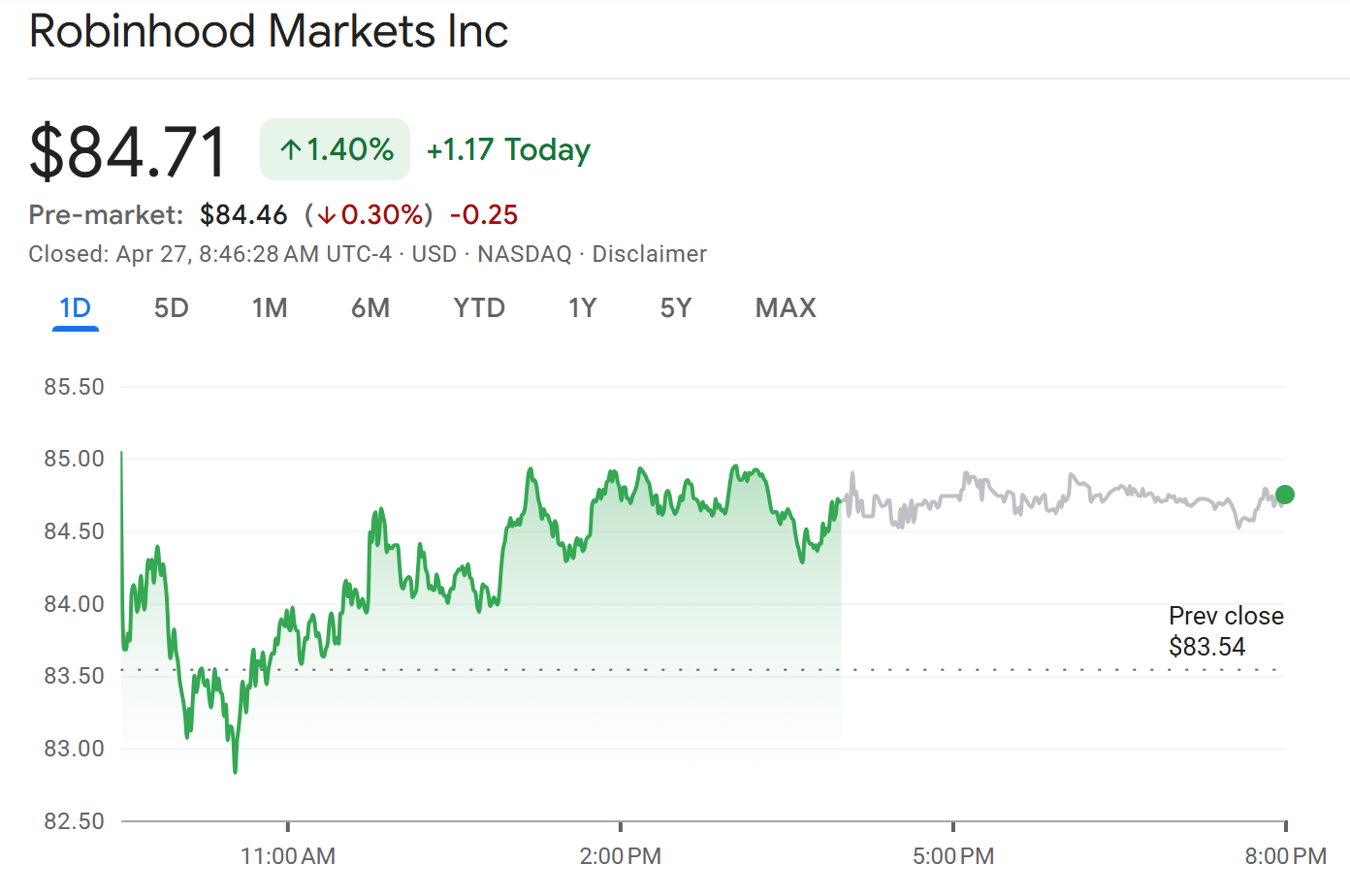
Robinhood confirmed that fraudulent emails sent from noreply@robinhood.com were a phishing attempt. The company said attackers abused its account creation flow without compromising customer accounts or company systems.
The falsified message, with the subject line “Your recent login to Robinhood,” prompted recipients to delete it. Customer balances and personal data remained untouched, the company’s help account stated on X.
Phishing Email Bypasses Robinhood Authentication
A Robinhood customer who analyzed the raw .eml file said the message passed SPF, DKIM, and DMARC checks. The email originated from Robinhood’s own infrastructure.
Attackers injected HTML into the legitimate email body. The injection embedded a “Review Activity” button that redirected to a domain called tinzio.net via googletagmanager.com.
David Schwartz, CTO emeritus at Ripple, also flagged the campaign, highlighting that the messages may actually be coming from Robinhood’s email system.
“I’m not sure exactly what’s going on, but it seems (at least from a quick look) like these emails were somehow injected into Robinhood’s actual email infrastructure at some point,” he warned.
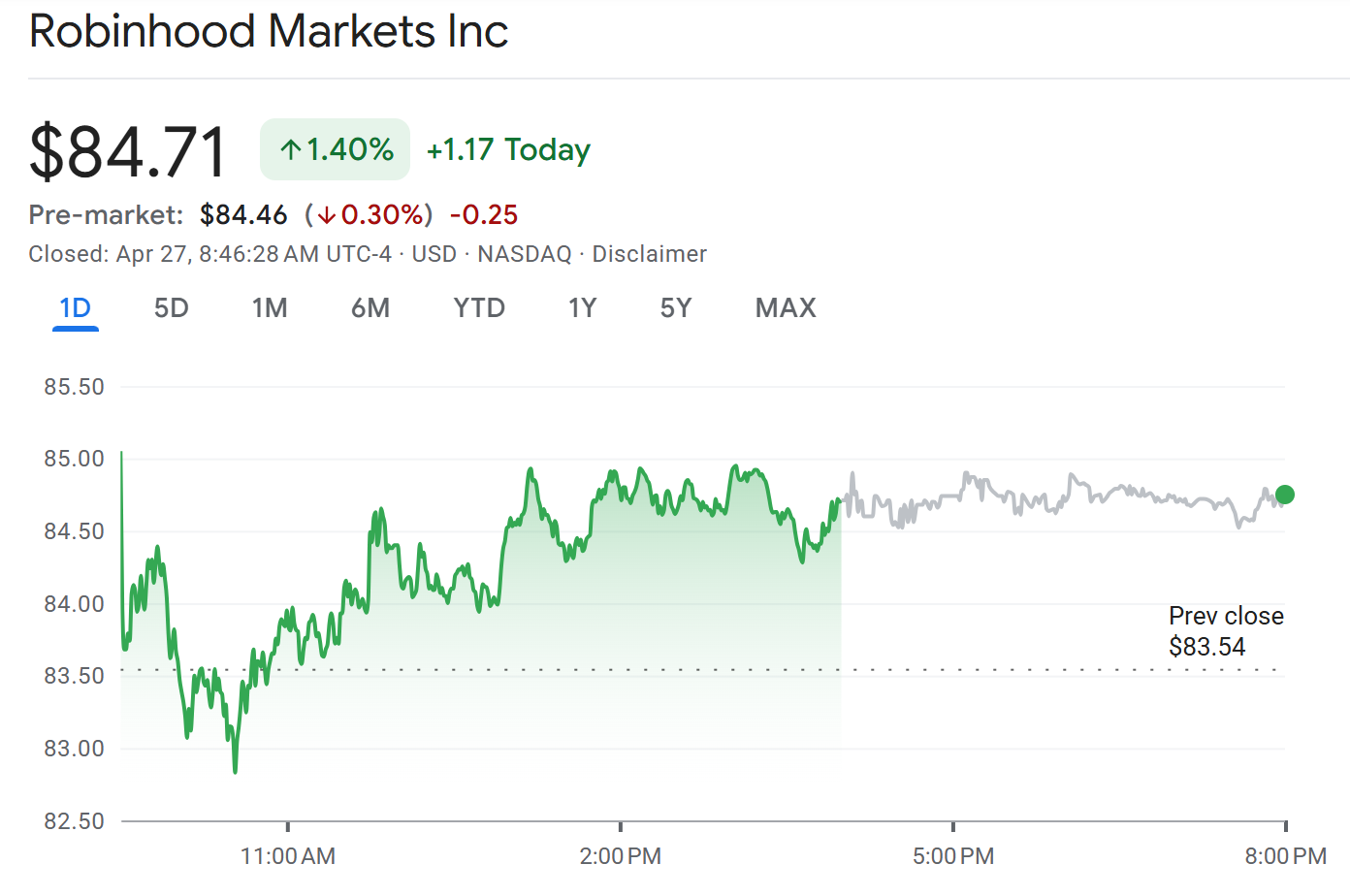
Robinhood (HOOD) traded near $84.71 on Monday morning, up 1.40% on the day, but recorded pre-market losses of up to 0.3% despite the phishing incident on Sunday evening.
What Robinhood Customers Should Do
Robinhood Help advised affected customers to contact support through the app or website rather than click any links.
The brokerage encouraged anyone who interacted with the email to change passwords, rotate two-factor authentication (2FA), and review recent device activity.
The pattern points to attacks in which authentication standards pass even as the email payload itself becomes malicious.
Robinhood has not detailed how attackers gained access to the account creation flow. It also has not said whether other customers received similar messages.
The post Robinhood Stock Could Suffer After Users Report Phishing Incident appeared first on BeInCrypto.
Crypto World
KuCoin Hosts HEXAGON BLOCK PARTY at Hong Kong Web3 Festival, Headlined by DJ Don Diablo and Rooted in Shared Values of Community and Connection
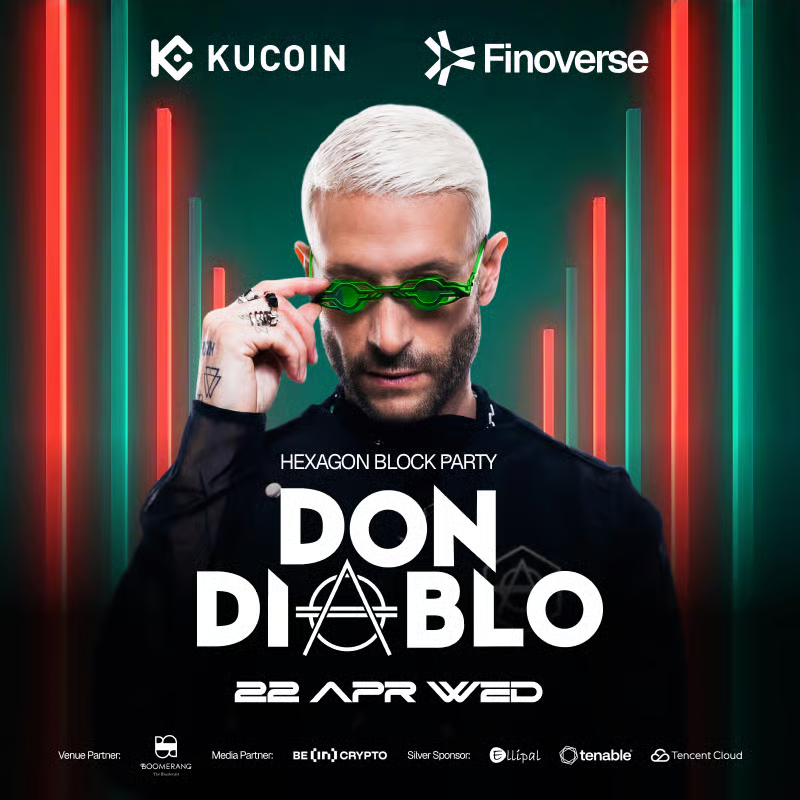
Headlined by internationally renowned DJ Don Diablo, the event brought together guests from the Web3 and fintech communities for an immersive evening experience.
KuCoin, a leading global crypto platform built on trust, and the exclusive Crypto Exchange and Payments Partner for Tomorrowland Winter and Tomorrowland Belgium (2026-2028), brought the spirit of global electronic music culture to Asia with the HEXAGON BLOCK PARTY in Hong Kong on April 22, which it co-hosted with Finoverse. BeInCrypto served as the event’s official media partner.
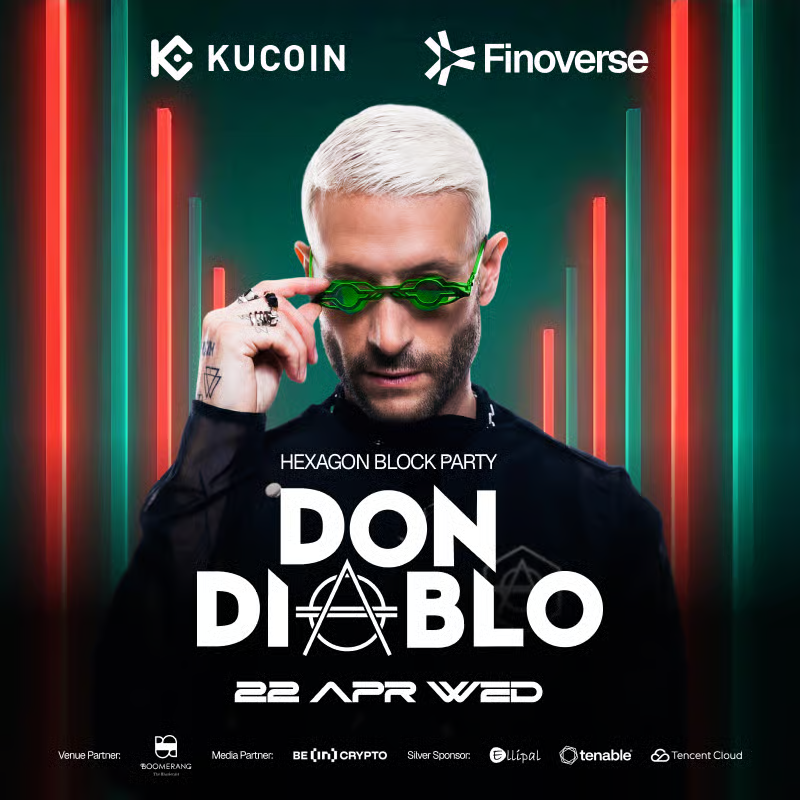
Headlined by internationally renowned DJ Don Diablo, the event welcomed guests from across the Web3, fintech, and broader innovation communities, creating an immersive gathering shaped by shared energy, conversation, and in-person connection. Building on KuCoin’s recent Tomorrowland Winter activation, which highlighted a shared belief that trust can be strengthened through community, creativity, and cultural experience, the event carried that momentum forward in Hong Kong through a similar spirit of openness, energy, and human connection.
Held in the heart of Hong Kong, HEXAGON BLOCK PARTY was designed as more than an evening celebration. By combining world-class music with a culturally driven atmosphere, the event offered a welcoming space for founders, builders, creators, and community participants to come together in a more human and experience-led setting. It reflected a shared belief that meaningful community is built not only through ideas and technology, but also through moments of creativity, openness, and collective experience.

The event aimed to create a cultural touchpoint in Hong Kong that resonated beyond the venue itself. The event served as a space where ideas, creativity, and communities could converge, bringing together guests across Web3, fintech, and digital culture through a shared experience rooted in openness, energy, and connection.
As the global partnership between KuCoin and Tomorrowland continues, the journey moves forward to Tomorrowland Belgium in July 2026, where KuCoin will once again collaborate with Tomorrowland to create new experiences at the intersection of music, culture, and Web3, further expanding the role of digital assets in real-world cultural moments.
About KuCoin
Founded in 2017, KuCoin is a leading global crypto platform built on trust and security, serving over 40 million users across 200+ countries and regions. Known for its reliability and user-first approach, the platform combines advanced technology, deep liquidity, and strong security safeguards to deliver a seamless trading experience. KuCoin provides access to 1,500+ digital assets through a broad product suite and remains committed to building transparent, compliant, and user-centric digital asset infrastructure for the future of finance, backed by SOC 2 Type II, ISO/IEC 27001:2022, and ISO/IEC 27701:2019 Certifications. In recent years, we have built a strong global compliance foundation, marked by key milestones including AUSTRAC registration in Australia, a MiCA license in Europe, and regulatory progress in other markets.
Learn more at www.kucoin.com.
The post KuCoin Hosts HEXAGON BLOCK PARTY at Hong Kong Web3 Festival, Headlined by DJ Don Diablo and Rooted in Shared Values of Community and Connection appeared first on BeInCrypto.

Key Takeaways
- GEV stock has climbed 209% in the past year and recently reached fresh 52-week peaks
- First quarter earnings per share of $17.44 demolished the $1.95 forecast — an exceptional 790% outperformance
- BNP Paribas moved GEV to Hold from Buy, pointing to maxed-out turbine production capacity until decade’s end
- Analyst price targets surged 22% post-earnings, with the consensus reaching $1,179
- Buy ratings from 74% of covering analysts substantially exceed the typical S&P 500 range of 55–60%
GE Vernova’s performance has been nothing short of spectacular on the market. Leading into the current week, shares had soared 209% across the trailing twelve months — including a remarkable 76% gain in 2026 year-to-date. Fresh all-time highs followed an exceptional quarterly report, yet the company now confronts an unexpected analyst downgrade.
BNP Paribas downgraded GEV from Buy to Hold this week in a move that caught market attention. The rationale was direct: while current performance is strong, GE Vernova has effectively booked its turbine manufacturing capacity completely through 2030, creating a ceiling on near-term expansion potential. Despite the downgrade, BNP elevated its price objective to $1,190 from $765 — a threshold the stock traded beneath just weeks ago in February.
GEV shares declined 1.6% in Monday’s premarket session, trading near $1,131.
Quarterly Performance That Shocked the Street
The first quarter results that sparked this discussion were remarkable by any measure. GE Vernova delivered earnings per share of $17.44 versus Wall Street’s $1.95 projection — representing an approximately 790% outperformance. Revenues reached $9.34 billion, surpassing the $9.19 billion consensus and marking 17% growth year-over-year.
Management also upgraded its free cash flow outlook and highlighted data center electrification as a central catalyst for expansion. The voracious power requirements of AI infrastructure are creating electricity demand at levels unseen in decades, positioning GE Vernova directly in line with this secular trend.
Shares rallied nearly 14% following the earnings release. Analysts responded by broadly increasing their price projections — the mean target climbed from $968 to $1,179, representing a 22% weekly jump.
Robert W. Baird established a $1,400 target while maintaining an Outperform stance. Goldman Sachs confirmed its Buy rating with a $1,328 price objective. Morgan Stanley increased its target to $960 alongside an Overweight rating. Current consensus stands at Moderate Buy with a mean price target of $1,077.
Institutional Activity Signals Confidence
Institutional investor behavior tells a story of growing conviction. Capital World Investors expanded its GEV holdings by 1,907.5% during Q3. Franklin Resources increased exposure by 170%, while SG Americas grew its stake by more than 10,000%. Both Raymond James and Nordea made substantial position additions.
The notable exception was the State of Michigan Retirement System, which reduced its holdings by 3.5%, disposing of 2,600 shares to conclude the quarter holding 71,040 units valued at approximately $46.43 million.
Even with BNP’s recent downgrade included, 74% of Wall Street analysts maintain Buy ratings on GEV — significantly higher than the 55–60% Buy-rating baseline for S&P 500 constituents.
The stock’s 12-month low stands at $356.94. Last week saw a 12-month high of $1,181.95. GEV trades at a P/E ratio of 33.45 with a market capitalization approaching $308.63 billion. The company distributed a $0.50 quarterly dividend on April 14th.

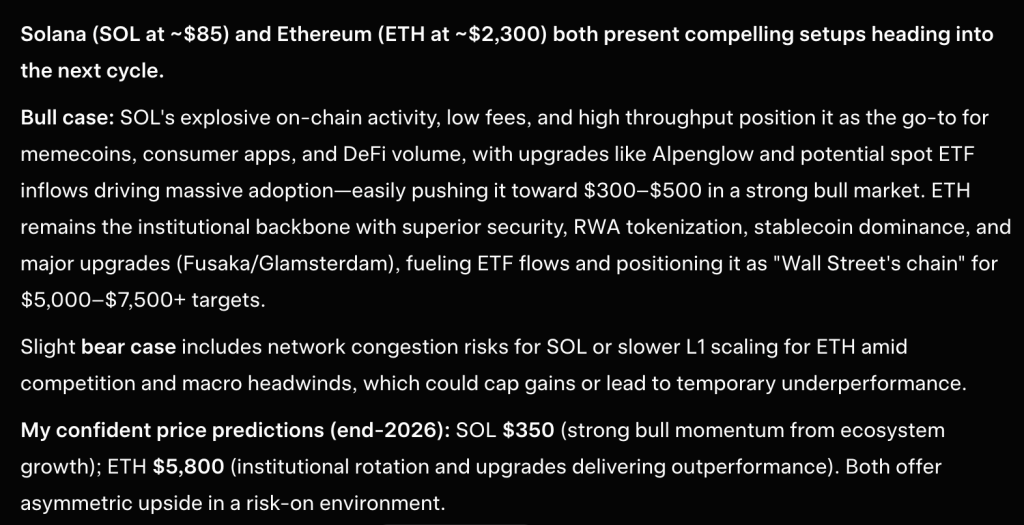
Elon Musk’s Grok AI predicts has issued sweeping 2026 price targets for Solana and Ethereum, and the crypto community is paying attention.
SOL currently trades around $85, while ETH sits near $2,300, both consolidating amid macro headwinds and growing institutional demand. The forecasts are bold enough to warrant a closer look at what’s actually driving them.
Grok’s projections place Solana between $210 and $290 by December 2026, a 2.4x to 3.3x move from current levels, citing catalysts including Goldman Sachs’ $108M SOL ETF stake and the Zepz remittance partnership as structural demand drivers.
For Ethereum, Grok’s base case lands between $4,900 and $6,700, with a higher-conviction $7,500 target circulating across Binance Square analysis, implying a 2.6x gain from present prices.
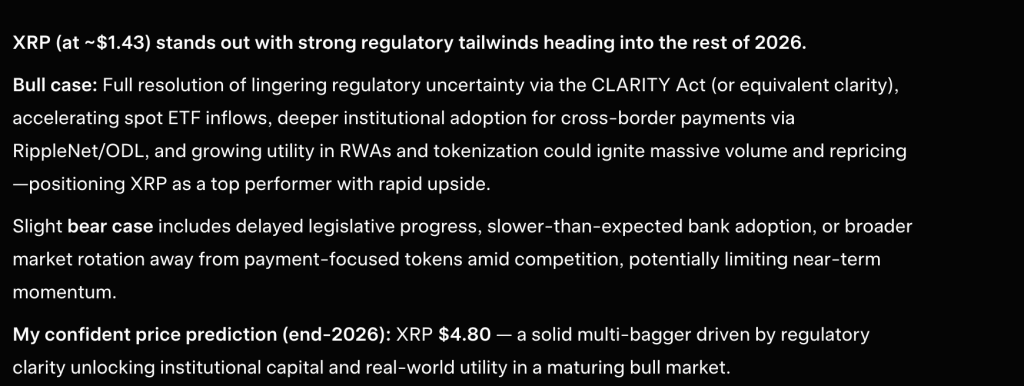
XRP sits in a similar position, trading near $1.43 while quietly benefiting from one of the clearest regulatory narratives in the market.
Grok projection would reasonably place XRP in the $3.80 to $5.20 range by December 2026, implying a 2.6x to 3.6x move, driven by potential legislative clarity around digital assets, renewed institutional flows through RippleNet and ODL corridors, and expanding relevance in tokenization and cross-border settlement.
The setup is less about hype and more about regulatory unlock acting as a delayed catalyst, meaning upside likely hinges on policy timing aligning with broader market strength.
Whale accumulation data and potential U.S. strategic Bitcoin reserve proposals are amplifying bullish sentiment across both assets. Whether those targets are realistic depends heavily on one question: does macro cooperate?
Can Solana Hit $350 and Ethereum Reach $5,800 by Late 2026?
SOL price looks like it is done falling for now and is starting to build a base around the $80–$88 zone, which is usually how reversals begin, quiet, low volatility, and no hype.
As long as $80 holds, the structure stays intact, and this looks more like accumulation than weakness, with the real upside only unlocking once it pushes back toward the $120–$140 resistance range.
ETH price is in a similar spot, just on a bigger scale. It is not breaking out yet, but it is holding key support and compressing, which often comes before a larger move. The key level to flip things is a break toward the upper resistance zones, where momentum can accelerate quickly.
The bigger picture is still constructive. If institutional flows keep building and macro conditions stabilize, both assets have room to move higher over time, but it is likely a grind first, not an instant breakout.
The risk is clear, though. If SOL loses $80 or ETH drops below its key support, the whole bullish structure weakens, and the timeline for any recovery gets pushed back.
Why GROK AI Predicts XRP Could Have High Odds Of Hitting Its Target First
XRP price is showing a much heavier structure than SOL or ETH right now, still in a clear downtrend on the higher timeframe, but starting to stabilize around the $1.30–$1.45 range.
That zone is acting as a base after the sharp February flush, with price moving sideways and volatility cooling off, which is typically where accumulation begins if sellers are exhausted.
The key level to watch is reclaiming $1.60–$1.70, because that is where the last lower high sits, and breaking it would be the first real signal that structure is shifting.
Until then, this is more of a range than a confirmed reversal. If $1.30 breaks, the downside likely opens again toward $1.10, but if it holds and builds, this could quietly turn into a bottoming phase before any larger move.
Grok Prefer New Launches Because It Could Give Higher Returns, Bitcoin Hyper Is Next?
Even if those larger targets play out, SOL and ETH remain large-cap assets, meaning the upside is real but not explosive. The asymmetry just isn’t the same once a project is this big.
That is why some traders look earlier in the cycle, where the market cap is still forming, and the upside is not fully priced in.
Bitcoin Hyper is trying to sit right in that gap, building a Layer 2 on Bitcoin with SVM integration to bring faster execution and smart contracts into the BTC ecosystem. The idea is to combine Bitcoin’s security with the speed and flexibility usually found on chains like Solana.
The presale has already raised over $32.5M at $0.0136792, suggesting steady demand and growing interest. Features like staking and the bridge design aim to make it functional, not just narrative-driven.
But it is still early, and that comes with trade-offs. Liquidity is unproven; execution matters, and how it performs post-launch remains uncertain.
So the setup is clear, large caps offer more stability with limited upside, while something like Bitcoin Hyper offers earlier positioning with higher potential, but also higher risk.
The post Elon Musk’s Grok AI Predicts the Next XRP Price, Solana and Ethereum Moves appeared first on Cryptonews.


- The USDPT stablecoin will run on Solana and be issued via Anchorage Digital.
- Launch is planned for May 2026 after final rollout preparations.
- Western Union links crypto wallets to its global cash network.
The Western Union CEO, during the Western Union’s first-quarter earnings discussion, announced that the company is moving closer to launching its dollar-backed stablecoin USDPT on the Solana blockchain, with a rollout targeted for May 2026.
The update comes after months of internal development around Western Union’s broader digital asset strategy, which aims to combine blockchain settlement with its long-established global cash transfer network.
USDPT moves from concept to near launch
USDPT, short for US Dollar Payment Token, is a fully dollar-backed stablecoin designed to operate on the Solana network.
The token will be issued through Anchorage Digital Bank, a federally regulated crypto institution in the United States.
This structure places regulatory oversight at the centre of the project, while still allowing blockchain-based settlement.
According to details shared by Western Union, the stablecoin will be integrated into a newly developed system known as the Digital Asset Network.
This network will connect crypto wallets, exchanges, and digital platforms directly to Western Union’s physical cash-out infrastructure, which spans more than 200 countries and hundreds of thousands of agent locations worldwide.
The system is designed to allow users to move between digital dollars and physical cash without relying on traditional banking intermediaries.
Users will be able to send USDPT on-chain and withdraw local currency at Western Union locations.
Solana chosen for speed and scale
Solana has been selected as the underlying blockchain for USDPT due to its high throughput and low transaction costs.
The network can process thousands of transactions per second, with settlement times measured in seconds.
This aligns with Western Union’s requirement for high-volume remittance flows.
Notably, Western Union processes millions of cross-border transactions annually, many of which involve small-value transfers.
The company has highlighted that traditional settlement systems often take several days and rely on multiple intermediary banks, while, in contrast, USDPT on Solana is expected to reduce settlement time to near-instant execution while lowering operational costs.
Anchorage Digital Bank will handle issuance and custody, ensuring that each USDPT token remains fully backed by US dollar reserves under regulated standards.
Launch timeline set for May 2026
While earlier guidance placed the rollout within the first half of 2026, the latest update narrows the timeline to May 2026.
The project is described as being in its final preparation phase, with technical integration and network testing underway.


For two years, Litecoin’s social media managers laughed at Solana’s blockchain outages. This weekend, they had to eat their own words as Litecoin’s blockchain suffered its own denial-of-service and double-spending attack.
Repeated Solana outages drew smug chuckles from Litecoin. Unlike Solana, according to its sustained declarations, Litecoin doesn’t have outages.
On Saturday, that talking point died. Litecoin definitely had an outage, as well as a double-spending problem.
A consensus bug in Litecoin’s privacy upgrade let an attacker mint invalid coins. Looking to double-spend as quickly as possible, the attacker rapidly traded LTC for other digital assets at crypto exchanges before honest miners could stop the sales.
Its blockchain split. Eventually, miners rolled-back transactions, creating about 32 minutes of de facto downtime.
Interestingly, due to the unusually slow mining times during the attack, it actually took over three hours in real-time for the network to produce the 13 replacement blocks that would have normally consisted of just 32 minutes worth of transactions.
Anyway, the Litecoin Foundation then explained its 13-block reorganization to its own followers.
No more 100% uptime
Just weeks earlier, Litecoin boasted of its “100% uptime,” claiming its blockchain “100% works” after being “100% battle-tested.”
Litecoin’s account spent 2024 and 2025 laughing at Solana’s problems without fixing its own.
When Solana scheduled maintenance for a weekend in June 2025, Litecoin told the Solana account, “This way you can schedule your outages for the weekends. Good call.”
It replied to another Solana status update with one word, “Downtime.”
When the two networks signed a tongue-in-cheek ceasefire later that month, the foundation’s joke version had Litecoin promising to stop “mocking Solana for six hours and Solana will just continue to not do anything.”
Solana’s own people declined to return the favor this weekend. Vibhu Norby, Solana Foundation’s interim chief product officer posted, “I will not bring up the 1,000 times @litecoin dunked on Solana for downtime. Because we are better than this.”
Read more: CHART: It’s been 262 days since Solana’s last major outage
Litecoin and Solana downtimes
The Litecoin vulnerability lived in MWEB, Litecoin’s Mimblewimble-based confidential transaction extension. Aurora Labs CEO Alex Shevchenko, whose chain ingests LTC via NEAR Intents, documented the exploit in real time.
The attacker submitted a malformed MWEB peg-out. Non-upgraded Litecoin mining nodes accepted it as valid, releasing synthetic coins into the regular Litecoin blockchain.
The attacker then bridged the proceeds through THORChain and NEAR Intents to swap for ether.
Honest miners running the patched 0.21.5.4 client rejected the attacker’s blocks. From there, the two forks raced.
After several hours, the patched chain eventually won heavier proof-of-work and the network re-organized blocks 3,095,930 through 3,095,943 out of existence.
Although the reversed transaction time window was only 32 minutes, it took nearly three hours to actually reverse those minutes, because hashpower was split between honest and exploited nodes.
The patch was on GitHub for a month
Dragonfly Managing Partner Haseeb Qureshi noted that the Litecoin double-spending bug was “known, but the fix was not fully propagated.”
Indeed, the underlying consensus fix had sat in a private GitHub branch for about 30 days.
A security researcher questioned that asymmetric disclosure window, which gave insiders a month-long head start. Several major mining pools, apparently, never installed the public release in time.
For non-insiders, the public Litecoin Core 0.21.5.4 release shipped on Saturday, shortly after the attack had begun.
Got a tip? Send us an email securely via Protos Leaks. For more informed news, follow us on X, Bluesky, and Google News, or subscribe to our YouTube channel.


Banking Circle has rolled out institutional stablecoin settlement services after securing regulatory approval in Luxembourg.
Summary
- Banking Circle has launched regulated stablecoin settlement services after securing CASP approval in Luxembourg.
- The bank now supports USDC, USDG, and its own EURI for institutional fiat and crypto conversions.
According to a Monday announcement from the Luxembourg-based bank, the expansion follows its April 15 registration as a Crypto Asset Service Provider with the country’s financial regulator, enabling regulated conversion between fiat and stablecoins for institutional clients.
Support currently includes USDC issued by Circle, USDG from Paxos, and the bank’s own euro-pegged token EURI, extending capabilities first introduced with EURI in August 2024.
Serving more than 750 payment firms, financial institutions, and marketplaces, Banking Circle said its infrastructure processes over €1.5 trillion, or about $1.7 trillion, in annual transaction volume. Chief digital asset officer Kirit Bhatia stated in the release that stablecoins are “a natural extension” of the bank’s existing systems, adding that they play a key role in lowering costs and improving settlement efficiency.
Banking Circle expands foothold as euro stablecoin race intensifies
Banking Circle’s earlier launch of EURI positioned it among the first banks to issue a euro stablecoin aligned with the European Union’s Markets in Crypto-Assets Regulation, with the CASP approval now allowing it to scale regulated services across clients.
Competition across the region has accelerated as traditional banks and crypto firms build compliant payment rails under MiCA. French lender Société Générale, through its digital asset arm SG-FORGE, introduced the euro stablecoin EURCV in April 2023 on Ethereum and later expanded to additional networks as part of its multi-chain strategy.
On April 15, SG-FORGE integrated its dollar-denominated token USDCV into MetaMask, giving users access to a regulated stablecoin issued by a European bank.
Swiss-based Sygnum added EURCV to its B2B platform in January 2025, targeting institutional clients and partner banks. In September 2025, a group of lenders, including ING, UniCredit, and CaixaBank, announced plans for Qivalis, a MiCA-compliant euro stablecoin scheduled for release in the second half of 2026.
The consortium has since expanded to 12 banks, adding BBVA, BNP Paribas, and DZ Bank, and partnered with Fireblocks to support custody and tokenization ahead of launch.
Crypto-native firms continue to build competing infrastructure. In April 2025, Circle introduced the Circle Payments Network to offer managed settlement services for banks and payment providers.
Separately, an April 21 partnership between Coinbase and global payments platform Nium enables businesses to fund cross-border transfers using USDC and settle in either fiat or stablecoins across more than 190 countries.


Institutional money is flowing back into crypto faster than retail this cycle, and the data is starting to back the rally bitcoin has been quietly running.
Digital asset investment products attracted $1.2 billion in inflows last week, a fourth consecutive weekly gain, according to CoinShares data published Monday.
Total assets under management across crypto funds rose to $155 billion, the highest level since February 1, though still well below the $263 billion peak from October 2025. Bitcoin alone took in $933 million, bringing year-to-date flows to $4 billion. Ether attracted $192 million, the third straight week above $190 million.
Meanwhile, blockchain equity ETFs are one to watch for outside of crypto-related funds. These products invest in publicly traded companies that derive revenue from crypto infrastructure, like miners, exchanges, and chip makers selling into crypto applications.
Inflows totaled $617 million over the past three weeks, including a record weekly figure, marking what CoinShares analyst James Butterfill described as an explosion in demand for indirect technology exposure to the asset class.
The pattern suggests allocators who cannot or will not hold spot bitcoin directly are rotating into the equity wrappers around the sector.
Bitcoin tagged $79,399 overnight, its highest level since January 31, before reversing to $77,705. The level matters because $80,000 is where buyers from January and February are approaching breakeven on positions held through the war-driven correction.
The week ahead is the test of whether institutional flows can absorb that selling pressure or whether a third rejection from $79,000 starts to define a range rather than precede a breakout.
Megacap tech earnings on Wednesday and Thursday from Alphabet, Microsoft, Amazon, and Meta, followed by Apple on Thursday, represent roughly a quarter of the S&P 500’s market capitalization and will determine whether the broader risk-on bid that has been lifting bitcoin alongside equities continues.
Strong earnings would extend the four-week run of crypto inflows and bitcoin may gets the catalyst it needs to clear $80,000. Disappointing results, however, could send prices dwindling lower.
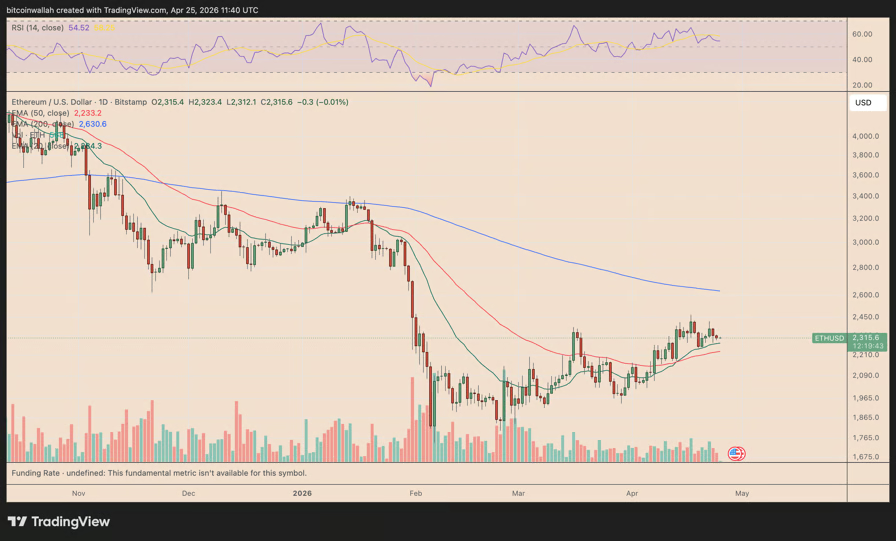
Ether (ETH) has surged more than 10% in April, reaching as high as $2,430 this month amid renewed market optimism.
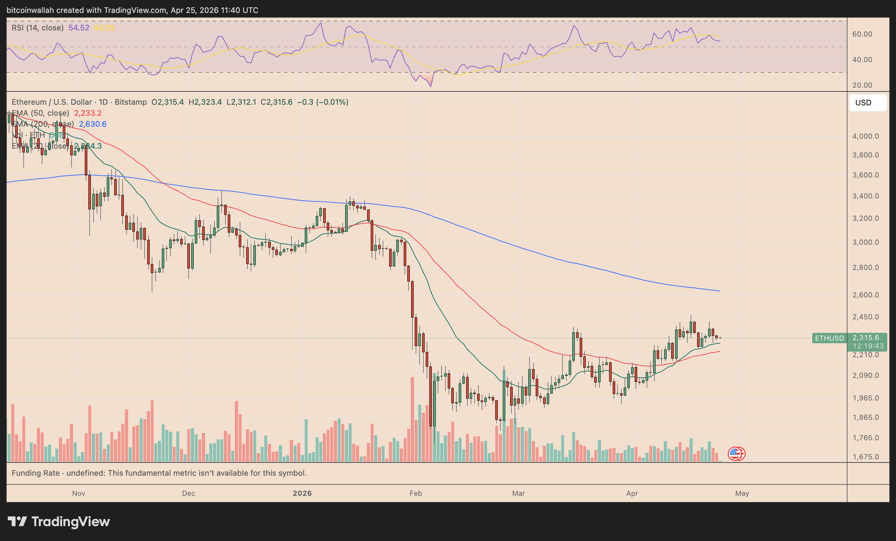
ETH/USD daily chart. Source: TradingView
Yet during the same period, the Ethereum Foundation, a nonprofit overseeing the Ethereum protocol’s development, has continued notable treasury sales.
Key takeaways:
- The Ethereum Foundation has sold approximately 20,000 ETH so far in 2026.
- Institutional demand for ETH remains strong, offsetting the foundation’s impact on the market.
Why is the Ethereum Foundation selling ETH?
In early April, the Foundation sold 5,000 ETH for roughly $11 million in DAI. This was followed by a larger 10,000 ETH OTC sale to Tom Lee’s Bitmine at an average price of $2,387, raising approximately $23.9 million.
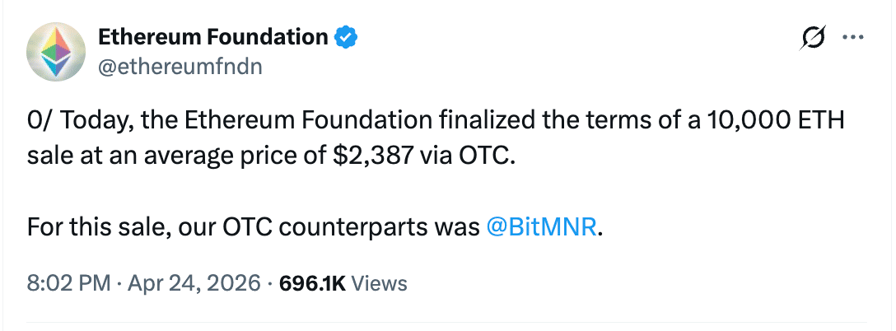
Source: X
The sales are not reactions to price action but follow a disciplined Treasury Policy adopted in June 2025.
The Foundation maintains fiat and stablecoin reserves equal to roughly 2.5 years of operating expenses. Periodic ETH sales replenish these reserves to fund protocol development, research, grants, and ecosystem support.
In 2026 alone, the Foundation has sold approximately 20,000 ETH, raising over $45 million. It still holds around 92,500 ETH (~$215 million) in its liquid treasury, plus 53,000 ETH staked, according to data resource Arkham Intelligence.
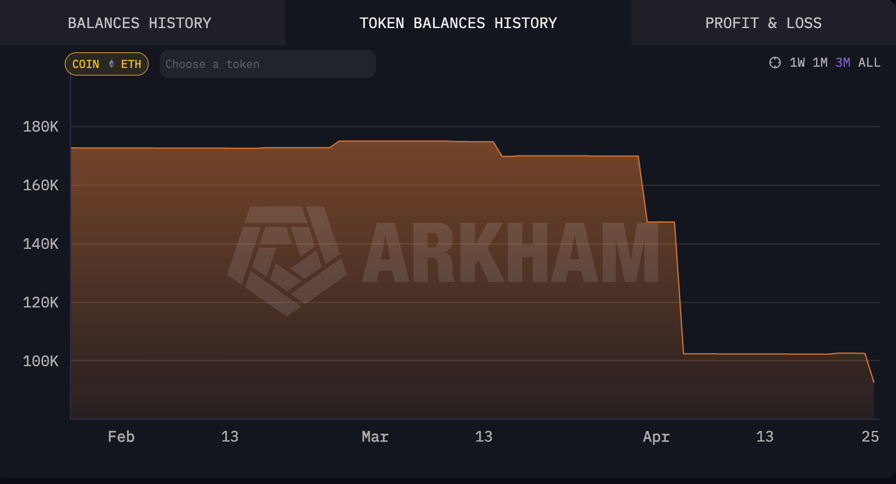
Ethereum Foundation’s ETH balance. Source: Arkham Intelligence
The Foundation’s 53,000 staked ETH may generate $4–$5 million in annual yield, assuming the current ETH price and the annual percentage yield of approximately 2.7%–3.8% gross remains about the same or higher in the future.
This new income stream should gradually reduce the Foundation’s reliance on ETH sales to fund its operations.
Are Ethereum Foundation’s sales bearish for ETH?
The Ethereum Foundation’s ETH sales remain small relative to daily ETH volume.
A typical 5,000–10,000 ETH sale represents just 0.08%–0.25% of Ethereum’s average daily trading volume of $10–12 billion.
This modest size means the market can comfortably absorb the Foundation’s selling pressure with negligible impact.
On-chain data already highlights robust underlying demand for ETH from large holders.
For instance, the number of daily accumulation addresses, wallets steadily buying and holding Ether, rose to 2,434 this week, surpassing the number of exchange depositing addresses (wallets preparing to sell), which fell to 2,300, as shown below.
Binance ERC-20 stablecoin whale activity index. Source: CryptoQuant
Also, spot Ethereum ETFs have recorded strong inflows for three consecutive weeks, attracting more than $2 billion in new capital since early April, according to data from SoSoValue.
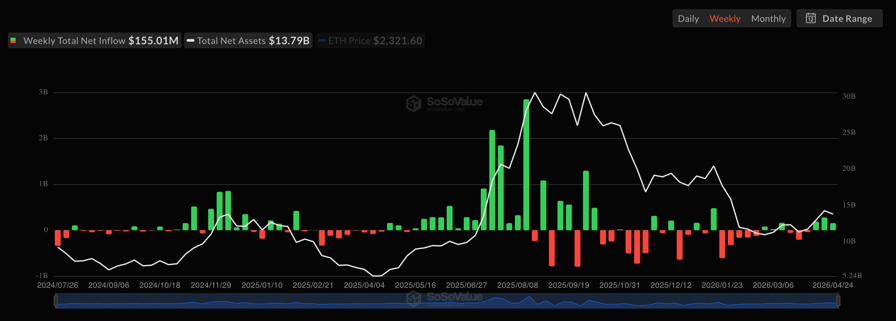
US spot Ethereum ETF weekly flows. Source: SoSoValue
This sustained institutional buying signals growing demand for Ethereum investment products on Wall Street.
Ether’s rising wedge hints at 15% dip ahead
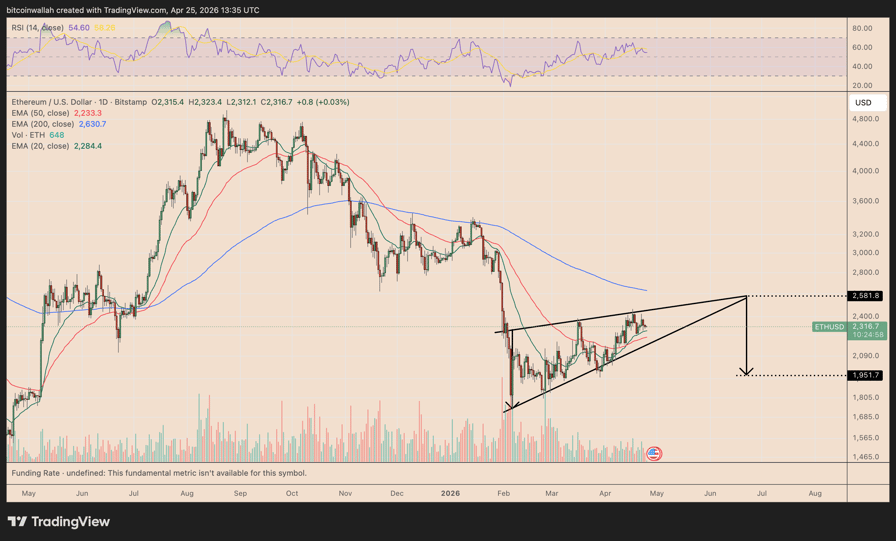
From a technical perspective, Ether is currently forming a rising wedge pattern, a structure defined by two ascending trend lines that are converging, accompanied by noticeably declining volume.
In technical analysis, a rising wedge resolves when the price breaks below the lower trend line and falls by as much as the structure’s maximum height.
ETH/USD daily chart. Source: TradingView
Applying this rule to ETH’s chart brings its downside target to around $1,950, down by over 15%, by June, assuming the breakdown point is the wedge’s apex at approximately $2,580, where the two trend lines converge.
Related: Ethereum whale opens $90M long bets as ETH price chart eyes $3.2K
Conversely, a break above the wedge’s upper trendline may invalidate the bearish outlook. Instead, bulls may target the 200-day exponential moving average (200-day EMA, the blue line) at around $2,630 as their next upside target.


Pudgy Penguins’ recent rally may be a breakout driven by ecosystem momentum. This move appears to have benefited long-term holders in unexpected ways, according to on-chain data.
According to DNTV Research founder Bradley Park, the surge may have provided liquidity, that is, enough buyers in the market, for large holders to sell following a mid-April token unlock.
“The news around the Pengu Card, PenguBot, and other ecosystem updates are secondary narratives at best,” Park told CoinDesk. “The real story is the large token unlock that happened roughly 10 days ago.”
The Pudgy Penguins team did not respond to a request for comment by press time.
Token unlocks are scheduled releases of coin supply, similar in spirit to post-IPO lockup expirations that periodically flood equity markets with newly available shares.
Park points to the token unlock on April 17, when roughly 703 million PENGU — about 0.79% of the total supply of roughly 88 billion — hit the market in a single tranche.
The on-chain activity in the hours that followed, paired with a sharp jump in futures positioning, tracks the pattern seen at prior unlocks, where large holders use a window of rising liquidity to sell into strength.
The primary unlock wallet received 182.8 million PENGU and, within roughly 50 minutes, dispersed them across 19 separate addresses.
Park calls the sequence a “vesting-claim-and-disperse” pattern, the kind of choreography more commonly associated with preparing to sell than with settling in for the long hold.
The mechanics aren’t complicated: tokens come out of the vesting contract and get split across multiple wallets, which lets the eventual sale move in pieces small enough that no single transaction tips the market against the seller.
The futures market moved alongside it. Open interest in PENGU rose from about $36 million to $59 million during the rally, with repeated short squeezes amplifying upward momentum.
Short squeezes — the same mechanic retail traders watched drive GameStop in 2021 — force traders betting against the price to buy back in and cover their positions, layering fresh demand on top of whatever was already pushing the market higher.
For a holder trying to exit, that is close to an ideal environment: someone else’s forced buying absorbing their selling, with the price still moving the right way.
Open interest measures the total value of futures contracts still open in the market, and when it rises alongside price, it usually means traders are piling into new long positions rather than closing out old ones. That deepening of liquidity is exactly what a large holder needs to sell size without moving the price against themselves.
“My hypothesis: the price rally was engineered to provide exit liquidity for unlock recipients,” Park told CoinDesk in a note. “The bullish narratives — game launches, Visa card, Telegram bot — gave market participants a reason to bid, while the unlock beneficiaries used the resulting liquidity to sell into strength.”
“The news didn’t cause the rally,” he added. “It provided cover for post-unlock distribution.”
Park’s analysis aligns with broader signs of concentration in the NFT market.
As CoinDesk reported earlier, buyer participation has been declining even as prices rise, with activity increasingly concentrated in a handful of collections, such as Pudgy Penguins. In that environment, relatively small flows can have an outsized impact on price.
Next month will show if this is an isolated event or part of a pattern.
Pudgy Penguins’ vesting schedule shows monthly unlocks of roughly 703 million PENGU continuing through at least July, with the next tranche scheduled for May 17.
Each event introduces new supply, creating recurring windows where price action and underlying flows may diverge.
What the market has to sort out now is whether the rally reflects durable demand or just well-timed liquidity around new supply.
The ecosystem news is real enough. Whether it points to growth or to a cover for an exit is the question the next few months of unlocks – without the same bullish narratives – will answer.

Six exclusive seasonal fragrances that warm the skin

Poll projection shows Corbyn losing his seat to the Greens
Winds of Valen: Beginner tips and tricks

Manchester United reach agreement with Casemiro over contract clause amid transfer speculation

US brings back mandatory military draft registration

Steven Gerrard disagrees with Gary Neville over ‘shock’ Chelsea and Arsenal claim | Football


-

 Politics7 days ago
Gary Stevenson delivers timely reminder to register to vote as deadline TODAY
-

 Fashion3 days ago
Weekend Open Thread – Corporette.com
-
 Crypto World2 days ago
Hyperliquid $HYPE Rally Builds Momentum as AI Sector Enters Prove-It Phase
-
Crypto World7 days ago
Bank of Hawai’i (BOH) Q1 2026: Net Income Drops to $57.4M as Net Interest Margin Expands
-

 Politics5 days ago
Making troops accountable for war crimes threatens US alliance, ex-SAS colonel warns
-

 Politics5 days ago
Disabled people challenge government SEND proposals over segregation concerns
-

 Business5 days ago
Rolls-Royce Voted UK’s Most Iconic Trade Mark as IPO Register Hits 150
-

 Business4 days ago
Patterson-UTI Energy, Inc. (PTEN) Q1 2026 Earnings Call Transcript
-

 Politics5 days ago
Zack Polanski responds to home secretary’s taser threat
-
 Crypto World6 days ago
Five Value Stocks with Recovery Potential in 2026: PayPal (PYPL), Nike (NKE), and More
-

 Politics5 days ago
Starmer handler McSweeney to be dragged from shadows by Foreign Affairs Committee
-
 Sports1 day ago
IPL 2026: Ruturaj Gaikwad registers slowest fifty of the season, enters all-time unwanted list | Cricket News
-
Politics5 days ago
Wings Over Scotland | How To Get Away With Crimes
-

 Crypto World6 days ago
New York sues Coinbase, Gemini over prediction market offerings
-
 Business5 days ago
HCL Tech share price tank over 9% after weak Q4. JPMorgan, HSBC & 3 others cut target price
-

 Politics5 days ago
‘Iran is still a nuclear threat’
-
Entertainment6 days ago
Sydney Sweeney cameo cut from “The Devil Wears Prada 2”, source explains why (exclusive)
-

 Crypto World6 days ago
Crypto’s great hope in Senate’s Clarity Act still has a path to survive tight calendar
-
 Sports4 days ago
Tim Bradley names the current best in the world: “Better than Inoue and Usyk”
-

 NewsBeat1 day ago
LK Bennett closes all stores after entering administration
You must be logged in to post a comment Login