

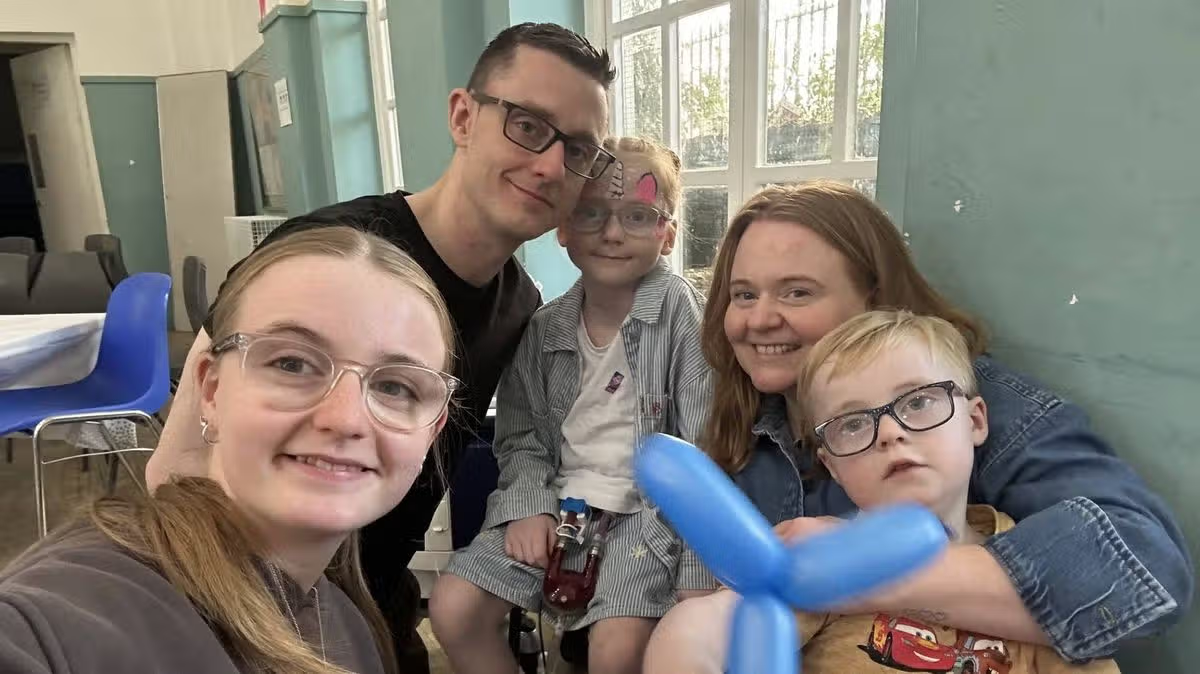
Essie Loftus is awaiting a heart transplant
A “happy” girl whose stomach pain turned out to be a sign her heart was failing now has a mechanical heart pumping blood for her while she waits for a transplant. Her parents, Annemarie, 41, and Michael, 46, said she began showing “subtle” changes in 2024, including not wanting to cycle to school and being “chubbier” than her siblings.
Annemarie and Michael, from Dublin, noticed Essie, seven, had “lost her spark” the following summer. By March 2026, she had developed worsening stomach pain, exhaustion and vomiting, and was initially diagnosed with constipation.
As her condition continued to worsen, further tests uncovered that she had hybrid cardiomyopathy, a rare heart condition that affects the heart’s ability to pump blood, which explained her earlier symptoms.
She was subsequently transferred to Great Ormond Street Hospital in London after medical staff warned that she would likely require a heart transplant to survive. In order to keep her heart functioning while she awaits a donor organ, Essie was placed on an advanced life-support system for 12 days before being fitted with a Berlin Heart mechanical pump on May 5.
Now, with Michael and Annemarie dividing their time between London and Dublin while also caring for their two other children, Ayla, 13, and Cael, four, young Essie takes around 25 medicines each day as she waits for a new heart.
Annemarie, a Montessori teacher, told PA Real Life: “When I see Essie with the biggest smile on her face, or she’s got some story to tell me about winding up the doctors, you just think to yourself, ‘If she can get through this all, then so can we’.”
Michael, a streaming media engineer, added: “She’s an inspiration to us every day.”
Essie had always been constantly “running around” and “cheeky”. However, at the age of four in 2024, her parents Annemarie and Michael began noticing some “subtle” shifts in her behaviour, including becoming “very concerned” about whether they would drive or cycle to school.
They also noted she appeared “a bit chubbier” than their other two children, though they did not think “too much of it” at the time. By the summer of 2025, the couple felt that Essie had “lost her spark” and sought the help of a play therapist, though she appeared to be “was fine”.
Despite this, Essie continued to seem not “quite herself” and by March 2026 she had started “complaining” of stomach pains.
Annemarie added: “She was saying that she was tired and wanted to go to bed early, which wasn’t like her. We took her to the St Patrick’s Day parade and she wanted to be carried and not stand. It just got worse – over the next day or two she started vomiting and couldn’t keep anything down.”
At the end of March, the couple took their daughter to their GP, who diagnosed her with constipation and prescribed medication. However, when her condition failed to improve over the following days, they brought her to their local children’s hospital, where she received the same diagnosis.
Annemarie and Michael had a “feeling” that “something wasn’t right”, prompting them to return to hospital, where she underwent a series of tests, including an ultrasound, electrocardiogram (ECG) and X-ray. Just hours later, on April 15, a meeting with the cardiac nurse specialist and chief cardiologist confirmed it was “something serious”.
Michael recalled: “They told me separately to Annemarie that they thought Essie had restrictive cardiomyopathy. I didn’t know what that meant, but they mentioned the word transplant, and of course, in between going in and out the room, I Googled it, and that was probably the worst day of my life. It wasn’t a good day.”
Restrictive cardiomyopathy, as described by the NHS, is a condition in which the walls of the heart’s main chambers become stiff and rigid, preventing them from relaxing properly after contracting and stopping the heart from filling with blood adequately. According to the National Library of Medicine, the average survival rate following diagnosis is estimated at between two to five years.
Essie was admitted to intensive care before undergoing a cardiac catheterisation to assess her heart function. The couple revealed her diagnosis was subsequently changed to hybrid cardiomyopathy, meaning she displayed signs of both restrictive and dilated cardiomyopathy, and that treatment was a viable option.
In dilated cardiomyopathy, the muscular walls of the heart become stretched and thin, preventing them from squeezing properly to circulate blood around the body, according to the NHS. This explained Essie’s exhaustion, and the condition can also cause swelling, which accounted for her appearing “chubbier” than her siblings, as well as stomach pain, as a weakened heart causes fluid to accumulate in the digestive organs.
Three days later, she underwent additional tests to determine whether she was eligible for a mechanical heart at Great Ormond Street Hospital, and was confirmed as a suitable candidate. The mechanical heart, known as a Berlin Heart Ventricular Assist Device (VAD), is used to support children suffering severe heart failure while awaiting a heart transplant.
It takes over the function of a child’s own heart when it becomes too weak to pump sufficient amounts of blood to the lungs and around their body, according to Great Ormond Street Hospital.
“We were just trembling, sitting there, holding each other, shaking with fear and anxiety and everything you can imagine,” Michael said. “Eventually they came and told us, and we were just so happy and relieved.”
However, in the long run, Michael and Annemarie would need to alternate between one of them remaining at Great Ormond Street Hospital with Essie while the other stayed in Dublin with their other children.
“It was very difficult to accept, but it meant saving Essie – we had a good cry and we knew it was something we needed to do,” Michael said.
Within days, Essie was airlifted from Dublin to Great Ormond Street and placed on an advanced life-support system that temporarily pumps and oxygenates a patient’s blood outside the body for 12 days before receiving the mechanical heart on May 5.
Annemarie said: “It’s horrific to watch your child go through something like that. Essie has been through some things adults will never, ever go through. When she got on to the Berlin Heart, we just felt like we’re one step closer to transplant and she got her spark back.”
Essie remained in intensive care for several weeks following the procedure, with her parents beside her, and gradually started to recover her strength. While in intensive care, they received news of a matching donor for transplant, but were subsequently told the tissue wasn’t suitable and they couldn’t go ahead, leaving them “so disappointed”. Yet Michael and Annemarie credit Essie’s “character” with helping her survive the experience.
Michael said: “We always said her sassiness and sense of humour will do her well when she’s older, we just didn’t realise that she was going to need it so soon.”
In June 2026 Annemarie’s mother died and she felt she did not “get time to grieve” while worrying about Essie, balancing care for her other children and making repeated trips between Dublin and London.
“It’s all just been so tough, and I don’t know if I’ve processed it all, I feel like maybe I will years later,” she said. “I believe there will be some major breakdowns once this is over, but it’s just about putting one foot in front of another for now.”
Currently, Essie undergoes regular wound dressing changes and monitoring, taking approximately 25 medications daily. The Berlin Heart VAD features a plastic pump or chamber positioned outside the body, with the air-filled section connected through a lengthy plastic tube to a driving unit that Essie wheels alongside her.
She receives bedside schooling at Great Ormond Street for an hour each day and interacts with other children and nursing staff, frequently pretending to be a nurse on the ward.
“The team have just been incredible at making life feel as normal as possible, and there are parents here that all understand what we’re going through,” Michael added.
Michael will remain at Great Ormond Street until Essie can receive a transplant, though they “have no idea” when that might be. “It’s just a waiting game for us and our little girl now,” Michael said.
For more information, visit gosh.nhs.uk and organdonation.nhs.uk










![Instead of airing the episode they filmed a new, humorous tribute, in which Lee's mother-in-law Wendy [Deborah Grant] painted an awful picture of him a year after the funeral](https://i.dailymail.com/1s/2026/09/22/11/111394503-16148555-image-a-3_1790072227229.jpg)





















































You must be logged in to post a comment Login