Large emergency services response as climber suffers serious fall at Welsh beauty spot | Wales Online
Need to know
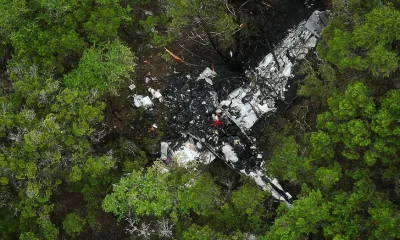
Police and the ambulance services were called after a climber took a significant fall at Craig y Forwen, part of World’s End
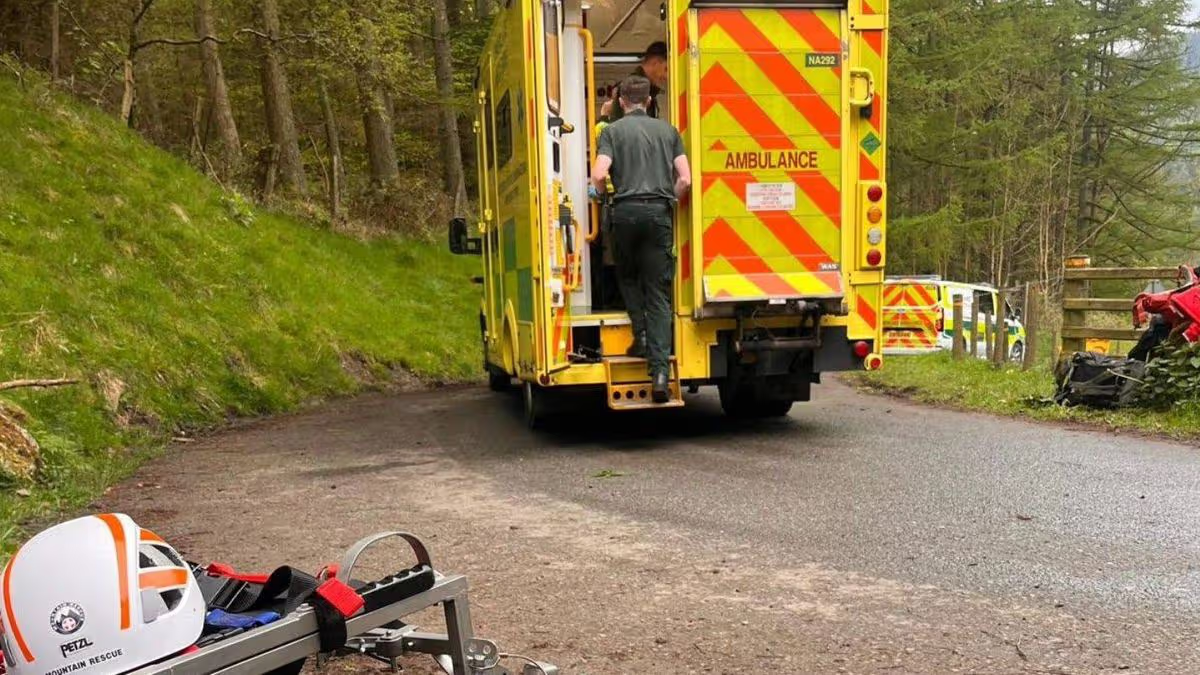
A large emergency services response was launched after a climber fell at Craig y Forwen.(Image: NEWSAR)
Emergency services responded to a climber’s fall.
A large emergency services response was launched after a climber fell at Craig y Forwen in north east Wales on Sunday evening, May 3.
Police, ambulance services and the North East Wales Search and Rescue (NEWSAR) team were scrambled to the scene. The crag is part of World’s End valley, which runs between Llangollen and Wrexham.
Witnesses reported multiple ambulances and police vehicles attending the incident.
A NEWSAR spokesperson said: “The Welsh Ambulance Service assessed and stabilised the casualty on scene, and the team assisted with a stretcher carry to the waiting ambulance.”
The climber was taken to hospital for further checks. NEWSAR wished them “a full and speedy recovery”.
Get daily breaking news updates on your phone by joining our WhatsApp community here. We occasionally treat members to special offers, promotions and ads from us and our partners. See our Privacy Notice
The 30-year-old was a ‘temporary resident’ in Vietnam at the time of his death
A Cambridgeshire man died of ‘traumatic injuries’ after a crash in Vietnam, an inquest has heard. Luke Khushil Vaja, aged 30, died on April 16, 2025 in Da Nang City, Vietnam. A written inquest into his death, carried out by Coroner Elizabeth Gray, concluded he died of “multiple traumatic injuries”.
Advertisement
The inquest read that Vietnam Police were called to a single-vehicle crash at the intersection of Tran Hung Dao, Le Van Duyet, Van Don, Nai Hien Dong Ward, Son Tra District, Da Nang City, Vietnam at around 6.25am on April 16. Mr Vaja was found dead by police at the scene, next to a two-wheeled motorbike.
A police report said the incident was a “self-inflicted traffic accident”. The motorbike found next to Mr Vaja was noted to be “slightly damaged”.
After his death, Mr Vaja was brought back to the UK for a CT post mortem to be carried out. This post mortem confirmed his cause of death which was “consistent with reports of a single-vehicle collision”.
The inquest also read that Mr Vaja’s family requested more details from Vietnam Police, including CCTV footage, images of the crash and blood test results. The family has not yet received this.
Advertisement
The family were also advised by the police force that an “investigation is still in progress”. Coroner Gray expressed her condolences to the family and friends of Mr Vaja.
Readers discuss religion, King Charles’ visit to the US and issues of the House of Lords (Picture: Getty Images)
Do you agree with our readers? Have your say on these MetroTalk topics and more in the comments
Should ‘faith-defined communities’ be put to a stop?
This week on the news, following the stabbings at Golders Green, I keep hearing statements such as ‘the Jewish community fear for their safety’ or ‘Jewish people don’t feel safe walking in their own communities’.
In my opinion, part of the problem is the existence of faith-defined communities.
In the 21st century, in the UK, communities should be integrated – including people of all faiths and none. There should be no Jewish communities, Christian communities or Muslim communities or communities of any faith. Faith and religion are divisive and people have been warring over it for millennia. Until people can learn to live with each other’s differences, there will always be hate and wars over faith.
Advertisement
We can make a start, by getting rid of faith-defined communities and integrating. Alfie Mullin, West London
No bad words against King Charles
I don’t want to hear any more criticism of our royalty. King Charles has done an absolutely amazing job on his State visit to the US. His speeches have been wonderfully composed and president Donald Trump has engaged with him and Queen Camilla.
Advertisement
This has been to the advantage of our country and he has accomplished far more than our politicians. Molly Neville, Sheffield
‘Feeble words’ from politicians following the Golders Green attack
After yet another cowardly attack on the Jewish community at Golders Green, the ridiculously weak home secretary Shabana Mahmood says that wider society needs to stand up and confront this antisemitism. Feeble words from a desperate minister running out of ideas. Bill, Sutton
Do British politicians forget they are of ‘migrant descent’?
This reader says Shaban Mahmood seems to have forgotten her heritage (Picture: Thomas Krych/ZUMA Press Wire/Shutterstock)
It seems to me that Priti Patel, Suella Braverman and Shabana Mahmood overlook the fact that they are themseves of migrant descent – they appear to be more anti-migrant than the majority of the population. Roger Smith, Witham
UK needs Depsit Return Scheme for litter
I regularly tidy up in my patch of north London and I couldn’t agree more with Michael (MetroTalk, Thu) with regards to some people not caring about litter.
But when is the UK going to have a Deposit Return Scheme, widely used across Europe?
Advertisement
Machines located across the city enable you to separate tins, plastic bottles and occasionally glass. It works, with high recycling rates and is cost neutral, with credit given on each item processed. John O’Sullivan, via email
House of Lords are ‘politically appoited cronies’
With the departure of the last hereditary peers, the House of Lords has become the house of politically appointed cronies. It is high time this body was elected. All candidates should renounce any allegiance to any political party to stand and sit as independents. Alan Cheesman, Orpington
This reader says the House of Lords needs reforming (Picture: Getty Images)
Is Metro’s Medium Soduku more difficuly than the Hard level?
Every time I pick up a Metro I find the Medium Sudoku is more difficult than the Hard one. It’s too frequent to be a coincidence. Are you trying to boost the ego of people doing your puzzles? H Temple, via email
This reader thinks so!
Not sure if you might every now and again mix up the Medium and Hard Sudoku puzzles? Last Thursday, I found the harder puzzle easier to solve. Maybe I’m smarter than I think! The puzzles page is still my favourite part of Metro. Claire, Manchester
Do you agree with our readers? Have your say on these MetroTalk topics and more in the comments
An expert has explained the chances of hantavirus spreading from the ship
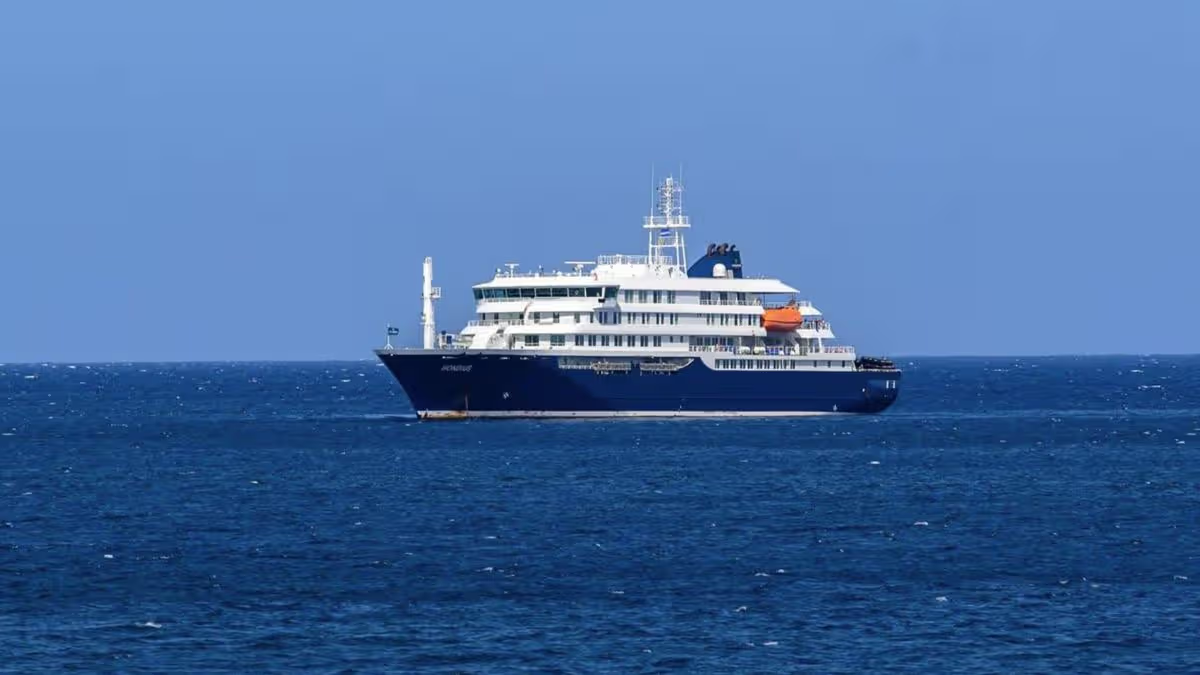
An expert has said that the risk of hantavirus spreading is ‘essentially zero’, after three people died from a suspected outbreak on a cruise.
Advertisement
It comes as a British crew member is being prepared for medical evacuation from the Dutch-flagged cruise ship MV Hondius, which is currently anchored off the coast of Cape Verde. The crew member, a Dutch colleague and a passenger are set to be taken to the Netherlands.
A Dutch passenger died on board the ship on April 11. On April 27, the wife of the passenger died, and authorities confirmed a variant of hantavirus. On May 2, a German passenger on board died, though the cause has not yet been confirmed.
Click here to get the biggest stories straight to your inbox in our Daily Newsletter
Now, Professor Sir Andrew Pollard, director of the Oxford Vaccine Group at the University of Oxford, said that the virus is “rarely” spread between people.
The Andes virus, which has been identified as the variant behind the outbreak, is “known very rarely to spread between people with close contact”, Sir Andrew said.
“It means it is very easy to isolate people who are unwell and to follow quarantine and so on to avoid spread to other people,” he said.
Advertisement
Once these passengers have been evacuated the ship will start the three-day journey to the Canary Islands, docking in either Gran Canaria or Tenerife.
An update from health officials in Spain on Tuesday said: “The World Health Organisation has explained that Cape Verde cannot carry out this operation. The Canary Islands are the closest place with the necessary capabilities.
“Spain has a moral and legal obligation to help these people, among whom are also several Spanish citizens.”
But the leader of the regional government of the islands have expressed concern over the plan, with its leader Fernando Clavijo writing on X: “Our position is clear regarding any decision made by the WHO and the State: safety and guarantees for the passengers and for the people of the Canary Islands.”
Advertisement
Some 19 British nationals were listed as passengers on the ship, which was sailing from Argentina to Cape Verde, with four British crew members.
A British passenger and the British crew member are among those taken ill in the suspected outbreak, which has been linked to three deaths.
The World Health Organisation (WHO) said on Tuesday that it has been notified of seven suspected cases.
The British passenger was medically evacuated from the ship on April 27 and remains in isolation in hospital in Johannesburg, South Africa.
Advertisement
Prime Minister Sir Keir Starmer has said plans are being made for the “safe onward travel” of Britons on the ship.
Content cannot be displayed without consent
And the Foreign Office has confirmed that it has been directly in touch with all British passengers on board the ship, which was sailing from Argentina to Cape Verde.
Professor Sir Andrew Pollard, director of the Oxford Vaccine Group at the University of Oxford, told BBC Radio 4’s Today programme: “The Andes strain of this virus is common amongst rodents in countries like Argentina in South America.
“It’s an infection which actually doesn’t cause much harm to the rodents, but it can be acquired by humans who are in close contact with the environment around the rodent, because it’s spread in saliva and urine and faeces from those animals.
Advertisement
“With this particular hantavirus, the Andes virus, it is known very rarely to spread between people with close contact, usually symptomatic individuals who are in close contact with each other.
“And that’s important because it means it is very easy to isolate people who are unwell and to follow sort of quarantine and so on to avoid spread to other people.
“It’s not like the situation we had with Covid-19 in the pandemic where people could spread even without symptoms, and therefore it was able to spread very easily in the population.”
He added: “The authorities will be very familiar with managing respiratory virus infections on cruise ships, because every year there are outbreaks of influenza on cruise ships, for example, and so working out the public health interventions to isolate the cases, make sure that there isn’t any onward transmission to people, will have really good protocols already in place.
Advertisement
“I think the risk is essentially zero of spread outside of this particular outbreak, because the authorities have recognised this and they know exactly what to do to make sure that the individuals are isolated and there’s no-one with transmission now that we know what we’re dealing with.”
Dr Jacqueline Weyer, acting deputy executive director for National Institute for Communicable Diseases in South Africa, said that Andes virus is a “slow burner” and “moves really slowly” which “allows a window of opportunity to contain the outbreak”.
Get MEN Premium now for just £1 HERE – or get involved in our WhatsApp group by clicking HERE
But she told Sky News that the British passenger in hospital in Johannesburg will be under “strict isolation precautions to ensure that we don’t see onward transmission”.
Advertisement
She said that investigations have found no rodent infestations on the ship itself and that the “exposure event” was probably through rodent exposure in Argentina.
Asked about passengers on board the ship, she told the broadcaster: “I’m not sure at this stage if the patients will actually be allowed to disembark or if the isolation will be continued, we are waiting for the directive on that.
“Of course, when these individuals are allowed to disembark, it will also be with some measures in place to ensure that we don’t have a wider scale outbreak when they try to return home.”
Passengers are currently confined to their cabins while “disinfection and other public health measures are carried out”, the WHO said.
Advertisement
Hantavirus infections, which are usually spread by infected rodents’ urine or faeces, can lead to severe respiratory illness and can sometimes be fatal. While it is rare, hantavirus infections can spread between people, according to the WHO.
There is no specific treatment or cure, but patients have a better chance of survival if they receive medical attention early.
Sir David Attenborough has brought the joy of the natural and animal world to the nation’s screens through his beloved programmes for 70 years.
His reverential, sometimes playful tone has become a mainstay of British television, while his efforts to raise awareness for conservation and climate change have inspired millions.
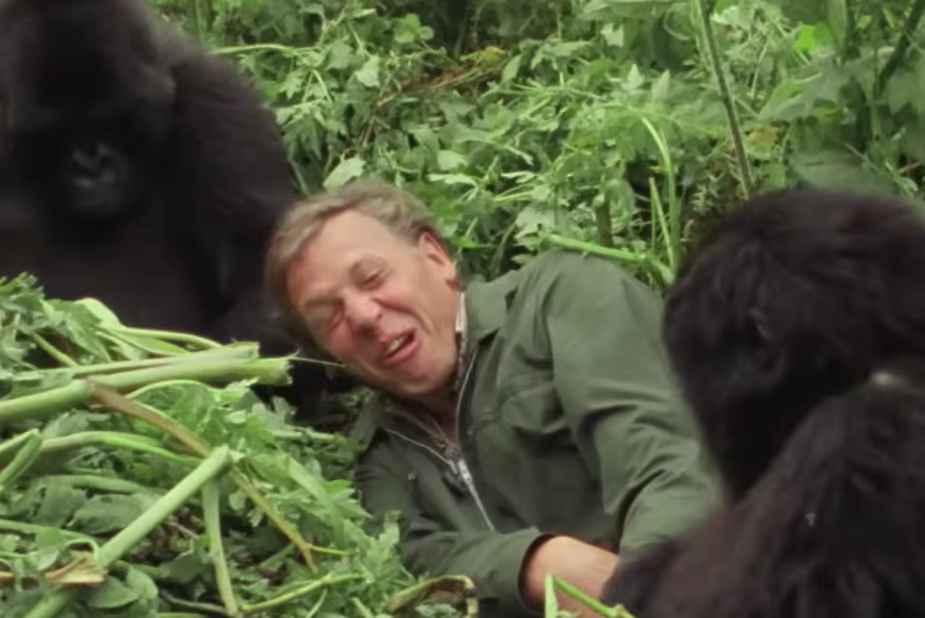
In a clip that has been voted one of the top TV moments of all time, one young gorilla lies across his body, while just at the edge of the picture you can see the baby gorillas who were busy removing his shoes.
The 13-part series featured footage from 30 countries. More than 500 million people tuned in – 11.4 per cent of the global population.
Advertisement
In 1984, Sir David became one of the first underwater presenters as he observed the grey reef shark in The Living Planet. Developments in full face plates allowed him not only to be able to deliver his commentary but to be recorded clearly.
Also in The Living Planet, he presented in zero gravity from the Nasa experimental plane, nicknamed the vomit comet.
He bounced and floated around as he described how we take gravity for granted, before ending his commentary completely upside down.
Sir David Attenborough is famed for his decades-long career as a broadcaster and naturalist (John Walton/PA)
In 1990, he took viewers swimming with dolphins in Trials Of Life.
Advertisement
The presenter gave viewers insights into the body language and sounds that dolphins use to communicate, strapping on his scuba diving suit to eavesdrop on their conversations.
Outtakes with an exotic bird
In The Life Of Birds in 1998, he clutched his binoculars as he walked carefully towards a lyrebird in south Australia and marvelled in delight over its extraordinary impersonation skills.
The bird’s camera shutter, car alarm and chainsaw calls were its attempts to outdo rivals and attract a mate.
Advertisement
Sir David could be seen laughing incredulously at the bird as it repeatedly interrupted his takes with its incredible noises.
Seeing a blue whale in action
Sir David’s sheer excitement at the moment a huge blue whale surfaced during 2002’s The Life Of Mammals, was heart-warming to witness. He is shown clinging on to his little boat, which is dwarfed by the 30-metre whale, the largest animal known to have existed.
Also in The Life Of Mammals, Sir David visited a group of orphaned chimps which were being taught the survival skills needed to live in the wild. As his boat neared the landing point, an enthusiastic chimp jumped straight in to greet him. He later enjoyed a nut-cracking session with a group of dexterous mammals.
Advertisement
Another spectacular moment in the series came when Sir David trudged slowly through knee-deep snow to come face-to-face with a Siberian tiger in captivity.
Sir David Attenborough has been hailed by many as a ‘national treasure’ (Chris Young/PA)
– A sequence in Life In Cold Blood in 2008 used slow motion to show the diversity in size, shape and ability of frogs and toads. Sir David lay on the floor of a Madagascan rainforest with a tiny pygmy frog resting on his fingertip to marvel at the “miracle of miniaturisation”.
– In Frozen Planet in 2011 he became the oldest person to visit the North Pole, venturing into high altitude and extreme cold at the age of 84.
Sir David met and sat with a 13-year-old hand-reared cheetah named Ares in 2014 for series three of David Attenborough’s Natural Curiosities.
Advertisement
Featured in the Impossible Feats episode, the encounter demonstrated the cheetah’s specialized adaptations, with footage showing the calm, friendly interaction rather than a wild hunting scenario.
The broadcaster celebrated his 90th birthday in 2016, and sat down with journalist Kirsty Young for the BBC’s Attenborough At 90 documentary to recount the highlights of his life and career.
Later that year, Planet Earth II was released with Sir David’s soothing narration accompanying scenes including rare snow leopard mating footage and lions attacking a giraffe in a desert.
The critically acclaimed documentary series also featured an intense, high-speed scene of a newborn marine iguana escaping from a swarm of racer snakes on Fernandina Island – which has been hailed as one of the most tense sequences in wildlife television history.
Advertisement
Making history with Blue Planet II
Sir David also returned as a presenter for Blue Planet II in 2017, which became the most-watched UK television show of 2017, with a chart-topping 14 million tuning in to the first episode of the wildlife series, which included dramatic footage of walruses fighting to find a home, along with dazzling scenes of surfing dolphins and a sex-changing fish.
The series is also thought to have triggered an increase in public, media and political attention to plastic pollution.
Sir David Attenborough at the world premiere of the BBC’s Blue Planet II (Geoff Pugh/Daily Telegraph/PA)
The debut episode of Dynasties – which focused on the chimpanzee – became the most popular programme of the month when it aired in November 2018.
Advertisement
The series, narrated by Sir David, also documented the struggles of baby penguins fighting to avoid an icy death, with the BBC camera crew intervening and coming to the rescue of the stricken birds, breaking a long-held stance of wildlife filming not to get involved.
A surprise cameo at Glastonbury
In 2019, Sir David made a surprise appearance on Glastonbury’s Pyramid stage with a four-minute trailer for the BBC’s new natural history series Seven Worlds, One Planet ahead of Kylie Minogue’s performance.
Sir David also made a speech to the huge crowds gathered, celebrating the work of Glastonbury in banning single-use plastic bottles from the Somerset event that year.
Advertisement
Sir David Attenborough made a surprise appearance on Glastonbury’s Pyramid stage (Aaron Chown/PA)
Receiving a rare second knighthood
Sir David was awarded one of Britain’s highest honours, the Knight Grand Cross of the Order of St Michael and St George, by fellow avid environmentalist the then Prince of Wales in 2022.
That year, Sir David was also named a Champion of the Earth by the UN’s Environment Programme (UNEP), and appointed a member of the Order of the Companions of Honour in the New Year Honours list recognising his major contributions to science.
Sir David Attenborough after being appointed a Knight Grand Cross of the Order of St Michael and St George (Andrew Matthews/PA)
The broadcaster says she will be forever grateful to the woman who reached out after spotting her distress on TV
Gemma Jones SEO Writer and Monde Mwitumwa TV and Celebrity Reporter
11:10, 06 May 2026
Nobody would have realised that the well-known GB News presenter Nana Akua was battling an excruciating skin condition that left her feeling as though chemicals had scorched her face.
Concealing the problem beneath thick makeup, she maintained a composed appearance before the cameras and continued hosting her programmes – until a viewer got in touch to “save her skin”, reports the Express.
Advertisement
The television personality revealed: “One weird thing that did happen on GB News was that I had a weird thing going on with my skin.
“A woman who was watching and saw me on TV reached out and told me ‘I can see that your skin is in pain’”.
Speaking to Express, the TV star shared more details as she continued: “I was wearing make up and everything so I thought that you couldn’t tell.
“But anyway, she took me under her wing and I tried some products and now my skin is healed.
“I’ve never used cheap stuff on my skin, but what I was using, I washed my face and put it on and it literally burnt my face. I used to get skin issues around my eyes, and I couldn’t work out what it was.”
The star went on: “But then I came off the products that I was using. I didn’t realise just how bad it was until the lady reached out and I tried this new cream.
Advertisement
“When you’re on TV all the time, you have to put make up on every single day. And it’s heavy make up. My skin has gone through a really weird phase. And then it only went worse when some products were burning me.”
“But I listened to this woman and she saved my skin – I have to thank her for that.”
The individual who provided this transformative guidance was skincare specialist and aesthetician Andria Vassiliou.
Advertisement
Throughout her career, Andria has maintained a deep commitment to addressing problematic skin conditions and has embraced every opportunity to help women tackle their most challenging skin concerns.
She graciously invited Nana to the Cetuem clinic to explore potential solutions.
A programme of treatments alongside a tailored skincare routine was implemented. Within several weeks, Nana’s skin had become calmer and had regained its radiance.
Nana now describes Andria as the “skin queen” and credits her as her saviour.
The row of retail units outside Cardiff Bus Interchange is filling up slowly
Sandwich chain, WhichWich? is opening a second venue in Cardiff, just months after debuting its first Welsh shop in January.
Advertisement
WhichWich is a Texan-based brand known for its fully customisable hot toasted sandwiches and is due to will open a second Cardiff unit at the Bus Interchange.
The brand saw its first unit in the UK outside of London open in Cardiff on January 17. It’s not known the opening date of the shop, which will face outwards onto Central Square, but the sandwich chain will join Starbucks and acai bowl spot, Kiwi, on the run of units at the interchange.
With a tag line claiming “superior sandwiches” Which Wich will have pre-made menu favourites like their California Chicken Club, Loaded BBQ Pork or Super Veggie wrap or you can pick from 40 more toppings to make your own.
From superstar gigs to cosy pubs, find out What’s On in Wales by signing up to our newsletter here
Advertisement
Alongside their lunch menu there’s afull toastie breakfast menu of English muffins, breakfast pots and fresh brewed coffee – which they claim to be “Seattle’s best.”
Founded in Dallas, Texas in 2003, Which Wich has an ‘innovative ordering system’ which sees customers grab their chosen sandwich type’s designated bag, writing on it your particular order and adding your name to said bag, before paying and handing it over to the cashier.
If, once you’ve recieved the bag, you are not 100% into your sandwich the Which Wich website says they have a ‘Sandwichfaction Guarantee’ and they’ll replace it, refund your money, or both if not.
Advertisement
This second sandwich spot for Wich Which? joins a number of new openings this spring, with work ongoing in the city centre for Solina pasta restaurant at the former Zero Degrees site and Roos at the former warden’s lodge in Sophia Gardens is also still undergoing work, aiming for a late spring opening.
Of the six British singles players who began the year in the top 100, Cameron Norrie is the only one to have avoided injury or illness, and he has returned impressively to the world’s top 20 in recent weeks.
Raducanu, 23, had been due to return at the Italian Open in Rome this week but withdrew after her media commitments on Tuesday with post-viral symptoms. Kartal is currently on track to reappear during the grass-court season, but the back injury the 24-year-old suffered during her run to the Indian Wells fourth round in March has cost her the entire clay swing.
Francesca Jones had a month out after a glute injury at the Australian Open and Draper’s comeback from his serious arm injury has been checked by a knee problem, while Fearnley came through qualifying in Rome after a seven-week absence.
British number three Katie Boulter, who tumbled out of the top 100 last year as she battled foot and hip injuries, says it can be hard to step away even if players have information to suggest their bodies are at breaking point.
Advertisement
Fitness trackers, which offer performance analysts a wealth of data, will be allowed on a trial basis at this year’s remaining three Grand Slams, as they have been for a while now on the men’s and women’s tours.
But Boulter, who has climbed back into the top 60, told BBC Sport: “I think it’s impossible as a tennis player to be like, ‘I’m going to take the week off because my wearable [device] says that I’m in red’.
“Financially, there might be people that don’t have that luxury to stop a week out of their schedule and not play – the majority of us are still trying to make a living.
“I’ve played through many injuries, I’ve also stopped through many injuries. Ultimately you have to make the best judgement call you can.
Advertisement
“It’s good to have that information, but it doesn’t necessarily marry up sometimes.”
The LTA has refreshed its entire physiotherapy staff over the past 18 months and believes it now has the right expertise to support the modern player. The next task is to consider how best to upgrade its recovery facilities.
British players have a lot more resources at their disposal than many other nationalities. An LTA physio was sent to Miami in March as Kartal started to realise the extent of her back problem, but the emphasis is also on players building their own support network.
Winning the final, where one of Bayern Munich or Paris Saint-Germain lie in wait, will guarantee another €6.5m euros (£5.6m), and that also comes with an additional €4m (£3.5m) for reaching the UEFA Super Cup in August. That curtain-raiser for next season is worth €1m (£863,000) to the winner.
“This is a disgraceful and deeply frustrating attack”
11:06, 06 May 2026Updated 11:11, 06 May 2026
A heritage railway has hit out at ‘disgraceful’ vandals after trains were daubed with graffiti in a ‘deeply frustrating’ act of vandalism.
The Bury-based East Lancashire Railway said police are investigating the incident, which targeted an East Lancashire Railway (ELR) heritage set overnight during the May Bank Holiday. A locomotive and several coaches from the InterCity 125 rolling stock were daubed with extensive graffiti.
The heritage railway has described the ‘mindless attack’ as a ‘calculated act of destruction’. It comes months after one of the coaches had been repainted in February – while it also follows a similar incident last year.
Advertisement
Click here to get the biggest stories straight to your inbox in our Daily Newsletter
After discovering the graffiti, volunteers immediately stepped in and worked tirelessly for several hours top clean it up, using specialist materials to remove the graffiti before it could permanently set. ELR says the volunteers’ swift action prevented what could have been significant and lasting damage – although further polishing and restoration work is still required.
Mike Kelly, chairman of ELR, said: “This is a disgraceful and deeply frustrating attack on a railway run largely by volunteers, with many steam and diesel traction owned either by the ELR or groups and in some cases, private individuals who give their time freely to preserve our railway. It is nothing short of a kick in the teeth for those who work so hard to maintain and preserve historic traction and rolling stock.
Advertisement
“What makes this even more infuriating is that this follows a similar incident less than 12 months ago, when nearly 30 glass panes across two coaches were smashed, causing thousands of pounds worth of damage. We are working closely with the police and are determined to see those responsible identified and held accountable.
“I want to place on record my sincere thanks to our outstanding volunteers, whose immediate and determined response ensured the damage was contained. Their commitment stands in stark contrast to the senseless actions of those responsible.”
ELR says Greater Manchester Police attended the scene, gathered evidence and said patrols in the area would be stepped up. Additional CCTV coverage is also being installed as part of strengthened security measures. Anyone with information about those responsible is urged to contact Crimestoppers anonymously on 0800 555 111 or online.
Podcasting has become one of our most intimate cultural forms. We often listen alone, through headphones, to voices that guide us through complex or deeply personal stories. Over time, we come to trust these voices not just for the information they convey, but for the sense that someone has listened, selected and shaped what we hear.
That relationship is unsettled by The Epstein Files, a new AI-generated podcast series that promises to process millions of Epstein-related documents into a coherent narrative. But when no one is clearly responsible for what we hear, the authority of the voice becomes harder to trust.
Created by data entrepreneur Adam Levy, the series draws on more than three million documents linked to Jeffrey Epstein and presents them as a “forensic audit” in the form of a conversational podcast between two AI-generated hosts.
Launched in February 2026, it’s had more than two million downloads so far. It’s a daily, self-updating show built through an automated pipeline that ingests, cross references and scripts material using AI systems, operating at a speed that traditional newsrooms could only dream of.
Advertisement
At first listen, The Epstein Files works, sounding like a carefully crafted podcast. But despite the jokes, cross-talk, hesitations and filler words that mirror shows like This American Life, Serial or S-Town, there are no identifiable human speakers behind the voices. From research to publication, the process appears to be largely automated, in line with Levy’s intention to “strip the emotion” from the story.
The hosts also claim that the podcast acts as a filter, combining AI-assisted processing with “human analysis” to review the records rather than speculate. But this distinction is harder to verify when the processes behind selection, interpretation and emphasis remain largely invisible.
Emotion, judgement and interpretation are seen here as irritations or threats. However, systems that select, rank and narrate information do not become neutral simply because those decisions bypass direct human involvement.
The series presents itself as “the first AI native” investigative documentary. Yet it lacks many of the features we’ve come to expect. There are no interviews, no location recordings, and hardly any sonic cues to guide the listener. Instead, it relies almost entirely on simulated conversation.
Advertisement
Scale is not judgement
The use of AI in podcasting is not simply a technical development. It disrupts the way shows are produced, structured and distributed. Rather than acting as a tool, these systems are beginning to reshape or obscure editorial processes that usually rely on human judgement.
The Epstein Files demonstrates how effectively AI can process vast quantities of material, producing a narrative that sounds coherent. But coherence is not the same as sense making, and pattern recognition is not interpretation. Deciding what matters, what is credible, and what should be left out remains a human task.
Automation does not remove judgement. Instead it relocates it, often in ways that are harder to see. Decisions are embedded in training data, system design and weighting mechanisms while appearing as neutral or unbiased outputs.
Advertisement
When information can be processed at scale, the question is no longer just what we know, but how we decide what counts as knowledge. Editorial standards don’t disappear, but they become harder to identify.
Why audio makes this harder
The human voice carries assumptions of authenticity. It signals presence, experience and connection. When we hear someone speak, we tend to assume a relationship between voice and responsibility. That assumption becomes more difficult to sustain when the voice is artificial yet sounds convincingly human.
These nameless hosts are not neutral. They are modelled on familiar broadcast styles associated with authority in western media. In doing so, they reproduce ideas about professionalism and trust, while remaining detached from any identifiable speaker.
What is striking about The Epstein Files is how persuasively authority is performed. The conversational structure suggests multiple perspectives, the tone implies neutrality, and the pacing suggests careful deliberation. But none of this guarantees that the material has been critically evaluated.
Advertisement
Content that creates itself
It could be argued that automation results in more transparency. But this relies on the assumption that volume can substitute for editorial oversight. When material is misinterpreted, stripped of context or simply wrong, it’s often unclear how those mistakes might be identified or addressed.
This is particularly troubling with material such as the Epstein case, which centres on human harm and exploitation. Such stories demand sensitivity, restraint and clearly traceable accountability. The way these stories are processed and retold can also feel detached from the people most affected by them.
At the same time, AI generated podcasts are growing. They are cheap to produce and increasingly difficult to distinguish from human made content. Their appeal may lie in speed, availability and the impression that someone has already done the work of sorting through chaos.
Advertisement
For audiences, the question is not only how to identify what is true or false. It’s also about recognising what is missing. Listening has typically meant encountering different voices, perspectives and forms of responsibility. When those elements are reduced or removed, the act of listening itself begins to change. The Epstein Files offers little sense of a right of reply for its audience. There is no clear editorial voice and no visible chain of accountability.
Broadcasting always depended on relationships between voices and listeners, and between storytelling and editorial judgement. This is beginning to change. The Epstein Files does not signal the end of podcasting or investigative journalism. But it marks a moment in which the cultural meaning of the voice is being tested.
Co-presence and community is central to radio and podcasting. But in The Epstein Files, nobody is there. There may be voices but if you listen very closely, you’ll notice that no one ever takes a breath.













































You must be logged in to post a comment Login