

Crypto World
Iggy Azalea Hit With Lawsuit Over Memecoin

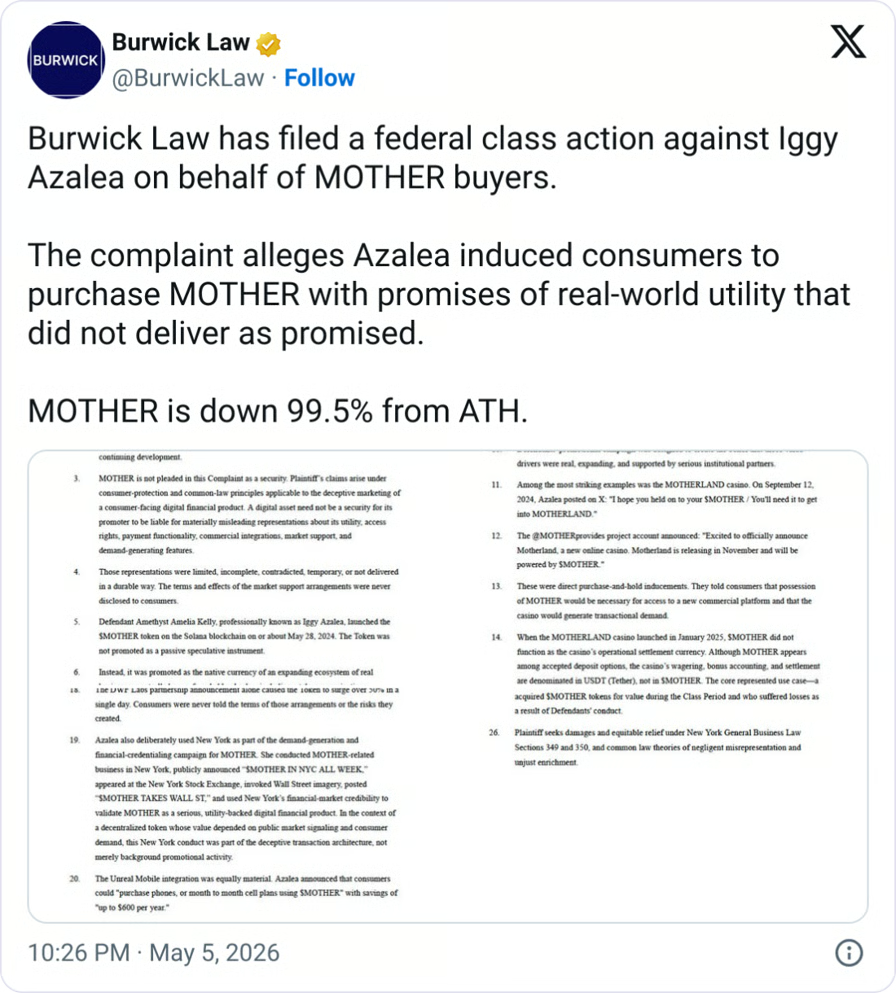
Rapper Iggy Azalea is facing a class-action lawsuit in the US, accusing her of misleading investors about the real-world utility and future development of her Solana-based memecoin Mother Iggy (MOTHER).
The complaint filed by plaintiff Kenneth Kolbrak in a Manhattan federal court on Monday claimed Azalea, whose real name is Amethyst Amelia Kelly, made representations about the token having real-world utility, commercial integrations and continuing development that never materialized.
“Those representations were limited, incomplete, contradicted, temporary, or not delivered in a durable way,” the complaint said. “The terms and effects of the market support arrangements were never disclosed to consumers.”
Azalea’s MOTHER was one of the buzzier tokens launched amid a frenzy of celebrity-tied memecoins in 2024. The token was launched in May 2024 and reached a peak market value of over $136 million by mid-June. Its market capitalization is now sitting at $1.3 million, according to CoinGecko.
Unlike other celebrities who launched memecoins, Azalea has remained involved with the token, interacting with supporters on social media and promoting it on X.
Kolbrak, the lead plaintiff, claimed he lost “several hundred dollars” investing in MOTHER, which the lawsuit said he would not have done, or would have paid less for, if not for Azalea’s promotions.
According to the complaint, Azalea promoted the token as “the native currency of an expanding ecosystem of real businesses controlled or co-founded by Azalea, including a telecommunications company, an online casino, a luxury gifting marketplace, a merchandise store, and entertainment integrations.”
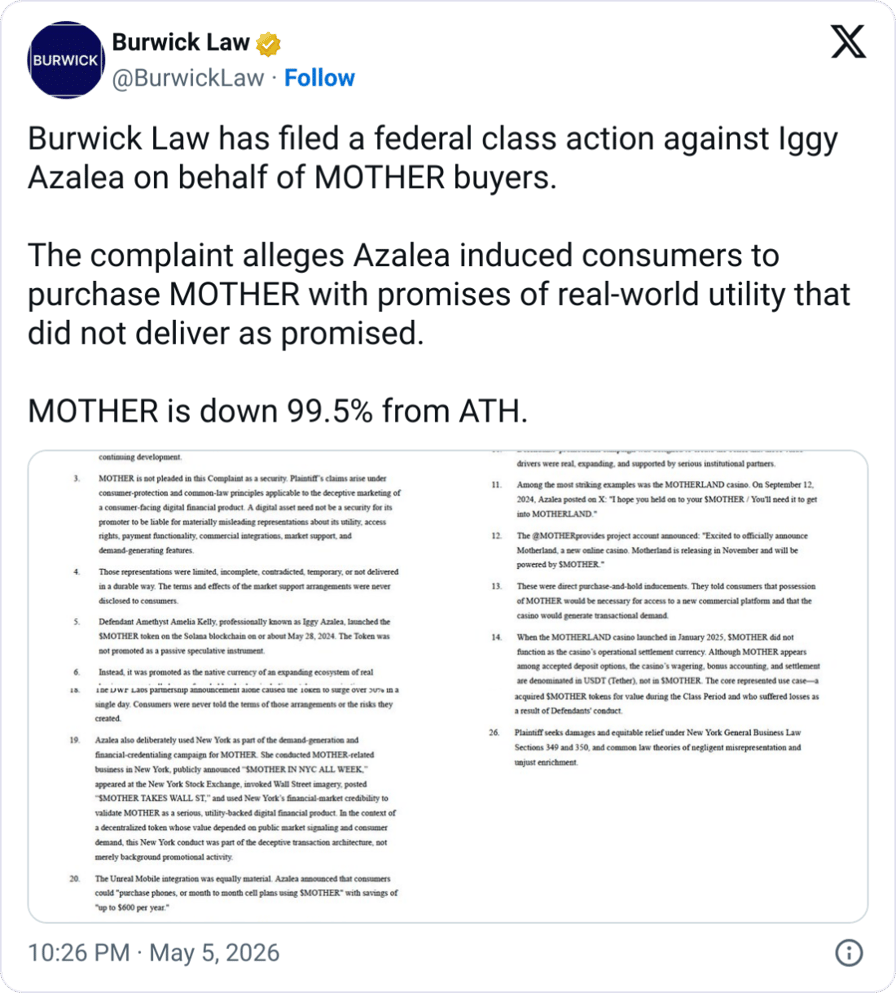
Source: Burwick Law
The lawsuit claimed that Azalea promoted the online casino MOTHERLAND, which was marketed as being “powered by $MOTHER,” but when it launched in January 2025, the platform used Tether (USDt) for its “wagering, bonus accounting, and settlement.”
The complaint also claimed that Azalea said MOTHER could be used to buy phones and mobile plans through the provider Unreal Mobile, however, “no durable, publicly observable MOTHER payment integration exists on the Unreal Mobile platform” as of the filing of the lawsuit.
It further accuses Azalea of not telling tokenholders about the terms or risks involved when crypto market makers Wintermute and DWF Labs were brought on to manage MOTHER’s trading.
Related: World Liberty sues Justin Sun for defamation in WLFI dispute
The lawsuit seeks damages for MOTHER buyers who lost money, along with attorney fees and costs.
The class is represented by Max Burwick of Burwick Law, who has helped launch multiple class-action lawsuits against crypto projects.
Information on Azalea’s lawyers was not available at the time of writing. Azalea and her management could not be reached for comment.
Magazine: Meet lawyer Max Burwick — ‘The ambulance chaser of crypto’

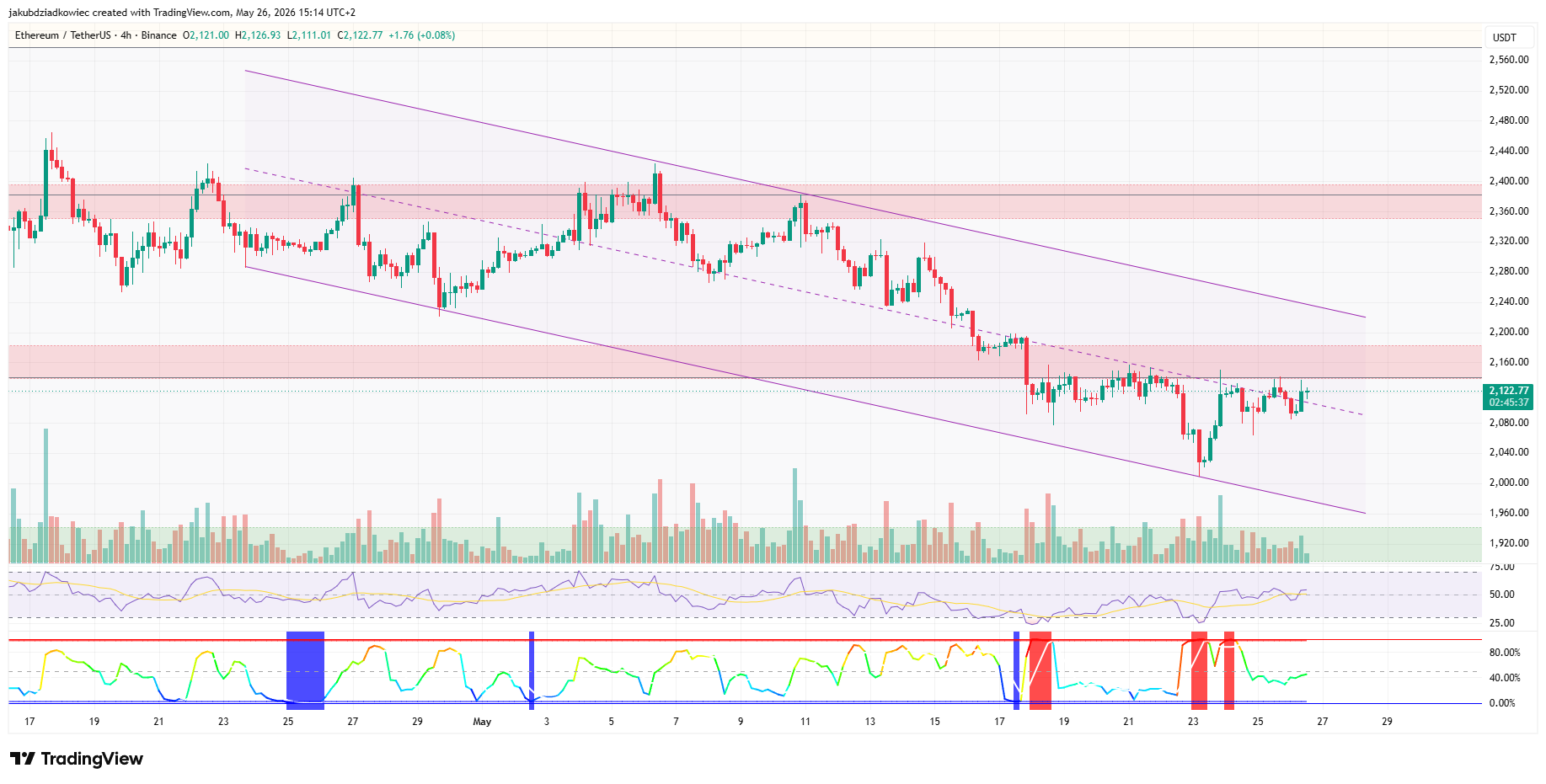
Ethereum (ETH) price trades near $2,120 after losing the lower band of its ascending parallel channel and slipping below the 0.236 Fibonacci retracement at $2,140 last week, leaving bulls and bears divided on the next directional move.
The Bollinger Band Width Percentile is at a multi-month low, signaling that volatility expansion is near. Traders now watch whether the demand zone near $1,950 holds or breaks before the price decides which way to go.
4-Hour Chart Shows Bears Still in Control
ETH has traded within a descending parallel channel on the 4-hour timeframe since April 26. The token is currently trading at $2,122 and testing the channel midline from below.
A break above the midline could open the path to $2,230. That level matches the channel’s upper boundary and would also clear the daily resistance flagged by short-term traders.

However, volume continues to contract during the attempted move. The Relative Strength Index reads near 55, a neutral value that mirrors prior failed bounces inside the channel.
Until volume returns, the structure favors sellers. A close below $2,080 would re-anchor the price inside the lower half of the channel and reset the bearish rotation.
Demand Zone Could Trigger a Bounce Toward $2,400
Not every signal points lower. One analyst argues that ETH is defending the daily demand zone between $1,942 and $2,015 and preparing for a rebound.
“ETH is holding above the daily demand zone of 2k-1.9k and trying to rebound. As long as the zone sustains, we are expecting a bounce from this zone towards 2.4k or higher levels. This bias is valid as long as it stays above the demand zone,” wrote Crypto Candy.

The thesis depends on buyers stepping in at the green block and refusing to let the price close beneath $1,942. A confirmed rejection from that band would mirror past bounces that targeted $2,463.
Such a move would also force a daily close back inside the ascending channel that broke last week. Failure to defend the zone, however, would invalidate the bullish setup.
Ethereum Price Prediction Points to $2,382 or $1,920 Breakdown
The daily chart connects both signals. Ethereum has broken below the lower band of an ascending parallel channel that has held since February 7. Price has also slipped below the 0.236 Fibonacci retracement at $2,140.
The Bollinger Band Width Percentile registers an extreme contraction. Such readings typically precede a sharp expansion in either direction and rarely persist for more than two weeks.
A reclaim of the channel would clear the path to the 0.382 Fibonacci level at $2,382, the next major resistance. Beyond that, the golden ratio sits at $2,772.
A failure to defend $1,950 would expose $1,920, the strong horizontal support flagged by traders. Further weakness could drag the price toward the February swing low near $1,750.

The Relative Strength Index is climbing back from bearish territory but still reads near 40. That value confirms momentum has not yet flipped in favor of buyers and aligns with the bearish forecast outlined earlier this quarter.
The next two weeks will likely settle the dispute. Whichever side breaks the volatility coil first should dictate the direction of ETH prices into the third quarter.
The post Ethereum Volatility Hits Multi-Month Low: Rally Next or Further Downside? appeared first on BeInCrypto.

TLDR
- XRP whale transactions above $1 million dropped by 57.3% within nine days.
- Market analyst Ali Martinez reported that large XRP transactions fell from 157 to 67.
- The decline suggests major holders have reduced aggressive market activity for now.
- XRP crowd sentiment has turned sharply negative and reached a three-week high.
- Traders are watching whale activity for signs of the next major XRP move.
XRP whale activity has dropped sharply over nine days as market analyst Ali Martinez reports fewer large transactions while crowd sentiment turns more negative.
According to market analyst Ali Martinez, XRP whale transactions worth more than $1 million fell from 157 to 67 in nine days. The drop represents a 57.3% decline in high-value network activity and has drawn attention from traders watching large-holder behavior.
Martinez’s data shows that major XRP wallets have made fewer large moves at a time when the token’s market structure remains under close watch. In crypto markets, traders often monitor whale transactions because large orders can affect liquidity, volatility, and short-term direction.
The decline does not confirm that large holders are selling, based on the interpretation shared around Martinez’s data. Instead, the lower transaction count suggests whales have reduced their active participation while they wait for clearer market conditions.
XRP Whales Pull Back From Large Transactions
Martinez’s figures show a steep fall in transactions above the $1 million level. The count moved from 157 to 67 within nine days, cutting high-value activity by more than half.
Market watchers often treat this type of drop as a sign that large holders are taking fewer aggressive positions. According to the analysis tied to Martinez’s data, whales may be reassessing liquidity conditions rather than leaving the market.
In XRP’s case, fewer whale-sized transactions mean fewer large orders are pushing the market in either direction. Traders following the token have described the current setup as a compression phase, where price action narrows and volatility tightens.
Order books can become more balanced during such periods because neither buyers nor sellers dominate activity. However, the same analysis notes that this setup does not give a clear breakout direction on its own.
Negative Sentiment Adds Pressure On XRP Outlook
At the same time, XRP crowd sentiment has turned sharply negative, with fear, uncertainty, and doubt reaching a three-week high, according to the sentiment data referenced in the market discussion.
Negative crowd sentiment can affect trading behavior because retail traders often react quickly to weak momentum or uncertain market conditions. The data does not show that whales have exited their XRP positions, but it does show that large holders have stepped away from heavy transaction activity.
According to the current reading of Martinez’s whale transaction data, the next major XRP move may depend on the return of large, conviction-led flows. Until those flows return, XRP is likely to remain locked in a narrow range, according to traders tracking whale activity, sentiment, liquidity, and macro conditions.
Historical comparisons cited by market observers suggest that similar compression phases in XRP and other large-cap crypto assets have come before stronger volatility. Still, Martinez’s data only confirms the drop in whale transactions, not the direction of XRP’s next move.

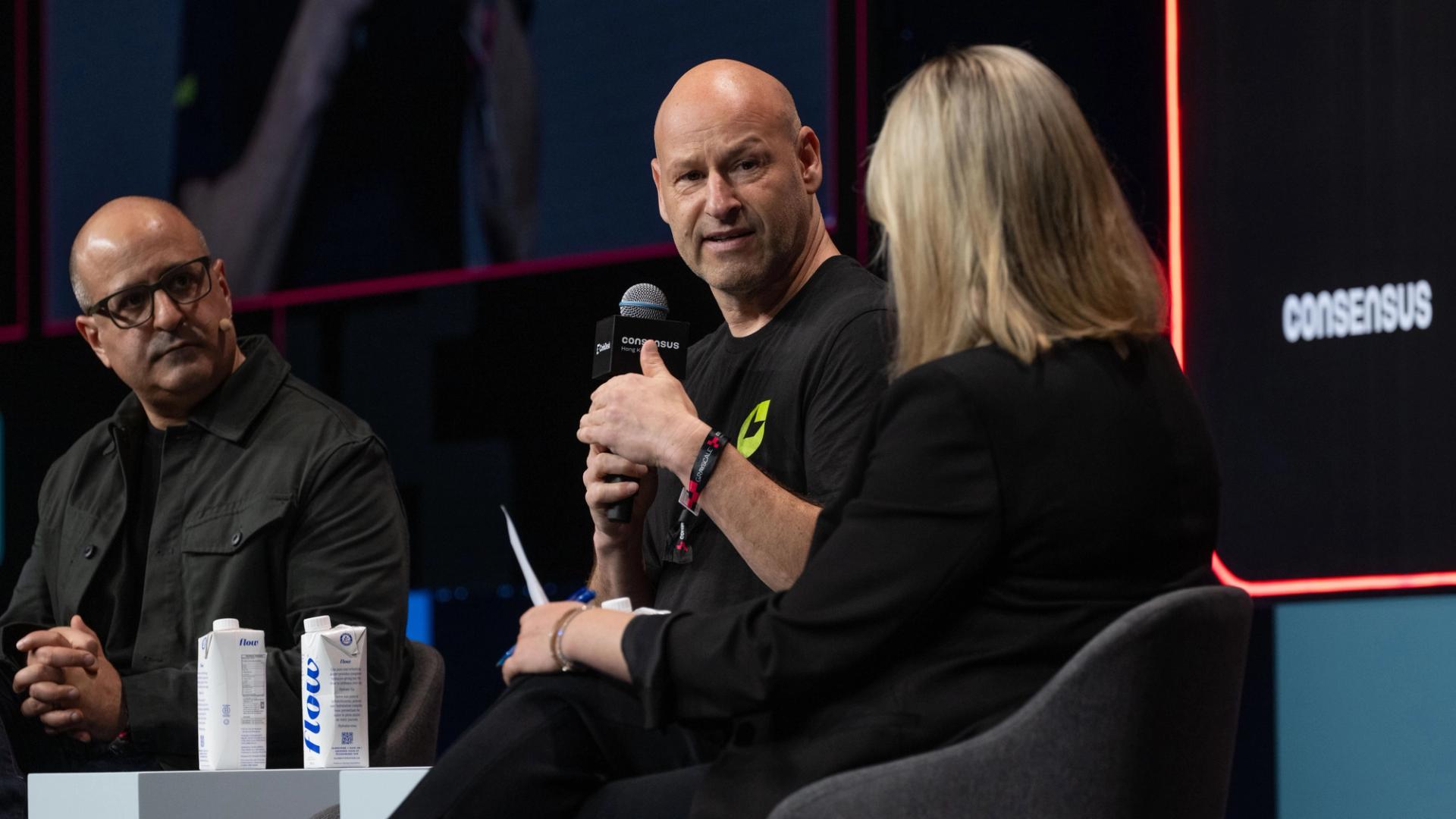
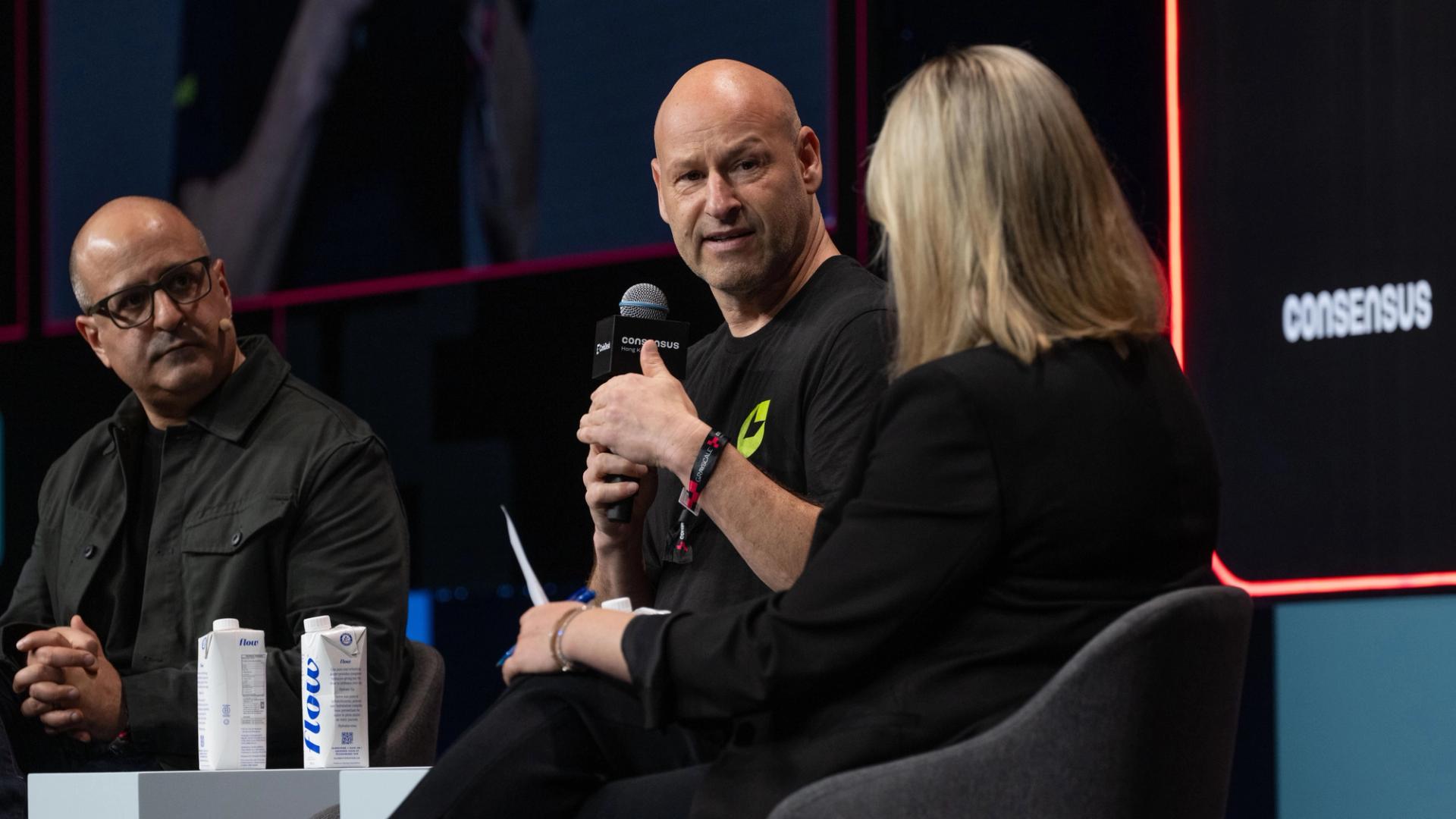
SharpLink Gaming (SBET), the Ethereum treasury backed by Ethereum co-founder Joe Lubin, is joining the Russell 2000 and Russell 3000 indexes later this month, potentially opening the stock to fresh institutional demand from index-tracking funds.
The inclusion will take effect after markets close on June 29 as part of FTSE Russell’s annual index reconstitution, the company said Tuesday.
Russell indexes are widely followed benchmarks for U.S. equities, with roughly $12 trillion in assets tied to them through passive and active investment strategies, the press release said. Membership in the Russell 2000, the benchmark for small-cap U.S. stocks, could increase trading volumes and institutional ownership.
SharpLink has emerged as one of the largest public holders of ether (ETH), part of a wave of companies adopting crypto treasury strategies last year modeled after the bitcoin holder Strategy (MSTR). Since then, most digital asset treasuries halted or pivoted to selling their assets as their stock prices cratered and crypto markets pulled back.
The firm held 872,984 ETH in early May, according to its latest quarterly earnings report, making it the second-largest public ETH treasury, trailing Bitmine’s 5.4 million ETH stash. SharpLink’s holding is worth roughly $1.8 billion at current prices, and it hasn’t reported any ETH purchases since October.
The stock has fallen about 95% from its speculative frenzy peak last May, when investors piled into crypto treasury firms during a broader rally in digital assets. Even so, the shares remain more than double their level before SharpLink pivoted to an Ethereum treasury strategy. The stock is down about 2% on Tuesday, similar to ETH’s price.
The index inclusion validates the company’s “institutional-grade ETH treasury strategy,” SharpLink CEO Joseph Chalom said, adding that it can strengthen the firm’s “access to capital markets.”
TLDR
- Stable has launched StableEarn to help USDT holders access yield through real-world asset products.
- The product uses Theo’s RWA suite tied to assets such as U.S. Treasurys and gold.
- StableEarn is built on Morpho, with risk management parameters curated by Gauntlet.
- The vaults route USDT deposits into Theo’s yield products instead of relying on crypto token incentives.
- Stable said the product expands yield options for users on its USDT-focused Layer 1 blockchain.
Stable has introduced StableEarn, a new yield product that lets USDT holders access returns tied to real-world assets through Theo’s onchain products.
According to Stable’s Tuesday statement, StableEarn gives Tether’s USDT users a way to earn yield from products connected to assets such as U.S. Treasurys and gold. The company said the product uses Theo’s real-world asset suite, which includes products such as thUSD, thBILL, and thGOLD.
Theo CIO Iggy Ioppe said StableEarn brings “USDT-native” and “institutional-grade” yield to onchain dollar users, with returns generated by real-world markets. Theo works with partners including Standard Chartered’s Libeara and Wellington Management on its RWA products, according to the announcement.
Stable, a Layer 1 blockchain built around USDT, said the product is designed for holders of Tether’s stablecoin, the largest stablecoin by supply. The project is backed by Bitfinex and previously raised $28 million in a funding round co-led by Bitfinex and Hack VC, with Franklin Templeton among the investors.
StableEarn Routes USDT Into RWA Products
Stable said StableEarn is built on Morpho, a decentralized lending protocol, with risk parameters curated by Gauntlet. Under the vault structure described by the companies, users deposit USDT into automated smart-contract pools that move funds into Theo’s yield-generating products.
The companies said the vaults do not depend on token emissions or crypto incentive programs often used in some DeFi yield products. Instead, StableEarn links deposits to products tied to real-world markets through Theo’s platform.
Stable CEO Brian Mehler said USDT holders have long faced challenges when trying to put their stablecoin holdings to work at competitive yields. In his statement, Mehler said StableEarn combines institutional-grade yield with a blockchain built specifically around USDT.
Vaults in DeFi are automated pools that use smart contracts to deploy user deposits into selected strategies. In StableEarn’s case, the companies said USDT deposits are routed into Theo-developed products rather than being used for reward-token-based yield programs.
Stable Expands Its USDT-Focused Ecosystem
Stable’s launch of StableEarn comes after the project rolled out its mainnet last year. The network presents itself as a USDT-dedicated Layer 1 blockchain, with Bitfinex among its key backers.
Tether’s USDT remains the largest stablecoin in the market, giving Stable a large target user base for products built around dollar-denominated blockchain activity. Stable said StableEarn adds another use case for USDT holders who want yield options connected to real-world asset products.
At the same time, the product places Theo’s RWA offerings at the center of Stable’s yield strategy. According to the companies, Theo’s products are tied to assets such as Treasurys and gold and involve partners including Libeara and Wellington Management.
The launch also puts Morpho and Gauntlet into the product’s operating structure. Stable said Morpho provides the vault framework, while Gauntlet curates risk management parameters for the product.
Crypto World
Piper Sandler says Strait of Hormuz to remain closed for months and oil to hit new highs

Piper Sandler isn’t buying the talk that an Iran deal is nearing, telling clients that the Strait of Hormuz will largely stay closed and oil will hit new highs.
“We think the Strait of Hormuz remains largely closed for months yet, meaning shortages become more urgent and oil hits new highs this Summer,” according to a recent note from the investment bank’s energy and macro teams.
West Texas Intermediate Futures are down since Friday but bounced back some on Tuesday with mixed messaging on a possible Iran deal over the long weekend. The U.S. military said it conducted “self-defense strikes” in southern Iran, which included targeting Iranian missile launch sites and vessels placing mines around the Strait of Hormuz. The news came after President Donald Trump said Saturday that an agreement with Iran has been “largely negotiated“, with details to be announced shortly. Meanwhile, Iran’s foreign ministry has said navigation through the vital shipping channel “will have costs.”
Piper Sandler said it has very little confidence that the commercial traffic through the Strait would return to even 50% of its pre-crisis levels, either next week or next month.
The U.S. has been “unwilling to press the fight” because the scale of Iran’s retaliation could have broader implications for its neighbors and may further disrupt global supply chains, the note said.
The bank also argued that Iran’s leaders are unwilling to settle for any compromise because they believe they have leverage, reinforcing concerns that the Strait closure could extend for months.

WTI crude, YTD
Various economies in the Middle East, Asia and Europe rely heavily on shipment through the Strait, which is particularly important for oil and LNG exports from the Middle East to Asia. The narrow passage that once carried about one-fifth of the world’s seaborne oil has seen historic dips, with tracking data showing vessel traffic falling sharply to near zero since the war escalated.
WTI crude futures neared $120 a barrel during the onset of the conflict, but were last trading around $94 a barrel. If Piper Sandler’s call for a new high comes true, it would send quite a jolt to the global economy and undermine the stock market comeback that has come as oil traded off that war-time high.
Bitwise’s spot Hyperliquid ETF (BHYP) pulled in $40 million in assets within eight trading days of its NYSE debut, fueled by an 18-fold jump in client inflows and steady on-chain accumulation by the issuer.
On May 26, a Hyperliquid (HYPE) whale opened a 10x leveraged long worth $9.1 million, signaling that high-conviction traders are chasing the rally alongside institutional flows from Bitwise’s new product.
Hyperliquid ETF Inflows Climb 18-Fold
Bitwise CEO Hunter Horsley said roughly $12 million of BHYP ETF traded in the first 90 minutes of Tuesday’s session, lifting fund assets to about $40 million just over a week after launch.
After its first five sessions, Bitwise reported $30.5 million in AUM, $26.9 million in net inflows, and $9.2 million in average daily volume.
Arkham reported on May 26 that Bitwise ETF clients bought a combined $35.9 million of HYPE during the prior week, an 18-fold jump from the first week of flows.
Lookonchain flagged an additional 162,367 HYPE buy worth roughly $10.11 million within a two-hour window, taking Bitwise’s reported holdings to 723,361 HYPE as of May 21.
The pace mirrors broader institutional HYPE demand tied to ecosystem buybacks.
Whale Bets on Continued HYPE Momentum
On the same day, Lookonchain identified wallet 0x3ed4 opening a 10x long on 142,754 HYPE worth roughly $9.1 million notional.
The position carries a liquidation price of $41.93, well below HYPE’s recent trading range.
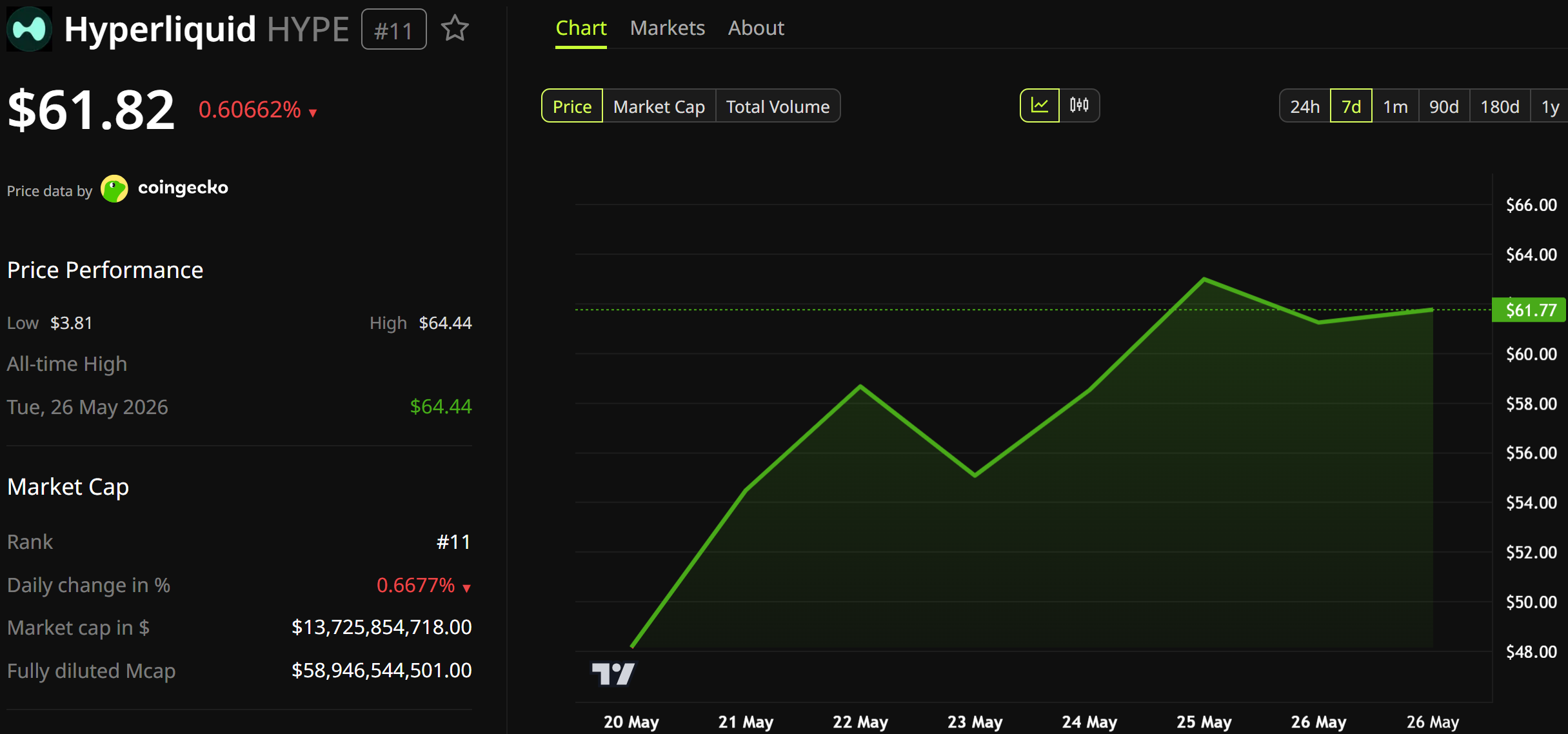
The token printed an intraday high of $64.44 on Tuesday before settling near $61.82, up 26% over the past seven days.

The same wallet had opened a $8.24 million leveraged long on Zcash (ZEC) the prior day, fitting a broader pattern of whale-driven HYPE rallies across volatile altcoins.
Spot HYPE ETF Race Heats Up
Meanwhile, competition for HYPE exposure is intensifying. 21Shares listed its spot Hyperliquid ETF (THYP) on Nasdaq days before Bitwise’s NYSE listing, while Grayscale has filed for HYPE ETF, and VanEck has confirmed HYPE ETF plans for the US and Europe.
BHYP differentiates with native staking via Bitwise Onchain Solutions, published fund wallet addresses, and a structure that uses 10% of annual management fees to buy HYPE for the issuer’s balance sheet, held for a minimum of 12 months.
Early flows holding through the typical post-launch cooldown depend on how quickly competing issuers convert filings into live products.
The post Whales Go 10x Long on Hyperliquid as Wall Street Jumps on HYPE ETF appeared first on BeInCrypto.
Five separate crypto venues are already pricing the SpaceX IPO ahead of its scheduled June 12 Nasdaq debut. Their numbers do not agree. The gap between them is wider than anything traditional brokerage screens will show on listing day.
The rocket company filed its S-1 prospectus with the Securities and Exchange Commission on May 20, 2026. The filing targets a $1.75 trillion valuation, a $75 billion raise, and a Nasdaq listing under the ticker SPCX.
Hyperliquid Set the Synthetic Price
Trade.xyz launched the SPCX-USDC synthetic perpetual on Hyperliquid through the HIP-3 framework on May 18, 2026.
The contract opened at a $150 reference price, calibrated to a $1.78 trillion valuation. It spiked to $216 within hours before settling at $202.89.
The day-one print hit $33 million in volume. On May 19 alone, the contract did another $7.1 million. SPCX-USDC confers no ownership of SpaceX shares.
Traders take long or short positions against an oracle-anchored reference, and funding rates pull the perp toward the oracle when positioning skews.
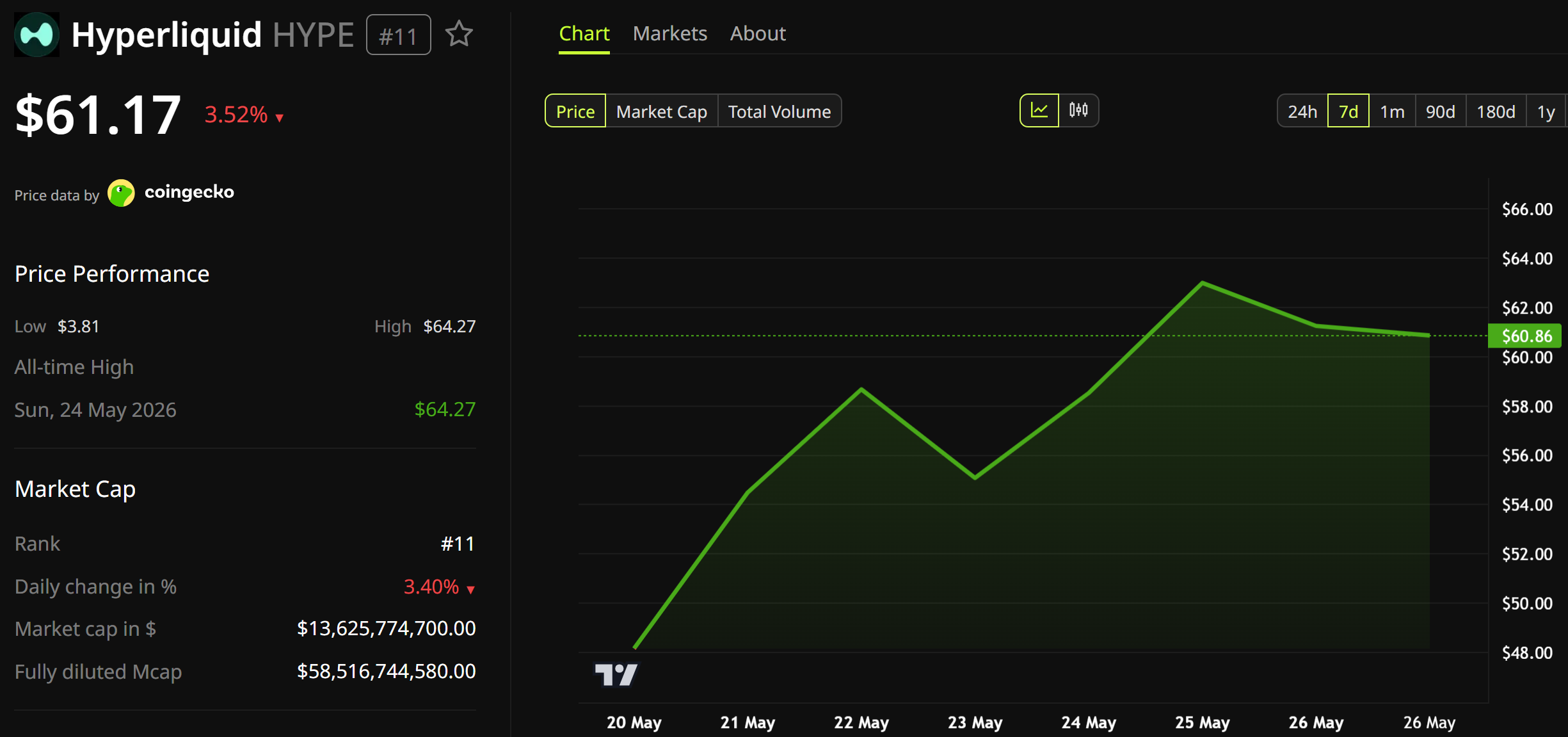
HYPE, the native Hyperliquid token, has closely tracked the perp. The token traded at $61.17 as of this writing, up by over 70% year-to-date.

Analyst conviction tied to Hyperliquid’s $200 billion valuation case has anchored the rally.
Centralized Exchanges Followed Quickly
Hyperliquid was first, not alone. Bitget launched a SpaceX pre-IPO perpetual with 5x leverage on May 22, 2026. OKX listed a USDT-settled SpaceX pre-market contract on May 7, two weeks before the S-1 hit. BingX rolled out its VNTL SpaceX-tracking token on April 10.
Binance pushed past $280 million in cumulative SPCX volume by late May. The exchange launched its OpenAI pre-IPO perpetual on May 26.
That cadence treats these synthetics as a recurring product category rather than a one-off event.
Four centralized venues with KYC requirements and a decentralized order book converged on the same product within five weeks.
That convergence puts the regulatory question on a clock measured in months, not years.
Polymarket Prices the SpaceX IPO Distribution
Polymarket and Kalshi capture the full probability distribution rather than a single number. As of May 26, Polymarket’s leading bucket for SpaceX’s closing market cap sits at $2.0 trillion to $2.5 trillion.

The implied probability is 39%, with the $1.5 trillion to $2.0 trillion bucket printing 26%.
Kalshi traders price a 92% chance of OpenAI filing for a 2026 IPO and 69% for Anthropic. The modal Polymarket outcome implies a 14% to 43% pop over the S-1 target on day one.
That spread is wider than the comparable Reddit or Klaviyo day-one ranges by a factor of two.
Polymarket’s stock-like behavior has been driven by exactly this kind of pre-event distribution trading.
Tokenized SPCX Arrives After the Bell
The fourth lane opens at the listing bell. Ondo Finance, Backed Finance, Dinari, and PreStocks have signaled they will list tokenized SPCX representations once shares start trading.
Ondo’s Global Listing model brings public equity tokens on-chain on the same day they list on the underlying exchange.
SPCX tokenized exposure could appear on Solana, Base, and Ethereum within hours of the June 12 New York open.
The same rails that handle gold and commodity tokens will carry SPCX. The tokens would offer 24/7 trading, fractional exposure, and composability with DeFi lending protocols.
The risk asymmetry is real. Earlier, OpenAI and Anthropic pre-IPO tokens on smaller venues fell more than 40%.
Both companies stated that unauthorized share transfers carry no economic value.
SpaceX’s 18,712 Bitcoin treasury
The most underdiscussed crypto angle sits inside the S-1 itself. SpaceX disclosed 18,712 BTC as of March 31, 2026. The position carries $661 million in historical cost and $1.29 billion in fair value, per the filing.
The company originally acquired 25,724 BTC in 2021 and has held a large position through the cycle.
SpaceX’s holdings rank among the top 10 corporate Bitcoin holders globally. The space firm holds more than Tesla’s 11,509 BTC and trails Strategy’s record holdings of 843,738 BTC.

Buying SPCX on June 12 means acquiring a $1.29 billion Bitcoin allocation embedded inside a $1.75 trillion equity.
For brokerage accounts that cannot hold spot BTC directly, the listing offers correlated exposure. The compliance team already understands the wrapper.
What the Spread is Telling Traders
Each crypto market pricing SPCX sits on the same unresolved question. Are these products unregistered securities, swaps, or something else entirely? US regulators have not answered publicly as of May 26, 2026.
State regulators in Texas and New York may be watching. No enforcement action is pending, and the Commodity Futures Trading Commission (CFTC) has not asserted jurisdiction over the SPCX synthetic stack.
If a regulator letter or enforcement filing lands before June 12, the entire synthetic complex reprices in days.
If nothing lands, the post-IPO tokenized wave goes live with structural ambiguity intact.
The Polymarket-Hyperliquid spread is what crypto retail thinks the bookrunners are missing.
The post 5 Ways Crypto Markets Are Pricing SpaceX Before Wall Street Can appeared first on BeInCrypto.


Solana’s official X account posted a redesigned image of Ferrari’s new Luce EV in the blockchain’s signature purple-to-teal gradient, captioning it “Fixed it.” The post landed hours after Ferrari unveiled the Luce in Rome as RACE stock fell more than 6% on the day.
The fix was aesthetic rather than mechanical. Solana rebranded the car in its own colors, a playful flex that positioned the protocol as a cultural presence alongside one of the world’s most recognizable car brands.
Ferrari’s $640,000 Electric Debut Falls Flat With Investors
Ferrari unveiled the Luce, Italian for light, in Rome on May 25. The four-door, five-seat car is the Maranello brand’s first all-electric production model. It was developed with LoveFrom, the design collective led by former Apple chief design officer Jony Ive and designer Marc Newson.
The Luce runs four electric motors producing more than 1,000 horsepower. Top speed exceeds 310 kph, with a claimed range of more than 500 kilometres on a 122kWh, 800-volt battery. Ferrari filed more than 60 patents connected to the vehicle.
CEO Benedetto Vigna called the Luce “the result of five years of work.” Priced at €550,000 (roughly $640,000), deliveries are expected in the fourth quarter of 2026.
Investors Unmoved by Ferrari’s Electric Pivot
Shares in Ferrari NV fell more than 6% in Milan trading on the day of the reveal. Analysts flagged the vehicle’s unconventional design and its strategy of targeting buyers new to the brand as risks to the company’s premium valuation. Ferrari has been courting younger audiences on multiple fronts, including Ferrari’s European crypto payments rollout, though the Luce’s market reception suggests the repositioning carries near-term costs. Research has shown luxury brands risk youth market share without deeper digital-native strategies.
Solana’s Brand Flex
The Solana account on X shared an edited image of the Luce in Solana’s signature purple-to-teal gradient alongside the caption “Fixed it.”
Solana (SOL) is a blockchain network that competes primarily on transaction speed, and the post played directly on that reputation by implying the protocol had already outpaced Ferrari’s Q1 network activity in the one metric the Italian automaker has always owned. The post fits a broader pattern of blockchain projects adopting consumer brand playbooks to build cultural relevance beyond their core user base.
The stunt adds to Solana’s public narrative at a time when Solana whale selling pressure and institutional repositioning remain points of focus for analysts. Solana’s May price outlook reflects both the project’s expanding profile and the broader volatility facing crypto markets.
Ferrari confirmed it will continue selling six-, eight-, and twelve-cylinder models alongside the Luce, leaving the long-term investor case for its electric pivot still to prove out.
The post Solana “Fixes” Ferrari’s New Luce as RACE Stock Falls 6% appeared first on BeInCrypto.

Decentralized derivatives platform Grvt is partnering with tokenization specialist Plume to launch three tokenized real-world asset (RWA) yield products. The move integrates fixed-income and structured-credit exposure directly into Grvt’s platform, enabling users to access on-chain yield strategies from self-custodial wallets without moving assets to separate venues.
The products will track tokenized institutional-grade assets, including exposure to the iShares AAA CLO Active ETF, which totals roughly $2.2 billion in assets. The three investment vehicles — Base Yield Fund, Balanced Fund and Opportunistic Fund — will be available inside Grvt’s trading environment, letting users tap into yield strategies from the same wallet they already use for perpetual futures trading.
Plume, which focuses on tokenized real-world assets, provides the on-chain yield infrastructure that underpins these products. Grvt’s announcement notes that the arrangement merges tokenized fixed-income exposure with Plume’s network, expanding the utility of perpetual futures by layering yield opportunities onto the same self-custodial balance.
Perpetual futures contracts, or perps, are a staple for traders seeking to speculate on price movements without owning the underlying asset. Unlike traditional futures, perps carry no expiration, allowing positions to be maintained indefinitely. Grvt’s daily trading activity sits within a wider DeFi ecosystem that processed about $15.2 billion in perpetual DEX volume over the last 24 hours, according to data from CoinGecko, with Grvt handling around $1.23 billion of that turnover.
In February, Grvt also integrated the Aave lending protocol to let traders earn yield on margin collateral while their perpetual positions remain open, illustrating the platform’s ongoing push to combine on-chain liquidity with yield opportunities.
Key takeaways
- Grvt and Plume will launch three tokenized RWA yield products — Base Yield Fund, Balanced Fund, and Opportunistic Fund — integrated directly into Grvt’s platform.
- The products provide exposure to tokenized institutional-grade assets, including about $2.2 billion in iShares AAA CLO Active ETF assets.
- Access to the yield strategies is designed to occur within self-custodial wallets used for trading, eliminating the need to transfer assets across separate custody or brokerage setups.
- Overall market activity for perpetual futures remains substantial, with 24-hour DEX volume near $15.2 billion and Grvt contributing roughly $1.23 billion of that total.
RWAs on-chain: scale, momentum and what changes for users
The Grvt–Plume collaboration sits amid a broader surge in tokenized real-world assets, a sector that data provider RWA.xyz puts at more than $34 billion in on-chain value. That figure marks a substantial increase from about $5.8 billion at the start of 2025, underscoring rising institutional interest in on-chain renditions of traditional financial products.
The trend is visible across the crypto ecosystem as exchanges, trading venues, and tokenization firms push to bring asset classes like fixed income, private credit and securitized assets onto blockchains. For readers following the rails that enable these products, the momentum is as much about infrastructure as about novelty — from tokenized funds to on-chain settlement and collateral models that could broaden access to traditional assets for crypto traders and institutions alike.
In context, the market momentum is mirrored by notable cross-sector moves. In March, EtherFi allocated $25 million to Plume’s Nest protocol to provide users with exposure to tokenized yield strategies tied to institutional assets and government securities. Around the same time, BTC Markets signaled plans to approach Australia’s securities regulator for a markets license to offer tokenized RWAs, including equities and bonds. Earlier in February, Binance expanded its tokenized assets by adding tokenized equities and ETFs from Ondo Finance to its Binance Alpha platform. Separately, Securitize announced a collaboration with Hamilton Lane, OKX Ventures and stablecoin infrastructure provider STBL to launch a stablecoin backed by tokenized private credit assets.
Industry observers also point to research from Boston Consulting Group, which in a May report highlighted tokenized funds, collateral and fixed-income products among the digital-asset offerings most likely to gain broader institutional adoption over the coming decade. The shift signals digital assets moving beyond purely speculative trading toward infrastructure that supports payments, settlement and capital markets operations.
What to watch next: integration, adoption and regulatory signals
The Grvt–Plume integration adds a concrete use case for on-chain yield in a space where tokenized RWAs are increasingly seen as a differentiator for platforms seeking richer, income-generating offerings. For investors and traders, the key questions are how quickly these products scale, what risk controls accompany tokenized fixed income on-chain, and how on-chain yield will interact with broader regulatory expectations as tokenized RWAs grow in prominence.
As ecosystems mature and more venues bring tokenized assets to market, readers should monitor user uptake of these new yield products, the resilience of on-chain yield infrastructure in volatile markets, and any regulatory clarifications that could shape the deployment of tokenized fixed-income strategies across decentralized platforms.
Source data and market figures referenced in this article include CoinGecko for perpetual futures volume and Grvt’s own disclosures, while on-chain asset totals are tracked by RWA.xyz. For context on related ecosystem activity, industry updates point to EtherFi, BTC Markets and Binance’s tokenized equities initiatives, as well as ongoing collaborations like Securitize’s. The broader market outlook from institutions such as Boston Consulting Group frames tokenized RWAs as a meaningful frontier for institutional adoption in the coming years.


A New York Times investigation has uncovered that officials at the Commodity Futures Trading Commission (CFTC) who questioned the agency's approach to prediction markets were subsequently suspended and removed from their positions. The finding sheds light on internal dynamics at the U.S. regulator… Read the full story at The Defiant

Cinco Concejos Financieros

How to keep car cool in the heat

Cy Xayarath on Nursing, Service and Staying Consistent


-

 Crypto World5 days ago
Blockchain.com files with SEC for U.S. IPO
-

 Fashion4 days ago
Holiday Weekend Open Thread – Corporette.com
-

 Business4 days ago
Dell Technologies DELL Stock Surges 15% on AI Server Momentum and Analyst Upgrades in 2026
-

 Crypto World5 days ago
Bitcoin Accumulation Weakens as BTC Realized Losses Hit $600M
-

 Crypto World3 days ago
Robinhood crypto COO Tanya Denisova exits
-

 Crypto World4 days ago
Space X IPO Is ‘Bad News’ for Tech Stocks: But What About Bitcoin?
-

 Politics4 days ago
Makerfield: a tale of two social-media histories
-

 Business2 days ago
NYT Strands Answers May 24 2026 Revealed for Puzzle No. 812 Theme Summer Essentials
-

 Tech1 day ago
Microsoft’s quiet Claude Code retreat and the real cost of enterprise AI
-

 Crypto World5 days ago
MicroStrategy’s Saylor Says Miners No Longer Set Bitcoin Price, Another Force Has Taken Over
-

 Tech5 days ago
WhatsApp ads could make Irish debut after discussions with DPC
-

 Crypto World4 days ago
AI infrastructure race heats up as IREN pitches full-stack strategy, WhiteFiber lands $160M deal
-
 Tech4 days ago
A 0.12% parameter add-on gives AI agents the working memory RAG can’t
-

 Tech5 days ago
You Can Now Add ChatGPT To PowerPoint
-
 NewsBeat5 days ago
Charity run by Reform leader Malcolm Offord accused of ‘law breaking’ over Scottish registration
-

 Business5 days ago
Trump Invests $1M-$5M in Kura Sushi USA Chain With 27 California Locations
-
 Crypto World1 day ago
Nvidia (NVDA) CEO Calls on Super Micro to Strengthen Export Controls Amid Smuggling Probe
-

 Tech1 day ago
Westone Audio and Etymotic Acquired by Fidelity Collective in Major IEM Market Move
-

 Sports5 days ago
2026 CJ Cup Byron Nelson leaderboard: Brooks Koepka finds putting stroke in Round 1
-

 Crypto World6 days ago
Exa Labs raises $250 million in funding led by a16z
You must be logged in to post a comment Login