A 45-year-old man was pronounced dead at the scene
11:15, 07 May 2026Updated 11:22, 07 May 2026
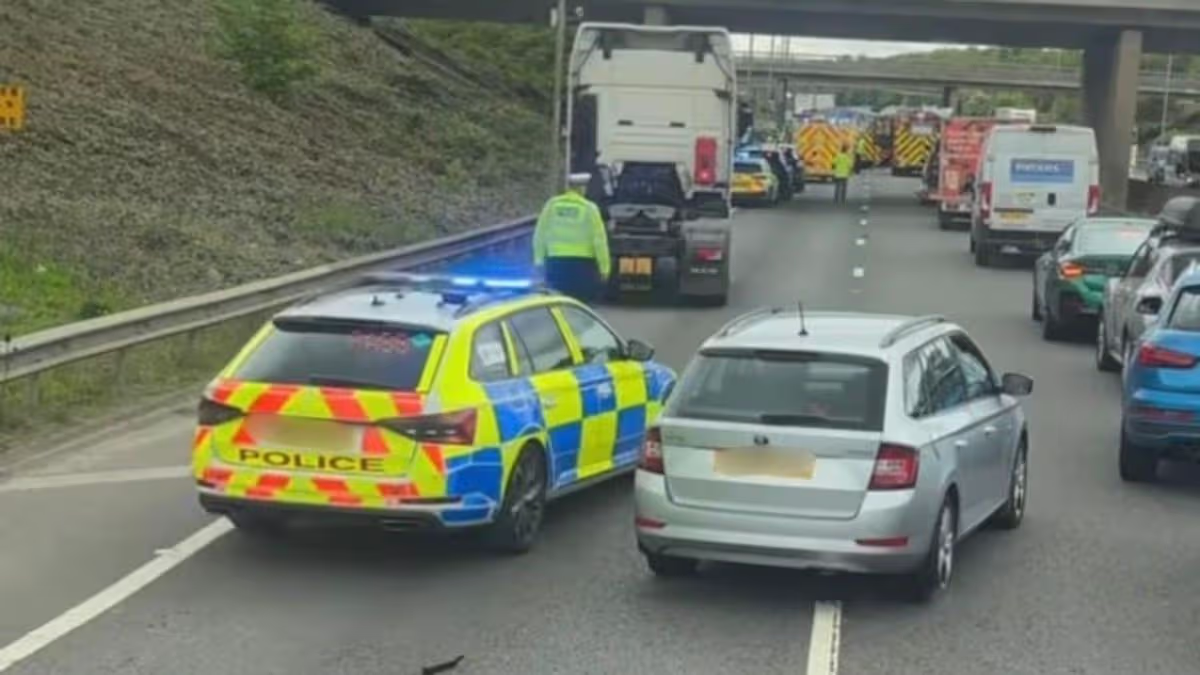
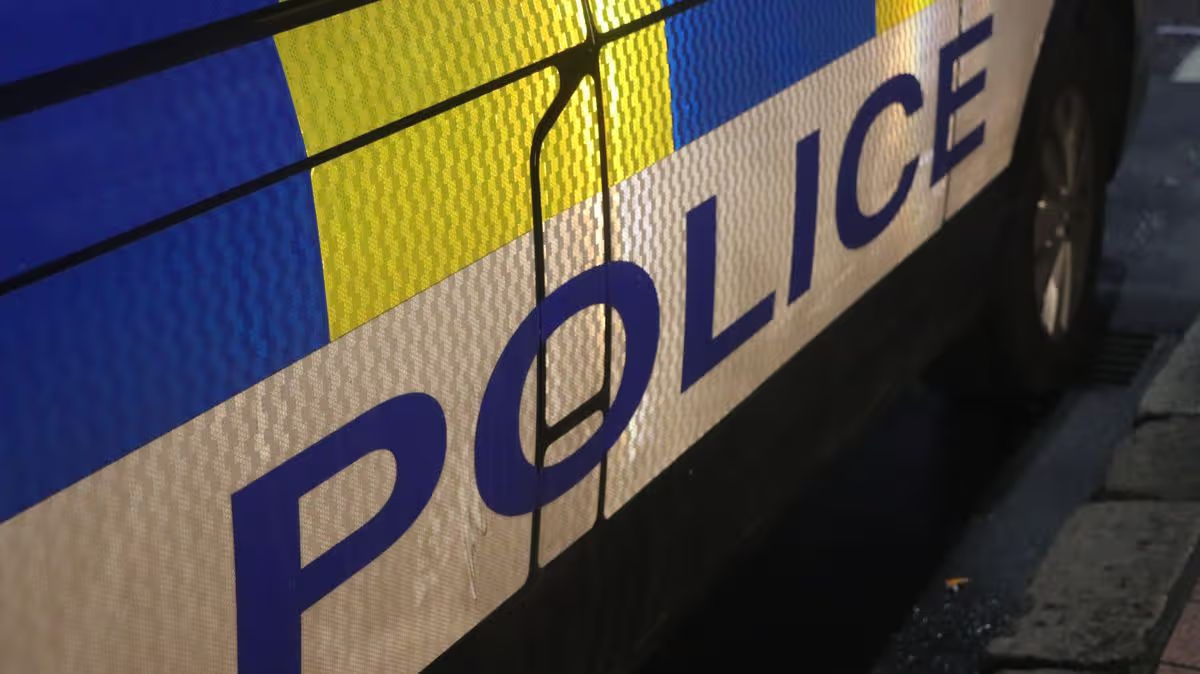
A man has died in a crash involving a car and a lorry in Peterborough yesterday (Wednesday, May 6). Cambridgeshire Police were called to the eastbound carriageway of the A1139 Fletton Parkway at around 11.50am.
The collision involved an HGV and a white Xpeng G6 and happened near the exit from the A1(M). Police, paramedics and fire crews attended the scene and the road was closed for around five hours.
The driver of the car, a 45-year-old man from Peterborough, died at the scene. Officers are now appealing for anyone with information about the crash to come forward.
Advertisement
Anyone who saw the crash or has dashcam footage of the collision or the vehicles leading up to the incident should contact the police. You can report any information through the Cambridgeshire Police website quoting Operation Braddock. You can also call 101 if you do not have access to the internet.
To get more news and top stories delivered directly to your phone, join our new WhatsApp community.Click this linkto receive your daily dose of CambridgeshireLive content.
We also treat our community members to special offers, promotions, and adverts from us and our partners. If you don’t like our community, you can check out any time you like. If you’re curious, you can read ourPrivacy Notice.
A car meet-up was organised in memory Shea McGreevy on Monday evening in West Belfast
Police have said five vehicles were damaged and two officers injured as they issue a renewed appeal for information following a car meet-up in West Belfast that led to violent disorder.
Advertisement
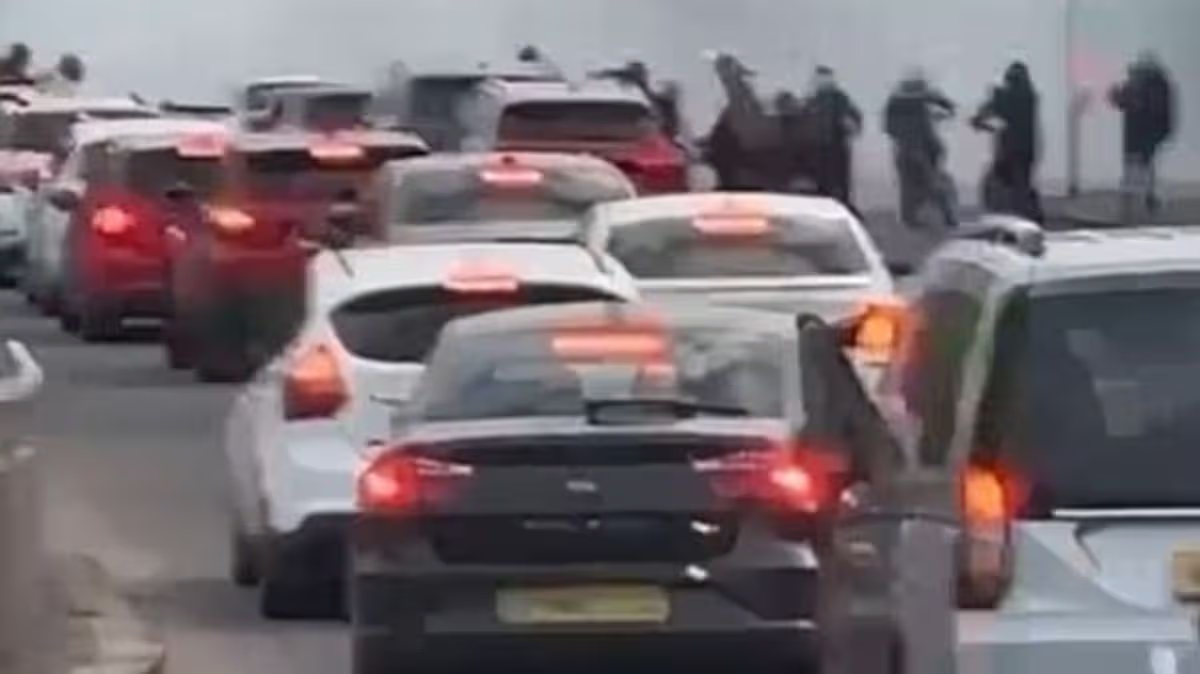
A car meet-up was organised on Monday, May 4, in memory of Shea McGreevy who died in a jet ski accident the previous week which saw large numbers of cars and scramblers gather on the Stewartstown Road and engage in dangerous driving.
Police attending the scene were attacked by a large group who had their faces covered.
The PSNI has now issued a renewed appeal for information asking people to contact them.
Chief Inspector Ferguson said: “At approximately 7.30pm, officers attended after receiving reports of cars and scrambler bikes gathered in the area and engaging in dangerous driving.
“A large number of people with faces covered emerged from the crowd and began to throw masonry and other projectiles at police.
“Five police vehicles were damaged and two officers sustained injury.
“I am appealing to anyone who may have any information or CCTV, dash-cam or other footage that could assist in identify those responsible, is asked to contact police on 101 quoting reference number 1141 04/05/26.
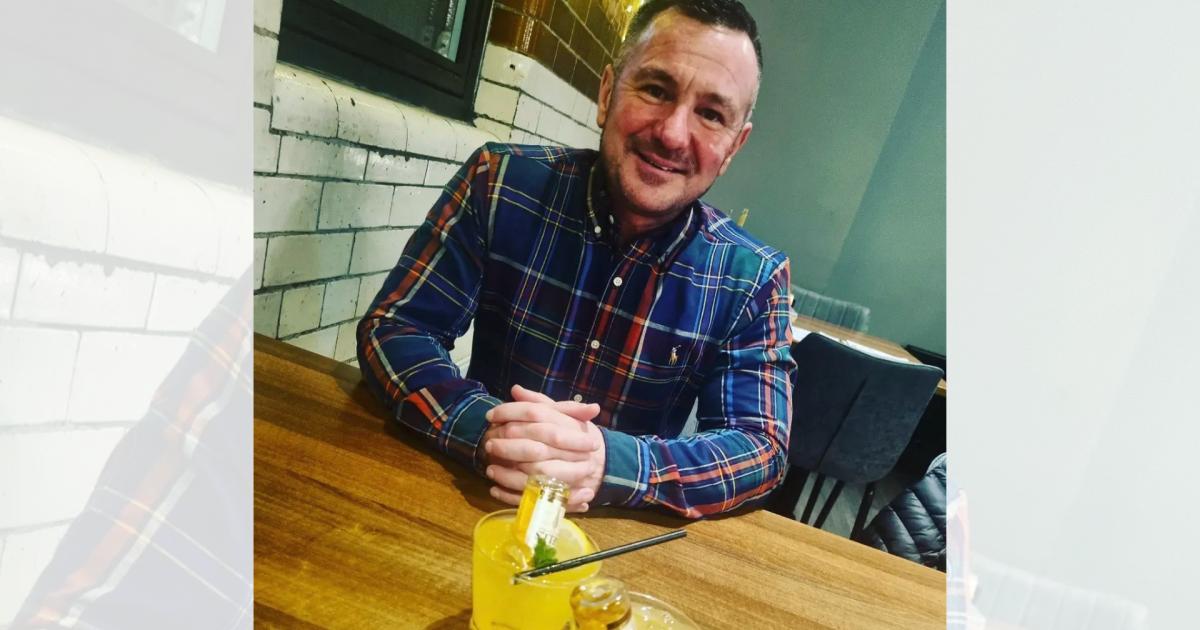
Gary Brunton had been out with his friends on Bank Holiday Monday (May 4) evening, when it is believed he fell from the staircase leading to the flat above the Demi Sports Bar, on Albert Road in Consett.
The 51-year-old from Consett was taken to hospital with serious injuries but died on Wednesday (May 6).
Today (May 7), his family paid tribute to him, saying: “Losing Gary has left our entire family heartbroken beyond words.
Gary Brunton (Image: DURHAM CONSTABULARY)
“He will leave an enormous gap in the lives of not just our family but also his friends, who he loved so much.
Advertisement
A fire service car next to the Demi Sports Bar, Consett (Image: NORTHERN ECHO)
“To never see him again is breaking our hearts. We are going to miss him every day.
“We ask for privacy while we grieve and try to come to terms with our unimaginable loss.”
An investigation is underway, and police are appealing for witnesses to the incident to come forward.
Yesterday afternoon, a fire service car remained parked outside the scene, while fire service staff were inside the venue.
Advertisement
A County Durham and Darlington Fire and Rescue Service (CDDFRS) spokesperson said: “We are working collaboratively with partner agencies and other authorities to support the investigation.
“Our thoughts remain with everyone affected by this incident.”
James McClean has voiced his opinion on the UEFA Nations League fixtures
14:05, 07 May 2026Updated 14:17, 07 May 2026
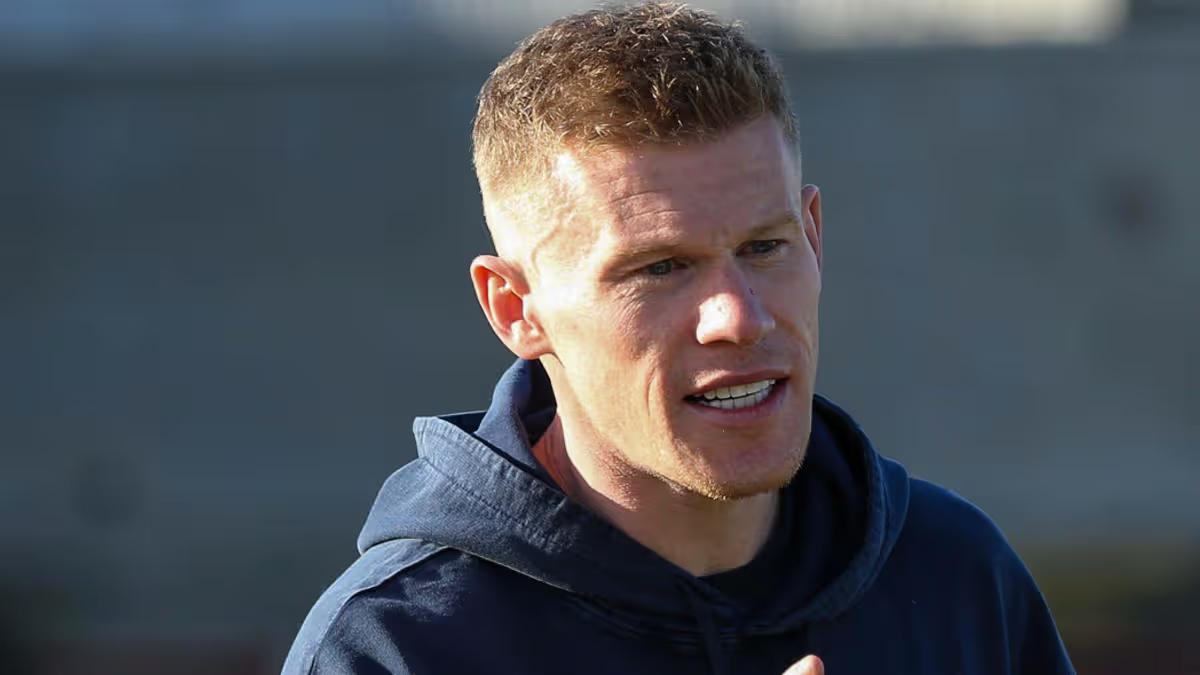
James McClean has voiced his opinion that the Republic of Ireland’s forthcoming UEFA Nations League matches against Israel ought to be cancelled.
Heimir Hallgrímsson’s squad are scheduled to take on Israel on 27 September away from home, with the return fixture taking place at Dublin’s Aviva Stadium seven days later.
Earlier this week, a coalition of prominent figures and footballers urged the Football Association of Ireland to withdraw from both fixtures. Musicians Paul Weller and members of Kneecap, alongside actor Stephen Rea and several current and former players, put their names to an open letter demanding a boycott as part of the Stop the Game initiative, led by Irish Sport for Palestine.
Advertisement
Taking to his Instagram story on Thursday to share the letter, McClean offered his perspective on the situation.
He wrote: “You can write every letter, sign a million petitions, protest every day of the week but it will be like pissing into the wind for the sheer fact that there is not a backbone within the FAI.”, reports the Irish Mirror.
“It’s a tough one in fairness for the players and I get it, it’s an opportunity to play a football game for your country, that being said I can’t see too many if any objecting to the game being played anyways, the decision should be taken out of their hands.
“Simply the game should never be going ahead, if there is one country that should recognise oppression and the turmoil that brings then it’s Ireland.. although with the decision makers in this country you’d be mistaken to think we ever had any history of it.
Advertisement
“There’s my thoughts for what it’s worth, have a great day.”
Shamrock Rovers captain and PFAI chair Roberto Lopes was amongst those who put their name to the correspondence sent to the FAI.
“We have to stop the game. As players and fans, our natural instinct is always to get out there and compete, but this is a moment where we need to look at the bigger picture,” he said.
“We can’t ignore the humanitarian catastrophe in Palestine; the sheer loss of life there has to take precedence over any sporting consideration.
Advertisement
“Ireland has an opportunity here to lead-to be a pioneer and do what others won’t. We need to be brave enough to say enough is enough. We can’t just stand by. Please, stop the game.”
The letter stated: “To the Football Association of Ireland, Irish fans are rightfully known across the globe as “the best fans in the world”, but with this comes a responsibility to the Irish people whom our country represents. We call upon you to refuse to participate in the two scheduled UEFA nations league games against Israel.
“Firstly, on the basis of the clear and ongoing serious breaches of UEFA and FIFA statute regarding Israeli teams playing on occupied Palestinian lands. As a member of UEFA you have a duty to upload these rules if UEFA will not.
“Secondly, on the basis of a brutal system of apartheid and acts of genocide, both of which are accepted by the Irish government. It is inconceivable that we would be willing to be silent and give cover to such crimes in the name of football.
Advertisement
“We call on you to ensure the Irish football team is not used to mask UEFA rules breaches, apartheid and war crimes. And to respect the call to boycott the game by the majority of players, fans and communities across Ireland.
“Last November, 93% of FAI members voted to instruct the Association to go to UEFA and call for Israel’s suspension under those statutes. We call on you to full respect and represent this mandate.
“Through your leadership and courage we show the world that whilst others may stand idly by, Ireland will not.
“Just as history rightly celebrates the Dunnes Stores workers during South African apartheid, the FAI will be celebrated by future generations of Irish people for doing the right thing when others did not. Yours in sport. Stop the Game.”
Advertisement
The Stop the Game campaign has emphasised: “This campaign is only beginning and we will do everything in our power to ensure Irish football is not used to give cover to apartheid and genocide.”
Research shows Brits struggle to identify well-known species of birds highlighting a significant wildlife knowledge gap
Forest Holidays launch Nestflix
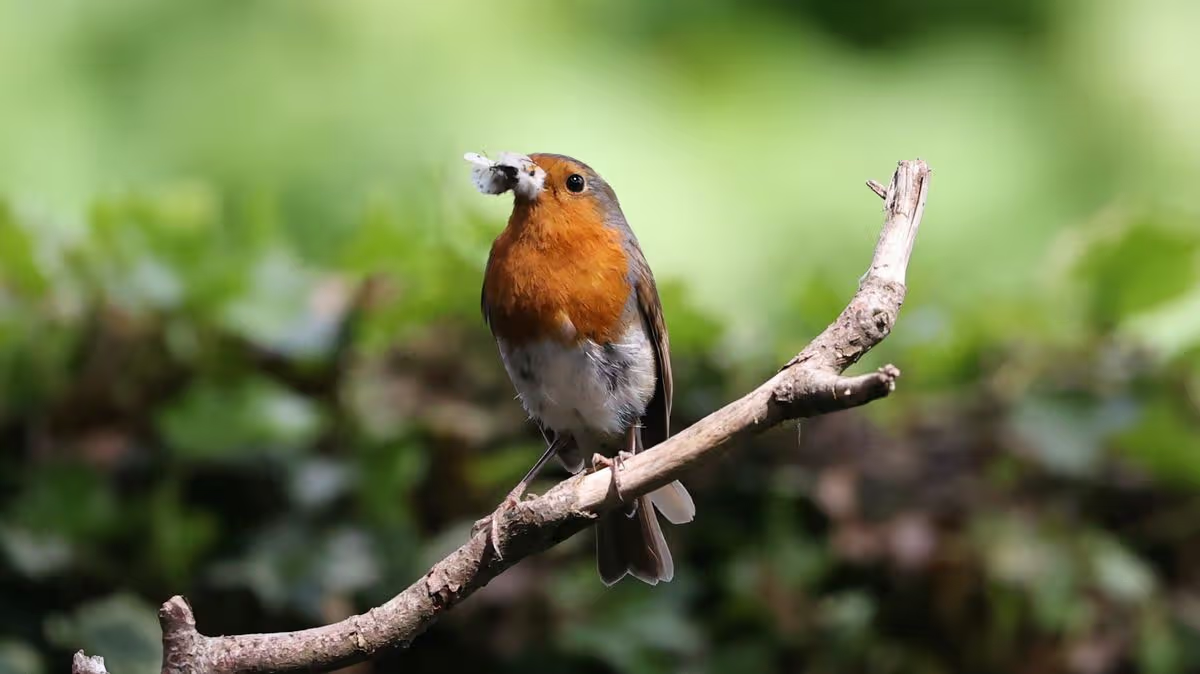
A quarter of Britons are uncertain they could distinguish between a robin and the red kite. A survey of 2,000 adults found barn owls, pheasants and blue tits are amongst the birds the nation finds difficult to recognise – despite them being familiar species and native to the UK. Kestrels, starlings and even herons also appeared in the top 30.
More than a third (34%) blamed their lack of knowledge and disconnect with the great outdoors on being overwhelmed by digital content, and 21% say they are more likely to see birds on screens than outside.. But it also emerged 36% watch ambient nature content online to unwind.
The research was commissioned by Forest Holidays to support the launch of ‘Nestflix’, a tongue-in-cheek, alternative streaming-style platform featuring aptly titled shows such as Beaky Blinders and Game of Crows, filmed across British forests to help people better connect with our country’s wildlife.
The nature travel specialist is also partnering with the Get Birding podcast, hosted by Sean Bean, to celebrate the bird life found across the nation’s woodlands.
Gerry O’Brien, a forest ranger at Forest Holidays, said: “In today’s digital world, it’s easy to default switching on a screen to unwind – but often what we really need is to switch off properly.
“With Nestflix, we wanted to playfully remind people – via the kind of content they love – that the greatest show on earth actually isn’t found on a streaming platform – it’s happening all around us in nature.
Advertisement
“From birdsong at dawn to the fascinating drama of animals in our forests, the natural world offers the perfect antidote to endless streaming and sometimes, the best way to truly unwind is simply to log into nature.”
The downsides of screen exposure are well documented, with more than half (53%) agreeing it results in missing out on fresh air and physical activity, while just under a third (32%) also recognise it affects their sleep quality.
Despite this detachment, birdwatching is starting to experience a resurgence in popularity throughout the UK, with nearly half of respondents (44%) already taking part in the hobby – whether consistently or more occasionally.
Advertisement
This involvement is mirrored in schemes such as the RSPB’s Big Garden Birdwatch, which draws hundreds of thousands annually, while rising enthusiasm is also visible online, with posts tagged #birdwatching on social media platforms continuing to climb.
When weighing up a nature-centred getaway, 37% identified the opportunity to unwind and decelerate as most appealing, and for 26% they recognised this kind of retreat as a chance to boost mental health.
Notably, observing wildlife in its natural environment leaves the most enduring impressions for people while away, with 37% of those surveyed via OnePoll stating forest walks have remained with them most vividly.
Gerry O’Brien added: “Our research shows many people feel disconnected from nature, but it’s encouraging to see that they realise the benefit in spending time outdoors and the hugely positive effect that can have on how we feel.”
Advertisement
BIRDS BRITS ARE LEAST LIKELY TO IDENTIFY IN THE WILD:
It follows disorder in the Nailors Row area earlier in the week
An 11-year-old boy has been arrested on riot offences following disorder in Derry earlier this week.
Advertisement
Police made the arrest on Thursday, May 7, as part of an investigation into disorder that took place in the Nailors Row area of the city earlier this week.
The boy was arrested arrested on suspicion of offences including riotous behaviour and possession of an offensive weapon in a public place. He has since been released on bail.
A PSNI spokesperson said: “Police in Derry/Londonderry have today, Thursday 7 May, made a further arrest as part of their investigation into recent disorder at the Nailors Row interface in the city earlier this week.
“An 11-year-old boy was arrested on suspicion of offences including riotous behaviour and possession of an offensive weapon in a public place. He has since been bailed to allow for further police enquiries to be conducted. “The investigation to identify all those involved continues, and anyone with information, including dash-cam, CCTV or other footage, can contact police on 101, quoting reference number 1383 of 05/05/26 or submit a report online using the non-emergency reporting form via http://www.psni.police.uk/makeareport/
Advertisement
“Alternatively, you can contact the independent charity Crimestoppers anonymously on 0800 555 111 or online at http://crimestoppers-uk.org/.”
Wold Top Brewery’s Alpine Pale is the spring/summer edition and is available exclusively in selected Asda stores throughout Yorkshire and the north of England.
Wold Top’s MD, Kate Balchin, said: “We were speaking to the buyer at Asda about range changes, and they mentioned that a new, seasonal beer, with the same ABV for each one, would be a great addition to their range, so this is what we’ve done!
“It’s a brand new recipe focusing on the different flavours imparted into beers by hops from different growing regions. Alpine Pale is a fresh, pale ale made using European hops, which bring soft floral notes, a gentle spice and a clean, refreshing finish. It will be followed later in the year by beers brewed using British hops, American hops and New Zealand hops, respectively.”
Alpine Pale, 4.6% ABV, is gluten free and vegan friendly.
Wold Top was founded in 2003 and is located on the Mellor family farm at Hunmanby Grange near Filey.
The team use home-grown barley and water from the farm’s borehole to produce a range of award-winning cask, keg and bottled beers that are available nationwide.
Advertisement
In 2024, the brewery was overall winner in the York Press Business Awards, also winning the sustainability category.
Yes, too much caffeine can lead to jitters, a bad night’s sleep, and even high blood pressure.
But there’s a lot of evidence to suggest that moderate coffee consumption (roughly three cups or less a day, or 200-300 mg per day of caffeine) could actually be good for us.
The paper, published in JAMA, involved 131,821 participants, who the researchers followed for 43 years.
The data came from the Nurses’ Health Study and the Health Professionals Follow-up Study. None of the participants had dementia, Parkinson’s, or cancer at the start of the study.
Every two to four years, the scientists asked participants to share their caffeine intake as part of dietary questionnaires.
Advertisement
The researchers compared these self-reports to health data across the years, including cognitive tests they asked people to complete throughout the study. In the decades of follow-up, just over 11,000 people developed dementia.
And once they’d compared the results, the researchers found that:“Greater consumption of caffeinated coffee and tea was associated with lower risk of dementia and modestly better cognitive function, with the most pronounced association at moderate intake levels”.
In this study, “moderate” caffeine consumption was about two to three cups of coffee a day, or one to two cups of tea daily.
Even in the “high” consumption bracket, though (up to five cups of coffee a day), dementia risk seemed to be 18% lower. And cognitive decline seemed slower n caffeinated coffee drinkers, too.
Advertisement
Does that mean drinking coffee will definitely lower my dementia risk?
This was an observational study, which only showed a link between coffee consumption and dementia.
Researchers couldn’t prove for sure that it was the coffee itself that made the difference; although they tried to account for things like diet quality, things like medications could have impacted the results.
Still, the results were not seen for those drinking decaffeinated coffee or tea, suggesting there might be something about caffeine that could help the brain.
Artificial intelligence can now outperform doctors at diagnosing patients in the emergency department, according to a new study in Science.
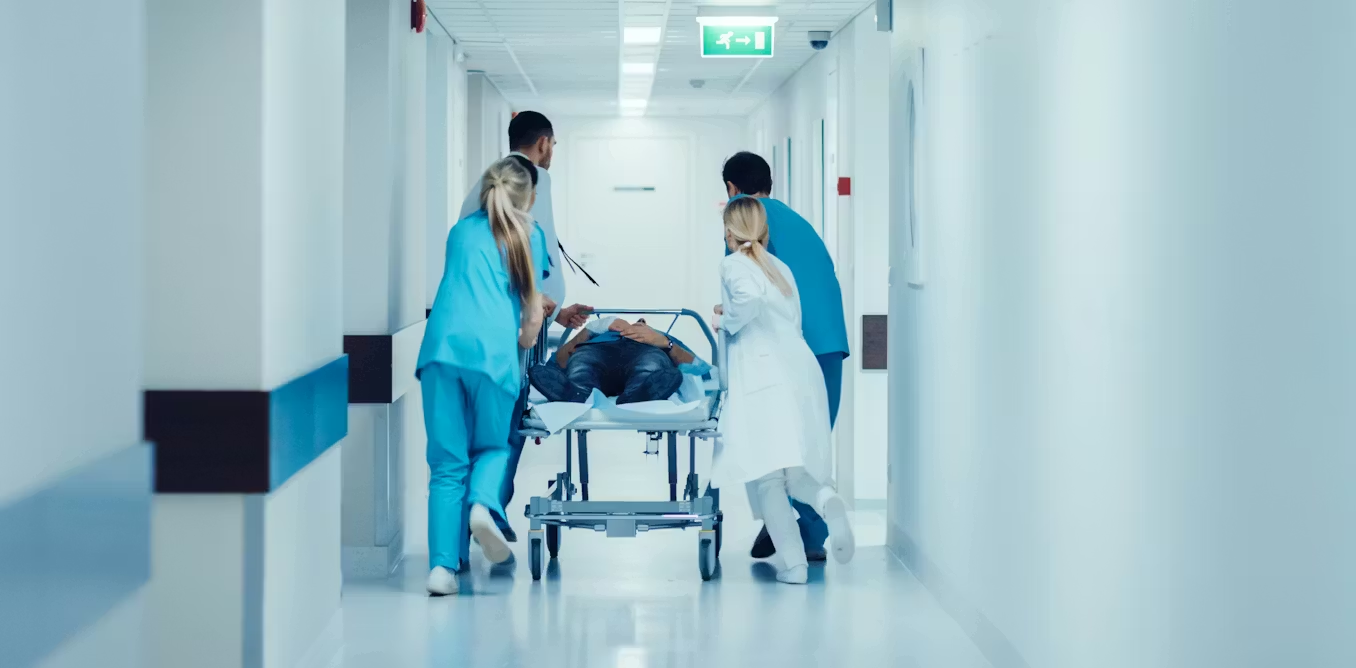
The AI was given written notes from real emergency department records from a hospital in Boston, US, and asked to weigh in at different points during the patient’s care. At the earliest stage – triage, when a patient first arrives – the AI identified the correct diagnosis, or something closely related, in 67% of cases.
The two doctors used for comparison managed 50% and 55%. That’s a meaningful gap, especially at the moment when information is scarcest and uncertainty is highest.
This study matters because the field is moving so fast. Earlier research showed that large language models – the technology behind systems like ChatGPT – could pass medical licensing exams. Interesting, but not all that illuminating. Passing an exam is not the same as being useful on a ward.
Advertisement
This new study goes further. It puts AI alongside doctors across several tasks, using genuine clinical text from a real emergency department. That makes it more directly relevant to medical practice than most of what’s come before. It suggests these systems are developing into something that could genuinely help doctors think through a wide range of possible diagnoses, especially in situations where missing a serious condition is the main concern.
There are good reasons, though, not to get carried away.
The AI was working entirely from written text. It never saw the patient, never noticed how breathless or frightened they looked, never examined them, spoke to their family, weighed up the chaos of a busy department, or took any responsibility for what happened next. It was not practising emergency medicine. It was offering a written opinion based on selected information.
There’s also a gap between producing a list of possible diagnoses and actually improving patient outcomes. A longer list might help a doctor think more broadly, but it could equally generate new problems: unnecessary tests, over-treatment, extra workload, or unwarranted confidence in an answer that sounds plausible but turns out to be wrong.
Advertisement
And some of the benchmark cases used in studies like this may have been publicly available when the AI was trained, which doesn’t undermine the emergency department findings, but is another reason to treat headline numbers with some scepticism.
The hard question
So the question isn’t really whether AI can help doctors think through difficult cases. The harder question is how this should be tested and governed in real clinical settings like the NHS.
That question is already urgent. A Royal College of Physicians snapshot found that 16% of UK doctors were using AI tools in clinical practice every day, with another 15% doing so weekly. Doctors are already using these tools in their daily work – before hospitals and health systems have properly worked out how to assess them, train staff to use them safely, spot when they’re causing harm, or decide who is responsible when something goes wrong.
Around 16% of doctors in the UK use AI every day. Josep Suria/Shutterstock.com
It’s tempting to say that the solution is to keep a human in the loop. But that phrase does very little work on its own. We need to know which human, in which loop, and with what authority. A doctor’s ability to override an AI suggestion is not, by itself, a safety system. Someone still has to decide which tools get used, who can change how they behave, how harms are spotted, and who is responsible when the tool quietly starts failing.
Advertisement
This study represents genuine progress. But it doesn’t, on its own, change how medicine should be practised. The right response is neither to prohibit these systems nor to let them quietly become part of the routine before anyone has thought it through. They should be trialled in real clinical settings, used as a form of second-opinion support rather than a substitute for clinical judgment, and measured against what actually matters to patients: care that is better, safer and faster.
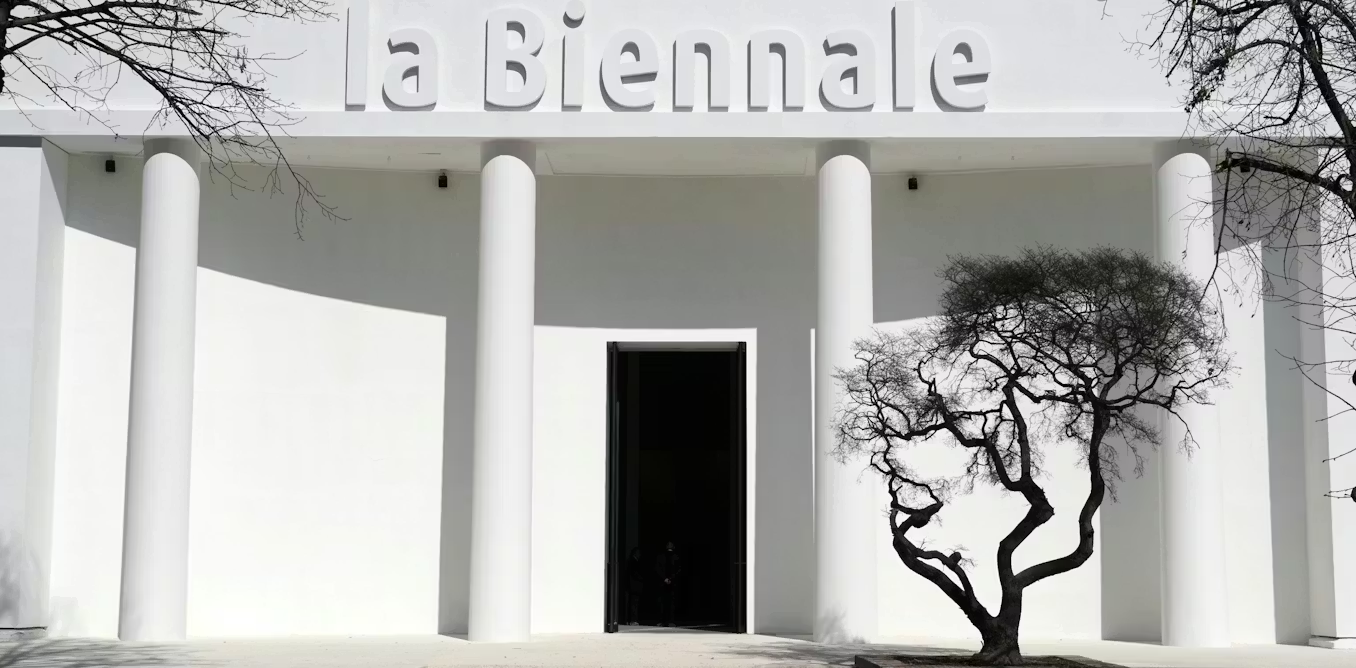
Just days before the opening of the 2026 Venice Biennale, organisers announced that Iran would no longer participate.
A short statement posted to the Venice Biennale website on May 4 said: “With regard to the National Participations in the 61st International Art Exhibition…it has been announced that the Islamic Republic of Iran will not participate.” No explanation was given. I believe that silence is itself revealing.
Iran’s withdrawal is less a sudden decision than the result of converging geopolitical and economic pressures that are reshaping both the global art world and Iran’s place within it.
At the most immediate level, the withdrawal reflects the material realities of crisis. With internet access restricted, international flights suspended and communication networks severely disrupted, even the basic logistics of participation – coordinating, shipping and installing artworks – probably became nearly impossible for Iran.
Advertisement
These conditions have been compounded by intensifying economic pressures, including the sharp devaluation of the Iranian rial, which has made international cultural engagement increasingly difficult to sustain.
An explanation of the Venice Biennale.
Such constraints point to a fundamental condition of contemporary art: global exhibitions rely on infrastructures of mobility and communication that are easily destabilised by conflict and sanctions.
The timing is also significant. The decision comes amid renewed military tensions and escalating political rhetoric surrounding Iran’s position in the global order. In such moments, when political discourse edges toward existential threat, the stakes of cultural visibility are heightened. At the same time, sustaining cultural presence becomes more difficult.
More revealing still was the lack of any announced artist, curatorial framework or exhibition concept for Iran’s pavilion, even days before the Biennale’s opening.
Iran’s presence at the Venice Biennale has historically been organised through state institutions, with oversight exercised by the ministry of culture and Islamic guidance since the Iranian revolution (1978-79). As with many national pavilions, this model positions art as a form of cultural diplomacy. But in Iran’s case, it has often produced a disconnect between official representation and contemporary artistic practice.
This gap is significant. The Venice Biennale, often described as the “Olympics of the art world”, remains structured around national pavilions, with each country responsible for presenting its cultural identity on a global stage. Yet, as critics have long argued, it has never been a neutral platform, but a space where art and geopolitics intersect.
Advertisement
More broadly, biennials are deeply embedded in political and institutional contexts, rather than existing outside them. Within this framework, they are often understood as sites of cultural soft power, where nations project influence through artistic production.
National representation in crisis
Iran’s withdrawal must also be understood in relation to the wider turmoil surrounding the 2026 biennale itself. This year’s edition has been marked by extraordinary controversy, including disputes over the involvement of Russia and Israel, calls for boycotts and the resignation of the entire international jury just days before the opening.
These events expose the fragility of the biennale’s longstanding claim to neutrality. Rather than existing outside politics, it has become a site where geopolitical tensions are actively staged and contested.
To exhibit at the biennale is never neutral: it means entering a highly visible arena shaped by competing narratives of legitimacy and power. For the Islamic Republic, this raises a deeper tension. The biennale’s national pavilion model requires countries to present a coherent cultural identity through contemporary art. Yet Iran’s artistic landscape is anything but singular. It is shaped by internal contradictions between state and independent practices, censorship and experimentation and local production and diasporic circulation.
Advertisement
The entire jury resigned just days before the opening.
These tensions are difficult to reconcile within a state-managed exhibition framework. The very premise of the pavilion – art as national representation – sits uneasily with a system in which artistic expression is subject to ideological and institutional control.
At the same time, the Biennale embodies forms of global circulation, cultural competition and visibility tied to international art markets that do not always align with the cultural and political ethos of the Islamic Republic. Representation therefore involves negotiating how a nation appears, to whom, and on whose terms.
The current moment makes this tension even more acute. As political rhetoric escalates and the possibility of large-scale destruction is invoked in global discourse, cultural visibility becomes more urgent. Art offers one of the few spaces through which narratives beyond conflict and diplomacy can emerge. Yet for Iranian artists, cultural presence is becoming more fragmented, shaped by diasporic networks, constrained by national borders and limited by economic and infrastructural pressures.
Advertisement
Iranian artists, particularly those working through independent and diasporic networks, have for decades operated beyond the frameworks of state representation, with their work circulating internationally through alternative artistic circuits. Iran’s missing pavilion, then, does not signal the disappearance of Iranian art. Rather, it reveals the precarious conditions through which that art circulates.
Iran’s absence from the Venice Biennale also highlights the limits of the national pavilion model. The system has frequently been criticised for reducing complex artistic practices to simplified national identities, even as contemporary art now operates through transnational networks that exceed the boundaries of the nation-state.
In Venice this year, the missing pavilion reflects an art world shaped as much by political crisis as by artistic production. Iranian art is not absent from the global stage. Yet the conditions under which it circulates and remains visible have become increasingly fragile.
The morning session had been held in ideal weather conditions on the north coast
12:22, 07 May 2026Updated 12:56, 07 May 2026
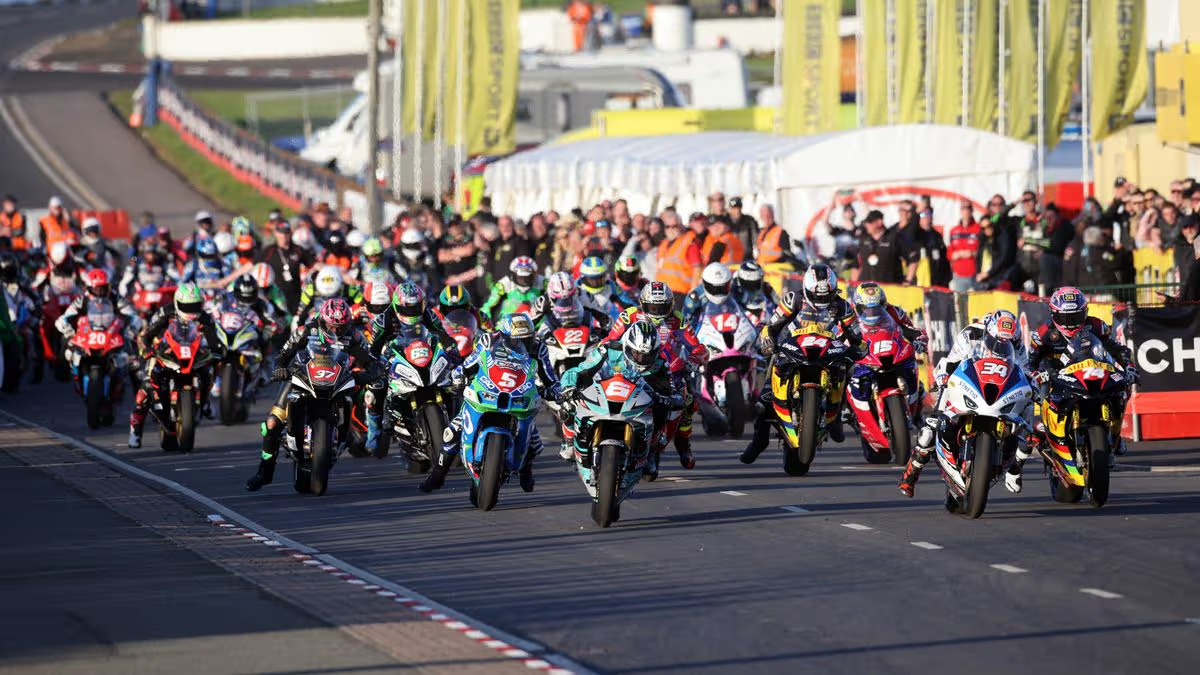
An incident at the Briggs Equipment North West 200 has led to Thursday’s Superbike Qualifying session being halted.
Organisers announced a stoppage due to an ‘incident’ on the course, with a delay of 45 minutes planned.
That was later followed by an update from race control stating an additional one hour stoppage.
Advertisement
Thursday’s morning session had been held in ideal weather conditions on the north coast.
Honda Racing’s Dean Harrison set the fastest lap of the week to date at 123.12mph before the red flag incident.
Glenn Irwin (Nitrous Competitions Racing Ducati) was in second place, with Peter Hickman third fastest.
The North West 200 takes place on public roads around the ‘Triangle’ circuit between Portrush, Portstewart, and Coleraine.
Advertisement
The event is Northern Ireland’s largest outdoor sporting event, attracting massive crowds of well over 100,000 spectators annually to the Causeway Coast in May.







































You must be logged in to post a comment Login