




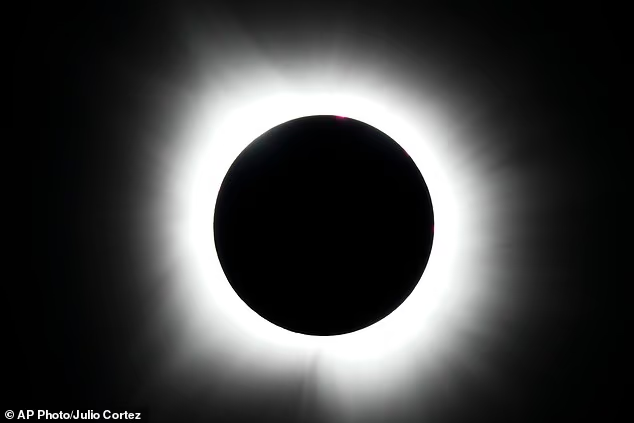
The best solar eclipse in a generation has officially started, with skies beginning to darken over the UK.
If bad weather or a shortage of eclipse glasses have scuppered your viewing plans, there’s no need to worry.
You can follow along with the whole event by tuning into NASA‘s live broadcast below.
And you’ll even get a better view than anyone currently watching from the UK.
Most of the UK will see over 90 per cent of the sun vanish, but this stream will capture the moment of totality as the moon covers the entire face of the sun.
From Britain, first contact – the moment the moon’s shadow first moves over the sun – starts shortly after 18:00, with maximum coverage an hour later.
However, NASA’s coverage will be coming live from the path of totality in Iceland and Spain, so expect slightly different timings.
The broadcast will launch at 18:15 BST, and the first glimpse of totality should come about 30 minutes later from NASA’s telescopes in Iceland.
If bad weather or a lack of eclipse glasses has scuppered your plan to watch the solar eclipse tonight, you can still watch NASA’s livestream of the whole event

Britons have been left scrambling to get their hands on eclipse glasses, as shortages spark enormous queues. Pictured: Queues form outside the National Maritime Museum, Greenwich
While the UK is being treated to the best eclipse in over 27 years, true totality will only be visible in a narrow path between 108 and 122 miles (174 to 196 km) across.
However, viewers of NASA’s livestream won’t just get one chance to witness totality.
At 19:28 BST, shortly after maximum coverage in the UK, the space agency will broadcast footage of the totality from Spain.
Even more excitingly, NASA has also launched a WB–57 high–altitude jet to chase the totality.
A NASA–funded team will climb 50,000ft (9.5 miles) above the ground to escape the water vapour, clouds, and turbulence that could interfere with scientific readings.
Flying at 460 miles per hour (740 km/h), the jet will follow the moon’s shadow and stretch totality out to three minutes.
Meanwhile, a suite of four specialised cameras hidden in the nose–cone will snap images of the sun at least 20 times a second.
NASA hopes that this will reveal new information about the sun’s corona, the outer atmosphere of the sun which is normally hidden by the bright surface.

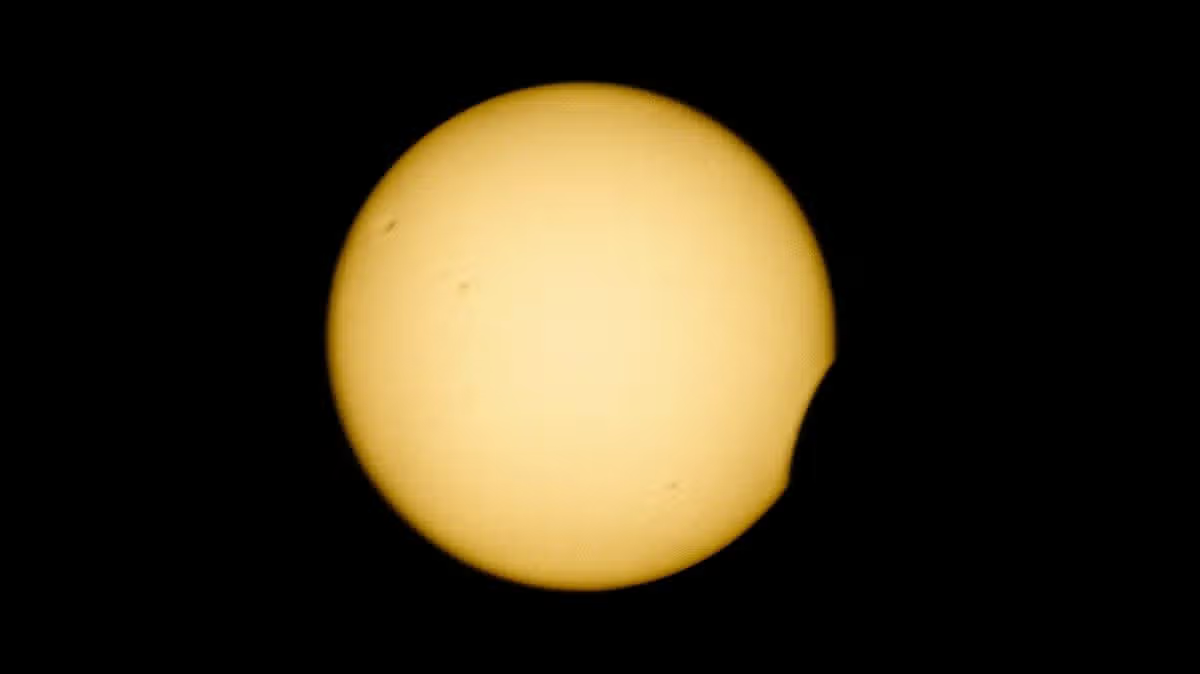
Up to 96 per cent of the sun will be obscured during the eclipse, but NASA’s livestream will broadcast from the path of totality, revealing the spectacular total eclipse

NASA will also be launching a high–altitude jet to chase the moon’s shadow, extending totality to three minutes and capturing scientific data about the sun’s atmosphere
At the same time, the space agency will also be launching 80 scientific balloons in Iceland and six in Spain that will be gathering photos and atmospheric measurements.
Live commentary throughout the broadcast will be keeping you updated on all these scientific observations, so you can learn how researchers are making the most of this rare spectacle.
For an alternative viewing option, you can also tune into the Royal Observatory Greenwich’s live stream of the partial solar eclipse.
Astronomers will be recording the eclipse with one of their modern telescopes, so you can safely see what the eclipse looks like over London without your own eclipse glasses.
What is an eclipse?
Dr Shyam Balaji, an astrophysicist at King’s College London, told the Daily Mail: ‘During a total solar eclipse, the moon’s orbit puts it directly in front of the sun.
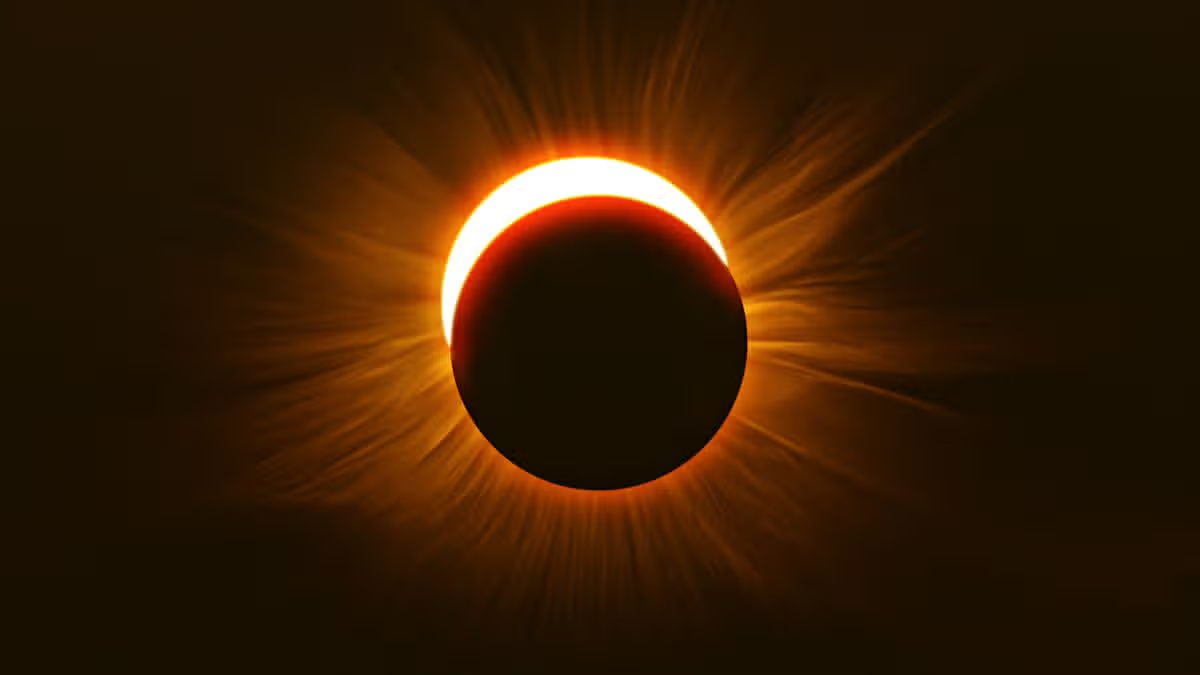
‘This obscures the sunlight that can pass directly towards the Earth, enabling us to see just the corona of the sun, which is the outer rim.’
Although the moon is between Earth and the sun every new moon, solar eclipses are much rarer, only occurring once every 18 months or so.
This is because the moon’s orbit is tilted by about five degrees relative to the plane on which the Earth travels around the sun.
That means that it is quite rare for all three bodies to be precisely lined up in such a way that the moon perfectly blocks the sun.
In fact, it is only due to an incredible cosmic coincidence that such a perfect solar eclipse can occur on Earth.
While the moon is about 400 times smaller than the sun, it also happens to be about 400 times closer to Earth.
By pure chance, this allows the moon to perfectly obscure the sun, something which is completely unique in the solar system.
When is the next eclipse?
If you want to see another eclipse from the UK, the next good opportunity won’t be until November 14, 2050.
During that partial eclipse, over 80 per cent of the sun will be obscured from all parts of the UK except the far south and south west of England.

NASA’s broadcast will launch at 18:15 BST, and the first glimpse of totality should come about 30 minutes later from NASA’s telescopes in Iceland. Pictured: NASA researchers prepare equipment in Burgos, Spain
However, if you want to see totality from the comfort of the UK, you’ll be waiting until September 23, 2090.
For less discerning eclipse chasers, there will be a few smaller partial eclipses in the coming years that could be worth seeing from Britain.
On June 1, 2030, viewers will be able to see 50 per cent of the sun obscured just after sunrise.
Then, on August 21, 2036, Britain will be treated to a partial eclipse obscuring 60 to 70 per cent of the sun.
Outside of the UK, a rare ‘Ring of Fire’ eclipse will be visible in parts of South America and Africa on February 6, 2027.
Meanwhile, the next true total eclipse won’t come until August 2, 2027, and will be visible in southern Spain, North Africa, Saudi Arabia, and Yemen.















































You must be logged in to post a comment Login