Mother and son Cecilia Lusevic, 56, and Mateo Bilis-Lusevic, 12, said they heard a loud bang when the police boat crashed into Westminster Bridge and then watched as the officers were rescued from the Thames.
The visitors from Chile were on a river tour boat on the north side of the central London bridge when they saw the incident. They were evacuated from their vessel shortly after.
Mateo said: “Two boats were riding extremely fast through the water.
“Suddenly, I heard a boom. I was looking towards the boat, and I heard a boom.
Advertisement
“Then three people went flying into the water and one of the people was really hurt.”
He said the officers were in the water for about 10 minutes and a life ring was thrown for one of them.
A black rigid inflatable boat arrived to help them out of the water – the same boat that witnesses said they saw paramedics treating the casualties aboard.
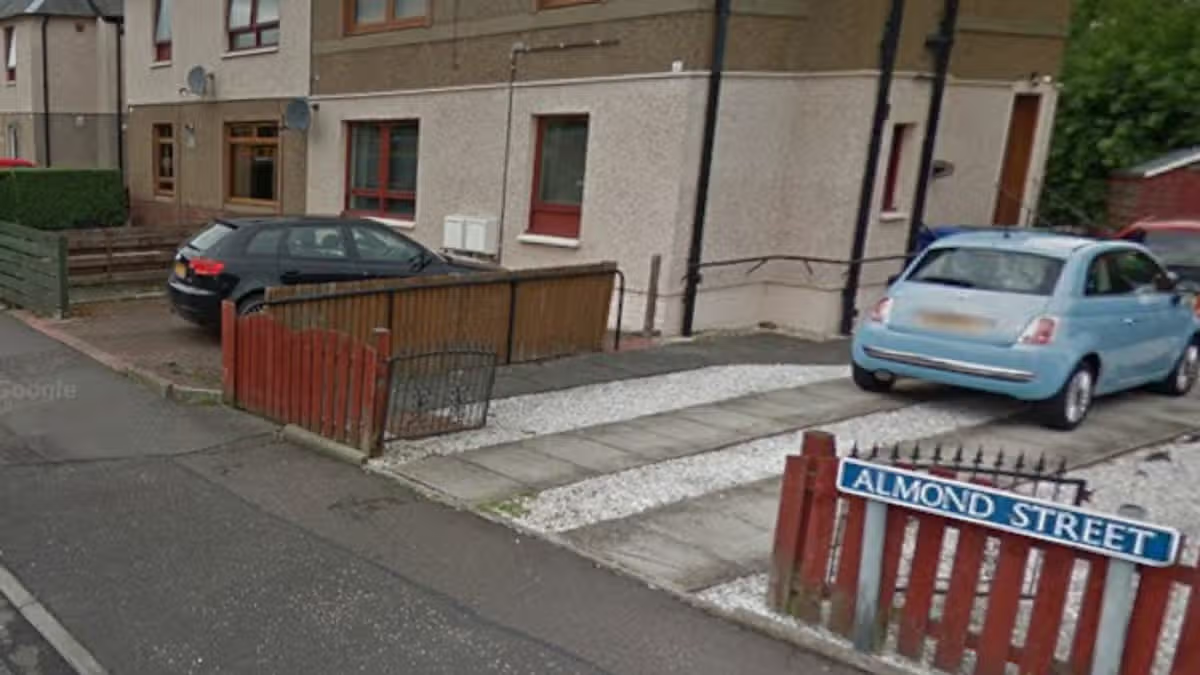
Emergency services were called to Almond Street after reports of concern for a man, who later died. A report will be submitted to the Procurator Fiscal.
A man has died after becoming unwell following an incident on a street in Grangemouth.
Advertisement
Emergency services were called to Almond Street at around 7.45pm on Thursday after reports of concern for a man.
Police Scotland said officers attended and engaged with the man before he became unwell.
He died a short time later.
The circumstances surrounding the death have not been disclosed.
Advertisement
A Police Scotland spokesperson said: “Police received reports of concern for a man in the Almond Street area of Grangemouth around 7.45pm on Thursday, 23 July, 2026.
“Officers attended and engaged with the man.
“The man subsequently became unwell, however died a short time later.
“A report will be submitted to the Procurator Fiscal.”
Advertisement
Get more Daily Record exclusives by signing up for free to Google’s preferred sources. Click HERE.
Lisa is less than thrilled about Carla’s new prison buddy. (Picture: ITV)
During every visit to Coronation Street, somebody has the worst week of their lives. This week, it’s Sarah Platt (Tina O’Brien), and next week’s not looking good for DS Lisa Connor-Swain (Vicky Myers), the woman who just arrested her for murder.
To think that Swarla were just getting back on track.
After Lisa was very nearly tricked into turning her back on her beloved Carla Connor-Swain (Alison King) by her bunny-boiling ex Becky Swain (Amy Cudden), the most shipped couple on the Cobbles finally got their happily ever after…
… then someone was bumped off on the day they got married.
That, as it turns out, explains all the hushed conversations between Gary and Sarah recently. Because she called him on the night of the murder, begging her bad-boy ex boyfriend to help dispose of the body.
Sarah killed Theo, and Gary helped her get away with it. (Picture: ITV)
Lisa’s been devastated by what happened to Betsy. (Picture: ITV)
Needless to say, Lisa’s not in a forgiving mood right now.
We see this first hand in tonight’s episode of Coronation Street, when Sarah’s desperate insistence that she didn’t mean to kill Theo and didn’t involve Gary fall on deaf ears.
Advertisement
This is only reinforced later when Kit listens to a voicemail from Lisa, advising him to think very carefully about protecting Sarah. Gulp.
Given that Lisa’s family troubles seemed to have turned her into a slightly more scary Mancunian version of Judge Dredd, it’s probably not going to go down well when her wife decides to visit the woman she’s just sent down.
In next week’s trip to the Cobbles, Carla informs Lisa that she’s going to visit Sarah later, she’s not coping very well and her boy Harry is really struggling without her. Lisa’s left troubled.
Andy Burnham has ruled out calling a snap election after becoming Britain’s seventh Prime Minister in a decade.
In an exclusive interview with the Manchester Evening News, Mr Burnham said he would stick to Labour’s 2024 manifesto. Holding a general election now, he added, would ‘postpone that essential work’.
He spoke after his first day at Number 10 North in Manchester city centre, and his first week as the leader of the UK.
The government HQ is at Heron House, in the same building as the intelligence agency GCHQ. Asked if he was going to call a general election, Mr Burnham said: “No I’m not. I don’t think that is right.
Advertisement
“We live in a parliamentary democracy. There was a manifesto in 2024. I’m sticking to that manifesto. I’m bringing forward my version but it is still within that manifesto. I just think that we need to focus on making the country work.
“That is the biggest priority right now. A general election would postpone that essential work. I’m also trying to do politics differently, as I did when I was mayor of Greater Manchester.”
Though he’s relishing his new role as PM, Mr Burnham says he misses being Greater Manchester mayor. Asked what he missed, he said: “All of it. All the elements of it, and you could probably tell that. It was lovely being back in the city today, I’ve not been back for a while. People were just great, as ever.”
After spending the day with colleagues at Heron House, Mr Burnham stepped outside for a moment to massive cheers. Waving to the crowd, he called out: “I love you Manchester!” before returning inside.
Mr Burnham is set on splitting his time between 10 Downing Street in London and its northern equivalent in Manchester. While some have said this will cost more, Mr Burnham insisted it will save money.
He added: “We all spend so much money going to London all the time, and that’s the way it’s always been. We all have to buy train tickets. We all have to go down to London. Now I can come and meet people from across the country in Manchester, it saves a lot of expense.
Advertisement
“Is it a gimmick? Well, the fact that I was there today with the Chancellor, the cabinet secretary, the First Secretary of State, the Transport Secretary – a large part of the government was there in Manchester with me today.
“And the fact of us being there, taking decisions there, just means that we’re rebalancing power in the country aren’t we? And the benefits that will fall to Manchester are massive. But it’s about No 10 North taking power out of Whitehall and putting it into all parts of the country. That’s its job.”
Mr Burnham said it was also about letting other areas of the country ‘go on the devolution journey that Manchester has been on’. The main priority of the northern HQ is to ‘rebalance power in Britain’, he said, adding: “People should not underestimate the scale of what we’re doing.”
Advertisement
After becoming leader, Mr Burnham said the days of Whitehall resisting devolution were ‘over for good’. “The good news is that the civil service is really strongly buying it,” added. “I think they realised that what we’ve been doing hasn’t been working as a country. We’re not where we should be.”
He said there was a ‘new generation of civil servants’ who believe power and investment need to be ‘fairly distributed’.
“Otherwise we end up where we are, which is a country that doesn’t feel contented,” he said. “People feel alienated, don’t they, frompolitics?”
The PM said voters felt decisions were made far from them and ‘they don’t think those decisions are made with the north inmind’.
Advertisement
He added: “I understand the cynicism, don’t get me wrong. I’m not going to say I don’t. But I hope to show people that it’s misplaced, that this brings some real benefits.”
Mr Burnham has made a series of policy announcements – mostly aimed at tackling the cost of living crisis – including capping bus fares; cutting business rates on pubs and music venues; and cutting VAT on domestic electricity bills.
Some, like the £2 bus fare, are costed. The detail around others is less clear. Mr Burnham said the scrapping of the digital ID scheme – estimated to be in the region of £1.8m over three years – would ‘help pay for new priorities’.
Mr Burnham has also pledged to end rough sleeping, which will cost £340m over five years. He vowed to eradicate it when he became mayor of the Greater Manchester. There were initially improvements, but data shows rough sleeping in the region is rising again.
How will he do something nationwide when he could not achieve that in the region?
“Well it’s a good question and a fair one,” he said. “And what I would say to that is, obviously, a Bed Every Night scheme still runs and rough sleeping is significantly down on where it was when I came in as mayor.
“But what I discovered was that we couldn’t do what I wanted to do when we were the only area doing what we were doing.”Mr Burnham also said that this meant people were travelling to Greater Manchester as it was the only region offering this support.
Advertisement
“All areas have to do it together,” he added. The Prime Minister also met with regional mayors at Heron House on Friday, telling them No 10 North was ‘at [their] service’ during a National Economic Council meeting.
Labour mayors Tracy Brabin and Steve Rotheram, as well as Reform UK’s Andrea Jenkyns were present.
After the meeting, Mr Rotheram told the Manchester Evening News all regional mayors at the table were ‘in union’, adding: “Over the next few weeks you’re going to get a better understanding of why we are so confident that this can deliver growth now.”
Asked for his response, Mr Burnham said: “Yeah, it was very positive. They felt that what we’re doing was the right thing and could actually help them do their jobs – that was very much the spirit of the meeting.
Advertisement
“The public would have found it refreshing if they could have sat there and heard it.”
A week is a lifetime in politics, as the old adage goes, and it certainly feels like a lifetime already for Mr Burnham.
“I love the job,” he insisted. He admitted the top role is ‘relentless in terms of the waves of things that come at you’.
Advertisement
He added: You can’t ever prepare for it because you can’t ever know what it’s like until you do it, but… I’m getting used to it very quickly because you have to. So I’m in at the deep end, but I’ve started swimming and I’ve enjoyed it so far.”
He said while the job is ‘challenging’ in many ways, making a difference to people’s lives was also ‘rewarding’. Next month, Mr Burnham will be doing a ‘listening tour’ of the UK to win over voters.
Asked about details, he said they had yet to be finalised, but it would include visiting all parts of the UK. Mr Burnham has twice bid for the Labour leadership – in 2010 and 2015 – and lost out.
Finally, this year, it was third time lucky for the new Makerfield MP. Does he feel it was worth the wait?
Advertisement
“It was worth it because I’m better now as a politician than I would have been,” he said. “Manchester made me. My time in Manchester… it gave me the ability to really find what I’m about and, you know, be confident in that and, you know, connect with people.
His time as mayor of Greater Manchester – from 2017 to 2026 – made him ‘stronger than I would have been,’ he said before adding: “It’s thanks to Manchester.”
Some people love to swear. In the workplace, some of those people might be in charge.
You may have worked with one (or be one) yourself. The team leader who likes to pepper a pep talk with spicy language, or the manager who uses swear words to express themselves in the clearest possible terms.
How colleagues respond to colourful language varies. Some might enjoy it, while others are unbothered. It can also be considered a sign of poor leadership, unprofessional – and simply unnecessary.
Our research suggests people’s reactions to a sweary boss depend not only on what is being said, but also on who is listening and where they live.
Advertisement
We found that there is not a single “correct” way for leaders to communicate. But overall, employees were less satisfied with supervisors who frequently used profanity.
So if you’re wondering whether filling meetings with swear words is a good management strategy, it’s probably safer to avoid them.
But some people in our study of 5,660 employees in 19 countries reacted in exactly the opposite way. Those who considered themselves to have more psychopathic and machiavellian personality traits – so with lower levels of empathy – reported greater satisfaction with their leader as profanity increased.
Psychopathy and machiavellianism both involve a certain level of emotional detachment and a willingness to disregard social norms, including the norm that bosses shouldn’t swear. For these people, a boss who swears may come across as more genuine and confident, unconstrained by unnecessary rules.
Advertisement
Employees with stronger narcissistic traits (characterised by a sense of entitlement and a need for admiration) were surprisingly indifferent. Swearing neither impressed nor offended them very much. Their feelings of satisfaction towards their bosses barely changed.
But personality turned out to be only half of the story. The country people lived in also mattered. In societies with higher levels of income equality, such as Sweden and Austria, personality differences were more visible. This meant that the same manager using the same kind of bad language could be viewed as approachable by one employee and unprofessional by another.
In countries with lower levels of equality, however, such as South Africa and Mexico, these personality differences almost disappeared. Regardless of their individual characteristics, employees generally reacted negatively to leader profanity.
Swearing is caring
Why might this be? Research on economic inequality suggests that in more unequal societies, people become more attuned to status and rank. Workplace hierarchies carry greater weight, so a leader’s swearing is less likely to be read as friendliness or authenticity and more likely to be seen as a display of dominance. In these places, the social context appears to override individual personality differences.
The practical message for leaders is refreshingly simple. Communication is never just about the words we choose. The same sentence can inspire one employee, offend another and leave a third completely unmoved.
This also explains why leadership advice often sounds contradictory. One expert encourages leaders to “be authentic”. Another recommends maintaining professionalism at all times. In reality, both can be right, but this depends on the people involved and the cultural environment.
So, should leaders stop swearing altogether? Not necessarily. But they should recognise that effective leadership isn’t about finding one communication style that works for everyone.
It’s about understanding your audience. Knowing your team is just as important as choosing the right (or wrong) words.
There is now widespread evidence that years of heading, tackling and collisions in football and rugby could increase the risk of dementia and other neurological diseases.
The latest – preliminary research presented at the Alzheimer’s Association International Conference in July 2026 – examined 142 former professional footballers aged 30 to 60, and 56 people of a similar age who had no history of contact sports or repeated head impacts.
The two groups performed similarly on objective cognitive tests, which measure abilities such as memory, attention and decision-making. The middle-aged retired footballers self-reported having worse mood, higher levels of anxiety and poorer cognition.
MRI brain scans were available for 124 of the former players and 40 non-players. On average, the footballers had less grey matter in several regions involved in memory, attention, decision-making and emotional regulation. Grey matter is brain tissue containing many of the nerve cells that process information.
Advertisement
These findings deserve attention, although they do not show that football caused the differences or that all players will develop dementia. The results are preliminary, have not yet undergone full peer review, and come from a study conducted at one point in time. Researchers will need to follow the participants for years to establish whether their symptoms or brain changes progress.
In 2020, I worked in a team which compared questionnaire responses from 468 retired male professional footballers with those from 619 men in the general population as controls. Of these, 326 of the former players and 395 of the controls also completed telephone-based cognitive dementia screening tests.
The former footballers were generally healthier, which could have protected them against dementia. Overall, they reported less diabetes, lower blood pressure and cholesterol, and less smoking and diagnosed depression – although they had experienced substantially more concussions and serious head injuries.
Advertisement
Average performance was similar on some cognitive tests. But on others, including tests of verbal fluency and everyday functioning, the former players scored less well. After differences such as age, education, hearing loss and health conditions were taken into account, former players had around twice the odds of falling below established dementia screening cut-offs on tests of verbal memory and verbal fluency.
A screening cut-off is a threshold used to identify people who may have cognitive difficulties. Falling below it does not confirm dementia, but indicates that further clinical assessment may be needed.
Former players were also more likely to report that a doctor had diagnosed dementia or another neurodegenerative disease, a condition involving the progressive damage or loss of nerve cells.
This study was cross-sectional: it captured participants at one point in time. It can show an association between a professional football career and poorer results on some measures, but cannot prove the cause.
Advertisement
Heading the ball is one possible contributor to the increased dementia risk. In a separate analysis of 459 retired footballers, those who recalled heading the ball more than 15 times during a typical match or training session had more than three times the adjusted odds of cognitive impairment, compared with those reporting five or fewer headers.
The finding should not be treated as proof that 15 headers are safe and 16 are dangerous. Players were estimating exposure from careers that had often ended decades earlier, and the study grouped their answers into broad categories. More precise, long-term measurement is needed, including following these retired players over time.
Large studies of former professional footballers in Scotland and Sweden substantiate our findings. Both found higher rates of dementia or other neurodegenerative diseases among outfield players, while goalkeepers did not show the same clear increase. Defenders, who generally head the ball more often, had the highest risk in the Scottish research. We found similar trends in our study.
Advertisement
Heading is only part of the picture. Footballers can also sustain concussion through head-to-head contact, falls and collisions with other players or goalposts. Concussion is a brain injury caused by a blow or force that disrupts brain function, but which does not necessarily lead to loss of consciousness.
In our study of retired professional footballers, concussion accompanied by memory loss was independently associated with greater odds of dementia risk.
Research on former elite rugby players has raised similar concerns about the long-term effects of repeated blows to the head. Separate research at Loughborough University used instrumented mouth-guards to measure head acceleration during matches and found that greater exposure was associated with more symptoms of low mood, anger, fatigue and anxiety in young elite players.
Advertisement
Mood symptoms require support in their own right, but depression or anxiety in a former player cannot be treated as evidence of brain damage. While both have been found to be risk factors for dementia, mid- and later-life depression has a complex relationship with dementia in later life. Long-term follow-up is needed to determine what the findings mean.
Current Football Association guidance for the professional game recommends no more than ten higher-force headers during a training week. These include headers from long passes, crosses, corners and free kicks.
FA concussion guidance also says that any player suspected of concussion should be removed immediately, should not return to playing that day, and should receive appropriate medical assessment. Recovery should involve a gradual return to normal activity and then football, guided by symptoms and professional advice.
Football brings substantial physical, social, health and psychological benefits. The evidence does not justify panic – but it does justify reducing avoidable head impacts, managing concussion properly, and monitoring players throughout and after their careers.
A sickening injury to England’s Gabriel Langton overshadowed his team’s silver medal in the men’s team gymnastics final at the Commonwealth Games in Glasgow.
The 19-year-old, from the City of Birmingham Gymnastics Club, needed lengthy treatment on the mat after a horrible fall in the final rotation of the evening at The Arena.
Langton fell head first to the floor after missing his catch on the horizontal metal bar, three metres in the air, leading to a lengthy delay to the action as he was tended to by up to a dozen medical staff.
He was eventually led away on a trolley after being moved on to a stretcher with his head and neck braced and left to huge applause from the packed crowd who had spent much of the previous 10 minutes in hushed silence.
Advertisement
Langton was seen to be conscious and moving his legs and arms before leaving the arena floor, while team officials later said he was moving and speaking to doctors.
When competition resumed, his England team-mates were unable to overhaul their deficit to Canada who claimed their first gold medal in the event in 20 years, having finished second to England at the past two games.
Langton, a late call-up to Team England in the place of the injured six-time Olympic medallist Max Whitlock, was unable to join his teammates on the podium as England collected their silver medals.
Team-mate Luke Whitehouse, who was first on to the apparatus after the competition restarted and posted a relatively low score of 11.700, said: “When something like that happens, you’ve just got to forget about it and reset. I just had to focus on my routine one skill at a time.”
Advertisement
Whitehouse added: “From what we’ve heard, he’s doing OK. Gymnastics is such a dangerous sport and things like this remind us of that. It’s one of those things you have to put out of your mind.”
Felix Dolci, who helped Canada to gold and led qualifying for the all-around competition said: “It’s terrible but it goes to show that gymnastics is a very very difficult and complicated sport. It’s dangerous you know sometimes.
“All our thoughts go to Gabriel and the team. Pushing through this is definitely not easy, (England) stayed focussed, they stayed in the zone, a huge shout out to them because that’s not an easy one.
“For any gymnast that was on the field of play, seeing this not only is difficult, but something you never want to see. It goes to show how hard the sport is.”
Advertisement
Hamish Carter from Team Scotland – who narrowly missed out on a bronze medal to Australia in the final rotation – said: “I didn’t actually see what happened. I’m just so happy that he’s alright and, having experienced that, anything could have happened.
“We’ve walked away with no medal but I’m thinking of Gabe in this moment.”
The 25-year-old was found to have explosives in her car at the Irish border when she was stopped by Garda
Rebecca Black, Press Association and Olivia Bridge Reporter in Live News Network
22:30, 24 Jul 2026
A law student hoping to be a barrister has landed in court after she was allegedly caught with a bomb in the back of her car.
The court heard Isobella Perrie Sullivan, 25, was approaching the Irish border with the explosives when Gardai stopped her. It is believed she was involved in “IRA operational activity”.
Advertisement
The aspiring barrister was arrested and charged with possession of explosives. Sullivan appeared before a special sitting of Trim District Court in in Co Meath on Friday.
The young woman, of Abbeylands Park, Clane in Co Kildare, wore a pink White Fox Boutique hoodie as she listened to proceedings.
Another suspect, a man in his 40s, remained in custody at a Garda station in the Dublin area on Friday night.
Earlier Garda Commissioner Justin Kelly described “an extremely significant seizure”.
At court a Garda officer outlined how Ms Perrie Sullivan had been stopped by Gardaí on the N2 at Aclint, Carrickmacross, Co Monaghan, suspected to be involved “in IRA operational activity”.
During a search of her vehicle, a bag was discovered in the rear seat that contained Semtex and a detonator, the court heard, prompting the area to be evacuated and Ms Perrie Sullivan was arrested.
The court heard that Ms Perrie Sullivan was studying for a law degree and wanted to become a barrister.
Advertisement
Gardaí objected to bail due to the seriousness of the offence.
Defence solicitor Gavin Booth, of Phoenix Law, said his client had been asked to take a bag to the north, and had not been aware what was in it, adding she had been “manipulated”.
He said she lived with her father in Kildare and wanted to become a barrister.
He said both her parents are devastated and can’t believe what has happened, adding that if granted bail they would intend to keep her on a “tight rein and ensure she abides by all conditions”.
Advertisement
Judge Raymond Finnegan agreed to allow bail.
It came with a number of conditions, which included an independent 15,000-euro surety, that she surrenders her passport, stays at an address approved by Gardaí, has a mobile phone number on which to be available 24/7, to sign in every day at Naas Garda Station and a curfew of 9pm to 7am.
Gardaí also requested another condition, that she not have any contact with anyone in the Saoradh political party or the New IRA.
Police Scotland has declared a major incident as emergency services continue to tackle a wildfire which has been burning in the Cairngorms National Park for 10 days.
The force said it followed “a significant change in weather conditions” which has increased the risk of fire spreading towards the village of Nethy Bridge.
All Nethy Bridge residents have been evacuated to allow emergency services to continue their response.
Supt Judy Hill said: “The weather conditions experienced within the Cairngorms over the last 24 hours have added further complexities to this situation.
“With evidence suggesting the fire is spreading towards Nethy Bridge, the decision has been taken to declare a major incident and evacuate residents as a precaution.
“Additional police resources are being deployed to assist in contacting those who need to leave their properties and to maintain cordons around restricted areas while our fire service colleagues continue to tackle the wildfire.”
Donald Trump has threatened to impose tariffs over a major outbreak of an ‘explosive diarrhea’ parasite potentially linked to lettuce from Mexico.
In a press briefing at the White House, the President said: ‘I think what we are going to do is put a major tariff on Mexico because of the lettuce.’
Trump weighed in as cases of cyclosporiasis soared to 11,000 across 41 states, leaving public health officials scrambling to find the cause.
The President also reiterated his threat to put major tariffs on Canada after wildfires left much of the northern US covered in toxic smoke.
Advertisement
Health officials have suggested that cases of the parasite, a disease transmitted by food or water contaminated with human feces, may be linked to shredded iceberg lettuce from Taylor Farms that was sent to Taco Bell restaurants in nine states.
Tests on lettuce from Taylor Farms’ manufacturing facility in Mexico have returned a false positive, however, a voluntary recall of the products is still in place.
The business temporarily closed its Central Mexico site on Thursday.
Advertisement
Health and Human Services Secretary Robert F Kennedy Jr claimed on Tuesday that the outbreak was ‘under control.’
The FDA said Wednesday it was tracking another outbreak of the parasite that has sickened 72 people, in a separate cluster from the one sickening thousands and potentially linked to lettuce.
The agency revealed the number of cases but gave no further details, including the location of the patients or the potential source of their sickness.
The announcement of a new outbreak of cyclosporiasis suggests that the agency has identified a cluster of cases that are related to a common source.
Advertisement
It does not mean that the cases are unrelated to the main outbreak, but they may have been listed separately as they are believed to have been caused by a separate contaminated item.
Health officials are now recommending people wash their hands and ‘any fresh produce’ thoroughly before preparing food.
As washing is not guaranteed to remove the parasite, they are also advising cooking food to a temperature of at least 158F (70C) to kill the parasite.
Cyclosporiasis spreads when people eat food or drink water that has been contaminated with human feces.
Advertisement
Join the discussion
Has this outbreak changed what you’ll buy at the supermarket?
No update was given for Taco Bell’s potential role in the outbreak, as the fast food chain’s lettuce supplier is Taylor Farms
It is ‘unlikely’ to spread directly from person to person, according to the Centers for Disease Control and Prevention (CDC), because it takes one to two weeks for the parasite to become infectious after passing into the environment.
Advertisement
Dr Luis Ostrosky, an infectious diseases expert at UTHealth Houston, said: ‘Cyclosporiasis spreads via the fecal-oral route, where fecal particles containing the parasite are passed to the mouth.
‘It typically does not transmit from person to person and does not spread in the way that we see with norovirus or the flu.
‘It takes one to two weeks after the parasite is passed in a bowel movement for it to become infectious, and many days to a few weeks after that exposure for symptoms to appear.’
Overall, the CDC has recorded nearly 11,000 suspected or confirmed cases of the infection this year, the most since 2019, when there was an outbreak linked to basil.
Advertisement
It has confirmed 4,100 cases of the infection and is investigating 7,400 others across 41 states. There have also been 308 hospitalizations, but no deaths have been reported.
Michigan is recording the most cases, at up to 2,100, followed by Illinois, Kentucky and Texas, all recording up to 160 cases.
In the major outbreak, the addition of four more states to the tally suggests the agency is beginning to connect cases in states, allowing them to home in on a potential source.
Caused by the microscopic parasite cyclospora, it is a gastrointestinal illness causing symptoms including watery and explosive diarrhea, cramping and a fever.
Advertisement
Patients become sick within a week of infection, which can make it difficult to identify the source.
Individuals suffering from the parasite may also feel they are getting better before symptoms suddenly become much worse again.
A spokesman for Taylor Farms said on Thursday: ‘We’ve commissioned independent experts to conduct a top-to-bottom review of food safety processes and protocols in our central Mexico facility.
‘We continue to work with health authorities, customers, and independent farming partners to address this issue.’
Advertisement
Taco Bell has removed the lettuce from its supply chain.
A spokesman said last week: ‘Taco Bell has taken precautionary action, and we encourage all relevant restaurants, retailers, and foodservice operators to do the same.’
National Highways estimated the upgrade scheme will cut journey times by 10 minutes each trip
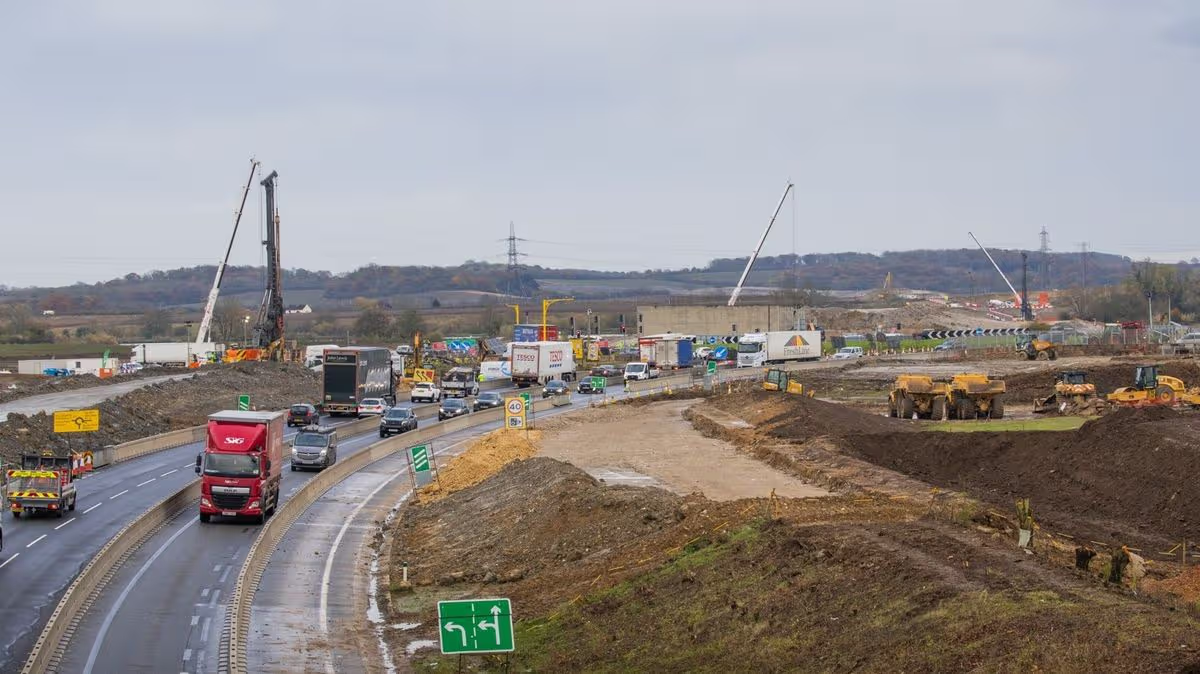
The £1 billion A428 Black Cat to Caxton Gibbet upgrade have been deemed as “absolutely needed” by locals however, some people have questioned whether the cost is worth the result. The £1 billion upgrade aims to deliver a new 10-mile dual carriageway, replacing the final stretch of single carriageway on the strategic road network between the M1 at Milton Keynes and the east coast ports of Harwich and Felixstowe.
Advertisement
National Highways is redeveloping the Caxton Gibbet roundabout into a two-level junction. This will link the new A421 dual carriageway with the A428 and A1198. Traffic on the new dual carriageway will move over the junction using a flyover bridge. The scheme is expected to open to traffic from spring 2027.
Charles Gentry, 42, lives in the village of Caxton, near some of the ongoing works. Mr Gentry said that when the construction began, “there were some queues for the roundabout towards Cambridge but it looked worse coming this way from Papworth [Everard].”
He added: “So, I think we’re lucky in the direction that wasn’t too badly impacted. I think it will be a big improvement [once complete], and Caxton roundabout has always been a source of traffic jams.”
He thinks the changes will “make things a lot better”. However, he does feel as though the cost does seem “a lot” but said it is “hard to quantify” whether the result will be worth the cost. He feels that with “a lot of people working from home, maybe there’s less people travelling around still”.
Advertisement
Once complete, the scheme is estimated to cut journeys at peak times by 10-minutes, according to National Highways. Speaking about this, the 42-year-old said it is “probably not” worth the money for the shortened trip at a time “when everyone is struggling to pay bills”. Although, he did emphasise that the project is “making jobs for people that feeds back into the economy”.
A 40-year-old resident from Caxton, who wished to remain anonymous, said that it is not worth it and there are “definitely” better things that money could be spent on.
He added: “I remember when the roadworks weren’t there and it was fine going in and out. It was not as busy as it is now. All this building work has delayed it a lot. The new roundabout going up to Cambourne near Papworth [Everard] is just ridiculous.
“I remember when the roads just used to come up beside McDonald’s [near Cambourne] and just go straight through.” He said it has made it worse and caused more traffic. He said the project is “definitely unnecessary”.
Advertisement
Stacy Messenger, who also lives in Caxton said it will “definitely” improve motorists’ journeys and feels these improvements were “absolutely needed”. She said National Highways and those involved with the works have been “really good at communicating any closures and changes so we have known well in advance when things are happening”, so she feels it hasn’t impacted her.
She said that people are using Caxton as a “rat run to stop queuing”, adding that from St Neots to the A428, “there were real big tailbacks” when the works started. However, she does not notice it as much now.
Speaking about the cost of the entire project, the resident, who has lived in Caxton for nine years, added: “Because so many people have to live further out but are still working in Cambridge, anything that improves the journey and the connectivity is worth it.
“People can’t afford to live in Cambridge so you have to live further away so I think it was needed. In the grand scheme of things, it’s needed. I think 10-minutes is a decent saviour time in a rush hour.”
Advertisement
Trevor Bishop, 68, has also lived in Caxton for nine years. He said: “My opinion is that a dual carriageway is unreservedly, 100 per cent a good idea.”
Mr Bishop said he feels “positive towards any disruption” caused by the works, adding “we can always go the back way through Great Gransden if there is a hold up”.
He feels as though the project is worth the money because prior to the improvements, he said: “There is a relatively short stretch between the Black Cat roundabout and Cambourne which is a single carriageway.
Advertisement
“If you are driving through, on the dual carriageway to the roundabout and then it is single through to St Neots. I think people would get frustrated with that because they were used to driving fast. I will always get stuck behind these sorts of things.”
In terms of saving time, he said it is “probably not” worth it for that result but he is “more interested in the safety factor” so for him, “it is money well spent”.
Paul Salmon, senior project manager for National Highways at Black Cat said: “Our A428 Black Cat to Caxton Gibbet is a vital project, bringing important investment to the area which will improve journeys considerably between Milton Keynes, Bedford, St Neots, Cambridge and beyond.
“Tens of thousands of drivers currently use Black Cat and the surrounding roads every day. Following this work drivers will save up to 10 minutes per journey each – that’s at least 1.5 hours saved per working week. But it is about much more than this. Faster journeys will bring a huge boost to regional growth, easing congestion and making travel more reliable.”




















































You must be logged in to post a comment Login