There will be adjustments to public transport pick-up and drop-off points as a result
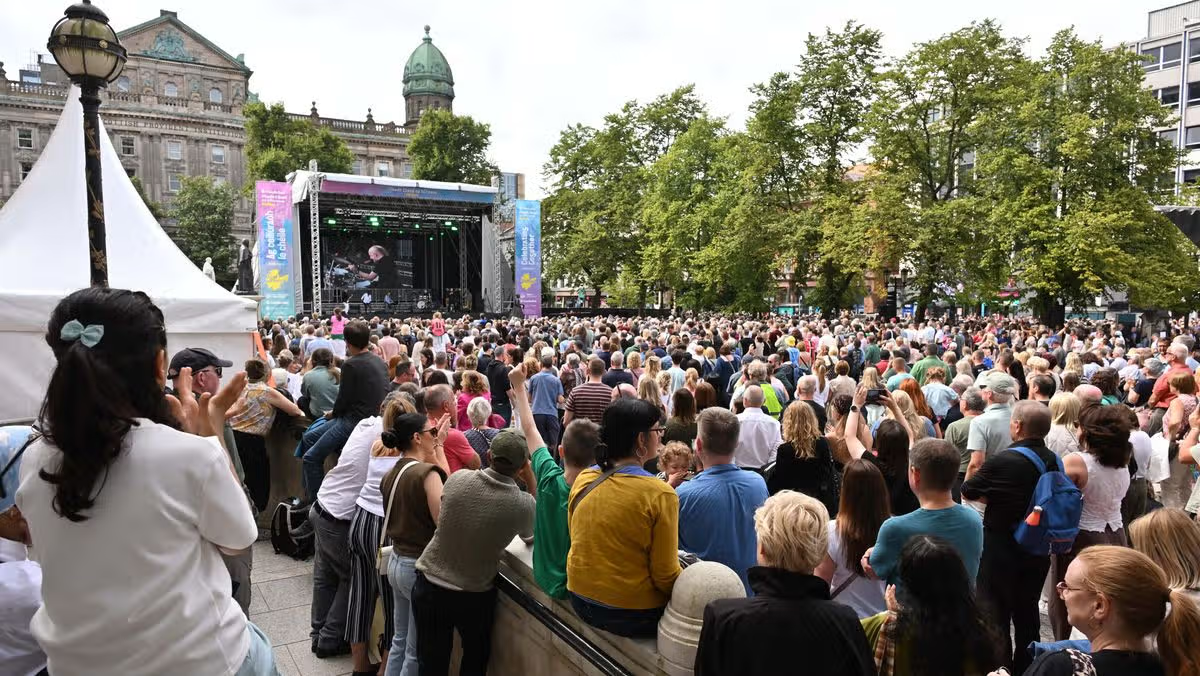
Further road closures have been announced due to “high footfall” in Belfast city centre during the Fleadh Cheoil na hÉireann.
Advertisement
It’s expected around 800,000 people will descend on the city for the eight-day festival, with figures from Belfast One showing over 300,000 people attended the first two days.
As a result, organisers of the Fleadh have taken the decision to close the roads directly in front of and to the sides of Belfast City Hall from 5am on Wednesday, August 5, to support people to move around safely.
The newly announced road closures include Wellington Place, Donegall Square North, Donegall Square East and Donegall Square West. There will be adjustments to some Translink pick-up and drop-off points as a result of the closures.
A statement on Trafficwatch NI, a traffic website operated by the Department for Infrastructure, said: “These roads will now be closed to all traffic from tomorrow until the event finishes on Sunday evening, as part of the phased road closures put in place by Belfast City Council.
Advertisement
“There will be adjustments to some Translink pick-up and drop-off points as a result, along with service diversions in place for the rest of the week.
“Users are encouraged to keep updated via the Translink website and the Journey Planner app, plan ahead, expect services to be busy and leave extra time for their journey.
“With thousands of additional passenger journeys already made this week, Translink have added enhanced capacity and frequency across the public transport network, and will continue to monitor demand as the event continues.
“The road at the lower end of Chichester Street, along with Donegall Square South, will remain open, and pedestrians are urged to take care, use road crossings and follow the directions of event stewards.
Advertisement
“Public hire taxis – who currently use the ranks at Donegall Square North and Donegall Square East – can make use of Upper Arthur Street and back onto Chichester Street for the next near rank.”
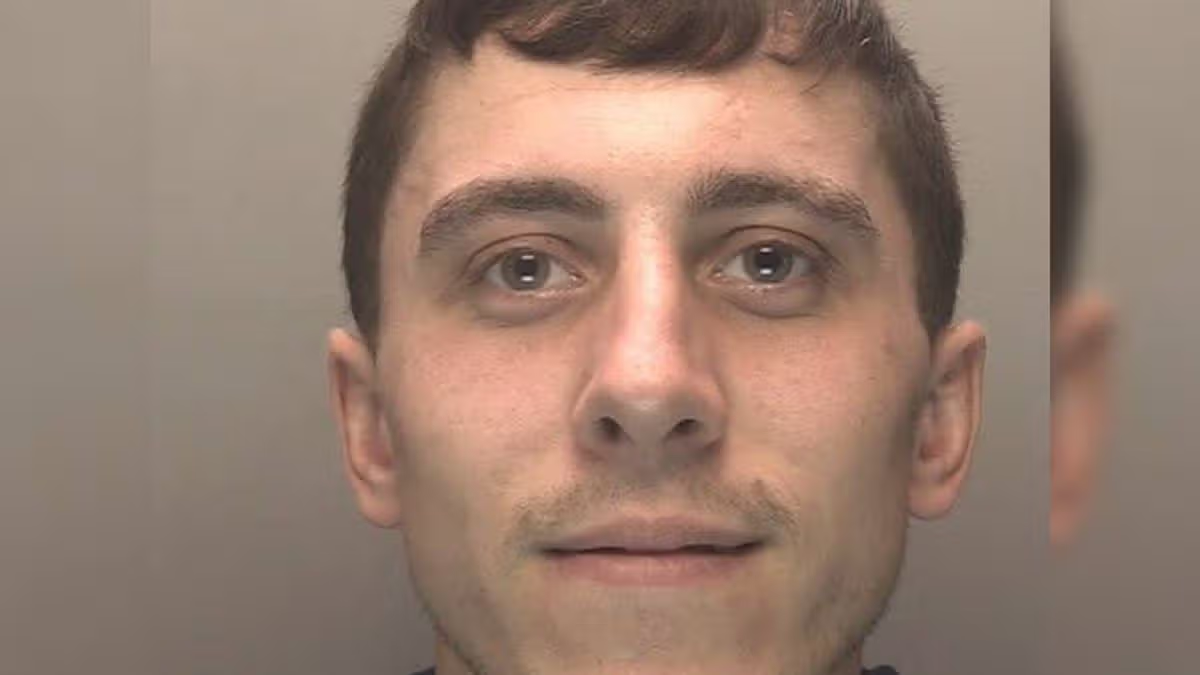
Stephen Grzyb disappeared on Saturday, prompting a major manhunt
Izzie Addison and Adam Care
21:15, 04 Aug 2026
A prisoner who fled from the police after he was dropped outside a court is now back in custody, police said.
A manhunt was launched after Stephen Grzyb, 22, ran off after being taken to Liverpool Magistrates’ Court on Saturday, Merseyside Police said.
Advertisement
Grzyb, of Princess Drive, Liverpool, was due to appear in court charged with a domestic burglary.
Police said he fled down Red Cross Street in the direction of The Strand just after 10am.
He had been taken to the court from a police custody suite by security firm GeoAmey, which is contracted by the Ministry of Justice to transport prisoners.
According to its website, the firm oversees more than 8,500 prisoner movements every week.
In a statement on Tuesday, Merseyside Police said: “An escaped prisoner who absconded outside Liverpool Magistrates’ Court after being transported from Belle Vale custody suite by GeoAmey has been arrested and is in custody.”
Ensure our latest stories always appear at the top of your Google Search by making us a Preferred Source. Click here to activate or add us as your Preferred Source in your Google search settings.
New York City Mayor Zohran Mamdani’s plan to open five city-owned grocery stores is being misrepresented online in posts that claim identification will be required to shop there. The claims are juxtaposed against Democratic resistance to nationwide voter ID requirements.
Republican officials and other major public figures, as well as conservative social media influencers, were among those who made the claim.
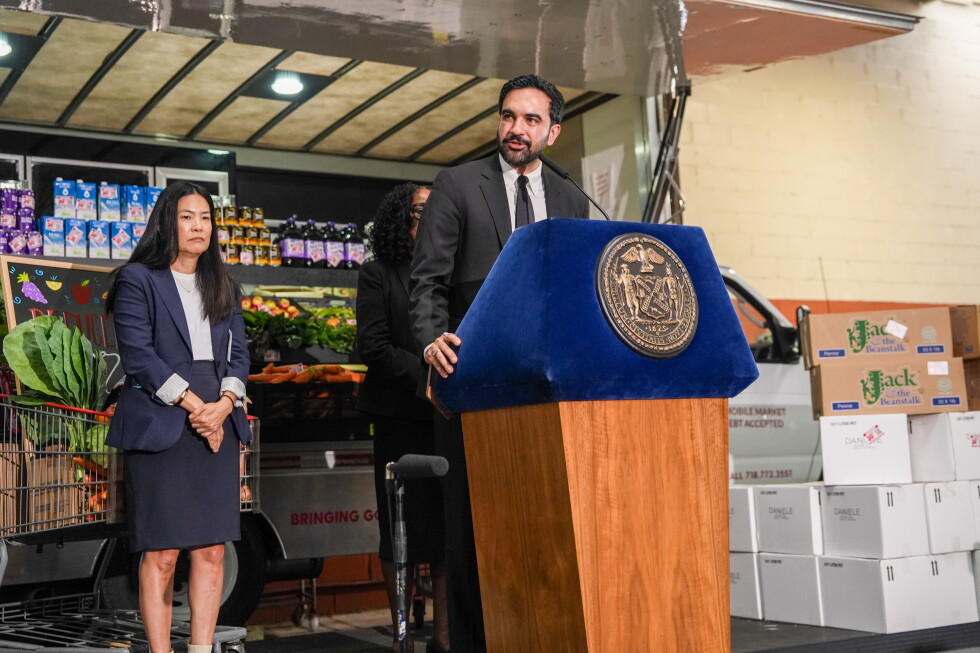
Misinformation began spreading in response to a comment made at a press conference last week by Jeanny Pak, the interim president and CEO of New York City’s Economic Development Corporation. Asked how the city will stop people from taking advantage of lower prices at the stores, Pak mentioned the possibility of a “library-card-esque” system.
But city officials say there will be no ID requirement for shoppers.
Advertisement
Here’s a closer look at the facts.
CLAIM: ID will be required to shop at city-owned grocery stores in New York City.
THE FACTS: This is false. No one will be asked to show ID to shop at stores owned by the city, according to officials. A customer card, akin to a loyalty savings card at a traditional supermarket, is being discussed as a way to manage supply and stop people from reselling large amounts of discounted items, but the program would be voluntary and would not require ID to access.
Mamdani laughed off the claim during an appearance on The Joy Reid Show on Monday night, saying: “When we’re talking about a city-run grocery store, one in each borough, which by the way, you do not need an ID to shop at, no matter what you’ve just heard in the news of today, we’re talking about actually addressing the question of skyrocketing grocery prices.”
Advertisement
Joe Calvello and Dora Pekec, both spokespeople for Mamdani, similarly refuted the claims in X posts that evening.
“Insane that this even needs to be said, but to be absolutely clear: NYC Grocery stores will be open to everyone,” Calvello wrote. “There will be no system to verify identity, residency or income, and no one will be asked to show ID to shop. This is the dumbest and fakest online news cycle I have seen.”
The system Pak referred to as “library-card-esque” at last week’s press conference is a customer card that would help stores manage supply and keep aspiring resellers from buying discounted items in bulk, according to Cassio Mendoza, another Mamdani spokesperson. He explained that obtaining such a card would not require ID, residency, or income verification and would be available to anyone who wants one.
In a request for proposals seeking private grocery store operators to run the city-owned shops, the system is described as “a voluntary free-to-access membership card program to monitor sales activity, and implement the discount program and any associated demand management measures.” It makes clear that the cards should not be required for physical access to the stores.
Advertisement
A statement from the Mayor’s Office further clarified that “the operator selected through the City’s procurement process will determine the specific design of that card system” and that “it is not something people will need to apply for through City Hall or another government agency.”
The false claim spreading online is being used to criticize opponents of voter ID laws, many of whom are Democrats. In particular, President Donald Trump’s SAVE America Act would require people to show documentary proof of citizenship before registering to vote and impose nationwide voter ID requirements. The measure has passed the U.S. House but has not gotten a vote in the Senate, where even some Republicans oppose it.
“Comparisons to voter ID laws or the SAVE Act simply do not apply,” the Mayor’s Office statement reads. “This is not an identification system, nor is it a mechanism to verify who someone is, where they live, or how much they earn.”
On Wednesday, August 12, the Moon will pass directly between the Earth and the Sun, blocking much of the Sun’s light and creating a dramatic partial solar eclipse across Scotland
21:16, 04 Aug 2026Updated 21:16, 04 Aug 2026
Scotland is set to enjoy one of the most spectacular astronomical events in a generation, with the deepest solar eclipse visible from the UK since 1999 now just days away.
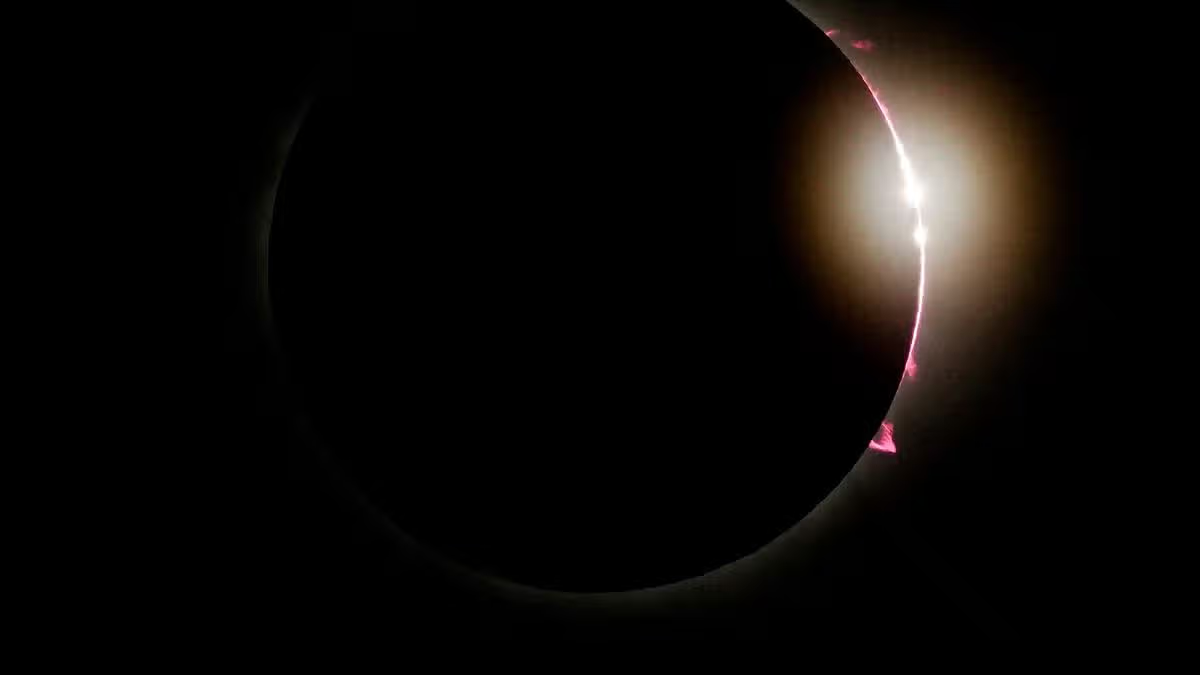
On Wednesday, August 12, the Moon will pass directly between the Earth and the Sun, blocking much of the Sun’s light and creating a dramatic partial solar eclipse across Scotland.
While a total solar eclipse, where the Moon completely covers the Sun, will only be visible from a narrow path stretching across Greenland, Iceland, Spain, northern Russia and a small part of northern Portugal, people across Scotland will still see around 90% or more of the Sun obscured.
Advertisement
The eclipse will be the deepest visible from Scotland since August 11, 1999, when a total solar eclipse was visible from parts of south-west England.
Scotland’s best places to watch the eclipse
The Isle of Barra in the Outer Hebrides is expected to offer Scotland’s best view of the eclipse.
Because it sits furthest west and closest to the path of totality, Barra will experience around 93% coverage, making it the best place in the country to witness the event.
Advertisement
The eclipse takes place shortly before sunset, meaning the Sun will be very low in the western sky. Experts recommend choosing an elevated location or somewhere with an uninterrupted view towards the west or north-west.
Other excellent viewing locations include:
West Coast and Islands
The west of Scotland will see the greatest eclipse coverage.
Isle of Barra offers around 93% coverage with an uninterrupted Atlantic horizon.
The Outer Hebrides and Isle of Skye provide excellent coastal viewpoints for the sunset eclipse.
The Ayrshire coast is one of the best mainland locations thanks to its wide-open sea views across the Firth of Clyde.
Edinburgh and the Lothians
Edinburgh will see around 90.7% of the Sun covered.
Some of the city’s best vantage points include:
Advertisement
Arthur’s Seat
Calton Hill, where the Astronomical Society of Edinburgh is expected to host a public viewing event using solar telescopes.
Blackford Hill, beside the Royal Observatory Edinburgh.
Glasgow and Central Scotland
Glasgow is forecast to enjoy around 91.4% eclipse coverage.
Recommended viewing spots include:
Cathkin Braes, the highest point in the Glasgow area.
Loch Lomond Shores, offering expansive views across the water.
Queen’s Park flagpole viewpoint.
What time is the eclipse in Scotland?
Timings vary slightly across the country, but the eclipse follows a similar pattern throughout Scotland.
LocationEclipse beginsMaximum eclipseCoverageEnds
What is a solar eclipse?
A solar eclipse happens when the Moon moves directly between the Earth and the Sun.
Advertisement
As the Moon passes in front of the Sun, it casts a shadow across part of the Earth. Because the Moon’s shadow only covers a relatively small area, a total solar eclipse is only visible from a narrow path, while a much larger area experiences a partial eclipse.
There are between two and five solar eclipses every year, with a total solar eclipse occurring somewhere on Earth roughly every 18 months.
How to watch the eclipse safely
The UK Health Security Agency (UKHSA) warns that people should never look directly at the Sun, even during a partial eclipse, without proper eye protection.
Advertisement
The safest way to watch is by using specialist eclipse glasses or handheld solar viewers that meet the ISO 12312-2:2015(E) international safety standard. Eclipse glasses should only be bought from reputable retailers and should not be used if the filters are scratched, torn or otherwise damaged.
Another safe option is to make a simple pinhole projector using a piece of card with a small hole punched through it. This projects an image of the Sun onto another surface, allowing the eclipse to be viewed indirectly.
A bonus treat for skywatchers
The celestial display does not end with the eclipse.
The event coincides with the peak of the Perseid meteor shower, meaning that once darkness falls, Scots could be treated to dozens of shooting stars streaking across the sky if cloud conditions are favourable, rounding off a remarkable night for astronomy enthusiasts.
She was given a prognosis of four to six months to live back in 2023 but thanks to a new treatment, she is living with cancer and feeling well
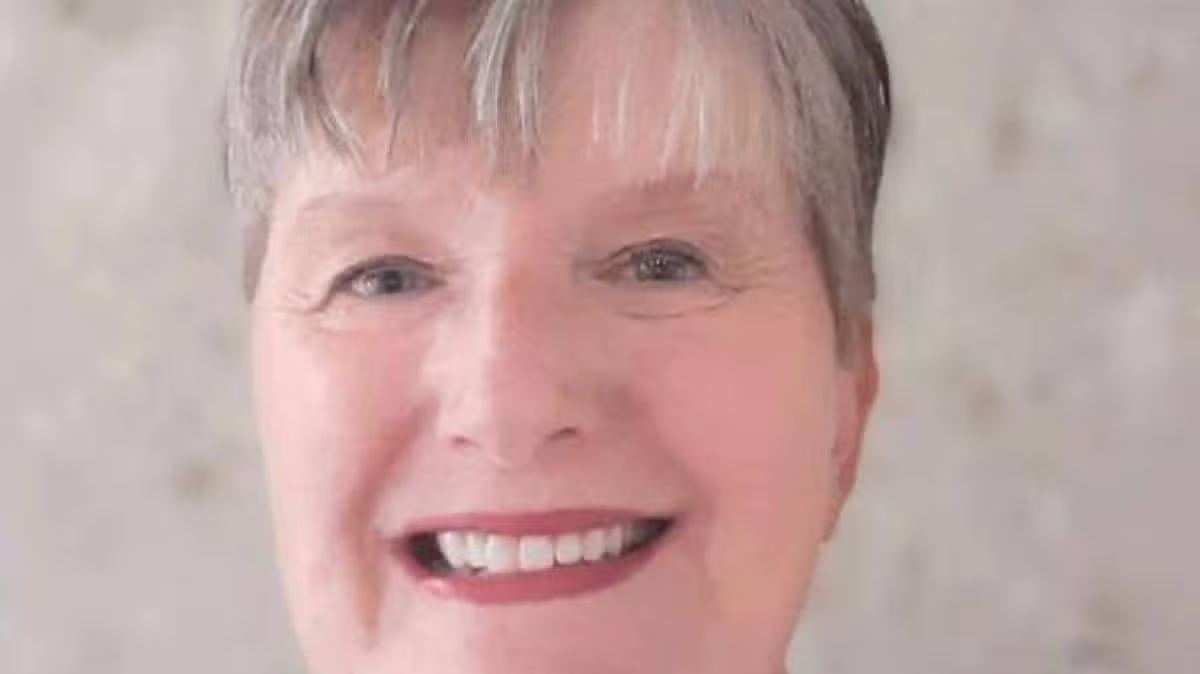
This is Christine Campbell who was diagnosed with ovarian cancer five years ago and given a prognosis of four to six months to live back in 2023. Now thanks to a new treatment, she is living with cancer and feeling well
Advertisement
Christine, from Dundonald was first diagnosed with ovarian cancer in April 2021 after a gynaecological appointment. She is still living with the disease, but it’s currently stable and there are no new tumours.
Annually, almost 204 women are diagnosed with ovarian cancer in Northern Ireland, and 120 women die from this disease. In the Republic of Ireland, approximately 400 women are diagnosed with ovarian cancer, and almost 300 women die.
Ovarian cancer is the fourth leading cause of cancer death in women in Ireland, after lung, breast, and colorectal cancer. It is considered one of the more common cancers in Ireland, yet new statistics from the Irish Network for Gynaecological Oncology show that less than one in three women (29%) feel confident they would recognise the symptoms.
Christine displayed the classic symptoms of ovarian cancer, but had no idea until her diagnosis. She knew something was wrong but looking back now, she wishes she had been more aware of what to look out for.
Advertisement
“My symptoms actually started in November 2020, but I didn’t realise they were symptoms of ovarian cancer,” she told RSVP Magazine. “In April 2021, I was eventually diagnosed with stage 4 ovarian cancer as an emergency patient.
“I was really lucky, I got a cancelled gynaecological appointment. I was red flagged in February for an appointment after seeing my GP and had been referred to the hospital, but because it was still the pandemic, I was told it could be months before I got an appointment.
“In April, I got a cancelled appointment and was diagnosed with stage four. I had heard of ovarian cancer but I didn’t really know the signs and symptoms and I hadn’t recognised any of those signs and symptoms in myself. As a 55-year-old woman at that time, I really should have known. There’s no screening process for ovarian cancer so raising awareness of the signs and symptoms is so important.”
Christine was suffering from the typical symptoms of the cancer but it wasn’t until she began to bleed that she really knew something was going on.
“The first symptom I noticed was bloating and stomach distention,” she explains. “My waist had actually gone from 32 inches to 42 inches in the space of a couple of months. I was asked at the hospital whether I could be pregnant, as they could see the swelling of my stomach.
“I then noticed that I was going to the toilet a lot more and having to get up in the middle of the night, which had never happened before. I was also having bowel accidents, which was really embarrassing. It turned out, it was because there was a tumour pressing on my bowel and blocking it.
“Just before my diagnosis, I noticed that I couldn’t look at food or stand the smell of food. I couldn’t cook, it would make me feel ill. I lost my appetite completely – I was surviving on yogurt and cream crackers.”
Advertisement
She concludes: “The key thing for me was that I started to bleed, and I had already been through the menopause so I knew something was wrong.”
Christine went through three rounds of chemotherapy, surgery and further chemo, which she responded really well to. She was then eligible to go on a medication that stopped the blood flow to the cancer cells and stopped them from growing. However, she received the news in July 2023 that it had stopped working.
“My disease had metastasised and spread to other parts of my body,” she says. “When I asked what the prognosis was, I was told I had four to six months.
“I think anybody that receives that news can do one of two things: you can curl up and accept it, and I would not condone anyone for doing that – but I was determined I was going to beat this. I try to keep a positive attitude and hold onto an element of hope.”
Advertisement
She was given maintenance treatment to keep the symptoms and pain at for as long as possible and was eventually told that nothing more could be done and she would be moved onto pain management when she needed it.
However, in April 2024 she was told that a new drug had become available. She got access to it and began taking it in June 2025 and the disease has been stable ever since. For Christine, the quality of her life is more important than the quantity, and she now focuses on living everyday to the fullest, and using her voice as an advocate to inform people about ovarian cancer and its signs.
“It hasn’t gone away, but it’s stayed stable and it’s given me so much extra time and I am forever grateful for it,” she says. “I’ve been fortunate and I have very limited side effects. There’s nothing that stops me living my life with a cancer diagnosis.
Advertisement
“I can do normal day to day things that every person wants to do, with the support of the people out there who are helping me to live my life as well as I can, which includes a palliative care team. They’re very supportive, they talk to me about diet and exercise to build up strength.
“There’s support out there. The likes of OvaCare and the Society of Gynecology run workshops and coffee and chats, which is great for me to meet like minded people. That’s a comfort to me and I think other people find comfort in me as well – the fact that five years after my diagnosis I am still here and I am still fighting this.”
For anyone who is dealing with any of the B.E.A.T. symptoms, Christine urges them to talk to their GP.
“Our bodies go through so many changes – puberty, child birth, perimenopause, menopause, all the rest of it,” she says. “You do understand your body and you know something is wrong, but you maybe just don’t know what it is and I think that’s why awareness is so important. I am using my voice to advocate for awareness around the signs and symptoms and that’s given me a purpose.”
Advertisement
World Ovarian Cancer Day was earlier this year and the theme was #NoWomanLeftBehind, which promotes the urgent need to ensure that all women, regardless of geography, socio-economic background, or access to healthcare, have the knowledge, support, and resources to recognise ovarian cancer symptoms and seek timely care.
The INGO’s research also found that only two percent of women were aware of the B.E.A.T acronym, which represents the key symptoms of ovarian cancer:
Bloating that is persistent and doesn’t come and go
Eating less and feeling full more quickly
Abdominal and pelvic pain you feel most days
Toilet changes in urination or bowel habits
If these symptoms occur frequently, are persistent, and represent a change from what is normal for someone, medical advice should be sought. Early detection significantly improves outcomes, making awareness and timely action critical. The clear message is that if a woman experiences any of these symptoms for three weeks or more, she should contact her GP.
Lauren Laverne hosted the latest instalment of the BBC programme with Alex Jones
TV and radio star Lauren Laverne said it was “so lovely to be back” as she presented The One Show.
Advertisement
The BBC programme had been on its summer break until late in July, and as she presented Tuesday’s instalment (August 4) of the show with Alex Jones, Lauren shared that she was happy to be on the sofa again.
During the summer, the star had revealed to fans that she had been diagnosed with a disorder with “no cure”, reports the Mirror.
She wrote on Instagram in July: “Hey, so personal news. I’m quite a private person by nature but I’m sharing this as one of the many things I’ve learned after going through health challenges in recent years is that talking about this stuff helps people.
“I’ve been diagnosed with something called smouldering myeloma (yes that is a weird name and no I’d never heard of it either). It’s an asymptomatic blood and bone marrow disorder that in some people can develop into blood cancer.”
Advertisement
“Thankfully for me the risk of this happening in my case is pretty low,” the star informed her followers on the platform. “At the moment I feel OK and don’t need treatment.”
She added that there was “no cure yet” and that it meant her immune system was “a bit compromised”.
Lauren addressed her health on The One Show after a feature about hospitals taking services directly into shopping centres, an initiative benefiting patients while simultaneously encouraging people back into town centres.
Advertisement
After it aired, Lauren said to her co-host that she thought it was “a great idea”. “I mean, Al, you know, I have to do quite a lot of outpatient appointments,” she said.
“And actually the idea of doing them somewhere a little bit more relaxed, a little bit more, it’s not quite as kind of medicalised as a hospital, that would be quite nice.”
“It really appeals to me,” she went on.
Advertisement
The TV star opened up about her smouldering myeloma diagnosis two years after she told her fans that she had received the “all clear” following treatment for an unspecified form of cancer.
Even in the quaint world of Godshill Model Village events move quickly.
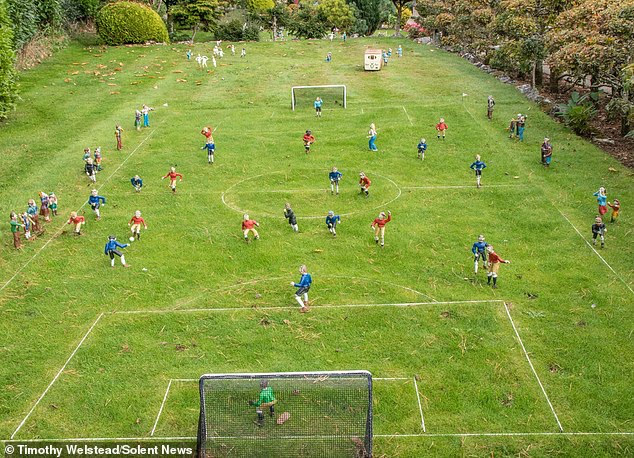
On Saturday the Daily Mail reported that directors of the miniature village on the Isle of Wight had decided to remove Erica the much-loved streaker from their football pitch over fears her exposed breasts caused offence to visitors.
But 72 hours later village bigwigs have decided Erica and her topless bosom can stay after all thanks to a poll.
Godshill Model Village hosted an online referendum on the fate of Erica and an overwhelming 98 per cent of voters chose to keep her.
Advertisement
To welcome her reinstatement in the village she will be used to help raise money for breast cancer charities.
Erica will now be hidden in various spots in the village to encourage people to find her and then donate to charity, rather than returning to the football pitch.
She was originally placed on the football pitch as a nod to the era of prolific football streaking in the 1970s and 80s.
Her cheeky pose brought ‘innocent delight’ to children who saw her 7in blonde frame which cost £300 to fashion from painted resin.
Advertisement
Can you spot the streaker?
The streaker, intended as a ‘lighthearted joke,’ was placed on the village’s miniature football pitch as a nod to the game’s streaking era of the 1970s and 80s
And now, Erica the topless streaker shall return after a poll found in her favour
Advertisement
Regular visitor Rupert Willoughby said he felt ‘dismay’ when he learnt that the village had removed the figure and decided to lead the campaign to democratically decide her fate.
After the lifting of Erica’s suspension, a spokeswoman for the village said: ‘She will be returning… but this time swapping the football pitch for various secret locations around the gardens.
‘We would like her return to help raise awareness and funds for a wonderful local breast cancer charity.
‘So, if you spot her hiding in the gardens, there will be a donation pot nearby if you’d like to show your support.’
Advertisement
Previously director Penny Dyer said Erica was going to be removed because of complaints from a small number of visitors.
She said: ‘The streaker on the football pitch has been part of the model village for many years, and for most visitors has been seen as a light-hearted joke.
‘However, we’ve received a small number of comments from visitors who felt it was inappropriate for a family attraction.’
Advertisement
Share or comment on this article:
Model village reinstates topless streaker following huge public backlash (and she’s even raising money for a breast cancer charity!)
Fifa’s chief of global football development Arsene Wenger says scrapping the plan to have private investment in Fifa competitions was “absolutely necessary and beyond question”.
Fifa president Gianni Infantino planned to create a commercial subsidiary to run its main events, including its World Cups, with external investors able to buy stakes.
There was further criticism from Prince Ali of Jordan, who accused Fifa of creating a situation which “amounts to blackmail” over unpaid prize money and support for Infantino’s re-election.
Fifa secretary general Mattias Grafstrom, meanwhile, called the last week “a sad and reproachable series of events” in an internal email to staff.
Wenger has been in a role which encompasses data analysis of the game, Fifa’s online training and youth competitions, since 2019.
A week after Infantino’s investment plan was first released, the Frenchman issued a statement through Fifa in which he demanded “transparency and integrity” from world football’s governing body.
“The recent events at Fifa deserve some clarity from my side,” Wenger’s statement read.
“I was not involved in this strategic plan and first became aware of the project through media reports.
“The decision to withdraw the project was absolutely necessary and beyond question, because I firmly believe in an independent Fifa that serves our game with commitment, transparency, and integrity.”
Carlos Cordeiro – Infantino’s senior adviser on global strategy and governance – is the only Fifa official to resign over the scandal, saying the proposal was “a bad deal for football” and would “mortgage football’s future”.
Police said the shop was ‘well-known’ for selling alcohol and vapes to children
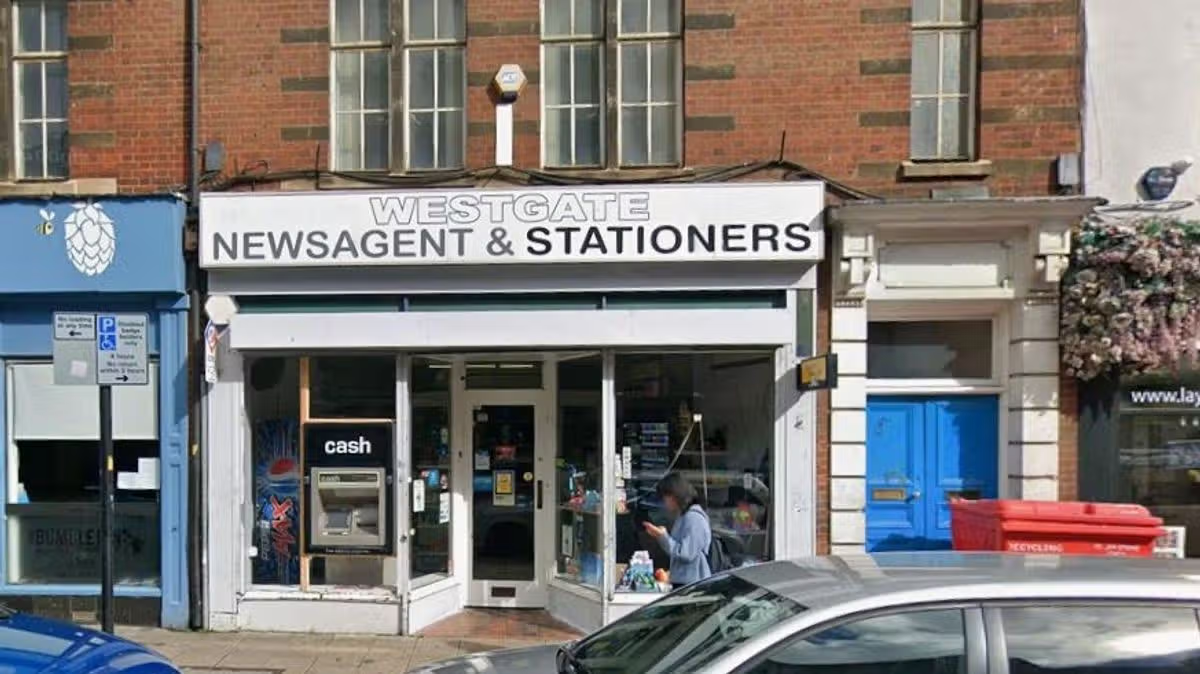
A shop that sold vodka and a vape to a 14-year-old has had its licence revoked. Cambridgeshire Police requested a licence review for Westgate News at 44 Westgate, Peterborough.
Advertisement
Officers were concerned about the sale of alcohol, vapes, and nicotine products to children, serious and repeated breaches of licence conditions, and that staff “knowingly” sold products to children.
Evidence provided by police in the licensing review said that on January 26, 2026, a 14-year-old girl was sold vodka, a vape, and a soft drink at the shop. Other incidents include a vape being sold to a 12-year-old child and alcoholic BuzzBall cocktails being sold to children.
In licensing documents, the police said: “The volume, consistency, and longevity of intelligence – combined with evidential incidents and enforcement action – demonstrate that this premise is systematically undermining the licensing objectives, particularly in respect of children. The latest intelligence confirms that these issues remain ongoing, necessitating decisive action by the Licensing Authority.”
The shop was “well-known in school to sell vapes to children”. Police believe this demonstrated that the shop developed a “reputation amongst school-age children”.
Advertisement
In a licensing review meeting held by Peterborough City Council on Friday (July 31), the shop had its licence revoked. The licensing review was brought under the objectives of prevention of crime and protection of children and harm.
During the meeting, the sub-committee reviewed CCTV footage that showed the sales of alcohol and vapes to underage children.
The decision notice said: “In order to promote the licensing objectives in question, the sub-committee believes it is necessary to revoke the premises licence.”
John Douglas, 63, of the Trashcan Sinatras, has died days after the release of the group’s latest album (Picture: Instagram/@jrdouglasesq)
Tributes have poured in after the death of John Douglas, the guitarist and singer of the Trashcan Sinatras.
The news of his death emerged four days after the Scottish indie rock group released their new album, Ever the Optimist.
It was their first full-length release in a decade by the five-strong outfit.
John, who was born in the small town of Irvine in north Ayrshire, joined the band in 1986, and went on to play on their seven albums.
Advertisement
The bandmates, Francis Reader, Paul Livingston, Stephen Douglas, and Davy Hughes, wrote on social media today: ‘We are devastated to inform all of you that we have lost our dear friend and brother John after a brief illness.
‘He died peacefully in the early hours of Monday the 3rd August 2026, surrounded by loved ones, his beautiful voice and songs filling the room.
Stephen Douglas is John’s brother, and the pair, along with Livingston, joined Reader and Hughes after the band was launched in 1986.
Hundreds of fans paid tribute to the musician.
Advertisement
One said: ‘Such sad news – Was an absolute honour to host John at The Tin in Coventry.’
The young Trashcan Sinatras pictured in Minneapolis, US, in 1991 (Picture: Hulton Archive)
Another one wrote: ‘A real gem of a man. I met one of my heroes, he became a friend, the kind that rarely comes along. A gem. I’ll miss you John, we all will.’
One person described John as the ‘heart of TCS.’
Trashcan Sinatras climbed to global fame with their hit single Obscurity Knocks, featured on their debut album Cake.
It also included hits like Only Tongue Can Tell and Circling the Circumference.
Advertisement
The success of the Cake album saw it spend three months on Billboard 200 list, followed by touring in the UK and North America.


















































You must be logged in to post a comment Login