And even those who already know the borough well may discover something new.
The Insider’s Handbook will be available throughout the festival weekend at the new Visit Bolton area, alongside regional chefs and local businesses showcasing what the borough has to offer.
Packed with ideas on where to eat, drink, shop, stay and explore, the guide brings together some of Bolton’s best attractions, hidden gems and local favourites.
Advertisement
It also includes little-known facts about the borough, including the fact that Bolton’s Egyptology collection is the largest and most significant collection of ancient Egyptian artefacts held by a local authority museum in the UK, with around 12,000 objects spanning more than 5,000 years of history.
Recommendations include Grade I-listed Smithills Hall, Smithills Open Farm, Jumbles Country Park and Turton and Entwistle Reservoir.
Readers can also discover walking routes, parks and green spaces including Queen’s Park, Elizabeth Park and Moses Gate Country Park, alongside family attractions, cultural venues and food and drink destinations.
The handbook highlights Bolton’s busy calendar of sporting, arts, comedy, music and community events, giving visitors plenty of reasons to return and explore more of the borough.
Advertisement
Visitors can follow ready-made day-out itineraries or create their own using the online itinerary builder available on Visit Bolton website
They were among defendants sentenced recently at York Magistrates Court.
Jaimee Reilly, 26, of Far Moss, Selby, pleaded guilty to stealing razor blades and alcohol worth a total of £131 from Sainsbury’s, coffee worth £56 from B&M, razor blades and alcohol worth a total of £185.50 from Tesco and bank card fraud, all committed in Selby.
She was given an 18-week prison sentence suspended for 12 months on condition she does six months’ drug rehabilitation and 10 days’ rehabilitative activities. She must pay £185.50 compensation to Tesco, £56 compensation to B&M and £131 compensation to Sainsbury’s.
Advertisement
Keith Harrison, 52, of Buile Hill Avenue, Little Hulton, Worsley, Salford, pleaded guilty to stealing sunglasses worth £40 and £887 in separate visits to Sunglasses Hut, items worth £370 from Swarovski, items worth £139 from Hugo Boss, items worth £98 from Reiss, items worth £123 from Cosmetic Company, all at York Designer Outlet.
He was jailed for 12 weeks and ordered to pay £404 compensation.
Connor Atkins, 30, of no fixed address, pleaded guilty to failure to comply with the requirements of the sex offenders’ register. He was jailed for eight weeks.
Craig Callaghan, 37, of no fixed address, pleaded guilty to stealing flowers worth £40 from Tesco in Selby, and deodorant worth £80 from Poundland.
Advertisement
He was jailed for four weeks and must pay £120 compensation.
Eliza Carthy, 51, of Mount Pleasant East, Robin Hoods Bay, pleaded guilty to drink driving in Scarborough.
She was banned from driving for three years, fined £120 and ordered to pay £85 prosecution costs and a £48 statutory surcharge.
Vicky McClure has opened up about her demanding schedule after reuniting with her Line of Duty co-stars
Tianna Corbin TV Reporter
12:02, 29 Aug 2026
Actress Vicky McClure has shared her experience of working with her former co-stars Adrian Dunbar and Martin Compston once again.
The trio were last on-screen together six years ago when Line of Duty came to a dramatic end in 2021.
Advertisement
With many fans demanding more instalments from the programme, their calls were answered when the BBC confirmed that the show would come back for a seventh series in 2025.
Now, filming for the upcoming season has officially come to an end with actress Vicky McClure speaking to The One Show presenters on how it was being with Adrian and Martin again, reports the Mirror.
When asked what it was like working together after all this time, Vicky told the BBC presenters it was ‘surreal’.
Although she explained that they’ve kept in touch over the years, which meant it wasn’t unusual to be together, it was ‘weird’ to act alongside one another as they had to be ‘really serious’.
Advertisement
Asked how she maintains composure on-set, given their close friendship, Vicky revealed that the demanding timetable plays a crucial role.
“The schedule is tight,” she confirmed, adding that they didn’t have time to ‘mess about’.
A synopsis for the upcoming series reveals that AC-12 has now been disbanded and rebranded the Inspectorate of Police Standards.
Advertisement
As anticorruption has ‘never been more difficult’ in the challenging climate, the trio are given their ‘most sensitive case so far’.
In the upcoming series, fans will also see Robert Carlyle join the cast as Detective Constable Shaun Massie. His role is described as ‘a Specialist Rifle Officer (SRO) and veteran marksman, operating with Tactical Operations Unit 7 (TO-7) to take down Organised Crime Groups’.
While DC Shaun Massie is a ‘gruff loner’ who keeps himself to himself, things take a turn when his boss, TO-7’s commanding officer DI Dominic Gough (Tom Weston-Jones), is accused of being a sexual predator, which results in Massie’s otherwise detached demeanour changing drastically.
TO-7 will also feature Line of Duty newcomers Laura Aikman as DC Paula Beckman, Levi Brown as DC Luke Tobin, and Amy Leigh Hickman as DC Nira Rashid.
Advertisement
The previous series of Line of Duty is available to watch on BBC iPlayer.
“The members of the Board of Directors acknowledge that Atletico de Madrid is open to standard transfer market negotiations when conducted in a professional, ethical and respectful manner. We fully stand behind the club’s previously communicated position that FC Barcelona failed to meet these requirements and, as a result, there will not be any negotiation and there is zero consideration of an Alvarez transfer to Barcelona. citing their concerns over how they believe the Catalan club conducted the negotiations.”
What kind of society would you rather live in: an equal one where everyone is just about getting by? Or an unequal one where most people are doing substantially better, but a small group consistently falls behind? Now imagine having to choose that society before you were even born, but with no idea of where you’ll end up in it.
Seen this way, inequality becomes a question of risk. Would people gamble on the unequal world, knowing they might be among the unlucky few? Or would they stick with a basic but adequate life for all?
Back in the 18th century, philosopher and social reformer Jeremy Bentham would probably have taken the gamble. Two hundred years later, egalitarian philosopher John Rawls, who was behind this thought experiment (which he called the “veil of ignorance”), argued against it.
Economists call this an efficiency-equity trade-off; balancing fairness with the sometimes competing priority of making the most of society’s finite resources. Political scientists point to such attitudes on inequality as a fundamental difference between left and right. Yet it turns out most people want more details before answering the gamble. How big are the gains, how severe are the losses, and how likely are they?
To quantify this, our work (together with our colleague Tommaso Reggiani) measured wellbeing through subjective life satisfaction. Such measures have been used extensively in public policy over the last 20 years, reflecting a broader shift away from purely economic measures towards a fuller picture of how people actually experience their lives.
The Office for National Statistics asks citizens about life satisfaction on a scale from zero to ten: in the UK, 94% of people rate their life satisfaction at five or above, with the average around 7.5.
We asked people to rate various hypothetical situations to help us understand how each individual uses the zero-to-ten scale. We could then put numbers on the gambles Rawls asked us to imagine. Suppose you had a debilitating medical condition. Would you accept a risky treatment that improves your life satisfaction by one point nine times out of ten, but decreases it by one point the other time in ten?
Advertisement
We also scaled up such questions. What if you were a policymaker, deciding on behalf of the whole population? Would you end a pandemic lockdown, improving the wellbeing of most but causing the death of one person in 10,000?
The mathematics of empathy
As expected, we found that people’s decisions were naturally spread over a wide spectrum, from the risk-taking to the risk-averse. It is heartening, however, that most people were more cautious with the lives of others than with their own. What’s more, 87% were willing to trade away some of their own life satisfaction in exchange for greater equality.
With a computer-simulated model of people’s choices, we can assess both existing and new situations. We compared the UK’s unequal distribution of life satisfaction with the hypothetical case of a society where everyone has the same life satisfaction. The results imply the average person would be willing to accept roughly a one-point reduction in average life satisfaction to get there.
Although such an extreme situation would be impossible in practice (perhaps even dystopian), this one-point figure still gives us a useful measure of how much people value greater equality in wellbeing.
Advertisement
These findings suggest that policy based on wellbeing alone is not enough – it should also reflect fairness. UK government policy already does this to some extent, with gains for the worst-off being given greater weight.
But our research offers a more precise way to quantify fairness. These values should be embedded in decisions on everything from transport to the NHS, and should inform the AI systems increasingly being used to assist decision-makers (the AI community already recognises the relevance of the veil of ignorance). Governments could then quantify how well their wellbeing-equity trade-offs align with the values of the public.
Most people are somewhat risk averse, and more so inequality-averse, regardless of their personal politics. Author provided (no reuse)
This research is far from over. In particular, we would like to explore how we might reach a better consensus between the risk-takers and the risk-averse.
Advertisement
The promising part is that these differences do not appear to be political. In our sample of the UK population, the gambles people accepted on behalf of both themselves and others had surprisingly little to do with how they voted, or with their broader political views. In this sense, the model captures something we might describe as a common empathy.
This challenges a familiar narrative. Inequality is often framed as a political divide, with the left emphasising redistribution and fairness and the right focusing on incentives and individual reward.
But when we look at outcomes – how well people’s lives actually go – there is far more agreement than you might expect. The disagreement may lie less in what people want, and more in how they think it can be achieved.
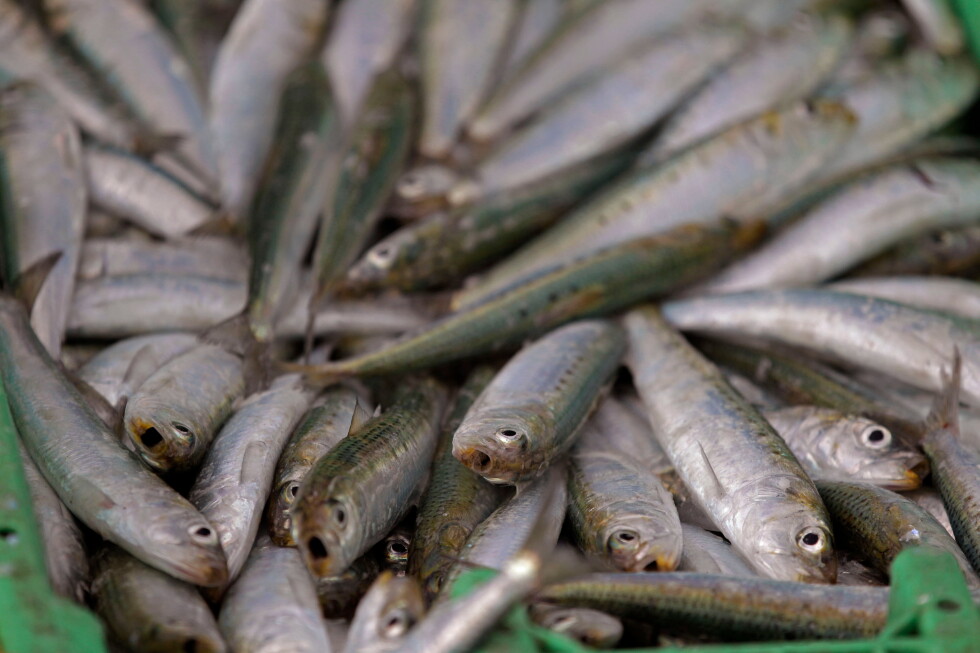
JOHANNESBURG (AP) — Scientists in South Africa are investigating why masses of sardines have washed up dead or dying along parts of the country’s west and south coast — and if a herpes virus detected in the fish is responsible.
The mass mortality of sardines this month has so far stumped the country’s Department of Forestry, Fisheries and the Environment, though scientists have come to at least one conclusion: it is the first time that the virus in question — pilchard herpesvirus, or PHV — has been identified in sardines off South Africa.
PHV, which was linked to two mass sardine mortality events in Australia in the 1990s, can cause inflammation and thickening of sardines’ gills, which interferes with their oxygen uptake, according to the South African environment department.
Sardines and pilchards are the same type of fish, with sardines being the younger, smaller ones.
Advertisement
PHV is a fish virus and poses no known risk to human health, the department said, and its detection does not mean that healthy sardines caught commercially or canned sardine products are unsafe to eat.
Dozens of sardines taken from affected areas, some dead and some alive, are being examined by scientists at the South African Institute for Aquatic Biodiversity and a local university.
In some initial results, dead fish collected from the mass mortality events showed consistently high levels of PHV, the department said in a statement, while live fish that were examined had varied levels of the virus.
Scientists have also considered whether harmful algae found in the ocean or unusually cold sea temperatures or low oxygen conditions might be responsible for the sardine deaths, but “the evidence increasingly points to PHV as the leading explanation,” the environment department said.
Advertisement
Dalene Vosloo, a biological sciences lecturer at South Africa’s University of KwaZulu-Natal who is not involved in the investigation, said the herpes virus may not tell the whole story and “it remains possible that multiple factors contributed to the mortality event.”
Changes in water quality or temperature can make fish more vulnerable to disease, she said.
While the investigation continues, the sardine deaths have caused other complications.
Advertisement
Sign up for Morning Wire:
Our flagship newsletter breaks down the biggest headlines of the day.
Advertisement
The Koeberg Nuclear Power Station north of Cape Town on South Africa’s west coast — the only nuclear power station in Africa — had to cut power by 50% at one of its two units after dead sardines clogged a seawater intake, according to the national electricity company that runs the station.
Signatories include John Hunt, whose wife and daughters were murdered in a crossbow attack, and Emma Webber, whose son Barnaby was stabbed to death in Nottingham (Picture: BBC News/PA)
Dozens of bereaved families have urged the government to block more killers from being freed under its early release scheme.
In a letter to Justice Secretary Alex Norris, the families said they feel victims are ‘being asked to bear the consequences of the prison capacity crisis’.
Signatories include John Hunt, whose wife Carol and daughters Hannah and Louise were murdered in a crossbow attack in 2024, and Emma Webber, whose son Barnaby was stabbed to death in Nottingham in 2023. Barnaby’s killer Valdo Calocane was convicted of manslaughter on the basis of diminished responsibility.
Also, a signatory to the letter is Diana Parkes, whose daughter Joanna Simpson was killed by her estranged husband Robert Brown in 2010. Brown was also convicted of manslaughter on the basis of diminished responsibility.
Advertisement
Their letter comes after Prime Minister Andy Burnham indicated the Government would make changes to the early release scheme to ensure that the killers of PC Andrew Harper, who were convicted of unlawful act manslaughter, are not eligible.
Without further changes to the scheme designed to tackle jail overcrowding, 5,000 people are currently set to be released early, down from 6,000 after some exemptions were announced as part of an urgent review.
BBC racing commentator John Hunt and his daughter Amy Hunt giving their first interviews since the murders of his wife and two daughters (Picture: BBC/PA)
(From left to right) Nottingham stabbing victims Ian Coates, Barnaby Webber and Grace O’Malley-Kumar (Picture: Nottinghamshire Police/PA)
Emma Webber, the mother of Barnaby Webber, speaking to the media (Picture: PA)
A Ministry of Justice spokesperson said the Government is ‘fast-tracking a plan to keep more of the most dangerous offenders behind bars’.
In their letter, the families welcome the efforts made to ensure PC Harper’s killers do not benefit from the scheme.
This Is Not Right
On November 25, 2024 Metro launched This Is Not Right, a campaign to address the relentless epidemic of violence against women.
Advertisement
With the help of our partners at Women’s Aid, This Is Not Right aims to shine a light on the sheer scale of this national emergency.
You can find more articles here, and if you want to share your story with us, you can send us an email at vaw@metro.co.uk.
Read more:
Advertisement
But they insist that ‘the protection now being considered for one group of bereaved families should not inadvertently exclude others whose loved ones were killed, including in circumstances that resulted in a conviction for voluntary manslaughter’.
It adds: ‘Voluntary manslaughter includes cases in which all the elements of murder are present, including an intention to kill or cause serious harm, but a partial defence reduces the conviction from murder to manslaughter.
‘These offences can therefore involve some of the most serious and devastating homicides heard by our courts.’
Advertisement
The letter also highlighted concerns that some of the most serious domestic homicides result in convictions of voluntary manslaughter and that it would be ‘difficult to reconcile with the Government’s commitment to halve violence against women and girls’ if those offenders were released early.
The letter adds: ‘In recent days, we have spoken with numerous bereaved families affected by homicide.
‘A consistent theme has emerged: many feel that victims are being asked to bear the consequences of the prison capacity crisis through the earlier release of those convicted of the most serious offences.
‘Whether intended or not, this is creating a growing sense that justice for victims and public protection are being compromised in order to address pressures elsewhere in the system.
Advertisement
‘We therefore urge the Government, as it seeks to prevent those responsible for the killing of PC Harper from benefiting from the early release scheme, to ensure that voluntary manslaughter is also brought within the proposed exemption.’
PC Harper’s killers Jessie Cole and Albert Bowers were found guilty of unlawful act manslaughter, and remain eligible to be freed (Picture: Thames Valley Police/PA)
Voluntary manslaughter involves killing with the intent to kill or cause serious harm, but where a partial defence applies, namely loss of control, diminished responsibility or killing pursuant to a suicide pact.
Involuntary manslaughter can involve conduct that was grossly negligent given the risk of death and did kill, and conduct taking the form of an unlawful act involving a danger of some harm that resulted in death.
PC Harper’s killers Jessie Cole and Albert Bowers were found guilty of unlawful act manslaughter, and under current plans remain eligible to be freed in January, half way through their 13-year sentences.
The officer was fatally injured when he got caught in a strap attached to the back of a car and was dragged down a country road as the killers fled the scene of a quad bike theft in Sulhamstead, Berkshire, in 2019.
Advertisement
A Ministry of Justice spokesperson said: ‘We have always stated we wanted to go further, and we are fast-tracking a plan to keep more of the most dangerous offenders behind bars.
‘That’s on top of murderers and those serving sentences for rape, serious child sexual abuse and grooming offences who are already blocked from any changes.
‘We share the public’s anger that these options are even being considered, after we inherited a prison system on the brink of collapse.
‘We are fixing this by building 14,000 new prison places, expanding electronic tagging on an unprecedented scale, and investing in probation services at record levels.
Advertisement
‘We are also exploring how we can go further, including faster deportation of foreign criminals, better use of the women’s estate and reviewing the unjust IPP sentences.’
Queen Camilla, patron of SafeLives, speaks to Hetti Barkworth-Nanton chair of the board at Refuge (left) watched by Diana Parkes (Picture: PA)
The Prime Minister has asked the Justice Secretary to present a plan for further changes of the early release scheme to Parliament in early September.
Hetti Barkworth-Nanton, chairwoman of the board at Refuge, England’s largest specialist domestic abuse service provider, said: ‘This letter brings together more than 35 signatories, including bereaved families from across the country who have experienced the worst loss imaginable.’
Ms Barkworth-Nanton, who was best friends with Joanna Simpson, added: ‘We welcome the Government’s willingness to recognise that offences of this gravity should not benefit from accelerated release.
‘Our concern is that this principle should be applied consistently across all homicide offences.
Advertisement
‘Families should not feel that the level of protection they receive depends on the particular legal category attached to the offence. Justice must be fair, consistent and centred on victims.’
Frank Mullane, chief executive officer of Advocacy After Fatal Domestic Abuse, said: ‘The breadth of support for this letter demonstrates the strength of feeling among bereaved families.
‘These are not isolated voices. Families from many homicide cases in recent years are united in calling for a clear and consistent approach to homicide and early release.’
Jo Early, chief executive officer of Support after Murder and Manslaughter, said: ‘Bereaved families understand the pressures facing the justice system.
Advertisement
‘But they should never feel that justice for victims is being diluted because of those pressures. The most serious offences should be treated consistently and public confidence must be protected.’
The garden centre not only sells plants that have been grown in-house, but also has a popular café
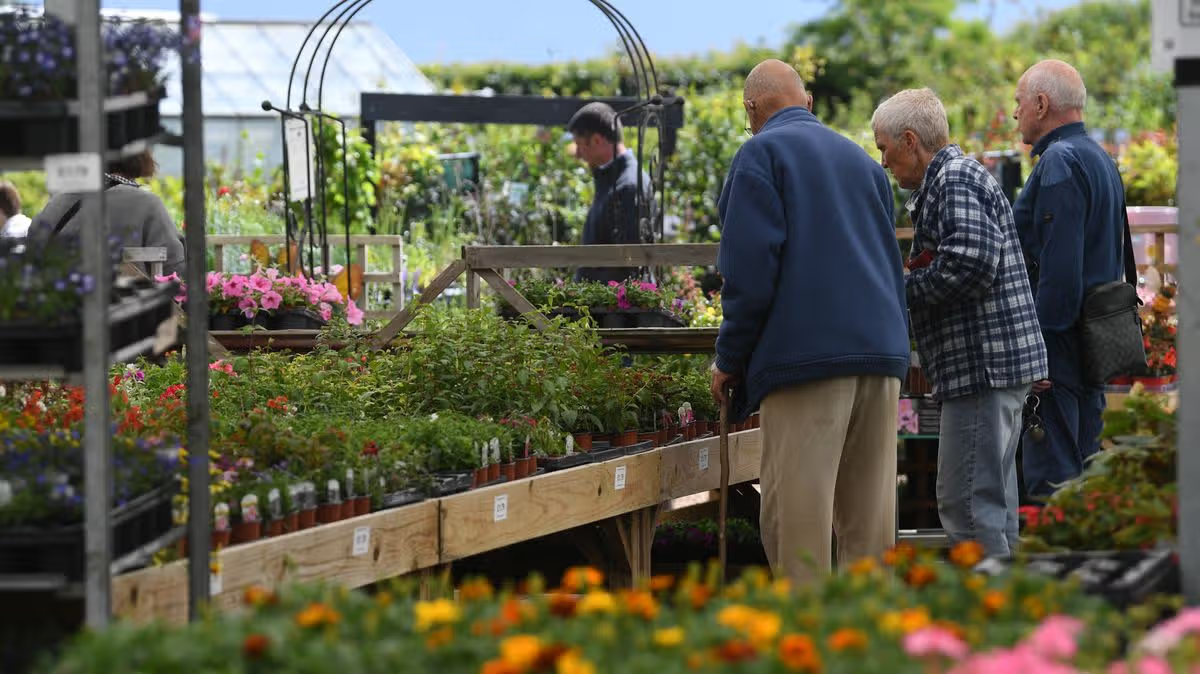
A bank holiday weekend is the ideal time to have a wander around a garden centre and enjoy some good food. Oakington Garden Centre, in the village of Oakington, has been owned and run by the Sadler family since 1981. The team grow and nurture their own plants and have curated them for specific zones in a customer’s garden.
Advertisement
It could be quite easy to spend hours wandering through all the bright and colouful plants they have on offer. It could also be a great place to find a gift for a green-fingered friend. Aside from plants, the garden centre also has the Olive Tree café. The café offers seasonal dishes made from ingredients from local suppliers. Olive Tree has indoor seating but if it’s a sunny day, the outdoor seating is a charming spot to enjoy some lunch surrounded by olive trees.
The café’s in-house chefs prepare homemade food fresh every day including classics such as scones and sausage rolls. Vegan and gluten-free options are also available. A variety of sweet treats are made by the team’s pastry chefs or supplied by Hambleton Bakery.
The café has received raving reviews online, with an average of 4.4 stars on Google amongst nearly 900 reviews. One person said it was a “great place for garden shopping or just for a coffee and wander around for a few hours if you like”. They described it as a “really therapeutic experience” adding that there was a “variety of plants and garden stuff”.
Another customer said it is an “excellent, unique place to wander around and find great plants, seeds and decorations for your garden”.
Advertisement
Oakington Garden Centre can be found on Dry Drayton Road. It is open from 9am until 5.30pm Monday to Saturday and from 10am until 4pm on Sundays. The café is open from 9am until 4pm Monday to Saturday and from 10am until 4pm on Sundays.
Andoni Iraola, making his competitive Anfield debut as Liverpool head coach, oversaw a draw against Newcastle on the opening weekend of the campaign, though it could have been a lot worse.
Forest, meanwhile, have endured a miserable start to the season, suffering back-to-back home losses to Leeds United, thus crashing out of the Carabao Cup in midweek.
Oliver Glasner, who had a decent record at Anfield as Crystal Palace manager, can hand a debut to Liam Delap after he completed a £45million transfer from Chelsea earlier in the week.
Advertisement
Remarkably, Forest will arrive on Merseyside looking to leave with all three points and a clean sheet for a third season in succession.
Here’s everything you need to know about where to watch the match…
How to watch Liverpool vs Nottingham Forest
TV channel: In the UK, the game will be televised live on TNT Sports. Coverage starts at 11am BST on TNT Sports 1 ahead of kick-off at 12.30pm.
Advertisement
Live stream: TNT Sports subscribers can also catch the contest live online via the HBO Max app and website.
From humble beginnings as a box of broken pottery, a lesser-known museum in Waterbeach now offers a glimpse into life in the fens 850 years ago. Denny Abbey and Farmland Museum first came about thanks to a collection of broken pottery that was kept by four-year-old Craig Delanoy in Haddenham in 1969.
Advertisement
Years later, Craig grew his collection and it eventually became a museum. In the early 1990s, the museum was set in Craig’s parents’ garden. As it grew, it eventually moved to Denny Abbey and remains there today.
Denny Abbey is a Grade I listed building and is the only religious site in England to have been occupied by three different monastic orders. During its 850 years, it has been a Benedictine priory, Templar retirement home, Poor Clare Nunnery, and a working farmhouse. Today, visitors can go inside and explore its “jigsaw of windows”.
You’ll also find the Stone Barn at the museum – a 17th century threshing barn which houses farming equipment that would have been used by fenland farmers. One of the items is a plough which is thought to date back to 1760. It was found at the top of Bassingbourn church tower, as ploughs used to be taken to churches to be blessed. It’s unclear why the plough was taken up the church tower, where it remained for many years.
Also at the museum there is the Village Shop which has a ‘treasure trove’ of 1940s products. In Walnut Tree Cottage you can see what a typical home looked like for someone working the land in the 1940s. Every room in the cottage has been dressed to look exactly as it would have done almost 90 years ago.
Advertisement
Taking a step 600 years back in time, visitors can go to the Refectory, where the Poor Clares nuns used to dine together. They would sit in silence whilst spiritual text were read, and after the dissolution of Denny Abbey in 1530, it was the only building of the Poor Clares to survive. Later on, the building was converted into a barn to house grain and cows. In the 1980s, archaeologists found an almost complete Medieval tiled floor here, which can still be seen today.
Denny Abbey and Farmland Museum can be found on Ely Road in Waterbeach. It’s open from 10am until 4pm Thursday to Sunday. It is closed Monday to Wednesday. However, visitors who go on bank holiday Monday (August 31) will be able to have a look around the makers’ market. Described as a “wonderful day out”, the makers’ market takes place from 10am until 4pm. Local artisans, crafters and makers will have a range of items for sale including bespoke jewellery, homeware and artisan food.
The makers’ market will be open between 10am and 4pm on Bank Holiday Monday.
‘Cavan, Down, Dublin, Louth, Tyrone, Derry and Wexford will be Monaghan’s Division Two opponents next season. Nothing easy. Nothing guaranteed. No honeymoon period for the new manager’
10:53, 29 Aug 2026Updated 10:59, 29 Aug 2026
Advertisement
Social media can be a fairly toxic place at the best of times.
For many outside the county, the news came as a bolt from the blue.
Bannigan had guided Monaghan back to Division One in his first season in charge.
Advertisement
Although they lost their top-flight status in 2026, there were extenuating circumstances.
Scotstown’s extended club campaign robbed the Farney of a host of key players for the early part of the season while a crippling injury list meant Bannigan was never able to name a full-strength team at any time this season.
After losing to Mayo by the bare minimum in Clones, they toppled Connacht champions Roscommon and Leinster champions Westmeath in St Tiernach’s Park.
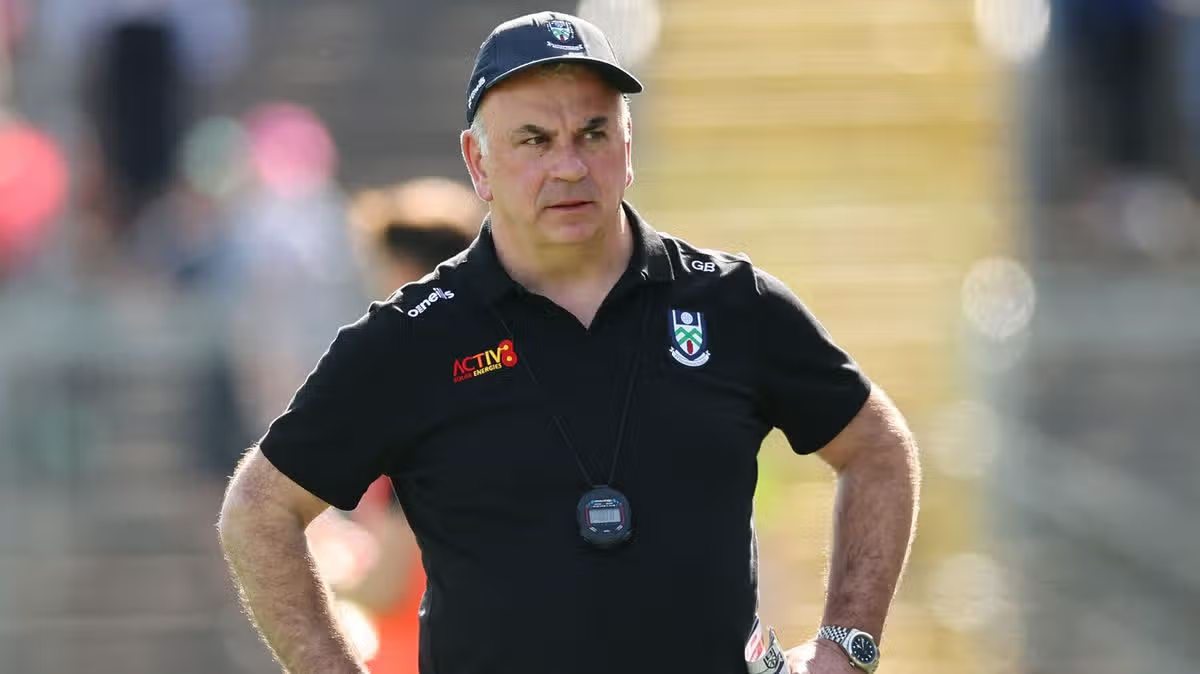
That run of five remarkable Championship performances said everything about Gabriel Bannigan’s Monaghan.
They were brave, honest, determined and exciting to watch.
Advertisement
Prior to their quarter-final loss to Louth at Croke Park, it was confirmed that the influential Beggan would play no part. Monaghan ended up losing the game 0-27 to 2-18.
As Bannigan’s scathing departure statement alluded to, he was already making plans to continue into the 2027 campaign.
The next man in is already behind the eight ball.
The Aughamullen native stated that he didn’t want to step down and made reference to “moving goalposts” in his statement.
Advertisement
That’s hardly cryptic and he hinted at outside inference with the selection of his backroom team as he sought to make changes for next season.
It is unclear whether or not Andy McEntee and John McElholm, father of Tyrone star Eoin, were going to be retained or if Bannigan simply wished to add another coach to his management team.
We may never know, but the whole saga will hardly woo a worthy successor away from a leading club or county position.
So where do Monaghan go from here?
Advertisement
The aforementioned McEntee is one possibility.
Bannigan worked with his predecessor Vinny Corey who, in turn, was part of Seamus McEnaney’s backroom team.
‘Banty’ is another name who has already been touted for the role – it remains to be seen if he is keen on a third stint as Monaghan boss.
As manager of Ulster Club champions Scotstown, David McCague is sure to be in the running while Kilcoo boss Martin Corey, brother of Vinny, is another possible candidate.
Advertisement
More leftfield appointments might include Crossmaglen natives John McEntee, current boss of Inniskeen, and Wicklow manager Oisin McConville.
The latter would seem the least likely option given that the Garden County are set to play in the Sam Maguire Cup next season, although he did make reference to the travelling involved in the aftermath of their brilliant Tailteann Cup victory.
Whoever is in the frame, Monaghan need to act fast as recent history suggests that delayed managerial appointments rarely work out.
Just ask Derry.
Advertisement
Get it wrong and Monaghan could slip down the pecking order and fast.
They don’t need to look too far to heed the warning signs.
Cavan were precariously close to being back in the Tailteann Cup this season after finishing sixth in Division Two.
Down, despite beating then-then Ulster champions Donegal in Ulster and winning Division Three, still failed to qualify for the Sam Maguire.
Advertisement
Cavan, Down, Dublin, Louth, Tyrone, Derry and Wexford will be Monaghan’s Division Two opponents next season.
Nothing easy.
Nothing guaranteed.
No honeymoon period for the new manager.
Advertisement
Monaghan has a proud tradition of punching well above their weight.
In stepping down, Gabriel Bannigan claims his hand was forced. Monaghan must now ensure they get the appointment of his successor right.
The Tailteann Cup trapdoor is there for them if they don’t.
Want to see more of the stories you love from Belfast Live?Making us your preferred source on Googlemeans you’ll get more of our exclusives, top stories and must-read content straight away. To add Belfast Live as a preferred source, simplyclick here.
























































You must be logged in to post a comment Login