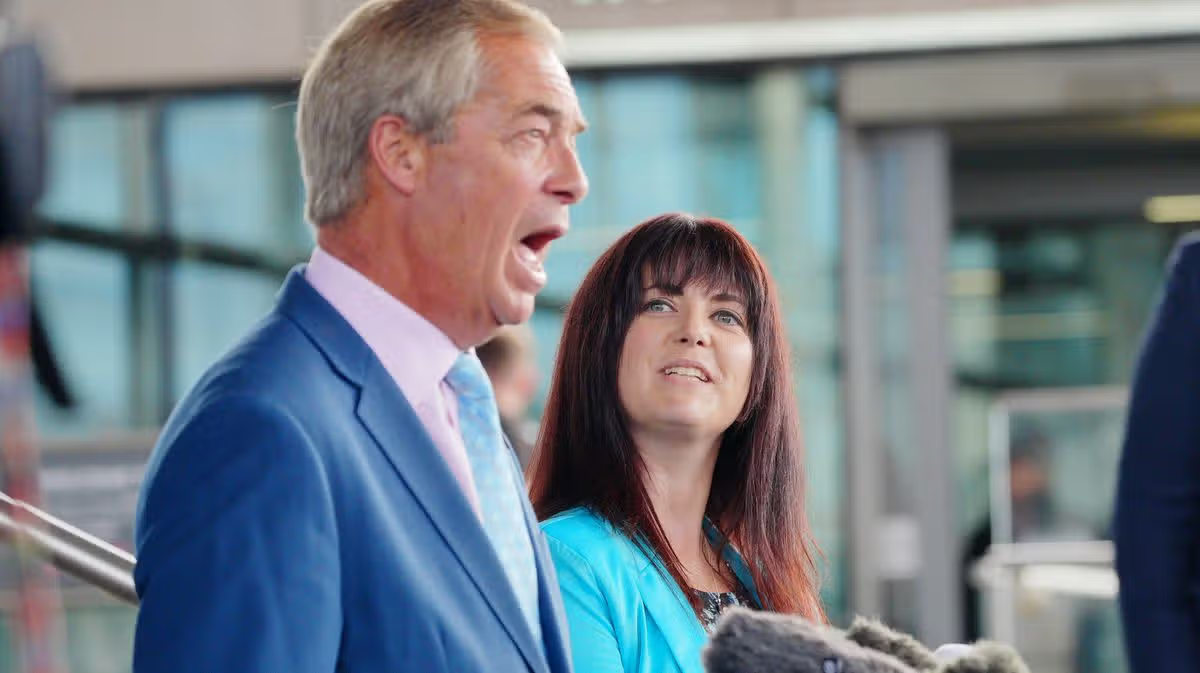
We learnt last week that when the Reform group first met in the Senedd, they set up their group constitution. While Dan Thomas was appointed by Nigel Farage, that constitution said, it would be the Senedd group who decided the new leader.
The party said that if there was no contest, then the new leader would be appointed but even if there needed to be a vote, it would be of group members, not the wider party and they wanted a new leader in place by the end of the month.
We know that James Evans, the Brycheiniog Tawe Nedd MS and former Tory MS, ruled himself out despite claiming he had the support of the “majority” of the group. He said he didn’t think a leadership contest was in anyone’s best interests.
The Met Office has said there could be “air frost” this week
The Met Office has forecast “chilly nights” in parts of the UK this week alongside possible “frost” in the air at times.
Advertisement
It comes as the UK is set to see a generally “warm” week, with temperatures climbing into the mid 20s in places. But the week will also see cooler snaps as well as some strong wind and heavy rain.
The Met Office said that Monday (September 21) will be dry, warm and sunny across southern parts of the UK, with light winds forecast. More clouds and some patchy rain will be expected in the north and west of the country, with temperatures reaching highs of 24C in the south and 22C in the north.
Click here to get the biggest stories straight to your inbox in our Daily Newsletter
A cold front will move over the country across Scotland and Northern Ireland on Tuesday (September 22), bring a mix of cloud and sunshine to the country. Temperatures will be warmer in the south east, reaching 25C or 26C.
Advertisement
More changeable conditions are then expected to hit from Wednesday.
Met Office Deputy Chief Forecaster, Tony Wisson said: “The forecast becomes more changeable from Wednesday as a series of weather fronts move across the UK.
“There remains some uncertainty over the exact track of a frontal system on Wednesday which could bring a spell of heavy rain, particularly across eastern and southeastern Scotland, and potentially parts of northern and northeastern England.”
Content cannot be displayed without consent
Mr Wisson continued: “We’re closely monitoring this development and would encourage people to keep up to date with the latest forecasts over the coming days. It’s likely that many southern areas will remain largely dry.
Advertisement
“It’s set to be a notably chilly night on Wednesday into Thursday, with a chance of localised air frost in some rural locations, as cooler air moves in from the northwest.
“Thursday should bring long sunny spells for much of England and Wales, though we’re also monitoring the potential for strong winds to affect the far northwest of the UK. Temperatures in London may reach around 22°C, but another cool night is likely to follow in the south.
“With watchpoints ahead this week, it’s a good idea to keep an eye on the forecast as the week goes on.”
Alexander Brennan killed Brodie McGregor at her flat in Glasgow’s Springburn on August 26, 2024.
14:28, 21 Sep 2026Updated 14:30, 21 Sep 2026
A thug who brutally murdered his partner in a frenzied attack was given a life sentence. Alexander Brennan, 54, killed young mum Brodie MacGregor, 23, at her flat in Glasgow’s Springburn on August 26 2024.
Brennan left Brodie’s face effectively hanging off after he repeatedly struck her with glass bottles in a scene a witness said would “stay with me forever”. Callous Brennan got rid of his blood-stained trousers and locked Brodie’s dead body inside her flat before dialling 999.
He then boarded a train to the Falkirk area where he told a friend’s partner “I just couldn’t stop.” Brennan, of Larbert, was found guilty today of murdering Brodie and was jailed for a minimum of 22 years.
Advertisement
Judge Lord Scott told him: “You murdered her when she was 23 – there were no victim impact statements but I am told about surviving siblings and a young child left without their mother. You brutally murdered a woman who offered no threat to you.
“A doctor described her injuries as ones seen in high velocity impacts or falling from a building. As she lay there for around an hour, conscious or unconscious, you took no steps to seek medical assistance which would have offered a slight chance that she would survive.
“You showed complete disregard to whether she lived or died.” The High Court in Glasgow previously heard that Brennan had fallen out with Brodie.
Advertisement
A taxi from Stirling dropped Brennan off at Brodie’s home around 1.35am and he went inside. Brodie dialled 999 around 4.35am, where she was heard to say on the call: “You attacked me.”
Officers attended Brodie’s home but were told by her that the call was a mistake and that she was safe in Brennan’s company. CCTV later showed the pair separately leaving the property and walking in the surrounding area before returning to the flat.
Around 9.41am, footage showed Brennan putting his blood stained trousers in a clothing bin near Brodie’s flat. He was seen to place a phone to his ear at 9.55am in a 999 call which lasted over 90 seconds.
Advertisement
When asked by the call handler if the patient was breathing, Brennan replied: “I don’t think so.”
Later in the call, the handler asked him what happened and he did not respond to the question. Paramedics quickly arrived at the flat but could not get in so the fire brigade were called to force open the door lock.
Witnesses found Brodie lying face down on the living room floor, surrounded by fragments of broken glass bottles. Prosecutor Alan Parfery asked detective sergeant David White what he noticed about Brodie’s mouth and he replied: “It looks like her mouth has been severed completely.
Advertisement
“Her face more or less was hanging off.”
The flat – which was in a state of disarray – was found to have blood in various areas. DS White said: “There was a lot of blood spraying which extended to the ceiling. This was one that stood out for me and will stay with me forever.”
Brodie was unfortunately pronounced dead at the scene at 10.15am. Meantime, Brennan was on a train to Camelon in the Falkirk area where he visited the home of friend Robert McCallum.
Mr McCallum’s then partner Tina Marie Hatton, 46, told jurors that Brennan had “blood all over him” and she put his stained jumper in the washing machine. Miss Hatton asked what had happened and was told “I couldn’t stop.”
Advertisement
When asked by Mr Parfery if he gave an explanation for the comment or who he was referring to, Miss Hatton said: “He just mentioned Brodie and that she was a b****.”
Miss Hatton added that Brennan told her that he was “done.”
Hatton was seen on CCTV to go into a shop that day and the next day before his eventual arrest at an associate’s house in Stirling on August 28.
Advertisement
The blood stained jumper was seized from the washing machine and the trousers were recovered from the clothing bin. The blood on the garments was found to have come from Brodie.
A post-mortem examination carried out on Brodie after her death identified a total of 78 injuries to her head and body.
Doctor Julie McAdam, 54, stated that Brodie’s cause of death was “facial injures.”
The doctor added: “She had extensive facial injuries.
Advertisement
“There were a mixture of blunt force injuries, bruises, abrasions and lacerations.
“She also had severe sharp force injuries to her face, particularly her mouth.”
An injury which separated Brodie’s lips from her gumline, is one the experienced pathologist said she had never seen before.
Brodie was described as having two “bilateral black eyes”, which Dr McAdam said is seen in “high velocity injuries, people in road traffic injuries or seriously assaulted.”
Advertisement
It was further stated that Brodie had also swallowed a lot of blood which filled her lungs and airways.
Dr McAdam added that Brodie would have been alive for an hour after suffering her injuries and could have survived had medical assistance been sought sooner.
The advocate depute suggested a scenario that the face and head injuries could be explained by Brodie being struck with intact and broken glass and then being continued to be struck with broken glass.
Advertisement
Dr McAdam replied: “Yes.”
Mr Parfery told jurors in his closing speech: “In a stunning act of brutality he struck her with broken glass bottles multiple times.”
Brian McConnachie KC, defending, stated after the verdict: “As far as events are concerned, he has very little recollection.
“As I understand it, he has some recollection of an argument taking place but has unable through proceedings to accept total responsibility for what took place.”
Advertisement
It was revealed that Brennan has previous convictions for assaults which include to injury.
Family and friends flocked to social media to pay tribute to the mum following her death.
One wrote: “So sad. RIP Brodie, thoughts go out to her family.
Another said: “May her soul rest in peace and her family stay strong. My thoughts are with them all.”
Advertisement
A third added: “Poor girl, RIP sweetheart. My thoughts are with your family and friends.”
Get more Daily Record exclusives by signing up for free to Google’s preferred sources. Click HERE.
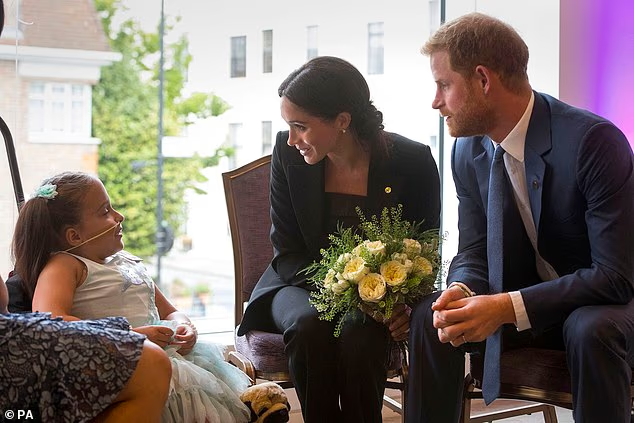
Meghan Markle will not be joining Prince Harry at the WellChild Awards celebrating the achievements and resilience of seriously ill youngsters and their families.
The Duchess of Sussex has not been seen at a public event since the Sussexes returned to the UK in late August, and speculation was rife she would attend the event being staged later in London.
Harry attended major events associated with his Invictus Games on consecutive days last week but there was no sign of his wife.
It has been reported Meghan is aiming to rekindle her work with her UK-based charities but it is understood she will not attend today’s charity event.
Advertisement
Harry has been patron of WellChild – the national charity for seriously ill children and their families – since 2007 and regularly attends the awards ceremony.
The engagement is described as ‘continuing his long association with WellChild as the charity’s patron’, with the awards, which he has attended 15 times, being a ‘significant part of his annual programme’.
In a message on the charity’s website the duke said: ‘It is always a privilege to be part of the WellChild Awards and to meet the extraordinary children, young people, families and professionals whose courage and determination inspire us all.
Advertisement
The Duke and Duchess of Sussex meet a child during the 2018 WellChild Awards in London
‘This year feels particularly special as we celebrate 20 years of the WellChild Nurse programme; two decades of supporting thousands of children and families and helping them to live more of their lives at home.
‘These awards are a wonderful opportunity to celebrate that impact, but above all to celebrate the incredible people at the heart of it. Their stories are a powerful reminder of what can be achieved through compassion, connection and community.’
During the event Harry will meet this year’s winners and their families, carers and health professionals to hear about their experiences supporting children with serious and complex health needs.
Advertisement
Last Thursday, Harry made his first public appearance since returning to the UK, when he attended an event for the Invictus Games, describing life since his return as ‘eventful’.
He then played pickleball with schoolchildren at Ninestiles Academy in Birmingham on Friday, to mark the launch of a new Invictus Games education scheme called Inspire.
The duke’s public engagements come as the serialisation of a book about his mother Diana, Princess of Wales written by his uncle Earl Spencer made serious allegations against the King.
The earl accused the monarch of gaslighting him after Buckingham Palace pushed back against allegations that he said ‘we’ll forget her soon enough’ after Diana died.
Advertisement
Prince Harry play fights with a WellChild award winner at the last ceremony in September 2025
Since the Sussexes flew home on August 26 they have been involved in their own public spat with Buckingham Palace about their status and their children have moved schools after issues were raised by their security team about the school run.
The Sussexes stepped down as working royals in 2020 for personal and financial reasons but rumours remain rife as to why they unexpectedly relocated to the UK from California, where they had created a life away from the institution of the monarchy.
Speculation ranges from the couple wanting their children to develop a closer relationship with their grandfather the King, Meghan seeking a return to acting and the Sussexes wanting to increase their profile.
Advertisement
In the run-up to their return Charles was said to be glad to be able to spend more time with the Sussex family, but remained adamant they would not be working royals, and there was no half-in, half-out option.
Within two weeks of arriving there was reported pushback from the Sussexes after a letter, authorised by the King, was circulated by the Lord Chamberlain to senior stakeholders in the Government and military reiterating the couple were ‘private citizens’ and setting out guidance on how they should be treated.
Harry and Meghan were said to be ‘surprised’ by the formal letter and the couple, who are waiting to hear whether they will be given taxpayer-funded security, were reported to prefer the term ‘public figures’ instead.
School has been an issue for the Sussexes, with their children Prince Archie, seven, and Princess Lilibet, five, moved to a new undisclosed institution after just two days in class.
Advertisement
The decision came after heavy traffic and the lengthy journey to the school reportedly put the Sussexes’ security team under strain.
Marcus Rashford, Kobbie Mainoo and Tino Livramento have also pulled out of the squad for the Nations League games against world champions Spain, Czech Republic and Croatia due to injuries.
Vice-captain Rice, who featured in Arsenal’s 3-0 defeat at Brighton on Saturday, made 69 appearances for club and country last season through to the end of the World Cup and England are being careful with his load management.
The 24-year-old has featured in all five of Chelsea’s Premier League matches this term but struggled with injuries in a disrupted campaign last season, recently saying during a Twitch stream that he “had one leg for 10 months”.
Manchester United manager Michael Carrick confirmed Rashford picked up an “issue” during the 1-1 draw at Fulham on Sunday, with the forward substituted while appearing to be struggling with his hip – which was a persistent issue over the summer.
Midfielder Mainoo, who travelled to this summer’s World Cup but did not play a single minute of the tournament under Tuchel, was also substituted during the closing stages of the draw at Craven Cottage, while Livramento missed Newcastle’s win over Hull.
Gibbs-White, meanwhile, has received his first England call-up in almost a year. The Nottingham Forest captain, who has scored more Premier League goals this calendar year than any other player, missed out on England’s World Cup squad despite his outstanding form.
Advertisement
Gibbs-White has yet to start a match for England but won the last of his six caps in October last year when he featured as a second-half substitute in the 3-0 win over Wales.
Gibbs-White has received his first call-up since last October (Getty)
The 26-year-old was also overlooked last week when Tuchel named his first squad since the World Cup but Palmer’s withdrawal has opened up a place in the No 10 position, with Phil Foden once again overlooked.
Everton midfielder Garner received his first England call-up in March, with Tuchel praising his versatility, but he missed out on the World Cup due to Mainoo’s strong end to the season.
England will play four matches over the newly expanded three-week international break, kicking off against World Cup winners Spain at Wembley on Saturday 26 September.
That is followed by trips to Czech Republic and Croatia, before concluding the set of Nations League games against the Czech Republic at Wembley on Tuesday 6 October.
Advertisement
Updated England squad
Goalkeepers: Jordan Pickford, James Trafford, Jason Steele
Defenders: Trent Alexander-Arnold, Jarrad Branthwaite, Trevoh Chalobah, Marc Guehi, Ezri Konsa, Jarell Quansah, Lewis Hall, Nico O’Reilly
Midfielders: Elliot Anderson, Jude Bellingham, James Garner, Morgan Gibbs-White, Myles Lewis-Skelly, Alex Scott
Advertisement
Forwards: Harry Kane, Dominic Calvert-Lewin, Eberechi Eze, Anthony Gordon, Rio Ngumoha, Morgan Rogers, Bukayo Saka
He died when he was hit by a coach on the busy road
A “kind and loving” man who was killed when he was hit by a coach on the A14 has been named by police. The crash happened on Saturday, September 12 at around 1.35pm between Histon and Milton.
Advertisement
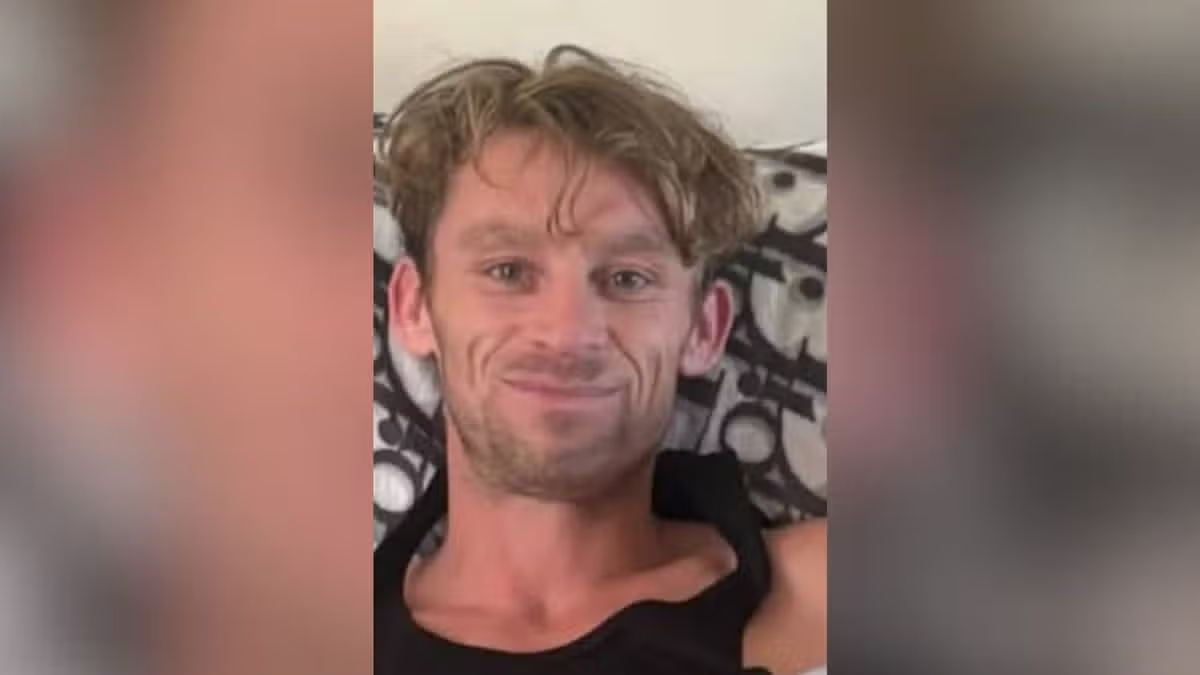
Nathan Price, 33, of King’s Hedges Road in Cambridge died at the scene after being hit by a white Yutong coach. The driver of the coach, a 39-year-old man from Peterborough was uninjured.
Paying tribute to Nathan, his family said: “In loving memory of Nathan Ellis Price, a very much-loved son, brother, father and uncle. Nathan was a kind, loving person with the biggest heart and has left a very big void in our hearts.”
Police are continuing to appeal for anyone who may have dashcam footage of the crash to get in touch. Anyone with information should call 101, quoting incident 260 of September 12.
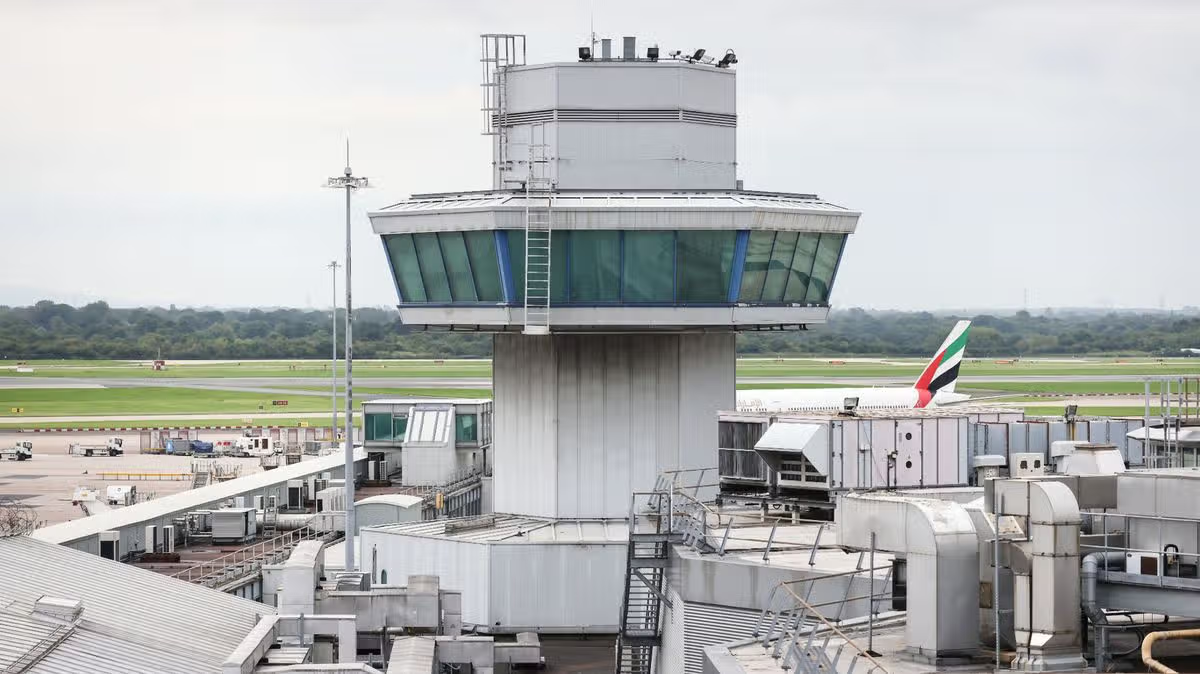
Nats saying the two incidents in September are unrelated does not offer reassurance, the managing director of Wizz Air UK said.
Yvonne Moynihan said in a statement: “Last week, a Nats system failure brought widespread disruption to the south of the UK. Today, another failure has affected the north. Passengers and airlines are entitled to ask: which part of the country will be next?
“Nats claims the two incidents are unrelated. Far from offering reassurance, this raises an even more serious question: how many other hidden weaknesses remain within its systems? Repeated apologies are no longer enough.
Advertisement
“Nats must urgently fix these failures, demonstrate that robust back-up systems are in place and provide full transparency about how repeated outages can occur within such a short period.
“Airlines are once again being left to manage the operational and financial consequences of a failure entirely outside their control while passengers pay the real price through delays, cancellations and disrupted plans. This cannot continue.”
Donald Trump declared today that Russia has ‘lost control’ of its diesel industry after a Ukrainian blitz, even as his own war with Iran sends US fuel prices to record highs.
‘A large number of their Diesel refineries have been blown up and are, at least temporarily, out of commission,’ Trump wrote on Truth Social on Monday morning.
‘This ridiculous and never ending War with Ukraine must be ended,’ he said, claiming 25,000 people, ‘mostly soldiers’, were being killed every month. ‘What a shame!’
The statement came hours after Trump pressed Volodymyr Zelensky to halt Kyiv‘s strikes on Russian refineries during a Sunday phone call, the Financial Times reported.
Advertisement
The president’s message was ‘diesel, diesel . . . diesel’, a senior Ukrainian official on the call told the paper. A second official said Trump wanted Russian fuel flowing back onto the world market to push prices down.
Trump claimed a week ago that Moscow and Kyiv had agreed to stop striking each other’s energy sites, while blaming the global diesel spike on the Ukraine war rather than his conflict in Iran. Ukrainian officials said no such truce existed.
The US and Israel’s strikes on Iran in February effectively closed the Strait of Hormuz, through which roughly a fifth of the world’s oil supply normally passes. US diesel hit a record $6.51 on Monday, according to AAA, up from about $3.76 before the war.
The squeeze has become a headache for Republicans weeks before the midterm elections. Diesel prices are particularly important to the economy because the fuel powers trucks, trains and farm machinery that move food and goods.
Advertisement
President Donald Trump speaks during a campaign rally at the Gastonia Municipal Airport, Wednesday, Sept. 16, 2026, in Gastonia, NC
Flame and smoke is seen rising from Moscow’s oil refinery in the south east of the city following a largescale Ukrainian drone attack, Sunday
Flame and smoke is seen rising from Moscow’s oil refinery in the south east of the city following a largescale Ukrainian drone attack, Sunday
Advertisement
Trump’s call with Zelensky came hours after Ukraine launched what Russian officials said was the largest drone attack ever on Moscow, setting a major oil refinery ablaze and killing at least two people.
Moscow mayor Sergei Sobyanin said 450 drones were shot down.
Kyiv’s drone crews have increasingly targeted the intricate distillation towers that are among the longest parts of Russian refineries to repair.
Around a third of Russia’s refining capacity has been knocked out, forcing Moscow to restrict refined-fuel exports and turn to imports from India.
Advertisement
The pressure comes as the war with Iran expands into Yemen, where Saudi Arabia urged Trump over the weekend to strike Iran-backed Houthi targets.
Trump withdrew at the last minute on Sunday as US commanders were lining up targets and troops had missiles locked and loaded, the New York Times reported.
Iran-backed Houthi rebels seized territory in Yemen in weekend fighting with Saudi-backed forces. The fighting has further threatened shipping through the Bab el-Mandeb Strait, a key route for global energy supplies.
The route has become more important as the conflict has disrupted other energy corridors, including Saudi Arabia’s East-West pipeline, which carries Aramco oil around Hormuz.
Advertisement
Russian President Vladimir Putin meets with Russian Federal Customs Service Valery Pikalev in Moscow, Monday
Ukrainian President Volodymyr Zelensky (C) attends a ceremony of the National flag rising in the reclaimed city of Izyum in Kharkiv’s area, Ukraine, 2022
Putin said this month he had ordered his forces to prepare a mass air strike campaign in retaliation for Kyiv’s attacks on Russian energy sites.
‘They are hitting ours. They’ll get an answer. That’s basically how it is,’ he said.
Advertisement
The Kremlin leader is unlikely to agree to any energy truce before winter is out, when his forces plan a punishing air assault on Ukraine’s grid, people briefed on his thinking told the FT.
One senior Ukrainian official believes Trump may be sitting on the sweeping Russia sanctions law he signed last week as leverage to get Kyiv to stop the refinery strikes, the paper reported.
Zelensky, who meets Trump on the sidelines of the UN General Assembly on Tuesday, defended the campaign on Monday, calling the strikes ‘part of the pressure that is actually working and the world can feel it.’
Axel Rudakubana also allegedly punched an officer and threatened to “soak” another
Southport killer Axel Rudakubana was back in court today (Monday, 21 September) after allegedly throwing boiling water mixed with sugar at a prison officer.
Advertisement
During the alleged incident on May 8 last year, Rudakubana threw the substance through a hatch on his cell door at HMP Belmarsh in south London. Westminster Magistrates’ Court heard on Monday that “prompt medical attention prevented lasting injury”.
Two days prior, Rudakubana allegedly threatened to “soak” a female officer outside his cell if she did not pass him a newspaper and then threw an “unknown liquid” at her, causing no damage, prosecutor Catherine Pattison said.
Click here to hear the latest from Manchester’s courts in our newsletter
On October 28, Rudakubana also allegedly “punched a male officer who had challenged the defendant when he had attempted to walk past officers seeking to establish if he had taken certain medication”, the prosecutor said.
Advertisement
Ms Pattison added that in June last year, Rudakubana had allegedly sharpened stone shards at the prison, “seemingly prised from the floor of the defendant’s cell”, which were found stuck to the underside of a shelving unit. She went on: “When questioned by a prison officer, he said that he was keeping them for self-defence.”
Rudakubana claimed after the alleged boiling water attack that prison officers had been poisoning his food, the court heard. He is charged with attempting to cause grievous bodily harm, two counts of assaulting an emergency worker and possession of an offensive weapon in prison.
Ms Pattison told the court: “Since his incarceration there have been a number of incidents that have arisen that have resulted in four charges for which he appears before you today.”
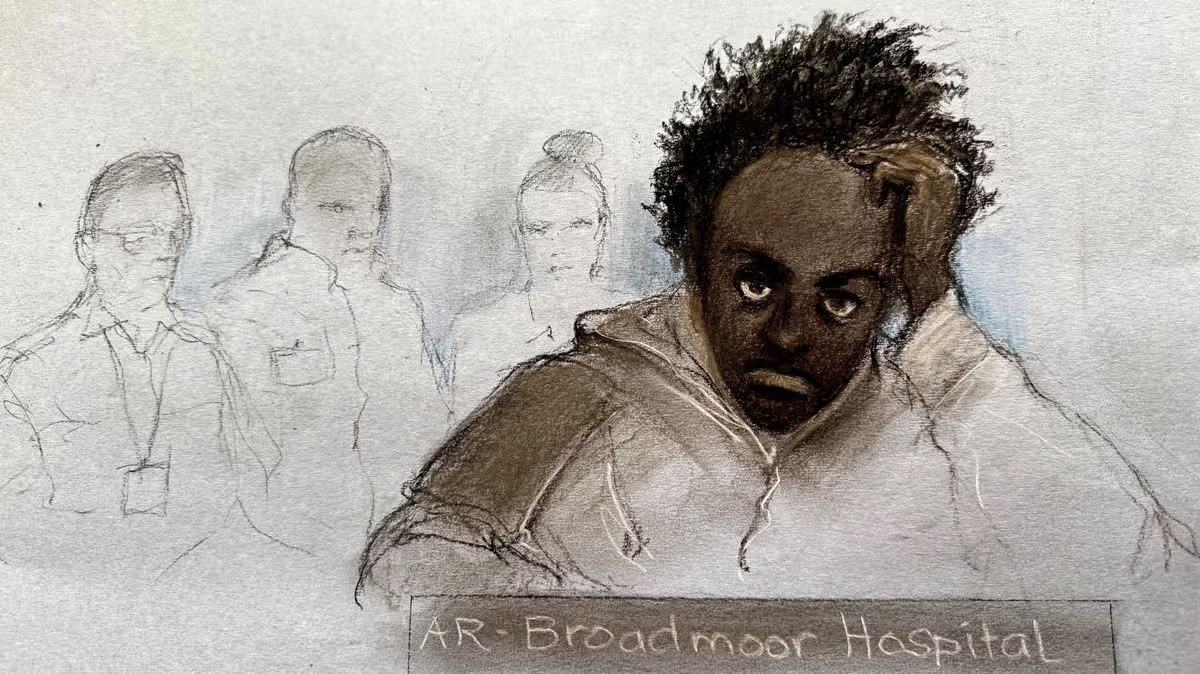
Rudakubana appeared via video link from Broadmoor psychiatric hospital and had his head rested on his hand during the hearing, during which he was not asked to enter pleas. He was remanded in custody to appear at the Old Bailey on October 19.
Offenders who present an increased risk and cannot be managed safely in a prison environment because of mental disorders can be moved to secure psychiatric units. People in these units are treated as patients rather than prisoners.
Broadmoor, in Berkshire, is the oldest of the UK’s three high-security hospitals and has held some of the UK’s most high-profile criminals, including Ronnie Kray and serial killer Peter Sutcliffe – also known as the Yorkshire Ripper.
Under the Mental Health Act, officials acting for the Justice Secretary have no choice but to accept the advice of clinical professionals to transfer prisoners to a secure facility.
Advertisement
An offender in a secure hospital will be compelled to engage with treatment and to undertake therapies before any return to prison or release into the community. Where offenders no longer require treatment in hospital, the Act allows a swift return to prison.
A pensioner was forced to have both his legs amputated after it took 29 medical appointments and four years to diagnose a common medical condition.
Nic Olsen, 80, visited his GP in 2020 after he began to experience foot and leg pain.
Believing it was linked to the back problems Mr Olsen had suffered with for years, he was referred to an orthopaedic specialist.
What followed was years of appointments with consultants, specialists and GPs, as well as endless scans and tests while his pain continued to worsen.
Advertisement
Each time he was sent away with new remedies, including being told to ‘walk more’, put insoles in his shoes or take cholesterol tablets.
The semi-retired financial adviser from Tugby, Leicestershire, even collapsed and saw his big toes ‘burst open’ before a blockage was finally spotted in the arteries in his lower legs.
He was diagnosed with peripheral arterial disease (PAD), which causes arteries to narrow due to the build-up of fatty deposits in the walls, leading to blockages.
The common condition affects one in five people over the age of 60 and can be diagnosed with a simple Doppler test, which uses ultrasound to measure blood flow.
Advertisement
However, by the time Mr Olsen was diagnosed, it was already too late and his condition was so advanced that treatment was unlikely to succeed.
Nic Olsen, 80, lost both his legs after it took four years for medics to diagnose a common medical condition
Mr Olsen visited his GP in 2020 after he began to experience foot and leg pain
Advertisement
He was given an angioplasty followed by two bypass surgeries to reopen the arteries, but after that didn’t work he was forced to have a double amputation.
Both legs may have been saved had he been diagnosed earlier.
His ongoing treatment is also estimated to have cost the NHS £1million. But the figure would have been a fraction of this had his condition been properly diagnosed earlier.
Mr Olsen’s initial symptoms included pain, swollen feet and the loss of the hair on his lower legs – all recognised signs of PAD.
Advertisement
His wife Fiona said the Doppler test would have quickly identified a circulation problem in his legs.
Instead, he had a spectrum of tests including MRI scans, X-rays and blood tests over the next four years.
The mother-of-one, a retired travel and tourism teacher, said: ‘A Doppler is a simple test – you’d be able to hear from that if there is a circulatory problem. But nobody did one for years.’
‘All Nic ever talked about was the pain,’ she added.
Advertisement
‘He would say it was like someone was stabbing him with a carving knife.
‘He had all kinds of examinations and saw all kinds of doctors, surgeons and specialists.
‘Finally, after four years, someone looked at his ultrasound and said, “Oh my God, this is serious”.
‘They tried everything, but we were left with no option but amputation.
Advertisement
‘Nic’s care from start to finish has cost the NHS over £1million – if this condition had been found at the start, it could have been a fraction of that.
‘He could have had an angioplasty there and then, when it was still early, which costs the NHS about £1,000 – and would have saved his legs.
‘He had 29 different appointments before he got a diagnosis, it’s disgraceful. Lessons have to be learnt.’
Mr Olsen, pictured with his wife Fiona and daughter Emma after his double amputation
Advertisement
For months after his first appointment, Mr Olsen continued trying to find answers to what was causing his pain, as it turned to agony and he became less mobile.
During a holiday to Tenerife in January 2024, one of his toenails burst open and began gushing blood.
However it wasn’t until nine months later that a different podiatrist asked about whether he’d had a Doppler test.
Mrs Olsen, who is now her husband’s full-time carer, said: ‘She did the Doppler finally and there were no sounds of circulation. We knew then that it was bad.’
Advertisement
He was sent for an electrocardiogram (ECG) – a test to record the electrical activity of the heart.
He was also referred to a vascular hospital where a consultant revealed that he had chronic PAD.
Despite the diagnosis, he was just told to walk 10,000 steps a day and was prescribed cholesterol tablets, she said.
In January, 2025, Mr Olsen collapsed from the pain and was unable to walk.
Advertisement
After three further trips to the hospital, a different consultant looked at his ultrasound scan and raised the alarm.
Mr Olsen was sent for an angioplasty – a procedure to unblock arteries – but the procedure didn’t work.
He then underwent an arterial bypass – a large and risky 13-hour surgery, again to no avail
She said: ‘By this point the pain was phenomenal for Nic, so the next option was amputation.’
Advertisement
He had his right leg – the worse of the two – amputated below the knee in April 2025.
Within two weeks of returning home from his amputation, his second foot became ulcerated and he needed a second amputation in July 2025.
Mr Olsen, who also has two sons from a previous relationship, went through months of gruelling rehab using prosthetic legs to walk again.
In June 2026, he was strong enough to walk daughter Emma Olsen, 30, down the aisle on her wedding day.
Advertisement
Mr Olsen went through months of gruelling rehab using prosthetic legs to learn to walk again
Fiona said: ‘Nic is very brave and doesn’t say a lot, but every now and then he’ll gasp from phantom limb pain.
‘I know he has some dark thoughts, but my husband is so strong.
‘Nic is doing so well because of his massive strength and stamina.’
Advertisement
Mr Olsen said: ‘I don’t think any of the people I spoke to knew what PAD was. All the symptoms were ignored.
‘After amputation, it’s two or three weeks after you get home is when reality hits, and you reach your darkest mental state.
‘I slipped through the net. But early diagnosis saves lives, and it’s totally preventable if it’s diagnosed early enough.
‘I wouldn’t be anywhere without Fiona there behind me.’
Advertisement
Mrs Olsen is now campaigning to make more people aware of the PAD symptoms her husband had – including resting leg and foot pain, swollen toes and no hair on his lower legs.
She said: ‘The whole thing was shambolic. The only way I can let my anger out is to help people in the future.
‘Even the specialists say we need to keep banging the drum – PAD can easily be put right if you spot the signs early.’
Around 631,000 years ago — a geological blink of an eye — catastrophe unfolded in what is now north-western Wyoming, US. During what is thought to have been a series of immense volcanic eruptions, life within hundreds of kilometres of the blasts was shattered. Ash was dispersed across much of North America and the effects were felt worldwide. This was a super-eruption of the massive volcanic system located in what is now the Yellowstone National Park.
Despite the scale, no known human witnessed the cataclysm. As far as we know, early humans had not yet reached the continent. Across oceans, perhaps early humans did wonder at the hazier skies and unusually vivid sunsets. Volcanic particles circulating in the sky cooled their climate and likely affected their weather patterns and lives. Whether they noted these changes – or connected them to any distant event – is unknowable.
Today, humanity would certainly notice. We already know that a super-eruption on this scale would be a threat civilisation as we know it. So what exactly would we experience if Yellowstone erupted? We are experts in disasters and volcanoes and what follows is a thought experiment into what might happen in the worst case scenario. We’ve based our hypothesis on research and by examining how countries have dealt with disasters in recent years.
T-2 months
Shortly after 6am, an analyst at the University of Utah Seismograph Stations sees a series of sharp spikes interrupting the usually quiet wavy lines recorded by Yellowstone’s earthquake monitors. The measurements represent earthquakes detected beneath Yellowstone overnight. The scientist raises an eyebrow and takes a deep breath – these observations don’t fit with Yellowstone’s usual behaviour.
Advertisement
The Insights section is committed to high-quality longform journalism. Our editors work with academics from many different backgrounds who are tackling a wide range of societal and scientific challenges.
People often imagine Yellowstone as a sleeping “supervolcano”. It may sleep, but its geological processes never do. An array of instruments monitors its activity – and any changes in it. A dense network of seismometers records earthquakes in the region. Around the clock, data feeds in from GPS stations, strainmeters (instruments which measure deformations and changes in the shape of the Earth’s crust) and sensors positioned within its active geyser areas. Satellite observations, gas sampling and field surveys add plenty more information.
Scientists look at the number of earthquakes along with their location, depth and size. Earthquake “swarms” warrant particular attention, especially when they appear to be migrating through the crust (Earth’s solid, outermost rocky shell) or becoming progressively shallower. Such patterns can indicate that magma or pressurised hydrothermal fluids (hot, mineral-rich water) is moving upwards.
Our scientist is relieved to discover that most of the unusual tremors are tiny — too weak to have been felt. But together, they form an unusually concentrated swarm. The analyst checks the signals against neighbouring seismometers and, more out of curiosity than concern, contacts colleagues at several partner organisations comprising the Yellowstone Volcano Observatory (YVO) in order to follow YVO’s response plan.
They deduce that, overnight, instruments have recorded a tightening cluster of earthquakes beneath Yellowstone’s vast caldera, which is roughly 55–70 kilometres across. Yellowstone experiences thousands of earthquakes each year, and swarms are not unusual. But this one appears to be migrating ever so slightly upwards. Still, an earthquake swarm by itself doesn’t mean Yellowstone is preparing to erupt, nor does ground deformation, changing temperatures or gas emissions. Scientists are more concerned about several such changes happening together.
The team of scientists decides to wait and see what happens next.
T−1 month
Four weeks later, the swarm has continued to migrate upwards. New events are also appearing along a narrow zone beneath the caldera, notes the analyst, who has now lost their appetite for both food and caution and is writing reports designed to be alarming. GPS stations above the swarm have begun moving apart. Measurements of strain have increased and satellite radar reveals the cause: there’s a broad area of accelerating uplift of the ground.
Advertisement
The surface of a volcano inflates and deflates as the magma chamber below it changes in pressure. Measuring this motion can help tell scientists whether a volcano is building to an eruption. USGS and Jessica Murray-Moraleda, CC BY-SA
Together, the observations are consistent with magma forcing its way into the crust – as seen in places like Hawai’i prior to eruptions. Reassuringly for YVO staff, Yellowstone has produced similarly alarming combinations of signals before with no subsequent eruptions. Between 2013 and 2014, parts of the caldera began rising at rates of more than 15 centimetres a year and earthquake activity increased.
This culminated in a magnitude 4.8 earthquake, the largest recorded at Yellowstone since 1975. Shortly after, the uplift changed to subsidence (the ground moving downward) and scientists concluded that the episode was associated with hydrothermal fluid movements rather than magma.
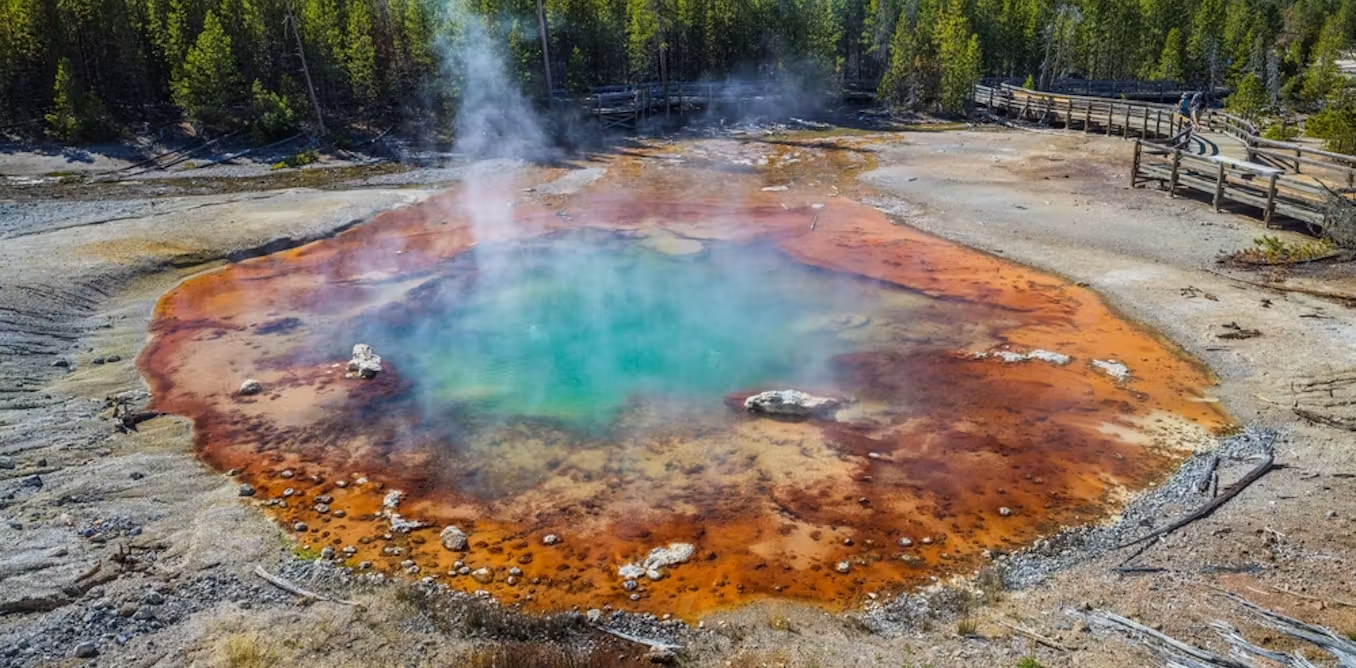
The Biscuit basin explosion at Yellowstone was an example of an eruption caused by hydrothermal fluid rather than magma.
Mindful of the need to keep the public informed without causing unnecessary alarm, YVO responds cautiously. A duty scientist assumes responsibility for assessing the incoming data. Additional, temporary seismometers and GPS units are deployed to provide more precise data, and gas and water are sampled more frequently.
YVO begins closer coordination with the National Park Service and emergency management authorities, reviewing road closures, public communications and evacuation plans. Perhaps ominously, but to err on the side of caution, Yellowstone’s Volcano Alert Level is raised from “normal” to “advisory”, indicating that unrest is above its established background level.
Advertisement
These developments are worrisome enough that scientists start speculating about a major eruption’s impacts. The media take an interest, but the volcanologists have learned how damaging it can be when volcanic uncertainties morph into a full-blown dispute, played out in public.
Scientists privately discuss differences in interpretations, agreeing on regular updates for the public via media briefings and social media postings. As the volcano’s activity continues to ramp up, high-level decision-makers are alerted that this situation could become a major catastrophe. The probability of it happening within three months increases from 6-9% to 21-27%.
Due to the uncertainties, the politicians make no specific declaration. The US’s Federal Emergency Management Agency nevertheless starts drawing up plans for a large-scale evacuation. They express confidence in public while perhaps fearing in private that a worst-case scenario could make it hopeless to try to save everyone.
Over the following fortnight, the unrest escalates dramatically. Earthquakes become more frequent and shallower. Long-period seismicity (much gentler earthquakes, usually caused by fluid movement rather than faults shifting and known to occur at Yellowstone) and sustained volcanic tremors suggest magma and pressurised fluids are forcing open fractures in the ground.
Advertisement
The uplift accelerates and GPS stations move centimetres in days. Geyser activity becomes increasingly erratic. Even the Old Faithful geyser becomes less faithful: its usually regular eruptions become harder to predict. Meanwhile, gas measurements and changes in spring water chemistry indicate an increased input of carbon dioxide and sulphurous gases into Yellowstone’s hydrothermal system. Taken together with the shallow earthquakes and rapid uplift, the concern is that magma may be moving upwards.
T-2 weeks: ‘It’s gonna blow!’
These new observations lead to a press conference describing an 85-92% probability of a cataclysmic eruption within three weeks. At this point, the YVO raises Yellowstone warning to “watch”, and the USGS raises the Aviation Colour Code to orange, with aircraft rerouted around the region.
An evacuation zone extending 100 kilometres beyond Yellowstone National Park is announced, affecting roughly 200,000 residents, as well as thousands of visitors in the region. The topic now dominates both traditional and social media. The attention likely spawns detractors as well as conspiracists. The former claim that nothing will happen. The latter spread the disinformation that YVO is being paid by foreign shadow billionaires to bring down the US so that other countries can control the world’s economy.
Even the best-laid plans don’t always go according to plan. wikipedia
Now that a super-eruption appears imminent with high confidence, world leaders swing into action. They must make a choice: help each other as a global village or repeat COVID-19 style global shuttering.
If they choose collaboration, then they start evacuations, moving people as far as needed – including across international borders. This would involve supporting them with adequate homes, water, food, electricity and community through schools, jobs, transport and safety. Achieving all this seems unlikely, since most of the world’s population has always lacked it. Nonetheless, the US has the money, skills and goods to evacuate and resettle the huge numbers, if leaders cooperate and use everything available.
More likely, many countries could be reticent to accept “volcano refugees”, making excuses – perhaps legitimate ones – that they don’t have the money, resources or space to safely settle so many people so swiftly. They are further stretched by those who self-evacuate through having more than one passport, along with the wealth or the social network to start afresh.
Charities step in to help some people leave on chartered planes, as well as via long, excruciating journeys on overcrowded trains and buses. The most marginalised and poorest may have no option but to stay behind. Some might join the minorities who do not believe the eruption will happen, who think their well-stocked underground bunkers will protect them (an overly optimistic belief), or who would rather die at home than live in a foreign land with a devastated world.
T=0
In an instant, seismic instruments are overwhelmed by an intense burst of shallow earthquakes. Expanding clouds of steam rise from newly opened cracks. The YVO and USGS have no choice but to raise the warning level and Aviation Colour Codes to red: a dangerous eruption is imminent.
Advertisement
The eruption does not begin with the entire caldera exploding at once. Instead, rising magma intrudes into Yellowstone’s shallow hydrothermal system, rapidly vaporising immense volumes of water. At atmospheric pressure, water can expand in volume around 1,700 times when converted to steam. Trapped beneath the surface, this rapid expansion triggers violent so-called phreatomagmatic explosions that send superheated steam, mud and shattered blocks of rock kilometres into the air.
There are no human casualties yet, thanks to the wide exclusion zones on land and in the air. Wildlife, livestock and vegetation are not as fortunate. Within roughly 4–6 kilometres of the initial eruption sites, the landscape is battered by falling rock, ash and mud. Beyond the exclusion zone, people watch an impressive two kilometre-high plume rise into the sky – but it rapidly grows larger, and any sense of relief is short-lived.
A few hours later, gas-rich magma, 650-800°C in temperature – well above the melting points of lead and zinc – breaks through the fractured surface. As the confining pressure falls, dissolved gases separate into distinct components from the melt and expand violently. The magma fragments into pumice (porous rock) and ash while tearing away huge fragments of the surrounding rock from the walls of the erupting vent.
Expanding gases and intense heat drive this material upwards, creating a vast eruption column rising 30–50 kilometres into the atmosphere – far above commercial passenger aircraft, which usually cruise at up to about 13 kilometres. On this clear morning, its upper reaches are visible from Denver, some 800 kilometres away.
Advertisement
As the eruption continues and the volume of material expelled mounts, scientists realise it might be the opening stages of a VEI 8 super-eruption (magnitude 8 or greater) – the highest formal notch on a scale used to measure the size of explosive volcanic eruptions. It was 74,000 years ago that humanity last witnessed this scale of eruption with Toba in Indonesia.
The immense umbrella cloud that forms does not behave like a normal ash plume that simply drifts with the prevailing wind. Its momentum initially drives ash outwards in every direction – spreading hundreds of kilometres before high-altitude winds take over and carry fine ash thousands of kilometres downwind within a day.
After a few hours of continuous eruption, parts of the column collapse, generating scorching pyroclastic density currents (extremely hot, fast-moving mixtures of gas, ash and rock fragments). These surge for tens of kilometres, splintering trees, igniting forests and burying the remnants beneath hot ash and pumice.
Anyone within this zone is pulverised by the blasts, crisped by the heat, or asphyxiated by the ash. There may be up to 1,000 immediate human deaths, including people who refused to move. It is too dangerous to recover most bodies. And even if it were possible, many bodies no longer exist to be recovered.
Advertisement
Outside the main pyroclastic density current zone, casualties mount from vehicle crashes as drivers lose visibility or skid due to ash, from heart and breathing difficulties and from suicide. Vegetation fires spreading beyond the immediate burn zone add perhaps hundreds of fatalities from burning, smoke inhalation and vehicle crashes.
As the magma continues to escape, sections of the unsupported ground subside, opening new fractures and vents while feeding further eruptive columns and pyroclastic density currents. Hundreds of kilometres away – in Denver and along the Canadian border – heavy ashfall darkens the sky, obstructs roads and disrupts power, water supplies and communications. This ash devastates farmland across at least eight states.
Further immediate deaths could result from loss of power disrupting traffic and street lights; curtailing health services including surgery and obtaining prescriptions; and electrocution, fire and carbon monoxide poisoning from trying to set up and operate home electricity generators. Looting and increasing crime during disasters is typically rare, but it could happen in a more desperate worst-case scenario, adding to the casualty toll.
Over the coming days, the eruption continues in pulses as sections of the caldera collapse and new vents open. Successive column collapses generate pyroclastic density currents with the resulting deposits reaching several hundred metres in thickness, as they did in the last super-eruption.
Advertisement
Nearby infrastructure is shattered and entombed beneath the deposits. Airports close because ash interferes with aircraft and other transport networks falter. Communities across all states bordering Wyoming face darkness, breathing difficulties and roofs collapsing under accumulated ash. As the eruption eventually begins to weaken, sulphur dioxide high in the atmosphere forms sunlight-reflecting sulphate aerosols that spread around the northern hemisphere to influence the world’s climate for several years.
T+3 days
Three days into the eruption, much of North America is living in the shadow of Yellowstone. Each successive powerful eruptive pulse sends another column tens of kilometres upwards, from where it spreads into a new umbrella cloud.
Within Wyoming and neighbouring states, conditions are catastrophic. Billings, Montana, the nearest large city, is disappearing beneath what will eventually exceed a metre of ash (one published model of a Yellowstone supereruption predicts the city as receiving up to 1.8 metres of ash). Salt Lake City, Utah, and Boise, Idaho, receive tens of centimetres. For southern Canada, much of the US and northern Mexico, day becomes twilight and breathing outdoors without masks becomes increasingly difficult. People on other continents watch in trepidation under vivid, red-orange sunrises and sunsets.
Back in the US, electricity networks begin failing. Warnings had not been heeded that damp ash conducts electricity, short circuiting power lines and substations. Ash clogs machinery and generator intakes. Its weight damages cables and weaker structures.
Advertisement
Infrastructure damage at Hebgen Lake due to the 7.2 magnitude earthquake of 1959. I.J. Witkind. – USGS Photographic Library/wikipedia
As electricity fails, so do water pumps, sewage treatment, heating systems, fuel stations and mobile phone and internet networks. People are scared and supermarket shelves empty nationwide as regional and national supply chains begin to break down.
T+2 weeks
Over the following weeks, the crisis becomes one of survival. Repeated ashfall blocks roads, overwhelms drainage systems and damages roofs. During rain, dry ash turns into a dense slurry that makes clearance work harder. Airports remain closed or severely disrupted across much of North America, while railways, freight depots and farms struggle to operate. Livestock and crops die where pasture and water supplies are buried or contaminated by ash.
Large areas close to Yellowstone remain evacuated, while across the US, shelter, fuel, food and clean water become increasingly scarce. Some countries airlift or airdrop humanitarian relief supplies, but are also concerned about stockpiling for themselves. Losses to agriculture, transport and insurance – with many other businesses and services closed – could lead Canada, Mexico and most Caribbean and Central American countries to declare states of emergency. This is partly due to direct impacts on those countries and partly due disruption across the USA and people fleeing from it.
T+4 months
Several months later, eruptions have weakened to intermittent explosions, but the threat of renewed activity remains. For millions, the disaster is far from over. Dry, windy days lift ash back into the air, while rain and snow turn it into a heavy deposit blocking drains and damaging infrastructure. Eye and throat irritation are widespread. People with asthma and other respiratory conditions face serious health risks under reduced and overworked health services.
Advertisement
Water treatment and power plants struggle with ash contamination, equipment failures, lack of spare parts and overwhelming demand, disrupting essential medical and industrial processes. Crops across the most heavily affected regions have been buried. The loss of American and Canadian grain, maize and soya exports drives global food prices upwards.
Flights gradually resume in less affected areas, but airports across North America repeatedly close whenever winds remobilise the ash. The unreliable airspace and transport networks – coupled with agricultural losses, business disruption and reconstruction costs – trigger banking and insurance crises, producing a global recession.
Meanwhile, the atmospheric effects become global. Most volcanic ash has fallen out, but sulphur dioxide injected into the stratosphere produces sulphate aerosols which reflect a significant proportion of the Sun’s energy. Scientists call it a “volcanic cooling episode”, avoiding the term “a new ice age”. Modelling suggests it’s unlikely to cool the global average by more than about 1.5°C, although particular regions and seasons could experience much larger changes. Notably, central North America remains far cooler than before the eruption.
T+10 years
In the years following the eruption, the world moves into long-term recovery and rebuilding. People across the world adapt to a more agrarian lifestyle, learning to fill the land with root vegetables, grains and legumes. With far less leisure time and diminished income, recreational facilities are turned over to food production, notably small-scale greenhouses and vertical farming for producing varied fruits, vegetables, nuts and legumes.
Advertisement
Livestock decreases due to lack of land and feed, opening up more space for crops. People still eating meat typically either hunt big game or trap smaller birds and mammals. Insect farming tends to dominate the re-establishment of bird or mammal farms. People living near coasts, rivers and lakes ramp up fishing, depleting stocks rapidly until controls are enacted in some locations, along with increased farming for seaweed. Where rules are not agreed or enforced, starvation and migration are rampant.
Freshwater availability varies. The world’s climate has changed, providing ample rainfall in some places while drying out others. Large-scale water treatment technology remains known and used, but supply lines for chemicals and spare parts are unreliable. Many people develop local approaches and manage while others suffer contaminated water and disease, including cholera, dengue fever and malaria, just as billions did before the eruption.
Before the eruption, around 4.4 billion people from the world’s population of 8.3 billion lacked full, safe freshwater access. A decade after the eruption, it’s possible that 4.8 billion people lack such freshwater, while the world’s population may have declined to 7.9 billion due to spikes in elderly and infant mortality.
For the eruption’s survivors, disease and death are still rising. The eruption may well provide substantive, long-term evidence for the carcinogenic level of silica in the ash. A small but statistically significant increase in diagnoses of both silicosis (an irreversible lung disease) and lung cancer appears from exposure to ash, with similar results for cardiovascular disease in people breathing in ash particles.
Advertisement
Rates are likely higher than measured, because health systems across a continent were knocked out by the eruption and struggling to recover ten years later. The worst part is that the lack of health systems means that many who are diagnosed cannot be treated properly. Survivable diagnoses become lethal.
Inside the eruption zone, two decades follow of a grey landscape. It appears almost lifeless, with the ash transformed into raging mudflows called lahars in every storm. But vegetation, starting with grasslands and shifting to forests, creeps back into the swathes wiped out in the explosion and people follow. These new pioneers coax the landscape into fertile framing, helping to feed hungry populations.
A lahar travels down a river valley in Guatemala near the Santa María volcano, 1989. wikipedia/USGS geologist Jeff Marso
The dispersed ash eventually settles out of the atmosphere, permitting the Sun’s rays to shine fully on the surface again – reviving agriculture and ecosystems. It also revives fears of human-caused climate change, despite the volcano-induced reduction in greenhouse gas emissions. Scientists work hard to determine whether the global climate has been knocked onto a new trajectory – which might be better or worse for human beings – or whether the heat stored in the atmosphere and oceans from humanity’s greenhouse gas burning will once again force a rapidly heating globe.
Additionally, scientists want to calculate deaths, injuries and loss to quality of life. Excess mortality analyses could suggest 0.7-1.3 billion premature deaths due to the eruption and its impacts. Perhaps double that number experienced temporary or permanent health effects but survived, although some will say that 100% of humanity was directly affected.
Advertisement
The good news, at least for our species, is that this unstoppable power of volcanism changed the planet, but did not end humanity – or come close to doing so.
T+1 million years
A creature descends to Earth from a sleek spacecraft, still humanoid but far removed from its ancestor species Homo sapiens sapiens. Tjjze (the pronoun used) has absorbed all the scant information available about ancient “Earth” and is curious to learn more.
The most notable material is the rise of its first technological civilisation just over a million years ago. This was followed by the species abandoning the planet as it changed 140,000-160,000 years ago – becoming taller, sleeker, with longer limbs, and with larger hands, heads and brains – having already established itself around the galaxy. In the remaining lore, myths recur of episodes of runaway planetary temperature changes, hot and cold, as well as a series of volcanic blasts that changed the globe.
Tjjze observes that the vegetation is lush and the H₂O is plentiful, providing ample food and water for the bizarre animals and ecosystems. A rapid scan reveals much below the surface. In fact, a large roughly ellipse-shaped ridge made of rock appears prominently underneath the top layers. Yes, this particular region, about 24.3 cqurzots in radius, is definitely lower than the vast plains outside the depression. This seems to indicate an ancient volcanic eruption. And to leave a scar this big, it must have been gigantic.
Advertisement
Tjjze warps the equivalent of the face into the equivalent of a frown as more data are revealed. Indeed, this definitely looks like a caldera. And the age is coming in at around a million years (plus/minus).
Could it have erupted during the time of the technological civilisation? Or were they lucky to have just missed it? It is impossible to really know.
To hear about new Insights articles, join the hundreds of thousands of people who value The Conversation’s evidence-based news. Subscribe to our newsletter.





















































You must be logged in to post a comment Login