Connect with us

NewsBeat

Parched Britain: UK’s 43 days with no rain and 35C heatwave triggers ‘exceptionally severe’ wildfire warning

Published

on

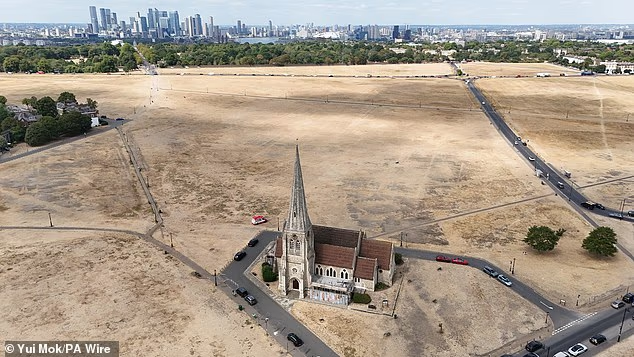
Grass in Blackheath, south-east London, has turned entirely brown

Experts have warned of ‘exceptionally severe’ wildfires as temperatures are set to soar to 35C today in the fourth heatwave of the year.

A plume of intense heat surging from North Africa is set to reach the UK today, after bringing exceptionally high temperatures to France and Spain in recent days.

Amber heat-health alerts have been issued for the East Midlands, the east, south-east and London as the mercury rises once again this summer. 

It has led to fears of wildfires on southern and eastern parts of England’s already bone-dry landscapes. 

Advertisement

The Met Office assessment showed any fires could be ‘exceptionally severe’ due to the conditions.

Fire services in England and Wales have already responded to more than 700 wildfires in 2026, with more than 200 recorded in the last two weeks, the National Fire Chiefs Council (NFCC) said.   

Fire chiefs said eight wildfires are currently burning across the UK and warned that there remains an ‘elevated risk’ of more igniting.

The Royal Horticultural Society garden in Wisley, Surrey, has been named as the driest place in the UK after going 43 days without any precipitation, turning the gardens to scorched dust.

Advertisement

If rain continues to hold off for another two days, it will equal the national record of 45 days set in the summer of 1976. 

Grass in Blackheath, south-east London, has turned entirely brown

Weeks of minimal rain and the second hottest month on record in the UK has left the fields severely parched

Weeks of minimal rain and the second hottest month on record in the UK has left the fields severely parched

Advertisement
The basin of Grafham Water in Cambridgeshire is visible, where water is receding due to the continued dry weather

The basin of Grafham Water in Cambridgeshire is visible, where water is receding due to the continued dry weather

Derbyshire Fire and Rescue Service said firefighters were continuing to ‘make progress at the major wildfire incident at Tintwistle Moor’ after 60 personnel were deployed on Tuesday.

Wildfire numbers in England and Wales remain lower than the 788 recorded by the same point last year, but fire chiefs warned that continued dry spells could raise the risk of fires starting and spreading rapidly. 

Large-scale wildfires across mainland Europe have demonstrated the threat posed by the dry conditions, with large-scale evacuations carried out in areas of France and Italy.

Advertisement

The NFCC said UK wildfires are typically smaller and different in nature to those seen in southern Europe, adding, however, that the ‘long-term effects of climate change are increasing the likelihood of larger, more complex and more resource-intensive wildfire incidents occurring’.

Phil Garrigan, chairman of the NFCC, said: ‘More than 200 wildfires in just 12 days shows how quickly the risk can escalate when hot, dry conditions take hold.

‘The scenes we’re seeing across parts of Europe are a stark reminder of what a changing climate means for fire and rescue services.

‘We are not seeing fires of that scale in the UK today, but the science tells us we should expect larger, more frequent and more complex wildfires in the future.

Advertisement

‘That’s why we need continued investment in specialist wildfire capabilities, including aerial firefighting support, so we’re prepared for the risks ahead.

‘But prevention remains our strongest defence. Most wildfires are avoidable, and we’re asking everyone to take extra care during the hot weather to help keep their communities safe.’

They called for Brits to be extra cautious with anything that could start a fire, including disposable barbecues and cigarettes. 

Photographs showed scenes of Blaenavon in Wales, on Tuesday as a major wildfire left the landscape scorched and blackened.

Advertisement

A blaze which broke out on Mynydd Garnclochdy between Blaenavon and Abersychan on Sunday, July 19, has now been burning for ten days.

Firefighters are continuing to battle flames across more than 220 hectares.

South Wales Fire and Rescue Service has been working around the clock in smoky and humid conditions, using specialist wildfire tactics and equipment to contain the flames.

Portions of Mynydd Garnclochdy and its surrounding upland common land are designated and managed as part of a Site of Special Scientific Interest (SSSI), specifically linked to the broader Blorenge SSSI ecosystem recognized for its vital peatland and moorland habitats.

Advertisement

At the height of the fire, shifting wind conditions carried smoke for miles across south Wales.

Last week, residents reported the smell of burning vegetation from as far as 30 miles away in areas such as Caerphilly, Cardiff and Newport.

A veil of smoke can be seen over the skyline of the World Heritage town.  

Up to an estimated 60 per cent of the common land used by local farmers to feed their livestock has been destroyed.

Advertisement

On Saturday, firefighters were seen battling a field blaze in Cambridgeshire, which was sending huge clouds of thick smoke into the sky.

Blackened hillsides show the devastating aftermath of the wildfire surrounding Blaenavon, Torfaen in Wales

Blackened hillsides show the devastating aftermath of the wildfire surrounding Blaenavon, Torfaen in Wales

Firefighters in Blaenavon are continuing to battle flames across more than 220 hectares after it has burned for ten days

Firefighters in Blaenavon are continuing to battle flames across more than 220 hectares after it has burned for ten days

People gather on the brown grass at the very dry Primrose Hill as heatwaves continue

People gather on the brown grass at the very dry Primrose Hill as heatwaves continue

Advertisement
Empty deckchairs on dry grass at Green Park in London

Empty deckchairs on dry grass at Green Park in London

Swithland Reservoir in Leicestershire is currently at less than 44 per cent capacity according to Severn Trent Water

Swithland Reservoir in Leicestershire is currently at less than 44 per cent capacity according to Severn Trent Water

Low water levels are seen at Howden Reservoir, Peak District, after sustained high temperatures and low rainfall

Low water levels are seen at Howden Reservoir, Peak District, after sustained high temperatures and low rainfall

Thick plumes of smoke formed over burning fields near Peakirk, Cambridgeshire

Thick plumes of smoke formed over burning fields near Peakirk, Cambridgeshire

Advertisement
Firefighters doused the burning vegetation with their hoses, stopping it from blowing towards houses

Firefighters doused the burning vegetation with their hoses, stopping it from blowing towards houses

Some 35 firefighters were needed to tackle the blaze, with Peterborough Volunteer Fire Brigade first on the scene at around 3.30pm on Saturday.

There were fears the flames would blow over to houses and allotments across the fields.

A Ministry of Housing, Communities & Local Government spokesperson said: ‘We’re investing nearly £100 million to help replace assets which can be used to tackle wildfires, including dedicated off-road vehicles which are suitable for England’s landscape.

Advertisement

‘This includes rolling out a pilot to place highly trained firefighters who specialise in wildfire response in key locations across England, working with industry experts to ensure this approach is tailored to the unique wildfire risks here.’

Fire chiefs said many wildfires are caused by everyday human activity, adding that ‘disposing of cigarettes safely, avoiding the use of disposable barbecues in open spaces and taking litter home can significantly reduce the risk of fires starting’.

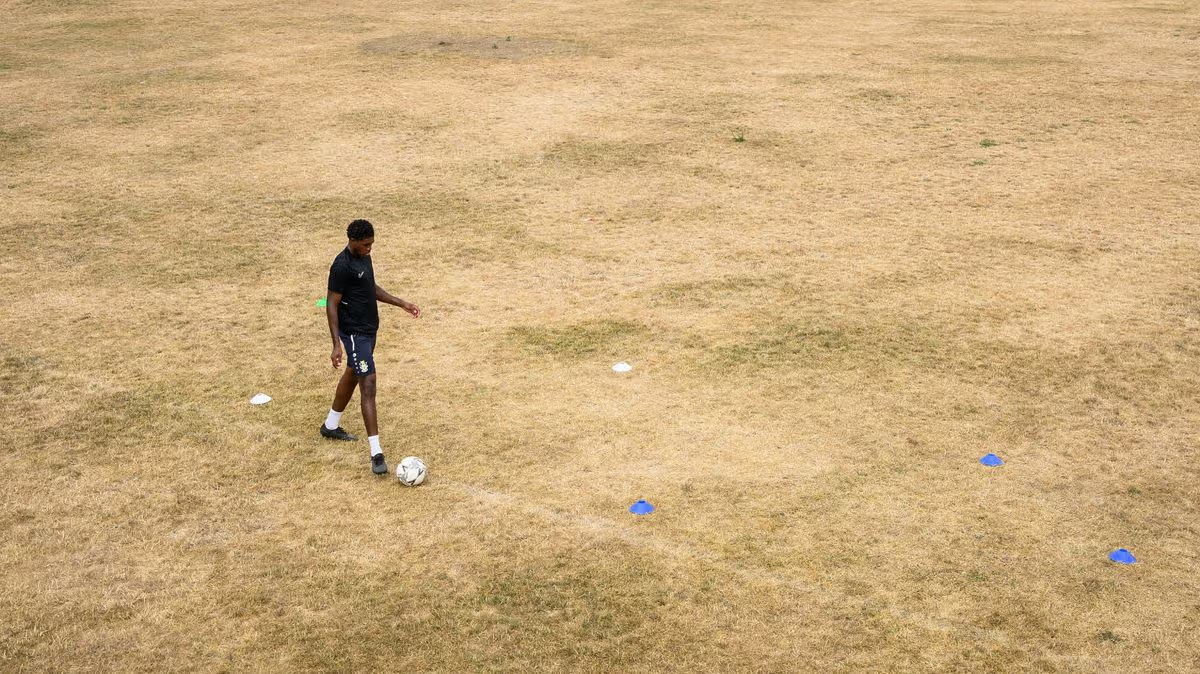
As Britain continues to bake in the hot sun, images revealed the extent of the lack of rainfall in parks across the country.

Brown grass could be seen across Blackheath in London and in many parks across the capital.

Advertisement

Rivers and lakes have dried up, with the Swithland Reservoir in Leicestershire now at just 44 per cent of its capacity. 

The flash-in-the-pan heatwave is set to end on Thursday, with conditions cooling further into the weekend.

July has been 3C above average across the UK, according to provisional Met Office data, potentially putting it among the hottest three or four months of July on record.

Fire chiefs said people should report any signs of fire immediately by calling 999 and asking for the fire and rescue service.

Advertisement
Dry fairways and parched fields surround the Kendleshire golf course, south Gloucester

Dry fairways and parched fields surround the Kendleshire golf course, south Gloucester

The green square surrounded by parched, dry and yellow grass on the cricket field of Maidenhead & Bray CC during a game, in Bray, west of London

The green square surrounded by parched, dry and yellow grass on the cricket field of Maidenhead & Bray CC during a game, in Bray, west of London

A woman sunbathes on the scorched grass in Wimbledon Park over the weekend

A woman sunbathes on the scorched grass in Wimbledon Park over the weekend

A large wildfire has burned in the Cairngorms national park in northern Scotland for two weeks

 A large wildfire has burned in the Cairngorms national park in northern Scotland for two weeks

Advertisement
This Environment Agency graphic shows how little rainfall there has been since mid-June

This Environment Agency graphic shows how little rainfall there has been since mid-June

The Met Office has also said UK heatwave thresholds will need to be adjusted to account for the consistently high temperatures caused by the warming climate, after records have been broken consistently this year.

Britain’s wild animals have also struggled to adjust to the record-breaking heat, with hedgehogs and foxes being taken to animal rescue centres in their droves across the country as temperatures spiked.

The RSPCA is urging gardeners to create shaded spaces for wildlife struggling to keep cool during the scorching weather as the fourth heatwave of the year looms.

Advertisement

The animal welfare charity said two baby hedgehogs were found ‘in distress’ in a back garden in Somerset and brought into the nearby West Hatch Wildlife Centre, where they are being cared for along with ‘several other recent admissions’ due to the heat.

Recent research from veterinary group Inspiring Vet Care found that in June this year its clinics treated 179 cases of suspected heatstroke – 66 per cent higher than the 108 cases treated in the same month two years prior.

Some 316 hedgehogs were admitted to the RSPCA’s four wildlife centres in June, a 56 per cent rise on the 202 admitted in the same month the previous year. 

Amy Ockelford, a senior press officer at the RSPCA, said wildlife centres are operating at ‘maximum capacity’ and are ‘fit to bursting’, and have seen an increase in admissions of hoglets and hedgehogs.

Advertisement

She said: ‘These animals are usually not out in the daytime, but they’re coming out because they’re struggling to find food and water, and ending up with heatstroke.’

The RSPCA employee encouraged people to think about wildlife as well as pets, adding: ‘Keep out clean, cool water for wildlife and try and create shaded areas where you can for them to avoid the direct sun.’

Ms Ockelford advised people to contact the RSPCA when they see wildlife in distress.

Meanwhile, Royal Parks staff have been advised not to leave deckchairs under trees over fears branches will fall during hot weather.

Advertisement

In a statement, a spokesperson for the charity – which looks after green spaces including Hyde Park and Kensington Gardens – said it has introduced the measure as an ‘additional precaution’.

Met Office meteorologist Marco Petagna said that heatwave thresholds for some counties rose by a degree four or five years ago.

‘Going forward they’ll need to be adjusted to take into account… current climate, otherwise we’re going to more frequently go into heatwaves. It’s a moveable thing, really, as we go through a warming world,’ he added.

It comes as blazes have wrought destruction in mainland Europe this week, with 220,000 forced out of their homes in south-west France and 116,000 evacuated in Spain.

Advertisement

In Bordeaux, an ‘apocalyptic’ fire has grown so large that it is generating its own thunderstorms, with 38C (100F) heat threatening to fan the flames of the terrifying blaze.

Hedgehogs suffering from suspected heatstroke are being taken to animal rescue centres across the country

Hedgehogs suffering from suspected heatstroke are being taken to animal rescue centres across the country 

The RSPCA said two baby hedgehogs were found 'in distress' in a back garden in Somerset

The RSPCA said two baby hedgehogs were found ‘in distress’ in a back garden in Somerset

French firefighters battle a wildfire spreading in Marcheprime, south-western France, July 26 2026

French firefighters battle a wildfire spreading in Marcheprime, south-western France, July 26 2026

Advertisement
Smoke from a wildfire spreading on Cap Ferret peninsula is seen over a pine forest in Lege Cap-Ferret, south-western France, July 24 2026

Smoke from a wildfire spreading on Cap Ferret peninsula is seen over a pine forest in Lege Cap-Ferret, south-western France, July 24 2026

In what represents one of the most devastating events in the country since the Second World War, more than 240 properties have been completely destroyed – many thought to be holiday homes owned by millionaire Parisiennes.

The inferno, which started on July 12 in forests on Cap Ferret, has been steadily approaching Bordeaux ever since, because of the strong winds which have been fanning the flames westwards.

And the return of searing temperatures this week threatens to complicate firefighting efforts.

Advertisement

Emmanuel Macron said on a visit to the wine-making capital: ‘The coming weeks will be tough and we have to hold out.’


Source link

Continue Reading
Click to comment

You must be logged in to post a comment Login

Leave a Reply

NewsBeat

I started litter picking on maternity leave: It turned into founding an organisation

Published

on

I started litter picking on maternity leave: It turned into founding an organisation
Hafsa saw there was litter in her local area, and decided to take things into her own hands (literally) (Picture: Supplied)

Not all heroes wear capes… our Unsung Heroes series celebrates ordinary people doing extraordinary work.

Today, it’s Hafsa Omar, 37, from Moss Side, Manchester, who keeps her community clean and tidy.

What do you do?

I’m founder of the Moss Side Eco Squad (@moss_side_eco). A volunteer group that picks up litter where we live.

How did it start?

On maternity leave, walking around with my baby in the pram, I noticed all the litter I had to dodge around. So, I thought, why not clear it up myself?

Advertisement

What next?

People approached me wanting to help. They just needed someone to organise them. So, I put a time on Facebook and seven or eight people turned up.

How did you fund equipment?

Ask Metro


Use AI to go deeper into the stories you care about – powered by Metro and trusted publications.

Advertisement

For my birthday, I asked for litter pick sticks and gloves instead of presents.

Where do you litter pick?

All over Moss Side. It’s given me a familiarity with my community. I’ve discovered cafés, shops and parks that I’d never seen before.

Is the social side fun?

We were strangers, now we’re all really good friends. We check on each other when sick, drop off food if needed and celebrate birthdays.

What’s been the reaction?

People often say thanks. We get offered free food from the takeaway. Or people come out of their house with a cup of tea for us. Locals donate bin bags.

Advertisement

Any tricky moments?

Some people assume we are 
ex-offenders doing community service!

What litter do you see most?

Takeaway wrappers. People chuck it out of car windows. I’ve caught them at it.

What happens then?

I ask, ‘Do you do that at home?’ They usually say sorry.

Any weird finds?

A dried-up stingray fish. No idea where it came from. Oh, and decapitated dolls.

Advertisement

What about dangerous items?

We don’t touch any drug paraphernalia. We report it to the council for disposal.

Do you see fly tipping?

Yes. Lots of landlords rent to students here. So people moving in and out every year and dumping mattresses outside.

How many items do you pick up?

We average two bin bags of rubbish per person – so maybe 20 bags each time. Most of us have family to care for and jobs to go to, so we’re all time-poor.

So there’s no pressure to commit

I’ve dipped in and out since we started in 2020, but other people continued.

Advertisement

Are you really tidy at home?

Yes, but not obsessively. I do love the BBC TV show Sort Your Life Out about helping people declutter. My dream job would be reorganising charity shop floors.

Why do you volunteer?

It gives me asense of belonging in the place where I live. I’ve moved around my whole life. This is the first place that really feels like home.

Any hobbies?

Swimming. I help organise the Junior Parkrun in Moss Side every Sunday for kids. And I take part in the adult run.

Become a litter hero for your area with keepbritaintidy.org

Advertisement

Source link

Advertisement
Continue Reading

NewsBeat

Cambridgeshire Iceland supermarket remains closed after roof collapses

Published

on

Cambridgeshire Live

No one was injured after the roof collapsed

A supermarket remains closed after its roof partially collapsed. Emergency services were called to Iceland in High Street, March, just before 3pm on Tuesday (July 28).

Advertisement

The supermarket’s roof had collapsed. No one was injured, but a cordon was put in place and the building next door was evacuated as a precaution.

The store closed on Tuesday and remains closed on Wednesday (July 29). An Iceland spokesperson said: “We are currently working with Cambridgeshire Police and Cambridgeshire Fire and Rescue Service following a roof collapse at our High Street store in March, Cambridgeshire. All colleagues and customers are safe, and the store remains closed as a precaution.”

Cambridgeshire Police assisted with the cordon on Tuesday. Cambridgeshire Fire and Rescue also assisted the police.

A fire spokesperson said: “A crew from Chatteris was called just before 3pm yesterday to assist police colleagues at an incident on High Street in March. Firefighters helped to make the area safe and returned to their station by 8.35pm.”

Advertisement

Fenland District Council has been contacted for more information.

Do you want more of the latest Cambridgeshire news as it comes in from across the county? Sign up to our dedicated newsletter to make sure you never miss a big story from Cambridge or anywhere else in the county. You can also sign up to our dedicated Traffic and Crime newsletters for the latest updates on the topics you are most interested in.

Source link

Advertisement
Continue Reading

NewsBeat

Transfer news LIVE: Arsenal FC get Vinicius Jr hope, Guimaraes update; Chelsea medical; Man Utd, Liverpool latest

Published

on

Transfer news LIVE: Arsenal FC get Vinicius Jr hope, Guimaraes update; Chelsea medical; Man Utd, Liverpool latest

The summer window is getting very busy as Arsenal, Chelsea, Manchester United, Liverpool and Tottenham all continue to chase some major signings. Arsenal may have been offered new hope in their ambitious pursuit of Vinicius Jr, though Real Madrid do not want to sell. The Gunners appear to have finally made a breakthrough over Bruno Guimaraes and have reportedly opened talks over Ivan Fresneda as they close in on another wonderkid in Axel Donczew, with Julian Alvarez also still on their radar.

Source link

Continue Reading

NewsBeat

Ruben Amorim’s honest answer on Manchester United came too late – ‘Mistakes’

Published

on

Manchester Evening News

AC Milan’s head coach Ruben Amorim has spoken honestly about what went wrong during his Man Utd tenure.

“Football is a game of mistakes. Whoever makes the fewest mistakes wins,” Johan Cruyff famously once said.

Advertisement

Managers are responsible for telling players how to play, so mistakes can be made before the referee blows for kick-off on a matchday.

Ruben Amorim made mistakes during his time at Manchester United, but the error that led to his downfall was his stubbornness and unwavering belief that his 3-4-3 system was the only way.

Amorim may have seen the light after six months of reflection following his sacking in January. He was appointed by AC Milan last month, and a recent interview suggests he recognises his shortcomings.

“They [Milan] appointed me because they felt I was the right guy for the way I want to play,” Amorim told Sky Italia. “They want to play the same way, but I think they signed me not just for my success, but also for my experience with a top club like Manchester United and the reflections I shared in our meetings with Mr Cardinale [Milan’s owner].

“They understood that I was prepared for this job, not just because of my past success, but also because of my failures. I think it helped a lot in those meetings.”

When asked what went wrong at United, Amorim said: “The first thing is that it doesn’t matter anymore. That is the feeling. There’s a history, then something happens, the context changes, and you focus on the next challenge.

“I learned a lot. It would be hard to point to one thing, but the important thing that I clearly know is that I made a lot of mistakes. When you do this kind of reflection, and you understand that it was not just their fault, but also my fault, I think you can be a better coach and a better man.”

Advertisement

Amorim’s answer was an honest admission that he was partly responsible for his tenure at United being a failure, although the response is open to interpretation about which particular mistakes he concedes.

Stubbornness was the biggest error. Amorim faced internal pressure to tweak his system in December, and he played with a back four in the win against Newcastle before reverting to 3-4-3 against Wolves at the end of that month.

Amorim felt undermined, suggesting the likes of Thomas Tuchel, Antonio Conte, and Jose Mourinho would not put up with being told how to coach, but it was obvious that he needed to tweak the formation.

Advertisement

Those changes of events led to his outburst at the end of his post-Leeds press conference at Elland Road. The tension with the board had reached a point of no return, and Amorim was dismissed, which club figures believed he wanted. A few days later, Amorim was pictured smiling with his wife outside their Cheshire home.

Whether or not Amorim has learned from the formation debacle at United will only be revealed when he encounters a rough patch at Milan. His United stint should have taught him that adaptability is not a weakness.

Amorim made other mistakes in Manchester that he should have reflected on during his time out of the game. He formed an opinion on Kobbie Mainoo from an early stage and didn’t back down from it.

He was brilliant in press conferences for journalists, but his honesty wasn’t beneficial for players who needed protecting. His handling of academy players, who he hung out to dry to the media, was also perplexing.

Advertisement

Milan released a video on social media of Amorim giving a speech to his new set of players following his appointment, and someone joked that the young players in the shot should pack their bags and leave before it’s too late.

However, there are still some positives to take from Amorim’s time at Old Trafford, and he deserves praise for improving the culture at Carrington by not being afraid to get rid of some big names (and big egos).

Amorim is guaranteed to be a better coach due to the experience he gained at United, but that is the reason he failed. United is not a club where you can learn on the job.

Source link

Advertisement
Continue Reading

NewsBeat

Why Raspberries And Blueberries Have Black Sheets In Their Trays

Published

on

Why Raspberries Have Black Sheets But Strawberries Don't

It’s amazing how much of everyday life I didn’t question for years – like what “wi-fi” really means, where we get paprika from, and what ASDA actually stands for.

And opening my fridge this afternoon, another banal mystery confronted me. What’s that squidgy black mat at the bottom of raspberry trays for, and why isn’t it in the bottom of my strawberry tray?

It seems I’m not alone. Posting to r/NoStupidQuestions, Redditor u/GrumpyOldSophon asked about the addition, wondering why you “never find this in packages of blueberries or strawberries”.

The sheet is absorbent, but it may have other qualities

Advertisement

It probably won’t shock you to learn that the sheet is there to absorb some moisture. Packaging specialists Packaging World described these sheets as “dual ply absorbent” material, “applied to a totally absorbent, yet sealed, topcoat”.

They’re designed for softer fruits, like raspberries and blueberries, as these aren’t as hardy as, e.g., strawberries or grapes. Speaking to Eating Well, Robert Schueller, a produce expert at Melissa’s Produce, said: “A raspberry is one of the most delicate fruits out there, so they have to be packaged very carefully”.

They provide some cushioning for the delicate fruits as they’re transported, too. And because they wick away moisture, they can help to prevent mould.

It makes sense for it to be black or red as it’s designed to catch berry juices, which would otherwise stain it.

Advertisement

Though there may be another, unexpected benefit here: pitching their black cartonboard packaging for strawberries, MM Karton said: “The contrast of black cartonboard and red strawberries is a real eye-catcher at the point of sale”.

Perhaps the red berry/black sheet colour combo makes our raspberries look more inviting, too.

That’s also why raspberries are packed into smaller containers

I have enjoyed many a mega-size box of strawberries this year.

Advertisement

But it turns out retailers aren’t being stingy for limiting their raspberry carton sizes; the berries are too delicate to be stacked on top of each other, unlike strawberries and even blueberries.

And, Schueller added, “you need to allow space for air in each package, too”.

Source link

Advertisement
Continue Reading

NewsBeat

FA ‘deeply concerned’ after being left in the dark over FIFA’s controversial proposal to sell the World Cup – as UEFA ‘threaten to boycott the tournament’

Published

on

The FA have deep concerns over FIFA's leaked plans to sell stakes in the World Cup

FIFA are attempting to pressure their 211 member associations into backing plans to sell stakes in the World Cup – just hours after the FA voiced deep concerns over Gianni Infantino’s divisive proposals.

News broke on Tuesday that FIFA boss Infantino was considering selling parts of the tournament to private investors and forming a new company in a deal that could be worth around £15billion, which the governing body later confirmed in a hastily-issued statement.

In a letter to the associations, Infantino says member nations must decide on the proposal by September 19 and explains the financial benefits of approving the project.

He says that a funding package around £35.5million per nation will become available if associations sign up, but if they reject it their earnings will be almost 75 per cent less.

Advertisement

The letter from Infantino says: ‘The decision on whether or not to proceed with this proposal belongs entirely to you. Should you wish to proceed this $10billion package will become available as of January 1, 2027, ushering in the next phase of our journey together.

‘Should you wish to retain the status quo and reject this proposal we still have our planned expansion of the Forward programme [development money] of $2.7billion as previously presented.

‘In total for the upcoming cycle starting as of January 1, 2027 each member association will have the possibility of access up to $40million per member association under this proposal.’

Advertisement

The FA have deep concerns over FIFA’s leaked plans to sell stakes in the World Cup

The report added that Infantino could become the commissioner of that company once his role at FIFA ends in 2031, although FIFA claim that has not been discussed.

Investment bank J.P. Morgan is FIFA’s financial advisor on the project while Joshua Kushner’s Thrive Capital is expected to lead the proposed investor group. Kushner is the brother of Donald Trump’s son-in-law Jared. The Trump administration is understood to have been consulted.

FIFA hope to raise more than £3 billion for the venture from a diversified, global investor group. The group is thought to include sovereign wealth funds.

Advertisement

Should their plans be successful, FIFA intend to give each of their 211 member associations a stake in the company – which they can choose to keep or sell – worth £15million each.

The FA, meanwhile, have deep concerns over FIFA’s leaked plans to sell stakes in the World Cup.

In a statement, an FA spokesperson confirmed they had been left in the dark over the controversial proposals which have sparked outrage amongst the football community.

The statement said: ‘We were completely unaware of this proposal and have no substantive details, including what the proposition actually is, and what conditions are attached.

Advertisement

‘Based on the limited information, we are deeply concerned about the lack of process and governance to get to this point, and the apparent substance and principles involved.

‘When the proposal is shared in the full and transparent way now promised by FIFA, we will make our views clear, and comment further.’

European Football Clubs, who represent over 800 European clubs, have also voiced their opposition. Crucially, the body is chaired by PSG President Nasser Al-Khelaifi and Qatar Sports Investments, who are owned by the Qatari state. Al-Khelaifi has been touted as a potential leadership challenger to Infantino. 

‘European Football Clubs (EFC) notes with serious concern the sudden, unilateral media briefings and announcement by FIFA about a potential new corporate structure for the commercialisation of certain football competitions,’ the statement read.

Advertisement

‘As an institution that represents over 850 football clubs – whose member clubs, their players and communities are fundamental participants in football worldwide, not least in FIFA’s competitions including all the international club competitions – it would be wholly appropriate for EFC to be fully consulted on a proposal of such magnitude. EFC learned about this proposal in the same way as most global football stakeholders – without warning and through the media.

‘EFC always seeks to work collaboratively and supportively with all stakeholders – FIFA, UEFA and all confederations, national associations, leagues, player and fan associations. In that vein, we urge for calm and thorough consultation on all topics affecting the football ecosystem, together with more rigorous and transparent governance processes put in place to protect the game for the long term. Only in this way can we build the right institutional frameworks and relationships required to promote the true success, stability and sustainability of football.’

Prime Minister Andy Burnham has also voiced opposition to the proposition.

‘Let me say this very directly,’ Burnham posted on X. ‘Football does not belong to investors. It belongs to the people who fill the stands and who stand on the touchline week in, week out, rain or shine.

Advertisement

‘The World Cup is not a product. It is the greatest competition in world sport, and it was never anyone’s to sell.

‘Dress the deal up however you like. Once you have sold a piece of it, you have sold out. Football belongs to the fans. It always has, and it always will.’

The plans would see FIFA set up by FIFA Forward Enterprise (FFE), a new company responsible for the ‘operational delivery of FIFA tournaments’ – including both the men’s and women’s World Cup.

FIFA claim their plans would help advance the FIFA Forward development programme, which distributes capital to member associations. The governing body hopes to increase funding from £6m to £15m for the 2027-30 international cycle.

Advertisement

FIFA would need approval from the FIFA Council and majority support from the FIFA Congress (the 211 member associations) to launch the new enterprise.

UEFA have already opposed the plans, while Concacaf and now the FA have raised concerns about the lack of consultation.

There are major concerns over what the proposals could mean for the game, including whether FIFA could increase the frequency of tournaments to create more opportunities for financial backers to see a return on their investment.

The Club World Cup and men’s World Cup are currently held every four years. FIFA have previously explored the possibility of staging both tournaments every two years.

Advertisement

FIFA maintain that they have a duty to control the development of this project, with external investors holding only a minority stake in FFE and having no operational role.

‘Concacaf was only made aware of this matter through media reports and, subsequently, via a media release,’ their statement read on Wednesday morning.

‘We are deeply concerned by the lack of due process.

‘We share the disappointment of many within our region and the game that this level of detail has been designed and shared publicly before any discussion with the relevant governance bodies and stakeholders has taken place.

Advertisement

‘As leaders within football, we are the custodians of the game. Collectively, FIFA, the Confederations and every Member Association have a responsibility to always act in the best interests of the sport. Every decision we make must be guided by good governance, robust processes and long-term stewardship.

‘This is the framework within which Concacaf operates. We trust that all within the FIFA family will act in the same manner.’

Source link

Advertisement
Continue Reading

NewsBeat

Drought declared across Cambridgeshire after very low rainfall and hot weather

Published

on

Cambridgeshire Live

The chair of the National Drought Group said water is being used faster than it can be replenished

Cambridgeshire is officially in drought, according to the Environment Agency. Seven regions across the country, including East Anglia, have been declared as being in drought.

Advertisement

They are East Anglia; Hertfordshire and London; Thames Valley; Hampshire and the Isle of Wight; Devon and Cornwall; the West Midlands; and Wessex. It follows record low rain and high temperatures.

The fourth heatwave of the year is set to peak on Wednesday (July 29) with temperatures of up to 35C, as experts warn wildfires could be “exceptionally severe”. The UK Health Security Agency (UKHSA) has issued an amber heat-health alert for the East Midlands, the East, South East and London.

Helen Wakeham, director of water at the Environment Agency and chair of the National Drought Group, said: “The hot and dry weather means we are currently using water faster than nature can replenish it.”

A Met Office assessment showed fires could be exceptionally severe by Wednesday if they start in parts of London, the South East, and eastern England, as a result of the hot, dry conditions.

Advertisement

Fire and rescue services in England and Wales have responded to 706 wildfires so far in 2026, with 208 incidents recorded between July 16 and 28 alone, the National Fire Chiefs Council (NFCC) said.

It added that the latest figures, which do not account for wildfires across the rest of the UK such as a major wildfire in the Cairngorms in Scotland, show “how quickly wildfire activity can increase during prolonged periods of hot and dry weather”.

Fire chiefs warned that wildfire risk “remains elevated across the UK”, with the NFCC adding there were “currently eight live wildfire incidents being monitored through national reporting systems”.

Wildfire numbers in England and Wales remain below the 788 recorded by the same point last year. However, fire chiefs warned “continued dry conditions, combined with warmer temperatures and harvesting activity in many rural areas”, were creating conditions in which fires can start and spread rapidly.

Advertisement

The NFCC said UK wildfires are typically smaller and different in nature to those seen in southern Europe, adding, however, that the “long-term effects of climate change are increasing the likelihood of larger, more complex and more resource-intensive wildfire incidents occurring”.

Phil Garrigan, chairman of the NFCC, said: “More than 200 wildfires in just 12 days shows how quickly the risk can escalate when hot, dry conditions take hold. The scenes we’re seeing across parts of Europe are a stark reminder of what a changing climate means for fire and rescue services.

“We are not seeing fires of that scale in the UK today, but the science tells us we should expect larger, more frequent and more complex wildfires in the future. That’s why we need continued investment in specialist wildfire capabilities, including aerial firefighting support, so we’re prepared for the risks ahead.

“But prevention remains our strongest defence. Most wildfires are avoidable, and we’re asking everyone to take extra care during the hot weather to help keep their communities safe.”

Advertisement

Source link

Continue Reading

NewsBeat

British Touring Shakespeare Bring His Greatest Love Story to Hampshire's Historic “Jane Austen” House

Published

on

British Touring Shakespeare Bring His Greatest Love Story to Hampshire's Historic “Jane Austen” House

Internationally acclaimed theatre company British Touring Shakespeare will bring William Shakespeare’s timeless romance Romeo and Juliet to the beautiful gardens of historic Chawton House in Hampshire known for its association with Jane Austen, on Friday 7th August at 6:00 PM, as part of their 2026 summer UK tour.

Source link

Continue Reading

NewsBeat

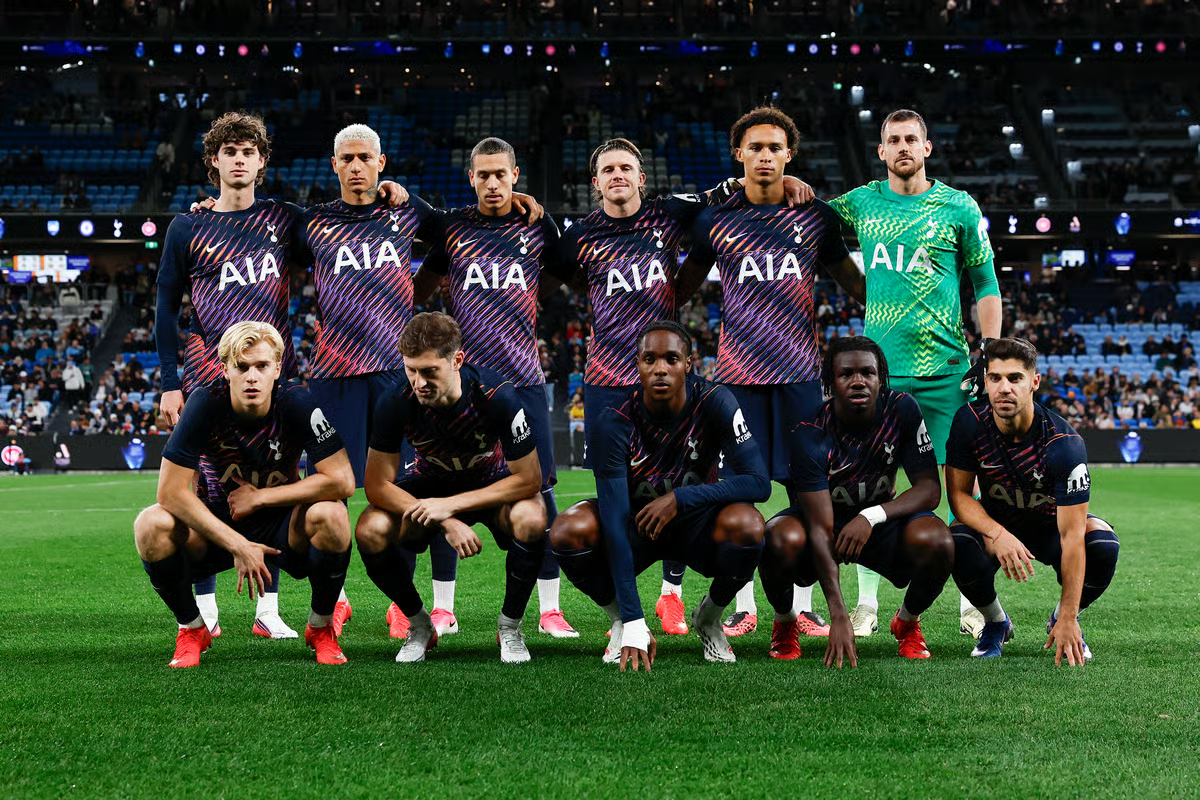
Tottenham vs Sydney FC LIVE: Pre-season friendly result, latest updates and fan reaction

Published

on

Tottenham vs Sydney FC LIVE: Pre-season friendly result, latest updates and fan reaction

This will technically be the third friendly Spurs have played this summer, having also beaten Milton Keynes in a behind-closed-doors affair before they flew across the world. Tottenham face Chelsea on Saturday but first take on the team who finished fourth in the Australian A-League last term, and they will play in front of a sell-out Allianz Stadium crowd in New South Wales.

Source link

Continue Reading

NewsBeat

Why Do People Keep Pooping Themselves At Concerts?

Published

on

Why Do People Keep Pooping Themselves At Concerts?

Look, I understand that an hours-long show can be tough on the bladder. We’ve written before at HuffPost UK about the many tricks artists use if they have to “go” mid-performance.

But the fecal fiascos that have taken place in recent concerts are a different beast entirely.

First, Olivia Rodrigo told KISS Radio that she could smell her fans’ nappies from the stage.

“Everyone is wearing diapers… they sit there all day,” she shared. “I think about it kind of often… It’s a real thing.

Advertisement

Noah Kahan, meanwhile, took to X after a woman reportedly defecated near the singer’s stage. “If you have to poop at a show please dear god just go to the bathroom lmao,” he wrote.

At later gigs, he made fans “solemnly swear I will not shit my pants. And if I do, I won’t take it from my pants and put it on the floor”, and beseeched his soiling-inclined fans to “fucking put some diapers on next time”.

On Monday 27 July, meanwhile, a Devilskin metal concert was derailed by an attendee’s baffling and “vomit”-inducing decision to crap in a moshpit.

Advertisement

What, I beg my fellow grown adults, is going on?

I mean, in the case of Rodrigo, there’s at least a vile logic to the odorous decision. “I have been to certain concerts and certain festivals where people wear diapers so that they can be front row of the show,” she explained.

“And that’s been an experience as a performer that I have… smelled.”

It’s not something I think someone who has probably filed their own taxes and may even share an office loo should ever voluntarily do, to be clear.

Advertisement

However, I guess that’s what commitment looks like to some superfans – Noah himself joked(?), “I shit myself onstage in Charlottesville, but that’s because I am dedicated to my craft.”

What “craft” is refined or gig-going fantasy realised by a mid-show floor poop, though?

Please, for the love of music: can we keep that extra fetid “o” out of “pop concerts” going forwards?

Advertisement

Source link

Continue Reading

Trending

Copyright © 2025