Connect with us

NewsBeat

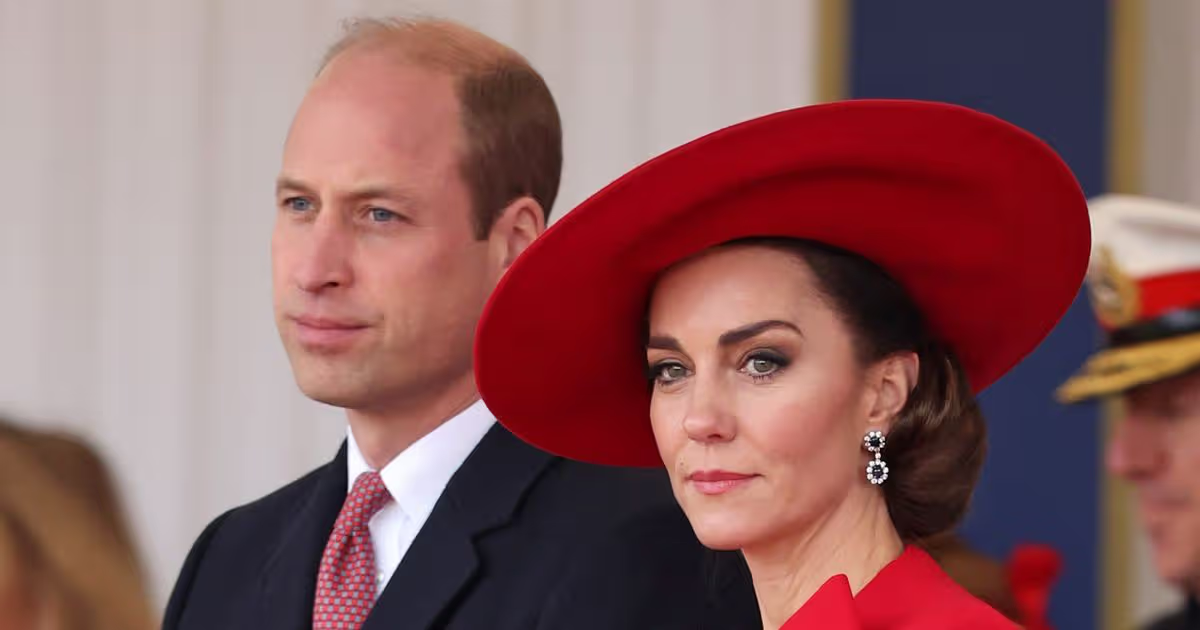
Prince William’s heartbreak over Kate’s cancer diagnosis as private battle uncovered

Published

on

Ipso logo

Friends have shared how ‘everything changed’ in an instant for the Prince and Princess of Wales

Prince William’s heartbreak and battle behind closed doors over his wife’s cancer diagnosis has been uncovered for the first time, with friends sharing how “everything changed” in an instant for the couple.

Advertisement

Kate, the Princess of Wales, is now in remission after being diagnosed with cancer in 2024. The diagnosis came after she was admitted to the London Clinic for major abdominal surgery. After the operation, she spent nearly two weeks in the hospital and was recuperating at home when she received the diagnosis of cancer and began chemotherapy.

After stepping away from royal duties to undergo treatment and recuperate, Kate has more recently been carrying out more regular engagements after slowly easing back into her public royal duties over the past year and a half.

It’s now been revealed how both William and Kate tackled the unexpected card they had been dealt, which came as an added blow following King Charles’ cancer diagnosis.

In a new book, William and Catherine: The Intimate Inside Story, which is being serialised by the Mirror, the publication’s Royal Editor Russell Myers writes: “While the start of the year usually represents a gentle beginning to the royal calendar, 2024 was about to change all that.

Advertisement

“William was left in an extraordinary position. Suddenly, with three children to care for at home and no live-in staff at their Adelaide Cottage home, and with his wife and father in hospital, his future was looking decidedly different. When the Princess of Wales entered hospital on 16 January, and was then ghosted out two weeks later to disappear completely from public view for potentially months on end, it created an incredible vacuum of information.

“When Catherine went in, he was fairly resolute,’ said a close aide. ‘They both very calmly told the children what was going on and how long Catherine would need to be away for, but explained other than that everything would continue as normal and when she came home, she would need to rest up for a bit.’”

Russell continues: “Catherine was able to keep in touch with her family through video calls from her bedside, catching up on what George, Charlotte and Louis had been doing at school and asking if ‘Papa’ had been able to cook for them while she had been away.

“At that time it seemed to all be perfectly in hand, they were the calmness in the storm certainly. But away from the children he was of course incredibly pensive. His father’s illness brought into focus just how quickly his life, and that of his family as well as the whole landscape of the institution, could change very quickly.”

The book continues to detail the moment Kate, with William by her side, was given the news, and her decision to share her diagnosis publicly. “Two weeks before that moment on a warm spring afternoon in March when she had sat down to pose for a photograph with her family, Catherine had been contacted by her medical team at the London Clinic,” Russell writes.

“With William by her side, the Princess of Wales, who had previously been in for a major, yet routine abdominal operation, was told that secondary tests had shown cancer was present. The advice was an immediate course of preventative chemotherapy in order to give her the best chance of a full recovery.

“Friends of Catherine say that although she was caught completely in shock, she remained composed. Her first thoughts were of her children and her husband. William, according to friends, later told how he was in ‘a state of disbelief’. First his father had been diagnosed with cancer, and a month later his wife was now facing a similar challenge. Catherine called her parents and her siblings to tell them, then she and William resolved to gather the children and impart what they knew in the best and most positive way possible.”

Advertisement

Russell says that Catherine had already decided to release a personal statement after seeing the “positivity and warmth that had greeted the King when he had been so open about his own diagnosis”.

He continues: “More than that, though, the princess believed that her experience could benefit others in similar distressing circumstances. Catherine’s family rallied round, with her sister Pippa helping to write the script for the short video statement.

“Dressed in a simple striped jumper and jeans, sitting on a wooden bench and surrounded by a serene spring backdrop of daffodils – a world away from the disgraceful chaos peddled by faceless social media trolls – Catherine calmly described how the diagnosis had come as a ‘huge shock’ on top of an’incredibly tough couple of months for our entire family’.

Advertisement

“The message, recorded in complete secrecy by a BBC special events team, was broadcast on the 6pm national news and online. Much like the announcement of the death of Elizabeth II, it felt like an earthquake whose reverberations were felt around the world. ‘The days beforehand were filled with shock, but at that moment, it was genuinely as if the world stood still’, said a senior courtier.

“‘Everyone knew it was a huge moment. It was incredibly emotional. But to know both she and William had had to prepare themselves to tell their three young children that Mummy was ill and would have to go back to hospital, but that she would be OK, was just extraordinary’.”

A close friend also spoke of the prince’s reaction. “It was like being hit by a bus, sudden, brutal, and completely disorienting. One moment life was normal, and the next, everything changed. He worships her, truly. She’s his world, and when the diagnosis came, it was as if the ground beneath him vanished.

Advertisement

“He talked about the rug being pulled, but it was more than that, it was heartbreak, fear and helplessness all at once. Watching him go through it was deeply emotional. You could see it in his eyes; in the way he held himself. But through it all, his devotion to her never wavered. He’s been by her side every step, and the depth of his devotion is something that stays with you. It’s love in its rawest, most powerful form.”

Discussing how William tackled his wife’s ill health, Russell writes: “The Prince of Wales took charge of the school drop-offs, while Catherine’s parents and siblings were regular visitors to the family home in Windsor. Quiet evening dinners were enjoyed at home, playdates were organised to keep the children entertained and there were weekends away at the Middletons’ family home in Berkshire – all part of enveloping George, Charlotte and Louis with as much love and support as possible. While the children benefited from having their mum at home all the time, the road of treatment and recovery was not simple.

“Once the initial shock of her diagnosis had passed, the schedule of regular hospital appointments and the time needed to recuperate and regain enough strength to start each week, both physically and mentally, took its toll. ‘Throughout everything thrown at her, she was incredibly upbeat’, a friend said.”

William and Catherine: The Intimate Inside Story, published on 26 February by Ebury, Penguin Random House, is available to pre-order now


Advertisement

Source link

Continue Reading
Click to comment

Leave a Reply

Your email address will not be published. Required fields are marked *

NewsBeat

Can we design sports shoes that don’t squeak? Here’s what the science says

Published

on

Why do sports shoes squeak? Here’s what our research reveals

The unofficial soundtrack of every basketball, squash or hard-court tennis match is the constant high-pitched squeak or shreak of the players’ shoes. But can this squeak be designed out of them while retaining the grip?

That’s the question an international team of engineers and applied physicists, including me, have been investigating. It sounds like a small design tweak. In fact, it cuts to a deep physics problem: how a soft body slides against a rigid one.

Perhaps surprisingly, the mechanism that produces sound when a soft solid slides against a stiffer one has long been the subject of scientific debate. Most theories are linked to the concept of “stick-slip”: when, instead of sliding smoothly, the sliding object rapidly alternates between sticking and slipping.

While it sticks, the soft body (such as a rubber sole) deforms and stores elastic energy. Then it suddenly slips, turning much of that energy into heat through friction – while also releasing rapid vibrations that radiate out as sound.

Advertisement

But this is not exactly what we observed in our experiments.

After Leonardo da Vinci

Our recently published study took inspiration from the simple-but-effective setup used by Leonardo da Vinci in his studies of friction from the late 15th century.

Leonardo da Vinci’s sketches of his pioneering friction experiments.
Codex Arundel, British Library (41r), 1500-05.

Leonardo used a wooden block resting on a flat surface. The block was subjected to two forces: a normal force (its own weight) and a tangential force which was applied using an additional weight attached to a cable.

Advertisement

By stacking and combining multiple blocks, Leonardo discovered the two fundamental laws of friction: that friction is proportional with how hard the surfaces are pressed together, and largely independent of the size of the contact area.

But Leonardo never published these findings, which were finally rediscovered and made public in the 19th century in notebooks scattered throughout Europe. In the meantime, the laws of friction had only been formally enunciated by French physicist Guillaume Amontons in 1699 – two centuries after Leonardo’s studies.

Furthermore, these laws are empirical rather than fundamental, and in extreme cases they break down. This led us to the question of what makes a shoe squeak.


À lire aussi :
Leonardo da Vinci’s early work on friction founded the modern science of tribology

Advertisement

A surprising result

One of the biggest difficulties in friction studies is that the interface being tested (where a shoe sole meets a hardwood floor, for example) is hard to get at, and comes under a lot of pressure while slipping at high speed. Placing sensors at the interface is almost impossible – and even if it were, this would probably alter the frictional response.

Our solution was to use an optical trick: we replaced the hardwood floor with a transparent acrylic plate and mounted an array of LED lights along its sides. When each test object – including multiple rubber blocks – made contact with the plate, light would leak into the contact region, brightening up this area alone. That allowed us to visualise exactly which parts of the soft-rigid interface were in contact.

We used a high-speed camera, capable of capturing up to 1 million frames per second, to film how the contact patches evolved while the “sole” was skidding, and recorded the sounds being emitted with a microphone.

We found that at the point of contact, tiny wrinkles in the surface of the rubber block – known as “opening slip pulses” – were created, which then raced along the interface at nearly 100 metres per second. While most of the block remained stuck in place, these rapidly moving wrinkles created the sound in each friction test.

Advertisement

Surprisingly, even tiny geometrical features at the frictional interface had profound effects on the sound generated. When it was perfectly flat and smooth, the pulses were messy and generated a scratch-like noise of many different frequencies – closer to the sound of peeling adhesive tape than a clean squeak.

But when ridges were present, like those on the soles of sport shoes, the pulses were confined by the width of these ridges, making them very regular (not messy any more). This turned the sound into a more musical tone akin to the squeaks heard on a basketball court.

We were also able to determine what decides the precise pitch of a shoe squeak. In each test, it was largely unaffected by either the speed of sliding or magnitude of the force applied (which relates to the weight of a player).

Rather, the clearest link was with the height of the rubber block – or the thickness of a shoe’s sole. Using this knowledge, we created a series of blocks of different heights in order to play a familiar melody, as shown in this video.

Advertisement

Video: Nature.

Our research lays the groundwork for controlling or suppressing squeaking in many mechanical systems involving soft-on-rigid friction. These range from brakes and tyres to hip and knee replacements, where polymer liners slide against polished metal or ceramic heads.

And yes, it could even lead to the development of squeakless sneakers. Designing intricate patterns that keep plenty of rubber in contact (so the grip stays high) but break the sliding into lots of tiny, out-of-sync microevents could kill the clean note of the squeak, and leave only a soft hush.

Table-top earthquakes

Beyond the realm of sports, this work also relates to much larger geophysical questions. Similar experimental approaches to ours have served as table-top models for studying earthquakes, during which ruptures and slip pulses spread along tectonic faults at extremely high speed.

Advertisement

If we can reproduce earthquake-like slip pulses in the lab, the next challenge is scaling – working out how those centimetre-scale measurements translate to what happens inside real faults in the Earth.

Achieving this could help interpret seismic signals more confidently: using waves recorded far from a fault to infer what has actually happened at the source. Better physics-based models could improve seismic hazard estimates and lead to more reliable hazard maps.

Meanwhile, we’ll keep thinking about squeakless sneakers too.

Advertisement

Source link

Continue Reading

NewsBeat

Vehicle crashes next to York Vangarde Shopping Park

Published

on

Vehicle crashes next to York Vangarde Shopping Park

Police, paramedics and firefighters were called to the scene in Vangarde Way, next to the Vangarde Shopping Park, shortly before 2.20pm on Saturday (March 7).

North Yorkshire Fire and Rescue Service said two fire crews were called to the scene.

In a statement on Sunday, a fire service spokesperson said: “Crews from Acomb and York were requested by police to attend an incident involving a single vehicle road traffic collision.

Advertisement

“Crews made the scene safe and left the incident in hands of police and ambulance.”

Source link

Advertisement
Continue Reading

NewsBeat

Spain, Greece and Portugal travel warning as rule changes for British tourists

Published

on

Spain, Greece and Portugal travel warning as rule changes for British tourists

Holidaymakers could face major delays this summer

A new border control system is being rolled out at all European airports, including those in Spain, Portugal and Greece, from April 10. The new Entry Exit System (EES) requires British travellers to provide fingerprints and photographs when entering the Schengen Area.

Advertisement

British holidaymakers have been cautioned about potential queues due to the new biometric system, which was first introduced in October at some EU airports. All 29 Schengen countries are now expected to have it fully operational by April.

Some airport organisations have called for an “immediate review” of the Entry Exit System (EES) rollout as it “continues to cause significant delays,” and cautioned that queues for non-EU passengers could stretch to four hours during the summer months.

The Foreign, Commonwealth & Development Office (FCDO) stated: “EES checks are being introduced in a phased way across external borders, with full operation expected from April 10, 2026.”

The Foreign Office suggested that EES might take each passenger a “few minutes extra” to complete and advised they “be prepared to wait longer than usual” at border control, reports the Express.

Advertisement

The new checks at European airports follow the recent announcement that dual British nationals could be refused entry at the UK border unless they possess a British passport. The new regulation could impact holidaymakers returning to the UK from their European trips.

Full list of countries with the new Entry Exit System

  1. Austria
  2. Belgium
  3. Bulgaria
  4. Croatia
  5. Czech Republic
  6. Denmark
  7. Estonia
  8. Finland
  9. France
  10. Germany
  11. Greece
  12. Hungary
  13. Iceland
  14. Italy
  15. Latvia
  16. Liechtenstein
  17. Lithuania
  18. Luxembourg
  19. Malta
  20. Netherlands
  21. Norway
  22. Poland
  23. Portugal
  24. Romania
  25. Slovakia
  26. Slovenia
  27. Spain
  28. Sweden
  29. Switzerland

Source link

Continue Reading

NewsBeat

International Women’s Day – 5 inspiring County Durham women

Published

on

International Women's Day - 5 inspiring County Durham women

Betty Brown, OBE — Post Office justice campaigner, Consett

Elizabeth Brown (Betty Brown) was made an OBE in the New Year Honours list. (Image: Lucy North)

Consett great-grandmother Betty Brown, 92, was the oldest person on the King’s New Year Honours List 2026 after receiving an OBE for services to justice.

She is believed to be the oldest surviving victim of the Post Office Horizon IT scandal, having run Annfield Plain Post Office with her late husband Oswall from 1985 until they were forced out in 2003.

The couple lost around £100,000 of their own money covering non‑existent shortfalls.

Advertisement

One of the original 555 claimants in the landmark group action led by Sir Alan Bates, Betty has become a leading campaigner, fronting national TV interviews and challenging ministers as victims finally secure compensation.

Vera Parnaby — “Mrs Poppy”, Consett

‘Mrs Poppy’ was also named in the New Year’s Honours list. (Image: SARAH CALDECOTT)

Known affectionately as “Mrs Poppy”, Consett’s Vera Parnaby has been selling poppies for the Royal British Legion for eight decades, raising well over £1m.

She began collecting aged six after her father was killed serving in the Second World War, accompanying her mother door‑to‑door.

Advertisement

Now in her mid‑80s, Vera is the Legion’s longest‑serving poppy seller and leads a dedicated volunteer team in Consett, even introducing contactless machines to keep donations flowing.

Her tireless fundraising has earned her a string of honours and a Pride of Britain regional fundraiser nomination, but she insists she has no plans to stop.

Rhiannon Hiles — Chief Executive, Beamish Museum

Rhiannon Hiles, Chief Executive of Beamish Museum.

Rhiannon Hiles has spent three decades at Beamish, The Living Museum of the North, after joining as a volunteer in 1995 and working through curatorial, commercial and development roles.

Advertisement

She became chief executive in 2021 and has since led the open‑air museum to its biggest ever accolade – Art Fund Museum of the Year 2025, the world’s largest museum prize.

In February, she was named a North East Business Titan for outstanding leadership and contribution to the regional economy, praised for putting people and communities at the heart of Beamish’s success.

She also holds senior roles in European and UK museum bodies.

Advertisement

Hannah Fox — Executive Director, The Bowes Museum, Barnard Castle

Hannah Fox, the director of The Bowes Museum.

Appointed director of The Bowes Museum in 2022, Hannah Fox arrived in Barnard Castle with a track record of transforming heritage sites.

In Derby she helped lead the £18m redevelopment of the Silk Mill into the Museum of Making, hailed as the UK’s first museum of its kind.

At Bowes, she has championed community‑led culture and co‑creation, fronting the Durham Creative Community Fellows programme, which supports 17 grassroots arts leaders from across County Durham in partnership with US‑based National Arts Strategies.

Advertisement

Fox regularly cites founder Josephine Bowes’ “tenacity, creativity and ambition” as the inspiration for the museum’s future direction.

Dr Sarah Price — Head of Locomotion, Shildon

Dr Sarah Price (right) with Bishop of Durham elect Rick Simpson. (Image: North News & Pictures Ltd)

Dr Sarah Price made history in 2018 when she became the first woman to lead Locomotion in Shildon, part of the national Science Museum Group.

The museum, on the world’s first public railway route, tells the story of railways and the people who built and worked on them.

Advertisement

Price has spoken about challenging the perception that railways are a male interest, noting that close to half of Locomotion’s visitors are women and girls.

Under her leadership the site has expanded its collection, events and outreach, using the region’s rail heritage to engage diverse audiences in science, engineering and history.

Source link

Advertisement
Continue Reading

NewsBeat

Michelle O’Neill’s briefing boycott let deputy First Minister claim high ground

Published

on

Michelle O'Neill's briefing boycott let deputy First Minister claim high ground

By choosing not to attend, Michelle O’Neill allowed the focus of the story to shift away from her argument about the war and towards the optics of her absence

Stormont rarely has much direct influence over foreign policy, but that has never stopped international events spilling quickly into the politics of this place.

Advertisement

The escalating conflict involving Iran is the latest example. While decisions about military intervention are being taken in London, Washington and elsewhere, the consequences are already being felt much closer to home. Families across Northern Ireland are watching developments anxiously as the situation in the Middle East deteriorates, aware that friends and relatives are among the large number of British nationals currently in countries that could become increasingly dangerous in the days and weeks ahead.

UK officials believe hundreds of thousands of Britons are in countries targeted by Iran, with more than 140,000 registered for Foreign Office updates. If the situation continues to escalate, the prospect of evacuations on a scale rarely attempted by the UK is now openly being discussed.

It was against that backdrop that the UK Government convened a series of briefings for devolved administrations last week, and First Minister Michelle O’Neill chose not to attend.

The First Minister’s explanation has been clear enough. She has said she remains in contact with both the British and Irish governments, and that her priority is to ensure that anyone from Northern Ireland who needs assistance leaving the region can do so safely. Her objection, she says, is to taking part in a briefing by the British Government on military operations when she fundamentally disagrees with the decision to join the conflict.

Advertisement

That position sits squarely within Sinn Féin’s long-established approach to international affairs. The party has consistently opposed British military intervention overseas, and Michelle O’Neill has framed the current conflict in similar terms, warning that the situation is spiralling and questioning where the escalation will end. She has also been careful to stress that the Iranian regime itself is brutal and repressive, while arguing that war will not deliver a peaceful outcome.

Taken in isolation, none of that is especially surprising. But the politics of the situation is not only about the substance of her argument. It is also about the moment in which the decision was taken and how it has been interpreted.

The briefings offered by London were not about seeking the endorsement of devolved ministers for military action. Stormont was hardly being invited to weigh in on strategic decisions about missile strikes. Their purpose, according to those who attended, was to ensure devolved administrations were updated on developments in the region and on the potential implications for citizens from their jurisdictions. In other words, they were about information rather than endorsement.

That distinction has allowed deputy First Minister Emma Little-Pengelly to frame the situation in a way that is politically advantageous for her. By attending both briefings and speaking afterwards about the scale of the challenge involved in any potential evacuation, the deputy First Minister has been able to emphasise a more practical focus on the immediate consequences of the conflict for people here.

Advertisement

Her criticism of Michelle O’Neill was measured but pointed. It was, she said, “genuinely disappointing” that the First Minister had chosen not to attend a meeting designed to update local leaders on events that could affect thousands of people connected to Northern Ireland. In Stormont terms, the exchange quickly settled into a familiar dynamic.

Emma Little-Pengelly’s argument was not really about foreign policy at all. Instead, it presented a contrast of one side attending briefings and focusing on practical contingencies, while the other is standing back on the grounds of principle.

The deputy First Minister used an opportunity to launch a broader attack on what she described as Sinn Féin’s historical relationship with Iran, while DUP leader Gavin Robinson went further, arguing the UK should have been involved earlier.

None of that necessarily changes the substance of the First Minister’s critique of the war itself. Across Europe and beyond, there are serious questions being asked about the legality of military action and the risk that the current escalation could pull more countries into a widening conflict.

Advertisement

But politics, particularly in Northern Ireland, rarely unfolds in a purely substantive way. At a time when families here are worried about loved ones in the region, participation in a briefing designed to provide information about their safety carries a certain symbolic weight, regardless of the technical purpose of the meeting itself.

It is worth saying that had the First Minister attended the briefings, I don’t believe anyone would have batted an eyelid. By choosing not to attend, Michelle O’Neill allowed the focus of the story to shift away from her argument about the war and towards the optics of her absence, which has given Emma Little-Pengelly an opportunity to present herself as the steadier voice in the room.

For all the latest news, visit the Belfast Live homepage here and sign up to our daily newsletter here.

Advertisement

Source link

Continue Reading

NewsBeat

Jail bosses blocked nearly half of early releases under government scheme due to ‘risks’

Published

on

Jail bosses blocked nearly half of early releases under government scheme due to 'risks'

Jail bosses vetoed 187 inmates deemed eligible, considering them to be “an immediate risk of harm” to an individual or group.

Prison governors blocked nearly half of all inmates set to be freed early under a government scheme, ruling them too high risk new figures have revealed.

Advertisement

The Scottish Prison Service released 286 prisoners from November 11 and December 13 to ease the overcrowding crisis.

However jail bosses vetoed 40 per cent – equivalent to 187 inmates – deemed eligible after considering them to be “an immediate risk of harm” to an individual or group.

In spite of this, 127 of the 286 freed had convictions for violent offences – or 44 per cent, the largest share of the total, data shows.

Advertisement

It comes as plans going through Parliament would slash the automatic release point to 30 per cent for sentences under four years.Critics fear the move could effectively scrap the prison governor’s veto.

As the veto applies only to emergency early release schemes, governors would be powerless to stop offenders being freed once they reach 30 per cent.

Scots Tory justice spokesman Liam Kerr said: “The Justice Secretary must start paying attention to victims, to prison governors and realise this situation presents yet more risks to community safety.”

SPS data shows 75 (26 per cent) of those released in November had convictions for crimes including drug offences, weapons possession and bail violations.

Advertisement

Short-term offenders walked free after serving 50 per cent of their sentence, until it fell to 40 per cent in February last year.

If passed, the change to 30 per cent will come into force in May, a month after the end of the emergency early release programme.

It is limited to those serving less than four years and excludes sex offenders, domestic abusers or terrorists.

Rob Hay, president of the Association of Scottish Police Superintendents said: “A declining prison population cannot be heralded as a success if it means a rise in crime and more victims.”

Advertisement

The Scottish Government said: “The governor’s veto remains in place – we have no intention of changing that.”

Source link

Continue Reading

NewsBeat

Emotion Hacks: How To Stop Doom Spirals

Published

on

Emotion Hacks: How To Stop Doom Spirals

Let’s not try to sugar-coat the obvious truth: Most of us are more stressed out than ever. While our specific sources of stress vary based on what’s happening in our individual lives, one thing we all share is that a lot of what keeps us up at night is totally out of our control.

The one thing we can manage, however, is our reaction to stress. Being able to regulate our strong emotions is an invaluable skill because they can affect not only our physical health, but also our most precious relationships.

So, when it seems like the world around us has erupted into flames and we feel that meme of the dog drinking coffee at his little table, eyes glazed over, saying “this is fine” — how can we actually mean it?

Advertisement

That’s what we — Raj Punjabi-Johnson and Noah Michelson, the co-hosts of HuffPost’s Am I Doing It Wrong? podcast — asked Ryan Martin, a psychologist, dean at the University of Wisconsin, Green Bay, and the author of several books on emotions including his latest, Emotion Hacks.

Press play to hear the full episode and learn how to hack your emotions:

One aspect of emotional regulation that Martin emphasised is choosing healthy distractions (versus coping mechanisms that may do more harm than good in the long run). If we execute these correctly, they can save us from — or at least tone down — panic that tends to swell when stress gets the best of us.

The one common thread that runs through all four tools, as you’ll find, is to shift focus away from your stressor in order to army-crawl your way out of despair and find a calmer headspace.

Advertisement

Here’s what Martin suggests:

1. Phone a friend. Martin wholeheartedly endorses Raj’s go-to coping mechanism of calling (or hanging out with) a friend who can make you laugh. Feeling joyfully connected to another human during a high-stress time can help you feel better fast.

2. Have a visual security blanket. Having a rerun of your favourite show or even some cute pet reels bookmarked on your phone can serve as an emotional life raft when you need it most. “I actually save, on my computer, some sort of motivating clips from YouTube that I can just go check out every now and then when I’m feeling down,” Martin says.

3. Shift your mind’s focus entirely. “I recently started colouring. I am not a good artist, but I found that … my brain doesn’t like rest as much as I want it to,” Martin says. “So I started [colouring] for 10 minutes a day.” This activity, he explains, diverts his mind away from politics or work or whatever he’s stressing about and gives it something new to focus on. “It’s kind of like having a mantra.”

Advertisement

4. Get outside. Martin points to a wealth of data that finds just how wonderful being outside in nature can make you feel. One study took it a step further, suggesting that being in nature and focusing on an activity — in this scenario, it was bird-watching — can be even more helpful. “And that’s because [the people in the study] were giving themselves something to focus on,” he says. “Instead of being in nature but then still thinking about work, they were thinking about birds. … It doesn’t have to be birds. It could be identifying plants. It could be looking for animals.” But it gives you something to focus on besides your stress.

Martin reminded us that these healthy distractions — which are essentially tools to help ground you when you hit an overload of some kind — aren’t just meant to be emergency emotional triage (though they certainly can be). They work best when they turn into habits that you practice regularly.

However, Martin also pointed out that avoiding discomfort shouldn’t always be our goal.

“I want to be careful about the idea of encouraging just avoidance too regularly because avoidance can certainly lead to other kinds of problems,” he said. “One of the things that I do think is important is that people … do need to learn to sit with some discomfort sometimes. We need to get maybe a little better at challenging ourselves.”

Advertisement

Martin said the goal isn’t to experience so much discomfort that it “harms” or “re-traumatises” us, but enough that we can start to get used to the feeling and work through it.

“The most obvious example of this is oftentimes around politics,” Martin noted. “This is something that I find myself regularly getting angry about and sometimes to a point that it doesn’t feel healthy for me anymore to wallow in it too much.”

Still, Martin said he recognises that avoiding all current events wouldn’t be healthy for him either.

“There’s a point at which I need to engage with that sort of thing just to be an informed person and to acknowledge what people are going through. And so I’m always trying to sort of find that balance of exposing myself to things I know are going to make me angry … while also trying to take care of myself.”

Advertisement

We also chatted with Martin about other powerful mood hacks, how to shift our personal narrative, and the ways exercise does (and doesn’t) help improve our mood.

Listen to the full episode above or wherever you get your podcasts.

For more from Ryan Martin, head here.

Have a question or need some help with something you’ve been doing wrong? Email us at AmIDoingItWrong@HuffPost.com, and we might investigate the topic in an upcoming episode.

Advertisement

Source link

Continue Reading

NewsBeat

I’ve found the 9 Korean pantry essentials chefs swear by for authentic flavour

Published

on

I’ve found the 9 Korean pantry essentials chefs swear by for authentic flavour

Korean cuisine has exploded in popularity over the last couple of years, with Korean restaurants and supermarkets popping up all over London.

According to research by Just Eat, Londoners spend an estimated £1.18bn on Korean ingredients every year, some 34 per cent of the national total, signalling the K-Wave is still washing over the UK.

A flurry of viral recipes, like Eric Kim’s gochujang caramel cookies in the New York Times and the ever-popular “army stew” budae-jigae, are also inspiring home cooks to try their hand at homemade Korean dishes.

But before you start cooking up a storm, there are some basic ingredients that you need to stock your pantry with that are essential to Korean cooking. According to Chef Woongchul Park, founder of Michelin-starred Sollip in London, these are the ingredients that form the core of the Korean taste profile.

Advertisement

Best Korean pantry essentials at a glance

“The Korean palate is a balance of sweet, salty, sour, spicy, and bitter flavours. Home cooks can achieve that by using a combination of sauces, pastes and condiments that come together to create the dishes you would find in any Korean kitchen,” he tells The Standard.

From the most basic of sauces, like soy sauce and sesame oil, to more complex ingredients such as gochujang paste and fish sauce, Park spells out the different ways each product is used in Korean cooking.

Soy sauce is a staple of many Asian cuisines, including Korean. Park explains that there are typically two types of soy sauces used — one for soup and another for dressing and dipping. “Commercial soy sauces are widely available and can be used for most dishes, but we also use a traditionally brewed soy sauce called Yangjo that is better used for salad dressing and dips.”

Advertisement

Sesame oil is also another ingredient that is mass-produced on a commercial level. Most of these are made from toasted sesame seeds and widely available in supermarkets across the country. You could plump for ultra high quality, cold-pressed, untoasted sesame oil — but Park says few people know the difference.

“At Sollip, we use a Korean sesame oil and also one from Tesco,” he reveals. “I think it’s good quality and accessible, and there isn’t really a difference between commercially made sesame oils.”

Gochujang, a savoury and sweet red pepper paste, and doenjang, a soy bean paste, are also considered the building blocks of a number of Korean dishes. Gochujang comes in different levels of spiciness, so Park recommends starting with a medium heat paste.

For sweetness to balance out spicy and sour dishes, many Koreans turn to a syrup called jocheong, a thick liquid sweetener made from fermented rice. This is a traditional ingredient with a viscosity akin to corn syrup or honey. It’s not easily available in the UK but Korean food enthusiasts can find it on specialist online retailers or some Asian supermarkets.

Advertisement

Fish sauce is extremely common in Asian cuisines. In Korea, it’s usually made from anchovies, but can also sometimes be made with shellfish or other types of fish, Park tells me. You can choose a fish sauce that depends on what kind of flavours you are going for, but the regular fish sauce made from anchovies is a must-have.

To give your dishes even more oomph, Park suggests a popular plant-based liquid umami booster called Yondu. Made by Korean brand Sempio, a few dashes of this stuff can add plenty of flavour — but Park also warns that using it too often will make everything taste the same. “It’s good for cooking soups and things like that. But in my personal opinion, it makes everything taste too similar, so I would recommend using it sparingly.”

Finally, kimchi — not quite a pantry ingredient, but certainly essential. Park prefers to make his own, as do many Korean families, but if you aren’t confident about it, there are plenty of kimchi products on the market to choose from, and I’ve found the best one below.

I tried the ingredients recommended by Park to bring you the best of the basics when it comes to Korean home cooking.

Advertisement

I tested several brands and variations of each ingredient recommended by Park, both cooked and uncooked.

For basic items like soy sauce, sesame oil, and fish sauce, I branched out from my usual go-tos and tried Korean-made ingredients to compare and contrast flavour profiles, but I also kept accessibility in mind, as not all Korean products are widely available.

I put pastes and kimchis to the test by cooking them in different ways, such as kimchi fried rice, tteokbokki and bulgogi bowls.

Kimchis were also tested uncooked as a side dish (also known as banchan) to determine how balanced and spicy they were.

Advertisement

Getting into a new cuisine is exciting and a great way to add new favourite dishes to your rotation. It’s also brilliant to introduce different ingredients to your cooking arsenal.

Korean cooking is defined by its ability to balance loud, punchy flavours with more subtle tastes and aromas, and these essential pantry ingredients are the building blocks you will reach for time and time again. While some ingredients are harder to find, like jocheong (Korean rice syrup), others are widely available in major supermarkets and specialist Asian retailers.

You also don’t have to go out of your way or spend a lot of money to get good-quality ingredients, either; as Park revealed, some commercially produced basic ingredients like soy sauce and sesame oil are perfectly acceptable for home cooking.

However, it can get overwhelming and confusing when shopping for products you aren’t familiar with, so I whittled down my list according to brands that are more easily available, accessible and affordable to give you the best chance at building your Korean pantry from scratch.

Advertisement

Source link

Continue Reading

NewsBeat

Jade Jones: Boxing debut win for Olympic taekwondo champion

Published

on

Jade Jones' arm is lifted as the winner of the boxing bout against Egypt Criss

Double Olympic taekwondo champion Jade Jones marked her boxing debut with a second-round knockout victory against Egypt Criss in Derby.

After two decades in taekwondo, Wales’ Jones traded sports at the start of last year saying she needed a fresh challenge, setting herself a bold target of becoming a world champion in two sports.

Her maiden bout came against Criss, daughter of hip-hop stars Anthony ‘Treach’ Criss from Naughty by Nature and Sandra ‘Pepa’ Denton from Salt-N-Pepa.

Jones, who won Olympic gold in London 2012 and Rio 2016, needed only two rounds to claim victory, with three successive left hooks flooring her opponent.

Advertisement

The 32-year-old from Flint has been training with former professional boxer Stephen ‘Swifty’ Smith at Liverpool’s iconic 4 Corners Gym.

Jones has also taken inspiration from former room-mate, unified world boxing champion Lauren Price, who played football for Wales in addition to being a kickboxer and taekwondo player, prior to her own switch to boxing.

Source link

Advertisement
Continue Reading

NewsBeat

‘This is a moment of grave peril’

Published

on

'This is a moment of grave peril'

UN humanitarian chief Tom Fletcher has warned that the war in Iran and wider region is having a “massive impact” on civilians, describing it as “a moment of grave, grave peril”.

He also voiced concerns about “secondary impacts” of the violence, saying the conflict risked fuelling an increase in extremism and polarisation in the Middle East and beyond.

“We’ve got to step back from the brink right now”, he told the BBC’s Laura Kuenssberg.

Source link

Advertisement
Continue Reading

Trending

Copyright © 2025