Connect with us

NewsBeat

Scots family ‘robbed of time’ as dad left ‘ignored’ and ‘scared’ in hospital before his death

Published

on

Daily Record

Dave Watson, 73, died in February after receiving what his family claim was poor care at the Royal Infirmary of Edinburgh.

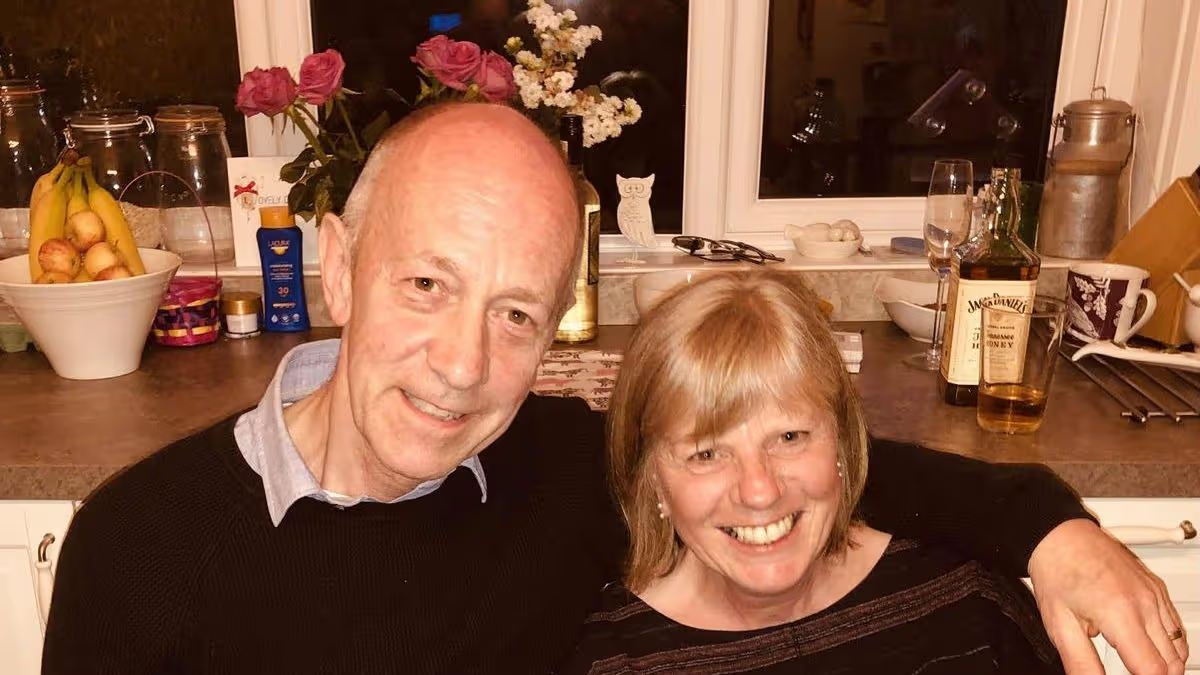
A Scots family have said they were heartbroken after being ‘robbed’ of time with their dad. Dave Watson, 73, died last month just two months after being admitted to hospital following a fall caused by a seizure.

Advertisement

Dave’s family have claimed that he was ‘ignored’ and ‘failed’ after he was forced to wait hours for an ambulance and 13 hours in a corridor at the Royal Infirmary of Edinburgh with broken ribs and a punctured lung on December 2, 2025.

Wife Elisabeth, a nurse with 43 years experience in the NHS, felt his care before his death on February 7 was not up to scratch following a litany of failures.

NHS Lothian have said that the family’s concerns are “being taken seriously” but can’t comment further while an investigation into their complaints is ongoing.

Speaking to our sister title Edinburgh Live, Elisabeth said: “I was there with Dave in A&E for hours and left to go and get him a bag. While I was at home I received a call to say Dave had fallen off the trolley in the corridor trying to go to the toilet – he was on his own for maybe an hour at most.

Advertisement

“No one seemed to be looking after him. He had crawled all the way down his bed and managed to fall out of the end without anyone noticing. He was not being monitored and I want to know: did he have a buzzer? Did he shout or ask for help?

“They were worried he had broken his hip so he was sent to get a CT scan. His results came back confirming his broken ribs, so we knew he just needed time and rehabilitation to heal.

“But the hospital seemed like a chaotic mess. I had to ask a friend who worked at the hospital to come and give Dave his medication on time as I had received no assurances from staff.”

Advertisement

In 2020, Edinburgh University physics graduate and music composer Dave, from the Comiston area of Edinburgh, was diagnosed with Parkinson’s and later developed Alzheimer’s. Despite that, he was able to live a relatively independent life supported by wife Elisabeth, daughters Amy and Catriona and son Tom.

After his wait at A&E, Dave was moved to the hospital‘s major trauma ward where his care was said to be excellent. So much so that he was described as ‘a new man’ going into the weekend.

Daughter Amy travelled to Disneyland Paris with her kids and husband believing her dad would be back home by the time she returned. But this was not the case.

Advertisement

Amy said: “I was so confident we would see him at home when I got back. He spent two days in major trauma but was then sent to surgical under the care of a cardiothoracic surgeon despite requiring no surgery or suffering from heart-related issues. Initially, dad had a lot of attention but it went downhill as the ward became busier.”

However, Dave developed sepsis from an intravenous cannula that had been left in for over 72 hours according to his family. Later that day, they were told he was unlikely to survive the night, forcing Catriona, a nurse in London, to fly home.

Amy said: “It was horrendous, I sat with my dad on our own for six hours while he was having seizures and hallucinating. They had no idea what to do.

“It took them hours to discover he had sepsis and then we were told he was not going to pull through. We had prepared ourselves to say goodbye.

Advertisement

“But by the next day, he had bounced back and survived. Catriona kept saying he was in the wrong ward. We knew he was not in the right place. But I think they took advantage of the fact we were there all the time as a family caring for him.”

To recover, he needed physical rehabilitation and that he was awaiting a transfer to Ellens Glen community hospital. However, Elisabeth believes he was side-lined as he was seen as a bed blocker by NHS Lothian.

She said: “All I kept hearing is ‘he is for rehab.’ I knew that rehab had to start right away but it never happened.

Advertisement

“It was imperative for his recovery to have physiotherapy and occupational therapy everyday and I worry this did not happen because he was not boarded in the right place. He was at a huge disadvantage. He was wasting away.”

Both Elisabeth and Amy describe a decline in Dave’s condition after initially rallying. They believe this was down to two factors: his medication not being administered properly and a lack of physiotherapy.

Amy said: “He was going stir crazy. During his time in hospital I witnessed first hand his medication not being given on time or at all.

Advertisement

“It is absolutely vital that someone with Parkinson’s is given their medication on the dot. When mum got a call from staff at the Royal to say they had a restraining order in place as he had bit a member of staff, we knew something was wrong.

“He had never displayed this kind of behaviour in his life, he must have been so scared. We would get calls through the night saying he was distressed.

“This is when we discovered his long standing 8pm Parkinson’s medication was regularly not being administered. I witnessed first hand his medication not being given on time or at all.

“We were regularly called in to help him use the toilet. They were having him go to his toilet on his back, not even offering him a commode. The level of care was shocking.”

Advertisement

Amy claims the lack of physiotherapy meant Dave was often hoisted up by nursing staff using their man power but the moment his blood pressure dropped, they abandoned treatment.

She decided to move her dad to his room chair to encourage recovery. After six weeks, Amy and her husband decided to get him up for a walk which left the nurses at the bay ‘freaking out.’

Amy said: “My dad was seven stone, so we knew we could support him. That evening, staff observed him walking out of the ward to the toilet by himself. This observation confirmed he never lost the capacity to walk; he was just sidelined and ignored.

Advertisement

“I felt like the hospital was constantly passing the buck. No one was taking responsibility.

“Low blood pressure is a well-recognised and long-standing feature of Parkinson’s disease. Nevertheless, physiotherapy sessions were repeatedly abandoned due to drops in blood pressure. They just left him in his bed making no effort.”

Elisabeth was horrified when she discovered Dave in early January 2026, alone on a mattress on the floor in the foetal position hallucinating. She claims a staff nurse was sitting outside the room on a computer watching him.

Advertisement

She said: “Enough was enough. I told them to get him on the chair and I stormed in and told them they have to get Dave out of here now.

“He should have been moved to Ellens Glen immediately but by the time he got there in the middle of January, it was too late. He needed intense care but was not given it, he would have been better off at home.”

Having decades of experience working as a nurse within the NHS, Elisabeth believes Dave’s treatment was emblematic of the crisis impacting NHS Scotland – long waiting times and not enough beds for reablement across the Lothians.

Dave was moved into Ellens Glen and sadly passed away on February 3. This was despite the family being assured throughout December and January that he was not at the stage of ‘end of life care.’

Advertisement

Amy said: “The damage was done by the time we went to Ellens Glen. The minute he rallied in hospital he had to be moved there.

“The fact he deteriorated so severely away from us showed how good a job we were doing caring for him at home. I genuinely believe he would have died in the Royal if we had not been there intervening and caring for him. We were taken advantage of, and he was failed.”

Elisabeth believes the NHS is ‘finished.’ Having spent four decades working in the sector, she describes an environment riddled with bed blockage and a lack of rehabilitative care.

Advertisement

She said: “Dave was failed by the system. If he had been given physio right away then we could have had longer with him.

“He is one of thousands who are being failed and dying in hospitals like the Royal. We have a capacity issue in Edinburgh.

“I’m appalled. I do feel that looking back and having worked with a lot of people, there is massive fragmentation.

“Senior members of NHS Scotland have no awareness of what is happening on the ground. The NHS is just firefighting now, it is panic management. The human level has gone.”

Advertisement

The family have contacted various senior figures within NHS Scotland as well as cabinet ministers but say they feel ‘fobbed off and ignored.’ They currently have a stage two complaint being investigated by NHS Lothian.

Tracey Gillies, Medical Director for NHS Lothian, said: “We extend our sincere condolences to Mr Watson’s family and want to assure them that their concerns are being taken seriously. As we are currently investigating a formal complaint regarding his care, we are unable to comment further at this time.”

Get more Daily Record exclusives by signing up for free to Google’s preferred sources. Click HERE.

Source link

Advertisement
Continue Reading
Click to comment

Leave a Reply

Your email address will not be published. Required fields are marked *

NewsBeat

Pensioner dies in hospital three days after horror Inverness crash

Published

on

Daily Record

An 88-year-old man has died in hospital three days after being involved in a car crash in Inverness.

A pensioner has died three days after being involved in a one-car crash in Inverness. Emergency services were called to a car park near Longman Drive in the city at around 2.40pm on Monday, March 9.

Advertisement

One car was involved in a collision and an 88-year-old man was taken to Raigmore Hospital for treatment. However, despite the best efforts of doctors, he died in hospital three days later on Thursday, March 12.

No further details of the crash were shared by police and they have not said if there were any other occupants in the car or any other injuries.

Police are now appealing for any other witnesses to come forward as they work to establish the full circumstances.

A spokesperson for Police Scotland said: “An 88-year-old man has died following a crash in Inverness.

Advertisement

“Around 2.40pm on Monday, March 9, officers were called to a report of a one-car crash in a car park near to Longman Drive in Inverness.

“Emergency services attended and the elderly man was taken to Raigmore Hospital, where he died on Thursday, March 12.

“Enquiries are ongoing to establish the full circumstances of the collision.

“Officers are keen to speak with anyone who witnessed the crash but has not yet spoken with police.

Advertisement

“Please contact Police Scotland through 101, quoting incident 1725 of the Monday, March 9.”

Get more Daily Record exclusives by signing up for free to Google’s preferred sources. Click HERE.

Source link

Advertisement
Continue Reading

NewsBeat

Prince of Wales remembers Diana on Mother’s Day

Published

on

Prince of Wales remembers Diana on Mother’s Day

The picture, posted online for the first time from the family’s private collection, shows Diana with a two-year-old William in a field of flowers, taken at the family’s main home at Highgrove, Gloucestershire, in 1984.

William’s signed message, posted on social media site X, said: “Remembering my mother, today and every day. Thinking of all those who are remembering someone they love today. Happy Mother’s Day. W”

Diana, who died aged 36 following a road accident in Paris on August 31 1997, would have turned 65 on July 1 this year.

Advertisement

The royal family also posted a selection of photos on X to mark Mother’s Day.

They included a photo of the King and his sister Anne, now the Princess Royal, at Balmoral, Scotland, in 1953 with their mother, the late Queen Elizabeth II.

The family are seated on a garden bench with the Queen’s corgi, Sue, in the background.

Advertisement

The photograph was taken before the births of Charles’ younger brothers, Andrew Mountbatten-Windsor and Edward, now the Duke of Edinburgh.

Other photos were shared of the late Queen with her mother Queen Elizabeth the Queen Mother, and of Camilla with her late mother Rosalind Shand.

The images are accompanied by the message: “Wishing Mothers everywhere, and those who might be missing their Mums today, a restful Mothering Sunday.”

Advertisement

Source link

Continue Reading

NewsBeat

Man Utd vs Aston Villa LIVE: Premier League match stream, latest team news, lineups, TV, prediction

Published

on

Man Utd vs Aston Villa LIVE: Premier League match stream, latest team news, lineups, TV, prediction

Michael Carrick is yet to lose at home since signing on as interim head coach, scoring at least twice in each of their four outings, and will hope to keep that record up as he faces Unai Emery’s side today. The Midlands side have been on rather shaky form of late, calling time on a run of one win in seven matches as they edged Lille in the Europa League last time out.

Source link

Continue Reading

NewsBeat

First World War memorial window rededication at York church

Published

on

First World War memorial window rededication at York church

St Lawrence Parish Church, on Lawrence Street, will hold a service of Choral Matins at 11am on Saturday, March 21, to mark the rededication of its First World War Memorial Window, which has recently been conserved by specialist Dunnington firm Barley Studio, at a cost estimated to be £80,000.

The service will be attended by the North Yorkshire deputy lieutenant Major General Charlton‑Weedy, the Lord Mayor and Civic Party, the York Guard, D‑Day veteran Ken Cooke, army cadets and organisers are hoping to see serving members of the military.


Recommended reading:

Advertisement

The towering 8.5 metre‑high stained glass window, made up of three lancets in the south transept, was created around 1930 by Arts and Crafts artist Joan Fulleylove.

It was donated in memory of former vicar Thomas Abelson Harpley and his son, Lieutenant Robert Abelson Harpley of the King’s Own Yorkshire Light Infantry, who was killed on the Somme in July 1916.

Unusually for a First World War memorial, the window depicts the Somme battlefield – including the church at Albert – alongside scenes of York such as Walmgate Bar and All Saints, Pavement, linking the western front to the parish back home.

It also serves as a tribute to more than 100 men of St Lawrence’s parish who died in the war, whose names are recorded on a large marble plaque beneath the glass.

Advertisement

The window re-dedication event takes place at 11am on Saturday, March 21, at St Lawrence Parish Church, Lawrence Street.

Source link

Advertisement
Continue Reading

NewsBeat

Long-term test of 2019 Tesla Model 3 Performance – part 3

Published

on

Long-term test of 2019 Tesla Model 3 Performance - part 3

The mixture of power, comfort and tech still feels up-to-scratch seven years after launch.

As you spend more time with an EV, your daily habits quietly rearrange themselves around charging. I’ve discovered that you can order – and steadily eat – a six‑inch breakfast sandwich at a motorway Subway in roughly the time it takes to add about 30 per cent of charge on a Supercharger. Linger in the service area for a coffee afterwards and the battery has typically crept up by another 20 per cent, turning what would once have been ‘dead time’ into an extra chunk of usable range without you really thinking about it.

The Tesla Model 3 Performance

On regular long runs, those short, stacked stops soon become second nature. You start planning the day not around ‘Can I make it?’ but ‘Where’s the nicest place to stop for 20 minutes?’ It’s a subtle but important shift: the car is no longer dictating your movements, it’s simply slotting into them.

Despite having lived with the car for months, I still forget how alien it can feel to first‑timers. The flush door handles – press the rear edge in and the front edge pops out – never fail to wrong‑foot passengers. When you know, you know, but watching friends prod, pull and paw at the doors before they finally swing open has become a running joke. It’s a reminder that, for all its now‑familiar silhouette, this is still a very different proposition to the average petrol saloon.

Advertisement

A 2019 Tesla Model 3 Performance

Inside, the minimalist layout that felt boldly futuristic in 2019 now has a hint of classic Tesla about it. Newer models have added polish and a gentle evolution in build-quality, but this early Model 3’s clean dash and single 15‑inch display still make most conventional cabins feel cluttered.

If there’s one question that still hangs over any used EV, it’s range – not what the brochure once claimed, but what the car will actually do on a grim, real‑world slog. On a recent 400‑mile round trip in cold and rainy conditions, the Tesla was quietly reassuring. Against the original 329‑mile WLTP figure when new, this seven‑year‑old Performance model now delivers somewhere between 200 and 250 miles from a full charge in mixed driving.

A 2019 Tesla Model 3 Performance

That’s without obsessing over every kWh; I drove at normal motorway speeds, used the climate control as needed, didn’t shy away from frequent bursts of power when needed, and treated it like any other family car. The motorway miles simply slipped by, the only real planning being where to combine charging with a sandwich or a coffee. Factor in what we now know about Tesla battery longevity – with relatively modest degradation at far higher mileages than this car has covered – and that 200‑plus‑mile comfort zone feels entirely usable for UK life.

Taken together, these months have shown that this 2019 Model 3 Performance is more than just a fast footnote in Tesla’s back catalogue. Yes, a new Model 3 offers more range and slicker software, and for many buyers that will be the rational route. But as a £22,000–£25,000 used proposition, this seven‑year‑old Performance still feels remarkably current: quick, comfortable over big distances and easy to live with once your routine falls into step with the charging.

Advertisement

Most importantly, it doesn’t feel like a technological dead end. With its over‑the‑air updates, still‑strong real‑world range and the backing of Tesla’s charging network, this particular seven‑year‑old EV doesn’t feel like a punt – it still feels like a future‑proof used buy.

The Lowdown

Tesla Model 3 Performance

YEAR BUILT: 2019

Advertisement

MILEAGE: 44,294

ACCELERATION: 0-62mph in 3.7 seconds

TOP SPEED: 155mph

RANGE: Potential 329 miles (WLTP) when new

Advertisement

PRICE: Estimated £22k to £25k in today’s market

Source link

Advertisement
Continue Reading

NewsBeat

Exact time to eat dinner so you sleep better

Published

on

Daily Mirror

With Daylight Savings approaching, sleep schedules often take a hit – but these tips can help to keep your sleep regular.

Spring has arrived, and before this month concludes, summer will be upon us. On March 29, the clocks will spring forward and British Summer Time will commence.

Advertisement

This brings brighter evenings – but one hour less in bed. This can prove a challenging transition, but with a few simple adjustments, the shift can be made more manageable.

Dr Tim Mercer, an NHS GP partner and GP trainer with Opera Beds has revealed some of his leading recommendations for easing this changeover period. He outlined why Daylight Savings can prove difficult to adapt to as well, reports the Express.

It’s entirely related to the amount of light we’re exposed to.

Dr Mercer stated: “Exposure to morning daylight suppresses melatonin production, waking us up and keeping us alert during the day.”

Advertisement

“During the evening and in darkness, melatonin production increases, signalling to your body that it’s time to sleep.

“With the later onset of darkness after the clocks go forward, your body may delay melatonin production, potentially making it harder to fall asleep at your usual time.

“This shift can lead to temporary disruptions in sleep patterns as your body adjusts to the new schedule.”

He added: “As the clocks go forward and we move into British Summer Time, we lose an hour of sleep, which can upset our internal body clock.

“If you have a good sleep routine, you may consider moving it forward by 10-15 minutes in the days leading up to the change.”

It’s also worth being mindful of your eating patterns, and to achieve the best night’s sleep, we ought to have dinner – typically the largest meal of the day – three hours before turning in.

He said: “On Sunday, March 29, eat dinner an hour earlier than usual. Where we’re losing an hour, eating too close to your bedtime can disturb your sleep and cause indigestion. You should aim to finish dinner a few hours before going to bed.”

Advertisement

Another approach to improving your sleep is keeping active, according to Dr Mercer: “Longer daylight hours provide more opportunities for outdoor activity, which can benefit your sleep.

“Engage in regular exercise, such as walks or outdoor sports, but avoid vigorous activity too close to bedtime, as this can be stimulating.”

Source link

Advertisement
Continue Reading

NewsBeat

Prince William shares emotional Mother’s Day picture of Princess Diana

Published

on

Wales Online

The picture of William and his mother has never been seen before by the public

Prince William has paid tribute to his late mother, Princess Diana, with a never-before-seen picture. The image – believed to be from the Prince of Wales’ private collection – shows the royal as a child around the age of two with his smiling mother in a field of flowers.

Posting the picture on social media William said: “Remembering my mother, today and every day. Thinking of all those who are remembering someone they love today. Happy Mother’s Day. W”

The Prince of Wales visited Cardiff on Saturday, March 15 to watch Wales win the team’s last game of the Six Nations, and its first win.

Advertisement

At the time of Diana’s death in August 1997, her eldest son was just 15 and Prince Harry was 12 years old. For the latest TV and showbiz gossip sign up to our newsletter

Content cannot be displayed without consent

The Royal Family social media page also posted a Mother’s Day message celebrating the mother’s of the family.

The post reads: “Wishing Mothers everywhere, and those who might be missing their Mums today, a restful Mothering Sunday.”

Get daily breaking news updates on your phone by joining our WhatsApp community here. We occasionally treat members to special offers, promotions and ads from us and our partners. See our Privacy Notice

Advertisement

Source link

Continue Reading

NewsBeat

LIV Golf: Bryson DeChambeau wins in Singapore after ‘brutal’ play-off

Published

on

Bryson DeChambeau holds the LIV Golf Singapore trophy

Bryson DeChambeau won his fourth LIV Golf title with a “brutal” play-off victory over Canadian wildcard Richard T Lee at Sentosa Golf Club in Singapore.

American DeChambeau secured the trophy at the first extra hole despite finding water off the tee, after both players had finished on 14 under par.

Lee birdied four of his final six holes to set the clubhouse target but could not maintain that momentum.

The first play-off hole saw DeChambeau dump his ball in a lake as they played down the 18th, immediately handing his opponent an advantage.

Advertisement

But Lee’s conservative approach backfired as DeChambeau rescued a par five.

Lee then agonisingly missed a short par putt and DeChambeau, clearly surprised at greenside, was able to celebrate a win.

“What a day, that was crazy,” DeChambeau told TNT Sports.

“When I hit it in the water, the wind just took it way out of line, it was brutal. I managed to gather myself and hit a 300-yard three wood to get back in it.

Advertisement

“I had to go for it and attacked it. I feel so bad for Richard. I wanted to go and play an extra hole. Sport is brutal – you never want to see someone miss a putt like that.”

Lee’s runner-up finish is the highest achieved by a wildcard in a LIV event and earned the 35-year-old $2.25m (£1.7m) from the $20m (£15.1m) individual prize fund.

“It was a short putt and I wanted to just hit it hard, and I hit it a little too hard,” Lee said.

“I think the adrenaline was pumping a little bit. Then again, I felt like I had it this week. I played really well. Hopefully next week I can try again.”

Advertisement

DeChambeau, 32, collected $4m (£3.1m) for his victory, with England’s Lee Westwood, 52, finishing third on 12 under to claim $1.5m (£1.16m).

Source link

Continue Reading

NewsBeat

Chemist issues new ‘serious harm’ warning for anyone taking promethazine and diphenhydramine

Published

on

Daily Mirror

Pharmaceutical expert said ‘recent research has linked sedating antihistamines to rising numbers of deaths’

A pharmaceutical expert has issued a new warning about people taking types of sleeping pills about possible dangers of ‘serious harm’. Writing on The Conversation website Dipa Kamdar Senior Lecturer in Pharmacy Practice, Kingston University explained that some drugs are sold over the counter at thousands of chemists around the country – and people assume they are totally safe.

Advertisement

However she explained people need to be aware of their side effects and in some cases what prolonged taking can do to the body. She said: “Many people assume that medicines sold over the counter are inherently safe. After all, if you can buy something in a supermarket or high street pharmacy, how dangerous can it really be?

“The reality is more complicated. Several commonly used over-the-counter medicines carry a real risk of dependence, misuse or harm when taken in higher than recommended doses, for longer than needed, or for the wrong reasons.“

On the issue of sleeping tablets, she highlighted two main brands – promethazine and diphenhydramine and said prolonged use can lead to people needing higher doses – and in fact lead to insomnia. She said: “Promethazine and diphenhydramine are sedating antihistamines sold as short-term sleep aids. Recent research has linked sedating antihistamines to rising numbers of deaths, prompting calls for a review of how they are supplied.

“Promethazine can quickly lead to tolerance, meaning higher doses are needed to achieve the same effect. Some long-term users report severe rebound insomnia when they try to stop. It is also used recreationally in “purple drank”, a mixture of cough syrup that contains promethazine and soft drinks. This combination can cause extreme sedation, slowed breathing and serious harm.”

Advertisement

Promethazine and diphenhydramine are both strong, sedating (drowsy) antihistamines. NHS guidance advises against taking these together, as it increases the risk of excessive sleepiness, severe sedation, and side effects like dizziness and confusion. Both are used for allergies, while promethazine is also used for short-term insomnia

The NHS advice for promethazine says:

Serious side effects

Call your doctor or call 111 straight away if:

Advertisement
  • you’re feeling confused – you’re unable to concentrate or think clearly, or have muddled thoughts
  • you have blurred vision
  • you have difficulty peeing

Call your doctor or call 111 straight away and stop taking promethazine if:

  • the whites of your eyes or your skin turn yellow, although this may be less obvious on black or brown skin – these can be signs of liver problems
  • you are bruising or bleeding more than normal
  • you have muscle stiffness or shaking, or unusual face or tongue movements
  • you have a fast, pounding or irregular heartbeat (palpitations)
  • your child becomes aggressive, sees or hears things that are not there (hallucinations) and becomes hyperactive

For more information click here.

The NHS advice for diphenhydramine says:

Call a doctor or call 111 straight away if:

  • you have a fast or irregular heartbeat (palpitations)
  • you feel any numbness or pins and needles
  • you feel very restless
  • you’re feeling confused – you’re unable to concentrate or think clearly, or have muddled thoughts

For more information click here.

Source link

Advertisement
Continue Reading

NewsBeat

Haddenham lost railway’s journey from train station to 40 new homes

Published

on

Cambridgeshire Live

There is now nothing at the site to suggest it was once a railway station

At first glance, there is little to suggest that trains once stopped here, which is a similar story to many Cambridgeshire railway stations that have come and gone over time. One in particular with an unusual story to tell, lies beneath newly laid tarmac as it is transforming into 40 new homes.

Advertisement

Haddenham Cambs was a single platform station which opened in April 1866 and offered three passenger trips a day, down the Ely to St Ives railway line.

The station was renamed Haddenham Cambs in 1923 to avoid confusion with with Great Western’s Haddenham station and was open for passenger journeys until 1931. The line was used by fruit pickers and for two annual excursions to Hunstanton and Great Yarmouth until 1958.

The original station buildings have long since disappeared with the former platform area forming part of the business Anson Packaging’s office buildings in 1977. The business site closed in 2016 and in 2022, work began to transform the landscape into 40 new dwellings, a substation and associated infrastructure.

The new properties are a mixture of 40 new two-bed and three-bed affordable rent and shared ownership properties set to be on the market for tenants in spring 2026.

Advertisement

A brief history of the railway line

The station was located outside the village of Haddenham next to the Station Road and Ely Way junction and was built to serve the surrounding Fenland communities.

The line was short connecting the village to the Ely and Huntingdon railway. It opened in August 1847, the same day as the Eastern Counties Railway opened its line from Cambridge to St Ives.

Despite a slow start and several failed proposals to expand the line in 1869 and 1872, an extension from Sutton to St Ives eventually opened in 1878 and connected Haddenham, Bluntisham and Earith Bridge increasing services to five trains a day.

Advertisement

Charles Howard spent 39 years of his service with the Great Eastern Railway Company at Haddenham station. He said: “When I came to Haddenham in 1887 the platform was only about two bricks high. I had that altered so that people could conveniently step into the carriages, as they would be able to do at any other station.”

“In those days we had a brick siding to cope with the tremendous brick trade which was done by Mr Jewson’s firm”.

Passenger numbers were modest as residents showed little enthusiasm for the rural station’s walking distance from the village and prohibitive fares. Freight traffic for transporting local products from the nearby goods sheds, coal yards and adjacent clay pit remained healthy over the years.

Mr. Howard spoke on the fruit growing industry in the area and said that in those days the gooseberry was the principal fruit grown. People across the community went in for growing all kinds of fruit and large quantities that were dispatched by rail

Advertisement

Prior to Mr Howard there had only been one other station master, Mr Jacobs, who was there for 21 years.

Following the First World War and the arrival of local bus services in 1922, there was a rapid decline in passenger numbers which came secondary to freight traffic transporting goods.The railway was absorbed into the London & North Eastern Railway (LNER) the same year, becoming a part of the wider train network as it is known today.

Passenger services on the line were withdrawn in February 1931. Despite this, the station continued to see occasional use for special trains carrying seasonal fruit pickers who came to the area to help with harvest work. The branch was the busiest with transporting goods such as milk, sugar beet, livestock and agricultural produce.

After the Second World War, most of this traffic gradually shifted to road transport and only two annual excursion trains to the seaside resorts of Hunstanton and Great Yarmouth also called at the station until October 1958.

Advertisement

Within the same year the tracks were lifted, and much of the former railway route was returned to farmland or reused as access roads across the surrounding fenlands.

The land was occupied in 1977 by Ansom packaging who were a leading supplier for the plastic packaging of Marks & Spencer produce. The business built a £1.5 million production space incorporating the former station house into its infrastructure.

The company remained on the site of the old railway station until its merger with the Danish firm Faerch in 2015 and moved to a new facility headquarters at Lancaster Way Business Park, Ely.

Today, little evidence remains of Haddenham’s once busy rural station but with the land once again redeveloped, the site enters a new refreshed chapter in its long history yet to be made.

Advertisement

Source link

Continue Reading

Trending

Copyright © 2025