

Crypto World
Solana’s Drift Floats Airdrop After $285 Million Hack, Faces Backlash


Solana-based perpetual futures exchange Drift Protocol is facing mounting scrutiny following the catastrophic $285 million exploit it suffered this week.
The backlash is being driven by a highly speculative recovery strategy and suspicious post-hack token movements.
Drift Team Linked Wallet Shifts Over $2 Million Tokens
On April 4, blockchain analysis platform Onchain Lens reported that a wallet linked to the Drift team deposited 56.25 million DRIFT tokens into centralized exchanges Bybit and Gate after the hacking incident. The tokens were valued at $2.44 million.
Transfers to exchanges are typically interpreted as a sign of potential selling activity. The timing has added to the concern, with the token falling to an all-time low of $0.03343 over the past 24 hours.
The move has drawn significant scrutiny from the community because it comes while the project is still dealing with the fallout from the hack.
That has made the transfer of internal funds to secondary markets during a severe liquidity crisis especially contentious. It has also raised fresh concerns about possible asset flight and complicated efforts to rebuild user trust.
On April 1, North Korean attackers hacked Drift Protocol, draining around $280 million. This slashed the platform’s total value locked from $550 million to about $230 million as of press time.
The April 1 attack ranks as the largest decentralized finance hack of 2026 so far. The fallout has continued to spread, with reports indicating that the number of affected projects has now risen to 20.
The breach also stands as the second-largest hack in Solana’s history, behind only the $326 million Wormhole exploit in 2022.
Solana Co-Founder Proposed Recovery Strategy
Amid the ongoing crisis, Solana co-founder Anatoly Yakovenko publicly suggested that Drift could survive by executing an “airdrop” of IOU tokens.
This mirrors the strategy employed by the centralized exchange Bitfinex following its $72 million hack in 2016.
Yakovenko said a core engineering team could rebuild the platform and use the IOU tokens to eventually make affected users whole.
Market analysts, however, point to major structural differences between the two cases.
Bitfinex benefited from a dominant position in centralized trading and recurring fee revenue during a historic crypto bull market. This allowed the exchange to gradually buy back its debt tokens at a 1:1 ratio.
Drift, by contrast, operates as a decentralized exchange in a highly competitive and fragmented market. With user confidence damaged and liquidity cut roughly in half, the protocol lacks the predictable revenue base needed to support an unsecured debt instrument.
Analysts have also argued that describing such an issuance as an “airdrop” risks obscuring the core issue. Without a solvent protocol and a viable path to repayment, the tokens would carry no intrinsic value beyond speculation on a future recovery.
The post Solana’s Drift Floats Airdrop After $285 Million Hack, Faces Backlash appeared first on BeInCrypto.



Disclosure: The author of this story owns shares in Strategy (MSTR).
Strategy (MSTR), the world’s largest corporate holder of bitcoin , repurchased $1.5 billion of its 0% convertible senior notes due 2029 last week for $1.38 billion, opting to reduce debt rather than add to its bitcoin treasury, according to a filing released Tuesday.
The company funded the repurchase using cash reserves, bringing those reserves down to about $871 million following the debt repurchase and related capital transactions.
Executive Chairman Michael Saylor referenced the move on Sunday in a post on X, writing: “This week we bought bonds, not bitcoin. The ₿itVac is charging.”
The repurchase marks a shift from the company’s usual bitcoin accumulation strategy as it looks to restructure liabilities tied to its bitcoin treasury model.
Upon settlement, the purchase reduced the company’s outstanding debt obligations to $6.7 billion from $8.2 billion.
Strategy holds 843,738 BTC acquired at an average price of $75,700 per coin, representing a total purchase cost of approximately $63.9 billion.
MSTR shares rose 1.9% in pre-market trading alongside bitcoin’s modest rise back to $77,000 over the weekend.
Read More: Strategy to repurchase $1.5 billion of 2029 convertible bonds using cash or bitcoin sales


Arthur Hayes posted a NEAR Protocol (NEAR) weekly price chart with the caption “We got a long way to go … pack your bags for da moon,” reinforcing a bullish stance on the Layer-1 token.
The post arrived as NEAR traded still well below its 2022 peak above $20. The weekly chart Hayes shared shows the token recovering from multi-year lows, suggesting he sees substantial upside from current levels.
His “Holy Trinity” Altcoin in Focus
Hayes’ conviction in NEAR predates the post. Three days earlier, he named Near Protocol alongside Hyperliquid (HYPE) and Zcash (ZEC) as his “holy trinity” of altcoin positions, a broader call across three assets. The new post narrowed the focus to NEAR alone, pairing the bullish caption with that long-range chart.
That framing suggests Hayes views NEAR’s current price range as an entry point rather than a position already playing out. He has described NEAR’s on-chain “intents” feature as a pathway to recurring protocol revenue and cited the convergence of AI infrastructure and blockchain scalability as the core of his thesis.
NEAR has positioned the protocol as infrastructure for autonomous on-chain applications over the past 18 months.
NEAR had already surged more than 65% in the seven days following the May 22 holy trinity call, according to market data. That move built on a period of NEAR Protocol price consolidation following sustained underperformance against larger Layer-1 peers. A separate analysis had flagged the token as potentially undervalued against Solana in daily active user metrics.
Hayes’ Broader Altcoin Playbook
The NEAR post fits a clear pattern of Hayes concentrating capital into protocol-level bets with specific revenue theses. He bought $1.1 million in HYPE earlier in 2026 and has published a $150 price target for HYPE by August. He has also rotated into DeFi positions across ENA, PENDLE, and LDO.
Each pick maps to a specific protocol thesis. For NEAR, the case rests on AI demand meeting on-chain cash flow potential. Whether the broader market prices in that combination before the next leg higher remains the key question in the weeks ahead.
The post Pack Your Bags For Da Moon: Which Coin is Arthur Hayes Eyeing? appeared first on BeInCrypto.
Crypto World
Bitcoin (BTC) ETFs crushed by outflows as bond market stifles interest-rate reduction hopes: Crypto Daily
It’s getting tough for crypto bulls.
Crypto exchange-traded products (ETPs), including ETFs, have fallen out of favor with investors as the U.S. Treasury market signals higher-for-longer interest rates.
Digital asset investment products recorded $1.47 billion in outflows last week, the second consecutive week of redemptions and the third-largest weekly outflow of 2026, according to CoinShares.
Bitcoin funds led the charge, dropping $1.32 billion in their largest weekly outflow of the year. The 11 U.S.-listed spot bitcoin ETFs alone witnessed an outflow of $1.26 billion last week, following the preceding week’s $1 billion exodus. Investors pulled $223 million from ether (ETH) funds.
Other altcoin ETFs also experienced a material moderation in flows.
“Cumulative outflows over the two weeks now stand at US$2.54bn, suggesting the Iran-related risk-off has deepened and broadened despite continued CLARITY Act progress,” James Butterfill, head of research at CoinShares, said in a report shared with CoinDesk.
The outflows occurred as bond-market traders ramped up bets that the Federal Reserve will keep interest rates higher under new Chairman Kevin Warsh.
Their positioning is evident from the section of the Treasury market curve, identified by the difference between two- and 10-year yields, which grew by over 12 basis points last week.
The two-year yield is more sensitive to interest-rate expectations, so the widening of the spread, driven by a faster rise of the two-year yield, implies expectations of elevated borrowing costs over the near term. Similarly, the gap between five- and 30-year yields also widened, flashing similar expectations.
Elevated interest rates often disincentivize riskier asset classes, especially weighing on emerging technologies like cryptocurrencies and zero-yielding assets like bitcoin.
Taken together, the outflows and yield curve signals paint a bearish picture for risk assets. Investors may be redeploying capital into impending IPOs, especially SpaceX, which could be the biggest ever, and into commodities, which are rallying amid disruptions to oil flows through the Strait of Hormuz.
Forthcoming U.S. inflation data releases, including the Fed’s preferred gauge, core PCE, due on Thursday, could clarify the market trajectory. Stay alert!
Read more: For analysis of today’s activity in altcoins and derivatives, see Crypto Markets Today . For a comprehensive list of events this week, see CoinDesk’s “Crypto Week Ahead.”
What’s trending
Today’s signal

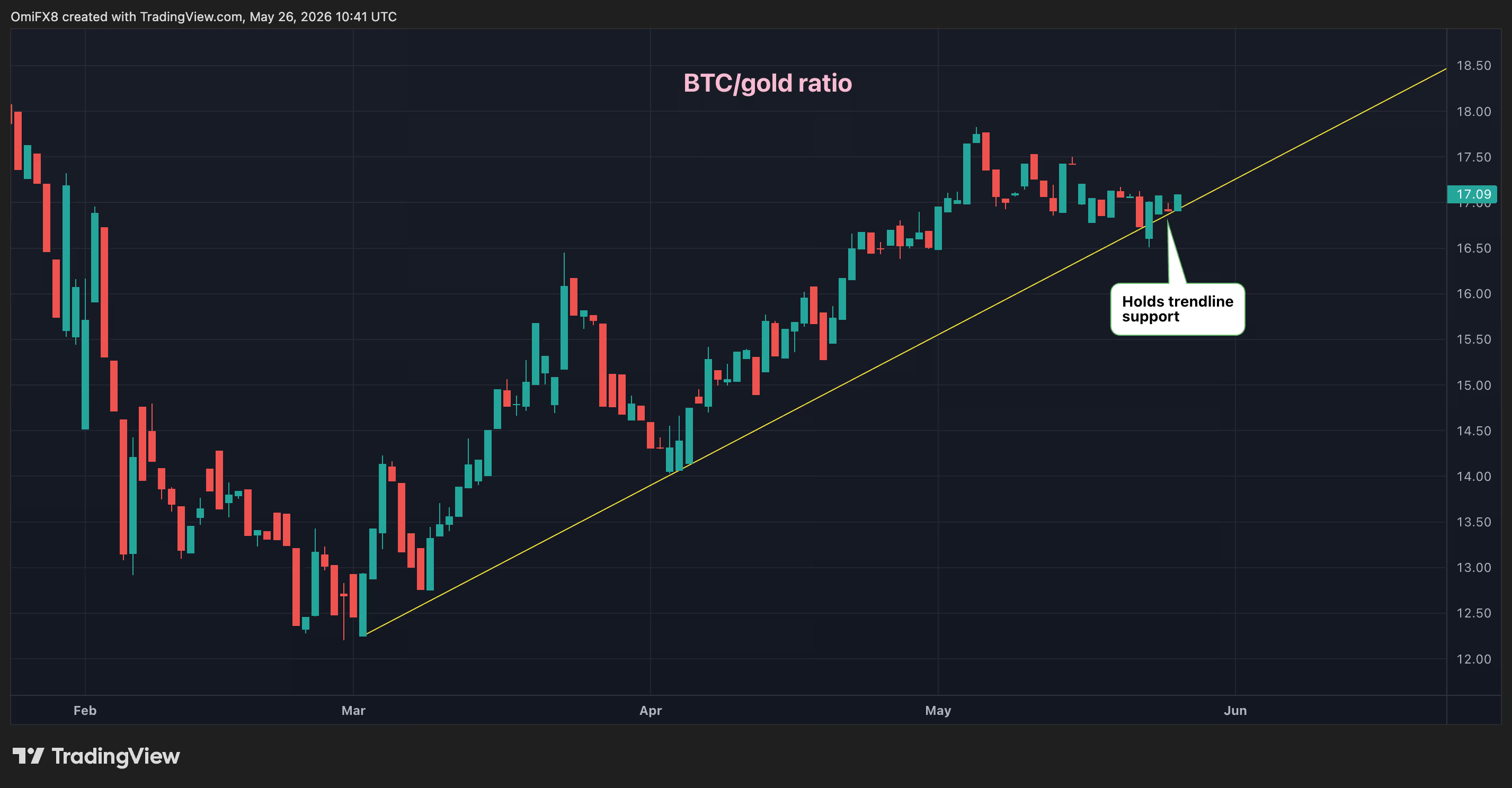
The chart shows daily swings in the ratio between the prices in U.S. dollars of bitcoin and gold.
The ratio has been rising since March, indicating BTC outperformance relative to gold, and as of writing, it is holding onto the bullish trendline support. A bounce from here would imply the continuation of the rally.
Conversely, if the support breaks, it signals a resumption of the broader BTC bear market.


European stablecoin issuer StablR has suspended minting and redemption services for its USDR and EURR tokens after a cyberattack left the assets under-collateralized, according to a company statement.
Onchain investigator ZachXBT publicly flagged the exploit over the weekend, posting that two contracts tied to StablR’s USDR and EURR stablecoins appeared compromised.
The Malta-based firm said it detected “irregularities” in its systems after internal alerts triggered an investigation.
StablR froze token operations and asked exchanges to halt trading, deposits and withdrawals for both stablecoins while the company investigates the breach. USDR currently has a $20 million market capitalization, while EURR has a $10 million market cap, according to CoinGecko data.
StablR acknowledged that the circulating supply of USDR and EURR is “currently not fully backed at the 1:1 ratio” as required under the European Union’s Markets in Crypto-Assets (MiCA) regulation.
The company said it plans to notify Malta’s financial regulator, the Malta Financial Services Authority, under the EU’s Digital Operational Resilience Act and MiCA reporting rules. External cybersecurity firms and law enforcement agencies are also involved.
Blockchain security firm GoPlus Security said the attack may have stemmed from a weakness in StablR’s Ethereum multisignature wallet setup.
The minting wallet was configured with a 1-of-3 multisignature threshold, according to GoPlus. Any one of three authorized owners could approve transactions alone.
Researchers say the attackers compromised a single key, added themselves as an administrator and removed the legitimate signers. They then minted roughly 8.35 million USDR and 4.5 million EURR, about $13.5 million in unbacked tokens at peg.
Thin liquidity on decentralized exchanges meant the attackers netted roughly $2.8 million after offloading the freshly minted supply.
StablR’s tokens briefly lost as much as 50% of their peg before starting to recover. USDR is now at $0.994, while EURR is at $0.548, far below the euro’s current value of $1.16.
Chief Executive Officer Gijs op de Weegh said the company is acting “with full transparency” as the investigation continues.
Ether’s (ETH) price printed a “bear pennant” on the daily chart, a technical chart formation associated with strong downward momentum. Could a weakening technical setup and a decline in total value locked signal the continuation of ETH’s correction to $1,800?
Key takeaways:
- Ether is forming a bear pennant on the daily chart, with a potential breakdown to $1,800.
- ETH price may see further losses if Ethereum’s total value locked continues to shrink.
Ether bears eye ETH price “dump” to $1,800
Ether’s 13% drop from its multi-month highs above $2,400 saw it breach a key trend line that has supported the price since early February.
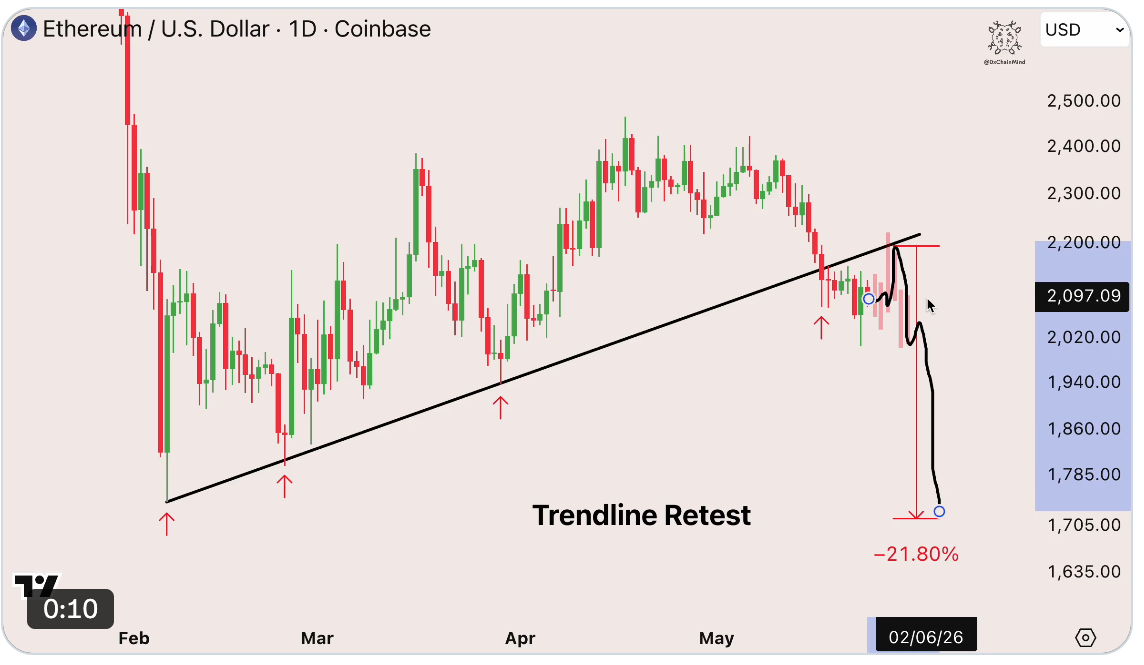
“ETH is going to dump hard soon?” Chain Mind said in a video posted on X, suggesting where ETH/USD might move next after dropping below the ascending trend line.
“This is the crucial moment for ETH,” Chain Mind said, adding that the price was required to reclaim the support level, otherwise a drop to areas below $1,800 was in the cards.
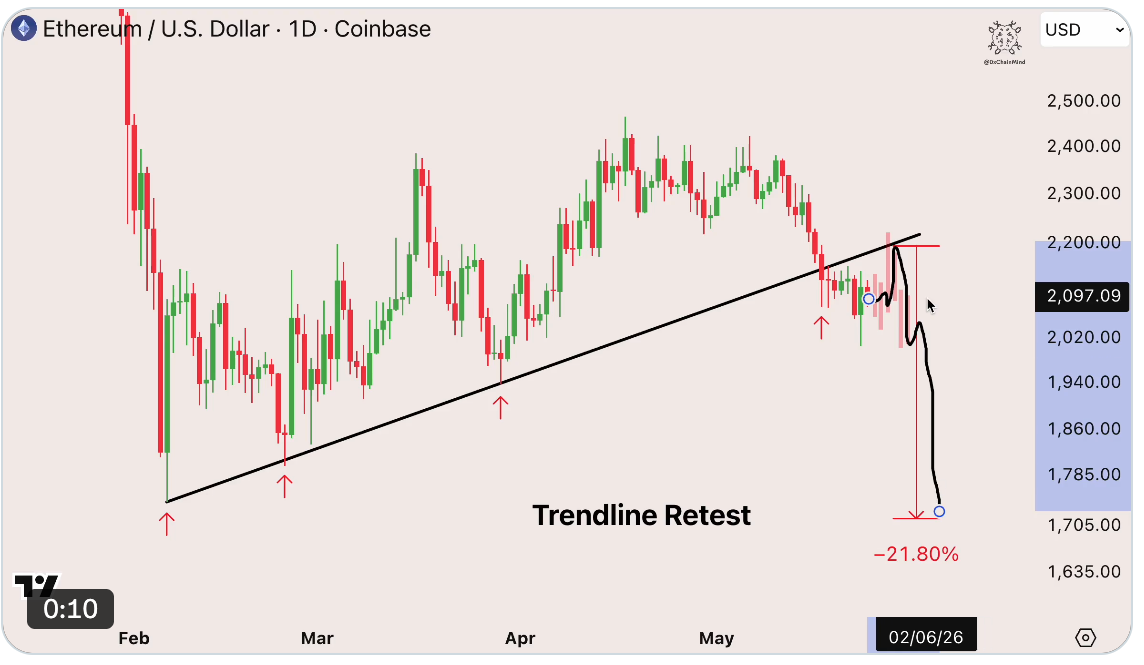
ETH daily chart. Source: X/Chain Mind
Meanwhile, ETH’s price has formed a bear pennant chart pattern on the daily chart, as shown below.
A bear pennant pattern is a bearish setup that forms after the price consolidates inside two converging lines following a sharp price drop.
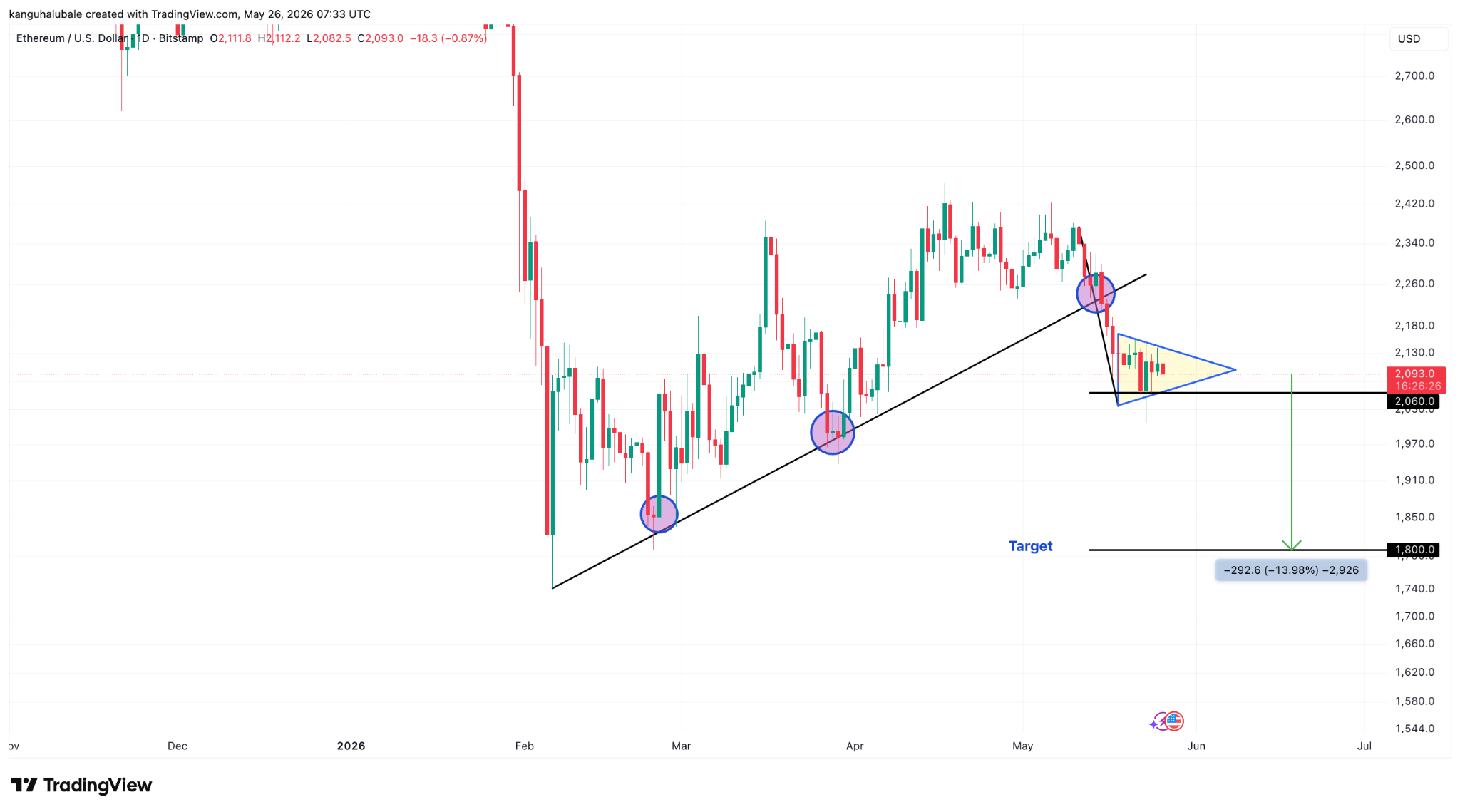
ETH/USD daily chart. Source: Cointelegraph/TradingView
The pennant will resolve once the price breaks below the lower trend line at $2,060, opening the way for a drop equal to the previous uptrend’s height. This puts the lower target for ETH/USD at $1,800, down 14% from the current price.
Crypto analyst Alex Marzell said that if Ether’s price dropped below $2,050, it would increase the chances of a move toward the next support zone at $1,800.
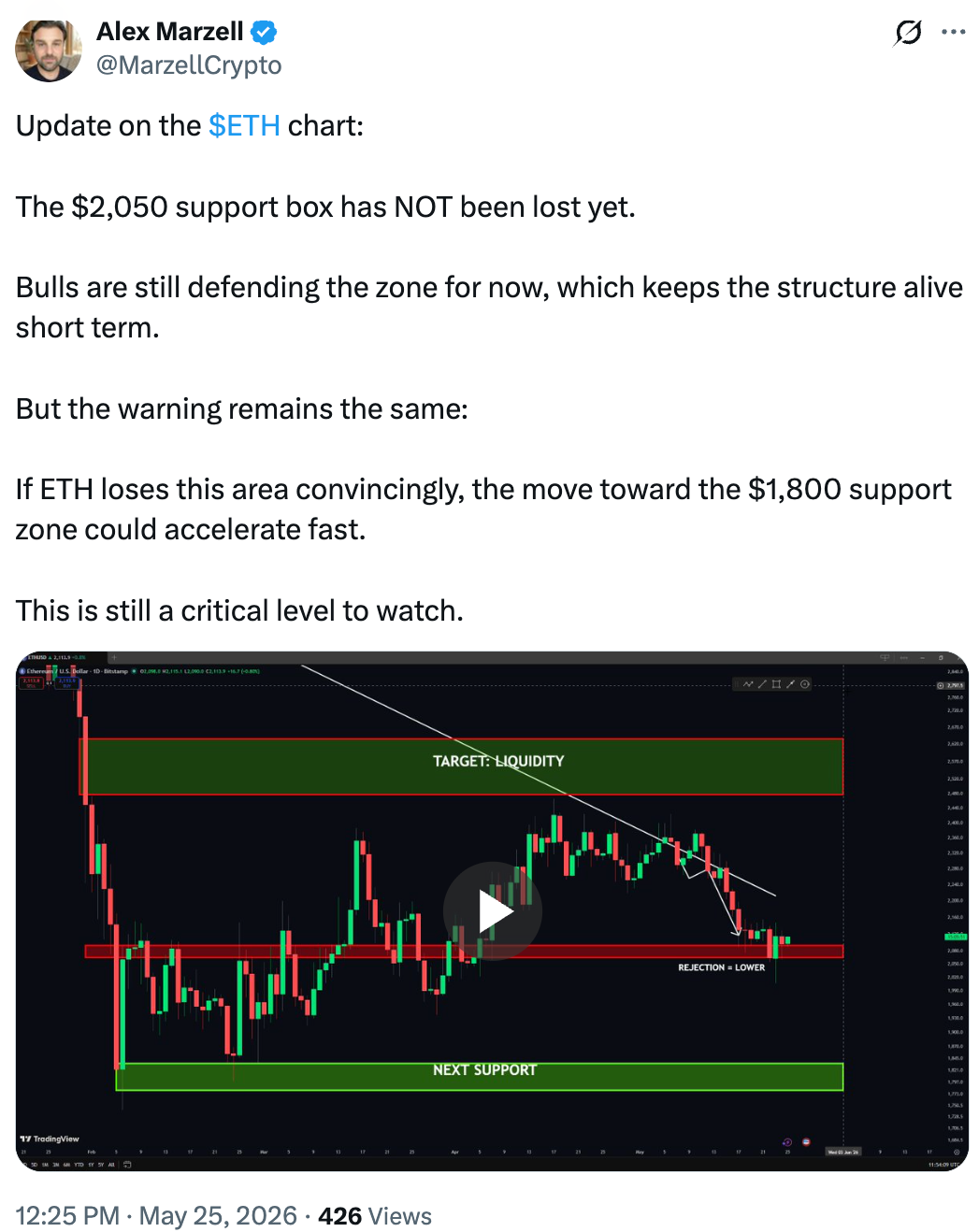
Source: Alex Marzell
As Cointelegraph reported, Ether’s downtrend is likely to continue toward $1,750 in the short term if key support levels do not hold.
Ethereum’s total value locked crashes 55%
Ether’s bearish technical outlook overlaps with several other headwinds, such as recent Ethereum Foundation departures, weakening social media sentiment, and declining total value locked (TVL) across its DeFi protocols.
Ethereum’s TVL has now fallen to $116 billion, levels last seen in April 2025. For comparison, the network’s TVL hit an all-time high of $258 billion on Aug. 14, 2025.
The TVL has therefore more than halved, representing a 55% decline.
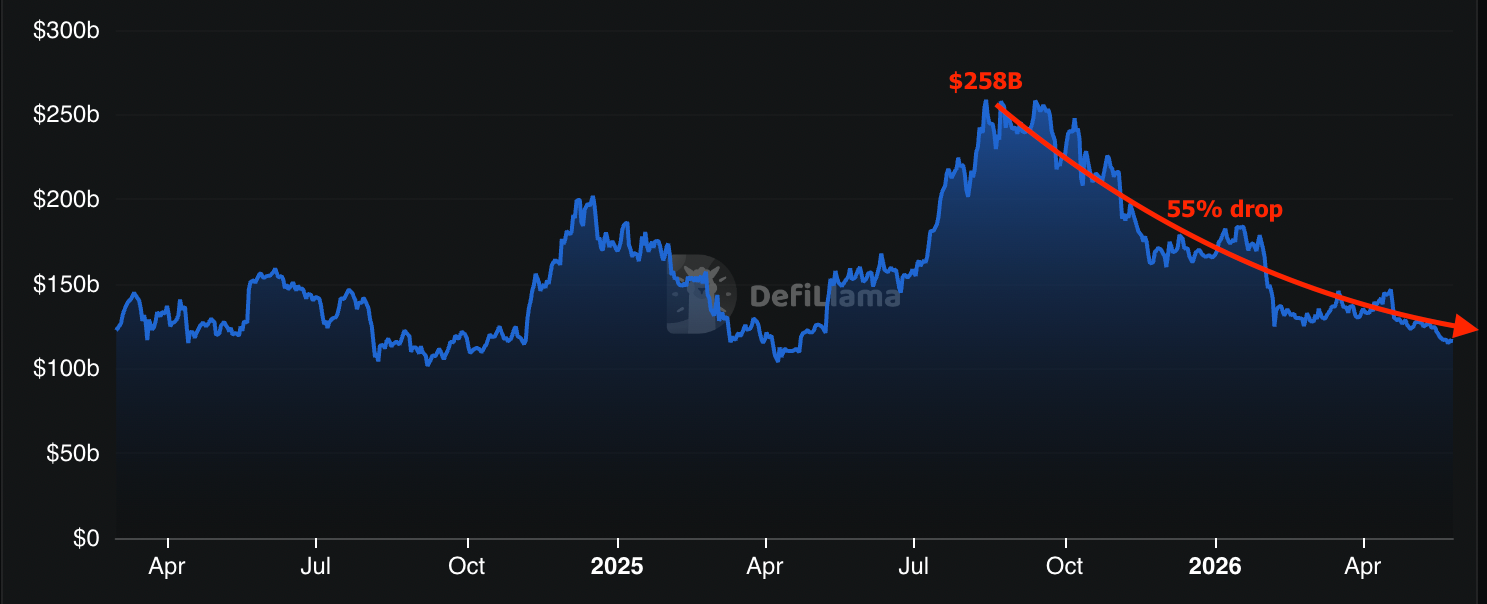
Ethereum total value locked. Source: DefiLlama
Negative TVL growth is more pronounced in Ethereum’s layer-2 (L2) network, led by Ether.fi whose total value locked is down 32% over the last 30 days.
“There is a sustained TVL decline” across Ethereum’s L2 sector, CryptoRank said in its Telegram note on Monday.
The sharpest corrections are seen in Arbitrum (-63%), zkSync (-64%), and Linea (-98%), “pointing to high liquidity sensitivity to incentive programs and short-term reward mechanics,” the crypto analytics platform said, adding:
“This reinforces the broader picture of capital fragmentation in Ethereum’s rollup ecosystem and undermines the ‘unified liquidity pool’ effect that early L2 development models envisioned.”
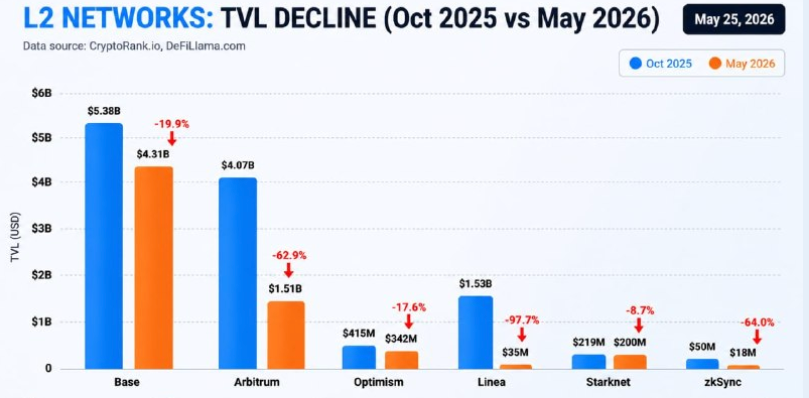
Layer-2 networks: TVL decline since October 2025. Source: CryptoRank
Declining TVL signals weakening onchain demand, adding downside pressure on ETH and increasing the risk of further price declines in the near term.


Bitget has launched a regulated tokenization platform called Reality, expanding its push into on-chain access to U.S. financial assets through tokenized stocks and ETFs.
Summary
- Bitget has launched Reality, a regulated platform issuing 1:1-backed tokenized U.S. stocks and ETFs through on-chain “rTokens.”
- The exchange said Reality supports 24/5 minting and redemption, stablecoin dividend payouts, and DeFi-compatible tokenized assets.
- Bitget has also expanded its tokenized offerings with SpaceX-linked pre-IPO products, including the SPCXUSDT perpetual contract and preSPAX spot exposure.
According to a statement shared by Bitget on Tuesday, the new platform will issue “rTokens,” which are blockchain-based representations of publicly traded equities and exchange-traded funds backed 1:1 by real shares held through regulated U.S. broker-dealers.
The exchange said the underlying assets are secured through FINRA-registered and SIPC-protected infrastructure tied to major U.S. exchanges, including Nasdaq and the NYSE.
Reality will initially focus on tokenized exposure to selected U.S. stocks and ETFs before extending into other asset classes such as bonds and Treasuries, Bitget said. The company added that users will be able to mint and redeem rTokens using stablecoins on a 24/5 basis while also using those assets as collateral across decentralized finance applications.
In the company’s announcement, Bitget CEO Gracy Chen said the exchange expects tokenized assets to account for nearly 10% of global financial assets by 2030. Chen attributed the growth outlook to stablecoin adoption, faster blockchain settlement systems, and rising interest from crypto exchanges and financial firms.
At the same time, Bitget positioned Reality as a response to long-running issues in the tokenized asset market, particularly limited liquidity and inconsistent handling of dividends and corporate actions. According to the company, dividend payouts tied to rTokens will be distributed directly in stablecoins instead of being reinvested into token prices.
“Reality aims to make the future of finance the default, not the exception. Its vision is to dissolve the old boundaries between traditional markets and crypto, turning tokenized assets into the natural, invisible layer of a single, always‑on, borderless financial system—where stocks, bonds, ETFs, Treasuries, and DeFi yields all live under one unified logic,” noted Reality in a May 26 X post.
Reality expands Bitget’s tokenized trading business
Alongside the Reality launch, Bitget has continued adding products tied to tokenized private and public market exposure. Last month, the exchange introduced IPO Prime, a subscription-based market that offers tokenized allocations linked to private companies before their public listings.
More recently, Bitget launched SPCXUSDT, a pre-IPO perpetual contract connected to expectations surrounding a potential SpaceX listing. According to Bitget, the derivative product allows traders to speculate on SpaceX valuation movements without owning equity in the company itself.
The exchange said SPCXUSDT trades around the clock, settles in USDT, and supports leverage of up to 5x. Funding fees are charged every eight hours. Bitget also clarified that the product tracks market expectations tied to a possible listing rather than actual ownership of SpaceX shares.
As crypto.news reported earlier, SpaceX could target a Nasdaq listing as early as June 12 under the ticker SPCX. The company may pursue a valuation near $1.75 trillion while seeking roughly $75 billion through the offering. SpaceX has not formally confirmed those plans.
Meanwhile, Bitget said its tokenized products lineup now includes access to more than 100 tokenized stocks, ETFs, commodities, gold products, and foreign exchange instruments.
Wall Street firms continue discussing tokenization growth
Outside the crypto sector, several traditional finance institutions have recently discussed the role tokenization could play in capital markets infrastructure. Last month, JPMorgan’s global head of ETF product, Ciarán Fitzpatrick, said tokenization could change not only ETFs but the wider funds industry as well.
Earlier this year, investment firm ARK Invest projected that tokenized assets could exceed $11 trillion by 2030. Data from RWA.xyz currently values the real-world asset sector at about $34.1 billion, including roughly $15.3 billion tied to tokenized U.S. Treasury products.
According to Bitget’s announcement, Reality has also undergone independent smart contract audits and reserve attestations through accounting firm The Network Firm, with reserve ratios maintained above 100% for all issued rTokens.

Solstice Finance’s native $SLX token has already been met with controversy since its launch, as some airdrop participants are not satisfied with the conditions that had to be fulfilled.
$SLX officially launched trading on 25 May on exchanges such as Binance Alpha, Bitget, OKX, Gate.io and MEXC. It had a fully diluted valuation of just under $230 million when it was initially launched, but dropped considerably within a few hours. Market data showed that shortly after launch the token lost over 40% of its value due to a mass sell-off of allocations.
Airdrop Farmers Push Back
The most significant and common complaints were from users who joined Solstice’s rewards program called ‘Flare’ and were hoping for a fully unlocked airdrop. Instead, many found their allotments are subject to vesting periods that require three months or nine months to unlock.
Community members were also upset by the short registration period, with some saying they were not informed and were deprived of allocations. It was reported that only registered wallets would be able to receive Season 1 rewards, whereas unregistered allocations would be lost.
Uneven Distribution Raises Questions
The airdrop distribution appeared biased, leading to criticism from the community. More than 99% of eligible wallets were allocated the lowest reward level, while only a small number of wallets controlled a larger share of distribution.
On-chain watchers attributed some wallets’ ability to sell SLX prior to the completion of public claim windows to selling pressure during the token’s first trading day.
Despite the controversy, Solstice says its token design is geared toward long-term growth of the protocol rather than short-term speculation. The project does not set specific dates for vesting and unlocking; instead these are linked to platform adoption and total value locked on the platform.
Conclusion
Although Solstice attracted attention with significant exchange listings, the troubled airdrop introduction has marred the launch. The backlash highlights the tension between projects seeking to prevent farming abuse and users demanding instant access to rewards. So far, the market appears skeptical about the long-term prospects of $SLX.

Key Takeaways
- Uber submitted an acquisition proposal worth €10 billion (~$11.6B) for Delivery Hero, pricing shares at €33 each.
- Following confirmation of the approach, Delivery Hero shares surged up to 13% during European market hours.
- Uber currently controls a 19.5% ownership position directly, plus 5.6% via derivative instruments.
- The proposal may serve as a strategic move to prevent competitor DoorDash from securing Delivery Hero operations.
- Industry-wide consolidation accelerates as compressed profit margins and diminished venture funding pressure independent operators.
Uber presented a €10 billion acquisition proposal for Delivery Hero this week, pitching €33 per share for the German food delivery platform. The proposed transaction places the enterprise value near $11.6 billion.
The Berlin-headquartered company acknowledged the unsolicited approach following the weekend. Shares climbed as high as 13% to reach €37.85 during morning European sessions, extending the stock’s year-to-date appreciation to approximately two-thirds.
Uber’s €33-per-share proposal landed marginally beneath Delivery Hero’s previous Friday closing price of €33.59. By the following Tuesday morning, shares were changing hands around €37.60, indicating market participants anticipate a revised, higher proposal.
Uber has systematically expanded its stake in Delivery Hero throughout recent weeks. The ride-hailing giant currently maintains a 19.5% direct ownership position, supplemented by an additional 5.6% held through derivative financial instruments — establishing it as the company’s predominant shareholder.
Just days earlier, Uber publicly stated it harbored no plans to accumulate 30% or greater of Delivery Hero’s voting shares. The comprehensive takeover proposition represents a dramatic pivot from that previously declared stance.
Strategic Timing Behind Uber’s Bid
Delivery Hero has navigated substantial organizational transformation recently. Co-founder and chief executive Niklas Ostberg revealed his planned exit by March of next year, while the organization initiated a comprehensive strategic assessment in December that encompassed potential transactions for certain business units.
This corporate review, coupled with Prosus divesting portions of its holdings to satisfy European Union regulatory requirements for an unrelated transaction, created opportunities for Uber to methodically increase its ownership stake.
The proposal’s timing also correlates with competitive dynamics. DoorDash has been reportedly exploring opportunities within Delivery Hero’s portfolio. Following its approximately $3.9 billion acquisition of British platform Deliveroo last year, DoorDash expanded its international footprint and appeared positioned for additional acquisitions.
Rapid Industry Consolidation Continues
The global food delivery sector has witnessed a steady reduction in standalone operators over recent years. The pandemic-driven surge in delivery volume has receded, taking with it the abundant venture capital that sustained smaller platforms.
Compressed operating margins combined with investor attention pivoting toward artificial intelligence and alternative sectors have accelerated merger activity. Achieving operational scale has transformed from advantage to necessity.
DoorDash completed its acquisition of Finnish operator Wolt. Delivery Hero absorbed Spain’s Glovo. Prosus purchased Just Eat Takeaway. The transaction pipeline remains active.
Amazon is simultaneously intensifying its presence in this market, rolling out 30-minute delivery services for groceries and everyday items across numerous American metropolitan areas. Competition continues intensifying across the sector.
Delivery Hero indicated it maintains focus on its ongoing strategic evaluation and will communicate additional developments when appropriate.
Aspex Management, a Hong Kong-domiciled investment firm, controls a 14.55% position in Delivery Hero following its purchase from Prosus — positioning it as the second-largest stakeholder after Uber.
Uber had not provided commentary in response to inquiries at publication time.

Crypto World
Bitcoin (BTC), ether (ETH) prices slide while stocks gain alongside AI tokens: Crypto Markets Today
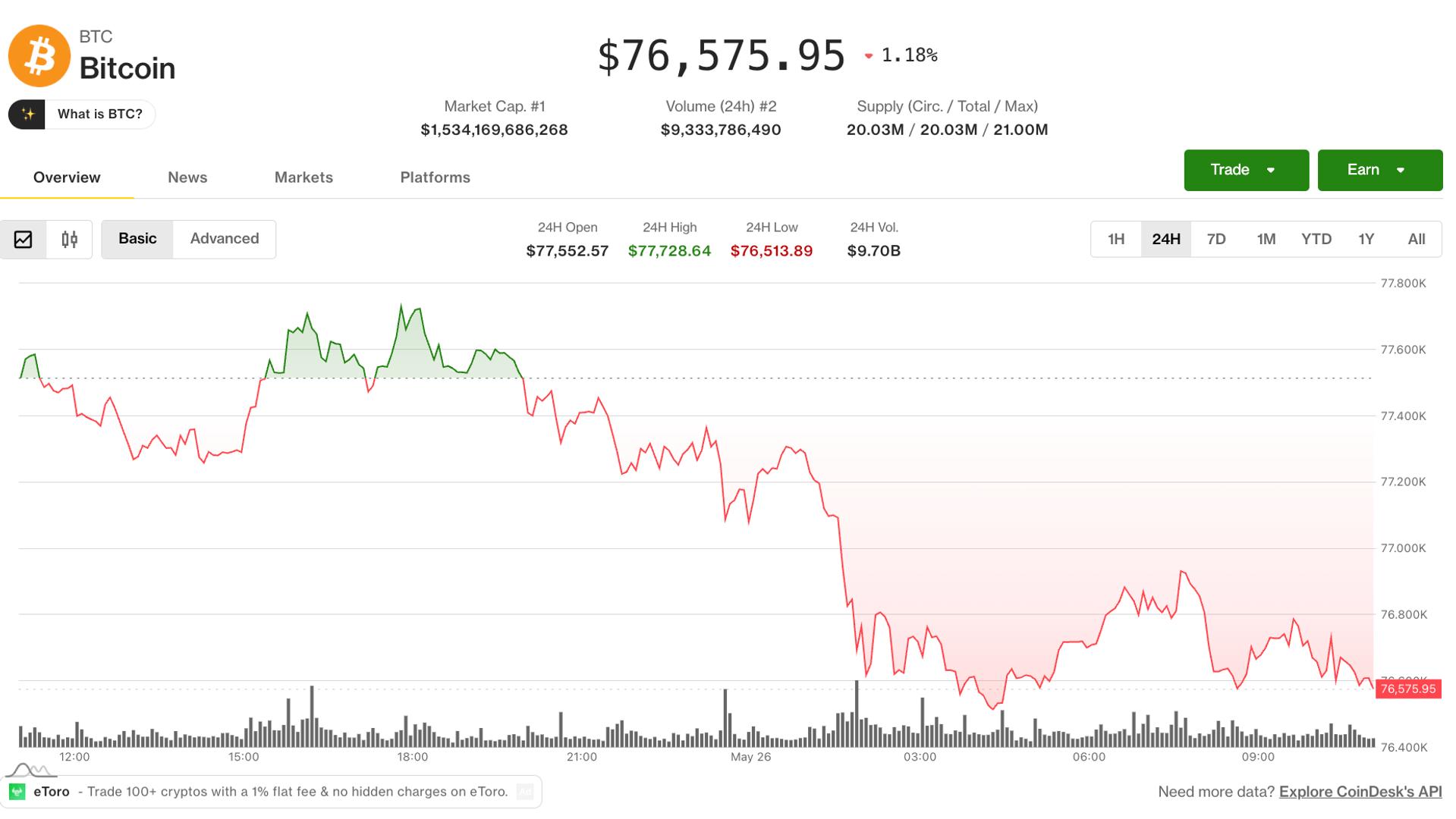
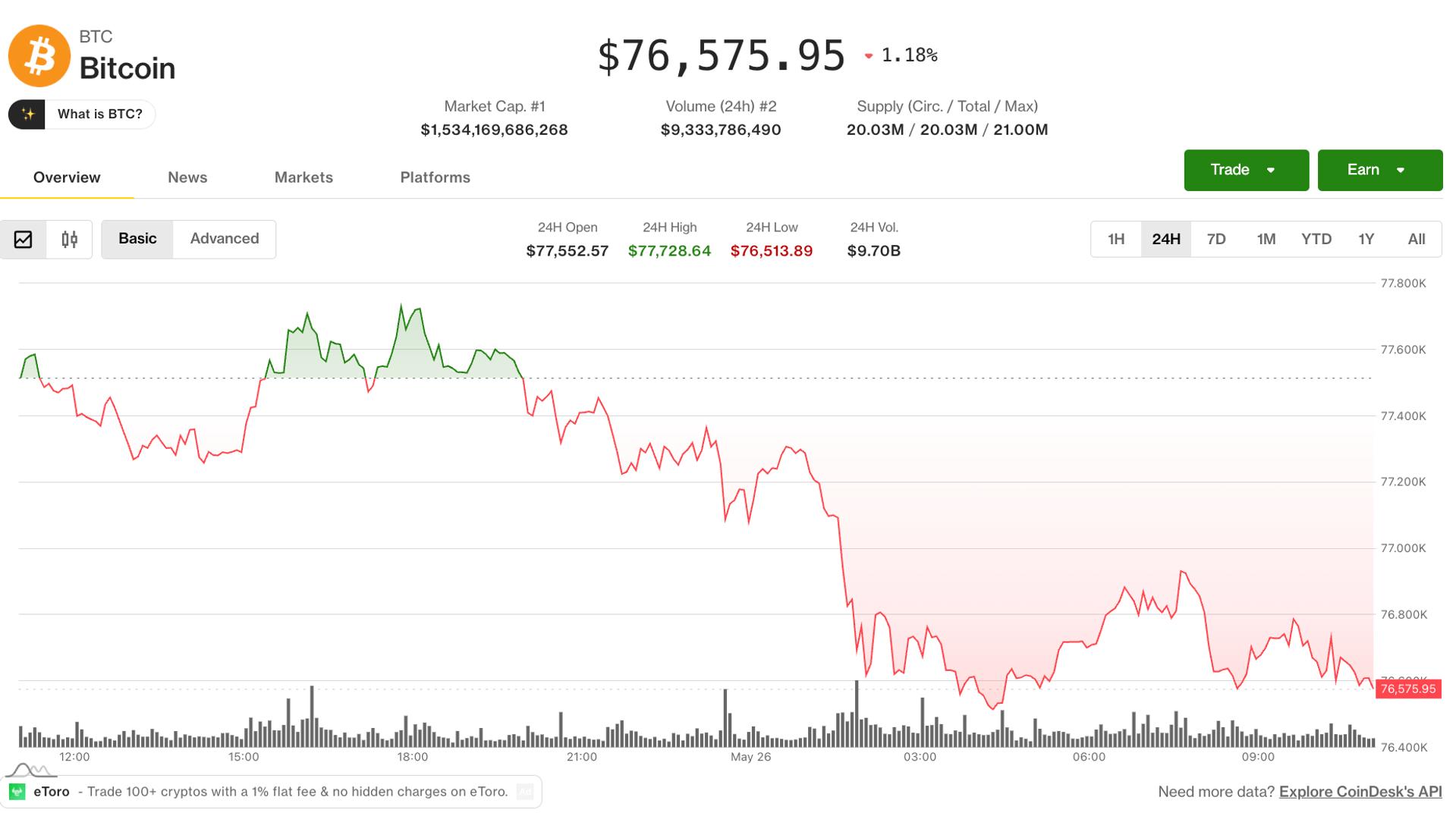
Bitcoin traded at $76,600 on Tuesday, down 0.8% since midnight UTC, as Monday’s brief bounce to $77,800 fades. The move leaves the largest cryptocurrency potentially forming another lower high in a bearish structure that has been in place since October, and down 7% over the past two weeks.
The weakness is not reflected in broader financial markets. S&P 500 index futures and Nasdaq 100 futures have gained more than 0.5%, pointing to crypto-specific headwinds rather than macroeconomic and geopolitical pressures.
Ether (ETH) is faring worse. Trading at $2,098, ETH has shed more than 10% over the past two weeks and sits firmly in the middle of the range it carved out between February and April, with no signs of reclaiming lost ground.
The altcoin market is mixed, with notable gains across AI tokens and steep losses for tokens that performed well earlier in the year like zcash (ZEC), which has lost around 7% since midnight.
Derivatives positioning
- Crypto futures market volume has dropped 10% to $130 billion in 24 hours. Notional open interest (OI) is little changed around $126 billion, and 24-hour liquidations have declined 21% to $126 million. This points to a steady, rather boring market environment following the extended U.S. weekend holiday (though crypto is never closed).
- SHIB, LINK, HBAR, NEAR and TRX are major OI gainers of the past 24 hours, while ZEC, XLM and HYPE are losers. The action indicates selective market positioning rather than broad-based capital deployment across the altcoin universe.
- NEAR rose 58% in the week ended May 24 and has since gained an additional 14% to $2.82, a level last seen in November. The rally, likely fueled by a series of upgrades involving dynamic scaling, privacy and quantum defenses, is accompanied by an influx of new money into derivatives. Open interest jumped to a record 309 million tokens from 182 million a week ago.
- NEAR also has the most positive 24-hour cumulative volume delta (CVD) among major tokens, a sign that buyers are setting the price action by trading at market orders rather than passive limit orders. Funding rates are only marginally positive, a sign the market is far from overheated. Together, these signal potential for continued price gains.
- OI for futures in Chainlink’s LINK increased to 42.96 million tokens, the most since Feb. 7. Annualized funding rates of around 8% point to futures trading above the spot price in a bullish sign for the provider of oracle data.
- Bitcoin futures have cooled. OI in BTC has pulled back to 711K BTC from 793k BTC early this month. ETH OI hovers just below record highs near 15 million ETH. BTC and ETH’s 30-day implied volatility indexes continue to slide in a sign of persistent volatility selling and no signs of panic demand for options.
- Still, on Deribit, BTC puts at strikes from $70K to $76K are among the most traded of the past 24 hours. Puts represent a bearish bet, offering protection against price weakness in the underlying asset.
Token talk
- CoinDesk’s Computing Select Index (CPUS) was the top-performing benchmark on Tuesday, rising by 1.9% since midnight UTC and 2.7% over the past 24 hours.
- The CPUS is a basket of AI tokens and chainlink. FET added 4.8% on Tuesday, and RENDER climbed 7.2%.
- The DeFi Select Index (DFX) also outperformed the crypto majors, rising by 1.3%. The gain suggests investors are opting for more speculative bets while waiting for bitcoin and ether to resolve their current trading ranges.
- Privacy tokens weakened across the board as monero (XMR) and dash (DASH) followed zcash (ZEC) lower by around 1.5% apiece.
- CoinMarketCap’s “Altcoin Season” indicator is currently at 35/100, up from last week’s low of 31/100 and below the monthly high of 50/100.
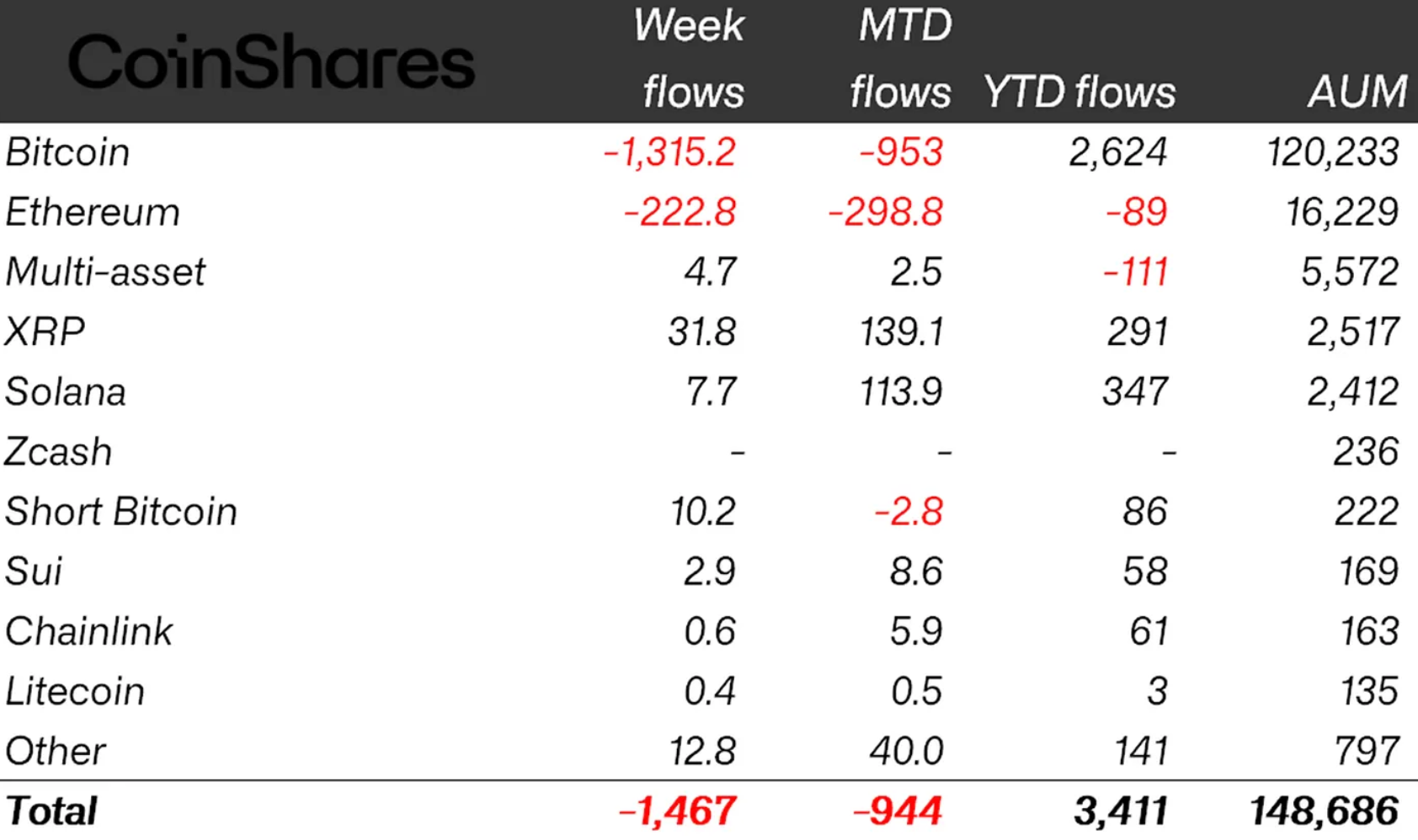
Crypto investment products recorded $1.47 billion in outflows last week, extending a second straight week of withdrawals as Bitcoin funds led the decline, according to CoinShares.
Crypto exchange-traded products (ETPs) extended the prior week’s $1.07 billion in withdrawals, CoinShares reported Tuesday.
Bitcoin products accounted for roughly $1.3 billion of the outflows, their largest weekly withdrawal of 2026, while Ether funds lost $223 million, the asset manager said.
Total assets under management in crypto ETPs stood at around $148.7 billion, with Bitcoin funds accounting for 80% with $120.2 billion.
CoinShares head of research James Butterfill said the selling reflected deepening Iran-related risk-off sentiment despite continued progress on the CLARITY Act.
Nine assets post inflows above $1 million
Altcoin ETPs still recorded notable gains despite the broader downturn, with at least nine assets seeing inflows above $1 million, Butterfill said.
XRP (XRP) led altcoin inflows with $31.8 million, while Solana (SOL) followed with $7.7 million.
Separately, data from SoSoValue showed Hyperliquid (HYPE) exchange-traded funds (ETFs) recorded $72.3 million in inflows.
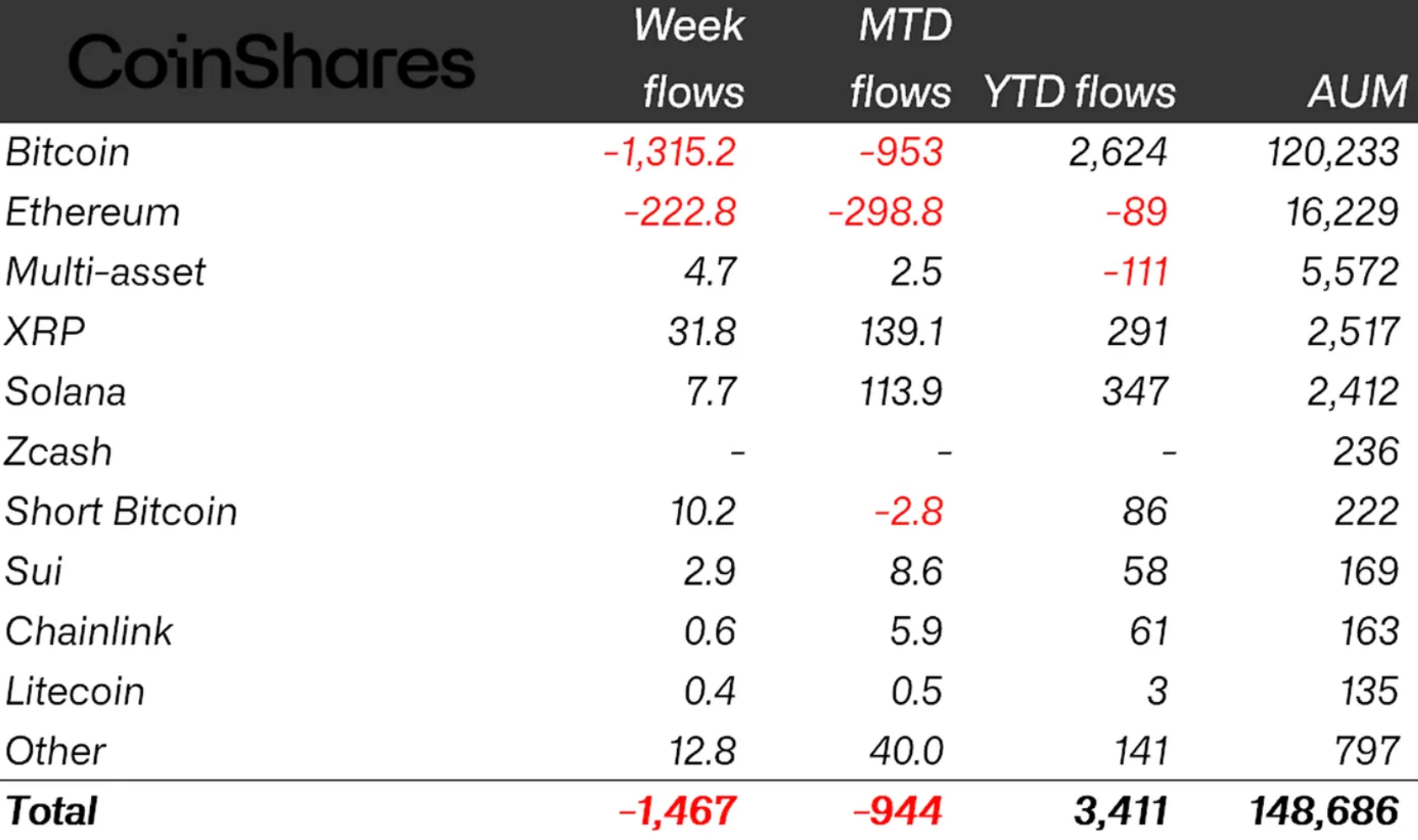
Crypto ETP flows by asset (in millions of US dollars). Source: CoinShares
Smaller inflows were also recorded in Sui (SUI) and Chainlink (LINK), at $600,000 and $400,000, respectively. Short Bitcoin products added $10.2 million, aligning with broader risk-off sentiment.
Related: $1.26B Bitcoin ETF outflows spark ‘contrarian’ buy signal: Santiment
Total assets under management in crypto ETPs stood at about $148.7 billion by the end of the week, with Bitcoin funds making up 80% at $120.2 billion.
Crypto ETP outflows spread globally as US leads losses
Outflows broadened across global crypto ETP markets last week, reversing the prior week’s relative “European resilience,” the report said.
The United States led with $1.43 billion in outflows, including $1.26 billion from US-listed spot Bitcoin ETFs, according to SoSoValue.
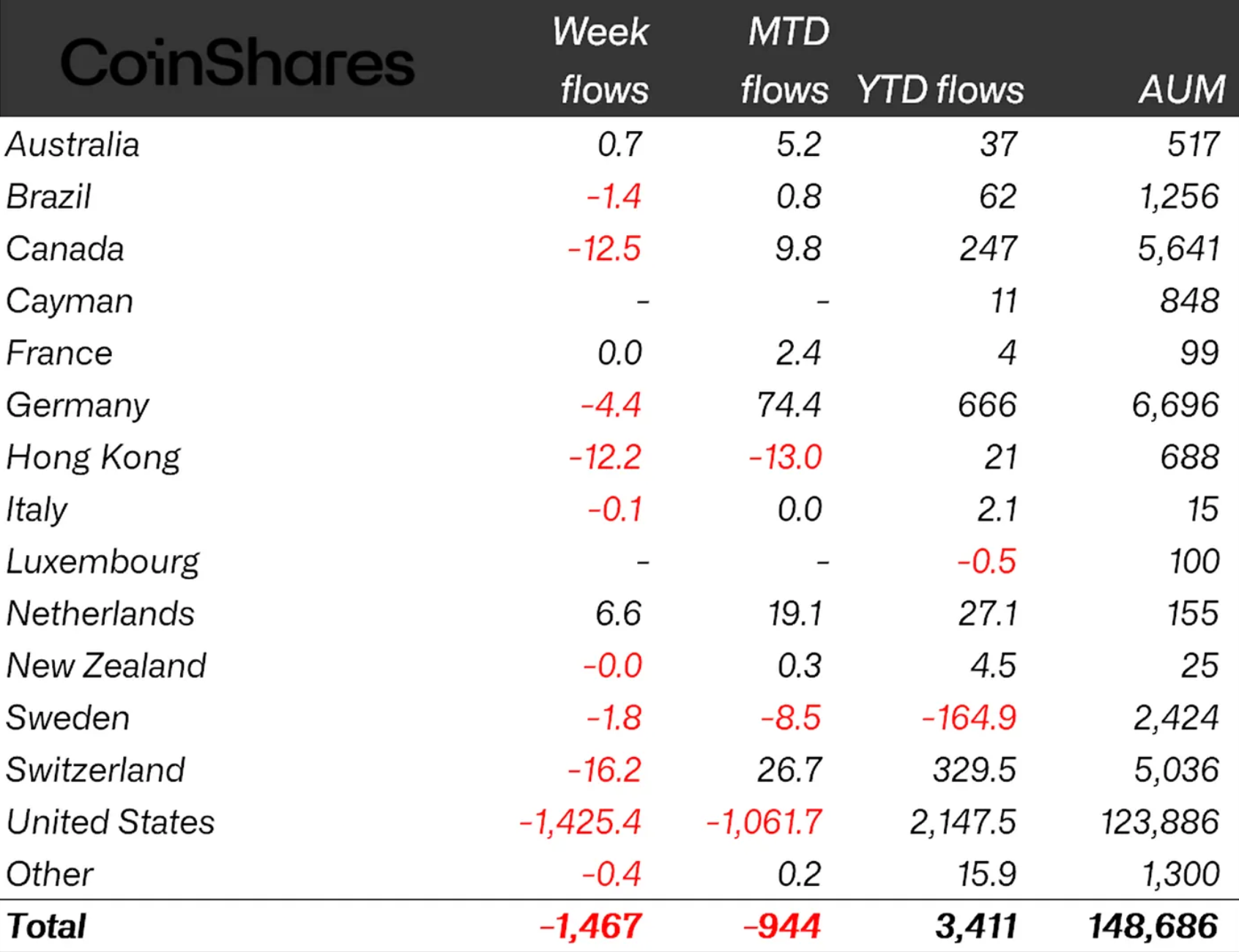
Crypto ETP flows by country (in millions of US dollars). Source: CoinShares
More losses were recorded in Switzerland at $16.2 million and Canada at $12.5 million. Hong Kong and Germany also saw outflows of $12.2 million and $4.4 million, respectively.
The Netherlands was the only country to see notable inflows at $6.6 million, while Australia followed with $700,000 of inflows.
Magazine: ETH bears growling, Tom Lee’s buying, XRP to ‘explode’: Market Moves

Why is it so difficult to travel to and through Europe by train?

Porthleven Harbour planning to introduce parking charges

Michael Saylor’s Strategy repurchases $1.5 billion in convertible debt


-

 Crypto World5 days ago
Blockchain.com files with SEC for U.S. IPO
-

 Fashion4 days ago
Holiday Weekend Open Thread – Corporette.com
-

 Business4 days ago
Dell Technologies DELL Stock Surges 15% on AI Server Momentum and Analyst Upgrades in 2026
-

 Crypto World4 days ago
Bitcoin Accumulation Weakens as BTC Realized Losses Hit $600M
-

 Crypto World4 days ago
Space X IPO Is ‘Bad News’ for Tech Stocks: But What About Bitcoin?
-

 Politics4 days ago
Makerfield: a tale of two social-media histories
-

 Crypto World3 days ago
Robinhood crypto COO Tanya Denisova exits
-

 Business2 days ago
NYT Strands Answers May 24 2026 Revealed for Puzzle No. 812 Theme Summer Essentials
-

 Crypto World4 days ago
MicroStrategy’s Saylor Says Miners No Longer Set Bitcoin Price, Another Force Has Taken Over
-

 Crypto World4 days ago
AI infrastructure race heats up as IREN pitches full-stack strategy, WhiteFiber lands $160M deal
-
 Tech4 days ago
A 0.12% parameter add-on gives AI agents the working memory RAG can’t
-

 Tech5 days ago
WhatsApp ads could make Irish debut after discussions with DPC
-

 Tech4 days ago
You Can Now Add ChatGPT To PowerPoint
-

 Business4 days ago
Trump Invests $1M-$5M in Kura Sushi USA Chain With 27 California Locations
-
 NewsBeat5 days ago
Charity run by Reform leader Malcolm Offord accused of ‘law breaking’ over Scottish registration
-

 Sports4 days ago
2026 CJ Cup Byron Nelson leaderboard: Brooks Koepka finds putting stroke in Round 1
-

 Crypto World6 days ago
Exa Labs raises $250 million in funding led by a16z
-
Business4 days ago
Goldman Sachs reinstates Ageas stock coverage with neutral rating
-
 Crypto World4 days ago
Verus Bridge Hacker Returns $8.5M ETH, Keeps $2.8M as Bounty
-

 Crypto World4 days ago
Trump Media’s Bitcoin Stash Shrinks Again as 2,650 BTC Lands on Crypto.com
You must be logged in to post a comment Login