

Crypto World
Bitcoin Faces Liquidation Risk Amid Falling Volume and Rising Shorts


Bitcoin leverage rises as spot demand weakens across markets. Negative funding rates reflect stronger short positioning pressure. Institutional accumulation offsets declining retail spot activity.
Bitcoin traded near $67,150 as derivatives activity shaped short-term price behavior. Market data showed declining spot volume alongside rising leverage metrics. The trend pointed to increased reliance on futures positioning rather than direct buying.
Falling Spot Volume Signals Weak Market Participation
Bitcoin recorded a steady drop in daily spot volume over recent weeks. Activity declined from 42,026 BTC on March 17 to 35,590 BTC on April 2. The contraction reflected weaker participation in direct market transactions.
At the same time, open interest declined from $23.33 billion to $21.26 billion. However, the drop remained smaller compared to spot volume losses. This difference suggested that derivatives exposure stayed relatively elevated.
The estimated leverage ratio increased from 0.2207 to around 0.225. The shift indicated that traders relied more on leveraged positions. As a result, price action became less dependent on organic spot demand.
Rising Short Pressure and Liquidation Risk Build
Funding rates remained mostly negative across perpetual futures markets. This pattern showed that short positions dominated trader sentiment. It also indicated persistent pressure against upward price movement.
Liquidity zones below the current price appeared closer than those above. This structure increased the probability of downward moves in the short term. Long positions faced a higher risk of forced liquidations under such conditions.
At the same time, analysts highlighted that leverage-driven markets tend to amplify volatility. Price swings often accelerate when liquidation cascades begin. Therefore, short-term direction remained sensitive to derivatives positioning.
Institutional Demand Contrasts with Weak Spot Activity
Despite weaker spot demand, institutional buying activity continued to absorb supply. Exchange reserves dropped by 66.3K BTC over the past 30 days. The decline reflected ongoing accumulation outside public trading venues.
Over-the-counter transactions accounted for 92.1% of recent flows. In contrast, regular market volume contributed only 7.9% during the same period. This imbalance showed that large buyers dominated current demand trends.
Broader macroeconomic uncertainty still influenced market stability. External shocks could quickly push assets back onto exchanges. Such shifts may increase available supply and trigger rapid price adjustments.
Market Structure Reflects Mixed Signals
Bitcoin’s current structure combined strong institutional accumulation with weak retail participation. This mix created uneven support across different market segments. It also increased reliance on leveraged trading activity.
At the same time, declining spot demand limited organic price growth potential. Derivatives markets continued to play a larger role in price discovery. This dynamic added complexity to short-term market direction.
Overall, the market showed signs of fragility despite ongoing accumulation. Liquidity positioning and leverage trends suggested elevated risk levels. As a result, near-term movements remained vulnerable to sudden shifts.


Key Takeaways
- The U.S. Department of Energy has chosen Oklo for advanced discussions regarding its Surplus Plutonium Utilization Program.
- Oklo will collaborate with newcleo, a European nuclear technology company, to transform Cold War surplus plutonium into usable reactor fuel.
- Shares of OKLO are currently trading at $65.88, representing an almost 18% increase over the previous seven days.
- The collaboration with newcleo features a possible capital injection reaching $2 billion, pending final agreements and regulatory clearance.
- Congressional Democrats have expressed concern over security risks, highlighting that the stockpile theoretically contains material for 2,000 nuclear weapons.
The U.S. Department of Energy has tapped Oklo Inc. to enter advanced negotiations as part of its Surplus Plutonium Utilization Program. This federal initiative aims to repurpose designated surplus plutonium by converting it into fuel suitable for next-generation nuclear reactors.
Shares were changing hands at $65.88 when the news broke, giving the company an $11.5 billion market capitalization. The stock has climbed nearly 18% in the last week alone.
Oklo stands among five advanced nuclear technology companies selected for participation in the program. The firm intends to spearhead the fuel conversion initiative in partnership with newcleo, a European developer of advanced nuclear reactor systems.
Newcleo’s involvement would contribute specialized fuel fabrication knowledge and potential financing for the project, contingent upon finalized contracts and government approvals. The partnership between the two entities was initially unveiled in October 2025, featuring a prospective $2 billion capital commitment from a newcleo-associated investment vehicle.
By February 2026, newcleo had initiated preliminary discussions with the U.S. Nuclear Regulatory Commission concerning an advanced fuel fabrication plant and a lead-cooled fast reactor architecture.
The plutonium targeted by this program originates from the Cold War era. Sourced from decommissioned nuclear weapons, approximately 20 metric tons are currently held by the United States at high-security storage sites located in South Carolina, Texas, and New Mexico.
President Trump issued an executive order roughly one year ago terminating a program intended to dilute and permanently dispose of this surplus material. The directive instead instructed federal agencies to make the plutonium accessible as fuel for cutting-edge nuclear energy systems.
Understanding the Plutonium Initiative
The substance possesses a half-life of 24,000 years and necessitates specialized protective equipment during handling. Storage occurs at facilities maintained under weapons-grade security protocols.
Oklo CEO Jacob DeWitte stated the program establishes a mechanism to accelerate reactor deployment. “Material previously earmarked for disposal can now be transformed into fuel for electricity generation,” he explained.
Newcleo CEO Stefano Buono indicated that utilizing the plutonium as reactor fuel would diminish America’s nuclear waste obligations.
The program mandates strict adherence to all U.S. security protocols, safeguard measures, and material tracking requirements.
Congressional Opposition and Regulatory Scrutiny
Democratic members of Congress have called on the Trump administration to abandon the initiative. Their concerns center on proliferation dangers, emphasizing that the accumulated stockpile theoretically holds sufficient plutonium to manufacture around 2,000 nuclear weapons.
The Department of Energy has not yet provided a response to inquiries regarding security protocols for the material.
It bears mentioning that current U.S. Energy Secretary Chris Wright was previously a board member at Oklo prior to his appointment to the Trump administration.
Regarding Wall Street coverage, BofA Securities launched coverage on Oklo with a buy recommendation and an $80 price objective, highlighting the company’s integrated build-own-operate business approach. Wolfe Research assigned a Peerperform rating with an estimated fair value between $51 and $71 per share.
Oklo disclosed Q1 2026 earnings per share of -$0.19, matching analyst consensus forecasts. Four financial analysts have recently increased their earnings projections for the next reporting period.



Bitmine Immersion (BMNR), the Ethereum treasury firm helmed by chairman Tom Lee, ramped up purchases again, making its biggest haul since December.
The company said Monday it bought 111,942 ether (ETH) last week, worth around $237 million at current prices. That lifted the firm’s holdings to almost 5.4 million ETH, about 4.47% of Ethereum’s circulating supply.
The purchase marks a renewed acceleration in Bitmine’s buying pace after Lee said earlier in May at Consensus 2026 in Miami that the company planned to slow weekly accumulation. The shift happened as the firm aims to take advantage of ETH sliding from $2,400 in early May and April to near $2,100.
“We continue to steadily acquire ETH,” Lee said in the statement. “We view the recent pullback of ETH to below $2,200 as an attractive opportunity.”
Lee added that the firm is expected to reach its goal to corner 5% of ether’s supply later in 2026.
Bitmine’s total crypto and cash holdings stand at $12.3 billion, according to the report. The company also holds 203 bitcoin, $444 million in cash and equity stakes including investments in Beast Industries and Eightco Holdings.
The firm said it has staked more than 4.7 million ETH — about 87% of its holdings — generating approximately $276 million in annualized staking revenue.
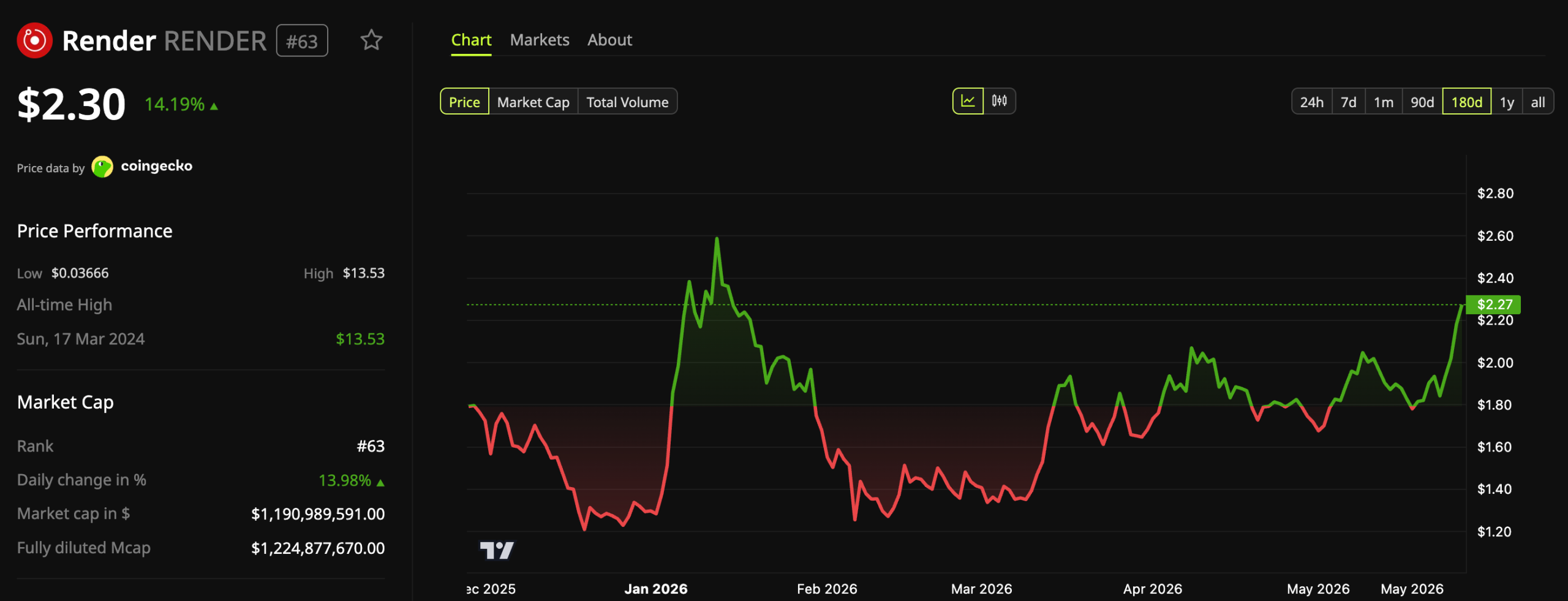
Render’s native token, RENDER, climbed to a four-month high of $2.32 on Tuesday, extending its recent rally as network activity and investor interest in AI-linked infrastructure projects accelerated.
At press time, the token traded near $2.30, up 14.19% over the past 24 hours. The latest move also outpaced gains across the broader cryptocurrency market, with traders continuing to rotate into artificial intelligence-related digital assets.

Follow us on X to get the latest news as it happens
RENDER Outperforms Bitcoin and Ethereum With Double-Digit Daily Rally
According to a recent analysis by BeInCrypto, RENDER has trended higher since May 18, with sizable buying volume backing the move. The rally has separated itself from speculative pump.
The report added that easing geopolitical tensions involving Iran helped improve sentiment toward AI-linked assets.
On-chain data further highlighted the surge in activity across the Render ecosystem. Blockchain analytics platform Santiment noted that daily active addresses jumped to 394, while 118 new wallets joined the network.
“These two metrics are important because they measure how many unique wallets are actively interacting with the network and how many new participants are entering the ecosystem,” the post read.
AI Infrastructure Demand Anchors the Move
Meanwhile, Santiment explained that most of Render’s 2026 momentum stems from expanding demand for AI infrastructure. The project has cemented its role as a decentralized GPU computing network for training, machine learning, and advanced rendering workloads.
The network expanded its GPU base throughout the year, integrating tens of thousands of units and supporting newer NVIDIA hardware.
The rally also aligns with a wider rotation into US-aligned AI tokens, with compute infrastructure names drawing fresh investor flows.
Whether the token holds above $2.3 remains to be seen. Sustained on-chain expansion in the coming sessions will reveal if the breakout has staying power.
Subscribe to our YouTube channel to watch leaders and journalists provide expert insights
The post Render Hits 4-Month High as New Wallets Pile Into the Network appeared first on BeInCrypto.
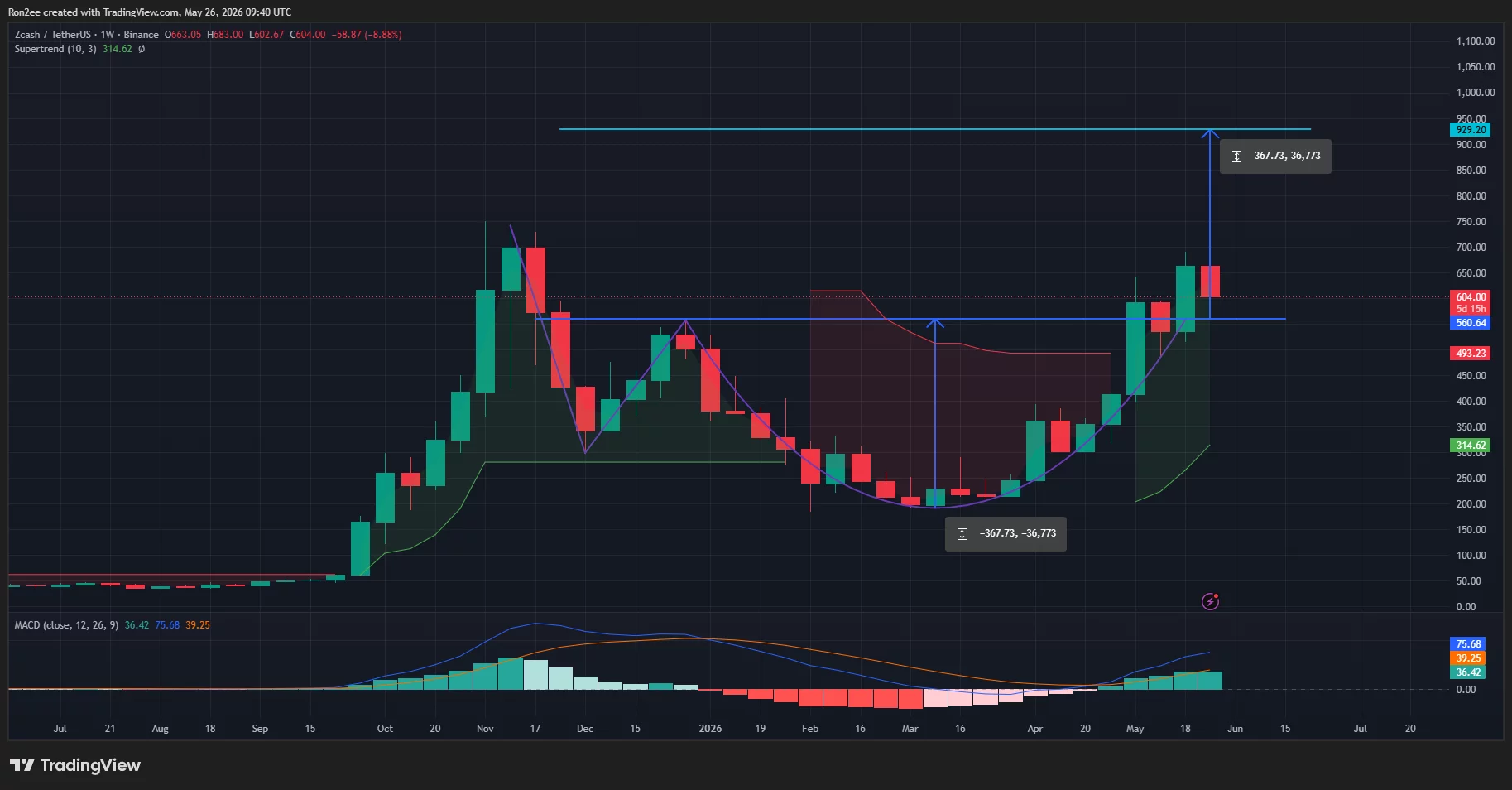
Zcash has extended its explosive recovery after confirming a bullish Adam and Eve pattern on the weekly chart, with traders now watching a potential breakout rally toward the $900 region.
Summary
- Zcash price surged more than 110% in a month after confirming a bullish Adam and Eve breakout pattern, with traders targeting a potential rally toward $929.
- Grayscale’s spot Zcash ETF filing, the SEC’s closure of its Zcash investigation, and shrinking liquid supply boosted institutional and retail demand for ZEC.
- CoinGlass data showed dense short-liquidation clusters between $680 and $700, while analysts warned the token remains heavily overbought near current levels.
Zcash (ZEC) price rose more than 110% over the past month and briefly touched $682 on May 22 before retreating toward the $600 support area at press time. From its year-to-date low, the privacy-focused cryptocurrency has rallied more than 245%, outperforming most major altcoins during the same period.
The latest leg higher followed a combination of regulatory relief, institutional accumulation, and aggressive short liquidations. Earlier this month, the U.S. Securities and Exchange Commission officially closed its investigation into the Zcash Foundation without recommending enforcement action, removing a long-standing compliance risk that had weighed on investor appetite for privacy-focused assets.
Grayscale accelerated the institutional narrative on May 12 after filing with the SEC to convert its Zcash Trust into a spot Zcash ETF on NYSE Arca. The proposal placed ZEC among a limited group of altcoins pursuing regulated spot ETF exposure in the United States as fund issuers continue expanding beyond Bitcoin and Ethereum products.
Arthur Hayes recently disclosed that Zcash had become his second-largest crypto holding after Bitcoin, while Raoul Pal and Multicoin Capital publicly backed the privacy-coin sector during the rally. Their comments fueled speculation that institutional capital could increasingly rotate into privacy-focused infrastructure projects after years of regulatory uncertainty around anonymity-enhanced cryptocurrencies.
On-chain supply conditions tightened sharply during the rally. Community data showed more than 30% of Zcash’s circulating supply, roughly 5.18 million coins, moved into privacy-focused shielded pools. The reduction in tradable supply amplified upside volatility once spot demand accelerated above key resistance levels.
Foundry USA later added official mining support for ZEC, bringing institutional-scale mining infrastructure and additional hash-rate stability to the network. During Consensus Miami, the Zcash Open Development Lab also unveiled early-stage “quantum-recoverable” wallets as part of a broader push toward post-quantum security protections.
Adam and Eve breakout structure projects move toward $929
Weekly charts now show Zcash completing a textbook Adam and Eve bottom formation after reclaiming the neckline near the $560 region. The structure formed after a sharp capitulation low near $190 earlier this year transitioned into a rounded accumulation phase throughout March and April.
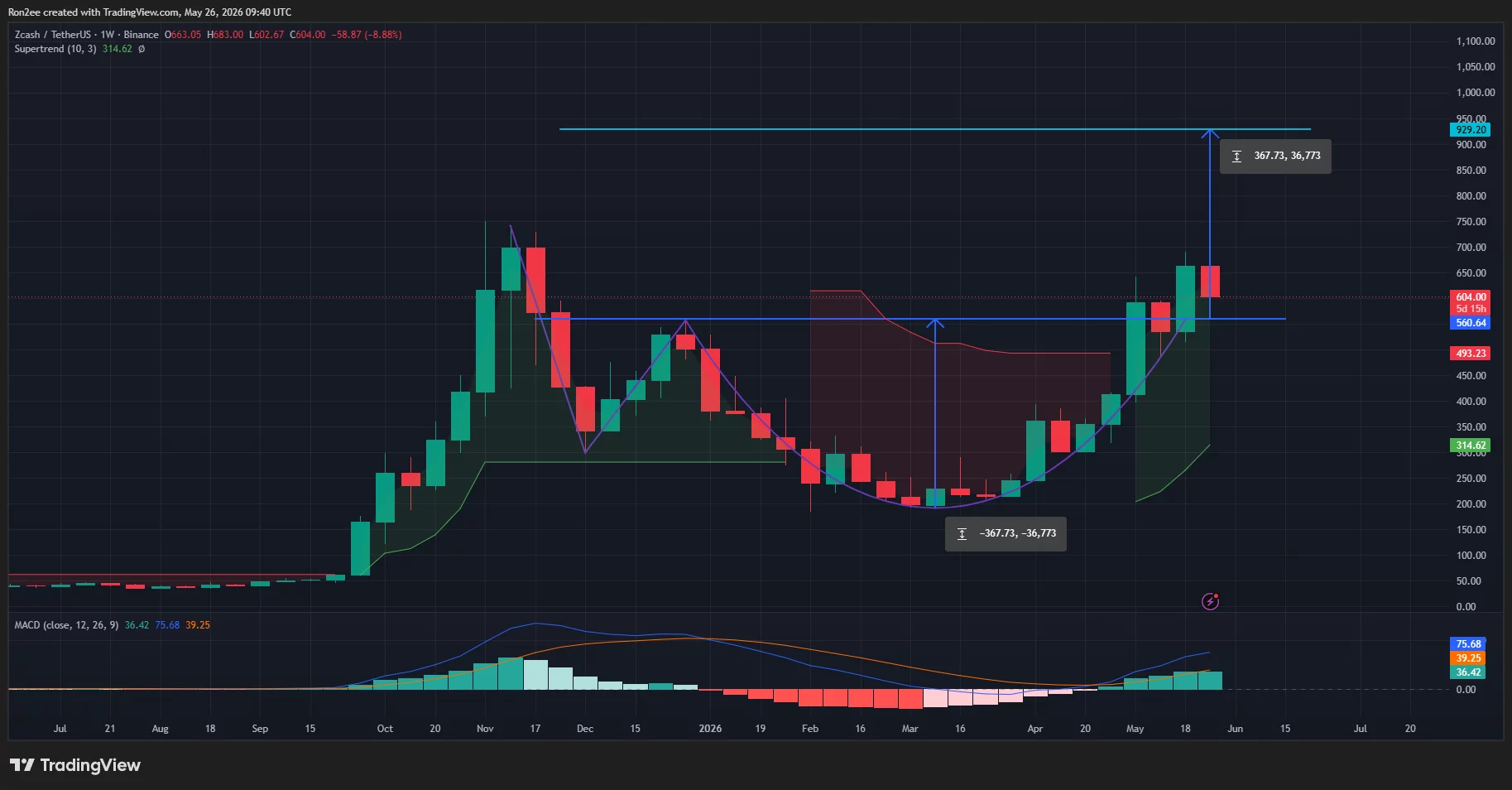
The measured move from the pattern projects a breakout target near $929, representing roughly another 50% upside from current levels. Traders calculate the target by measuring the distance between the neckline and the pattern low before extending the same range upward from the breakout point.
The chart also shows ZEC reclaiming the Supertrend indicator, which flipped bullish near the $314 region earlier this quarter. Price continues holding well above that level despite the recent rejection near local highs.
Momentum indicators remain constructive on higher timeframes. The weekly MACD histogram has expanded deeper into positive territory while the MACD line continues trading above the signal line, a structure traders often associate with continuation rallies rather than exhausted breakouts.
Crypto trader Ardi described Zcash as “one of the best macro recovery charts in the market right now” after the token completed a V-shaped recovery back into the upper $680 resistance region. In a post published on X, he added: “Once that level breaks and confirms as support, I’m still targeting a move into the $740 region next.”
Liquidation clusters and whale positioning tighten around $700
CoinGlass liquidation heatmap data shows dense leverage concentration between $680 and $700, where large short liquidation clusters accumulated during the past week.
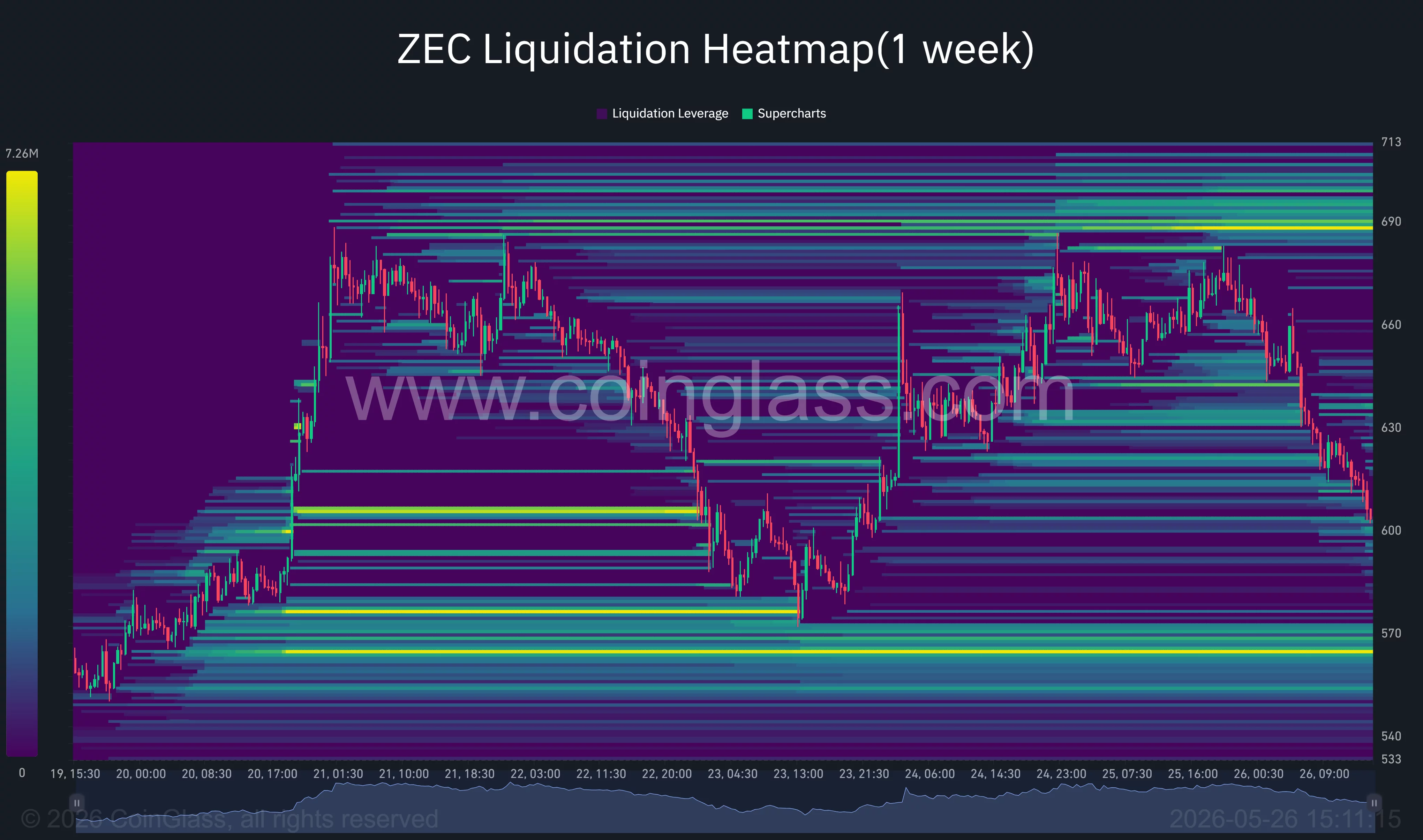
A breakout through that resistance range could trigger another cascade similar to the rally earlier this month that erased more than $55 million in bearish positions during a single trading session.
Major liquidity pools have also formed around the $570 and $560 support zones beneath current prices. Those levels align closely with the Adam and Eve neckline retest area, making them key regions traders will likely monitor for dip-buying activity if ZEC extends its pullback.
Lookonchain reported that a trader reopened a 40x leveraged Bitcoin short position worth more than $40 million while simultaneously holding a 53,500 ZEC long valued near $33 million. The platform said the trader’s Zcash position briefly fell nearly $1.9 million underwater after the latest correction.
Leverage exposure across ZEC derivatives markets has expanded rapidly alongside the price rally. Several perpetual futures platforms recorded elevated funding rates during the recent advance as traders crowded into aggressive long positions, expecting continuation toward new cycle highs.
Bitcoin stabilized near the $77,000 region after heavy ETF-driven selling pressure earlier this month, allowing speculative capital to rotate back into higher-beta altcoins, including Zcash, Solana, and other privacy-focused assets. The improvement in broader crypto sentiment helped sustain momentum across altcoins that had already broken above key technical resistance levels.
Upcoming U.S. inflation and labor-market reports remain another major focus for traders after Treasury yield volatility pressured crypto markets earlier this quarter. Any economic data supporting expectations for future Federal Reserve rate cuts could improve liquidity conditions for speculative assets and reinforce demand across altcoins.
Oil prices also retreated this week after reports that the United States and Iran extended ceasefire negotiations tied to shipping activity near the Strait of Hormuz. The pullback eased some inflation concerns across global markets and helped improve sentiment toward risk assets, including cryptocurrencies and high-beta altcoins like Zcash.
Weekly candles have started printing longer upper wicks near the $680 resistance region after ZEC’s 245% rebound from yearly lows. The rejection suggests some traders have begun taking profits into strength while leveraged positioning across futures markets remains elevated.
Per analyst Skinny, Zcash is highly overbought at current levels, and while the token could still climb toward last year’s highs, it may quickly reverse bearish once it reaches the $740 resistance zone.
Failure to hold the $560 breakout zone could weaken the current bullish structure and expose downside retracements toward the psychological $500 level. A sustained breakdown below that region would invalidate the Adam and Eve continuation setup and likely trigger another wave of long liquidations across leveraged derivatives markets.
For now, Zcash continues trading above its key breakout threshold while shrinking liquid supply, institutional catalysts, and concentrated short exposure keep traders focused on a potential move toward the $900 region.
Disclosure: This article does not represent investment advice. The content and materials featured on this page are for educational purposes only.
Crypto World
CLARITY Act Odds Just Crashed From 75% to 50% in One Week, Is the Crypto Bill Already Running Out of Time?
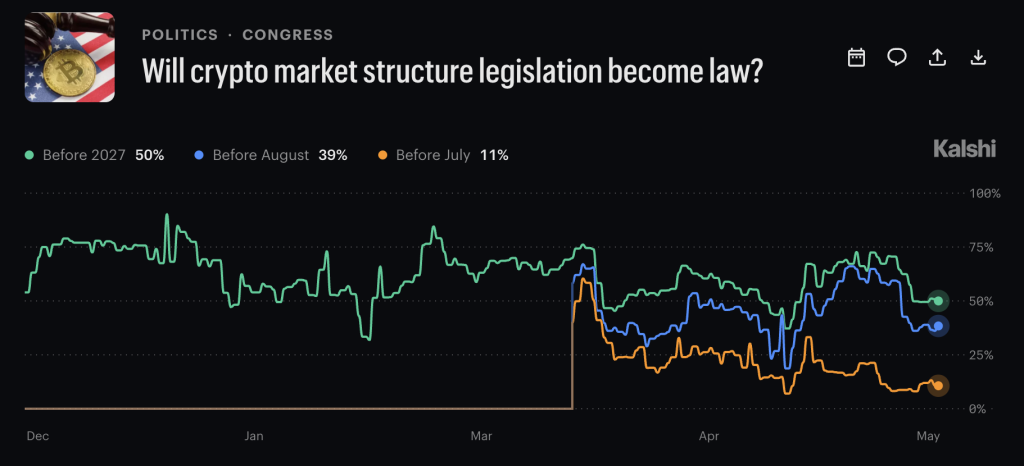
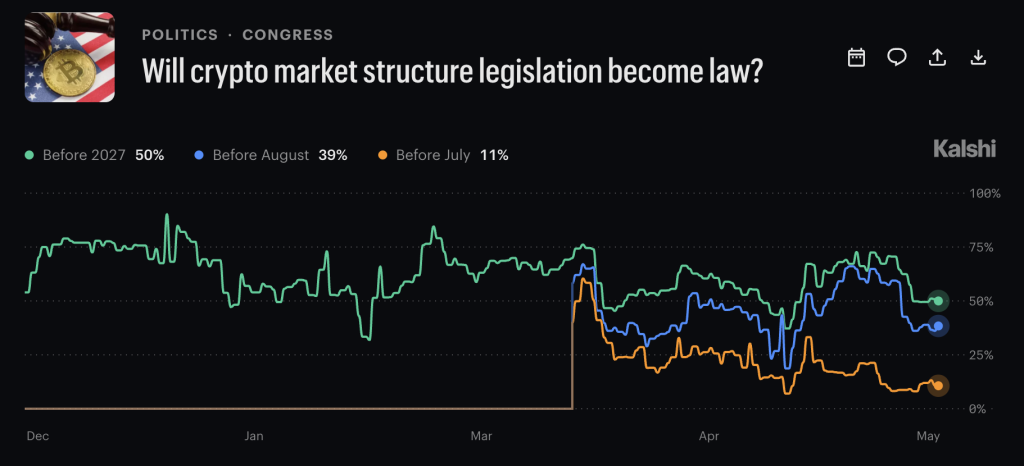
Prediction market odds on the CLARITY Act passing before 2027 collapsed from nearly 75% to 50% in a single week.
Traders are pricing in a compressed Senate calendar, unresolved yield-bearing stablecoin disputes, and the kind of banking lobby friction that has repeatedly stalled stablecoin regulation at the floor stage. The window for passage before August now sits at 37%-and before July, just 14%.
Discover: The Best Crypto to Diversify Your Portfolio
What the Prediction Market Data Actually Shows for The CLARITY Act
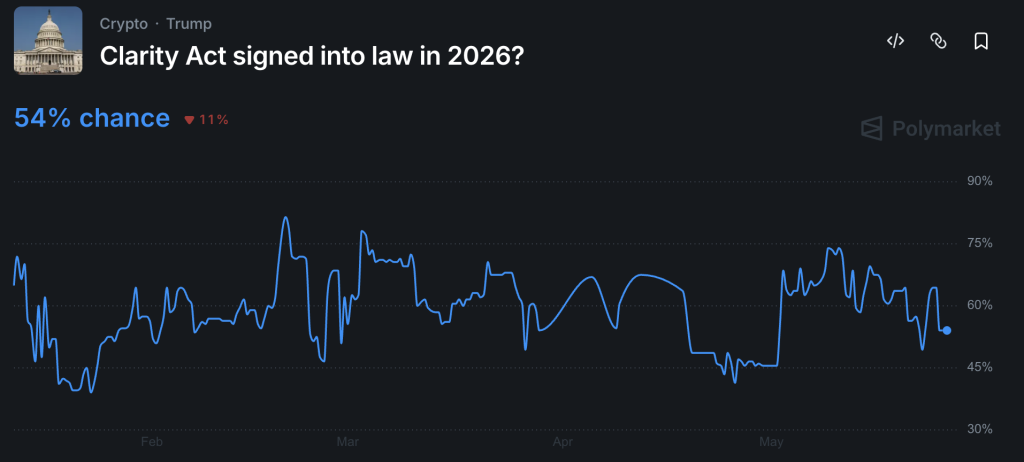
The Kalshi and Polymarket signals are telling different stories right now, and the divergence matters. Kalshi’s pre-2027 contract cratered to 50%; Polymarket’s 2026 passage contract is currently trading at 60%-up 16% over the prior month-suggesting retail prediction market participants are structurally more optimistic than the Kalshi positioning implies.
Galaxy Digital head of research Alex Thorn had already flagged this range, putting 2026 passage odds at roughly 50-50 in April and citing five sequential procedural hurdles: Banking Committee markup, a 60-vote Senate floor win, reconciliation with a Senate Agriculture companion, reconciliation with a House version, and a presidential signature.
The committee markup cleared on May 14th – Senate Banking passed the CLARITY Act 15 to 9, but that clears only one of five gates.
TD Cowen’s Jaret Seiberg is considerably more skeptical, telling clients he sees the bill’s chances at one-in-three for this Congress.
His argument: any serious fight over yield-bearing stablecoins and bank versus non-bank issuer parity could push final passage into the next administration entirely. That gap between Seiberg’s 33% and Galaxy’s 70-75% conditional estimate is where traders are currently trying to find equilibrium.
Senate Gridlock and the Yield-Bearing Stablecoin Fault Line
The core legislative friction driving this repricing is the yield-bearing stablecoin dispute, and it is not a peripheral issue.
The banking lobby is actively pushing for a blanket ban on stablecoin yield, framing it as a systemic risk to deposit-funded banking models.
JPMorgan Chase CFO Jeremy Barnum echoed that line publicly, emphasizing the risks of allowing stablecoins like USDC to generate yield for holders.
This is the same fault line that delayed the Senate Banking Committee markup by roughly four months, consideration was originally slated for January before senators needed more runway to negotiate the yield provisions.
That delay is now being read by traders as a structural signal: if yield language could slip the timeline by four months at committee, it can slip a floor vote past the August recess entirely.
Analysts tracking the Senate floor calendar note only 9 to 10 usable weeks remain in 2026 once August and pre-election breaks are excluded.
For crypto legislation as technically contested as the CLARITY Act, that is an extremely tight window – and it explains why the short-dated Kalshi contracts (before July, before August) have collapsed so sharply even as the longer-dated 2026 Polymarket contract holds above 60%.
Senator Cynthia Lummis, the bill’s sponsor, is pushing back on the pessimism. Her framing: “Wyoming didn’t wait for Washington to figure out digital assets.
We built the framework ourselves. I didn’t come to the U.S. Senate to slow that down, I came here to scale it-and that’s exactly what my bill, the Clarity Act, does.” Polymarket odds ticked up following her remarks, which suggests her floor advocacy is still moving retail contracts at the margin.
Discover: The Best Token Presales
The post CLARITY Act Odds Just Crashed From 75% to 50% in One Week, Is the Crypto Bill Already Running Out of Time? appeared first on Cryptonews.
Crypto World
Hyperliquid Just Launched Prediction Markets to Take On Polymarket: Is HYPE About to Hit $100?
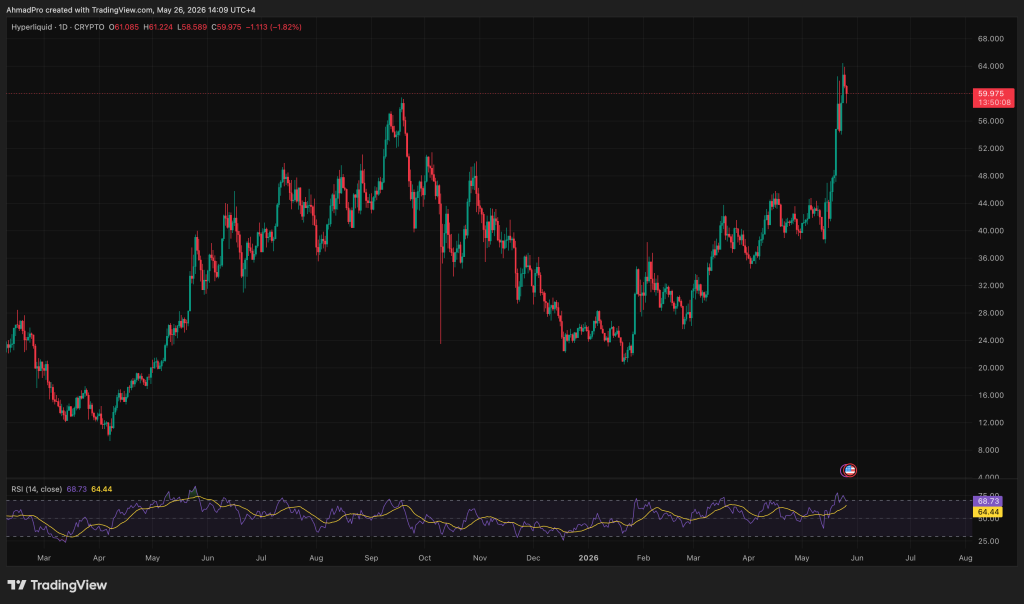
Hyperliquid just expanded its trading stack in a move that few DEXs have attempted at scale. The decentralized exchange launched canonical prediction markets for offchain events on May 25, with the first contract tied to the U.S. May CPI year-over-year figure going live at 20:00 UTC.
$12,800 in open interest and $10,300 in 12-hour trading volume on day one, small in absolute terms, but a sharp signal that traders showed up immediately.
Validators run automated newsfeed software that handles market publication and settlement voting, removing the manual bottleneck that plagues legacy prediction platforms.
The markets are built on Hyperliquid’s HIP-4 standard and settle in Circle’s USDC. The second contract targets the June federal funds rate decision, macro traders take note. When Hyperliquid first floated the prediction market concept in February, HYPE surged 20% on the announcement alone.
This launch puts Hyperliquid in direct competition with Polymarket, and the timing, coinciding with elevated macro uncertainty around Fed policy, could not be more deliberate. The broader market implications are still unfolding.
Discover: The Best Crypto to Diversify Your Portfolio
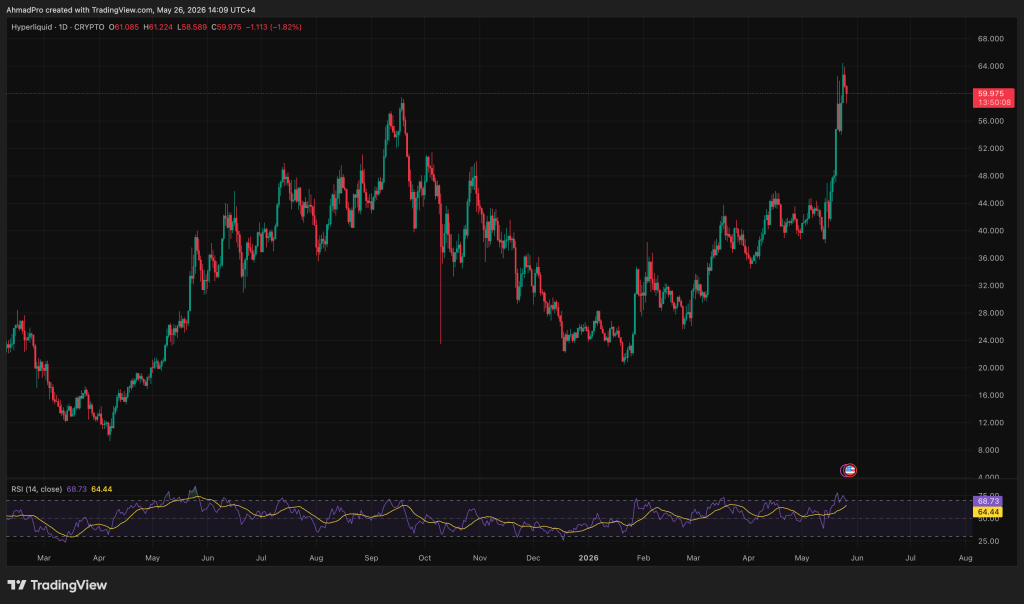
Can HYPE Price Break Out Toward $100 After the Prediction Market Catalyst?
HYPE’s reaction to the February prediction market announcement, a 20% spike in a single session, set a high bar for the actual launch.
Whether the live product triggers a comparable move depends on liquidity depth and contract expansion over the next 72 hours.
The data points to a market that is watching closely rather than reacting blindly.
Delphi Digital framed the broader thesis in a December research report: “What’s different now is that the stack is finally mature enough for true crypto superapps to exist without being limited to the wallet form factor.”
Hyperliquid is already at an all-time high, and a lot of traders are expecting this massive rally to continue toward $100 next.
Whether that happens or not still depends on the broader market.
LiquidChain Targets 1000x Upside as Hyperliquid Validates On-Chain Infrastructure Demand
Hyperliquid’s prediction market launch confirms one thing above the noise: on-chain financial infrastructure is attracting serious capital and developer attention.
That rising tide is also lifting earlier-stage infrastructure plays, and for traders watching Hyperliquid’s valuation ceiling, the asymmetry at current prices may be narrower than what’s coming out of the presale.

LiquidChain ($LIQUID) is a Layer 3 infrastructure project building what it calls the Cross-Chain Liquidity Layer, a single execution environment that combines Bitcoin, Ethereum, and Solana liquidity.
The project’s Unified Liquidity Layer enables single-step execution across all three ecosystems, while its Deploy-Once Architecture means developers write one contract and access the full stack (a genuinely underappreciated efficiency gain).
The presale is live at $0.01463 per $LIQUID, with $807,965.95 raised to date, approaching the $1M milestone. Verifiable settlement and cross-chain composability are the core differentiators.
Presale assets carry significant risk, including illiquidity and no guarantee of exchange listing.
Visit LiquidChain here before the round closes.
Discover: The Best Token Presales
The post Hyperliquid Just Launched Prediction Markets to Take On Polymarket: Is HYPE About to Hit $100? appeared first on Cryptonews.

Key Takeaways
- SNDK has climbed 132.73% over the last quarter and 5.05% in the past week, significantly outperforming broader market indices.
- The company delivered Q1 earnings per share of $23.41, smashing analyst expectations of $14.17, alongside revenue of $5.95 billion—a 251% jump year-over-year.
- Shares opened Tuesday at $1,478.69, trading within a 12-month range spanning from $35.79 to $1,600.00.
- While Jefferies Financial Group reduced its holdings by 41.3%, offloading 15,101 shares, numerous other institutional players increased their stakes.
- Wall Street analysts have raised their price projections broadly, with Citigroup establishing a $2,025 target and Melius Research pushing as high as $2,350.
Sandisk Corporation (SNDK) has delivered one of the most stunning performances in recent market memory. Trading at $1,478.69 as of Tuesday’s opening bell, the stock has skyrocketed more than 3,866% over the past year—an achievement few equities can match.
Technical indicators paint a picture of sustained momentum. The 50-day moving average currently stands at $999.79, with the 200-day average at $608.04. Remarkably, the stock’s 12-month low of $35.79 now seems like a distant memory given today’s valuation levels.
Zacks Investment Research has assigned SNDK a #1 Strong Buy rating, complemented by a Momentum Style Score of B. The stock’s 5.05% gain over the trailing week substantially outpaces the Computer Storage Devices sector’s modest 0.47% uptick during the same timeframe.
Looking at the monthly performance, SNDK’s 49.38% advance dwarfs the industry’s 26.52% gain. This isn’t merely short-term volatility—the fundamental data supports the extended rally.
Quarterly Results Shatter Forecasts
On April 30th, Sandisk unveiled quarterly results that exceeded even the most optimistic projections on Wall Street. The company posted earnings per share of $23.41, crushing the consensus estimate of $14.17 by an impressive $9.24.
Quarterly revenue reached $5.95 billion, representing a staggering 251% increase compared to the year-ago period when the company recorded a loss of $0.30 per share. Return on equity measured 44.06%, while net profit margin came in at a healthy 34.19%.
Looking ahead, management issued guidance for Q4 2026 with projected EPS ranging between $30.00 and $33.00. The full-year analyst consensus now stands at $63.58 per share—a substantial upgrade from the $41.60 consensus recorded just two months prior.
During the past 60 days, six earnings estimates have been revised upward for the current fiscal year with zero downward revisions. An additional five upward adjustments have been made for the following fiscal year.
Wall Street Raises Price Objectives
The blockbuster earnings report sparked a flurry of analyst upgrades and target increases. Wells Fargo elevated its price target from $975 to $1,250 while maintaining an equal weight stance. Mizuho established a $1,220 objective.
Weiss Ratings upgraded SNDK from hold to buy on May 20th. Citigroup increased its target from $1,300 to $2,025 alongside a buy rating. Melius Research now carries the Street’s most bullish target at $2,350.
The analyst community currently breaks down as follows: 3 Strong Buy ratings, 18 Buy ratings, and 4 Hold ratings. The consensus price target across all covering analysts sits at $1,157.14, yielding an aggregate “Moderate Buy” recommendation.
On the institutional ownership front, Jefferies Financial Group trimmed its stake by 41.3% during Q4, divesting 15,101 shares while retaining 21,499—valued at approximately $5.1 million based on the filing date.
Conversely, several other institutions moved to increase exposure. Larson Financial Group acquired an additional 37 shares, Westfuller Advisors boosted its holdings by 51.8%, and various other firms made incremental additions.
Regarding insider activity, Director Necip Sayiner offloaded 579 shares on May 8th at $1,503.11 per share, generating proceeds of $870,300.69. Company insiders have collectively sold 6,525 shares valued at roughly $6.55 million over the past three-month period.
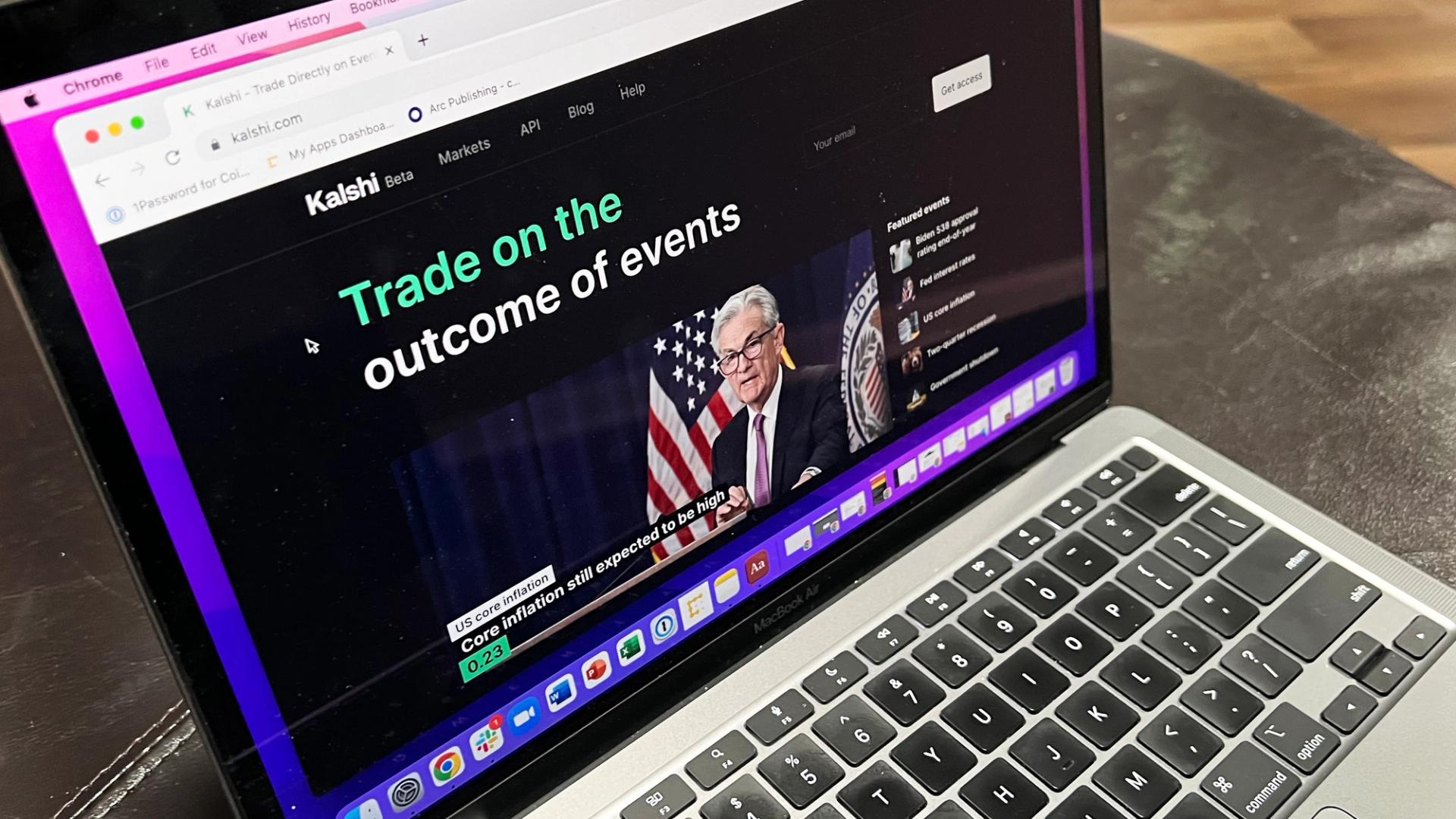
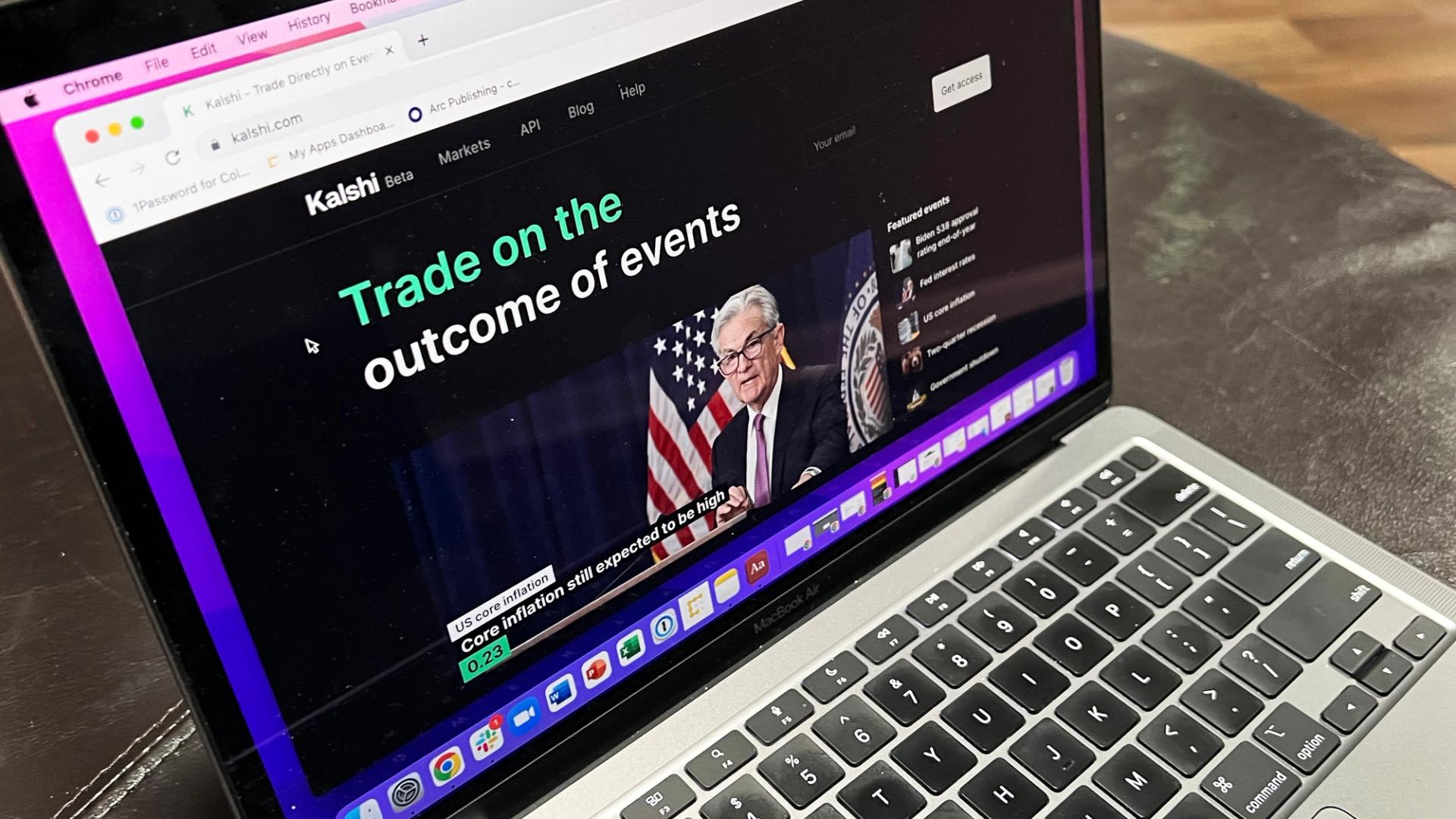
Spain’s Ministry of Consumer Affairs opened disciplinary proceedings against prediction market platforms Polymarket and Kalshi and ordered internet service providers to block access to the platforms.
In notices published in the country’s official state gazette, Spain’s gambling regulator, the Directorate General for Gambling Regulation (DGOJ), said the companies were offering betting products tied to uncertain future events without the licenses required under Spanish law, according to local news outlets.
Authorities said the precautionary blocking measures would remain in place while the cases proceed, a process expected to take three to four months.
The notices came after regulators failed to notify the companies through known foreign addresses.
Kalshi and Polymarket currently dominate prediction markets’ trading activity. Over the past 30 days, Kalshi recorded roughly $5.9 billion in trading volume while Polymarket processed about $3.8 billion, according to DeFiLlama data.
Combined, the two platforms represent nearly 88% of the roughly $11 billion in trading volume among the sector’s top markets during the period.
The move sees Spain join a growing number of jurisdictions targeting prediction markets as regulators debate whether the products should fall under gambling or financial market rules.
Indonesia blocked Polymarket earlier this week under online gambling restrictions, as did India. Other countries including Taiwan, Thailand China, and Japan have restricted the platform, while Ukraine blocked it with no legal way for it to come back.
Polymarket’s list of blocked countries also includes Belgium, Australia, France, the U.K., and Germany. The platform is relaunching in the U.S.
Kalshi followed a different regulatory route in the U.S., where it operates under oversight from the Commodity Futures Trading Commission (CFTC). Still, it’s been under fire.
Spanish authorities said unlicensed operators may lack safeguards such as identity checks, protections for minors and systems for self-excluded gamblers.

Founder and CEO of Ondo Finance, Nathan Allman, has died unexpectedly at the age of 32, the company announced in a statement. No cause of death has been disclosed.
Ondo described Allman as a driving force behind the company, as the team credited his vision, leadership, and belief in using technology to build a more open and accessible financial system.
Ian De Bode Named CEO
The firm said his influence on both the company and the wider crypto industry “cannot be overstated.” Allman founded Ondo in 2021 after previously working on digital assets initiatives at Goldman Sachs. A graduate of Brown University, he helped establish Ondo as one of the leading players in the tokenized real-world asset (RWA) sector.
During his time leading the company, Ondo introduced several major products, including USDY, a yield-bearing stablecoin, OUSG, a tokenized US Treasury fund, and tokenized equities through Ondo Global Markets.
Following his death, Ondo announced that longtime President Ian De Bode will take over as CEO. According to the company, De Bode has overseen Ondo’s strategy, products, and daily operations for more than two years and has the full support of the leadership team.
“We will continue building what Nate started. That is the most meaningful way we know to honor him.”
Tributes quickly poured in from across the crypto industry following Allman’s death. Former Binance CEO, CZ, called him a “pioneer in RWA,” while former Commodity Futures Trading Commission Chair Chris Giancarlo described him as “extraordinarily gifted.” Meanwhile, Crucible founder Meltem Demirors remembered Allman as “kind, thoughtful, caring.”
The post Ondo Finance Founder Nathan Allman Dies Unexpectedly at 32 appeared first on CryptoPotato.
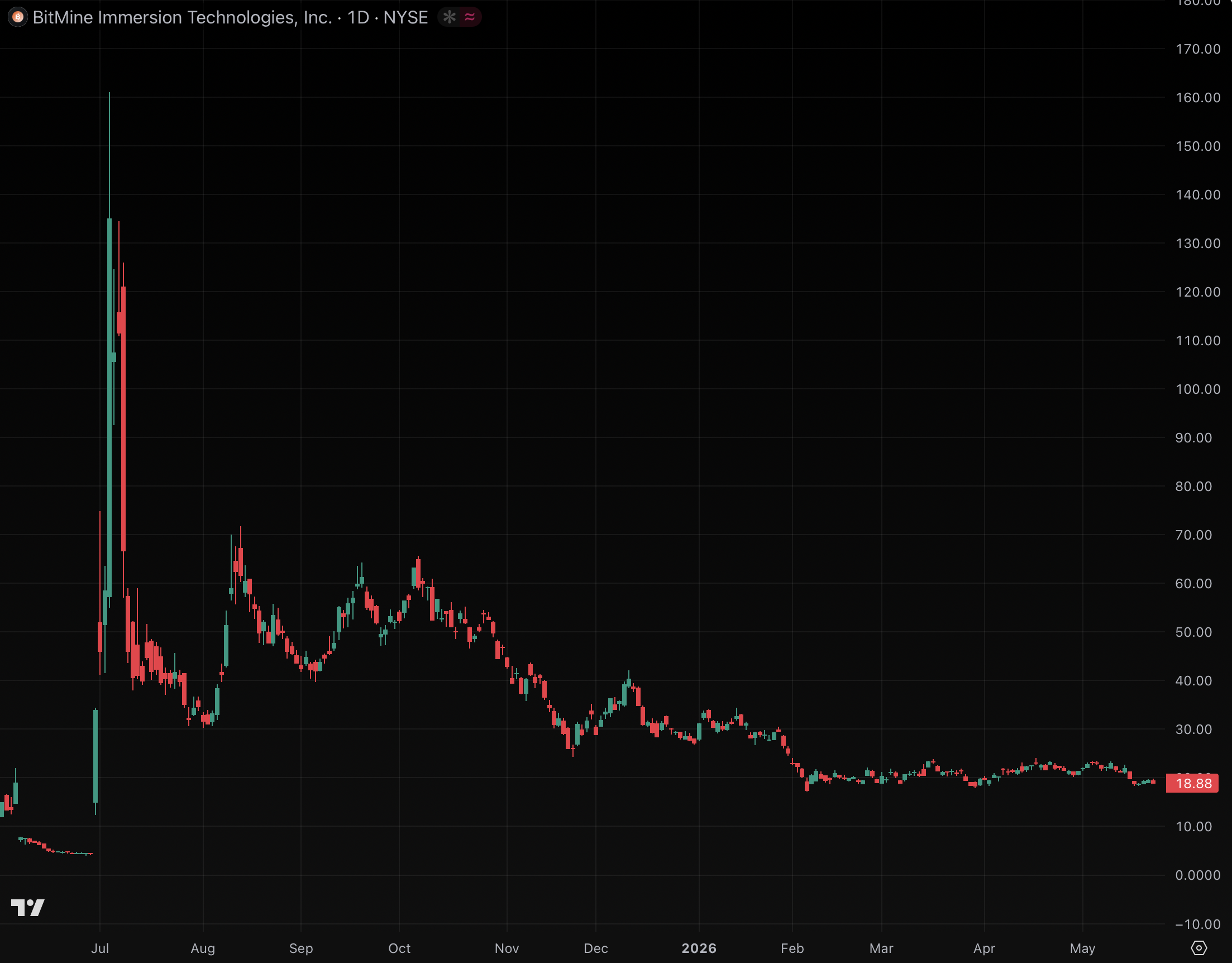
Tom Lee’s Ethereum bet has cratered the BitMine Immersion Technologies balance sheet by more than $8 billion. His personal compensation package, however, is still worth tens of millions of dollars.
BitMine is the publicly traded ether (ETH) acquisition company that Lee chairs. Its most recent quarterly filing disclosed a so-called treasury of 4,473,459 ETH, acquired for a not-so-brilliant cost basis of $16.97 billion as of February 28. Fair value on that date was only $8.79 billion.
In other words, thanks to Lee’s leadership, the company had an unrealized loss of $8.18 billion, or just over 48%, below its then-average cost basis of $3,795 per ETH.
Undeterred, the company kept buying anyway and by May 17 had reported 18% more: 5,278,462 ETH.
Indeed, the company has repeatedly proclaimed that it “aims to eventually hold 5% of the total ETH supply” because of the importance of alchemy.
However, like every so-called alchemist throughout human history, BitMine has failed to discover anything except how to make money disappear.
Meanwhile, Lee, his co-executives, and the agents who keep BitMine’s stock printer running have done extraordinarily well on a personal basis.
$348 million in warrants before the losses even began
BitMine became an ETH treasury company in July 2025 by hiring Lee-affiliated firm Ethereum Tower as strategic advisor.
- That deal cost shareholders 3,192,620 warrants at an exercise price of $5.40. That fair value was $348.96 million, expensed immediately against fiscal 2025 earnings.
- The placement agent on the related June 2025 stock offering, ThinkEquity LLC, walked away with another 1,231,945 warrants worth $134.65 million.
- Three men — then-Chief Executive Jonathan Bates, Chief Financial Officer Raymond Mow, and President Erik Nelson — collected $3.37 million in combined salary, bonus, and stock for the year.
- Outside directors split another $1 million in stock awards.
Tens of millions for Tom Lee
Five months after those strategic advisor warrants, BitMine asked stockholders to approve a new package for Lee, who had assumed the chairman role.
Despite BitMine’s common stock languishing 79% below its 52-week high at the time, a majority of voting power agreed on January 15, 2026.
The package was worth up to $95 million in cash over five years. BitMine paid $15 million upfront and committed to $20 million more in fixed payments over four years. The remaining $60 million unlocks only if BitMine hits annual revenue hurdles.
Targets escalate from $200 million in fiscal 2027 to $500 million in fiscal 2030. In addition to the cash, Lee received 1.5 million time-vesting restricted stock units and 4.5 million performance units.
Performance units vest at $125 and $250 share price targets.
Curiously, BitMine’s board justified the lavish deal by calling Lee a uniquely qualified leader. In actual fact, the company’s ETH treasury was already underwater by more than $4 billion at the time of the January vote, and losses have doubled since then.
Read more: Even Ethereum treasury companies are selling ETH to pay off debt
Compensation for me, dilution for thee
BitMine’s common stock has lost 30% of its value year-to-date, and 88% since its 52-week high.
The company’s quarterly filing acknowledged the likelihood of a poor stock price, “a 20% ETH correction can result in 50% equity drawdowns due to leverage and collapsing premiums.”
Surpassing that warning by more than double, ETH has already declined 42% from BitMine’s average purchase price.
Funding BitMine’s purchases of ETH requires an extraordinary pace of shareholder dilution. While shareholders burden losses, Lee and his leadership receive their compensation regardless.
BitMine’s at-the-market dilutive offerings of its common stock through Cantor Fitzgerald and ThinkEquity are authorized up to $24.5 billion. Through February 2026, those agents had already diluted shareholders by an addition 253 million shares for $10 billion in net proceeds, collecting $122.3 million in commissions.
Protos has previously documented how BitMine’s paper losses on ETH now exceed the customer losses at FTX. That terrible figure has remained true.
Got a tip? Send us an email securely via Protos Leaks. For more informed news and investigations, follow us on X, Bluesky, and Google News, or subscribe to our YouTube channel.

#shorts+@dreamreelspsk. Bible Story Series 13 #motivation #money #entrepreneur #facts #finance

Green Lane A1044 in Yarm taped off after two-car crash

Barilla expanding New York facility

US brings back mandatory military draft registration

Steven Gerrard disagrees with Gary Neville over ‘shock’ Chelsea and Arsenal claim | Football

Register Renaming | Hackaday
#shorts+@dreamreelspsk. Bible Story Series 13 #motivation #money #entrepreneur #facts #finance

WILL XRP REPLICATE THE NVIDIA BREAKOUT? – DTCC & RIPPLE PLAN STARTED IN 2021 – AI TAKEOVER IS HERE!

A brutal reality check on financial ruin and impending homelessness.
-

 Crypto World5 days ago
Blockchain.com files with SEC for U.S. IPO
-

 Fashion4 days ago
Holiday Weekend Open Thread – Corporette.com
-

 Business4 days ago
Dell Technologies DELL Stock Surges 15% on AI Server Momentum and Analyst Upgrades in 2026
-
 Crypto World4 days ago
Bitcoin Accumulation Weakens as BTC Realized Losses Hit $600M
-

 Crypto World4 days ago
Space X IPO Is ‘Bad News’ for Tech Stocks: But What About Bitcoin?
-

 Politics4 days ago
Makerfield: a tale of two social-media histories
-

 Crypto World3 days ago
Robinhood crypto COO Tanya Denisova exits
-

 Business2 days ago
NYT Strands Answers May 24 2026 Revealed for Puzzle No. 812 Theme Summer Essentials
-
 Crypto World4 days ago
MicroStrategy’s Saylor Says Miners No Longer Set Bitcoin Price, Another Force Has Taken Over
-

 Crypto World4 days ago
AI infrastructure race heats up as IREN pitches full-stack strategy, WhiteFiber lands $160M deal
-

 Tech5 days ago
WhatsApp ads could make Irish debut after discussions with DPC
-
 Tech4 days ago
A 0.12% parameter add-on gives AI agents the working memory RAG can’t
-

 Tech4 days ago
You Can Now Add ChatGPT To PowerPoint
-

 Business4 days ago
Trump Invests $1M-$5M in Kura Sushi USA Chain With 27 California Locations
-
 NewsBeat5 days ago
Charity run by Reform leader Malcolm Offord accused of ‘law breaking’ over Scottish registration
-

 Sports5 days ago
2026 CJ Cup Byron Nelson leaderboard: Brooks Koepka finds putting stroke in Round 1
-

 Crypto World6 days ago
Exa Labs raises $250 million in funding led by a16z
-
Business4 days ago
Goldman Sachs reinstates Ageas stock coverage with neutral rating
-
 Crypto World4 days ago
Verus Bridge Hacker Returns $8.5M ETH, Keeps $2.8M as Bounty
-

 Crypto World4 days ago
Trump Media’s Bitcoin Stash Shrinks Again as 2,650 BTC Lands on Crypto.com
You must be logged in to post a comment Login