Police have advised members of the public to avoid the area
19:11, 26 Jun 2026Updated 20:52, 26 Jun 2026
Police have advised members of the public to avoid a Co Down park due to the “discovery of suspected munition.”
Officers have been in attendance near the pitches at Ward Park in Bangor since around 6pm on Friday, June 26. A PSNI spokesperson said it’s expected they will be dealing with the matter for a number of hours.
A spokesperson for the PSNI said: “Members of the public are asked to avoid the Ward Park area of Bangor due to the discovery of suspected historic munition.
Advertisement
“Police are working to assess the object at this time. We appreciate this may cause some disruption, however keeping people safe is paramount and we will not take any risks.
“We thank those who may be affected for their patience, as we continue to work to keep people safe.”
The NSPCC made more than 200 referrals to the authorities last year after calls reporting children being left home alone
The issue of when a child can safely be left at home by themselves is a divisive one.
There’s also no clear legal standpoint on it with the issue of when a young person is ready to be left at home unaccompanied ultimately being a judgement call for individual parents and their kids.
While UK law doesn’t actually stipulate a specific age when you can leave a child unattended it does make clear that it constitutes an offence to leave a child alone “if it places them at risk”. For the biggest stories in Wales first sign up to our daily newsletter.
Advertisement
Now the NSPCC has said it made 202 referrals to Welsh agencies, including the police and children’s services, following contacts to its helpline about children being left home alone or unsupervised last year.
Such referrals are made if charity staff believe additional support or intervnetion is needed.
The NSPCC suggests children under 12 are “rarely mature enough” to be left unaccompanied for extended periods and states children under 16 shouldn’t be left alone overnight.
The charity emphasises that babies, toddlers, and very young children should “never” be left unattended.
Advertisement
A charity spokesman said: “There is no legal age limit for leaving children but the NSPCC recommends not leaving a child aged under 12 years old at home alone. Also, if a child has expressed worries about being left without a parent or carer, those should be taken seriously and respected.”
Bearing this in mind parents and guardians are encouraged to exercise their finest judgement when determining whether their child is sufficiently mature to be left unaccompanied, for instance at home or in the vehicle, and to avoid leaving them alone until they’re entirely confident their child is prepared for such independence – particularly if they’ll be looking after other children or animals while their parent or guardian is absent.
While the UK Government doesn’t stipulate a specific age or criteria for when a child can be left unattended it does provide legal guidance and endorses NSPCC recommendations.
The UK Government website notes: “Parents can be prosecuted if they leave a child unsupervised ‘in a manner likely to cause unnecessary suffering or injury to health’.”
Advertisement
The NSPCC stresses a ‘one-size fits all’ approach doesn’t work for the matter of children being left home unaccompanied as every child develops differently.
The NSPCC advice states: “Learning to be independent is an important part of growing up.
“Between work, appointments, and other family commitments every parent may need to leave their child home alone at some point so it’s good to have a plan in place.
“You might wonder what age your child should be before they can be left alone at home. But there’s no ‘one-size-fits all’ answer.
Advertisement
“Every child is different so build up their independence at their pace – and check in with them to make sure they feel safe.”
Their guidance continues: “A child who isn’t old enough or who doesn’t feel comfortable should never be left home alone. If this is the case it’s best to look into childcare options that might work for your family.”
The NSPCC goes on to specify that young children should never be left alone – even if their parent or guardian is just popping out briefly.
“Infants and young children aged nought to three years old should never be left alone – even for 15 minutes while you pop down the road. This applies not just to leaving them home alone but also in your car while you run into the shops,” the NSPCC says.
Advertisement
“While every child is different we wouldn’t recommend leaving a child under 12 years old home alone, particularly for longer periods of time.
“Children in primary school aged six to 12 are usually too young to walk home from school alone, babysit, or cook for themselves without adult supervision.
“If you need to leave them home it’s worth considering leaving them at a friend’s house, with family, or finding some suitable childcare.”
Providing advice to parents of secondary school-aged youngsters the NSPCC adds: “Once your child reaches this age you could talk to them about how they’d feel if they were left alone at home.
Advertisement
“Whether they’re 12 years old or almost 18 years old there might be reasons that they don’t feel safe in the house alone.
“Just because your child is older doesn’t necessarily mean they’re ready to look after themselves or know what to do in an emergency.
“It can help to go over the ground rules and remind them how to stay safe at home.
“Remember – you should never leave a child home alone if they don’t feel ready or if you don’t feel they’re ready.
Advertisement
“Sometimes it’s just better to leave them with someone – particularly if they’re nervous or have complex needs.”
Scotland‘s World Cup hopes are on the brink after finishing third in Group C following a 3-0 defeat to Brazil – and their fate is out of their hands.
Steve Clarke’s side defeated Haiti in their opening match before a slim 1-0 loss to Morocco. A dispiriting defeat to Brazil left them with just three points and a goal difference of -3, as well as an agonising wait to determine if they’ll make it into the knockout rounds.
From 12 groups only the best eight third placed finishers will progress meaning Scotland need four teams to finish third with fewer than three points or a worse goal difference than them (-3) to qualify.
The Scots may not know their fate until the final group stage matches have been played meaning a wait until Sunday and the conclusion of Group J’s fixtures. South Africa’s victory over South Korea in Group A and Ecuador’s stunning triumph over Germany in Group E are already significant blows that have severely narrowed their route to the knockouts.
Advertisement
How can Scotland qualify for the knockout rounds?
Following their defeat to Brazil, Scotland’s progress to the next stage of the tournament – which would put them in the knockout rounds for the very first time – is out of their hands.
Over the next few days, certain results will need to fall in their favour in order for them to book a spot in the last-32, but what scenarios from each group will hand the Scots a place in the next stage of the competition? Scotland need at least four results to go their way.
Here is how the third-placed sides currently stand:
Advertisement
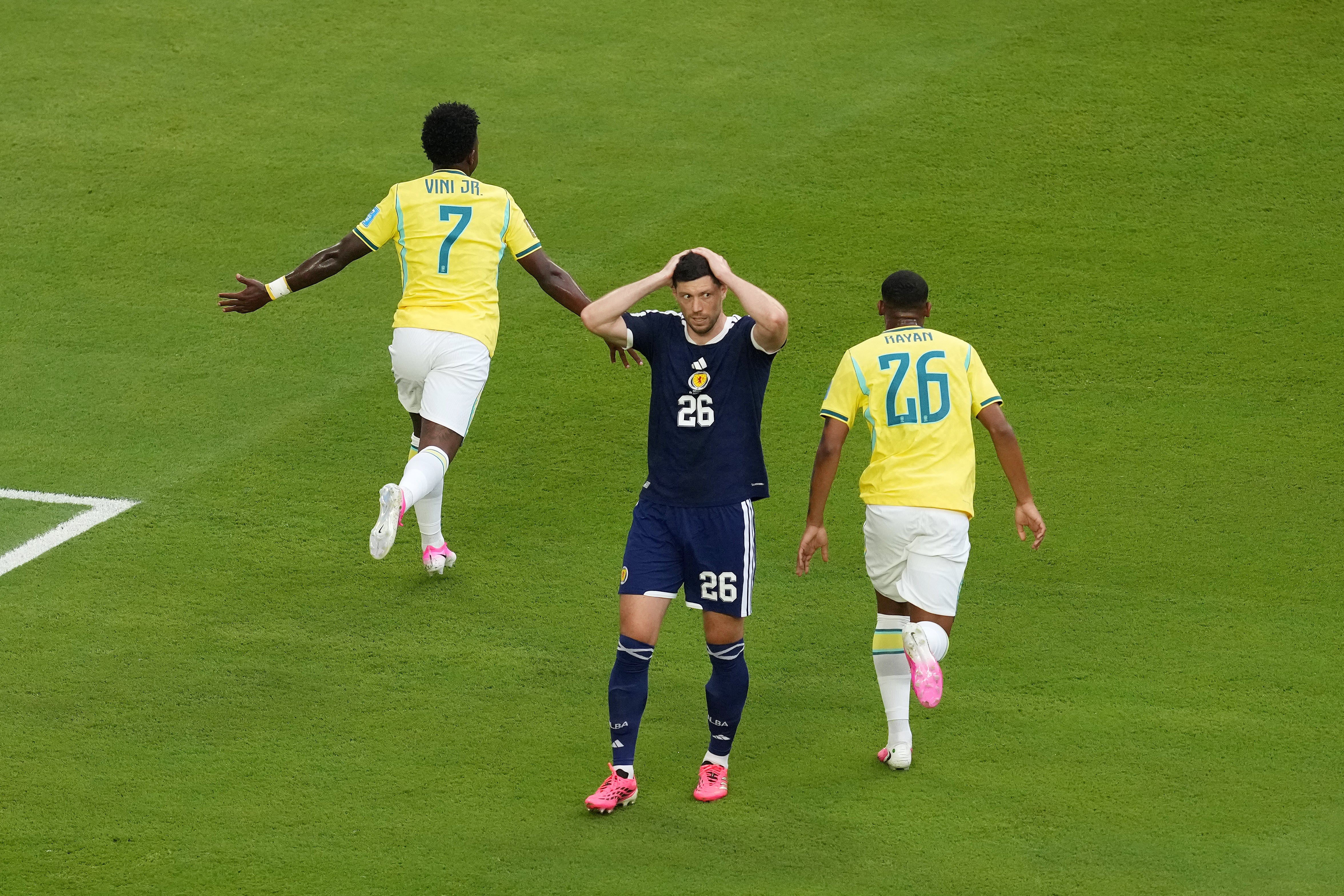
Scott McKenna was caught in possession leading to Brazil’s opening goal (PA)
Friday 25 June
Fixtures
Norway vs France (Group I) – 8pm BST
Senegal vs Iraq (Group I) – 8pm BST
Advertisement
Cape Verde vs Saudi Arabia (Group H) – 1am BST
Uruguay vs Spain (Group H) – 1am BST
Egypt vs Iran (Group G) – 4am BST
New Zealand vs Belgium (Group G) – 4am BST
Advertisement
What Scotland need
In Group I, a draw between Senegal and Iraq would be the ideal result. Iraq would need to win 3-0 to qualify while for Senegal, even a one-goal win would be enough. Scotland require a draw between Senegal and Iraq, or a narrow Iraq win.
In Group H, while at least one of Cape Verde or Saudi Arabia are guaranteed to better Scotland’s total, a victory for Spain against Uruguay would result in the third-placed team only finishing on two points. Scotland require a Spain win.
Group G sees the crucial match played between Egypt v Iran. A win for Egypt means the team finishing third could have fewer than Scotland’s three points. Scotland require an Egypt win, as long as Belgium v New Zealand is not a draw.
Advertisement
Saturday 26 June
Fixtures
Croatia vs Ghana (Group L) – 10pm BST
Advertisement
Panama vs England (Group L) – 10pm BST
Colombia vs Portugal (Group K) – 12.30am BST
DR Congo vs Uzbekistan (Group K) – 12.30am BST
Algeria vs Austria (Group J) – 3am BST
Advertisement
Jordan vs Argentina (Group J) – 3am BST
What Scotland need:
In Group L, should Croatia earn a point or better against Ghana then the third-place finisher would have more points than Scotland. Scotland need Ghana to beat Croatia by three goals.
Group K sees DR Congo and Uzbekistan face off for third place. A draw would be ideal or a win for Uzbekistan by three or less goals, with the Asian side’s goal difference set at -7 after two games. If DR Congo win they will finish third with four points. Scotland need DR Congo to fail to win.
Advertisement
In Group J, Austria and Algeria sit second and third respectively and both have three points. Algeria have the worse goal difference heading into their meeting so Scotland need an Austria win, and by two goals or more. Alternatively, if Algeria win by four or more goals, it would leave Austria’s goal difference -4 or worse.
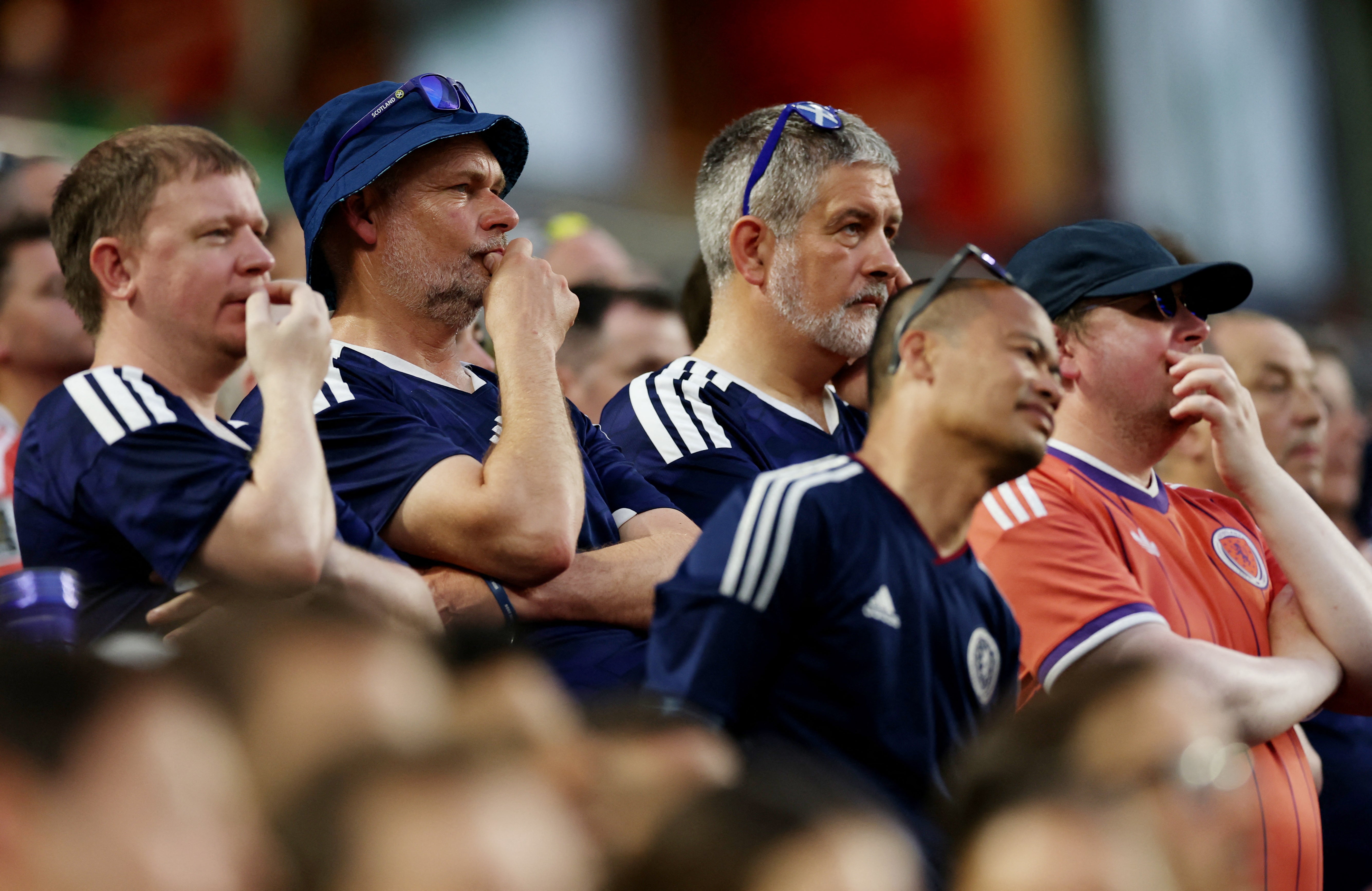
Scotland fans now face a nervous wait to see if their side will qualify for the knockout rounds (Reuters)
Here are the full group stage standings:
Who will Scotland play in the knockout rounds if they advance?
There are still plenty of scenarios and results which will influence Scotland’s route through the knockout rounds should they get there. But, having finished third in Group C, they are set to face Group A winners Mexico in the last-32 in Mexico City.
Advertisement
If Steve Clarke’s men win that tie they could then face England in the round of 16, also in Mexico City, providing Thomas Tuchel’s men finish top of Group L and then defeat probable opponents DR Congo or Senegal in the last-32. If the Scots defeat their old enemy, then a rematch against Brazil could be on the cards otherwise they could face one of Japan, Ivory Coast or Norway in the quarter-finals as things stand.
Georgia Harrison’s ex, Stephen Bear, has been convicted of breaching the terms of the restraining order against him.
Georgia Harrison has broken her silence after her ex-boyfriend Stephen Bear was convicted of breaching a restraining order put in place to protect her.
Advertisement
The Celebrity Big Brother winner, 36, pleaded guilty to breaching the restraining order after he launched an online campaign against Georgia, 31.
He had already served time in prison for illegally sharing a sex tape of of the former couple on OnlyFans. But after Bear was released from prison in early 2024, he embarked on a social media campaign in which he accused Georgia of being part of a conspiracy against him, with his guilty verdict being the result of a hidden plot.
Some of the posts were viewed millions of times and many included images of Georgia along with defamatory statements, reports the Mirror.
Georgia, who was pregnant at the time, chose not to go to court this week to see Bear convicted. She told The Sun: “I didn’t go to court this week. I didn’t stay away because it’s too hard.
Advertisement
“I stayed away because being there would give him the one thing he has always wanted, and the one thing the manosphere machine runs on: attention. A reaction and a spectacle.”
She added that “attention was worth more” to Bear “than the consequences” of his crimes and that the ‘manosphere system’ was rewarding him for that. As such, she wanted to focus on changing “the culture“.
Love Island star, Georgia, who gave birth to her first child, Sahara Jean, in October, has long campaigned for the law to better protect women and girls from acts of violence.
Advertisement
She first rose to fame when she appeared on Love Island in 2017, but by 2021, she had become an activist. Her work as a campaigner for women has earned her an MBE, making her the first Love Islander to be honoured in this way.
In January 2021, Bear was arrested after he uploaded a sex tape of himself and Harrison, that he had secretly recorded, to his OnlyFans account.
The following year, he was found guilty of voyeurism and disclosing private, sexual photographs and films. He was sentenced to 21 months in prison and given a five year restraining order forbidding contact with Harrison. He served just half of his sentence before he was released from prison.
Advertisement
During the criminal and civil cases, Georgia waived her right to anonymity in order to raise awareness about the impact ‘revenge porn’ can have on victims. The mum-of-one has also campaigned to increase the support for women and girls who have faced sexual crimes.
Georgia’s campaigning led to the government’s crackdown on image-based abuse through reforms to the Online Safety Act, which passed in October 2023.
Bear is due to be sentenced next month at Chelmsford Crown Court.
Get Daily Record Premium for just £1 per month in exclusive offer to celebrate the world cup. Click HERE.
Uruguay’s World Cup run ended in tatters with a red card shown at the very end of their defeat to Spain
03:14, 27 Jun 2026Updated 03:34, 27 Jun 2026
The World Cup clash between Spain and Uruguay exploded in the final stages with Agustin Canobbio shown a straight red card for a horror challenge.
The 27-year-old was involved in several heated moments before he was sent off for a reckless challenge on Pau Cubarsi. He was fortunate to not be punished earlier in the clash for numerous bad tackles and his reaction to Nico Williams’ clash with Nicolas de la Cruz.
The latter was one of four players shown yellow cards before Canobbio’s dismissal with referee Ismail Elfath doing well to keep the game flowing, much to Spain’s anger.
Advertisement
Eventually, he was left with no choice but to send Canobbio off as he launched into a challenge on Cubarsi with Marc Cucurella among those furious at the incident.
As he made his way off the pitch, the two benches clashed with Canobbio attempting to return to the field of play to continue arguing against his dismissal.
The full-time whistle followed soon after the flashpoint with Canobbio heading over towards the officials before being dragged away from the volatile situation by his team-mates.
It has been a particularly disastrous tournament for Marcelo Bielsa’s side as they failed to beat both Cape Verde and Saudi Arabia.
Advertisement
They also lost Manuel Ugarte to injury with goalkeeper Fernando Muslera also asking to be subbed off, as per Bielsa, following his error that led to Spain’s goal.
Their failure to claim any points against Spain resulted in Cape Verde finishing in second and qualifying for the knockout stages with a draw against Saudi Arabia, who finished bottom, enough to get the job done.
A meeting with World Cup holders Argentina in the round of 32 is their reward with Lionel Messi and Co. already confirmed as group-winners.
Advertisement
The latest set of results have also made it mathematically impossible for Ghana, England and Egypt to be eliminated. The latter are due to face New Zealand in just a few hours as they look to try and set up a favourable round of 32 tie.
Join our new WhatsApp community and receive your daily dose of MirrorFootball content. We also treat our community members to special offers, promotions, and adverts from us and our partners. If you don’t like our community, you can check out any time you like. If you’re curious, you can read our Privacy Notice.
Upgrade your World Cup TV setup with the Sky Glass ‘designed for football’
Advertisement
This article contains affiliate links, we will receive a commission on any sales we generate from it. Learn more
Sky is knocking 20% off its entire range of Glass TVs to mark the start of the 2026 FIFA World Cup. Until June 17, shoppers can upgrade to the Sky smart TV that’s ‘designed for football’ from £4.50 per month when taken alongside a Sky TV and Netflix package.
The closure will begin from 6am on Saturday, June 27
One of Manchester’s busiest roads is set to close this weekend, as drivers have been urged to plan ahead.
Advertisement
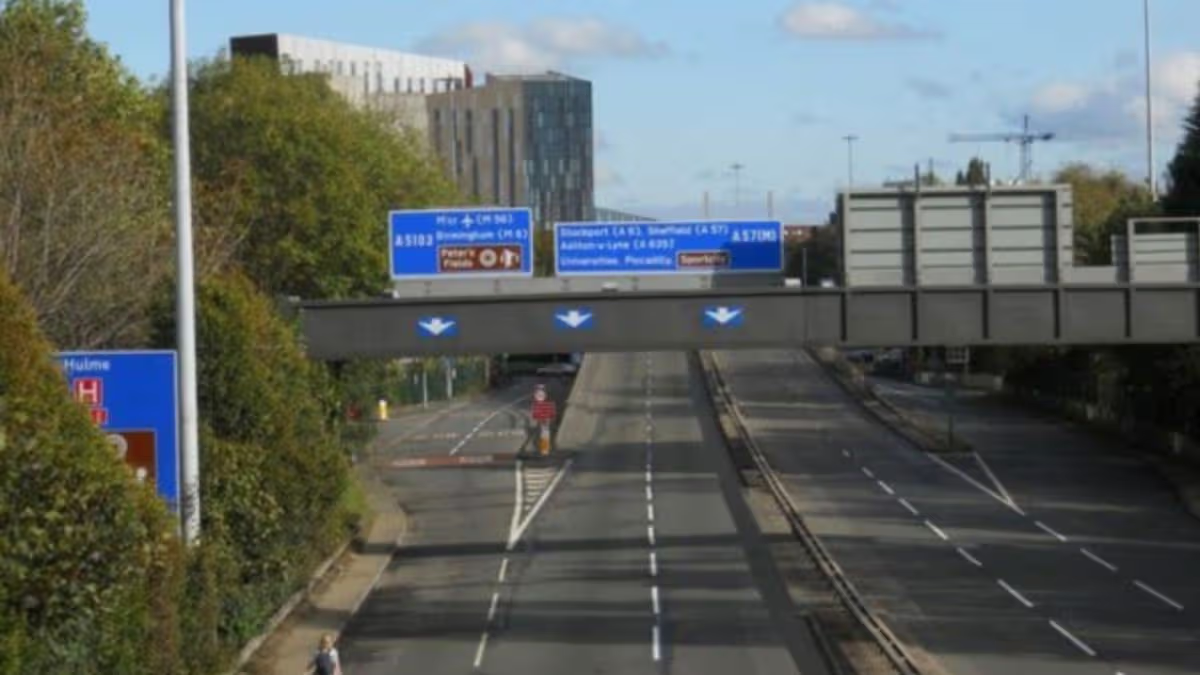
The A57 Mancunian Way is set to be closed for an annual safety inspection and maintenance. It will come into place at 6am on Saturday, June 27 and be lifted at 6am on Monday, June 29.
Both sides of the carriageway will be shut from the Chester Road roundabout to Fairfield Street, as well as all slip roads.
Click here to get the biggest stories straight to your inbox in our Daily Newsletter
The essential work includes safety checks, inspections, and repairs.
Advertisement
A signed diversion route will be in place, Manchester city council have said.
Diversion routes include:
Trinity Way
Great Ancoats Street
Bridgewater Viaduct
Whitworth Street West
Whitworth Street
Fairfield Street
Drivers have been warned of disruption amid the closure and have been advised to allow extra time, check routes and consider other ways to travel.
People living nearby are being urged to keep doors and windows shut
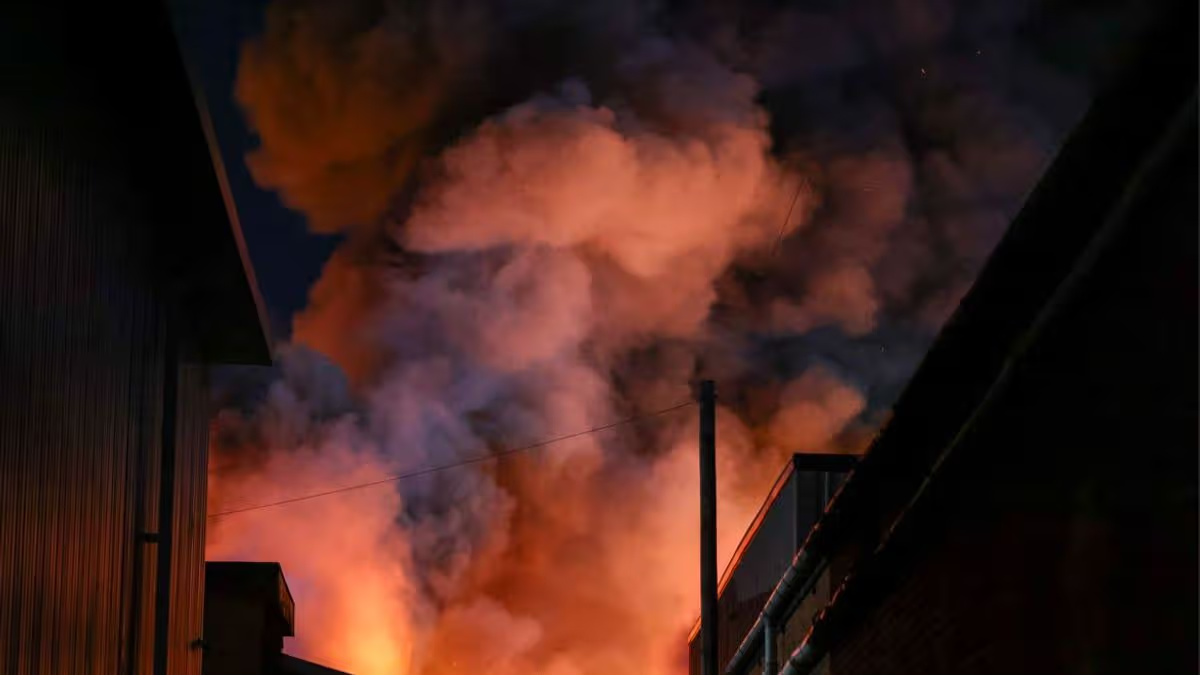
The fire in Cheetham Hill(Image: David Murphy )
Tom Burnett Content Editor
Firefighters are dealing with a huge building fire in Manchester in the early hours of Saturday morning (June 27).
Advertisement
Emergency services are at the scene of the blaze on Broughton Street, Cheetham.
The incident has been ongoing since at least 1am, with the fire understood to involve a warehouse.
Click here to get the biggest stories straight to your inbox in our Daily Newsletter
Smoke from the blaze is visible for miles around, with a number of road closures in place.
Advertisement
In a statement shortly after 2.30am, a Greater Manchester Fire and Rescue Service spokesperson said: “Our crews are currently dealing with a building fire on Broughton Street, Cheetham Hill in Manchester. Nearby residents are advised to keep their windows and doors closed and to avoid the area.
“Road closures are in place.”
This is a breaking incident. We will bring you further updates as they become available.
Advertisement
Another photo of the blaze
Firefighters are working to bring the fire under control tonight.
Smoke rising from the scene in Cheetham Hill(Image: Amber Greenwood)
Advertisement
People urged to keep doors and windows closed
A Greater Manchester Fire and Rescue Service spokesperson said:
Our crews are currently dealing with a building fire on Broughton Street, Cheetham Hill in Manchester. Nearby residents are advised to keep their windows and doors closed and to avoid the area. Road closures are in place.”
Incident ongoing since at least around 1am
Advertisement
The Manchester Evening News started receiving reports of an incident at around 1am. The fire is understood to be ongoing.
The agricultural economy was the backbone of wealth in ancient Greece. Food brought people together, whether in smaller groups at a wine-drinking symposium, or the entire community in a sacrificial feast of epic proportions. In The Odyssey, the ancient Greek epic poem, Odysseus’s son joins one of these early feasts – a community barbecue of 100 cattle.
Researchers have long recognised the economic, political and social importance of food in ancient Greece. But one key question has never been fully settled: how were animals actually raised within this system?
For nearly a century, academics have been locked in a debate over the organisation of ancient Greek animal husbandry. At one extreme is the idea of large, semi-nomadic herds moving seasonally across the landscape in search of pasture. At the other is a more intimate picture: smaller herds integrated into everyday farm life, feeding on local fields and crop by-products. In other words, were animals part of a mobile pastoral system, or woven tightly into mixed crop-and-livestock farms?
Advertisement
A video explaining my research.
Along with an interdisciplinary team of archaeologists and scientists, I have analysed one of the largest assemblages of animal remains in the ancient Greek world from the site of Azoria on Crete to address this debate. We published our findings in a recent article.
When early historians first addressed the question of how animals were reared and plants cultivated in ancient Greece, large herds of sheep and goats managed by semi-nomadic groups were a common sight in the modern Greek landscape. These herds moved from summer uplands to winter lowlands, searching for seasonal pastures.
However, another school of thought has suggested a different model for the economy. Based on interviews with elderly shepherds and farmers, archaeologist Paul Halstead has suggested in several articles and in his 2014 book Two Oxen Ahead. Pre-Mechanized Farming in the Mediterranean, that animals were mostly reared in smaller herds attached to farmsteads. They largely grazed on fallow fields or nearby rough pasture, he argued, or consumed fodder crops grown for them. In this model, plants and animals were integrated.
Advertisement
Over the decades, academics have lined up on either side of this debate. But until recently, it was impossible to directly assess the diet and mobility of ancient Greek animals and settle this debate.
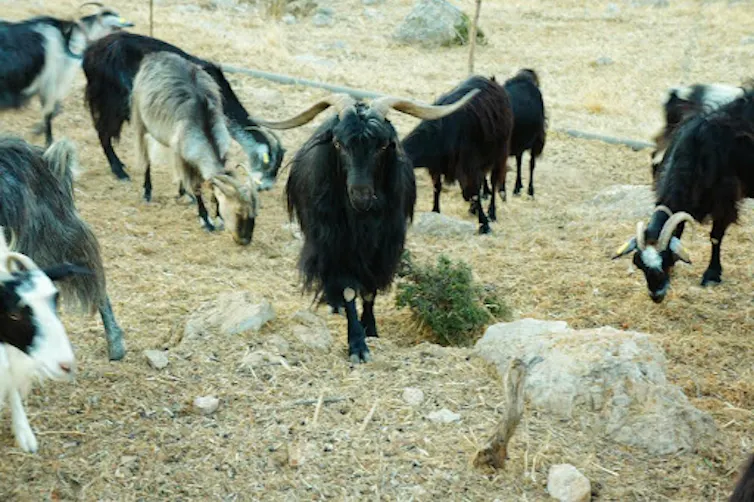
Goats in the Cretan landscape. Jonida Martini
Science meets history
The application of stable isotope analysis – a technique that measures forms of the same chemical element, called isotopes, which have slightly different weights – has given researchers their first opportunity to test these competing ideas using the remains of animals from ancient Greek sites.
By measuring the mix of isotopes preserved in ancient bones and teeth, scientists can work out what an animal or person ate and drank, and even gain clues about where it lived. This is because food and water leave chemical signatures that become locked in the body over time.
Atoms have multiple isotopes that vary their mass due to the number of neutrons. So, stable isotope analysis, which examines the amounts of different isotopes in archaeological remains, can answer questions about the sources (food, water, air) that contributed to the makeup of an animal (or human).
Goat tooth from the site of Azoria, sampled for carbon and oxygen isotopes. Author provided, CC BY-SA
The ratios of carbon and nitrogen isotopes provide evidence for the sorts of food consumed by ancient animals. The ratios of oxygen stable isotopes provide a seasonal signature for the growth of tooth enamel. By combining analyses of these different isotopes, it’s possible to directly address the agropastoral debate and assess the seasonal diet of animals.
The first applications of these techniques to ancient Greek animals only served to complicate the situation. Due to expense and availability of samples, only a handful of animals were tested at sites like Knossos on Crete or Argilos in northern Greece. Rather than one model, a range of different animal husbandry strategies were identified in the samples analysed from these sites. However, the small samples size meant researchers could not draw firm conclusions, other than confirming that animals in ancient Greece were raised using a mix of different farming method. Unfortunately, how this mix showed up in the ancient economy was unclear.
Our study at the site of Azoria on Crete is the first designed to explicitly test these two competing hypotheses in an analysis of 50 sheep and goats.
Testing the competing hypotheses
Azoria is, in many ways, the ideal site for examining the economy that underpinned the early development of city-states. It was suddenly abandoned right before the start of the classical period (around 510–323BC), in the early 5th century BC. This abandonment provides a snapshot of life at this moment, as the people left behind their trash (including plentiful animal and plant remains) and also their bulky pottery. The intact ceramic assemblages have helped us assess the function of different buildings and rooms.
The site of Azoria on Crete. The Azoria Project
Near the top of the hill are a series of public buildings, including the communal dining building. Here, citizens regularly gathered to feast and discuss the matters of the day. On lower terraces are several houses for elite citizens.
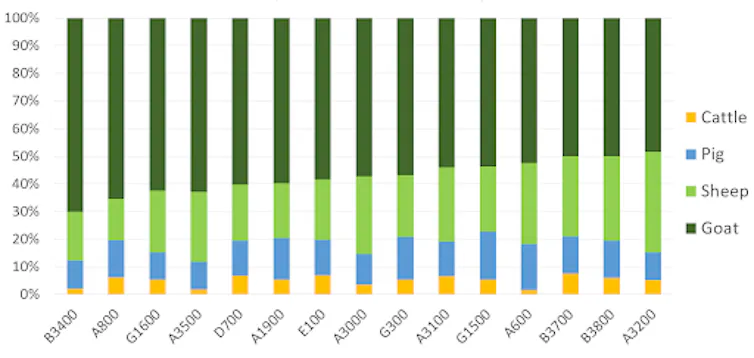
My analysis of over 200,000 animal remains from these spaces provides unprecedented insight into household dinners and public feasts. I found that the same animals, of the same ages, were consumed in houses and in the communal dining building. Mostly goats followed by sheep, pigs and cattle.
Advertisement
More interestingly, the food was prepared differently in feasts than at home, with professional butchers (likely sacrificial priests) wielding cleavers and chopping up cuts of meat for feasts, while household preparation was done using standard knives to slice meat.
While this might suggest that the same animals were used in both kinds of meals, the isotope analysis shows that this is not the case. The carbon values from animals eaten at home match up with oxygen values taken from different points along the same tooth, which change with the season. This indicates that these animals were mainly raised near local farms and ate plants that changed with the seasons.
The proportion of different domestic animals found in trenches at Azoria, showing their similar proportions. Author provided
However, the animals consumed in public feasts diverge from this pattern, showing an opposite pattern where carbon isotope values diverge from oxygen isotope values. This pattern indicates a movement between summer uplands and winter lowlands. Others show a flat trend to carbon isotopes, probably indicating they consumed specially grown fodder crops year round.
These results demonstrate that the ancient Greek food economy was more complicated than academics initially assumed. Rather than raising animals or plants together or separate from one another, both strategies existed. That said, it looks like the political unity of city-states may have been strengthened by large public sacrifices that provided meat for all citizens, made possible through the organised, specialised management of communal herds.
These conclusions give us a new appreciation for the communities that formed ancient Greek city-states. They worked together to support one another and to feed one another. To create a setting for feasting and political life. After all, you are defined by more than just what you eat, but also who you eat with, and, of course, what your food ate.
NEW YORK (AP) — From the front office to the field, the New York Mets have failed in almost every area over the past year.
And on Friday, manager Carlos Mendoza took the fall.
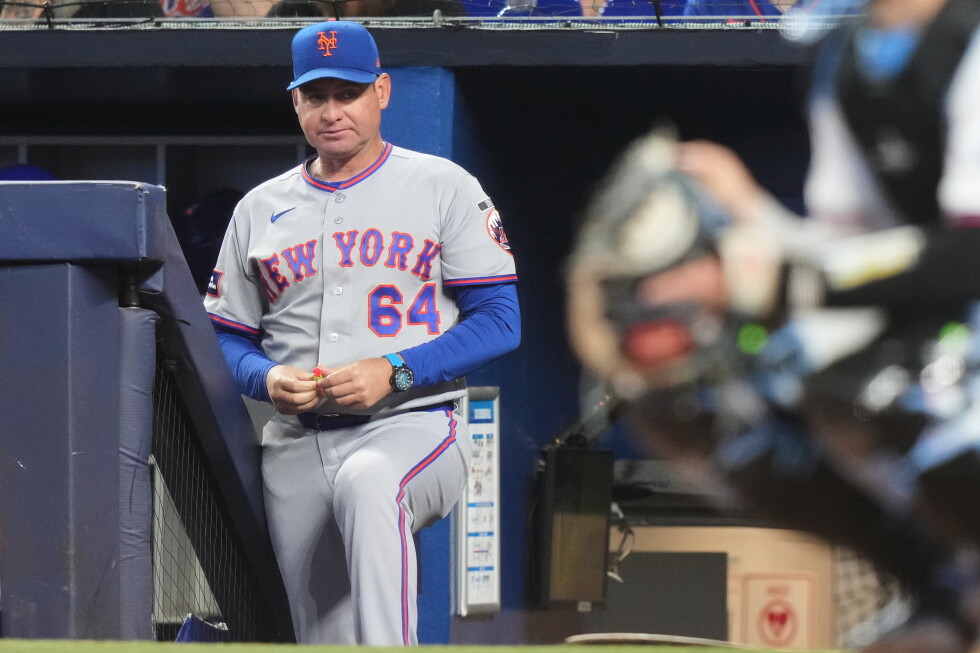
Halfway through a wretched season, Mendoza was fired as skipper of the underperforming Mets and replaced by former San Diego Padres manager Andy Green, who was already working in the organization.
New York was 34-47 at the season’s midpoint following a six-game losing streak, 15 games behind NL East-leading Atlanta and 9 1/2 back of the NL’s last wild-card berth.
“There is no sugar-coating it: This season has been a disappointment and our fans deserve better than what we’ve delivered,” Cohen said in a statement.
Although in some ways Mendoza had been on the hot seat for months, in others it was a stunningly swift decline for a skipper viewed as a rising star in 2024, when he earned high praise and was a Manager of the Year finalist after taking the Mets on a surprising playoff run in his debut season.
At a Citi Field news conference before Friday night’s series opener against the Philadelphia Phillies, president of baseball operations David Stearns thanked Mendoza for his contributions and called it “a very difficult day.”
Advertisement
“Despite all of our effors, Mendy’s included, we haven’t been able to get this going this year. And I take responsibility for that,” Stearns said. “I also have a responsibility to push us forward, to look for solutions and to make difficult decisions and change when I think it’s needed.”
Slowed by injuries to Francisco Lindor, Juan Soto, Clay Holmes, Francisco Alvarez, Luis Robert Jr. and Jorge Polanco, the Mets began the day a season-worst 13 games under .500. Friday night marked only the 10th time all year — and first since April 22 — that Lindor and Soto were both in the starting lineup. On two of those occasions, one left early because of a calf strain.
“I understand we have an uphill battle ahead of us this year, but we’re not turning the page,” Stearns said. “I think sometimes a new voice, a new perspective, a new view, helps. And sometimes it’s really difficult to explain why or how. But at this point, it was time to try.”
Advertisement
Stearns said he informed Mendoza of the decision when they met Friday morning, and the Mets held a team meeting Friday afternoon.
“At the end of the day, this is not on him. It’s more on us, the players, that we didn’t perform to our capabilities,” Lindor said.
The 46-year-old Mendoza spent 15 seasons working for the New York Yankees, the last four as bench coach, before the Mets hired him to replace Buck Showalter after the 2023 season. They reached the National League Championship Series in 2024 but missed the playoffs last year and are among baseball’s biggest disappointments this season.
“If we were playing better, he’d still be here. It’s just unfortunate he had to take the fall,” infielder Bo Bichette said.
Advertisement
Since starting 2025 a major league-best 45-24 through June 12, the Mets are 72-102. That left the team with a 206-199 record under Mendoza, who was in the final guaranteed season of a three-year contract. He was hired by the Mets a month after Stearns arrived.
After signing Soto to a record $765 million, 15-year contract before the 2025 season, Stearns made major changes last offseason. He overhauled Mendoza’s coaching staff and allowed fan favorites Pete Alonso and Edwin Diaz to leave as free agents. Brandon Nimmo and Jeff McNeil were traded, and Stearns brought in Bichette, Polanco, Robert, Freddy Peralta and Marcus Semien.
None of it has worked.
New York had a 12-game losing streak in April, its longest since 2002, and made six errors in the nightcap of Wednesday’s doubleheader loss to the Chicago Cubs, the team’s most in a game since 2014.
Advertisement
The 48-year-old Green, a former major league infielder, joined the Mets in 2023 as senior vice president of baseball development and had been running their farm system. He was given the title of interim manager for the rest of the season and will wear uniform No. 70.
“Tough. I don’t think anybody dreams of sitting in this seat this way,” Green said.
Green managed San Diego to a 274-366 record from 2016-19, finishing with losing records in all four seasons.
Stearns said Green will return to a front-office role after this season and the Mets will conduct a full search for a new manager. Green said he loves the player-development job he had and chose it largely to be able to spend more time with his three daughters.
Advertisement
“This wasn’t something I was running to,” Green said. “This felt more like a responsibility than an opportunity.”
Green played four games for the Mets in 2009, his final big league appearances as a player. He became the team’s fourth manager since Cohen bought the club from the Wilpon and Katz families after the 2020 season, following Luis Rojas, Showalter and Mendoza.
In other moves, the Mets reinstated outfielder Tyrone Taylor (right hip flexor strain) from the 10-day injured list and recalled left-hander Zach Thornton from Triple-A Syracuse to make his second big league start Friday night against Philadelphia. The club optioned outfielder MJ Melendez and right-hander Daniel Duarte to Syracuse following Thursday night’s 10-inning loss to the Cubs.
Advertisement
___
AP Baseball Writer Ronald Blum and AP freelancer Jerry Beach contributed to this report.
The drones, which would have laser mapping technology, could be deployed across complex coastal cliff zones in North Yorkshire if a council’s application for funding is approved.
The £75,000 funding application has been submitted to the Environment Agency to deliver an enhanced coastal monitoring project across priority, complex cliff adaptation sites by North Yorkshire Council.
At a meeting on Thursday, June 25, Cllr Malcolm Taylor, the executive member for highways and transportation, signed off on the application to the EA’s £12 million coastal adaptation programme.
Advertisement
Currently, NYC relies on biennial drone monitoring but this is supplied through the National Network of Regional Coastal Monitoring Programmes and the data is often limited in complex cliff environments due to vegetation cover, infrequent capture and delays between data collection and delivery.
North Yorkshire has some of the fastest eroding coastline in Europe and several communities, including those at Flat Cliffs in Filey, are facing “significant risk to residential property, access routes and essential infrastructure”.
If approved, the funding will be used to train three officers and to procure a professional LiDAR-enabled drone and associated software, training and licensing, specialist data and processing and analysis.
The scheme would allow more frequent and efficient data capture and provide “better monitoring of vegetated and landslide-prone complex cliffs and enable faster processing and analysis to support effective risk management and community engagement”.
Advertisement
The council’s shoreline management policy for the affected coastal sites is one of “no active intervention, meaning no new coastal defences are planned”.
“As a result, effective monitoring of cliff instability and erosion is essential to inform adaptation planning, early warning, evacuation planning and community engagement,” officers noted.
A report added: “The project will support North Yorkshire Council in improving the evidence base for coastal adaptation planning, evacuation planning and coastal strategy updates, strengthening communication of coastal erosion risk to communities living within complex cliff zones.”
An 18-year-old Venezuelan footballer, who represented his country at the Under-17 World Cup last year, has died after two earthquakes hit the South American country
02:44, 27 Jun 2026Updated 02:45, 27 Jun 2026
The Venezuelan Football Federation have announced that under-20 international Yimvert Berroteran has died after two earthquakes hit the South American country.
They said in a statement, translated into English from Spanish: “The Venezuelan Football Federation deeply regrets the passing of Yimvert Berroterán. Today, Venezuelan football bids farewell with immense sorrow to a young man who proudly, committedly, and lovingly represented the colors of our country.
“His departure grieves the entire Vinotinto family and leaves an indelible mark on all who shared time with him on and off the field. We extend our deepest condolences to his family, friends, teammates, coaching staff, and loved ones during this time of profound sadness. Yimvert, your light will continue to shine in every Vinotinto heartbeat. May he rest in peace.”
Advertisement
The former Everton, Newcastle United and West Bromwich Albion striker replied to their Instagram post by saying: “He cannot be a holy God!!!” and punctuated the comment with three broken heart emojis.
The FVF captioned their post: “Your light will continue to be present in every heartbeat, Vinotinto.” They signed off message with the infinity emoji.
There will be more to follow on this breaking news storyand Mirror Sport will bring you the very latest updates, pictures and video as soon as possible.



















![Get Money (feat. Junior M.A.F.I.A.) [2007 Remaster]](https://wordupnews.com/wp-content/uploads/2026/06/1782528327_maxresdefault-80x80.jpg)































You must be logged in to post a comment Login