Connect with us

NewsBeat

The idea that when Welsh firms are acquired they move elsewhere is a myth

Published

on

Wales Online

Gambit Corporate Finance has assessed the acquisition of more than 2,000 Welsh firms from 2000 to 2025.

The vast majority of firms acquired in Wales over the last 26 years remain operating here, countering a narrative that ownership exits can lead to significant extraction with businesses being hollowed out or moved elsewhere.

A new in-depth analysis by Cardiff-based boutique corporate advisory firm Gambit, based on more than 2,000 exit deals in Wales from 2000 to 2025, shows that following a change of ownership, more than 90% of firms remain actively trading in Wales.

The most popular route to exiting over the period was via a trade sale, with 74% of shareholders choosing this transfer of ownership option. The second most popular exit route was via a management buyout (MBO) or management buy-in (MBI), which accounted for 21% of the deals surveyed. Notable MBO/MBI exits were the MBO of Pembrokeshire holiday resort Bluestone Resort in 2013 for £87m and the MBO of Flintshire-based supermarket chain Iceland in 2020 for £115m.

Advertisement

There were 29 deals with a value of more than £100m. The highest, at £3bn, involved the sale of the assets of what was the listed utilities group Hyder.

During the 26-year period, South East Wales accounted for 61% of all Welsh exits, South West Wales 22% and North Wales 17%.

There were 34 flotations during the period, with the largest IPO (initial public offering) being Admiral’s £368m flotation in 2004.

During 2000-2011, 55% of exits involved businesses that were less than 10 years old. This dropped to 38% between 2012 and 2025. Gambit said this was symptomatic of the lack of available liquidity during a prolonged recession and market uncertainty around Brexit.

Advertisement

At 57, the average shareholder age at exit has been rising over the past decade. This may be an indication that external factors, such as Covid-19, have delayed owners from transferring their businesses.

On the figure that more than 90% of firms have remained active in Wales post change of ownership, founder partner of Gambit, Frank Holmes, said: “It’s a myth we can finally put to bed. There’s a persistent assumption in Wales that when a local business is bought, it gets hollowed out: the business relocates, the jobs go.

“We individually checked what actually happened to over 2,000 exits across 26 years. Around 90% of genuinely Welsh companies that were acquired are still active and trading in Wales today. Change of ownership isn’t the threat people assume it to be, particularly for buyouts and IPOs.”

Advertisement

The research shows that exit activity in the second half of the period – 2013 to 2025 – comfortably outpaces the first half, with 1,251 exits against 843, representing an average of 96 exit deals a year versus 65.

Mr Holmes said: “Whichever way you cut it, the Welsh market has been getting busier, not quieter. A catalyst for the spike can be attributed to the October 2024 Budget. Capital Gains Tax (CGT) rose immediately on its announcement and continued in 2025 and 2026.

“That’s a strong incentive to complete a sale before a deadline, and we know from our own activity it pulled a good deal of transactions forward into 2024 that might otherwise have been executed a year or two later.

“However, it was also four years post-Covid, which allowed companies to regain financial performance and improve valuations, thereby demonstrating the sustainable profitability necessary for exit, fortuitously in a strong, liquid market.”

Advertisement

The research shows that 50 firms were acquired by employee ownership trusts (EOTs) – a structure that did provide 100% CGT relief for sellers. The EOT exit route could well have peaked.

Mr Holmes said: “The maturation of the employee ownership trust option became increasingly favoured for predominantly people-services companies, with over 50 transactions in the period.

“This option benefited from the 100% CGT allowance or nil-rate tax incentive, since halved, which was compelling for owners but often funded with revolving debt structures, compromising growth potential. The jury is out on the sustainability of some of these businesses, as some notable failures have already emerged.”

On business owners considering an exit, or a partial one, Mr Holmes said: “Selling up should not be viewed as being a threat to their legacy and the economic wellbeing of their employees and other stakeholders, as it’s sometimes made out to be. It is an important factor in the lifecycle of a business, often left unaddressed and best approached in a planned fashion.

Advertisement

“An ageing generation of owners is going to drive a lot of succession decisions over the next few years.

“Those businesses which have a succession plan will be the ones that make themselves genuinely investable, by adopting tech and innovation-led strategies, cultivating credible management, thereby creating capacity to grow and understanding the optimum routes for exit, well before making a decision to embark on a transaction process.”

Source link

Advertisement
Continue Reading
Click to comment

You must be logged in to post a comment Login

Leave a Reply

NewsBeat

Lee Mack reveals the secrets of Not Going Out – from nearly marrying Catherine Tate to co-star fallouts and the ‘upsetting’ Bobby Ball episode he yanked off air – as Britain’s longest-running sitcom turns 20

Published

on

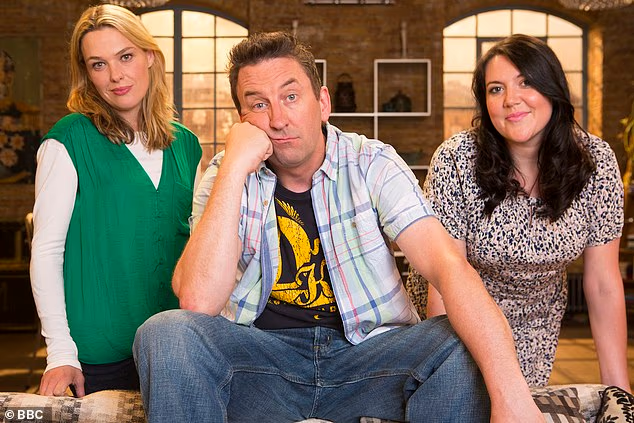
Lee Mack revealed the secrets of Not Going Out in a one-off documentary to celebrate the show turning 20 (pictured with Sally Bretton and Katy Wix)

Not Going Out is the longest-running British sitcom currently on air, with 106 episodes – and counting – spanning two decades. 

Created by Lee Mack in 2006, the BBC show followed unambitious layabout Lee (Mack) and his best friend’s sister Lucy (Sally Bretton), who is also the landlady of his London flatshare.

A will-they-won’t-they romance between the two unfolded over several series, until the unlikely couple married in the season seven finale.

The eighth series then jumped eight years into the future, with all subsequent instalments following their chaotic family life with three children.

Advertisement

Now on its 15th season the series shows no signs of stopping and is celebrating its 20th anniversary. 

To mark the milestone, the cast and crew opened up about the show’s behind-the-scenes secrets in a one-off documentary, 20 Years Of Not Going Out, which also features classic clips, exclusive archive material and never‑before‑seen outtakes.

Lee Mack revealed the secrets of Not Going Out in a one-off documentary to celebrate the show turning 20 (pictured with Sally Bretton and Katy Wix) 

Advertisement
Lee revealed that in the unaired pilot, Catherine Tate took on the female lead but she dropped out to focus on her eponymous sketch show (pictured filming another pilot – The Smiths)

Lee revealed that in the unaired pilot, Catherine Tate took on the female lead but she dropped out to focus on her eponymous sketch show (pictured filming another pilot – The Smiths) 

Discussing the show, Lee mused: ‘After 20 years of Not Going Out we are delighted to finally give a warts and all peep behind the curtain of how it’s made. 

‘Thankfully we have hoovered behind that curtain, but unfortunately the warts have not cleared up.’

Speaking in the upcoming documentary, Lee explained the idea for Not Going Out first came from his 1999 sketch show, Lee Mack’s Bits, which he performed at Edinburgh Festival with Catherine Tate and Dan Antopolski. 

Advertisement

He revealed that during the writing process he came up with several jokes that didn’t work as skits, but he jotted them down with the hopes of one day using them in a show. 

That day came sooner than Lee imagined, and he was commissioned to develop a sitcom script for the BBC, creating a pilot that was never aired. 

Not Going Out has boasted a stellar rotating cast over the years, including Hugh Dennis, Miranda Hart, Timothy West, Bobby Ball, Abigail Cruttenden, Deborah Grant, Tim Vine, Geoffrey Whitehead and Katy Wix. 

Yet in that unaired pilot, it was Catherine Tate who took on the female lead, and she was selected to star in the series before she dropped out to focus on her eponymous sketch show.

Advertisement

Insisting that there were no hard feelings about her withdrawal, Lee mused: ‘Catherine was really successful and she wanted to do her own thing.’ 

However, he revealed that while Catherine’s involvement was fleeting, she had a lasting impact on the show, with her appearance resulting in changing the sitcom’s name from its working title, Number 17.  

‘A few people said to me they didn’t believe me and Catherine were a couple,’ Lee recalled. ‘So I said we’ll not being going out with each other, we’ll just be landlady and tenant. 

‘And there might be a spark of romance there but if people say “I don’t believe you’re a couple,” we can say “well, we’re not,”  hence the name, Not Going Out.’ 

Advertisement

While the name stuck, Catherine didn’t, and she was soon replaced by American actress Megan Dodds for the first series, with Sally then taking over as Lucy from series two onward.

Catherine was replaced by American actress Megan Dodds for the first series (pictured with Tim Vine and Lee) with Sally then taking over as Lucy from series two

Catherine was replaced by American actress Megan Dodds for the first series (pictured with Tim Vine and Lee) with Sally then taking over as Lucy from series two 

The format was changed by the departure of Tim Vine, with his decision to quit the show causing a fallout with Lee. Yet he was swiftly replaced by Hugh Dennis

The format was changed by the departure of Tim Vine, with his decision to quit the show causing a fallout with Lee. Yet he was swiftly replaced by Hugh Dennis

Another star who quit the show after hitting the bigtime was Miranda Hart, who made an impression with her role as an acupuncturist in series one, so was brought back to play Barbara the cleaner for the next two seasons. 

Advertisement

Yet like Catherine, she too was offered her own programme, and left the series in 2009 to work on Miranda, making way for Katy Wix’s character, Daisy. 

By which point the series was a fan favourite and pulled in regular viewing figures between three and four million per episode. 

So Lee explained that he was left blindsided when the BBC suddenly cancelled the show halfway through season three.

The fans were also shocked, starting an online campaign and driving strong DVD sales until the Beeb reversed their decision, commissioning two more series nine months later. 

Advertisement

Yet while it was clear the public appetite for the show was still strong, Lee feared the show’s format was getting a bit stale. 

Lee mused: ‘If you fancy your landlady and you constantly want to tell her you like her but you haven’t got the confidence to do it, I think it’s mildly amusing in your early 30s.

‘But in your early 50s it suddenly becomes a bit creepy…’ 

The format had also been changed by the departure of Tim Vine, with his decision to quit the show causing a fallout with Lee. 

Advertisement

‘I fancied a change really and it’s not really a great reason perhaps,’ Tim mused.

‘But we’ve made up about it now, me and Lee. It came as a shock to the system when I first said it to him.’ 

Lee then explained he didn’t want to make a big fuss about Tim leaving so it didn’t alarm viewers, explaining why they wrote him out of the show with just one throwaway scene referencing his character had moved to Germany for work.  

Tim was then replaced by Hugh Dennis, who said it was presented to him as being the last series of Not Going Out, and that he had no clue the show would still be going. 

Advertisement

Yet Lee continued to play around with the format and series seven saw him make the decision to put an end to the will-they-won’t-they storyline. 

The Christmas special showed Lee finally confess his feelings for Lucy and the pair tying the knot, which Lee considered a fitting end to the show. 

Lee explained: ‘There was a possibility we’d get married and that would be the end of it – either the BBC didn’t want anymore of it, or I didn’t want to do anymore of it. 

‘At the end, they go off into the distance, just married on the back of the van, it could have been the end.’

Advertisement
While it was clear the public appetite for the show was still strong, Lee feared the show's format was getting a bit stale so he decided to put an end to the will-they-won't-they storyline and propel them into the future when they were married with children

While it was clear the public appetite for the show was still strong, Lee feared the show’s format was getting a bit stale so he decided to put an end to the will-they-won’t-they storyline and propel them into the future when they were married with children

Tragedy struck in 2020 when Bobby Ball, who played Lee's father Frank, died. Lee revealed they filmed a funeral scene as tribute but it was deemed too sad to air so they scrapped it

Tragedy struck in 2020 when Bobby Ball, who played Lee’s father Frank, died. Lee revealed they filmed a funeral scene as tribute but it was deemed too sad to air so they scrapped it 

Instead of airing the episode they filmed a new, humorous tribute, in which Lee's mother-in-law Wendy [Deborah Grant] painted an awful picture of him a year after the funeral

Instead of airing the episode they filmed a new, humorous tribute, in which Lee’s mother-in-law Wendy [Deborah Grant] painted an awful picture of him a year after the funeral

It was at this point that Lee was cast to appear with former co-star Catherine in a UK reboot of Everybody Loves Raymond, entitled The Smiths.  

Advertisement

‘I sort of realised you can’t do both, which one do you want to do?’ Lee recalled. ‘And I thought, why don’t I not do Everybody Loves Raymond and just do this and get it to become a family sitcom.

‘So we missed out the formative years but we showed the episode where the baby is born – then cut to seven years later.’ 

Co-star Sally shared: ‘He didn’t want to do any of the newlywed romance, he wanted to get straight to the aggravation.’ 

It’s a format that has allowed the show to continue. 

Advertisement

Yet tragedy struck in 2020 when Bobby Ball, who played Lee’s father Frank, died at the age of 76 after testing positive for Covid.

Reflecting on his passing affecting the show, Lee mused: ‘People often say the best comedy is a comedy that makes you laugh and makes you cry. 

‘That’s just not true, that’s the best comedy-drama. The best comedy is one that makes you laugh, that’s why it’s called a comedy. 

‘After Bobby died we did an episode where it was his funeral. We just couldn’t find a way of not making it really sad. 

Advertisement

‘So we said, “you know what, we’ve never done this before, let’s just drop the whole thing”.’ 

Instead of airing the episode they filmed a new, humorous tribute, in which Lee’s mother-in-law Wendy [Deborah Grant] painted an awful picture of him a year after the funeral.

Not Going Out is currently in its 15th season, making it Britain’s all-time second longest running sitcom behind Last of the Summer Wine. 

‘The idea of me doing it 20 years on from now, when I’d be 77, seems like insanity,’ Lee said. ‘But then it felt like that 20 years ago!

Advertisement

‘Not Going Out has highs and lows, hard work, good laughs, screaming and shouting, all sorts of emotions with it. But it’s the show I’m most proud of.’ 

20 Years Of Not Going Out airs Wednesday, September 23 at 9PM on BBC One and BBC iPlayer. The series 15 launch episode airs directly after at 9.30PM.

Source link

Advertisement
Continue Reading

NewsBeat

ANDREW GRIFFITH: Burnham would rather tax us all to death than take hard decisions

Published

on

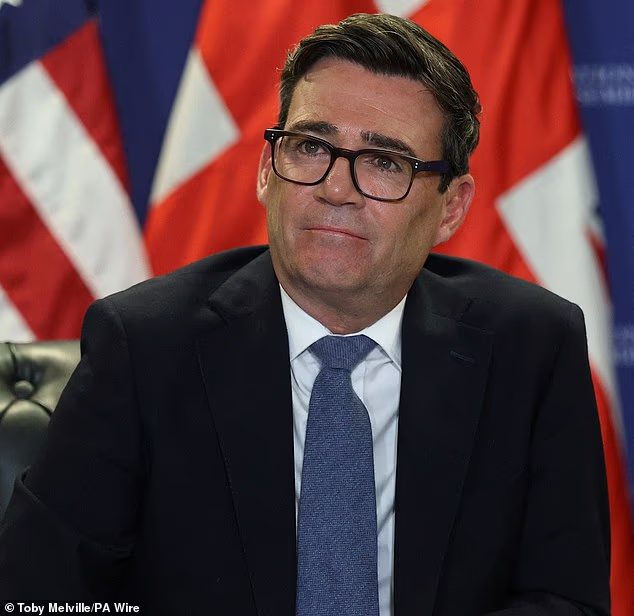
Senior financiers and chief executives in the City have warned Andy Burnham his rumoured plans to hike capital gain tax would be a huge drag on the success of investment

Picture a couple who retired a few years ago and have lived in the same house for 30 years, brought up their children in it, cleared the mortgage and paid every penny of tax they ever owed. They wish to downsize to be closer to the grandchildren, so freeing up their larger home for a growing family.

Unfortunately, the taxman wants thousands of pounds in stamp duty for the new home, which makes the cost of the move uneconomic. What’s more, next year the state pension rises above the income tax threshold for the first time, and every week brings a fresh rumour about what the Chancellor might take next: their savings, their pension pot, whatever they had hoped to pass on.

There are millions of people like them and on October 28 they will sit down to watch John Healey’s first Budget wondering how much more of their money Labour is going to take.

Mr Healey has been challenged again and again to rule out tax rises – and every time he has refused. That may be defensible in normal times, but after two Budgets in which Labour hiked taxes and with warning signs flashing across the economy, these are far from normal times.

Advertisement

While we are talking about more and more pensioners potentially having to file a tax return for the first time, are we really suggesting that in the final years of her life, Granny is going to have to wait in the queue for an HMRC phoneline?

This is classic Labour. At the last election they promised not to raise taxes on ‘working people’. Within months, Rachel Reeves had put a jobs tax on employers across the country and, as a result, payrolls have shrunk by more than 200,000 since Labour took office. Then came a tax on family farms, a tax on family businesses, VAT on school fees, and a ‘tourist tax’ on the seaside guesthouse.

The result is the highest tax burden since the Second World War, and for many in the Labour Party and their donors, it is still not enough. Every day, everyone from young people starting out to departing non-doms tell me they feel overtaxed.

Only yesterday senior financiers and chief executives in the City warned Andy Burnham that his rumoured plans to hike capital gains tax from 24 per cent to 45 per cent would be a huge drag on the success of investment.

Advertisement

Senior financiers and chief executives in the City have warned Andy Burnham his rumoured plans to hike capital gain tax would be a huge drag on the success of investment

Chancellor John Healey has been challenged again and again to rule out tax rises ¿ and every time he has refused

Chancellor John Healey has been challenged again and again to rule out tax rises – and every time he has refused

And just last week Sky News obtained a 50-page dossier which had been drawn up for Keir Starmer this spring, mapping out the road to this October’s Budget. It admits there is ‘limited fiscal space to support living standards’, which roughly translates to: don’t expect the Budget to help you. Yet the same document finds room for ‘reforms to capital and property taxes’ and Andy Burnham has already lifted six of its other policies.

Advertisement

For Labour, ‘reform’ means increase. When the party ‘reformed’ agricultural relief in 2024, farmers got a tax on the family farm.

Property tax ‘reform’ could mean your council tax or the stamp duty on your next home going up. Capital gains tax ‘reform’ means taking more of your savings, and the Sky News dossier mentions pensions, too. It’s clear that while Labour has a new Prime Minister, the plan has stayed the same – and the plan means you are going to pay more.

All of this instead of getting a grip on a welfare bill that is out of control, with the latest figures – as the Daily Mail reported yesterday – showing one in five working-age adults is claiming universal credit. Almost a million young people are classified as ‘Neets’: not in work, education or training.

Yesterday’s revelation that the Treasury has borrowed £8.1billion more than expected this fiscal year proves that tax rises are inevitable. Without cutting back on welfare, Burnham will be forced to find more than £300million a day in repayments.

Advertisement

This is a scandal! Labour would rather tax the country to death than take the difficult decisions to get our economy out of the doldrums into which it has plunged it.

All the while, wealth creators are heading for the exit and the tax bill that’s left over lands on everyone else who is trying to get by.

So, as Shadow Chancellor, I challenge John Healey to rule out any new taxes – and I will keep making that challenge every day until the Budget. That means no higher rates and no new stealth taxes.

The dividing line on tax between Labour and Conservatives could not be clearer. In stark contrast with Labour, I will cut taxes in my first budget as Chancellor. Stamp duty on your home, the family farm and the family business death taxes will all be abolished. We will reverse the imposition of VAT on education and abolish business rates for thousands of High Street shops. All fully funded from fixing the out-of-control welfare spend and cutting back the size and cost of government.

Advertisement

Stamp duty is a tax on social mobility that keeps pensioners in homes too big for them and stops younger people moving to take a better job or to have children. The housing market is struggling as it is, so let’s unleash it from the chains of stamp duty and start stimulating growth in our economy.

That retired couple should be able to sell up, move closer to their grandchildren and keep what they have worked for. Under Labour they are taxed for moving, and kept guessing about everything else.

The simple truth is that Labour wants to raise taxes to pay for more benefits. The Conservatives will cut taxes, cut the welfare bill and let people keep more of their own money.

Source link

Advertisement
Continue Reading

NewsBeat

Far-right activist Danny Tommo branded ‘disgusting’ after slashing dinghy in Channel

Published

on

Far-right activist Danny Tommo branded ‘disgusting’ after slashing dinghy in Channel

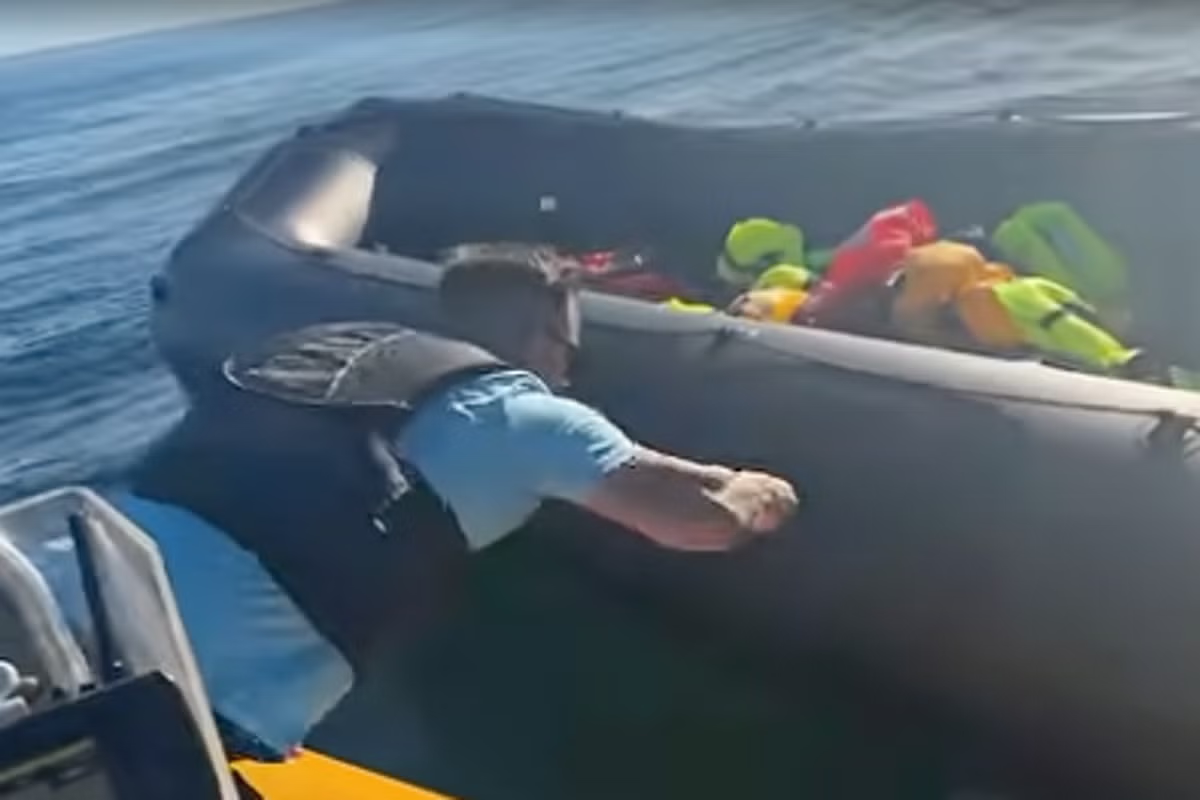
Far-right activist Daniel Thomas has been condemned by charities after footage showed him using a blade to slash a dinghy in the Channel while a rescue worker was onboard.

Thomas, who is known by the name Danny Tommo, filmed himself tracking two inflatable dinghies on Tuesday afternoon, which were carrying asylum seekers from France.

In the video clip, he can be seen approaching the dinghy, which is full of life jackets left by passengers, and using his blade to repeatedly stab holes in the side of the vessel.

He then shouts towards a rescue worker onboard, who is wearing an orange hi-vis outfit, to “get off” while escaping air from the dinghy can be audibly heard.

Advertisement

As he slashes the boat, Thomas can be heard shouting: “This is England. This is not France any more.”

Far-right activist Danny Tommo can be seen slashing the dinghy with a blade
Far-right activist Danny Tommo can be seen slashing the dinghy with a blade (X)

After spotting the rescue worker, he says: “Get off the boat. You’ve got time to get off the boat.”

His boat then motors away, before the rescue worker can be seen climbing onto the larger emergency boat that was positioned next to the dinghy.

Hampshire and Isle of Wight Constabulary said it was conducting inquiries into the incident.

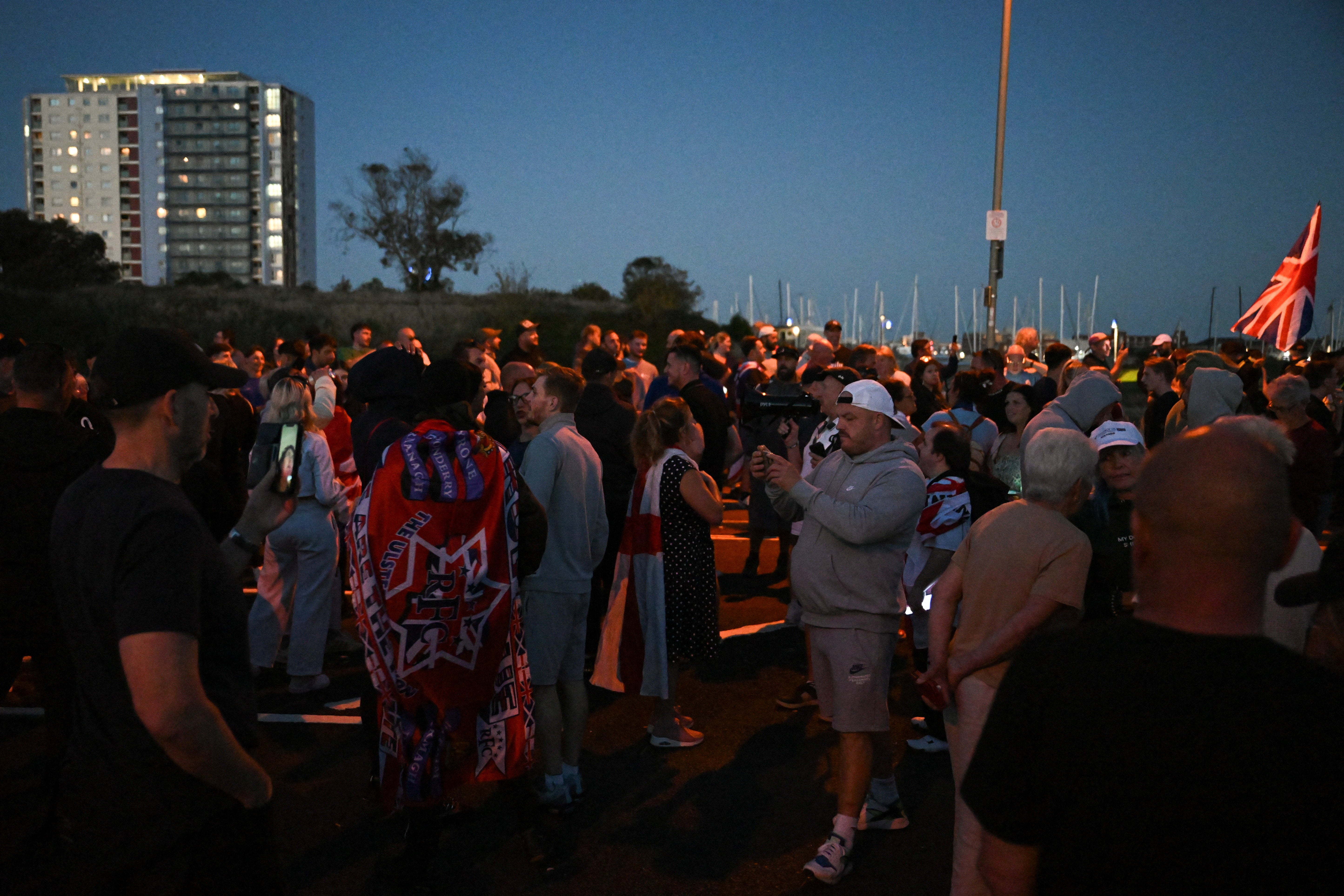
Anti-migrant demonstrators gather in Gosport on Tuesday
Anti-migrant demonstrators gather in Gosport on Tuesday (Getty)

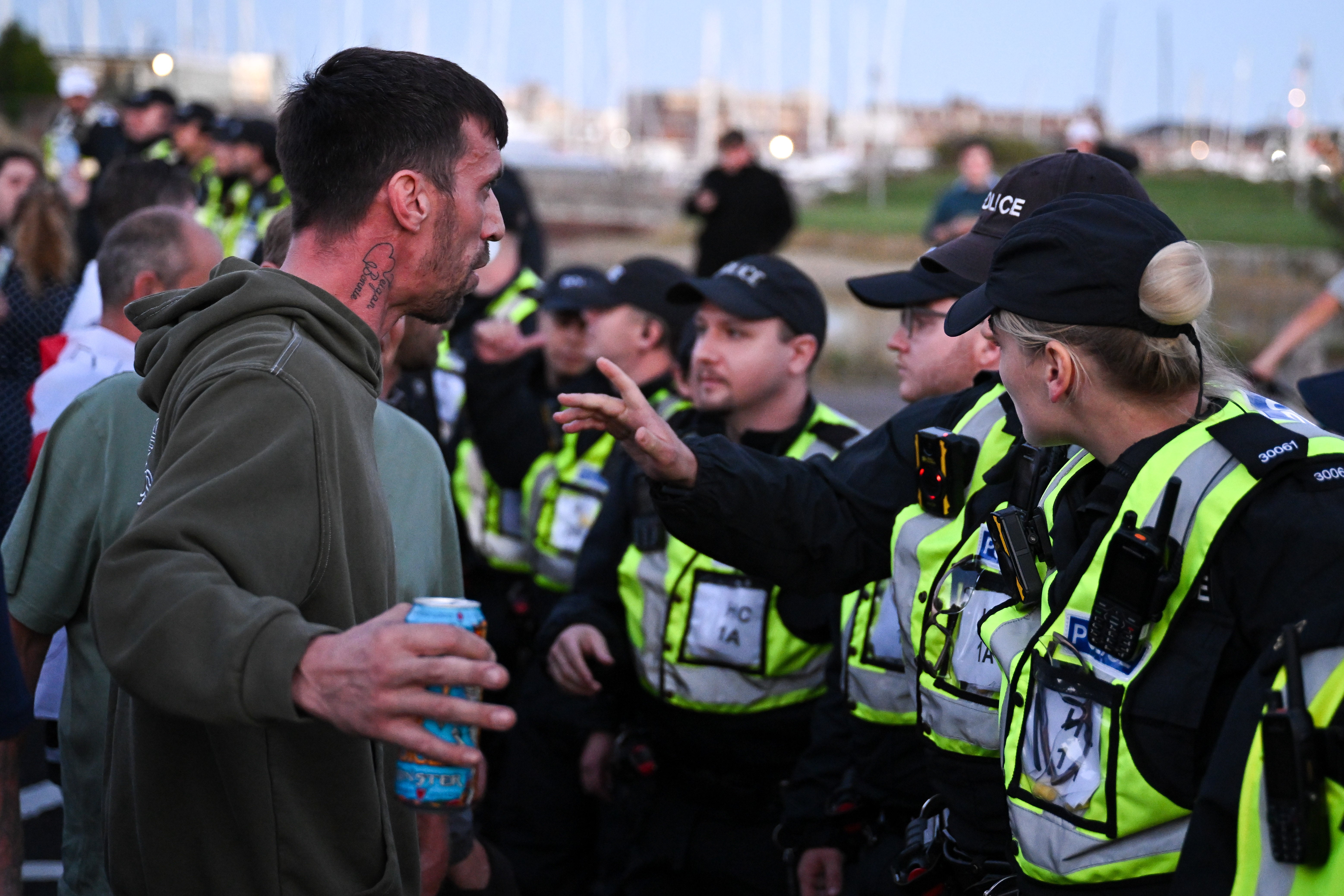
Officers made six arrests for offences including assaulting an emergency worker and aggravated trespass at a protest in Gosport on Tuesday night, following reports a dinghy with migrants on board was en route to the UK.

British rescue boats were sent to collect the passengers on the craft after they refused help from the French coastguard.

Advertisement

The French coastguard earlier said around 60 migrants on a small boat spent more than 33 hours at sea “in precarious conditions” and refused help as they were “determined to take all risks to reach the United Kingdom”.

It was expected the migrants would be taken to Gosport, leading to anti-migrant protesters gathering in the area. As a result, the vessel headed east along the coast, arriving in Dover after 12:30am on Wednesday morning.

Police arrested six people after disorder broke out in Gosport
Police arrested six people after disorder broke out in Gosport (Getty)

Charities have condemned Thomas’s actions, with the Joint Council for Welfare of Immigrants branding it “violent and dangerous”.

Stand Up to Racism posted on X: “Danny Tommo already has a conviction for knife crime. The footage of him going wild with a knife and slashing a boat with [an emergency worker] on it in the Channel today is disgusting.”

Thomas – founder of anti-migration group Patriot Platform and an associate of political activist Tommy Robinson – was a leader of recent protests in Portsmouth and organised demonstrations in Dover. He regularly livestreams his actions to his followers.

Advertisement

In 2016, it was reported that he was jailed for two years after being convicted of attempted kidnapping. Portsmouth Crown Court heard how Thomas and two accomplices went “mob-handed” to the victim’s home armed with knives after wrongly accusing him of stealing drugs.

Demonstrators gather during a protest linked to the arrival of a migrant boat
Demonstrators gather during a protest linked to the arrival of a migrant boat (Reuters)

UK authorities are understood to have plans to deal with small boat arrivals further along the coast.

Some 17,480 migrants have arrived after crossing the Channel by boat so far this year, including 5,011 since Andy Burnham became prime minister.

The total so far for 2026 is down 46 per cent on the same point last year.

A government spokesperson said: “The Border Security Command works around the clock to protect our border and will continue to detain, check and process every small boat arrival.”

Advertisement

Source link

Continue Reading

NewsBeat

Suffolk village to hold crunch meeting over plans for Piddington-style independence referendum in protest at government plans for asylum seeker accommodation at military base

Published

on

RAF Barnham could have at least 1,250 asylum seekers by Christmas

A tiny Suffolk village is to hold a crunch meeting within days to ask residents whether it should launch a Piddington-style independence referendum in protest at government plans to house 1,250 asylum seekers at a nearby military base.

A delegation from Barnham travelled to the trailblazing Oxfordshire village last night to learn from the high-profile poll there that garnered international attention.

The five-strong team, led by parish council chairman John Bauer, have now decided to hold a special parish meeting within a fortnight to discuss holding an in/out vote and other measures it can use to highlight its plight.

The urgency is due to the speed at which Labour is trying to push the scheme through as it tries to move migrants from expensive hotels.

Advertisement

Details only emerged in June and a decision is expected this autumn, with asylum seekers potentially moving in by Christmas.

Mr Bauer told the Daily Mail: ‘The whole exercise is because people in Barnham and Piddington feel that the democratic process, as far as the asylum seekers accommodation process is concerned, just wasn’t working.

‘When we heard about it, it was quite shocking because we were being asked about something that hadn’t yet been passed on to us by the Government.

‘We knew nothing, the district council knew nothing, the county council knew nothing and the MPs knew nothing. That is not how the democratic process should work.’

Advertisement

RAF Barnham could have at least 1,250 asylum seekers by Christmas

The delegation to Piddington included another parish councillor, Conservative district councillor Andrew Smith, who is chairman of its development control committee, and two villagers who will be able to devote significant personal time to setting up a referendum or other measures.

‘We will be putting a proposal to them [villagers] which could well include a referendum and if there’s an appetite for that. If there is then a yes, we will go ahead,’ Mr Bauer said.

Advertisement

The meeting will have Piddington Parish Council chairman Tim McNally as a guest to explain his community’s approach to plans for asylum seekers’ accommodation in his area.

It is also expected to launch a ‘skills audit’ similar to one carried out in Piddington which identified what expertise individuals can bring to the resistance.

Mr Bauer, 66, said: ‘I don’t think the Government are listening to us. The fact they’ve taken this very high-handed route without even informing their MPs and they’re using the urgent Crown Development route [where applications are decided by the Secretary of State] to get it through with indecent haste I think means they aren’t listening.

‘But something like the referendum that Piddington has given them pause for thought.’

Advertisement
The village, which only learned of the plans in June, is considering a Piddington-style independence referendum

The village, which only learned of the plans in June, is considering a Piddington-style independence referendum

The vote in Piddington earlier this month over Home Office plans for MoD Bicester saw 90 per cent of locals opt to secede from the UK.

Barnham, which has around 580 residents, would see the population more than double if the plan to accommodate asylum seekers is given the go-ahead.

This ratio could be even greater after details of a private meeting between Home Office officials and councillors in Norfolk, which borders RAF Barnham, were leaked in which the Government department admitted ‘a lot more’ migrants could be housed at the facilities than had been admitted.

Advertisement

The village has a hall, church and primary school but no other amenities such as a shop or pub where migrants – who will be able to come and go from the base as they please – will be able to spend time.

Protests have taken place outside RAF Barnham since the controversial plans for the base, as well as the one in Bicester and a third site in Linton-on-Ouse, North Yorkshire, were announced three months ago.

Violent disorder also broke out over several nights two miles away from Barnham in Thetford, Norfolk, last month, after it emerged the Home Office was looking to quadruple the number of asylum seekers placed in private accommodation.

Until now, Barnham has relied on an ‘evidential’ approach involving planning issues such as environmental concerns.

Advertisement
Protesters gather outside RAF Barnham in July

Protesters gather outside RAF Barnham in July

The base was once used to store nuclear and chemical weapons and there are concerns the land could be contaminated.

The site is also a nesting ground for stone curlews, a species of bird so endangered that any development within 1,500m is forbidden.

Locals were vocal in their opposition to the Home Office’s plans at Barnham’s last parish council meeting.

Advertisement

Mother-of-two Collette Skelly, 58, who has lived in the village for 15 years and was at the meeting, said: ‘It’s a good way of raising publicity.

‘At the moment, there is nothing on the news about Barnham. So Piddington had to do it as a publicity stunt to raise attention.’

A man in his 60s added: ‘It’s on the news, they’re questioning the Prime Minister about Piddington today, so it’s working, isn’t it. I’d absolutely support it.’

Adrian Whittle, the leader of Reform UK at West Suffolk Council, declared he would support the village’s right to hold a referendum.

Advertisement

‘It raises the profile that people haven’t just given up, they want their country back, they want their lives back,’ he said.

An aerial view of part of the base at MoD Bicester

An aerial view of part of the base at MoD Bicester

Some were concerned that it would become a distraction from the formal planning approach to blocking the scheme.

James Hollins said: ‘The referendum is rubbish, it can’t go anywhere, it’s got no legal standing.

Advertisement

‘We can demonstrate but they’re not going to listen.’

Announcing the referendum result on Wednesday last week, Piddington Parish Council chairman Mr McNally said: ‘We have given a message to the world.’

Vice-chair Susannah Parden added: ‘We are Piddington, the village that roars.’

Tory home affairs spokesman Chris Philp said the vote should be a ‘wake-up call’ for the government.

Advertisement

Source link

Continue Reading

NewsBeat

All Creatures Great and Small’s Charlotte star has a famous mum and fans will be floored

Published

on

Manchester Evening News

The Charlotte Beauvoir actress has two very famous parents who fans will recognise

All Creatures Great and Small series seven teased in trailer

There’s been plenty of change to speak of in season seven of All Creatures Great and Small, including blossoming romances for the men of Skeldale House.

The much-loved Channel 5 period drama returned on Thursday (September 17), entering a post-war era, taking viewers back to Spring 1946. The characters are finally enjoying a more peaceful world, and things are looking up for James Herriot (Nicholas Ralph), who continues to impress as a vet and as Helen’s (Rachel Shenton) husband.

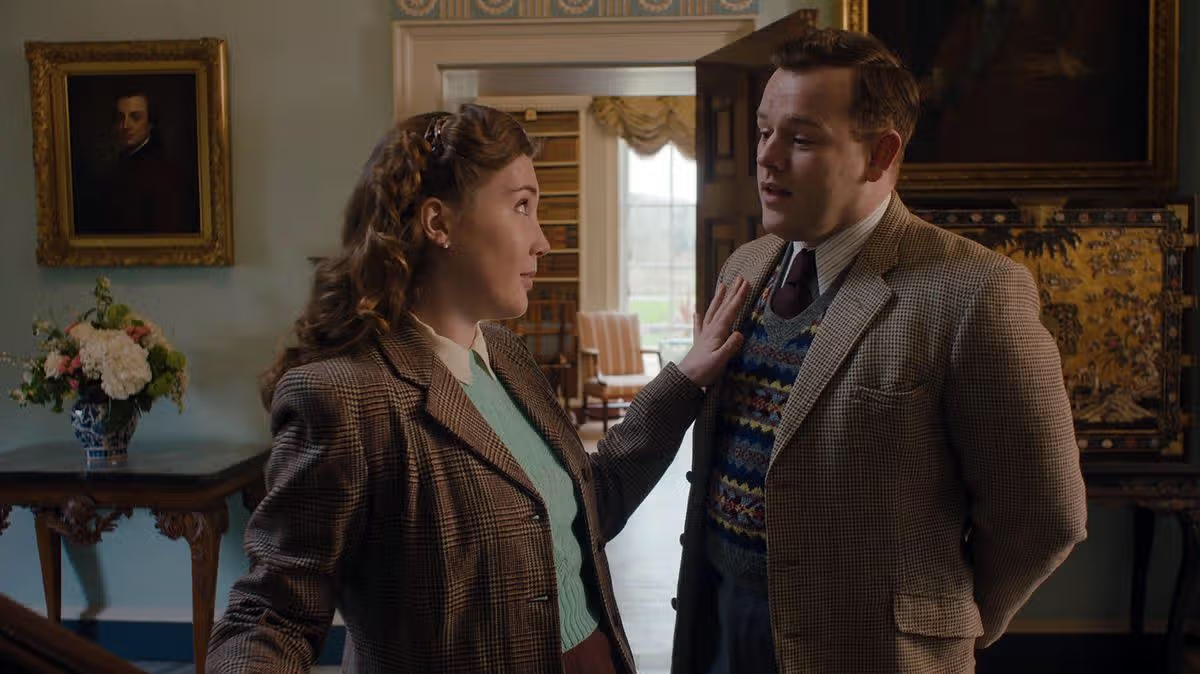
Siegfried Farnon (Samuel West) is now in a relationship with Dorothy (Maimie McCoy), the returning long-term friend of Mrs. Hall (Anna Madeley). Meanwhile, the eccentric vet’s brother, Tristan Farnon (Callum Woodhouse), is now also committed to Charlotte Beauvoir (Gaia Wise).

The pair originally met after Tristan answered a veterinary call to examine and save her beloved horse in series six. The pair quickly found a lot of common ground over their shared traumatic experiences during the war, with Tristan serving on the front line and Charlotte serving in the Auxiliary Territorial Service in Sicily, looking after animals.

Despite Charlotte hailing from an upper-class background, as her father is General Beauvoir (Jonathan Hyde), and Tristan living in a cramped Skeldale House, their relationship continues to develop as they navigate life together in the Yorkshire Dales.

Speaking about Tristan’s on-screen relationship with Charlotte, actor Callum Woodhouse told PBS: “I really love it too. It’s been one of my favourite relationships I’ve ever got to play on screen. I think Gaia [Wise], who plays Charlotte, is one of the most wonderful actresses I’ve gotten to work with.

Advertisement

“She was a joy to play all those scenes with, she’s just spectacular. And I think our chemistry is wonderful, so I really lucked out in finding someone that I get along with. And it couldn’t have come at a better time for Tristan. I think he’s past flitting from woman to woman.”

Who plays Charlotte in All Creatures Great and Small?

Actress Gaia Wise plays Charlotte in the period drama, and fans may recognise her from crime dramas including Silent Witness and The Chelsea Detective, in which she had guest roles.

The 26-year-old, from London, also starred in the films A Walk in the Woods, based on Bill Bryson’s book of the same name, and the suspense thriller Dead of Winter, both of which also star her mum, Dame Emma Thompson.

Advertisement

Oscar winner Emma, 67, has enjoyed an acting career spanning decades with notable movie roles including Margaret Schlegel in Howards End, Elinor Dashwood in Sense and Sensibility, Karen in iconic holiday romance Love Actually, Professor Sybil Trelawney in Harry Potter, Agent O in Men in Black, and the title role in Nanny McPhee.

In 1995, Emma met her future husband, Greg Wise, while filming the period drama Sense and Sensibility, where he played John Willoughby, and they married in 2003. The couple welcomed their daughter Gaia into the world in 1999 before formally adopting Tindyebwa Agaba four years later.

Greg, 60, originally from Newcastle, has starred in a long list of television shows and movies, including Johnny English, Walking on Sunshine, and Military Wives. He is also famed for playing Lord Louis Mountbatten in series one and two of Netflix’s The Crown.

Advertisement

All Creatures Great and Small airs Thursday at 9pm on Channel 5

Source link

Continue Reading

NewsBeat

When are Oasis Live 2027 tickets going on sale in the UK?

Published

on

When are Oasis Live 2027 tickets going on sale in the UK?

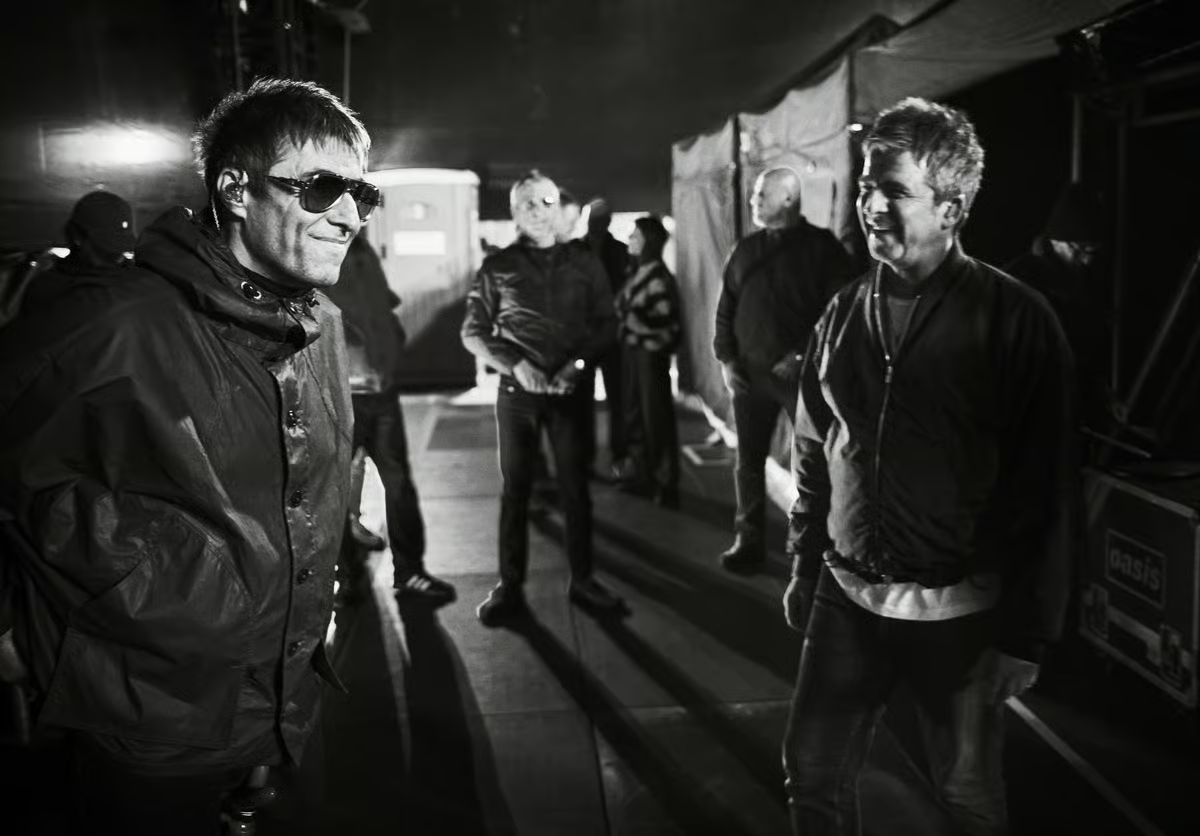
It’s just two days to go until Oasis fans will have the chance to get their hands on tickets for the band’s huge 2027 tour.

The Gallagher brothers are gearing up to hit the road for a 38-date world tour next year, with shows across the UK, Europe and America between May and September.

Source link

Continue Reading

NewsBeat

Drug deaths rise sharply in Scotland as figures remain worst in Europe

Published

on

Needles littering the pavement in a lane in Glasgow

When comparing Scotland with the rest of the UK, NRS uses a wider measure of age-adjusted drug poisoning deaths.

This includes all deaths where the underlying cause was listed as mental and behavioural disorders due to psychoactive substance abuse or poisoning by drugs whether accidental, intentional, of unknown intent or as a result of assault.

The most recent comparable data are for 2024 and show that Scotland had an age-adjusted death rate of 216 per million compared with 91 for England, 140 for Wales and 135 for Northern Ireland.

Catriona Matheson, professor of substance use at Stirling University, told BBC Radio Scotland Breakfast that the potency of nitazenes was unpredictable. Some can be 50 times stronger than heroin.

Advertisement

“People are not expecting that in the drugs that they’re taking,” she said.

“They may be buying what they think is heroin and in fact it may contain several other substances in it.”

Matheson said an increase in “polydrug use” in recent years had contributed to the problem and could prove to be lethal.

Source link

Advertisement
Continue Reading

NewsBeat

Emily Robinson wins The Conversation Prize for writers 2026 for her entry on the lost medieval island of Ravenser Odd

Published

on

Emily Robinson wins The Conversation Prize for writers 2026 for her entry on the lost medieval island of Ravenser Odd

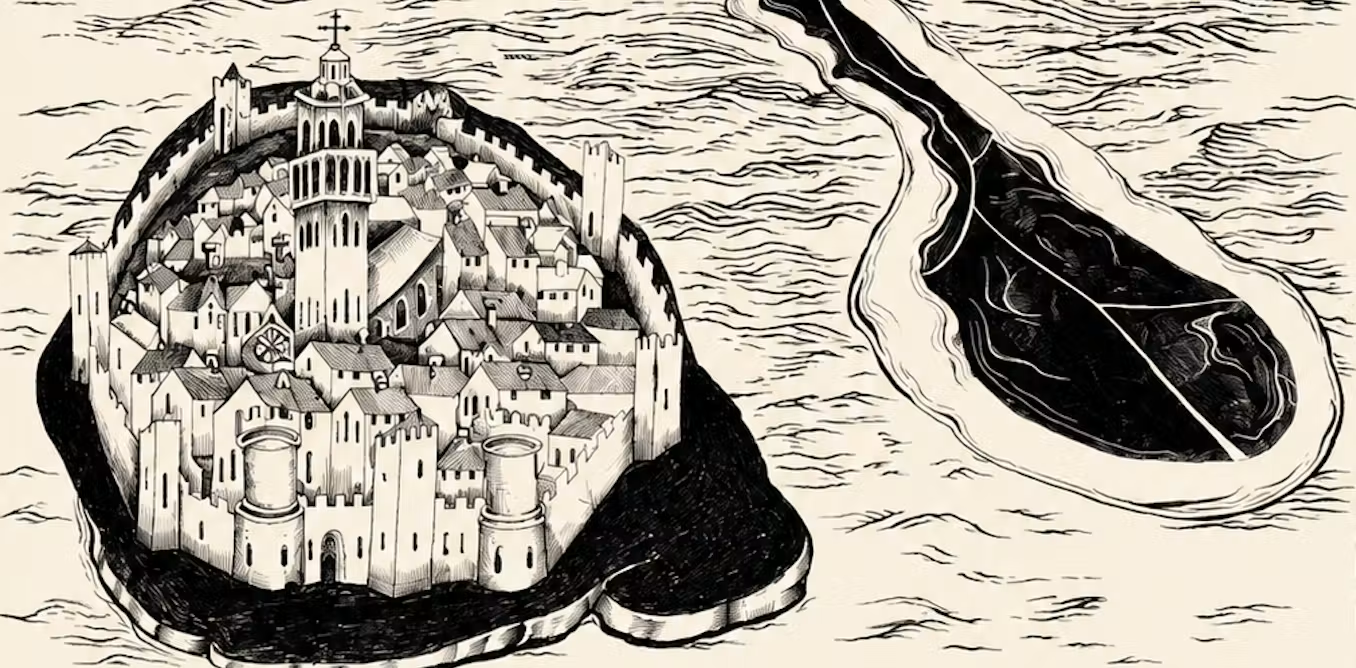
Congratulations to Emily Robinson, historian and professor at the University of Sussex, who is our 2026 winner of The Conversation Prize for writers for her entry on Ravenser Odd, the sunken medieval island that continues to inspire and obsess.

Now in its second year, the prize invites academics to submit a 2,000-word article and book pitch. The competition is run in partnership with Faber and Curtis Brown, with the winner receiving mentorship from both organisations and £1,000.

A huge thank you to everyone who entered this year. The standard was very high and it was very difficult to pick just one winner and one runner up.

We are particularly grateful to our judges: Catherine Clarke, professor and director of the Centre for the History of People, Place and Community at the Institute of Historical Research; Tim Minshall, the inaugural Dr John C. Taylor professor of innovation at the University of Cambridge; and Steven Vass, senior editor for Science Insights at The Conversation. Also to Fiona Crosby, senior commissioning editor for non-fiction at Faber, and Elliot Prior, associate agent at Curtis Brown.

Advertisement

The judges said: “After much deliberation, the judges have unanimously selected Emily’s article on Ravenser Odd as the winner of the competition. It tells the hugely intriguing story of a mysterious island in the Humber in the 13th century that then disappeared beneath the waves.

Her story does a lovely job of taking the reader on the writer’s journey to this remote corner of England, as well as exploring the fascination with the folklore of the island. The judges thought it would make a beautiful book with broad appeal that feels particularly timely in light of the threat of climate change.”

Emily said: “Entering the Conversation Prize helped me to really focus on why this story fascinates me. I’m now looking forward to working with the mentors and working out how to make it equally fascinating to other people.”

Emily is a historian of political ideas, identities and cultures in modern Britain, with a particular interest in the way that both time and feeling are conceived within different ideological traditions. Her current research focuses on popular understandings of history, and changing cultures of history-telling through the example of Ravenser Odd.

Advertisement

You can read her winning story here.

Runner up in the competition is Alison Garden, senior lecturer and UKRI Future Leaders Fellow at Queen’s University Belfast, for her story on mixed marriages during the troubles in Ireland and what they reveal about the more intimate side of conflict in Ireland.

Love across the divide.
Lize Smith/Shutterstock

The judges said: “Alison’s entry focuses on a much overlooked part of Ireland’s story: all the marriages that straddled the religious divide and how they affected the lives of these people and their families.”

The judges “commended the quality of the writing in Alison’s story, and the case studies that told of everything from houses being burned to mothers sidelined in their children’s baptisms. This has the potential to become a fascinating and important book.”

Advertisement

Alison said: “This is such a vital part of the Irish story, and it just doesn’t get the attention it deserves. It is a real privilege and joy to be able to share these histories. Through this project, I’ve talked to huge numbers of people, in Ireland and beyond, about mixed marriages and mixed families. I wanted to see whether there was a broader readership for this work and I’m absolutely delighted that taking that chance has brought this neglected intimate history to a wider audience.‘

Source link

Advertisement
Continue Reading

NewsBeat

Labours Chagos Deal Falls Apart Following Trumps Comments

Published

on

Labours Chagos Deal Falls Apart Following Trumps Comments

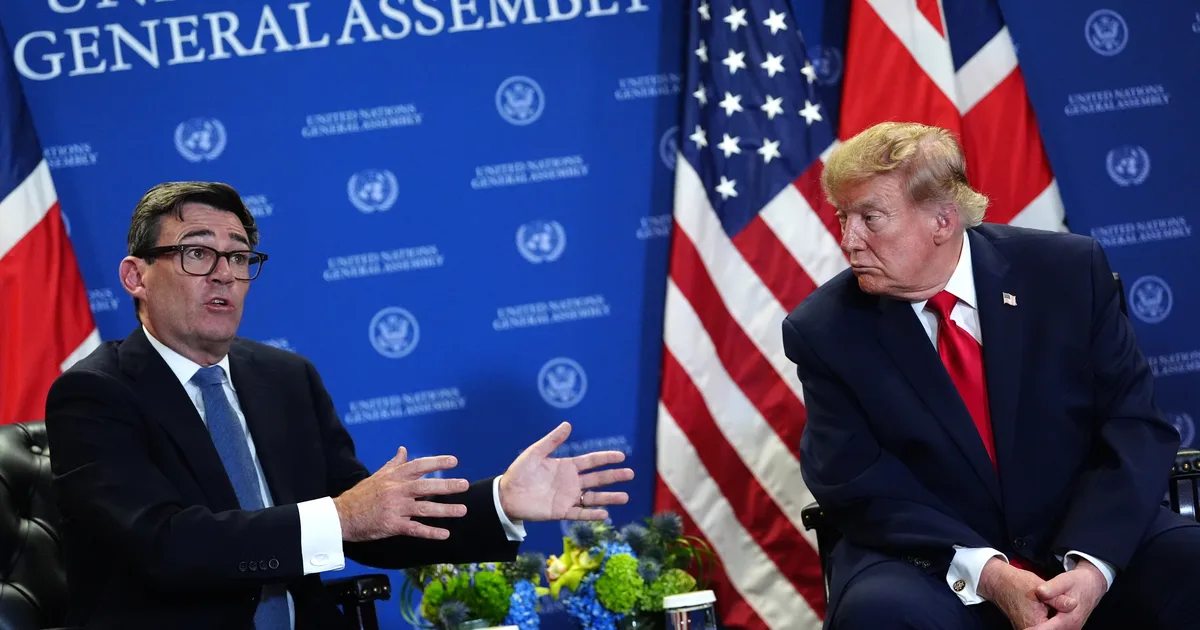
Labour’s plan to hand over the Chagos Islands to Mauritius is in tatters after Donald Trump branded it “ridiculous”.

The US president sounded the death knell for the controversial plan following talks with Andy Burnham at the UN General Assembly in New York.

The UK government announced last year – when Keir Starmer was still PM – that it was going to hand sovereignty of the islands to Mauritius.

Britain would also pay £9 billion over the next 99 years so the UK-US military base at Diego Garcia can continue to operate as it does at the moment.

Advertisement

Trump initially backed the deal, but after a series of flip-flops is now firmly opposed to it.

As Burnham looked on, he said: “I don’t support it. I think it’s a terrible deal.

“They all of a sudden say they have ownership, somebody has ownership that never showed up before after decades and centuries. I think it’s ridiculous. No, we were talking about that.

“It’s strategically very important, very important. You know, we had to send our B-2 bombers when we bombed the Iran nuclear, we sent the B-2 bombers back home to Missouri. As opposed to flying for a short period of time, they had to fly for a long period of time.

Advertisement

“It’s amazing how strategic it is, and I think the prime minister is going to be looking at it.”

On Wednesday, Streeting confirmed that the deal cannot go ahead as originally planned.

He told Radio 4’s Today programme: “This deal, as it is currently constituted, can’t go ahead without American support, so we have to get the deal to a place where it commands American support as well as the agreement of the government of Mauritius and our government.

“The reason why that is important is because we are trying to safeguard not just now but for the longer term the base at Diego Garcia and the capability it provides the United Kingdom and the United States for our national and collective security.”

Advertisement

Asked if the UK would pay Mauritius £120 million a year, as the deal said, Streeting replied: “Not at this stage. We’ve got to get to a point where we can agree a deal.”

Shadow defence secretary James Cartlidge said: “It shouldn’t have taken another intervention from the president for Andy Burnham to ‘review’ Labour’s Chagos surrender deal.

“If Burnham was really serious about our defence he would know that this deal should be binned entirely. It is absurd to hand over British sovereign territory, not to mention billions of pounds of hard-pressed taxpayers money, to an ally of China.”

Listen to Commons People, the podcast that makes politics easy. Every week, Kevin Schofield and Kate Nicholson unpack the week’s biggest stories to keep you informed. Join us for straightforward analysis of what’s going on at Westminster.

Advertisement

Source link

Continue Reading

NewsBeat

Suicide ‘poison seller’ linked to five deaths in Scotland to face justice in Canada

Published

on

Daily Record

Families of the victims of , who pleaded guilty to 14 counts of aiding suicide in Canada in May, are set to address court.

Families of the victims of a ‘poison seller’ linked to dozens of suicides and five deaths in Scotland are set to tell a court of their grief as he faces sentence.

Advertisement

Kenneth Law pleaded guilty to 14 counts of aiding suicide in an Ontario court in Canada in May. The 60-year-old sold lethal substances to victims across the world, including 330 packages sent to the UK.

While Law’s guilty pleas related to cases in Canada, he is also linked to the deaths of 79 people in the UK, which prosecutors say must be taken into account when his sentencing hearing gets underway today.

Impact statements from victims, including those in the UK, are set to be read to the court, with one mum saying Law should “rot in hell” for his vile crimes.

The court previously heard how Law owned four companies, with one website offering a “set of instructions” and advertising 40-minute telephone consultations for 150 dollars (£111).

The site also featured a “testimonial” from the estate of someone who had been successful in killing themself to prove the “efficacy” of his products.

In Canada, the maximum prison sentence for aiding suicide is 14 years – the same as for encouraging suicide in the UK. It’s understood Law could be sentenced to a longer term due to the number of victims in the case.

Victims’ loved ones will present impact statements to court today ahead of his sentencing. Deaf TikTok creator Imogen Nunn, known as Immy, died in January 2023 aged 25 after buying drugs online from Kenneth Law.

Advertisement

In an impact statement shared with the BBC, her mum Louise Nunn said: “You have destroyed my whole world. If Immy was here now, I know exactly what she would say to me, but I’m not Immy and I will never forgive you.”

The Canada court previously heard how one of his British victims, Tom Windsor, told police he used the substance sold by Law and was found unconscious by emergency crews while still connected to the 999 call.

He told the call operator he did not want to die.

A 43-year-old British woman died in July 2021 after her four-year-old daughter asked her mum’s husband where she was. The court heard they found his wife “slumped over their daughter’s dollhouse” in the living room.

One of Law’s victims died 12 days after a visit from South Wales Police, who were performing a wellness check.

Danielle Cornish, 29, told officers she had no intention of killing herself and police took no action, but she died on August 22, 2022, after telling emergency services she had taken the product sold by Law.

Another man, Oliver Wade, who had no record of mental health issues, killed himself three days after his mother died of cancer, the court heard.

Advertisement

The National Crime Agency (NCA) and the Crown Prosecution Service (CPS) said all 79 UK victims would form part of the wider investigation into Law, a hotel cook.

But victims’ families were told that Law will not face criminal proceedings in the UK because of the potential for him to challenge the extradition after being convicted in Canada.

British prosecutors described Law as a “serial offender who callously exploited many vulnerable and innocent people exchanging their lives for his financial gain”.

He sold 1,200 packages to 40 countries across the world from Canada-based websites, with 286 people in the UK receiving products, leading to 112 deaths. Some 330 products were sent to the UK, one to the Isle of Man and 12 to Ireland, the court heard.

Advertisement

A letter to bereaved UK families from the NCA and the CPS said the cases would be incorporated into the Canadian prosecution.

It said: “We recognise that this may be painful to hear, and that some victims and bereaved families may have hoped to see a separate prosecution in England and Wales.

“This difficult decision was reached only after detailed consideration of all available options.”

Advertisement

The Crown Office previously said it had been liaising closely with Police Scotland and Canadian prosecutors in relation to the deaths of a number of people in Scotland. It said: “We are limited in what we can say at this time.”

Senior NCA investigating officer Damon Hayes said the move “guarantees all victims and families in the UK will see justice”.

He added: “This approach is not unusual in cases involving serious offending that crosses international borders. This will allow the judge to take into account the full extent of Law’s criminal behaviour, including the fact that his actions resulted in the deaths of people in this country.”

But victims’ families criticised the move.

Advertisement

Adele Zeynep Walton, the sister of 21-year-old Aimee Walton, from Southampton, who died in 2022, said “doors have been shut” for families seeking justice.

Advertisement

The NCA has worked with 45 police forces across the UK to gather evidence on Law’s offending since it launched a probe in 2023.

Specialist CPS prosecutor Andrew Hudson told reporters “no victim has been left behind as part of this process” saying prosecutors would “ensure that the full devastating extent of his criminal conduct is seen and considered by the sentence in court”.

Get more Daily Record exclusives by signing up for free to Google’s preferred sources. Click HERE

The Samaritans is available 24/7 if you need to talk. You can contact them for free by calling 116 123, email jo@samaritans.org or head to the website to find your nearest branch. You matter.

Advertisement

Source link

Continue Reading

Trending

Copyright © 2025