


The ex-FM said she was given the advice by former US First Lady Hilary Clinton.
Nicola Sturgeon has recalled the moment former First Lady Hillary Clinton told her that women leaders are expected to “carry the can for the behaviour of a man”.
The former First Minister also said Prime Minister Andy Burnham has a “very southern view of what it means to be northern”, and predicted there would be an independent Scotland and a united Ireland in the next two decades.
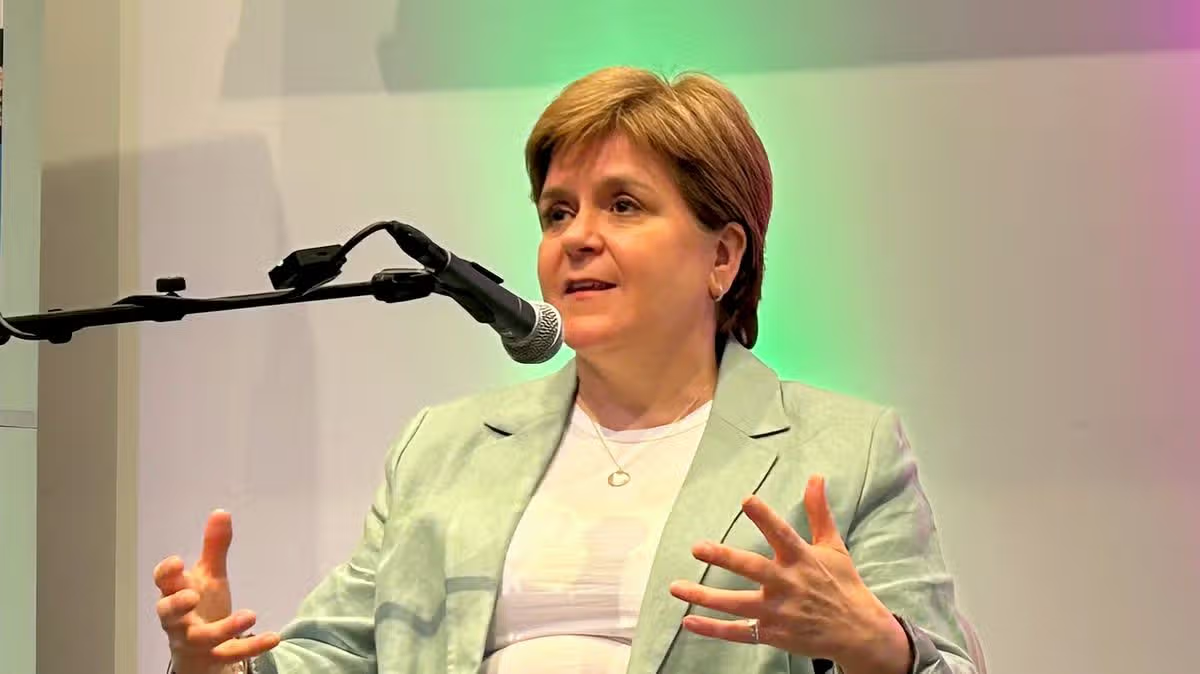
In a talk at the Féile an Phobail at St Mary’s University College Belfast on Thursday she spoke of the misogyny she experienced in her time in the Scottish Parliament and said Mrs Clinton was a “huge inspiration” to her.
The former SNP leader’s estranged husband Peter Murrell was jailed for more than five years in June after pleading guilty to embezzling more than £400,000 from the SNP over a 12-year period.
Sturgeon has said she is “innocent of any crime”, telling the BBC in May she felt she was “serving a sentence for a crime (she) did not commit”.
“I think she is hugely inspirational because she has suffered and been at the kind of leading edge of a lot of this misogyny and sexism and being expected to carry the can for the behaviour of a man that many women experience and she’s never kowtowed in the face of that,” she said.
“She’s been always resilient, standing up and fighting back every time somebody knocks her down, and she is also the most prepared and on top of her brief person that I’ve ever met, and she’s always inspired me.”
Sturgeon was also asked about the current state of UK politics and her views on the new Prime Minister, saying the two had a “massive fight” over Covid-19 regulations when he was mayor of Greater Manchester.
She said she hopes Mr Burnham succeeds in his tenure in No 10 because “him succeeding is potentially the only thing in England standing in the way of a Nigel Farage Reform government, and I definitely don’t want to see that”.
“I don’t think he offers much for Scotland or Wales or Northern Ireland,” she said.
“I mean the whole No 10 of the North, right? I mean, can you just humour me here for a second while I rant about this? Go and look at the No 10 of the North on a map of mainland Britain. It’s in the bloody English Midlands.
“Manchester, if you’re in London or the south-east of England, Manchester’s north, you don’t even have to go to Scotland to start questioning that, you know people in Newcastle don’t see Manchester as the north.
“So he’s got this kind of very southern view of what it means to be northern, so I don’t think he’s going to offer much for Scotland, and so I’m not sure that he’s going to make much difference to the debate or the arguments for Scottish independence.”
Sturgeon went on to reflect on the 2014 independence referendum when she was deputy FM, as nationalists in Scotland and Ireland continue to call for votes on constitutional change.
She said: “I had a kind of running joke a few years back with (Sinn Féin leader) Mary Lou McDonald about which would happen first: united Ireland or independent Scotland, and back then I was convinced it would be an independent Scotland. I’m more open to saying Ireland might get there first.
“There are differences as well as similarities, both of those campaigns stand on their own terms, but I do believe this: that if one happens, whichever one it is first, the other will happen pretty quickly after it.
“And so my prediction, and I think, don’t forget, and this is a massive thing that if somebody had said this even 10 years ago, the SNP have been in government now for 20 years, but if somebody had said 10, 20 years ago that one day three of the four UK nations would be led by nationalist governments, nobody would believe that – that’s the reality right now.”
She added: “The bonds that held the UK together are breaking down and – certainly in a Scottish context – the only thing holding it together right now is Westminster refusing to let people in Scotland decide on this, almost holding us prisoner, that can’t stand.
“So I do think I said 20 years. I think it may well be sooner, we’ll have a situation where Ireland is united, Scotland’s independent, Wales more autonomous, independent.”












































You must be logged in to post a comment Login