

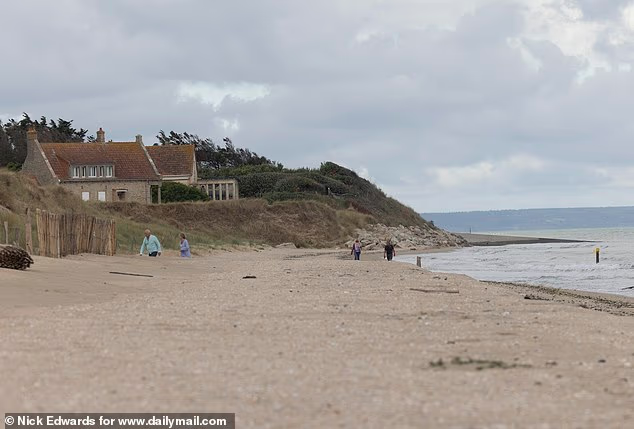
It’s a remote stretch of Channel coastline which had a role in 20th century history so fabled that it still attracts groups of tourists daily.
Utah Beach was one of the key battlefields for the tens of thousands of allied troops who braved the German machine guns to storm their way into Normandy and begin the liberation of Europe from the Nazis on the morning of 6th June, 1944 – D-Day.
This week, some 82 years and 92 days on from that legendary invasion, a reverse journey occurred which afforded an altogether less glorious glimpse of the Great Britain of today: a boat launched from Utah Beach and made its way to the same stretch of Solent coast that so many of those D-Day heroes had embarked from.
But instead of sailing into machine gun fire and exploding grenades, it arrived into the full glare of the UK’s 21st century culture wars, in which rising public indignation about the seemingly unstoppable tide of small boat migrants have tipped some into apparent mimicry of the very Nazis their great grandfathers fought so bitterly against.
At around 3.30am BST last Sunday, a so-called super dinghy, overloaded with an estimated 130 migrant passengers, embarked from the famous D-Day beach some 25 miles south east of Cherbourg, the port beloved of middle-class British holidaymakers heading to cultured Normandy or serene Brittany.
The vessel – thought to have been imported by people smugglers from China and assembled in Germany – had made it just four miles out to sea, and was still in the relative shelter of the Bay of the Seine, when it was intercepted by four French boats, marine traffic records show.
Utah Beach in Normandy is a stretch of coast that bears huge historical significance; it is where on the 6th of June 1944 tens of thousands of allied troops arrived to begin the liberation of Europe – D-Day

Some 82 years ago at 6.30am American troops from the US 4th Infantry Division began landing at Utah Beach to begin the most significant military operation of World War II

On that momentous day which changed the course of history, 20,000 US troops and 1,700 vehicles landed on Utah Beach. By the end of the first day, they had advanced four miles inland
But instead of forcing it to turn back, the French boats, as their rules of engagement insist they must, merely shadowed the 34ft inflatable’s movement for some ten hours, while alerting the UK authorities it was precariously heading their way.
Two RNLI boats were then dispatched from Bembridge and Yarmouth, the lifeboat stations on the east and west ends respectively of the Isle of Wight and, for good measure, a rescue helicopter joined them too.
Somewhere towards the midway point of the 95 mile stretch of sea between Utah Beach and the South coast of England, the RNLI boats took over escort duty from their French counterparts – and then the decision was then taken to ‘rescue’ the migrant passengers by getting them off the unstable dinghy and onto those two lifeboats.
Those not wearing one already were given lifejackets and all were helped to transfer safely.
The RNLI teams, travelling unusually slowly as their boats were so overloaded, while in contact with Border Force, then radioed ahead to seek clearance to bring them ashore. However the commercial ports of both Portsmouth and Southampton declined their request, insisting that they lacked the facilities required to process such a party.
Eventually, at around 5pm on Sunday afternoon, the migrants reached the UK coast and were brought ashore at Eastney Landing, a public slipway close to the ferry port area of Portsmouth.
But by this time news of the operation was circulating locally. And, by unhappy coincidence, Portsmouth – until now not directly involved in the small boats saga because of its sheer distances from the French coast – also happened to be the base for a new player in this arena, a hard-right protest group that styles itself ‘Patriot Platform’.
Its leader, ‘Danny Tommo’, real name Daniel Thomas, grew up in the area.
The balaclava-masked anti immigration group had just the previous day brought the port of Dover to a standstill in an intimidating ‘stop the boats’ protest. And here was a live incident on their doorstep that they could respond to rapidly.
The arriving migrants were therefore greeted with fury by protesters, some even wading into the sea for dramatic effect, in scenes of intimidation which shocked the country.
And if third choice landing point Eastney was thought the best bet in an emergency for bringing the migrants ashore, it had one distinct flaw: there is only a single road in and out which was quickly blocked.
A tense stand off then ensued which went on until the early hours of Monday morning.
It was only safe for the migrants to finally be moved out, on coaches, to begin the inevitable process of claiming asylum in Britain, almost 12 hours after they had arrived.
The group of over 100 undocumented mostly adult-male migrants had successfully completed the furthest ever recorded small boat Channel crossing.
The attempt had clearly taken both the French and the British authorities by surprise – just as, one might reflect, the D-Day landings had once surprised Hitler.
In the eight years since small boats began crossing the Channel, almost all have embarked from the area closest to mainland Britain, the stretch of coast around Calais and Dunkirk.
So why did this famous but remote beach, which is more than three times further from Britain than Calais, come to be part of the small boats saga – and will it happen again?
When the Daily Mail visited the peninsula in Normandy this week we discovered that while Sunday’s crossing may have been the first from the area it looks unlikely to be the last.
Many of those involved in Sunday’s audacious crossing are thought to have spent the days or weeks leading up to it at a camp which, like its notorious forbear in Calais, is nicknamed ‘The Jungle’.
Tucked away in a forest behind a school and sports centre in a suburb overlooking the port of Cherbourg, the encampment is some 30 miles from Utah Beach.
An Afghanistan flag hangs from a tree welcoming new arrivals while discarded shopping trolleys and a broken portable toilet cabin comprise an entrance to a clearing in which around 15 tents have been erected over wooden pallets to keep them dry from below.
Surrounding trees are hung with drying clothes. Litter is strewn across the camp, at the far end of which is a makeshift kitchen.
Clothes and other items belonging to other residents are strewn across some of the tents. There is no space to bring bags on the dinghies laid on by the gangsters so those who try to cross the Channel must leave almost everything behind – which accounts for much of the debris.

Fast forward to the early hours of Sunday morning and a rather different journey was taking place; a mega dinghy carrying 140 migrants was taking the opposite route heading for Britain

Once the 34ft long vessel had travelled roughly four miles from the beach, it was intercepted by four French boats and supported on the ten hour journey to reach Portsmouth. Anti migration protesters gathered on the south coast for their arrival – and some waded in to the water try to disrupt the arrival as migrants were brought in on RNLI boats

At 5pm on Sunday, the migrants reached the UK coast and were brought ashore at Eastney Landing, a public slipway close to the ferry port area of Portsmouth. The single road approaching the slipway was blocked by hundreds of protesters until 3am on Monday

A tense stand-off lasted for 10 hours as riot police held the activists back and the migrants waited until they could be taking to an asylum processing centre in Kent
One resident told the Daily Mail: ‘The people here change. Most move every few weeks or months.
‘They want to come to England. They only stay here for a bit and dream of the UK.’
Another said: ‘We want to be able to take the boat, leave Cherbourg and get to England. We have family on the other side’.
A third Afghan had a very specific plan – he wants to join friends in Stratford, East London. He told the Daily Mail: ‘I will come in a van. I like to drink alcohol.’
Another said he had lived in the camp for two months now while working out a crossing plan.
The Cherbourg camp has existed in one form or another for around a decade – dating back to the period before small boats when stowing away on freight vehicles was the most popular means of getting into Britain.
Because streams of lorries pass through the city and onto boats operated by Brittany Ferries which travel directly from Cherbourg to Portsmouth or Poole, it was a useful base then.
But in recent years the erection of a four metre high barrier with barbed wire across the city’s port, combined with enhanced security checks, have made it much harder to succeed this way.
Many still try, of course. Just last year a party of 16, which included a pregnant woman and several children, had to be rescued after locking themselves inside a Britain-bound refrigerated trailer in the port, after raising the alarm that they were in danger of freezing to death.
But the vast majority in recent years now opt to cross the Channel by dinghy – including an unspecified number of men thought to have embarked from here last weekend.
To get from the Jungle camp to Utah beach, the group was almost certainly shuttled to the launch point by the people smugglers, as the area behind Utah beach is practically inaccessible on foot as it’s crisscrossed by busy roads.
The party from the Normandy Jungle would have been met on Utah by other groups brought in by road from camps further east in the direction of Calais at around midnight on Saturday evening.
The appeal to people smugglers of the much longer and more dangerous Normandy-Solent route is simple: profit.
As the Daily Mail reported last month the people smuggling gangs charge around £2,000 each from desperate migrants to get them across the Channel meaning their gross income from Sunday’s boat alone would have been over £250,000.
And overheads are minimal – we found a Chinese-made vessel identical to the one used available for sale online for just £1,416.52 – while the ‘crew’ are typically one or two young men who are given a few hours of tuition and a free berth in exchange for taking command of a dinghy.
The one thing that can interrupt this money-making machine is the French police.
Because while we in Britain continue to have a perception of ineptitude – based on recurring images of gendarmes refusing to intervene when migrants are boarding boats in clearly shallow water – they have become much better at disrupting the people smugglers before they get to the water’s edge.
Under pressure from our government – who are paying £660million a year to incentivise them – the French have introduced new tactics based on sophisticated surveillance and reconnaissance operations.
These have managed to disrupt some of the regular launch sites around Calais and Dunkirk.
Supply chains have also been interrupted with boats and engines making their way through Turkey and the Balkans intercepted along with operations within the EU.
This is why new PM Andy Burnham has been able to claim that the government’s small boat strategy is ‘working’ – the overall numbers crossing have fallen since last year’s peak.
But with tens of thousands of pounds hanging in the balance for each planned operation, the cost of failure to the gangmasters because of police interception is enormous.
It’s likely therefore that the Utah Beach crossing is representative of a wider shift in tactics from migrant smugglers, who are increasingly eyeing routes further west.
When one of the new mega-dinghies set off from Dieppe, in eastern Normandy, in August, it was, at the time, the furthest west a major crossing had been recorded embarking from.
Now, less than a month later the Utah Beach boat moved that dial another 100 miles.
And French authorities are expecting even more dinghies to make the longer and hence more dangerous voyage from Normandy to England’s South Coast in the coming weeks.
A senior Interior Ministry source based in the Calais area told the Daily Mail: ‘The geographical focus of the people smugglers is definitely changing.
‘They are finding it much harder to get boats launched in the Pas de Calais, and so are moving west, across to Normandy.
‘We expect far more of the mega-dinghies to appear here in the coming weeks and months. The success on Sunday proved the voyage can be done.’
Donna Jones, Police and Crime Commissioner for Hampshire and the Isle of Wight, agreed that the success of last weekend’s crossing raises concerns that the Normandy to Portsmouth route could become a ‘destination of choice for people traffickers’.
A spokesman for France’s Maritime Prefecture also admitted that because the shortest point of travel to England, towards Dover from Calais was becoming less viable, ‘unusual routes,’ including ones from Normandy, were likely to be attempted.
Despite no casualties on the Sunday crossing, it is a highly dangerous route, passing through the Raz Blanchard or Alderney Race, a strait that runs between Alderney and Cap de la Hague which sees some of Europe’s strongest currents.
Outside the town of Ouistreham, a quaint seaside town, east of Cherbourg towards Le Havre. lies an encampment made up mostly of Sudanese men next to the canal.
Eight tents, table-top football, portable toilets, cooking equipment and chairs, serve as home to around 20 men.

This week, the Daily Mail visited Normandy and found the migrant encampment closest to Utah beach – near Cherbourg 30 miles away. Tucked away in a forest behind a school and sports centre an Afghanistan flag hands above a makeshift tent

This area has been unofficially named, like its notorious forbear in Calais, ‘The Jungle’ by local residents. Many of those involved in Sunday’s audacious crossing are thought to have spent the days or weeks leading up to it at the camp

The camp near Cherbourg has been here for around ten years and people stay for a short period of time as they plan their next move, with many aiming to reach the UK

Outside the town of Ouistreham, a quaint seaside town, east of Cherbourg towards Le Havre. lies an encampment made up mostly of Sudanese men next to the canal

In Ouistreham, eight tents, table-top football, portable toilets, cooking equipment and chairs, serve as home to around 20 men working out their next move
Again the camp used to be popular with those hoping to stowaway in lorries. But now that method has been largely shut down the current inhabitants are hoping to cross by boat.
One resident said he travelled to Ouistreham from Calais to rest after breaking his pelvis while trying to board a truck heading towards England.
Now he is considering his options. He told us most residents are trying to get to Britain.
Just a 15 minute walk away from the camp, Union flags flutter in the wind on Sword Beach, one of the sites where British soldiers landed on D-Day.
Meanwhile, on Utah Beach itself, there is almost no trace of last week’s operation. A discarded toothbrush, tablets and a piece of jewellery was all that remained on the beach from the spot, known locally as Redoubt Breach, from which they left.
A local dog walker told us they have not seen a single police officer in the vicinity of Utah Beach in 30 years.
This may soon change.

















































You must be logged in to post a comment Login