Connect with us

NewsBeat

The remote French beach where allied troops began the liberation of Europe in D-Day landings now being used as a mega dinghy launch pad bringing migrants to Britain

Published

on

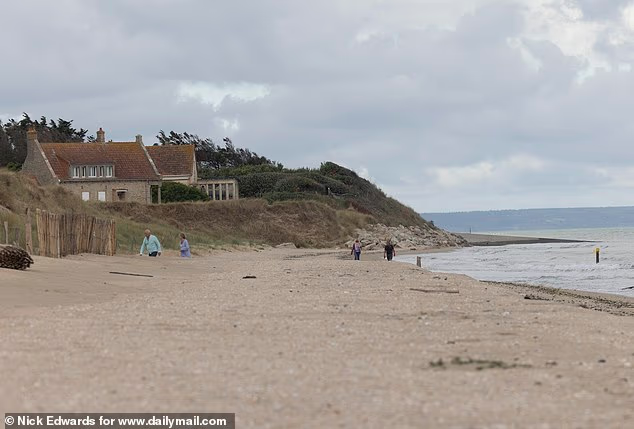
Utah Beach in Normandy is a stretch of coast that bears huge historical significance; it is where on the 6th of June 1944 tens of thousands of allied troops arrived to begin the liberation of Europe - D-Day

It’s a remote stretch of Channel coastline which had a role in 20th century history so fabled that it still attracts groups of tourists daily.

Utah Beach was one of the key battlefields for the tens of thousands of allied troops who braved the German machine guns to storm their way into Normandy and begin the liberation of Europe from the Nazis on the morning of 6th June, 1944 – D-Day.

This week, some 82 years and 92 days on from that legendary invasion, a reverse journey occurred which afforded an altogether less glorious glimpse of the Great Britain of today: a boat launched from Utah Beach and made its way to the same stretch of Solent coast that so many of those D-Day heroes had embarked from.

But instead of sailing into machine gun fire and exploding grenades, it arrived into the full glare of the UK’s 21st century culture wars, in which rising public indignation about the seemingly unstoppable tide of small boat migrants have tipped some into apparent mimicry of the very Nazis their great grandfathers fought so bitterly against.

Advertisement

At around 3.30am BST last Sunday, a so-called super dinghy, overloaded with an estimated 130 migrant passengers, embarked from the famous D-Day beach some 25 miles south east of Cherbourg, the port beloved of middle-class British holidaymakers heading to cultured Normandy or serene Brittany.

The vessel – thought to have been imported by people smugglers from China and assembled in Germany – had made it just four miles out to sea, and was still in the relative shelter of the Bay of the Seine, when it was intercepted by four French boats, marine traffic records show.

Utah Beach in Normandy is a stretch of coast that bears huge historical significance; it is where on the 6th of June 1944 tens of thousands of allied troops arrived to begin the liberation of Europe – D-Day 

Advertisement
Some 82 years ago at 6.30am American troops from the US 4th Infantry Division began landing at Utah Beach to begin the most significant military operation of World War II

Some 82 years ago at 6.30am American troops from the US 4th Infantry Division began landing at Utah Beach to begin the most significant military operation of World War II

On that momentous day which changed the course of history, 20,000 US troops and 1,700 vehicles landed on Utah Beach. By the end of the first day, they had advanced four miles inland

On that momentous day which changed the course of history, 20,000 US troops and 1,700 vehicles landed on Utah Beach. By the end of the first day, they had advanced four miles inland

But instead of forcing it to turn back, the French boats, as their rules of engagement insist they must, merely shadowed the 34ft inflatable’s movement for some ten hours, while alerting the UK authorities it was precariously heading their way.

Two RNLI boats were then dispatched from Bembridge and Yarmouth, the lifeboat stations on the east and west ends respectively of the Isle of Wight and, for good measure, a rescue helicopter joined them too.

Advertisement

Somewhere towards the midway point of the 95 mile stretch of sea between Utah Beach and the South coast of England, the RNLI boats took over escort duty from their French counterparts – and then the decision was then taken to ‘rescue’ the migrant passengers by getting them off the unstable dinghy and onto those two lifeboats.

Those not wearing one already were given lifejackets and all were helped to transfer safely.

The RNLI teams, travelling unusually slowly as their boats were so overloaded, while in contact with Border Force, then radioed ahead to seek clearance to bring them ashore. However the commercial ports of both Portsmouth and Southampton declined their request, insisting that they lacked the facilities required to process such a party.

Eventually, at around 5pm on Sunday afternoon, the migrants reached the UK coast and were brought ashore at Eastney Landing, a public slipway close to the ferry port area of Portsmouth.

Advertisement

But by this time news of the operation was circulating locally. And, by unhappy coincidence, Portsmouth – until now not directly involved in the small boats saga because of its sheer distances from the French coast – also happened to be the base for a new player in this arena, a hard-right protest group that styles itself ‘Patriot Platform’.

Its leader, ‘Danny Tommo’, real name Daniel Thomas, grew up in the area.

The balaclava-masked anti immigration group had just the previous day brought the port of Dover to a standstill in an intimidating ‘stop the boats’ protest. And here was a live incident on their doorstep that they could respond to rapidly.

The arriving migrants were therefore greeted with fury by protesters, some even wading into the sea for dramatic effect, in scenes of intimidation which shocked the country.

Advertisement

And if third choice landing point Eastney was thought the best bet in an emergency for bringing the migrants ashore, it had one distinct flaw: there is only a single road in and out which was quickly blocked.

A tense stand off then ensued which went on until the early hours of Monday morning.

It was only safe for the migrants to finally be moved out, on coaches, to begin the inevitable process of claiming asylum in Britain, almost 12 hours after they had arrived.

The group of over 100 undocumented mostly adult-male migrants had successfully completed the furthest ever recorded small boat Channel crossing.

Advertisement

The attempt had clearly taken both the French and the British authorities by surprise – just as, one might reflect, the D-Day landings had once surprised Hitler.

In the eight years since small boats began crossing the Channel, almost all have embarked from the area closest to mainland Britain, the stretch of coast around Calais and Dunkirk.

So why did this famous but remote beach, which is more than three times further from Britain than Calais, come to be part of the small boats saga – and will it happen again?

When the Daily Mail visited the peninsula in Normandy this week we discovered that while Sunday’s crossing may have been the first from the area it looks unlikely to be the last.

Advertisement

Many of those involved in Sunday’s audacious crossing are thought to have spent the days or weeks leading up to it at a camp which, like its notorious forbear in Calais, is nicknamed ‘The Jungle’.

Tucked away in a forest behind a school and sports centre in a suburb overlooking the port of Cherbourg, the encampment is some 30 miles from Utah Beach.

An Afghanistan flag hangs from a tree welcoming new arrivals while discarded shopping trolleys and a broken portable toilet cabin comprise an entrance to a clearing in which around 15 tents have been erected over wooden pallets to keep them dry from below.

Surrounding trees are hung with drying clothes. Litter is strewn across the camp, at the far end of which is a makeshift kitchen.

Advertisement

Clothes and other items belonging to other residents are strewn across some of the tents. There is no space to bring bags on the dinghies laid on by the gangsters so those who try to cross the Channel must leave almost everything behind – which accounts for much of the debris.

Fast forward to the early hours of Sunday morning and a rather different journey was taking place; a mega dinghy carrying 140 migrants was taking the opposite route heading for Britain

Fast forward to the early hours of Sunday morning and a rather different journey was taking place; a mega dinghy carrying 140 migrants was taking the opposite route heading for Britain

Once the 34ft long vessel had travelled roughly four miles from the beach, it was intercepted by four French boats and supported on the ten hour journey to reach Portsmouth. Anti migration protesters gathered on the south coast for their arrival - and some waded in to the water try to disrupt the arrival as migrants were brought in on RNLI boats

Once the 34ft long vessel had travelled roughly four miles from the beach, it was intercepted by four French boats and supported on the ten hour journey to reach Portsmouth. Anti migration protesters gathered on the south coast for their arrival – and some waded in to the water try to disrupt the arrival as migrants were brought in on RNLI boats

At 5pm on Sunday, the migrants reached the UK coast and were brought ashore at Eastney Landing, a public slipway close to the ferry port area of Portsmouth. The single road approaching the slipway was blocked by hundreds of protesters until 3am on Monday

At 5pm on Sunday, the migrants reached the UK coast and were brought ashore at Eastney Landing, a public slipway close to the ferry port area of Portsmouth. The single road approaching the slipway was blocked by hundreds of protesters until 3am on Monday

Advertisement
A tense stand-off lasted for 10 hours as riot police held the activists back and the migrants waited until they could be taking to an asylum processing centre in Kent

A tense stand-off lasted for 10 hours as riot police held the activists back and the migrants waited until they could be taking to an asylum processing centre in Kent 

One resident told the Daily Mail: ‘The people here change. Most move every few weeks or months.

‘They want to come to England. They only stay here for a bit and dream of the UK.’

Another said: ‘We want to be able to take the boat, leave Cherbourg and get to England. We have family on the other side’.

Advertisement

A third Afghan had a very specific plan – he wants to join friends in Stratford, East London. He told the Daily Mail: ‘I will come in a van. I like to drink alcohol.’

Another said he had lived in the camp for two months now while working out a crossing plan.

The Cherbourg camp has existed in one form or another for around a decade – dating back to the period before small boats when stowing away on freight vehicles was the most popular means of getting into Britain.

Because streams of lorries pass through the city and onto boats operated by Brittany Ferries which travel directly from Cherbourg to Portsmouth or Poole, it was a useful base then.

Advertisement

But in recent years the erection of a four metre high barrier with barbed wire across the city’s port, combined with enhanced security checks, have made it much harder to succeed this way.

Many still try, of course. Just last year a party of 16, which included a pregnant woman and several children, had to be rescued after locking themselves inside a Britain-bound refrigerated trailer in the port, after raising the alarm that they were in danger of freezing to death.

But the vast majority in recent years now opt to cross the Channel by dinghy – including an unspecified number of men thought to have embarked from here last weekend.

To get from the Jungle camp to Utah beach, the group was almost certainly shuttled to the launch point by the people smugglers, as the area behind Utah beach is practically inaccessible on foot as it’s crisscrossed by busy roads.

Advertisement

The party from the Normandy Jungle would have been met on Utah by other groups brought in by road from camps further east in the direction of Calais at around midnight on Saturday evening.

The appeal to people smugglers of the much longer and more dangerous Normandy-Solent route is simple: profit.

As the Daily Mail reported last month the people smuggling gangs charge around £2,000 each from desperate migrants to get them across the Channel meaning their gross income from Sunday’s boat alone would have been over £250,000.

And overheads are minimal – we found a Chinese-made vessel identical to the one used available for sale online for just £1,416.52 – while the ‘crew’ are typically one or two young men who are given a few hours of tuition and a free berth in exchange for taking command of a dinghy.

Advertisement

The one thing that can interrupt this money-making machine is the French police.

Because while we in Britain continue to have a perception of ineptitude – based on recurring images of gendarmes refusing to intervene when migrants are boarding boats in clearly shallow water – they have become much better at disrupting the people smugglers before they get to the water’s edge.

Under pressure from our government – who are paying £660million a year to incentivise them – the French have introduced new tactics based on sophisticated surveillance and reconnaissance operations.

These have managed to disrupt some of the regular launch sites around Calais and Dunkirk.

Advertisement

Supply chains have also been interrupted with boats and engines making their way through Turkey and the Balkans intercepted along with operations within the EU.

This is why new PM Andy Burnham has been able to claim that the government’s small boat strategy is ‘working’ – the overall numbers crossing have fallen since last year’s peak.

But with tens of thousands of pounds hanging in the balance for each planned operation, the cost of failure to the gangmasters because of police interception is enormous.

It’s likely therefore that the Utah Beach crossing is representative of a wider shift in tactics from migrant smugglers, who are increasingly eyeing routes further west.

Advertisement

When one of the new mega-dinghies set off from Dieppe, in eastern Normandy, in August, it was, at the time, the furthest west a major crossing had been recorded embarking from.

Now, less than a month later the Utah Beach boat moved that dial another 100 miles.

And French authorities are expecting even more dinghies to make the longer and hence more dangerous voyage from Normandy to England’s South Coast in the coming weeks.

A senior Interior Ministry source based in the Calais area told the Daily Mail: ‘The geographical focus of the people smugglers is definitely changing.

Advertisement

‘They are finding it much harder to get boats launched in the Pas de Calais, and so are moving west, across to Normandy.

‘We expect far more of the mega-dinghies to appear here in the coming weeks and months. The success on Sunday proved the voyage can be done.’

Donna Jones, Police and Crime Commissioner for Hampshire and the Isle of Wight, agreed that the success of last weekend’s crossing raises concerns that the Normandy to Portsmouth route could become a ‘destination of choice for people traffickers’.

A spokesman for France’s Maritime Prefecture also admitted that because the shortest point of travel to England, towards Dover from Calais was becoming less viable, ‘unusual routes,’ including ones from Normandy, were likely to be attempted.

Advertisement

Despite no casualties on the Sunday crossing, it is a highly dangerous route, passing through the Raz Blanchard or Alderney Race, a strait that runs between Alderney and Cap de la Hague which sees some of Europe’s strongest currents.

Outside the town of Ouistreham, a quaint seaside town, east of Cherbourg towards Le Havre. lies an encampment made up mostly of Sudanese men next to the canal.

Eight tents, table-top football, portable toilets, cooking equipment and chairs, serve as home to around 20 men. 

This week, the Daily Mail visited Normandy and found the migrant encampment closest to Utah beach - near Cherbourg 30 miles away. Tucked away in a forest behind a school and sports centre an Afghanistan flag hands above a makeshift tent

This week, the Daily Mail visited Normandy and found the migrant encampment closest to Utah beach – near Cherbourg 30 miles away. Tucked away in a forest behind a school and sports centre an Afghanistan flag hands above a makeshift tent

Advertisement
This area has been unofficially named, like its notorious forbear in Calais, 'The Jungle' by local residents. Many of those involved in Sunday's audacious crossing are thought to have spent the days or weeks leading up to it at the camp

This area has been unofficially named, like its notorious forbear in Calais, ‘The Jungle’ by local residents. Many of those involved in Sunday’s audacious crossing are thought to have spent the days or weeks leading up to it at the camp

The camp near Cherbourg has been here for around ten years and people stay for a short period of time as they plan their next move, with many aiming to reach the UK

The camp near Cherbourg has been here for around ten years and people stay for a short period of time as they plan their next move, with many aiming to reach the UK 

Outside the town of Ouistreham, a quaint seaside town, east of Cherbourg towards Le Havre. lies an encampment made up mostly of Sudanese men next to the canal

Outside the town of Ouistreham, a quaint seaside town, east of Cherbourg towards Le Havre. lies an encampment made up mostly of Sudanese men next to the canal

In Ouistreham, eight tents, table-top football, portable toilets, cooking equipment and chairs, serve as home to around 20 men working out their next move

In Ouistreham, eight tents, table-top football, portable toilets, cooking equipment and chairs, serve as home to around 20 men working out their next move 

Advertisement

Again the camp used to be popular with those hoping to stowaway in lorries. But now that method has been largely shut down the current inhabitants are hoping to cross by boat.

One resident said he travelled to Ouistreham from Calais to rest after breaking his pelvis while trying to board a truck heading towards England.

Now he is considering his options. He told us most residents are trying to get to Britain.

Just a 15 minute walk away from the camp, Union flags flutter in the wind on Sword Beach, one of the sites where British soldiers landed on D-Day.

Advertisement

Meanwhile, on Utah Beach itself, there is almost no trace of last week’s operation. A discarded toothbrush, tablets and a piece of jewellery was all that remained on the beach from the spot, known locally as Redoubt Breach, from which they left.

A local dog walker told us they have not seen a single police officer in the vicinity of Utah Beach in 30 years.

This may soon change.

Source link

Advertisement
Continue Reading
Click to comment

You must be logged in to post a comment Login

Leave a Reply

NewsBeat

Joseph Nguthiru: Turning the world’s most invasive plant into bioplastic

Published

on

Joseph Nguthiru: Turning the world’s most invasive plant into bioplastic

While he was on a university field trip in 2022, the boat in which Joseph Nguthiru was traversing Kenya’s Lake Naivasha suddenly came to a halt. It became tangled up in water hyacinth, an invasive plant that covers much of the water. Here, he and his fellow classmates in the boat were forced to sit for five long hours.

The hyacinth, which has been a problem in Kenya since the late 1980s, floats on the top of water, like a thick carpet and it can double in size in just a few days. It blocks oxygen from getting into the water, effectively making the area beneath it barren, killing aquatic life.

To win tickets to see Bel Trew’s latest compelling documentary click here

In some places, the hyacinth is so thick, engines need to be turned off and a long pole is used to pull boats through it.

Advertisement

Joseph, aged 28, says everyone in Kenya knows about the phenomenon, but it wasn’t until this trip that he’d “experienced the pain behind the people who face it every day”. The weeds mean it’s becoming almost impossible to fish here, which was a thriving industry and an important food source for local communities.

Joseph describes that day as a “crazy experience” but it left him thinking there must be a way to use this invasive plant, and help unclog the vital waterways.

People see the rubbish, but they don’t even have the time to think or to do anything about it. People have bigger problems to solve where I come from

Inspired, Joseph took some of the water hyacinth back to Egerton University, where he was studying civil engineering, and specialised in water and environmental engineering. He decided to base his final-year project on finding a solution for it. It took plenty of trial and error, but he turned it into a bioplastic, which was something the country needed after banning single-use plastic in 2017, and the project was a success.

Advertisement

Joseph went on to form HyaPak, a startup turning the invasive water hyacinth into biodegradable packaging. His work earned him the East Africa Youth for Climate Action Award, and he was named a Young Champion of the Earth, as part of the United Nations Environmental Programme. He’s also become a leader at the Obama Foundation, and was made a Presidential Awardee for Best Innovator in Kenya and included on the Africa 40 Under 40 list.

It wasn’t only that day on the lake that inspired him, though. He grew up in the Eastlands side of Nairobi, where he says, “one of the things you’re constantly exposed to is pollution, as there’s a lot of trash lying around”. Here, people have different problems, from paying rent and getting children into education, so pollution is a secondary problem. “You see it, but you don’t even have the time to think or to do anything about it. People have bigger problems to solve where I come from.”

And Joseph is aware that plenty of human-made waste ends up in the water. “The thing about humans is that we are really good at pollution, especially making trash go into water. So chemical waste, agricultural runoff, and even urban waste, some way or another, ends up in water bodies, and hyacinth derives from this.”

Advertisement

Anywhere you see water hyacinth, the water is polluted

The lake is also on the edge of one of Kenya’s biggest rose farming areas and it’s thought chemicals from the farms end up in the river, though they have started using closed-loop water systems which helps prevent this.

Water hyacinth is an indicator of those pollution problems. “Anywhere you see hyacinth, the water is polluted,” he says.

It’s technically easy to remove, as it just floats on water, but the issue is that after removing it, 6-12 days later, it will have grown back. “It’s one of the world’s fastest-growing plants,” Joseph says, explaining that the issue is they have to keep on removing it over and over again.

So far, HyaPak has removed about 20 acres (eight hectares) of water hyacinth, according to its last annual figures at the end of 2025. Though its regrowth speed makes it hard to calculate accurately.

Advertisement

For this reason, Joseph doesn’t like to think of HyaPak as “removing” the weeds, as it gives the impression it’s being eliminated and won’t come back. But that’s almost impossible to do, given the speed it grows. Instead, he prefers to look at it as managing it. “We need to utilise it for something that has a value and a benefit to the people and communities that you’re working with,” he says.

Aged just 28, Nguthiru has already been recognised by some of the world’s leading awards for his enviromental work
Aged just 28, Nguthiru has already been recognised by some of the world’s leading awards for his enviromental work (HyaPak)

It’s a bad problem fundamentally, but for Joseph, turning it on its head, he’s able to see how removing the weeds and replacing bioplastics feed each other. Finding a commercial use for this fast-growing weed also helps create what he calls “green jobs” – something that actually facilitates the world’s transition into a circular economy.

“We work with the fishing community and they collect the water hyacinth for us,” he explains, which both men and women do. For many of the people living here, they’re below the World Bank’s poverty line. By being able to add an extra source of revenue to the community, Joseph thinks this is “the best way to go about any social innovation”, plus it gives hope and dignity to people.

Once harvested, the weeds are dried on the side of the lake, then sent to HyaPak’s facility in Nairobi. They’re then crushed into a fine powder, the cellulose is extracted and is used to make different types of packaging materials. These include courier packages where HyaPak is working with one of the world’s largest courier companies to transition their packaging away from plastic, and liners for boxes, which help keep food fresher for 2-3 days longer without the need for cold storage.

But one of the biggest uses is more unexpected. In 2022, Kenya launched Jaza Miti, a huge tree-planting target, set by the president, Wiliam Ruto, to plant 15 billion trees over 10 years.

Advertisement

“It’s a crazy target,” Joseph says, breaking it down to meaning 4.1 millions trees would need to be planted each day. But it’s a target he admires. “If you’re planting 15 billion trees, you need 15 billion packaging bags for those trees. Overnight, there was huge demand [for bioplastic replacements] that didn’t exist before,” he says. Now HyaPak makes bioplastic alternatives that cover the root system of seedling trees before they’re planted, and then decompose directly into the soil. Of course, HyaPak’s unable to meet such huge targets, but it is scaling up to work towards the demand of the seedling bags.

Joseph’s plan now is to also try to scale the business in other countries suffering from the same invasive species, such as El Salvador, India, South Africa and then onto Mexico and Nigeria. It’s largely been made possible to imagine after winning the UN’s Young Champion of the Earth award, which really took HyaPak to the world stage.

As well as HyaPak, Joseph’s also co-founded M-SITU, which uses solar-powered artificial intelligence sensors to detect deforestation, wildfires and illegal charcoal burning. He created a small water-bottle-size detector, using 3D printing, that scans a radius up to 1km around it looking for illegal loggers or wildfires, so it can alert rangers. A pilot scheme in Kenya’s Ngong Forest cut ranger response times from six hours to 15 minutes.

All from one day getting stuck on a boat in a mass of invasive weeds, Joseph has turned a problem into a resource – and, in doing so, found a way to make the very thing clogging Kenya’s waterways part of the solution, providing value and jobs along the way.

Advertisement

The Independent will be revealing its 2026 Climate 100 List on 20 September

Source link

Continue Reading

NewsBeat

Dad, 35, ‘shot dead’ in West Lothian pictured as cops hunt attacker

Published

on

Daily Mirror

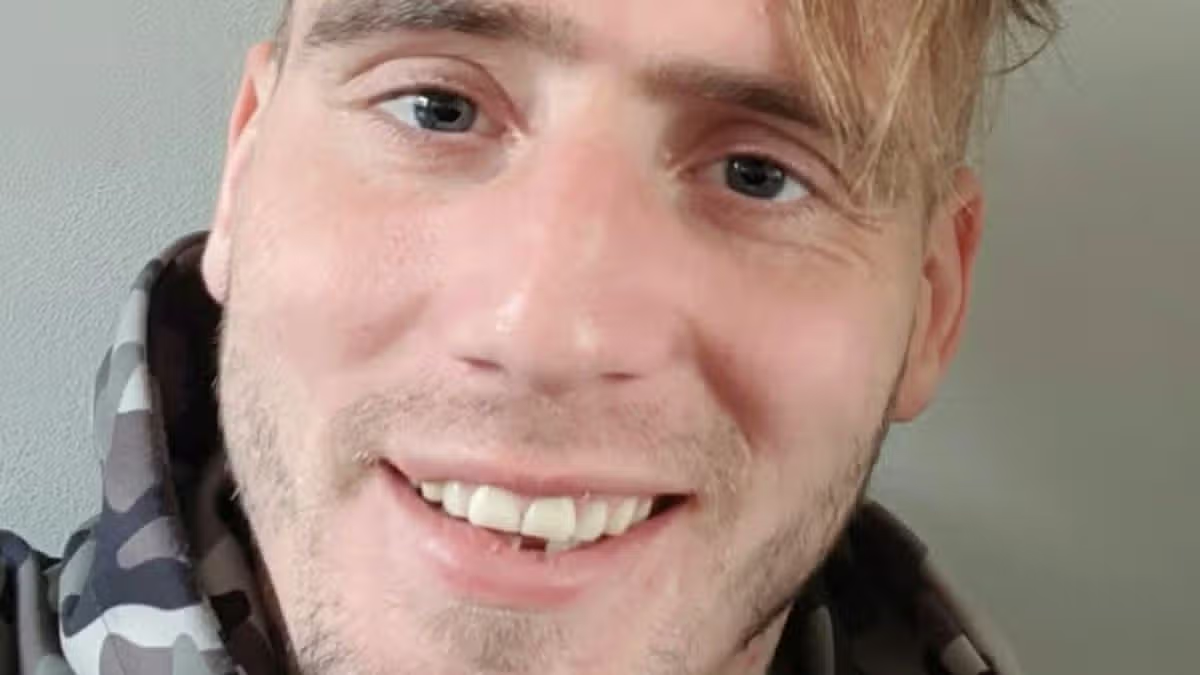
Billy Watson has been named locally as the 35-year-old man who was shot dead at a property on Harestanes Road in Armadale, with a police investigation underway

A dad who was killed in a suspected shooting in West Lothian has been named locally.

Advertisement

Billy Watson, 35, died at the scene after he was injured at a property on Harestanes Road in Armadale on Saturday.

Emergency services descended on the town shortly before midday after police received a report of a man injured at the property around 11.50am.

Billy, who was a dad, was pronounced dead at the scene and his next of kin has been informed and a major investigation is underway by police into what happened.

Detectives have said a line of inquiry is that a firearm may have been involved in the incident. A post-mortem examination will take place in due course and enquiries remain at an early stage.

Forensic officers and detectives have continued to work at the scene, examining property and taking photos, with a police cordon in place on the residential street, reported the Daily Record.

The area was also the focus of a major emergency service response, with an air ambulance deployed from Glasgow and tracked travelling towards Armadale before returning to the city.

People have taken to social media to express their sadness with one person writing on social media: “So sad my condolences to the family,” while another similarly wrote: “Condolences to the family cant imagine what they must be going through.”

Advertisement

Meanwhile, the Scottish Fire and Rescue Service confirmed they received a report of a vehicle set ablaze on Northrigg, a rural road leading to a nearby farm behind the scheme in question. The fire was put out by crews and there were no reports of injuries.

Police said enquiries are ongoing to establish the full circumstances of both incidents. Officers are keeping an open mind but are investigating them as linked, reported the

Detective Superintendent Michelle Findlay, of the Major Investigations Team, said: “Our thoughts are with the family of the man who has died in this incident.

Advertisement

“Officers remain in the area and anyone with concerns or any information can approach them or call us on 101, quoting incident number 1361 of Saturday, 12 September, 2026.”

Pauline Stafford MSP for Bathgate, said she is “deeply concerned” about the incident, adding: “My thoughts are with the family and all of those affected. While investigations are at an early stage I would encourage anyone with information to share it with the Police.”

The statement from Police Scotland read: “Around 11.50am on Saturday, 12 September, Police Scotland received a report of a man injured at an address on Harestanes Road in Armadale.

“Emergency services attended and the 35-year-old was pronounced dead at the scene. His next of kin is aware. Enquiries are at an early stage and a post-mortem will take place in due course. However, a line of enquiry is that a firearm may have been involved in the incident.

Advertisement

“Around 12pm on Saturday, 12 September, officers received a report of a car on fire nearby in the Netherhouses area, near to Armadale. The fire was put out by the Scottish Fire and Rescue Services and there were no reports of injuries. “Enquiries are ongoing to establish the full circumstances of both incidents. Officers are keeping an open mind but they are being investigated as linked.”

Source link

Continue Reading

NewsBeat

Person dies during service at Fife church as emergency services race to scene

Published

on

Daily Record

A member of the congregation died after suffering a serious medical emergency during a service at Holy Trinity Church in Dunfermline on Sunday morning.

A person has died at a church in Fife after suffering a medical emergency during a service this morning.

Advertisement

Holy Trinity Dunfermline confirmed that a member of its congregation became seriously unwell during the Sunday morning service, which starts at 11am.

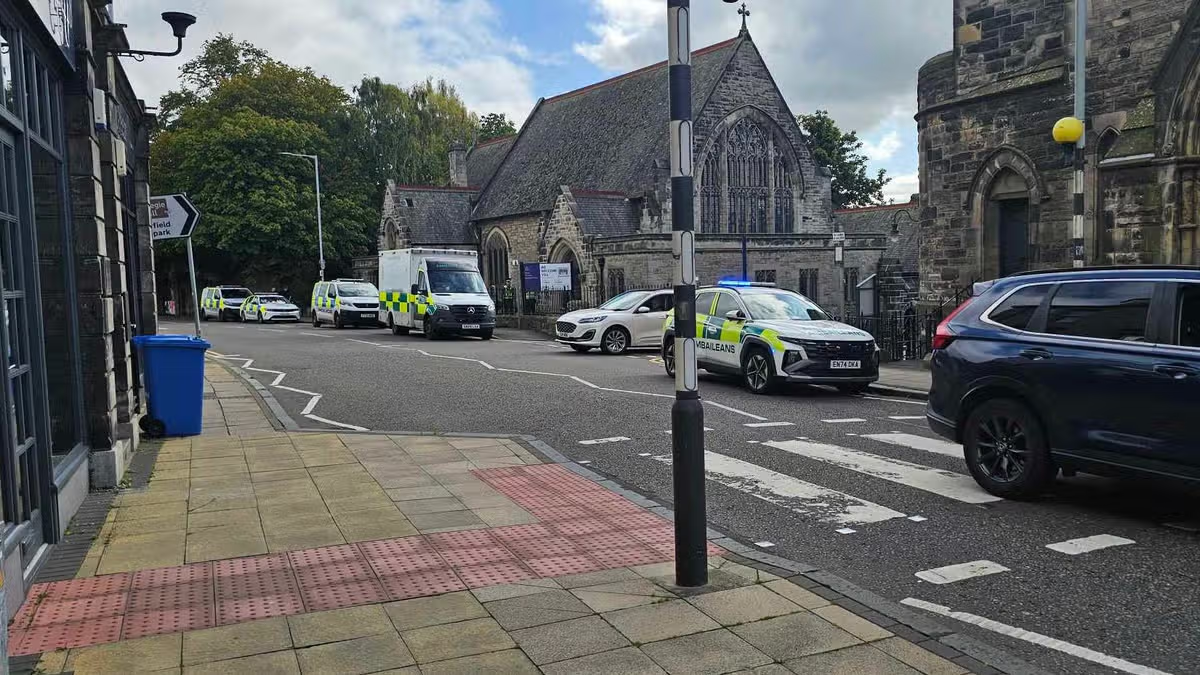
Despite the “swift arrival and intervention” of paramedics, the person sadly died. A picture from East Port shows three police vehicles and two ambulances outside the Scottish Episcopal Church.

The church service was cancelled following the incident.

In a post on social media, the church said: “As people may have seen from speculation and pictures already circulating on social media, and from the sudden cancellation of our service this morning, unfortunately a member of our congregation this morning suffered a serious medical emergency, and subsequently passed away, despite the swift arrival and intervention from paramedics.”

Advertisement

They thanked the multiple paramedic teams and police officers who attended, as well as members of the congregation who helped before emergency crews arrived and supported those involved.

The church added: “We would ask for prayers for all of those involved, and particularly the family and friends of the person who has passed away. May they rest in peace and rise in glory.”

Police Scotland have been contacted for further information.

Get more Daily Record exclusives by signing up for free to Google’s preferred sources. Click HERE.

Source link

Advertisement
Continue Reading

NewsBeat

Police release pictures of six men they want to speak to after violent anti-immigration protest in Portsmouth

Published

on

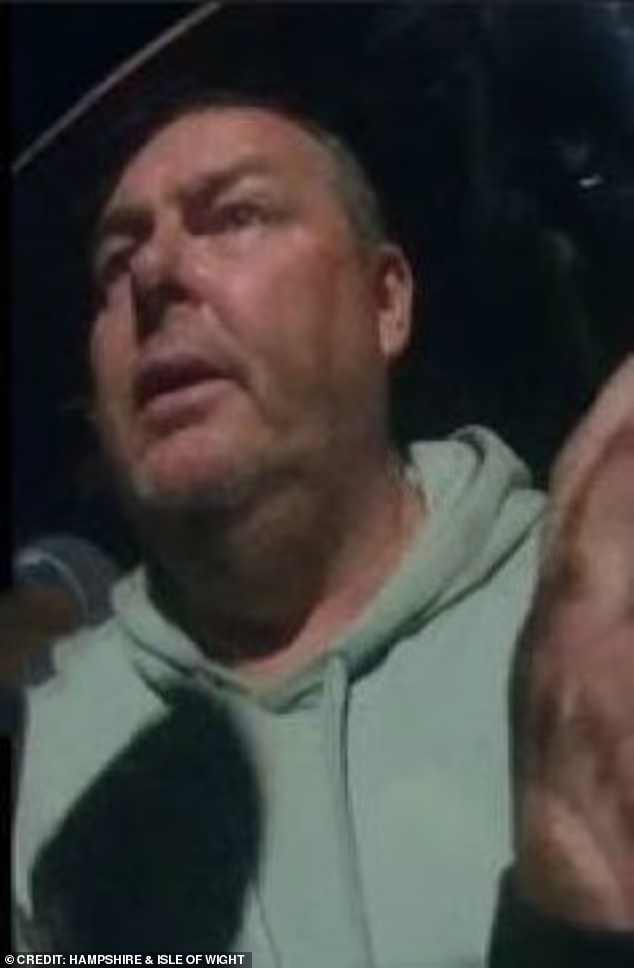
Police have released images of six men they want to speak to after the anti-immigration protest in Portsmouth last weekend. Pictured is one of the men

Police have released images of six men they want to speak to after the violent anti-immigration protest in Portsmouth last weekend. 

Overnight last Sunday, around 200 people gathered at Eastney Marina after a dinghy crossed the English Channel before dispersing early on Monday.

Seven police officers were injured and treated at the scene, while Coastguard and Border Force vehicles were damaged, Hampshire and Isle of Wight Constabulary said.

The force has reviewed ‘hundreds of hours’ worth’ of footage and has shared images of six men ‘who can assist our investigation’, the force said. 

Advertisement

The first man charged over last week’s demonstration in the city appeared in court on Saturday morning.

Del Leon Somerville, 42, of Paulsgrove, appeared before Portsmouth Magistrates’ Court charged with violent disorder and assaulting a police constable in the execution of their duty.

On Saturday afternoon, anti-immigration protesters took to the streets of Portsmouth again, facing off with anti-racism demonstrators.

A 16-year-old boy, from Waterlooville, was arrested on suspicion of violent disorder in relation to scenes last week and has been released on bail until December 12.

Advertisement

Police have released images of six men they want to speak to after the anti-immigration protest in Portsmouth last weekend. Pictured is one of the men

Around 200 people gathered at Eastney Marina after a dinghy crossed the English Channel

Around 200 people gathered at Eastney Marina after a dinghy crossed the English Channel

The force has reviewed 'hundreds of hours' worth' of footage and has shared images of six men 'who can assist our investigation', the force said

The force has reviewed ‘hundreds of hours’ worth’ of footage and has shared images of six men ‘who can assist our investigation’, the force said

Advertisement

Assistant Chief Constable Tony Rowlinson said: ‘We have been consistently clear that violence and criminal damage have no part in peaceful protest and we will investigate incidents like this thoroughly and take robust action against those responsible.

‘Clearly events on Sunday evening were not peaceful protest, rather violent public disorder, and this will not be tolerated as we work to keep our wider communities in Hampshire and on the Isle of Wight safe.’

He urged anyone who recognises the men to call 101 or make a report online quoting reference 44260435943.

‘The reality of public order policing is that arrests at the time are not always possible, especially where evidence may need to be reviewed to clearly identify who is responsible for offences,’ Mr Rowlinson said.

Advertisement

‘During the disorder seven police officers were injured and treated at the scene, thankfully no-one was seriously injured.

‘Our officers did not deserve to be assaulted as they worked incredibly diligently on Sunday to ensure the safety of everyone in the area.

‘Neither do they, or anyone from our partner agencies, deserve to be singled out online or subjected to abuse via social media.

‘We will work with our colleagues across policing to address any online threats that are made.

Advertisement
Hundreds of protestors clashed with police near Eastney beach in Portsmouth last weekend after a dinghy carrying 140 asylum seekers was escorted to the shore

Hundreds of protestors clashed with police near Eastney beach in Portsmouth last weekend after a dinghy carrying 140 asylum seekers was escorted to the shore

Police have urged anyone who recognises the men to call 101 or make a report online quoting reference 44260435943

Police have urged anyone who recognises the men to call 101 or make a report online quoting reference 44260435943

Dozens of anti-migrant protesters waded into the sea to confront 140 asylum seekers rescued from a packed mega-dinghy

Dozens of anti-migrant protesters waded into the sea to confront 140 asylum seekers rescued from a packed mega-dinghy

The demonstrators were dispersed by riot police at 3am and footage posted online showed migrants being taken off lifeboats to shore

The demonstrators were dispersed by riot police at 3am and footage posted online showed migrants being taken off lifeboats to shore 

Advertisement

‘The actions we have been taking as part of our investigation send a clear warning to anyone intent on causing disruption and disorder at any future events.

‘If you break the law we will take action against you and where it is feasible to do so seek a prosecution.’

Dozens of anti-migrant protesters waded into the sea to confront 140 asylum seekers rescued from a packed mega-dinghy.

A large group ran across the beach in Portsmouth and into the water, chanting ‘stop the boats’ and ‘enough is enough’ as a Coastguard vessel prepared to bring them ashore.

Advertisement

The demonstrators were dispersed by riot police at 3am and footage posted online showed migrants being taken off lifeboats to shore, where they were met by several buses which took them to a processing centre in Kent.

The incident was the flashpoint which triggered around 500 demonstrators to block the road to try to stop the coaches leaving Portsmouth. 

Some got into cars and followed the buses on their journey to the Manston facility in Kent.

It is the second major anti-migrant protest after hundreds of men wearing balaclavas blockaded the Port of Dover last Saturday.

Advertisement

The mega-dinghy had set off from the Baie de Seine in Normandy – a 180-mile drive south-west of Calais – suggesting people smugglers are expanding their launch points along the French coast to evade enforcement efforts.

But rather than intervene, the French coastguard shadowed the vessel for ten hours, claiming it was too dangerous because of the number of people on board.

British lifeboats, supported by a helicopter and a plane, then took over and brought the migrants to the UK.

Following calls to action on social media, protesters flocked to the coast and spent at least five hours on Eastney beach and in the water before police threatened arrests after a dispersal order was imposed.

Advertisement

Around 2,000 protesters descended on Portsmouth again on Saturday, September 12 following the arrival of a small boat of migrants in the city last weekend.

Police had banned face coverings for the event after masked men blocked roads in Dover, also in protest against immigration.

Three arrests were made, including one protester, 76-year-old Timothy Miller from Southampton who was caught covering his face in violation of the order and is due to appear at Portsmouth Magistrates Court on Monday.

Yesterday, a spokesman for Hampshire and Isle of Wight Constabulary said: ‘Three arrests were made at today’s protests.

Advertisement

‘A 76-year-old man from Southampton has been arrested on suspicion of wearing/using an item to conceal identity at a protest.

‘A 33-year-old man from Portsmouth was arrested on suspicion of obstructing a highway and criminal damage.

‘A 16-year-old male from (Waterlooville) was arrested on suspicion of violent disorder, in relation to violent public disorder at Eastney Marina on Sunday September 6.’

Today, a spokesman further clarified: ‘Timothy Justin Miller, 76, of Sherwood Avenue in Hedge End, Southampton, has been charged with wearing/using an item to conceal identity at a protest. He is due to appear at Portsmouth Magistrates Court on Monday September 14.

Advertisement

‘David Kenny McNally, 33, of Winchester Road in Portsmouth, has been charged with wilful obstruction of a highway and attempted criminal damage. He is due to appear at Portsmouth Magistrates Court on Thursday October 29.

‘A 16-year-old male from Waterlooville was arrested on suspicion of violent disorder, in relation to violent public disorder at Eastney Marina on Sunday 6 September. He has since been released on bail until Saturday December 12.’

Source link

Advertisement
Continue Reading

NewsBeat

Lord Deramore’s named School of the Year at Pride Awards

Published

on

Lord Deramore's named School of the Year at Pride Awards

Lord Deramore’s Primary School, in Heslington, was presented with the award at a special ceremony at York Racecourse on September 10.


RECOMMENDED READING:


Headteacher James Rourke said: “We have everyone who represents the school year groups and departments here with us on stage.

Advertisement

“We could not run the school without them.

“It’s a team effort, but the real winners are our children.”

Lord Deramore’s is a busy school with children from a wide range of backgrounds, including those with additional social and educational needs.

The school’s nominator said: “We were blown away by the effort they put into their Yorkshire Day celebration when we joined them as a civic party.

Advertisement

“The whole school had come together to learn about Yorkshires history, their place in the county, what made Yorkshire special and why they could be proud of where they lived.

“They had decorated the school and even got an ice cream van for the children to enjoy a treat.

“Whilst outside the regular curriculum, this is the above and beyond work that make a school special and its pupils connected and integrated in ways that many others don’t.

“It was a joyful celebration and one the children will remember and look forward to in future.”

Advertisement

In 2024, Lord Deramore’s was rated Outstanding by Ofsted, who praised the school for its high expectations and “effective” transition strategies, helping pupils get the support they needed immediately.

It added: “Pupils at Lord Deramore’s achieve exceptionally well.”

Through creative, memorable experiences the school fosters pride, belonging and connection, leaving a lasting impact on its children.

Advertisement

Source link

Continue Reading

NewsBeat

Miriam Margolyes’ most controversial moments – from wishing Boris Johnson dead to claiming Jewish people have ‘no compassion’ – as she sparks outrage with Andi Peters’ racism row

Published

on

Miriam Margolyes' most controversial moments after she sparked outrage by referring to Andi Peters as 'high yalla' during an interview (pictured alongside Christine Lampard)

She’s known for her outspoken views and controversial opinions. 

And over the years Miriam Margolyes has landed herself in hot water with her remarks, recently sparking fresh outrage during an interview on This Morning. 

During an interview last week, ITV bosses were forced to intervene after she referred to presenter Andi Peters as ‘high yalla’, when asking about his race. 

The term, which can also be spelled ‘high yaller’ or ‘high yellow’ is an outdated and offensive slang term used in the US to describe a black person with a light complexion.

Advertisement

Miriam’s comments, which were removed from the ITVX recording of the show, have since gone viral, with many viewers taking to X/Twitter to express their outrage over Miriam’s comments.

Yet that’s far from the only time Miriam has caused a stir with her remarks. 

Miriam Margolyes’ most controversial moments after she sparked outrage by referring to Andi Peters as ‘high yalla’ during an interview (pictured alongside Christine Lampard)

Advertisement
Miriam sparked more than 500 Ofcom complaints when she said she wanted former Prime Minster Boris Johnson to ' die' from coronavirus

Miriam sparked more than 500 Ofcom complaints when she said she wanted former Prime Minster Boris Johnson to ‘ die’ from coronavirus 

Boris Johnson death wish

Miriam sparked more than 500 Ofcom complaints when she said she wanted former Prime Minister Boris Johnson to ‘die’ from coronavirus

The former Prime Minister was hospitalised after catching the virus back in 2020. 

Advertisement

During an appearance on the Channel 4 show The Last Leg, Miriam spoke openly on her thoughts with how the government was handling the Covid-19 pandemic. 

She said: ‘Appallingly, of course, appallingly. It’s a disgrace, it’s a scandal. It’s a public scandal.’

Miriam added: ‘I had difficulty not wanting Boris Johnson to die. 

‘I wanted him to die. Then I thought that will reflect badly on me and I don’t want to be the sort of person that wants people to die.

Advertisement

‘So then I wanted him to get better, which he did do, he did get better.

‘But he didn’t get better as a human being. And I really would prefer that.’

Attack on ‘the new Jewish people’

Miriam launched a scathing attack on ‘the new Jewish people’ after claiming in an interview that their ‘essential decency and compassion has been squeezed out.. evaporated’.

Advertisement

Asked about comments made in 2024, in which she claimed the impact of Hitler on Jewish people could be seen in the way Israel had turned into a ‘vicious, genocidal, nationalist nation’, the Harry Potter star said she had no regrets, saying it’s ‘because I know I’m right’.

Interviewed for the Adam Buxton podcast, the star admitted that her outspoken views had led to her losing friends including ‘one in particular, who is Jewish and lives in Israel’.

She continued: ‘I’m terribly sad that I’ve offended some people, but to me, they proved that Hitler had won, and that, for me, was such a shock that really hurt me, because I didn’t want to think that was possible.

‘But it’s true, the essential decency and compassion of the Jewish people has been squeezed out, evaporated, and it is a terribly sad thing.

Advertisement

‘But if I don’t speak out against what I think is wrong, who am I?’

Miriam was born into a Jewish family living in Oxford but has become increasingly outspoken in recent years as a result of her hostility to Israel.

She said she had been ‘deeply hurt’ at the loss of friends, who objected to her remarks, and her stance following the October 7 Hamas terrorist attack on Israel.

She revealed ‘one in particular, who is Jewish and lives in Israel’ had said, ‘I don’t want to be friends anymore, go well on your journey, don’t contact me again.’

Advertisement

‘He was somebody to whom I was very close,’ said Miriam

‘That was, and is a deep hurt, and that doesn’t go away, but I can’t help it because I know I’m right.

‘I don’t know that I’m right about everything, but I do know that I’m right about the immorality of the Israeli position on Gaza and the activities of the Netanyahu government. That I know for sure they have done wrong.’

‘F*** you’ comment to Jeremy Hunt

Advertisement
Miriam shocked BBC Radio 4 listeners by telling presenters what she had 'really wanted to say' to the new Chancellor Jeremy Hunt

Miriam shocked BBC Radio 4 listeners by telling presenters what she had ‘really wanted to say’ to the new Chancellor Jeremy Hunt

Miriam shocked BBC Radio 4 listeners by telling presenters what she had ‘really wanted to say’ to the new Chancellor Jeremy Hunt.

Jeremy had been interviewed by journalist Justin Webb about his plans for the government’s new economic strategy on the Today Programme, in the slot before Miriam’s.

The comedian had been on the show to speak about the passing of her friend, Harry Potter actor Robbie Coltrane, who died the day before.

Advertisement

But she went off-piste and decided to make her views about the Chancellor known. 

‘I never thought I’d be sitting in the seat… [that Jeremy Hunt was sat in]’ she told Justin.

‘When I saw him there I just said ‘you’ve got a hell of a job, the best of luck’, and what I really wanted to say was ‘f*** you, you b*****d!’ But you can’t say that.’

Miriam told producers afterwards that she mistakenly believed she was off air, the BBC said.

Advertisement

This is despite being warned moments before by broadcaster Martha Kearney that they were still live.

Calling Charles Dickens’ Fagin ‘Jewish and vile’

BBC pulled a comment by Miriam from the radio after she said that Charles Dickens' Fagin was 'Jewish and vile' (pictured: Ron Moody in character as Fagin in 1968's Oliver!)

BBC pulled a comment by Miriam from the radio after she said that Charles Dickens’ Fagin was ‘Jewish and vile’ (pictured: Ron Moody in character as Fagin in 1968’s Oliver!) 

In 2024, the BBC pulled a comment by Miriam from the radio after the Harry Potter star said that Charles Dickens’ Fagin was ‘Jewish and vile’ on air.

Advertisement

The Jewish actor was speaking to Front Row about her earliest experiences with the novelist amid her Edinburgh Fringe run of Margolyes & Dickens: The Best Bits, in which she brings to life the author’s most colourful characters in a one-woman show.

And in a response to a question from BBC Radio 4 presenter Kirsty Wark about the character that stuck in her head as a child, she responded with the Oliver Twist villain.

The broadcaster has now removed the comment from the programme – saying that it should have been challenged at the time.

The eccentric grandee sparked laughter among the audience as she said: ‘Oh, Fagin. Without question. Jewish and vile.’

Advertisement

She added: ‘I didn’t know Jews like that then – sadly, I do now.’

One of English literature’s most despised characters, Dickens used anti-Semitic tropes of Victorian England to create the character of Fagin, the London crime lord who ruled over a band of child pickpockets.

The manipulative criminal is explicitly Jewish in the book, with Miriam saying in another interview last month that he is ‘not only extremely funny but horrible, evil, a complete a**e’.

Told to be ‘be quiet’ by Queen Elizabeth

Advertisement
In an interview The Times back in 2022, Miriam revealed that the late Queen Elizabeth told her to 'be quiet' during a meeting

In an interview The Times back in 2022, Miriam revealed that the late Queen Elizabeth told her to ‘be quiet’ during a meeting

In an interview with The Times back in 2022, Miriam revealed that the late Queen Elizabeth told her to ‘be quiet’ during a meeting.

Their encounter was many years ago, when Miriam was at Buckingham Palace for British Book Week.

‘The Queen told me to ‘be quiet’. It shocked me because I hadn’t quite realised how rude I was being. I was waffling on when she was talking to somebody else, and I was overriding that rudely,’ Miriam revealed.

Advertisement

She continued: ‘But it wasn’t deliberate – I wasn’t meaning to be rude. I say what I think and I don’t care how it comes out.

‘Sometimes it comes out in a way that people find very upsetting and offensive, and I’m sorry about that, but what I say is the truth.’

Controversial dating advice

During an appearance on This Morning, Miriam came under fire for giving some controversial dating advice.

Advertisement

As well as telling one caller to ‘lose weight’, she suggested that another should join a club to meet people.

‘Go volunteer at a centre for disadvantaged, poor people and cripples,’ she said.

‘You might meet another cripple, but that doesn’t matter,’ she added.

‘Lose a bit of weight and wash. Wash very carefully, all the crevices, all the bits you find difficult to reach. Wash!’ she also added.

Advertisement

Criticising Harry Potter fans

Miriam enraged adult Harry Potter fans by claiming they should be 'over' the book by now as it is 'for children'

Miriam enraged adult Harry Potter fans by claiming they should be ‘over’ the book by now as it is ‘for children’

Miriam enraged adult Harry Potter fans by claiming they should be ‘over’ the book by now as it is ‘for children’.

The actress played Professor Sprout in the acclaimed film series, based on J K Rowling’s books.

Advertisement

Despite insisting it was ‘wonderful’ and she was ‘very grateful’ to the franchise, the BAFTA award-winning actress said adult fans should be ‘over that’ by now as it is ‘for children’.

In an interview with New Zealand television network 1News, Miriam admitted: ‘I worry about Harry Potter fans.

She went on: ‘They should be over that by now. It was 25 years ago and it’s for children. I think it’s for children.

‘But they get stuck in it and I do cameos and people say ‘Oh we are having a Harry Potter-themed wedding’ and I think ‘gosh what’s their first night of fun going to be. I can’t even think about it.

Advertisement

‘Harry Potter is wonderful, I’m very grateful to it, it’s over.’

Andi Peters race row

Miriam landed herself in more hot water this week when she addressed the backlash to her 'racism row' with Andi on This Morning last week

Miriam landed herself in more hot water this week when she addressed the backlash to her ‘racism row’ with Andi on This Morning last week 

Miriam landed herself in more hot water this week when she addressed the backlash to her ‘racism row’ with Andi.

During the initial exchange, Miriam had impersonated presenter Christine Lampard’s Northern Irish accent, before turning to Andi and asking: ‘But what accent would be normal for you?’

Advertisement

‘This is normal. This is what I am,’ replied Andi, as Miriam continued: ‘Oh, you’re a mix, aren’t you? You’ve got a black daddy and a white mummy.’

‘No, no, no. Both my parents are black,’ confirmed Andi, before he joked: ‘What have they put on me, am I a lighter shade than normal?’

Miriam continued: ‘Both parents are I think you’re what I would call a “high yalla.” That’s what they call it in America. Oh, when someone isn’t deeply black, right?’

‘I didn’t even know there were shades,’ said Andi, as Miriam added: ‘There are shades.’

Advertisement

Worried about the direction of the conversation, producers are thought to have issued a warning to Andi through his earpiece – with him then saying out loud: ‘Oh, okay. They’re getting nervous now. They’re getting nervous now.’

‘Don’t be nervous,’ reassured Miriam, ‘We welcome everybody. That’s what I want to write about in my book. It’s about inclusion.’

She was then asked about the incident during an audience event to promote her new memoir, Miriam’s Full English, at Cliffs Pavilion in Southend.

In videos shared by audience members on social media, she insisted: ‘I didn’t want to embarrass or hurt Andi because he seems very nice.

Advertisement

‘I’d never met him before; I didn’t know who he was and I didn’t know he was black until I saw him. When you see someone, of course you know they’re black.

‘I wanted to know what he thought about it because that’s what interests me.’

Miriam then used an offensive term for disabled people as she continued: ‘How do black people feel? How do brown people feel? How do cripples feel? How do fat people feel?

‘You see what I mean? All of us feel something about who we are and how people see us, what they think of us.’

Advertisement

The host interjected to clarify that ‘in other words you wanted to discuss his identity with him’, to which the actress was in full agreement.

‘I am fascinated by other people,’ she continued. ‘They are the people that interest me, not the celebrities so much. It’s everybody. What their story is, what made them who they are, why you are the way you are.’

Source link

Advertisement
Continue Reading

NewsBeat

Search for Northern Ireland’s best crossiant returns for second year

Published

on

Belfast Live

“Northern Ireland has an incredible community of artisan bakers, and last year’s competition showed just how much talent there is here”

The hunt for Northern Ireland’s Best Croissant returns for a second year.

Advertisement

Artisan bakers from across the country are invited to put their lamination skills to the test as NI’s Best Croissant Competition returns on Monday, November 2.

Organised by The Edinburgh Butter Company, the competition celebrates the talent and craftsmanship of Northern Ireland’s independent bakeries.

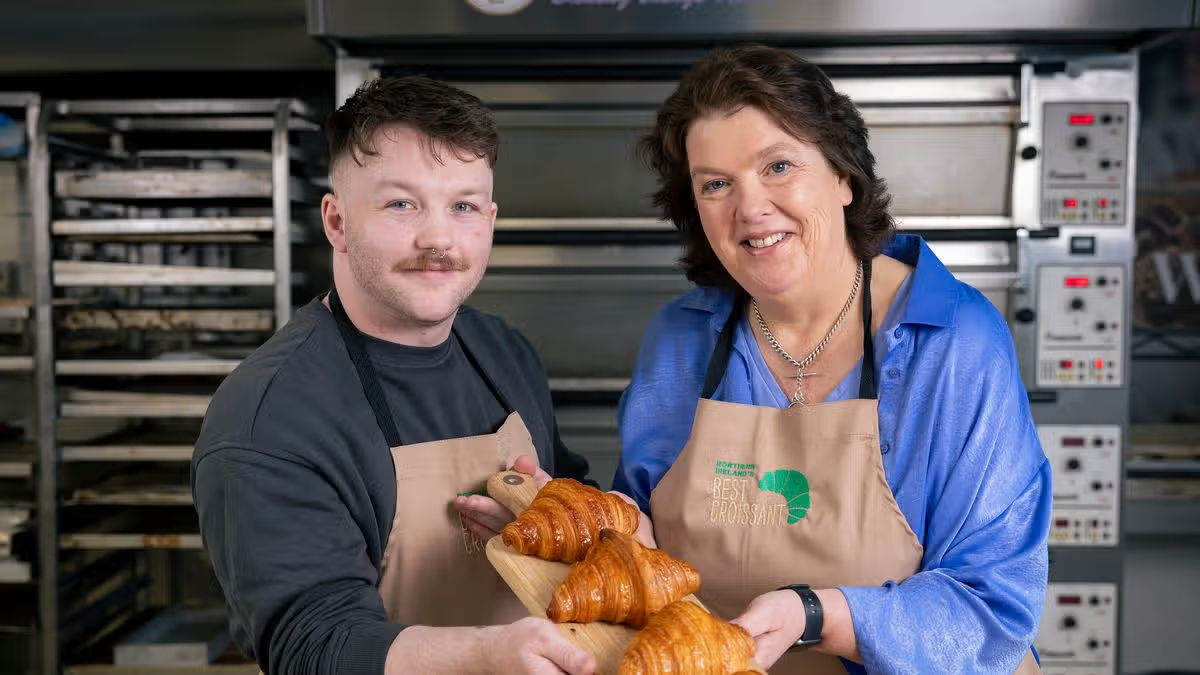
Last year, Saul Kearney of Mamo Patisserie in Belfast City Centre was crowned the winner of the first-ever competition and joins the judging panel for 2026.

The croissants will be judged on appearance, lamination, texture and flavour by fellow judges Jimmy Griffin, master baker and lamination specialist and food champion Paula McIntyre.

Advertisement

Registered bakeries from across Northern Ireland are invited to enter six plain croissants, made using The Edinburgh Butter Company’s cultured butter sheets, specially developed for pastry lamination. Every entrant will receive two complimentary sheets to practise with and use for the competition.

This year’s event takes place at Andrew Ingredients in Lisburn, the Gold Sponsor and host, and the winner will take home a bespoke trophy created by Metal Moran, with prizes also awarded for second and third place.

New for 2026 is a Best Off-Cuts Bake competition, giving entrants the chance to create something inventive using the pastry off-cuts from their croissants.

Chloe Black, Director of The Edinburgh Butter Company, said: “Northern Ireland has an incredible community of artisan bakers, and last year’s competition showed just how much talent there is here.

Advertisement

“We wanted to create an event that celebrates not only the perfect croissant, but the people, passion and craftsmanship behind it. We’re really looking forward to bringing everyone together again this year and seeing who can take the buttery crown!”

Claire Andrew of Andrew Ingredients added: “We’re delighted to host Northern Ireland’s Best Croissant Competition and support an event that celebrates the incredible talent within our local baking industry.

“We see the passion and dedication of Northern Ireland’s bakers every day, and we’re looking forward to welcoming them to Lisburn and finding out who will be crowned this year’s winner.”

Entries close on 30 September. Bakers can enter and find full competition details at Northern Ireland’s Best Croissant Competition

Advertisement

For all the latest news, visit the Belfast Live homepage here and sign up to our daily newsletter here

Advertisement

Source link

Continue Reading

NewsBeat

a look at the Danish way versus the British way

Published

on

a look at the Danish way versus the British way

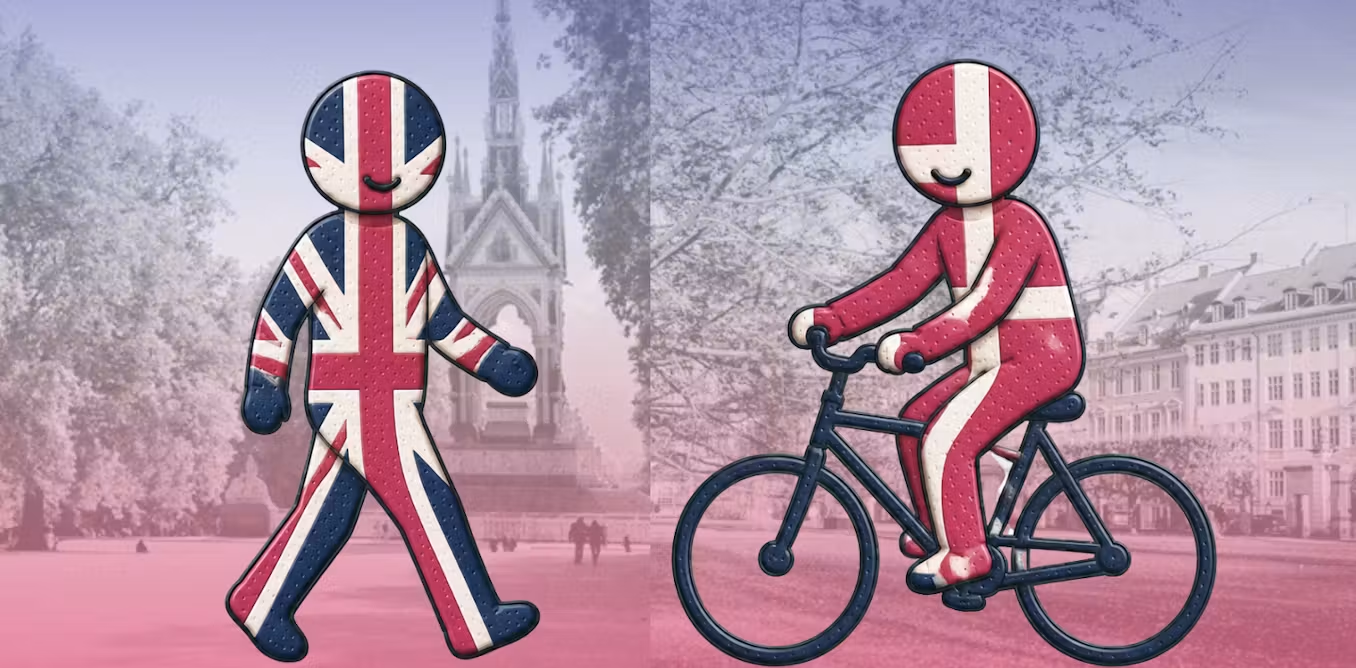
Denmark and the UK are often compared when it comes to health. Danes live longer, survive more cancers and report higher levels of wellbeing.

But the reasons why stretch well beyond hospitals and healthcare systems. One place to look is the everyday: how people structure their time, move through their day and balance work with the rest of their life.

A weekday in Denmark and the UK can look quite similar on the surface. People wake up, go to work, eat dinner and wind down in the evening. But look a little closer at how the day unfolds, hour by hour, and small differences begin to appear.

Time-use studies offer a useful window into these patterns. They track how people spend their day in detail, from commuting to leisure. While no two schedules are identical, they give a sense of what a “typical” weekday might look like. Here is what they reveal.

Advertisement

Health Gap / Sundhedskløften is a collaborative series from The Conversation UK and Denmark’s Videnskab.dk exploring what the two countries can learn from each other when it comes to health and wellbeing.

From cycling and alcohol to inequality, healthcare and everyday habits, the series looks beyond hospitals and medical treatment to explore how culture, politics and society shape the way people live – and how healthy they are.


Starting the day

Mornings begin in much the same way. A recent study in Sleep Medicine found that in Denmark people wake at around 7:03am on average, compared with 7:10am in the UK. The difference is small, but routines start to diverge soon after.

Advertisement

The commute

The journey to work is where the contrast becomes clearer. In the UK, many people commute by car, train or bus, often sitting and scrolling through their phones. In Denmark, the commute is more likely to involve movement.

Around 15% of all trips in Denmark are made by bicycle, compared with about 2% in England.

In Copenhagen, close to half of commuting trips are by bike. In London, cycling makes up 4.7% of journeys, even though numbers have increased in recent years.

This is not just about individual choice. Cycling in Denmark has been supported for decades through infrastructure and urban planning. Dedicated cycle paths have existed since the late 19th century, and cities have been designed to make cycling a safe and practical option.

Advertisement

In the UK, cycling routes are less consistently integrated, and participation varies more across groups.

By the time the working day begins, these differences have already shaped how much people have moved. In Denmark, many arrive at work having already been physically active. In the UK, the morning is more often spent sitting.

The working day

Working hours differ, too. Data from the OECD shows that Danish employees worked an average of 1,379 hours per year in 2023, compared with 1,524 hours in the UK in 2024. That amounts to roughly three extra working weeks each year. Very long working weeks are also rare in Denmark.

Family life is shaped by these patterns. Denmark has extensive publicly funded childcare, and most children aged three to five attend daycare. This makes it easier for parents to balance work and family routines. In the UK, childcare support has expanded in recent years, but costs can still be high, and arrangements are often more varied.

Advertisement
London workers heading to the office.
People in the UK work three more weeks a year, on average, than Danes.
IR Stone/Shutterstock.com

Finishing work

In Denmark, many people finish work around 4pm. This creates a clearer break between work and home life and leaves time to pick up children and settle into the evening.

In the UK, working hours are often longer or less predictable. As a result, the evening can feel more compressed, with less time between finishing work and going to bed.

Leisure and dinner

Dinner tends to conclude by 7pm in Denmark, leaving space afterwards for family time, socialising or relaxing. Many Danes also take part in organised sport: around four in ten adults report having participated in a sports club in the past year.

This may help explain why Denmark consistently ranks among the more active countries in Europe. More than a quarter of adults meet recommended physical activity levels, and most report being regularly active.

In the UK, people are active too, but the structure of the day is different. Longer commutes and later finishes can reduce the time available before the evening. Exercise is therefore more likely to take place in planned sessions, such as going to the gym, rather than being part of everyday routines.

Advertisement

Dinner also tends to be later, often followed by more sedentary activities. Leisure time still plays an important role, but it is more clearly separated from the rest of the day.

Winding down and sleep

By late evening, routines in both countries look similar again. People watch television, read or spend time online before going to bed.

Sleep duration is broadly comparable, but timing differs slightly. Data from World Population Review suggests that in Denmark bedtime is earlier on average at around 11:22pm, compared with 11:27am in the UK.

Happiness levels also vary. The World Happiness Report 2024 ranks Denmark second and the UK 23rd out of 147 countries. Many factors contribute to this, but daily routines probably play a part.

Advertisement

Taken together, these patterns show that life in Denmark and the UK is shaped less by what people do, and more by how their day is organised. Work, commuting, family time and leisure are present in both countries, but arranged in different ways.

In Denmark, movement is often part of the day itself, built into commuting and the time between work and home life. In the UK, activities are more often separated, with clearer boundaries between work, travel and leisure.

These are not simply individual choices. They reflect broader systems, from infrastructure and working hours to childcare and cultural habits. Small differences in how time is structured can add up, shaping how easy it is to be active, spend time with family or unwind in the evening.


This series was commissioned as part of a partnership between Videnskab.dk and The Conversation, where articles are published in English and Danish.

Advertisement

Source link

Continue Reading

NewsBeat

Believe it or not, THIS is Dubai. Forget the skyscrapers, shopping malls and soulless brunch spots – the UAE’s crown jewel has hidden pockets of old town charm, riverboat rides and traditional street food. Here’s how to find them…

Published

on

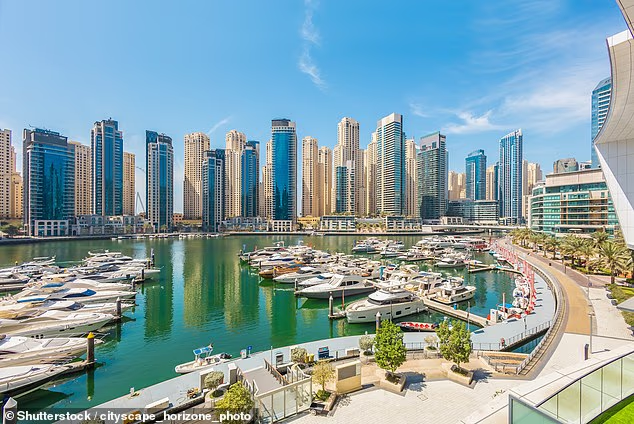
The Middle East conflict continues but life in glossy Dubai has returned very much to normal

Source link

Continue Reading

NewsBeat

Phil Foden: Manchester City midfielder sent off in derby

Published

on

Phil Foden sent off against Manchester United

Wayne Rooney: That can’t be a red card. It was more of a flick or a gesture, than a kick out.

Danny Murphy: Bruno kicked Foden first, but that’s not a red for him. But then Foden did kick out at him and if you kick upwards, you are going to get a red.

Gary Neville: A painful moment for Foden to have to make that run down the long tunnel. I’m surprised Fernandes didn’t get a yellow for the kick on the floor, he’s certainly pulled a reaction out of Foden which will help his team-mates.

Paul Robinson: Initially it looks really stupid from Phil Foden. He kicks out in the midriff of Bruno Fernandes. There is absolutely no way it was going to be overturned. That was petulant, that was stupid and he could have cost his side.

Advertisement

Roy Keane: Foden gets up and reacts obviously, so he’s sent off. Fernandes catches him and gives him a little kick. I guess it’s classed as violent. But Fernandes is the one who is violent here, I don’t think Foden should have a red card.

Source link

Continue Reading

Trending

Copyright © 2025