


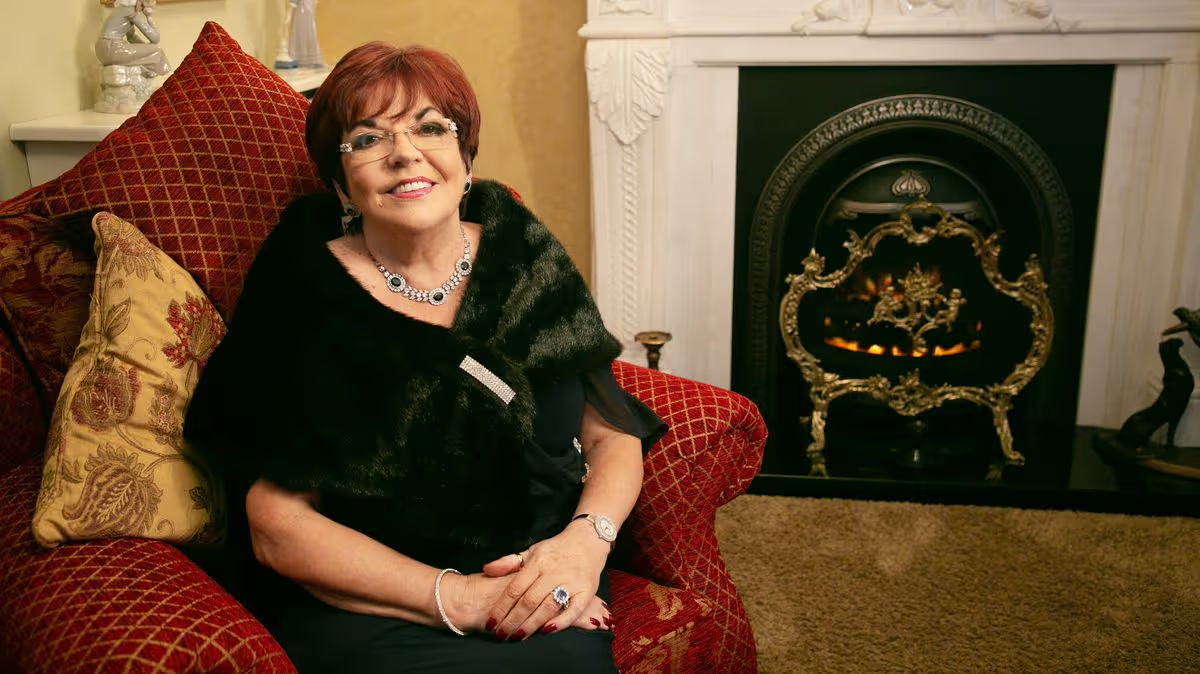
“It hits you, and it doesn’t really hit you until days after I was told that I thought, God almighty.”
For all the bright lights and packed venues that have defined Susan McCann’s career, the foundations of her life remain firmly rooted in something much quieter. Long before the tours, television appearances, and international stages, there was a small, isolated home on the border where music was shared rather than performed.
It was there, in a two-room house without electricity, that Susan’s understanding of life and of people first took shape. Her upbringing was modest, even by the standards of the time, but what their family home lacked in comfort it made up for in warmth and a constant sense of togetherness.
Those early years continue to inform how she sees the world, even now. The values formed in that environment would go on to underpin not just her career, but how she navigated its pressures.
“Well, see, we got you said, we grew up in a townland called Carrickasticken, which is midway between Dundalk and Forkhill, and when I was growing up, we didn’t have any electricity.
“We had gas light and tilly light. In fact, I was married, and my son was two and a half before Mum and Dad got electricity in where we lived. It was very isolated, but there was always loads of craic.
“The neighbours all came in, I don’t even hardly know my neighbours now, but then everybody knew one another and, they used to gather on a Saturday night in our house. Mum and Dad would have a bit of a sing song and all they would have sang.”
That sense of community extended beyond the immediate family, but it was within the household itself that Susan McCann first found her voice and her confidence.
“I was the only one that had a hard neck to go out and do it for a living but Mummy and Daddy, were good singers. In fact, they used to argue who I took the singing after, you know, it used to be a standing joke in there.
“And we had great fun. My brothers Joe, Arthur, Vincent and John all went over to England for work because there was none here for them. John was two and a half years older than me, and he would come home on holidays, and he’d teach me how to jive because he used to go dancing at all the Irish clubs in England. So we used to be dancing and singing, that’s the way our house was.
“And then the boys would bring home people with them. There were many a night there were boys lying on the sofa, you wouldn’t know who they were. That’s the truth.”
If her upbringing provided the foundation, her marriage provided the stability that allowed her career to flourish. For more than 50 years, Susan and her husband Dennis have navigated an industry not known for preserving relationships and have done so by staying firmly side by side.
“The honest-to-God answer is I don’t know. We have a lot in common; he loves the music. He was the bandleader all my life,” she said when I asked how their relationship stood the test of time.
“And Dennis is a very easy man to get on with. He’s very quiet, and we’re two opposites really. My father used to say to me that I had a tongue for 10 rows of teeth because I was that gobby, but that’s the way we are.”
“But was there ever a point where it came between us? No, sure, he was always with me. We were always together when we’d be away, which, in fairness, we probably never would have lasted if it hadn’t been that way.”
That partnership would prove essential not only during the busiest periods of her career but also in more difficult times. In recent years, Susan McCann has faced a serious health challenge, one that reshaped her perspective in a way that decades on the road never did.
“You know, the fans are great. I just love singing. I just went through a very hard two years there, and I’m just so glad to be able to sing again.
“And I mean this, you hear people say, thank God. If you haven’t your health, you have nothing, and you know what, a truer a word was never spoken.
“Because, when I was told I had cancer, people talk about a shock, and it hits you, and it doesn’t really hit you until days after I was told that I thought, God almighty. You know, the word cancer is so frightening.
“But it’s amazing what they can do now. I’m totally free of cancer at the minute, but they’re keeping a very close eye on me. They can say what they like about the NHS, but the NHS really looked after me.”
If that experience reinforced anything, it was the central role her family continues to play in her life. Even as she marks 50 years in music, the next chapter is already being shaped by those closest to her.
“I was out for dinner in my daughter Linda’s house one Sunday and my son-in-law Brian said to me, Susan, I’ve written a song for you. I never knew he would even be thinking about writing a song.
“And he had it written for like 6 months before he even let me see it and then he gave it to me, and of course I got really emotional. He wrote it from his heart. It’s just lovely. The song is lovely.”
The song was one of the last on her setlist at her celebratory show in Belfast’s Grand Opera House, where she was joined on stage by her daughter Linda on piano, and her grandchildren.
That sense of continuity is already visible in the next generation, with her granddaughters beginning to find their own paths in music.
“Sinead wants to make a career of singing. She went to university and dropped out to sing. She is a very good singer, but I don’t know if it is as easy as it was when I started. There is a whole lot of young girls coming up, and now we have the likes of Cliona Hagan, Claudia Buckley and Lisa McHugh and I love to see them.
“But Sinead is a good hard worker and she would do two gigs in the one night if she got the.”
“Laura, she’s a really beautiful singer. She is a different type of singer and she sings songs from the shows. She’s a classy, classy singer, but she’s going to London to do art.”
When asked what advice she would give them, she said: “I made a good living and I made a nice career for myself and I met lots of nice people, lots of not so nice people too. You have to work hard. If you don’t work at what you want to do, well then your chances of making it wouldn’t be great.
“So as long as they have respect for themselves and respect for their parents, that’s very important too, and respect for the people that come out to see them or the people that they work for. I think it’s important that young people learn that because if you don’t have a bit of manners and a bit of respect for older people, well then you’re no friend of mine.
For all the milestones in her career, it is a quieter moment, far from any major stage, that remains one of her most treasured memories. It came not from an award or a headline performance, but from her father, watching from the sidelines at her first show after winning the European Gold Star Award.
“I took Mummy and Daddy and my sister Marie to the show in Ardee, which wasn’t far from Forkhill. Marie and Mummy went down to get seats at the front beside the stage, and I was getting changed upstairs. The hall held about 300 people, and there were that many people turned up, they had to put speakers outside so they could hear.
“Daddy was a very humble man. He was a country man and never took his cap off. He was sitting looking out the window, and I can see him to this day. He looked out, and he said Susan, look at that crowd out there. I went to the window and right enough there was a crowd. He looked at me and he said, and they are all here to see you. I could cry thinking about it.”
For all the latest news, visit the Belfast Live homepage here and sign up to our daily newsletter here.








































You must be logged in to post a comment Login