




The government’s new social cohesion action plan, Protecting What Matters, is frank about its urgency: “Social cohesion is … not just a good in and of itself. It is also a vital front in the resilience of our national security.”
The 2024 Southport attacks and subsequent disorder, rising religious hate crime, unrest over migration policy and domestic extremism have all forced the issue of community division. Yet the government’s answer, built around integration, interfaith dialogue and civic ceremonies, mistakes the symptom for the disease.
“Cohesion” is vague, unmeasurable and elastic enough to mean whatever the government of the day needs it to mean. People describe the places they love as close-knit and safe, not “cohesive”.
A better framework would be community resilience: the measurable capacity of neighbourhoods to absorb shocks, resist divisive narratives and recover from crises. You cannot integrate people who are isolated, impoverished and without the infrastructure to bring them together. COVID laid bare what the evidence already showed: communities with stronger social infrastructure and higher levels of social capital demonstrated greater resilience to the pandemic’s social and economic shocks.
The government strategy does contain a chapter on “resilient communities”. However, it frames resilience narrowly, as emergency management of religious and political extremism, rather than as the everyday and routine fabric that makes any form of solidarity possible at all.
The missing piece
There is an extraordinary gap in Protecting What Matters. While there is acknowledgement of the effects of “visible deterioration of public services”, the word “poverty” does not appear once. The plan frames division through religion, identity and Islamophobia, which are outcomes and proxies, not root causes.
A study of over 15,000 residents across 839 English and Welsh neighbourhoods, validated by a 2024 analysis of the Understanding Society dataset, shows that deprivation, not diversity, erodes trust, participation and neighbourliness. Once you control for poverty, diversity is associated with higher volunteering and charitable giving. The crisis of solidarity is a crisis of resources, not cultural difference.
There is an undertone of nostalgia in the government’s plea for communities to “integrate”, a wistfulness for tight-knit mining towns where everyone knew their neighbour. But those communities were built on something material: secure jobs, union membership, working men’s clubs and shared economic fate.
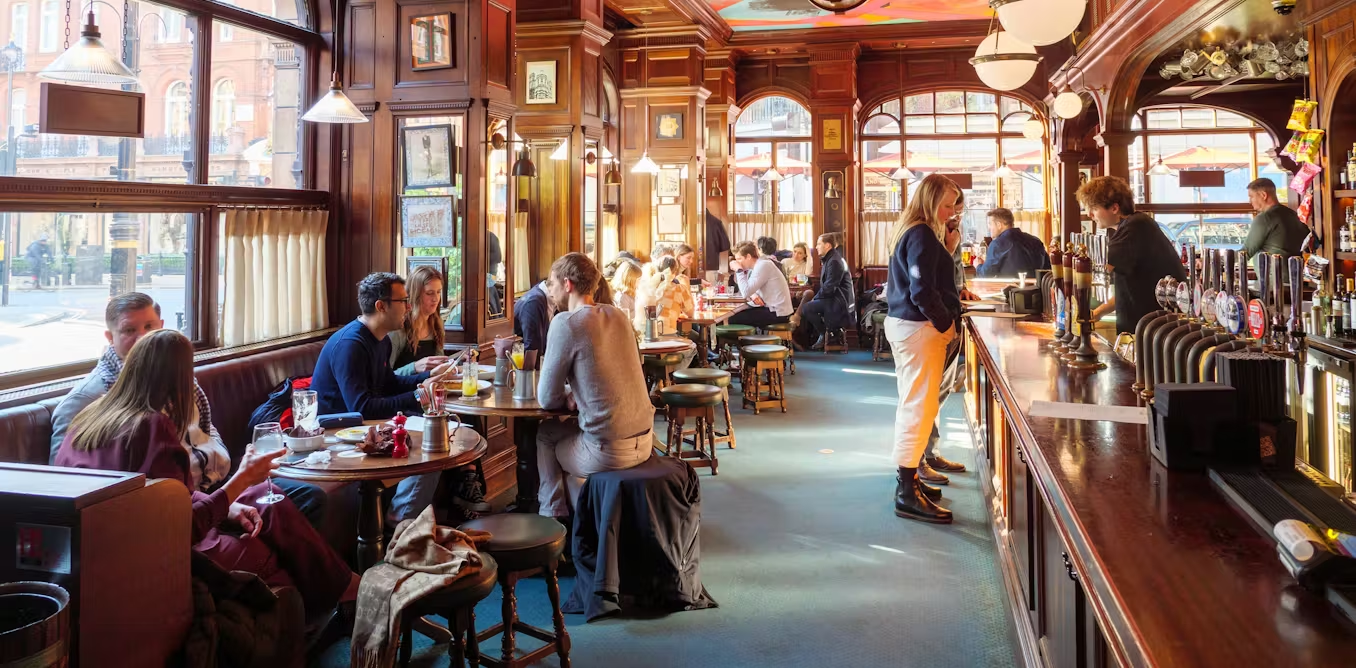
More in Common’s 2025 polling finds that 44% of Britons sometimes feel like strangers in their own country – a figure that could be read as evidence of cultural division. But More in Common’s own analysis shows this alienation is concentrated in economically left-behind areas, not diverse ones. People do not feel like strangers because their neighbours look different. They feel like strangers because the institutions that once made them feel they belonged – clubs, pubs, unions and jobs – have gone.
chrisdorney/Shutterstock
The argument that more homogenous communities are more cohesive is seductive, but weak. Britain’s most ethnically diverse neighbourhoods are not its least cohesive – they are, as Manchester researchers found, its healthiest. Mining towns were cohesive despite being male-dominated, often racially exclusive and economically coercive. The lesson is to replicate not their demographics, but the material conditions: jobs, institutions and shared infrastructure that give people a reason to show up.
Work provides far more than income: it furnishes identity, routine and daily social connection. Unemployment is not merely an economic condition; it is an isolating one.
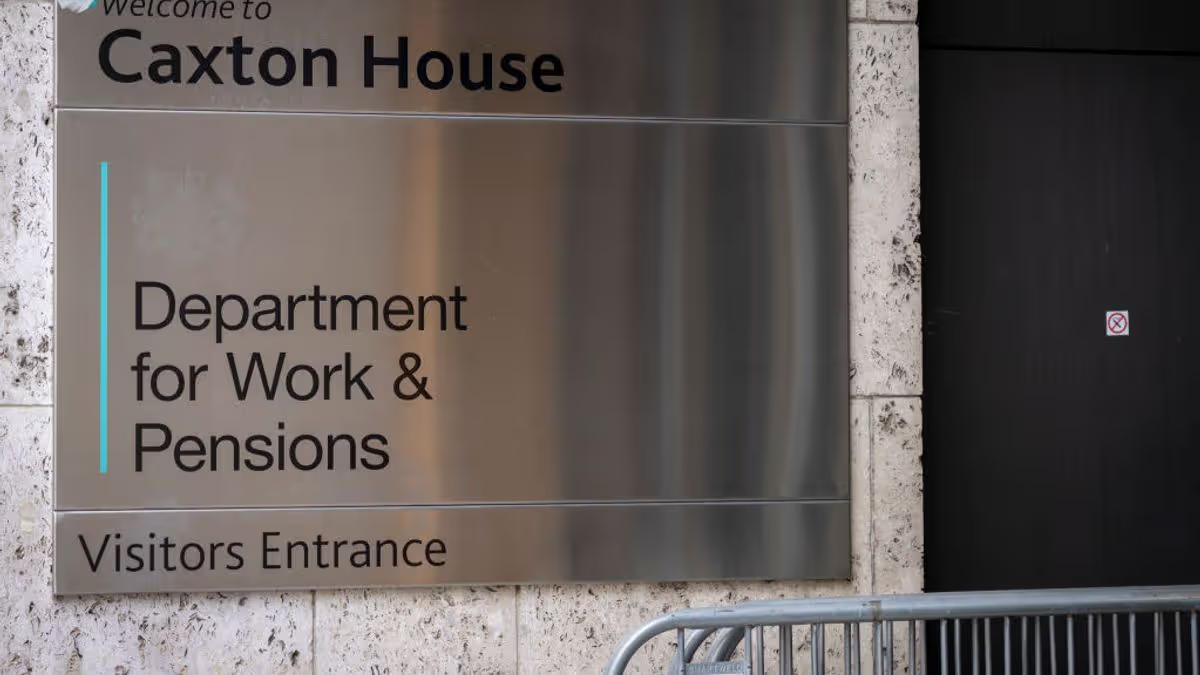
A recent randomised controlled trial by the Department for Work and Pensions found that structured group job-search workshops improved both mental health and employment outcomes among benefit claimants, precisely because they restored the social support, routine and shared purpose that work normally provides. Community resilience cannot be separated from economic development. Departments such as DWP and Jobcentre Plus have a direct stake in the social capital agenda.
Building resilient communities
Research I have conducted at the Independent Commission on Neighbourhoods (ICON) and a recent Joseph Rowntree report show that social infrastructure is key to resilience, but that different communities have different needs.
New housing developments need parks and primary schools from day one: accessible spaces that create early encounters and establish trust between newcomers. Established but deprived communities need to restore what has been stripped away, whether the pub, the library or the community centre. Sports facilities build bridging connections across difference, faith buildings deepen bonds within communities and civic spaces create the linking ties between residents and institutions. The task is to match the infrastructure to the social capital gap, not apply a single template everywhere.
The real test, which my colleagues and I call the “Wet Wednesday Night Test”, is whether your investment in social infrastructure gets 14 people to turn up for football (or cub scouts, or a book group) on a wet Wednesday in February. Nobody comes to “build social capital”. They come because the pitch is free, the lights work and there are hot showers. The pint afterwards does more for integration and social capital than any strategy document ever will.

Natee K Jindakum/Shutterstock
ICON’s research, drawing on over 100 peer-reviewed studies, shows that social infrastructure generates £3.50 for every £1 invested. Every £10,000 invested prevents an estimated £105,000 in riot damages.
During the 2011 riots, 71% of incidents occurred in areas ranked among the most deprived 10% of England – the same year in which 287 community centres had closed. The government described this as a “social cohesion” problem; it was a social infrastructure problem.
The government’s £5 billion Pride in Place programme makes a start at investing in communities. But more investment is needed to address the challenges in our most deprived neighbourhoods, where people face life expectancy four years below the national average.
A serious approach would use existing schools, job centres and childcare settings as social hubs, and make public transport free for under-18s so that young people can move around their own towns. And, it would tackle the poverty, insecure work and collapse of institutions that once gave people a reason and the means to show up for each other.
Build those foundations and what politicians call “cohesion” will follow. Nobody will use that word to describe what they feel when they step outside of their front door. They will just say it is a good place to live. That is enough.















































You must be logged in to post a comment Login