Mum Paris remarked: ‘That’s very gypsy-esque. That’s lovely’ as her daughter unwrapped her first wedding present.
22:10, 14 May 2026Updated 22:18, 14 May 2026
Tyson and Paris Fury‘s 16-year-old daughter is getting ready to marry fiance Noah Price this weekend. With days to go Venezuela opened up one of her wedding gifts early, with Paris remarking: “That’s very gypsy-esque. That’s lovely.”
A TikTok video shared by the teenager on Thursday gave fans another glimpse into the wedding prep, showing Venezuela unwrapping a gift from the crew of the family’s Netflix show At Home With The Furys.
She said: “OK guys, open my Netflix wedding present with me,” before explaining how she was dressed, adding: “I’m freezing so I’m in a dressing gown in the middle of the day. Oh my god what is it?”
Pulling a crystal vase out of its box, she said: “Oh that’s lovely. Oh it’s beautiful, check me out,” before posing with it. The camera, operated by Paris, then swung round to show the Netflix crew in the family living room.
Advertisement
Speaking last month, Gypsy King star Fury, 37, said he has had “zero” involvement with his eldest daughter’s wedding planning because he’s been so focused on his latest boxing comeback.
However, Paris, 36, has been by her daughter’s side. Earlier this month, fans saw their visit to a bridal store, which showed Venezuela holding a huge bag with a smile on her face next to her mum, writing: “Said yes to the dress!!”
Venezuela has also threatened to wear Crocs on her big day, telling fans: “I’m having a bit of a struggle on what shoes to wear. Do I wear white New Balance trainers or white Crocs? I don’t know. Or, maybe I wear blue Crocs? I’m not sure.”
Despite Venezuela’s age, mum Paris, 35, and dad, Tyson, 37, are said to be unfazed by the prospect of their eldest daughter tying the knot. Paris herself was just 19 when she wed 21-year-old Tyson in 2008.
Tyson had been training for his fight with Arslanbek Makhmudov, which he won, in the run-up to the wedding. He praised his wife and daughter for their efforts in planning it, saying: “Fair play to Paris and Venezuela, they’ve actually done this wedding without my input at all.
“I’ve had zero to do with it. I’m away doing business. I’m not thinking about domestic stuff at home. I’m thinking about the fight and that’s it. I’m out of bounds. Don’t tell me about anything like that.”

Earlier this week, HBO unveiled three more additions to the cast in what the media has repeatedly referred to as the final casting announcements for the new season.
Among them are Oscar winner Sir Ben Kingsley and Emmy nominee Max Minghella, best known for his work in The Handmaid’s Tale, Industry and The Social Network.
Advertisement
Rounding off the cast is Finnish actor Pekka Strang, who previously took the lead in Dome Karukoski’s Tom Of Finland.
Producers said at the time that it had “become apparent that the character which Mike White created for Helena Bonham Carter did not align once on set”.
More than 70% of people, including a majority of Leave voters, agree that Brexit has been more of a failure than a success in Northern Ireland, an opinion poll has suggested.
The results of the research from Queen’s University Belfast also indicate two-thirds of people in the region believe Brexit has made the break-up of the UK more likely.
The polling, carried out for Queen’s by LucidTalk, suggests that close to half of voters (48%) do not agree that the 2016 Brexit referendum was based on a “fair democratic process”, while 40% agree.
Advertisement
The report is the 15th in the “Testing the Temperature” series on Northern Ireland voters’ views on Brexit and the Northern Ireland Protocol/Windsor Framework, led by Professor David Phinnemore and Professor Katy Hayward.
Previous reports were produced as part of a four-year project led by Queen’s and funded by the Economic and Social Research Council.
This latest poll was conducted between April 17-20, using a weighted sample of 1,050 respondents from across Northern Ireland.
The survey found declining public understanding among respondents of the Windsor Framework, the post-Brexit deal between the UK and the EU aimed at reducing trading frictions between Great Britain and Northern Ireland.
Advertisement
Poll findings included:
– 72% of respondents agree that “Brexit has been more of a failure than a success for Northern Ireland”. This includes 60% of Leave respondents.
– 66% agree that Brexit has made the break-up of the UK more likely; 19% disagree.
– More than twice as many agree (52%) than disagree (23%) that their Brexit-related identity, Leaver or Remainer, is “very important” to them.
Advertisement
– 46% of respondents now regard the Windsor Framework as “on balance a good thing for Northern Ireland”, the lowest level since June 2021, while 38% disagree.
– Confidence in the NI Protocol/Windsor Framework as a tool for managing Brexit’s effects has declined, with only 46% now viewing it as an appropriate means of addressing Brexit in Northern Ireland, down from 61% in summer 2024 and equal to its previous low recorded in spring 2021.
– Views among respondents of the framework’s effects on Northern Ireland’s relationship with the rest of the UK remain negative, including on its place in the UK internal market (44% negative vs 28% positive).
– Perceptions of the Windsor Framework’s economic impact are more positive than negative, 45% believe it has had a positive effect on the economy, while 37% believe its impact has been negative.
Advertisement
– A majority of respondents (57%) believe the Windsor Framework offers unique economic opportunities, down from 68% in summer 2024.
– A majority distrust either a Conservative-led (76%) or Reform-led UK government (70%) to protect Northern Ireland’s interests in EU-UK relations.
– The SDLP is the most trusted party among respondents on the Windsor Framework (38%).
– The TUV the most trusted unionist party (30%) on the issue, though it is also the most strongly distrusted (50%).
Advertisement
Prof Phinnemore said: “The poll provides further evidence that understanding of the Windsor Framework is declining.
“In part, this is no doubt due to the complexity of some of its arrangements.
“Yet the poll findings also show fewer voters believing reliable information is available.
“With the UK and EU negotiating new agreements that are expected to reduce trade frictions arising from the Windsor Framework, it will be important that the new arrangements are clearly and reliably explained.
Advertisement
“If they are not, then this will only further damage trust levels in the UK Government and the EU.”
Professor Hayward said: “Ten years after the Brexit referendum, one in two voters in Northern Ireland still see their Leave/Remain identity as very important – across both camps and the political spectrum.
“This constitutes an additional layer of division broadly on top of existing ones.
“The need to manage this with compromise on both sides explains the region’s unique post-Brexit arrangements, ie the Windsor Framework.
Advertisement
“It also helps explain why the majority of both Leavers and Remainers here believe – albeit for different reasons – that Brexit has been a failure for Northern Ireland.”
The survey also suggested a preference among voters for closer ties with the EU – 59% of respondents oppose further loosening of UK-EU ties and 57% support the UK rejoining the EU, with strong gender and Remain/Leave divides.
Almost three-quarters (73%) of respondents support Ireland using its EU Council Presidency to improve EU-UK relations.
More than half of respondents (58%) oppose leaving the European Convention on Human Rights while 36% support such an exit.
‘The cost of Labour tearing itself apart is distraction and deepens an already destabilising moment in British politics at precisely the time the country needs the opposite’
No time for distraction
Wes Streeting’s resignation only deepens an already destabilising moment in British politics, at precisely the time the country needs the opposite.
Advertisement
Now comes word that Andy Burnham has found his route back to Westminster, after MP Josh Simons announced he would stand aside in his Makerfield seat to make way for the Greater Manchester mayor.
A by-election where Reform came second last time, with a Labour majority of less than 6,000, is far from a guaranteed landing pad – and the shadow of a leadership challenge to Sir Keir Starmer hangs over it.
Get past the noise, and look at what is actually happening. The NHS has hit its 18-week treatment target for the first time in years. The economy unexpectedly grew by 0.3%. These are early signs of a government delivering.
There is another cost to Labour tearing itself apart: distraction. While the party obsesses over internal warfare, serious questions emerge around Nigel Farage and his £5million gift from Christopher Harborne. Politics should be focused on answers, not drama.
Advertisement
Weigh it up
Weight loss jabs are already changing lives.
Now there is growing evidence that they could help change the workplace too. Research showing sickness absence among patients taking the injections has almost halved, which is encouraging news for families, employers and the NHS under relentless pressure.
Fewer GP appointments, fewer A&E visits and fewer people trapped by poor health are good for everyone. Fewer people off sick also means a healthier, more productive country.
Businesses, public services, and working people benefit too. The government is right to take their potential seriously. But there is a catch.
Advertisement
These jabs are not a miracle cure or a shortcut. Lasting success still relies on support, healthier lifestyles and long-term change. Britain needs bold action on obesity. But if these treatments help people live healthier, happier lives, they deserve a proper chance.
World’s Queen
Madonna has outlasted generations of pop stars. The Material Girl has watched trends, rivals and entire music eras come and go.
Now, at 67, she is still reinventing herself, still making music, and now preparing to headline the World Cup half-time show too. Decades on, the Queen of Pop remains firmly on her throne.
The Met Office said that over the next week there will be changeable conditions due to an area of low pressure nearby. This means there will be periods of rain or showers, interspersed by drier interludes.
However, as we head towards the bank holiday on May 25, an area of high pressure is likely to build from the south bringing more settled weather.
Advertisement
According to forecasters at the weather agency, there is also a chance temperatures will be “rather warm” by the bank holiday and half term.
The BBC’s long-range forecast also paints a similar picture. Their outlook for Monday, May 25 to Sunday, June 7 says it will be “most probably drier and warmer than normal.”
The forecast states that the UK may cool down towards the end of may for a couple of days if a period of high pressure moves to the north. Make sure you never miss Wales’ biggest updates by getting our daily newsletter
But, it goes on to add: “However, high pressure could also expand across the UK from the southwest, delivering warmer-than-average conditions again by the end of May.
Advertisement
“Either way, there should be plenty of dry weather, with near to below-normal precipitation amounts.
“A similar set-up should linger into early June. Although a little rain cannot be entirely ruled out anywhere, rainfall totals should be below normal across most areas.
“More seasonal amounts are possible in northwestern regions, with Scotland in particular more susceptible to occasional wetter spells. Temperatures are most likely to be near to, or higher than, the early-June average overall.”
There have been some reports that a heatwave could hit the UK as we head into the Bank Holiday weekend, but many forecasters have said any suggestions of this are premature.
Advertisement
The ECMWF (European Centre for Medium-Range Weather Forecasts) is currently forecasting maximum possible temperatures of 26C in the UK on the evening of May 22. The model shows warmest weather expected to hit just south of London, although the mercury could reach 23C or 24C across parts of Wales, central England and the east as well.
The Met Office is more sceptical and will not make such detailed predictions more than five days in advance, but they are also forecasting warmer weather. Their long range forecast states that by May 26 the weather may become “rather warm” and “especially in the south”.
Get daily breaking news updates on your phone by joining our WhatsApp community here. We occasionally treat members to special offers, promotions and ads from us and our partners. See our Privacy Notice
Weather maps show the UK is set for a warm bank holiday weekend with temperatures expected to reach 25C in parts of England, while 18 counties across the country could see highs of 24C or above
21:52, 14 May 2026Updated 21:52, 14 May 2026
Temperatures could climb to 24C across parts of Scotland over the upcoming bank holiday weekend, as warm air builds across the UK.
New GFS weather model data suggests highs of around 25C could be reached in parts of England on Sunday May 24, while Scotland is also expected to enjoy unusually warm conditions for the time of year, with highs of up to 24C possible in central and northern areas.
Forecast charts show much of Scotland turning warm by Sunday, with temperatures widely reaching the low to mid-20s. Even northern parts of the country could see values close to 24C in places.
Advertisement
By bank holiday Monday (May 25), Scotland is again expected to remain warm, with weather maps indicating highs near 24C in the far north. Similar temperatures are forecast across north-west England later in the day. Overall, most of the UK is expected to sit above 20C.
Temperature anomaly maps for May 24 show the UK largely shaded in red, indicating temperatures above seasonal averages. Darker red areas across Scotland highlight where conditions are expected to feel particularly warm compared with typical late May values.
Across the two-day period, the modelling suggests multiple counties across the UK could reach 24C or higher, with Scotland among the regions experiencing notable warmth.
Advertisement
UK counties set for 24C or above
England
Lancashire
Cheshire
Wiltshire
Hampshire
Berkshire
Buckinghamshire
Essex
Kent
Hertfordshire
Surrey
Scotland
Morayshire
Banffshire
Renfrewshire
Ayrshire
Ross-shire and Cromartyshire
Nairnshire
Northern Ireland
The Met Office has indicated temperatures may rise into the mid-20s as the bank holiday weekend approaches, with a gradual shift towards more settled conditions.
Met Office meteorologist Annie Shuttleworth said: “By the end of next week and the start of the bank holiday weekend, temperatures could be above average.
“From Thursday onwards, temperatures could rise above average, approaching 20C for some across southern areas. We could be closer to the mid-20s, possibly, for some areas, in the south-east, by the bank holiday weekend.”
The wider outlook from May 19 to 28 states: “As this period progresses, high pressure is likely to begin to build from the south bringing more settled weather, although with occasional showers.
“Temperatures near-normal to begin, but tending to rise as the period progresses, perhaps becoming rather warm by the end of the period, especially in the south. Winds will be stronger during the first part of the period, generally from a southwesterly direction, before becoming lighter in line with the more settled conditions.”
Rory McIlroy struggled on the opening day of the US PGA Championship 2026, with the Northern Irishman finishing four over par after a bogey-laden first round
23:02, 14 May 2026Updated 23:13, 14 May 2026
Rory McIlroy described his opening round at the US PGA Championship as “s***” after closing with four consecutive bogeys.
The 37 year old teed off early at Aronimink Golf Club in south-west Philadelphia and looked to have recovered following an initial bogey.
He clawed back with a birdie before producing 10 consecutive pars. However, his back nine – the opening nine holes on the course – wrecked his round with five bogeys and just one birdie, leaving him four over par.
Advertisement
When asked to sum up his round, McIlroy said: “S***.
“I started missing fairways. I missed the fairway right on four, the fairway right on six, the fairway right on seven, fairway right on nine.
“I made that birdie on five to get back to even-par after the soft bogey on four, then I just got on that bogey train at the end.”
Approaching the end of day one, there were six players tied for the lead on -3 – including defending champion Scottie Scheffler. Stephan Jaegar, Min Woo Lee, Justin Thomas, Rio Hisatsune and Aldrich Potgieter were the other co-leaders at that stage.
Advertisement
Holywood ace McIlroy admitted driving difficulties have plagued him throughout the season, saying: “I’m just not driving the ball well enough. It’s been a problem all year for the most part. I just need to try to figure it out. I honestly thought I’d figured it out.
“Just sort of, once I get under the gun, it just seems like it starts to go a little bit wayward on me.”
McIlroy is pursuing a seventh major championship following his Masters title defence last month. Although he curtailed his first practice session due to a troublesome toe problem, he confirmed this hadn’t impacted his performance.
Despite McIlroy’s earlier assessment that the layout was a “bash driver down, figure it out” course, several competitors struggled after finding themselves off the fairway. McIlroy conceded that straying off the fairway proved more costly than he had anticipated.
Advertisement
“There certainly is a penalty for missing the fairway. Probably more than what I anticipated after being here, whatever it is, two Fridays ago,” McIlroy said.
The Northern Irishman received tremendous backing from the sizeable crowds following his high-profile group, which also included Jon Rahm and Jordan Spieth – the latter chasing a victory to complete his own career grand slam.
Both Spieth and Rahm concluded their rounds at one under par.
The Spaniard endured a mixed outing, though a pitch-in eagle and a chip-in birdie on the back nine provided a welcome boost.
Advertisement
Pre-tournament speculation that Aronimink would pose little challenge to the world’s elite proved wide of the mark, with the clubhouse lead standing at just three under when the trio wrapped up their round.
“There was some chatter where people thought 15 to 20 under was going to win. And I think that got to somebody in the PGA and they did something about it!” Rahm said.
“Because if the golf course stays like this and it keeps firming up, yeah, obviously it’s not going to be anything like that.”
Rahm was also full of remorse after striking a volunteer with a divot during a moment of frustration.
Advertisement
“Just out of frustration, I tried to make an air swing, just over the grass, and I wasn’t looking, took a divot, and unfortunately, I hit a volunteer,” he added. “I couldn’t feel any worse. That’s why I was there apologizing. I need to somehow track him down to give him a present because that’s inexcusable and for something that could be completely avoidable.”

The Eurovision Song Contest was founded 70 years ago as a way for Europe, divided after war, to come together by celebrating its music. Every year, several dozen countries across the continent – and, more recently, far beyond – compete in what is considered the world’s most viewed non-sporting event.
As a cultural institution that last year attracted around 166 million viewers, the results of Eurovision have a big impact – not least by deciding the venue of the following year’s event. Yet the issue of bloc voting, where countries tend to vote more favourably within regional or cultural blocs, has long been a controversial aspect of the contest.
In 2008, the BBC’s Eurovision commentator Terry Wogan spoke out against bloc voting by Eastern European countries, saying: “You have to say that this is no longer a music contest. I have to decide whether I want to do this again.” He didn’t – it was his final show in the commentary hotseat.
On occasion, suspiciously friendly voting has strayed into something even more troubling. The 1968 contest, held at the Royal Albert Hall in London, saw a major upset when home favourite Congratulations, sung by Cliff Richard, was pipped by the Spanish entry La, La, La.
Advertisement
Forty years later, Spanish Eurovision host Jose Maria Inigo claimed that the vote had been rigged at the behest of Spain’s military dictator, Franco. His claims were later supported by an Irish TV investigation.
The modern, expanded Eurovision features two semi-finals as well as the grand final, held this year in Vienna on May 16. Its scoring combines a jury panel with a public vote, reducing the impact of each jury. But that didn’t stop another major voting scandal emerging in 2022.
The 2022 scandal
During the 2022 grand final in Turin, Italy, the European Broadcasting Union (EBU) announced that six juries’ scores from the second semi-final – Azerbaijan, Georgia, Montenegro, Poland, Romania and San Marino – had been nullified after “certain irregular voting patterns were identified in the results of [these] countries”.
The countries’ votes were replaced with an aggregate score “based on the results of other countries with similar voting records” for both the semi-final and grand final. This process was acknowledged by Eurovision’s Independent Voting Monitor.
Advertisement
The countries’broadcasters strongly denied any wrongdoing, with Georgia even suggesting their first-place vote in the final had been wrongly allocated as a result of the imposed system. Among online audiences, there was immediate speculation of a cover-up. After the final, the EBU issued a long explanation for their decision.
So had there really been collusion? Colleagues and I from the University of Stirling, including Riley Uttley, have re-assessed the 2022 voting scandal using applied statistical methods.
Each five-member Eurovision jury selected their ten favourite songs, with 12 points going to their favourite, ten points for second, then eight down to one for their tenth-best song. A similar points system was used to reflect each country’s public vote, doubling the total number of votes awarded by each country.
The jury results prior to the EBU’s intervention are shown below. The six juries whose scores were nullified – marked in red – awarded each other a total of 251 points. This is just seven points shy of the absolute maximum they could have given each other: 6 x (12+10+8+7+6) = 258 points.
Advertisement
Eurovision jury scores, 2022 second semi-finalScores in red were later nullified. Points include three non-competing juries: Germany, Spain and UK. Robin Hankin, CC BY
If the scores were allocated randomly, the odds of the six countries awarding each other 251 points would be less than 1 in 10,000. Such a low probability provides strong objective evidence that the six juries were indeed colluding.
Say we have two songs, a and b, and want to know the probability that a is judged better than b. Using the BT method, this probability is:
p(a) / p(a) + p(b)
where p(a) and p(b) are the respective strengths of the two songs.
This idea can be extended to the ranking of any number of songs. If we observe, say, that a ≻ b ≻ c ≻ d ≻ e (that is, song a is the best, then b, down to e), the probability of this voting decision is:
This is known as a Plackett-Luce likelihood function. While calculating each value is difficult, we can use standard optimisation techniques to maximise this probability, and thereby estimate the strengths of the songs.
When it comes to identifying the strength of collusion in the 2022 contest, my own technique known as reified Bradley-Terry can be applied to this likelihood function.
The unfair advantage of collusion is represented by adding an extra strength term to any competitor who benefitted from collusion. In the equation below, S represents the strength of the collusion effect, and is applied to song b. So, we replace every occurrence of p(b) with p(b)+S. Then, the probability of a ≻ b ≻ c ≻ d ≻ e is now:
The Eurovision 2022 semifinal had 18 songs and 21 juries, leading to a probability equation like the one above – but with a total of 220 terms. While this is a lot for a person to work with, it can be easily handled by the R programming language, an open-source statistical tool designed to handle masses of data and produce graphics and visualisations.
The removed juries all appeared to have very similar behaviour, so we represented the strength of the collusion of all six as a single number S, which we calculated to be 0.262. We then calculated the probability of S being as high, or higher, than this value on the assumption of no collusion.
We calculated this probability to be one in 58,000. Put another way, if you have 2.5km of matchsticks laid out end-to-end and burn one, it’s the probability of picking the burnt one. We can, therefore, confidently conclude that collusion did take place.
Advertisement
The 2026 voting system explained. Video: Eurovision Song Contest.
A final quirk
The 2022 Eurovision voting scandal had ramifications beyond the nullification of the six collusive scores. Jury voting for semi-finals was discontinued from 2023 until this year’s contest. Perhaps perversely, this made the juries carry more weight in each grand final.
With the semi-finals decided purely by public votes, which tend to be more dispersed and unpredictable, this meant the juries’ more concentrated voting patterns played a more significant role in deciding the ultimate winner.
Jury voting was reinstated for the semi-finals of this year’s contest. However, the juries are larger (seven members rather than five) and chosen from a more diverse background.
The clear favourites, Finland, will hope this is another step towards eradicating the controversial voting patterns that have haunted past contests – and made Eurovision a focus of keen interest for some applied statisticians.
Pittsburgh is a culinary paradise that doesn’t do half measures, and also packs a punch in the culture department as well (picture credit: Dustun McGrew)
If you’re the kind of person who gets a kick out of discovering exciting new flavours, there’s a place you need to hear about.
Pittsburgh is a culinary powerhouse that doesn’t do half measures. Forget beige and boring – this is a city of big, bold tastes that linger long after you’ve returned home.
With its legendary industrial history, Pittsburgh was built on innovation. Stroll or cycle around its streets today, and you’ll see this spirit lives on in chef-led restaurants crafting creative, adventurous dishes using fresh local produce.
It’s also worth leaving time to explore the city’s thrilling arts and culture scenes. But wherever you go, you’ll never be far from exceptional food at refreshingly reasonable prices.
Advertisement
And getting there couldn’t be easier, with direct, year-round British Airways flights from Heathrow in addition to Icelandair services from London, Manchester and Glasgow. Aer Lingus will also offer direct flights from Dublin from 25 May offering pre-clearance.
Read on for our top tips – then go and forge your own culinary adventure.
Bold flavours
With dishes like this Airline Chicken, served at Scratch & Co. it is not hard to see why Pittsburgh’s food scene is gaining international attention
The good folk of Pittsburgh are justly proud of their city’s foodie transformation. And the world is increasingly taking notice, with local eateries gaining national and international recognition.
When it comes to American culinary honours, they don’t get bigger than the James Beard Awards.
Pittsburgh is home to more than a dozen James Beard Awards, semi-finalists, like Nik Forsberg of fet-fisk, where you can find this Apricot Chicken (picture credit: Sarah LaPonte)
Pittsburgh now boasts more than a dozen semi-finalists, such as Nik Forsberg of fet-fisk, a Nordic seafood restaurant and oyster bar that began life as a pop-up.
Others include Kate Lasky and Tomasz Skowronski of European-inspired vegan hangout Apteka, and Wei Zhu from Chengdu Gourmet, a wildly popular Chinese restaurant specialising in Szechuan cuisine.
Advertisement
Take a taste of the city home with you by attending a pizza-making class at Enrico Biscotti, where a lead pizzaiolo will guide you through the whole process, from dough making to baking. Or grab one of 30 different varieties of handmade, traditional Italian biscotti.
Their flavours range from classic anise almond to creative options like coconut chocolate chip, fig pecan, and black pepper walnut.
Pittsburgh has a booming bar scene, from trendy cocktail joints to friendly neighbourhood bars (picture credit: Alex Mowery)
If you feel thirsty afterwards, you’re in luck. Pittsburgh has a booming bar scene, from trendy cocktail joints to friendly neighbourhood bars serving craft beer, wine and cider. Cheers!
Food meets fun
Picklesburgh is a four-day festival featuring live music acts, rides, a Pickle Juice Drinking Contest and of course – all the pickles you could ask for (image: Keep Pittsburgh Dope)
In Pittsburgh, food isn’t all starched collars and seriousness – this is a city that knows how to have fun.
After all, where else would you find a whole four-day-long festival dedicated solely to pickles?
Every year, a whole swathe of downtown is set aside to celebrate this delicious, yet humble ingredient, which has played a key role in the city’s culinary history.
Advertisement
Head along for themed food galore, from pickled peppers in hot sauce to pickle cocktails and (wait for it…) pickles covered in chocolate!
You can also try your hand on the ‘Mechanical Pickle Ride’, or watch contestants compete in the Pickle Juice Drinking Contest – a fan favourite.
This year, Picklesburgh runs from July 16–19, joining a packed calendar of events across the city, with many local businesses offering specials or themed activities. Why not try your hand at Pittsburgh Glass Center’s pickle-shaped glass blowing, for example?
(picture credit: Pittsburgh Downtown Partnership)
Highlights include PrideFest, Oktoberfest Pittsburgh, and Ribfest – where BBQ classics are served alongside live music and sports-themed entertainment. Keep an eye out too for the Little Italy Days festival in Bloomfield. Running 13-16 August this year, it celebrates authentic Italian-American cuisine, local businesses, artists and bands.
Foodie culture
Food and Pittsburgh’s culture are intrinsically linked. Make the most of this and take one of Burgh Bits & Bites famous tours as a unique way to explore several Pittsburgh neighborhoods. Offering eight different tours, each will immerse you in a local area, connecting you to its community, culture, history and spirit through its unique cuisine.
Advertisement
And it isn’t only food that runs through the city’s history. The legacy of the the Whiskey Rebellion (1791–1794), against the government’s attempt to tax the spirit, has lead to a thriving distillery scene in the city. Small-batch distillerstaking on the legacy of the rebellion, creating craft spirits using local malt and grains, and many local bars and breweries offering immersive experiences for enthusiasts and novices alike.
Pittsburgh’s Appalachian roots have inspired a unique farmer-to-table dining scene across the city, which can be really felt in its network of farmers markets. Serving up local farm fresh produce including eggs, cheese, homemade baked goods, jams and honey.
A meal is only as good as the ingredients used to make it, and these are the places to buy them!
Given its creative approach to food, you won’t be surprised to hear Pittsburgh hosts a thriving arts scene.
Advertisement
Keep an eye out for all the street murals – Pittsburgh is famous for them! (picture credit: Matt Shuck)
The city was the birthplace of legendary pop artist Andy Warhol and today the Andy Warhol Museum stands in his honour as the largest single-artist museum in North America.
For more contemporary art, go to the Mattress Factory, which is known for its immersive, room-scale installations.
Another must-visit spot for arty types is the Pittsburgh Glass Center, which serves as a creative hub for the city’s community of glass artists. And keep an eye out for all the street murals – Pittsburgh is famous for them! Including tributes to iconic Pittsburghers, from rapper Mac Miller to humanitarian and legendary Pirates baseball player, Roberto Clemente.
With so much to see, do, and eat, plus regular flights from the UK and plenty of affordable hotels to choose from, there’s never been a better time to visit this incredible slice of urban America.
If you’re considering a trip, why wait?
Advertisement
Get inspired at visitpittsburgh.com
Cheer on the black and gold!
(Mariah Wild / Pittsburgh Steelers)
Known as the City of Champions, Pittsburgh is home to three top sports teams who all wear black and gold kits.
So why not catch a top-class game while you’re in town? Fans of American football can cheer on the Panthers and Steelers at Acrisure Stadium, formerly Heinz Field.
Alternatively, mix sport with sightseeing by visiting PNC Park, where the Pirates play baseball in a beautiful ground with gorgeous views of the city’s skyline.
For a chance to learn more about the team’s most famous player, Roberto Clemente, pop over to The Clemente Museum – which celebrates his fascinating life on and off the field.
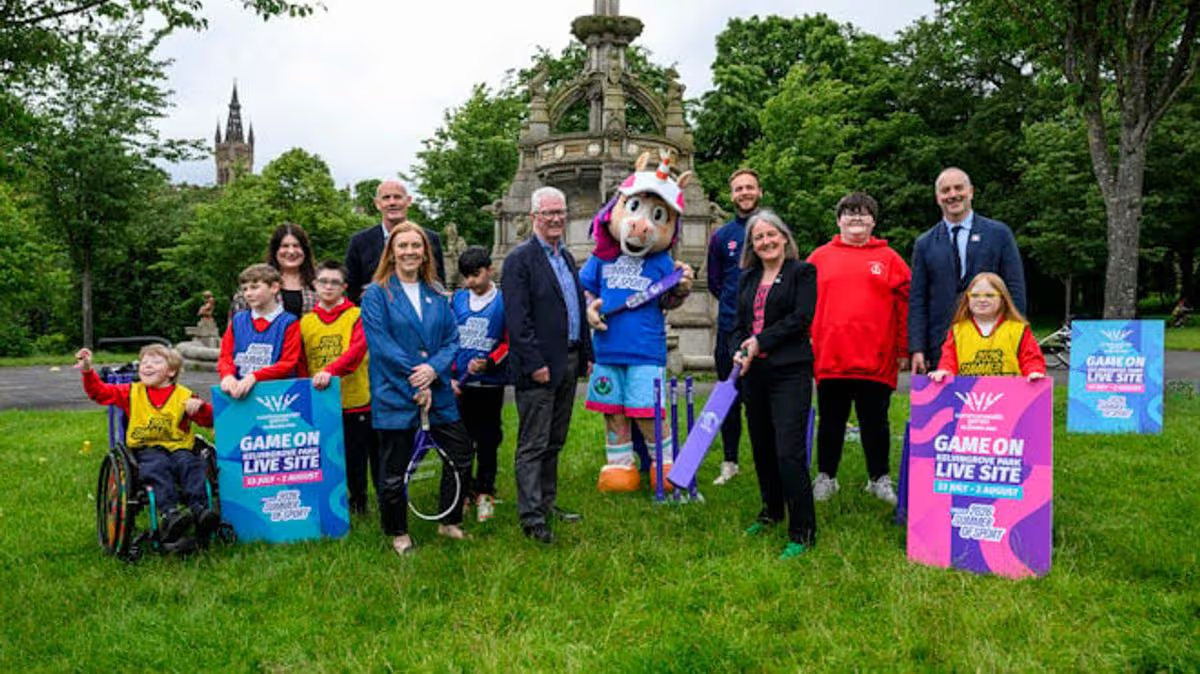
Northumbria University, based in Newcastle, formally signed the Brighton Plus Helsinki Declaration at Durham Cricket Ground on May 10.
The signing took place during the England Women’s One Day International against New Zealand.
The declaration is a global pledge supported by more than 600 representatives from approximately 100 countries.
Advertisement
It promotes equal opportunities for women and girls at every level of sport and physical activity, from grassroots to elite performance.
Professor Louise Bracken, pro vice-chancellor for research and knowledge exchange at Northumbria, said: “Signing the Brighton Plus Helsinki Declaration is a proud moment for Northumbria, and one that feels absolutely right.
“We are not starting from scratch.
“We have dedicated researchers, talented athletes, committed coaches, and passionate students who are already living these principles every day.
Advertisement
“What the Declaration does is bring all of that together under a shared, internationally recognised commitment.
“It sends a clear signal to our students, our staff, and our partners across the region that gender equity in sport is not an aspiration for us, it is a responsibility we take seriously.
“To sign alongside so many outstanding North East organisations, in the presence of Mayor Kim McGuinness, made this a genuinely significant day for the region.”
The original Brighton Declaration was first established in 1994 and updated in Helsinki in 2014.
Advertisement
It now covers both organised sport and wider physical activity, aiming to remove barriers and increase representation, access and support for women in every sporting context.
Northumbria’s signing builds on work already underway at the university.
Its Women’s Sport and Wellbeing Interdisciplinary Research Team (IDRT) is focused on evidence-based improvements in women’s health, sport, and wellbeing.
The team addresses issues such as menstrual health, menopause, and barriers to participation.
Advertisement
A cross-university group will oversee Northumbria’s progress against the declaration, with updates reported through the university’s gender equality forum.
The declaration carries no legal obligations, but signatories are encouraged to report on progress.
Dr Heather Robson, interim pro vice-chancellor for education and senior sponsor for gender equality at Northumbria, said: “Signing the Declaration is about a meaningful and public commitment, embedding Equality, Diversity and Inclusion into all sport and physical activity strategies at Northumbria ensuring that every woman and girl has the opportunity to participate in a safe, welcoming, and supportive environment, regardless of their background, ability or circumstances.”
The declaration’s principles cover a wide spectrum of support, including leadership, research, education, high-performance sport, facilities and grassroots access.
Advertisement
Northumbria’s women’s rugby league team has seen consistent success in the British Universities and Colleges Sport (BUCS) programme.
The team has won every league and cup competition since joining the league.
The university also introduced a new intramural netball league this year, engaging more than 160 students across 12 teams and nine academic schools and broadening participation for women in sport.
Annamarie Phelps, co-chair of the International Working Group (IWG) on Women and Sport, said: “The North East is a region defined by its passion for sport, and today it becomes a region defined by its commitment to equity.
Advertisement
“To see this cross-sector collective join our global movement is a testament to the power of collaboration and cooperation to ensure that every woman and girl has an environment she can thrive in.”
After scaling the 4,413 feet up the UK’s highest peak, the trio spent over 11 hours building their huge igloo – working through the night and finishing at 4.24am.
Three pals have built “the UK’s highest igloo” following a tough climb up Ben Nevis.
Advertisement
Stewart Thomson came up with the idea while hiking in the Mourne Mountains, in Northern Ireland. While on the hike, Stewart wondered what it would be like to build an igloo up there in the snow – and so he set about a plan.
Following a trial run on the summit of Slieve Donard, Stewart and his two friends Paul Cox and Donnacha Kimber mac Fhionlaoich – who are all from Northern Ireland – headed across to Scotland in April.
After scaling the 4,413 feet up the UK’s highest peak, the trio spent over 11 hours building their huge igloo – working through the night and finishing at 4.24am.
Speaking to Belfast Live, Stewart said: “After building an igloo on Slieve Donard I felt that we could build one somewhere higher and thought why not do Ben Nevis so it would be the highest in the UK.
“Although the additional height, 495 metres, proved to be a bigger challenge than we originally thought as we were carrying up our equipment as well and it really took it out of us with the climb itself taking five hours. The snow was also a bit different than the snow on Donard felt icer and heavier.
“If it wasn’t for these special sleds my mum made for us out of parachute material to move the snow blocks around I don’t think we would have had the energy to complete the igloo. In the end the three of us finished it in 11 hours and 38 minutes at 4.20am in the morning!”
The trio got some much-needed kip in the cosy igloo before inviting seven other hikers in to join them the following morning.
Stewart said: “Inside the igloo is actually very peaceful because the snow insulates all the sound and we slept through until 11am the next day.
“In the morning we got talking to hikers who were arriving and coming over to look at the igloo and we managed to get 10 people inside it at one point.
“We think this is the highest igloo that has been documented in the UK and it has been a great way for us to challenge ourselves, which is something that we all enjoy doing.”
To follow Stewart on his adventures, follow his Instagram page, here.
Get more Daily Record exclusives by signing up for free to Google’s preferred sources. Click HERE.
You must be logged in to post a comment Login