From the birth of Adele Dazeem to the slap felt around the world, it’s fair to say the Oscars has given us its fair share of iconic moments over the years that extend far beyond just who won what.
Excitingly, the Oscars is one of the few US-based awards shows that we can tune into live on this side of the pond, meaning those who want to can follow all of the action as it happens.
Here’s where you can watch the 2026 Oscars – and what to look out for on the night…
How can I watch the 2026 Oscars red carpet live in the UK?
Advertisement
For the third year running, Chicken Shop Date star Amelia Dimoldenberg is heading up all the red carpet action as the Academy Awards’ official correspondent and social media ambassador.
Alternatively, there’s also the option to watch Ross King and Angelique Jackson presenting live coverage of the red carpet as it happens on TV.
Advertisement
What about the main event – can I watch the 2026 Oscars ceremony live in the UK, too?
Jonathan Ross will be at the helm over on ITV1 and ITVX, where you can watch the awards live for free.
ITV will be broadcasting the Oscars as it happens, with coverage promising “live commentary, interviews with celebrity guests and film experts, and on-the-spot conversations with the stars as they walk the red carpet” kicking off at 10.15pm on Sunday night.
Over the course of the night, Jonathan will be joined by a panel including presenter Elle Osili Wood, actor and writer Samson Kayo and TikToker Fred Asquith, to debrief on the biggest night in Hollywood.
Advertisement
For night owls and/or the most devoted movie fans, the actual ceremony will kick off at midnight in the UK and will run until about 3am – so make sure you get the coffee in.
Alternatively, if you’d rather catch a few winks rather than following live, the ceremony – along with curated highlights – will be available to watch the next day on ITVX.
Jonathan Ross is once again fronting ITV’s coverage of the Oscars in 2026
ITV/Matt Frost/Shutterstock
And what about after the Oscars? Will there be live coverage of any after-parties?
While we’re sure the real after-parties take place well away from the cameras, you can check out Vanity Fair’s official 32nd annual Oscars after-party at the Los Angeles County Museum of Art.
Advertisement
Celebrities will be seen arriving for the party on the red carpet on Vanity Fair’s website and YouTube channel straight after the ceremony, from around 2.30am on Monday.
Internet personalities and social media influencers Quenlin Blackwell, Brittany Broski and Jake Shane will all be presenting live from the red carpet as the stars arrive to celebrate – or commiserate – their Oscars experience.
Which nominees and stars should we be looking out for at the 2026 Oscars?
Sinners did well at the recent Actor Awards, picking up Outstanding Performance By A Cast, while Michael B Jordan came away with Outstanding Performance By A Male Actor.
Could he pip the hotly-tipped Timothée Chalamet to the post to win the Best Actor Oscar as well?
Elsewhere, Jessie Buckley seems like a sure bet to take home the Best Actress gong after cleaning up in the category at the Actor Awards, Baftas, Critics’ Choice Awards and Golden Globes for her performance in Hamnet.
Oscars host Conan O’Brien rolls out the red carpet ahead of this year’s ceremony
Ariana Ruiz/PI via ZUMA Press Wire/Shutterstock
As for the coveted Best Picture, it looks like it will be Sinners vs. One Battle After Another after Hamnet lost momentum during awards season. Then again, who doesn’t love a total surprise?
Advertisement
Holding it all together will be comedian and TV host Conan O’Brien, who is presenting the Oscars for the second year running.
Flying debris possibly leading to ‘injuries or danger to life’
By Alexandra Snow Press Association
20:49, 04 Apr 2026
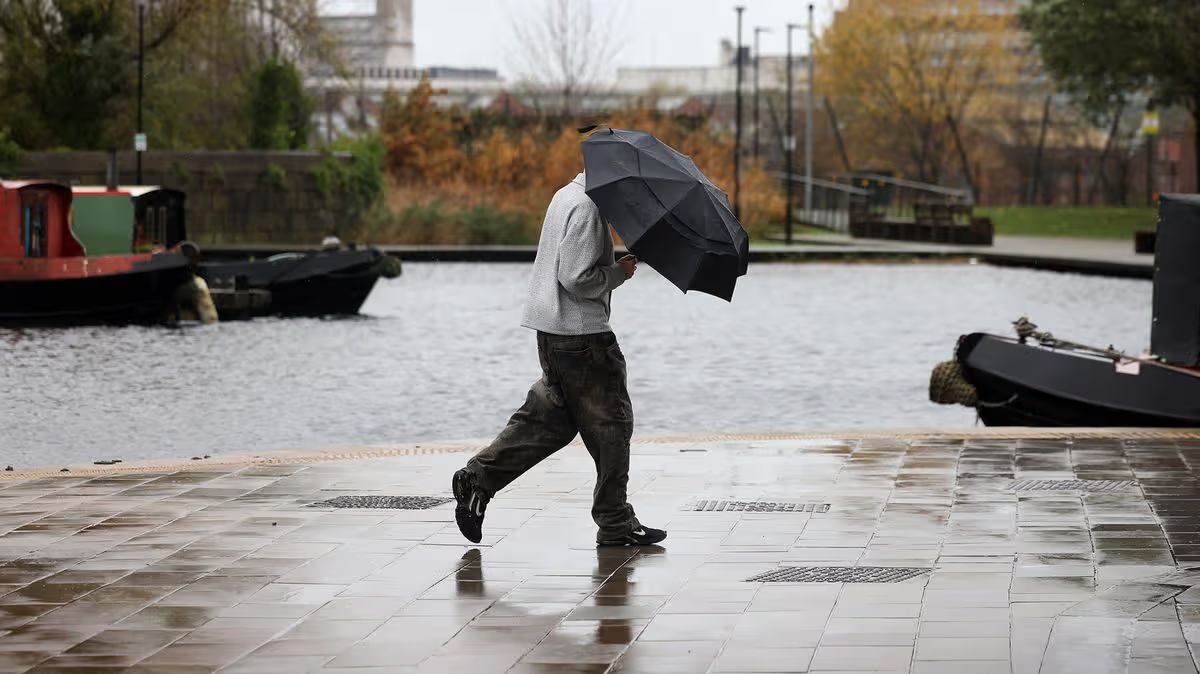
Power cuts warnings have been issued tonight as the Met Office say Storm Dave will “continue to deepen”, bringing heavy snow and gale-force winds to northern parts of the country. An amber weather warning for wind has been issued for parts of northern England, Scotland and Wales on Saturday evening, the Met Office added as it warned of flying debris possibly leading to “injuries or danger to life”.
The Met Office’s forecast said: “Storm Dave will continue to deepen as it moves north-eastwards. Heavy rain and snow will also bring some disruption.”
Advertisement
Gusts of wind of up to 66mph have been recorded in Capel Curig, north Wales, according to the forecaster. Meanwhile, the Energy Networks Association (ENA) – which represents electricity network operators – has warned of potential power cuts and issued safety advice following the weather warnings.
Get MEN Premium now for just £1 HERE – or get involved in our WhatsApp group by clicking HERE. And don’t miss out on our brilliant selection of newsletters HERE.
It said in a statement on Saturday: “The storm has the potential to affect local power infrastructure, increasing the risk of a power cut and fallen power lines. Network operators are increasing staffing for operational teams, and moving spare equipment to where the weather is expected to be most disruptive, so it’s ready to use if needed.”
The ENA shared advice for how to prepare for the severe weather, including to keep a torch ready and to boil water and keep it in a Thermos in case the power goes out.
Advertisement
The statement added: “You can call 105 for free in England, Scotland and Wales to report power cuts and receive updates. Remember, during power cuts, modern internet-powered landlines and mobile masts might not work.
“If you see damaged power lines or lines brought down over the coming days, stay well clear and call 105 for free to report it, or dial 999 if there’s an immediate danger to life. Make sure your neighbours are okay, especially if they’re elderly or vulnerable.”
Parts of Lancashire, North Yorkshire, Northumberland, north Wales and Scotland are covered by the amber warning, which comes into effect at 7pm on Saturday and is due to remain in place until 3am on Sunday. Up to 30 centimetres of snow could fall, as the Met Office has issued a yellow severe weather warning in Scotland for heavy snow and blizzards causing some travel and power disruption.
Greg Dewhurst, a Met Office meteorologist, said: “There is cold air across Scotland at the moment and, as the rain pushes across this afternoon, it is going to turn to snow. We’ll see heavy snow forming across parts of the Highlands as we go through the rest of the afternoon into the evening time and early hours, as much as 20 to 30 centimetres could fall over the higher ground, and five to 10 centimetres over lower ground.”
Advertisement
Those driving in the areas covered by the weather warning have been urged to check their journeys before setting off. Network Rail Scotland said the worst affected lines would be on the Ayrshire coast, the East Coast Main Line and in the north-east.
Nothing like the visit of a lower-league club to help the Chelsea storm pass, or at least to provide a break from the rain.
Chelsea were feeling sorry for themselves, but they are heading to Wembley now for a cup semi-final after a ruthless display of goalscoring pomp which lifted the mood and ensured smiles could return to the club. The question is for how long.
Upset emphatically avoided
How they needed that. More than about setting up a date with Wembley and an FA Cup semi-final as silverware potentially draws closer, this was about turning a page and stopping the rot.
Advertisement
The last time Port Vale and Chelsea faced off was in April 1929. The Valiants won 1-0. If anything could be gleaned from a match that took place 97 years ago to the month, it was that keeping focus would be key if slipping on this potential banana skin was to be avoided.
The visitors had shown spirit by beating Sunderland and Bristol City during an impressive cup run in which they have disguised their League One woes.
Until now. Chelsea were not messing around and showed no mercy. From the moment they edged ahead after barely a minute when Jorrel Hato swept home from a corner delivery unconvincingly flapped at by goalkeeper Joe Gauci, it became clear there were goals to be had, and Chelsea had them. Seven of them.
Hato was joined on the scoresheet by Joao Pedro – his 19th of a fine first season in west London – and by Tosin Adarabioyo, Andrey Santos and Estevao. Jordan Gabriel put the ball in his own net, and Alejandro Garnacho netted a late penalty with almost the last kick of the game.
Advertisement
Chelsea became the first team to score seven or more goals in an FA Cup quarter-final since 2006.
Estevao the entertainer-in-chief
A hamstring injury has disrupted Chelsea’s Brazilian wonderkid of late and an appearance off the bench in the dismal 3-0 defeat at Everton before the international break was no celebrated return to fitness.
Against Port Vale, he made his first start since the 4-0 FA Cup win at Hull in mid-February and he was the entertainer-in-chief at Stamford Bridge, where he is already loved, not yet a full season into his Chelsea career.
Advertisement
The teenager took defenders on, assisted his compatriot Andrey Santos with a fine corner, and then made it onto the scoresheet himself when snapping up the rebound from a Garnacho shot.
At 18 years and 345 days old, he became the youngest player to both score and assist in an FA Cup game for a Premier League side since Bukayo Saka for Arsenal against Bournemouth in January 2020. Fine company to be keeping.
Kavuma-McQueen’s deserved debut
The home crowd at Stamford Bridge had already been suitably impressed by this point, but there was more excitement to be had as 17-year-old academy starlet Ryan Kavuma-McQueen came on for his senior debut on 78 minutes.
Advertisement
The winger enjoyed a superb international break, scoring three exceptional goals in two games for England’s Under-17s and that, coupled with his starring role in the Chelsea academy teams, saw him handed the chance to impress.
Nervous at first, out on the right wing, Kavuma-McQueen grew into the game and ran at Port Vale with intent. There is plenty more to come from him, and Rosenior looked delighted when sending him on.
Proposals were initially submitted last year by Sunderland City Council to its own planning department for the land at Sheepfolds Industrial Estate, which is earmarked for major transformation under regeneration plans.
In August, SAFC owner Kyril Louis-Dreyfus confirmed the club was lodging a formal objection to the original plans, which he said could have “catastrophic operational consequences” for the club and the Stadium of Light.
The ground was built with scope to extend the stadium to a potential 63,000 capacity by extending the top tier around the entire bowl and the club has already submitted a pre-application notification for re-development and extension of the South Stand.
Stadium Of Light Credit: LDRS
Hundreds of objections were also lodged by residents over the application.
Advertisement
However, in February, the club and council confirmed a new and adapted plan for 450 homes had been submitted, which alleviated the previous concerns thanks to the inclusion of a larger “buffer zone” around the stadium.
A statement from SAFC said they “look forward to seeing the proposals progress through the planning process”.
At the latest meeting of the city council’s economic prosperity scrutiny committee, an update was given on when a decision will be made on the proposals.
Neil Guthrie, council director of development and property, said the application, which includes outline permission for a site masterplan featuring 450 homes, is “due to be determined by the planning committee on the 23rd of April”.
Advertisement
CGI image showing how the new residential community at Sheepfolds could look Credit CREO / SCC
The proposals also include consent for a programme of site remediation work.
He added that, subject to the outline consent being granted, a more detailed reserved matters application to allow construction of phase one of the residential development, which would provide more than 100 homes, is expected to be submitted in May.
This would be delivered by Vistry Group and would be on land immediately to the south of the Housing Innovation and Construction Skills Academy.
Meanwhile in the south east corner of the Sheepfolds site the council is developing proposals for a new mobility hub featuring car parking, EV charging, cycle storage and other services.
Advertisement
Mr Guthrie added designs are being finalised and a planning application for that is again due to be submitted in May.
The series was a defining show of the 2010s (Picture: Inc./Courtes/Shutterstock)
If you can’t get enough of BBC hit The Capture, starring Holliday Grainger, then we’ve got just the series for you to binge in the meantime.
Season 3 of the high-intensity drama hit our screens last month – but with episodes dropping weekly, you might be left with a thriller-shaped hole in your life the other six nights of the week.
Fear not, for we have you covered!
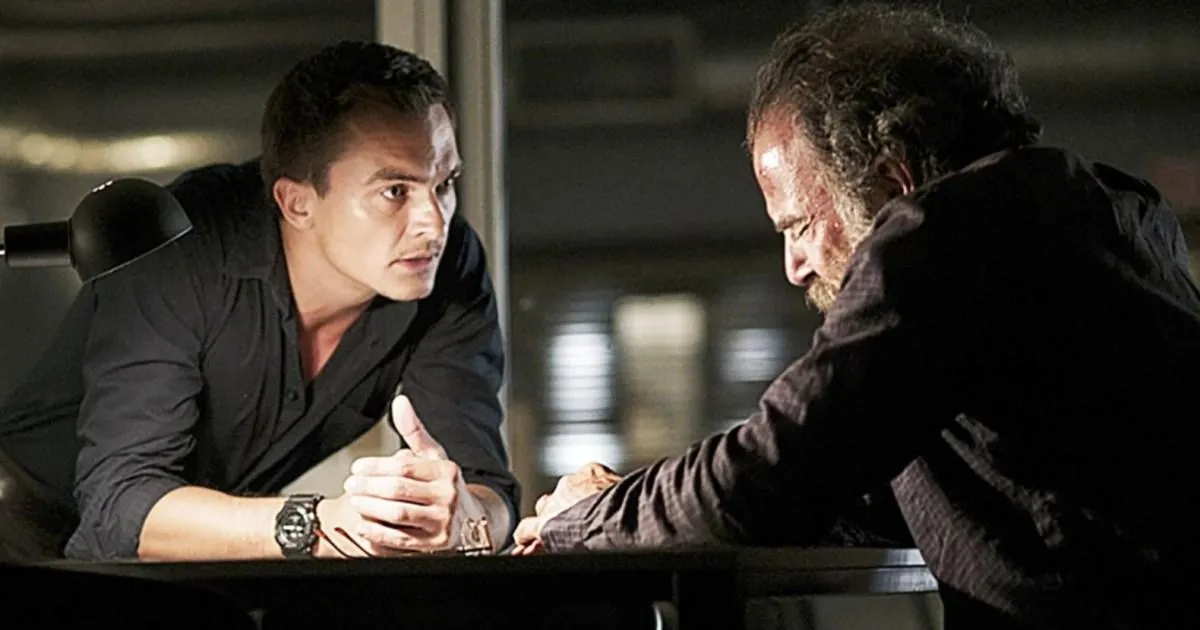
Homeland is on Channel 4’s free streaming service and shares some key elements with The Capture, making it a must-watch for fans of the BBC thriller.
Advertisement
In a thread on Reddit, 10thisisathr0waway10 agreed that the shows are ‘very similar’.
Both series explore themes of surveillance, technology, and conspiracy, and like with Rachel Carey (Holliday) in The Capture, Homeland has a strong female investigator at its core.
Before Homeland, Damian had starred in Band of Brothers (Picture: Jim Bridges)
Claire Danes won several major awards for her role in the series (Picture: Stephan Rabold/Showtime)
Carrie Mathison, played by Claire Danes, is a determined CIA officer whose instincts propel forward key investigations throughout the eight seasons.
Series one sees Mathison become suspicious that Nicholas Brody (Damian Lewis), a US Marine who has returned home after seven years missing in action, has been radicalised by terrorist group al-Qaeda and poses a threat to the country’s security.
It premiered in 2011 and was a huge hit with audiences.
Advertisement
Season one boasts a 100% rating on Rotten Tomatoes’ Tomatometer, with rave review from viewers like Pham L who said: ‘The plot is gripping and the acting is excellent. Not a single moment feels overdramatic.
‘It’s probably the best show I’ve watched in the past five years, especially if you’re interested in the complexities of US-Middle East relations in today’s world.’
Roberto D said that the show was his ‘favourite series of all time’. They went on: ‘There’s something truly special about it – a depth, an energy, a tension that never fades, even after eight seasons.’
Channel 4 began streaming Homeland in 2012 (Picture: Mark Seliger/Fox)
Mandy Patinkin plays a senior CIA officer in the thriller (Picture: 21/Showtime/Kobal/Shutterstock)
Matt S agreed: ‘This show is one of the best ever! It never gets boring and I’ve lost so much sleep because of it.’
The series ran until 2020, until it eventually concluded for good.
Advertisement
Aside from Damian and Claire, you might also recognise actors like Timothée Chalamet, Mandy Patinkin and David Harewood, to name a few.
Homeland is available to stream on Channel 4.
Got a story?
If you’ve got a celebrity story, video or pictures get in touch with the Metro.co.uk entertainment team by emailing us celebtips@metro.co.uk, calling 020 3615 2145 or by visiting our Submit Stuff page – we’d love to hear from you.
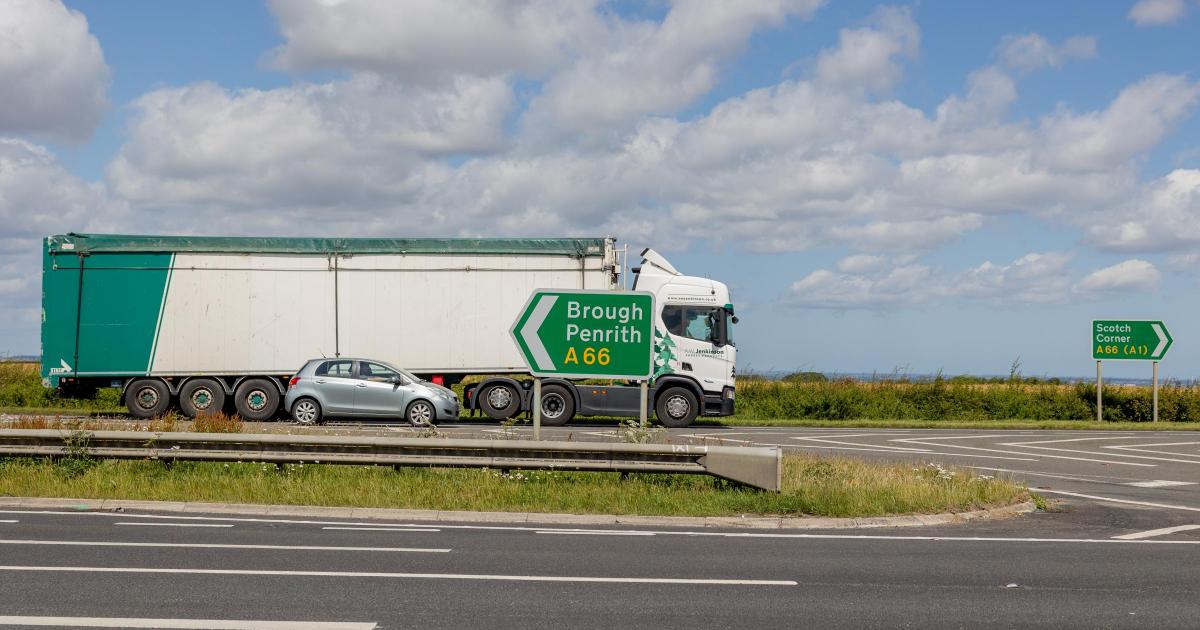
Durham Police say the major A-road will be inaccessible to high-sided vehicles at 7pm and all other vehicles at 9pm between Bowes and Brough tonight (Saturday, April 4) due to the storm.
The Met Office has warned of “disruptive and potentially damaging winds” that could reach 60mph from 7pm on Saturday evening to 3am in the early hours of Sunday.
The amber weather warning covering the North East. (Image: MET OFFICE)
An amber weather warning is also in place and extends across the region as the storm is set to hit the North East from 6pm.
A police spokesperson said: “The A66 Trans-Pennine between Bowes and Brough will be closed both ways from 9pm this evening (April 4) owing to Storm Dave – this is due to the high wind gusts – it will likely close to high sided vehicles sooner due to the same.
Advertisement
“It is worth checking ahead of any scheduled journeys as Storm Dave is likely to cause transport related issues over the next couple of days.”
Initially, the region was placed under a yellow alert but the Met Office now says flying debris could cause a danger to life, power cuts may occur and buildings may be damaged.
Motorists have been advised to drive slower in the blustery conditions, people have been urged to stay indoors and those living along the coast are warned to stay away from large waves.
Advertisement
Met Office deputy chief forecaster, Tom Crabtree, added: “Storm Dave will form and rapidly deepen on Saturday as it approaches the UK from the west.
“By Saturday afternoon winds will strengthen significantly, with gusts of 60-70mph expected at times across parts of Scotland with the potential for gusts of 80-90mph in exposed coastal locations in Scotland.
“Gusts of 50-60mph are likely more widely in northern Britain.
“As well as strong winds, Storm Dave will also bring heavy snowfall over the hills in northern Scotland where up to 10-20cm of snow could accumulate.
Advertisement
“Along with the strong winds this will lead to blizzard conditions.
“Elsewhere there will be heavy spells of rain as the system moves through eastwards across the UK.”
Celtic are five points behind both Rangers and Hearts
Anthony Evans Trainee Live Sports Writer
19:59, 04 Apr 2026
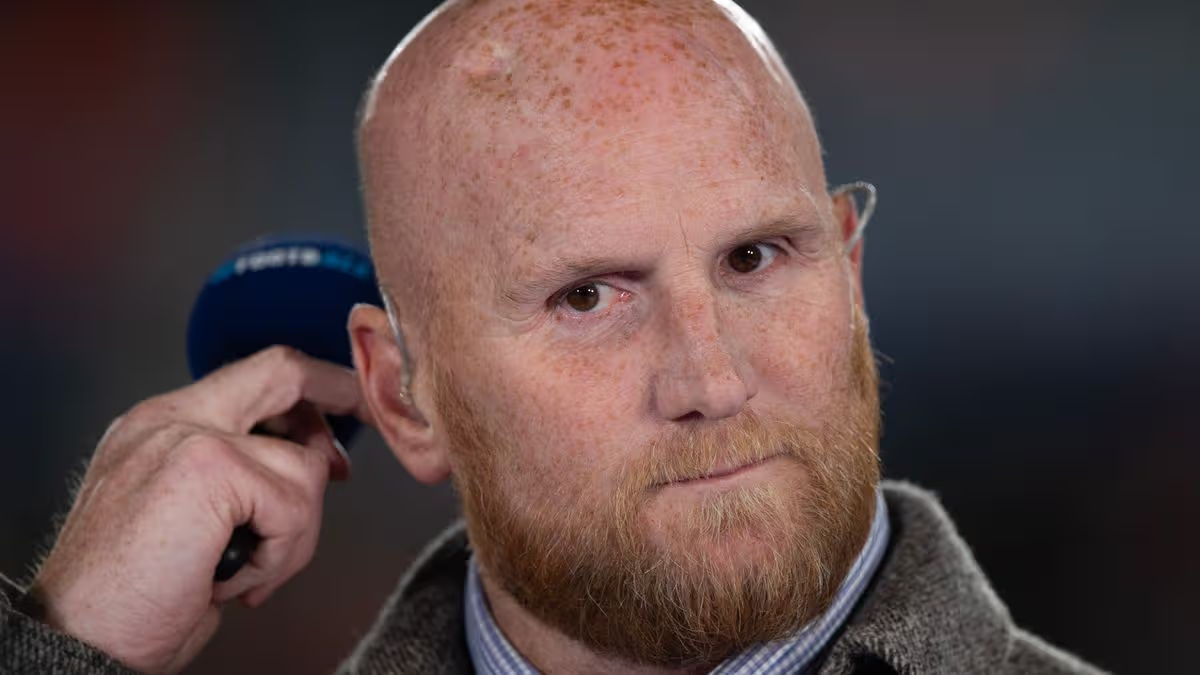
John Hartson has taken aim at the Celtic squad for their inconsistent performances, claiming they only raise their game when it suits them.
The former Parkhead striker believes experienced winger James Forrest deserves a place in the starting eleven as the title race intensifies.
Advertisement
Following a disappointing 2-0 loss at Dundee United prior to the international break, Martin O’Neill’s men now trail both Rangers and Hearts by five points.
Hartson – who netted 109 times in 201 appearances for the Hoops between 2001 and 2006 – has slammed the present squad for being ‘beat up’ during matches, reports the Daily Record.
On the Let Me be Frank Podcast with former Celtic forward Frank McAvennie, when questioned about what alterations he’d implement, Hartson responded: “I would be playing James Forrest. I know he’s f****** 57 years of age. I would play him.
“He’s the only one, for me, who is direct and looks to take players on. Tounekti does it on the other side. Tounekti has shown signs that he can produce things.
Advertisement
“But like I said. You have to do it, week in and week out, especially with the resurgence of Hearts. It’s a difficult place to go, at the best of times. It can be hostile there. Derek McInnes is doing a great job.”
“I thought Hearts would fall away. Halfway through the season, I thought Celtic would do what they normally do. They would come on strong. Momentum, and everything else.”
“But you can’t be willy nilly. You can’t just turn it on when you want to turn it on. Larsson did it week in, week out. Year in and year out, and so did all the other players.”
“We lost the odd game. Of course, we lost the odd game. Good teams lose football matches. It happens. But you can’t be at Celtic and play in second gear. You have to be at it every single week.”
Advertisement
“The man who is in charge now, Martin O’Neill, made sure that was the case. You have to play every single week.”
“I just look at the players, and they just trudge off, and they have been beat up. They don’t compete. They pull out of headers. Pull out of tackles. That’s not Celtic players you have seen in the past.”
One firm, Taiwan Semiconductor Manufacturing Company (TSMC), produces more than 90% of the world’s most advanced semiconductor chips. These chips are essential for smartphones, artificial intelligence, high-performance computing and cutting-edge military systems.
Taiwan’s dominance of advanced chips acts as a chokepoint for the global economy. Days or weeks without their manufacturing would affect the supply and price of numerous products around the world. This is comparable to how the current disruption to shipping in the Persian Gulf due to the Iran war is affecting oil-dependent markets globally.
Taiwanese semiconductor manufacturing supremacy has transformed the island nation into what I have described in my research as a “niche superpower”. It wields outsized global influence by commanding a strategically indispensable industry.
Taiwan did not stumble into this position. In the 1970s, Taiwanese technocrats recognised that the nation could not immediately compete at the world’s electronics frontier. One of them was Kwoh-Ting Li, then minister of economic affairs, who is often referred to as the “father of Taiwan’s economic miracle”.
Advertisement
At that time, Taiwan lacked the financial capital and technological skills to compete with industry leaders such as Japan and the US. So rather than trying to dominate the entire semiconductor industry from design through to production, Taiwanese policymakers focused on building capabilities in precision manufacturing. This is the most operationally demanding part of the semiconductor value chain.
Established in 1973 by the Taiwanese government, the Industrial Technology Research Institute carefully acquired semiconductor process technology through licensing agreements with the now defunct US firm Radio Corporation of America (RCA). It then trained a generation of Taiwanese engineers.
TSMC produces over 90% of the world’s most advanced semiconductors. jackpress / Shutterstock
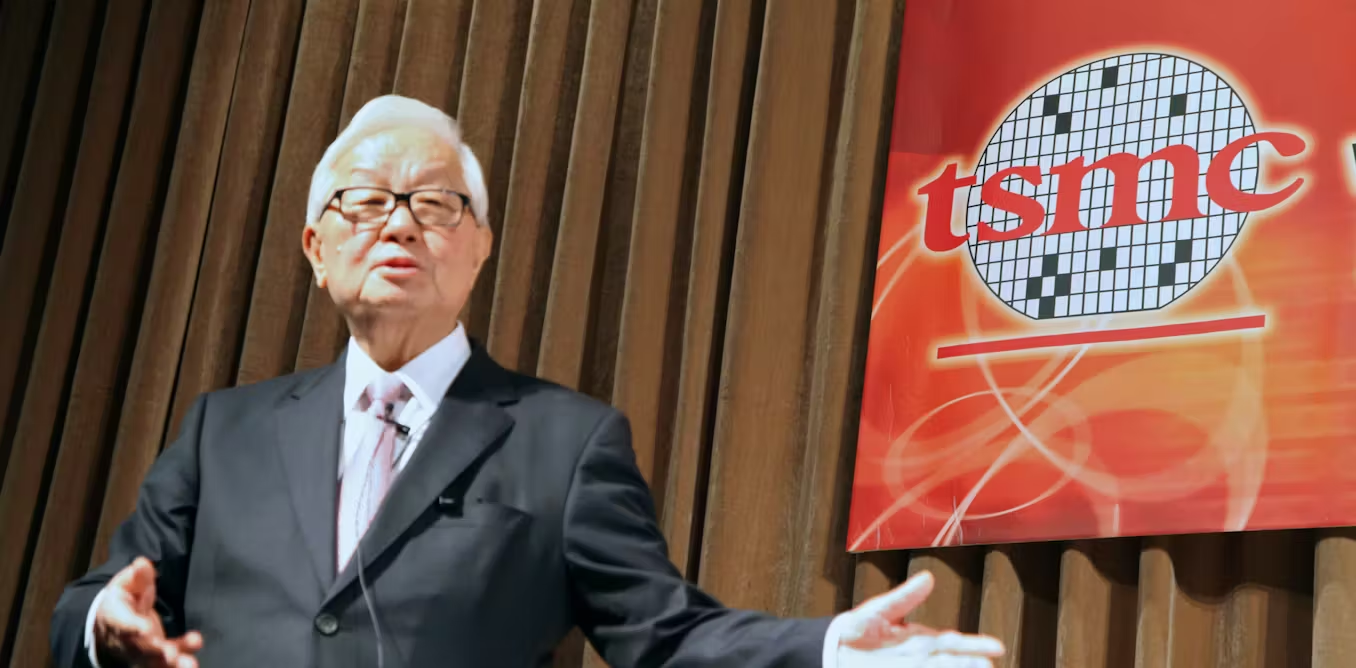
The pivotal moment came in 1987, when Morris Chang established TSMC. Chang, a US-trained engineer who had spent decades at American semiconductor multinational Texas Instruments, devised what is now known as the “pure-play foundry” model.
Rather than designing and manufacturing its own branded chips, this meant that TSMC would manufacture chips for other firms. This strategic choice was transformative because it reassured American and European semiconductor companies that TSMC would not compete with them. It allowed major tech firms such as Qualcomm and later Nvidia to outsource chip production to Taiwan without fear of intellectual property leakage or strategic rivalry.
Advertisement
The Taiwanese semiconductor industry grew within the Hsinchu Science Park, a major industrial cluster south of the Taiwanese capital of Taipei. By the early 1990s, Hsinchu Park hosted more than 140 chip manufacturing firms and employed around 30,000 workers. The strength of the cluster attracted legions of Taiwanese engineers back from the US, helping Taiwan become the global leader in the production of advanced semiconductors.
The ‘silicon shield’
Taiwan’s semiconductor dominance has played an overt role in protecting the island from its existential threat – a Chinese invasion. This phenomenon was explicitly named in 2021 in an article published in Foreign Affairs magazine, where the former Taiwanese president, Tsai Ing-wen, argued that Taiwan’s semiconductor industry acts as a “silicon shield”.
The dependence of the global economy on Taiwanese-made advanced chips, she argued, means the disruption caused by a Chinese invasion would trigger catastrophic global economic consequences. Taiwan’s allies would thus be compelled to come to its defence.
In recent years, Taiwan’s silicon shield has come under threat. Following the start of US export restrictions on advanced chipmaking equipment to China in 2020, Beijing has accelerated its efforts to build indigenous capacity in chip manufacturing. It has significantly increased investment in its semiconductor industry.
Advertisement
Semiconductors were the underperformer in the Made in China 2025 strategy, through which Chinese leadership aimed to transform their nation into a high-tech manufacturing superpower. China fell short of its goals for the localisation of semiconductor production and global market share, missing targets by the 2025 deadline.
However, Chinese chip manufacturers like HiSilicon and Semiconductor Manufacturing International Corporation have been gaining momentum. A proposal by 13 Chinese chip industry executives in March outlined aims to increase self-sufficiency to 80% by 2030. China’s semiconductor self-sufficiency is currently around 33%.
At the same time, Washington is pushing to bring semiconductor manufacturing back onshore. Biden-era initiatives such as the Chips and Science Act offered incentives for TSMC’s sprawling manufacturing facility in Arizona, which opened in 2022 as part of US efforts to boost domestic chip production.
These incentives for TSMC included up to US$6.6 billion (£5 billion) in direct investment and significant tax credits. TSMC committed an initial US$65 billion to the plan, with the Trump administration announcing in March 2025 that the company would boost its US investment by a further US$100 billion.
Advertisement
Elon Musk also recently announced plans for advanced chip facilities in Texas for his two companies, Tesla and SpaceX. In light of Musk’s concerns that companies like TSMC are not producing the volume of chips his companies need, the so-called “Terafab” venture aims to consolidate every stage of the semiconductor production process under one roof and is expected to cost in the range of US$25 billion. Other companies investing in chip fabrication in the US include Micron, Texas Instruments and Intel.
Despite US and Chinese efforts, replicating Taiwan’s manufacturing ecosystem is difficult. It requires not only capital and equipment, but also knowledge that has been accumulated over decades as well as dense supplier networks and an unparalleled engineering workforce.
TSMC has struggled to hire talent in Arizona, and has resorted to flying thousands of workers in from Taiwan in a bid to improve the skills of locals. And while TSMC is now producing semiconductors at the cutting edge of 2-nanometre scale, the Chinese self-sufficiency goals aim to have “entirely domestically produced equipment” for the less sophisticated 7-nanometre and 14-nanometre generations of chips.
The difference between 2nm and 7nm chips is significant – a 45% increase in performance while using 75% less power. The narrower chips are used for advanced processes such as cutting-edge AI, while the wider ones are used in a broader range of electronics, like smartphones, desktop processors and automobiles.
Advertisement
The CEO of TSMC, Che-Chia Wei, announcing a US$100 billion investment in US chip manufacturing alongside Donald Trump at the White House in March 2025. Samuel Corum / EPA
Taiwan’s semiconductor story is ultimately one of strategic foresight. By choosing manufacturing over design, embedding itself within US-led technological networks and cultivating world-class process expertise, Taiwan transformed structural vulnerability into structural power.
Through its semiconductor dominance, Taiwan stands out as the quintessential niche superpower. But history shows that superpower status, including in niches, is never permanent. The technological frontier moves, rivals learn and allies hedge.
For Taiwan, remaining indispensable to the global economy will require not only staying ahead technologically. It will also require carefully orchestrating the political, financial and human capital foundations that made its silicon shield possible in the first place.
Southampton, meanwhile, are on a run of 14 games unbeaten in all competitions and overcame Premier League opposition in Fulham in the last round thanks to an injury time penalty. The winners of this tie will progress to the FA Cup semi-finals, learning their opponents when the draw takes place tomorrow. Follow the game LIVE below with our dedicated match blog, featuring expert insight and analysis from Matt Verri!
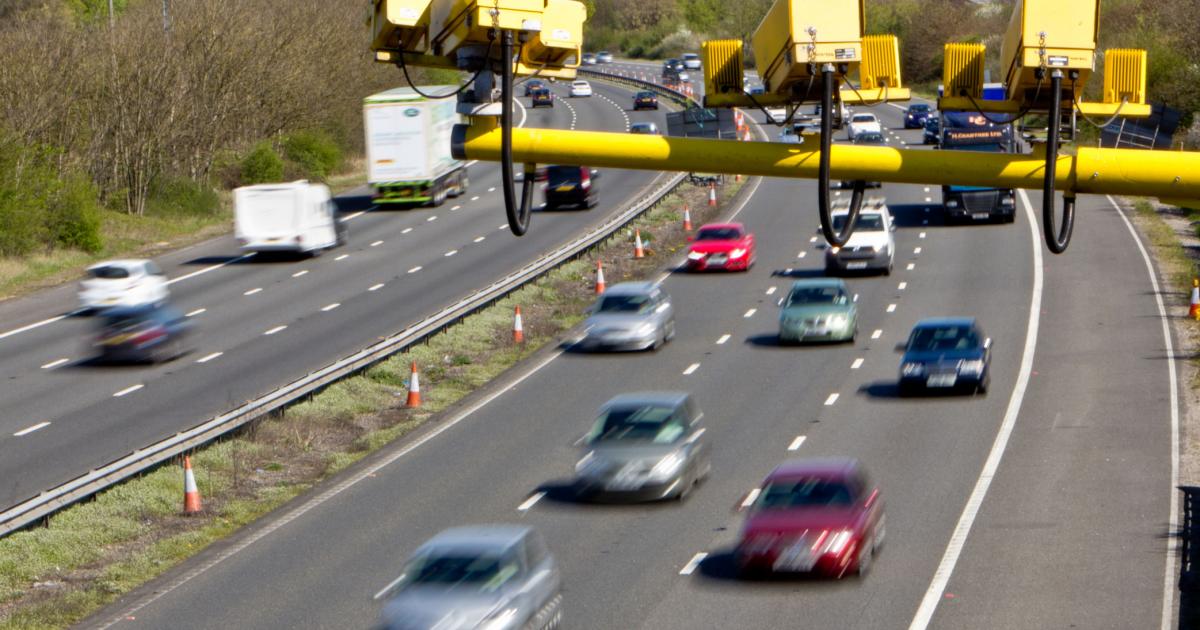
The Department for Transport revealed that all speed cameras were to be painted yellow by October 2016.
This should make most of them easier to see, but what about speed cameras on the other side of the road? Well, you might be surprised to know the answer.
Can you get caught speeding on the other side of the road?
In a way, yes.
Advertisement
Many motorists believe that if a speed camera is located on the other side of the road, they can’t get caught speeding. However, this is not strictly true.
Fixed speed cameras can’t usually catch motorists on the other side of the road, but mobile police vans or manually operated speed guns most certainly can.
Mobile vans can be parked anywhere, so it’s best to always stick to the limit.
Advertisement
Since the first speed camera was installed in the UK in 1991, drivers have been trying to trick the system and avoid being caught.
You should always drive safely and stay within the speed limit. This protects you and your passengers as well as all other road users and pedestrians.
It can also cost you penalty points and a speeding fine; if you are a repeat offender, you can lose your driving license altogether.
What happens if I am caught speeding?
Advertisement
It all comes down to the circumstances within which you were caught speeding, and how much you were more than the limit.
The minimum penalty for being caught speeding on the UK’s roads is a £100 fine.
In some circumstances, police can offer the option of attending a speed awareness course – an alternative to a fine and penalty points.
Have you ever been caught speeding? Let us know in the comments
Every mission to deep space is fraught with danger. A hardware failure during launch, an equipment malfunction far from Earth, or a small space rock hitting the vehicle are all scenarios astronauts will train for.
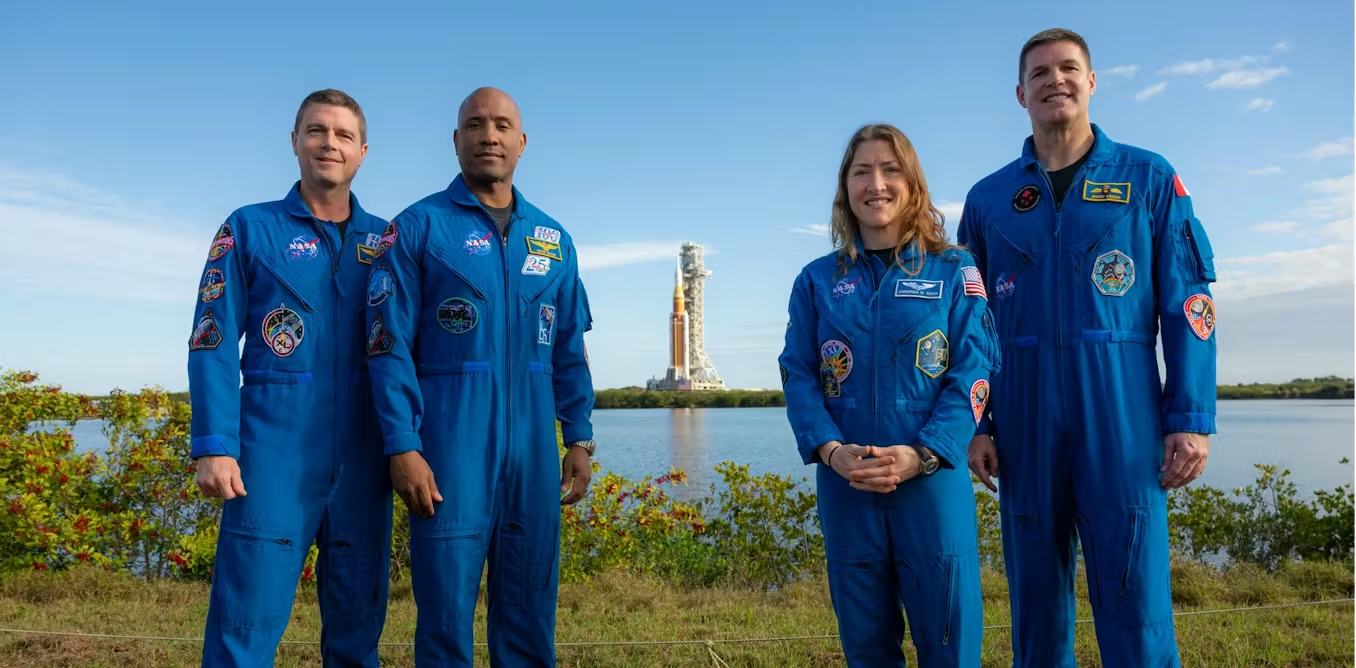
As humans set off on the Artemis II mission, visiting the Moon for the first time in more than 50 years, one persistent threat they face is from solar radiation.
Intense bursts of radiation from the Sun, known as solar particle events, can endanger the lives of space travellers, particularly those venturing beyond low Earth orbit (LEO). During these events, high speed, charged particles stream out from the Sun and into space.
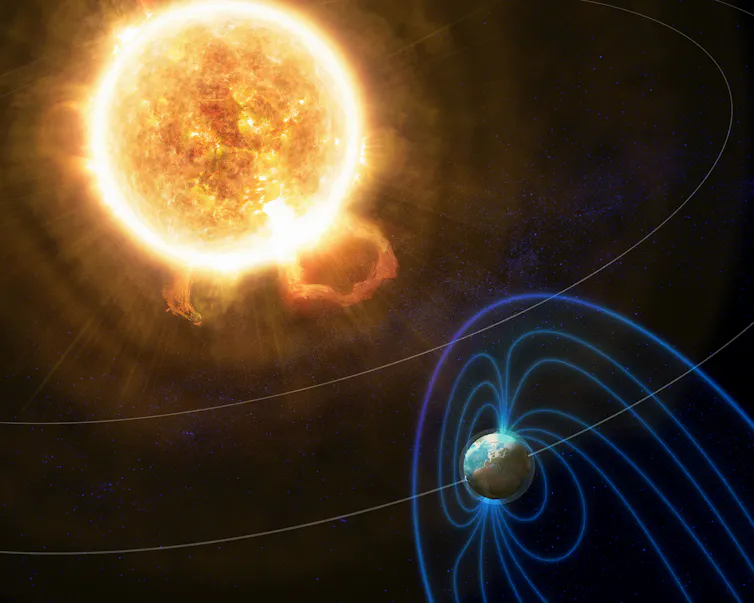
Exposure to these particles could lead to radiation sickness or, in the worst cases, prove fatal. On space stations and other crewed vehicles travelling in LEO, astronauts are afforded a high degree of protection by the magnetic bubble surrounding Earth (the magnetosphere).
Advertisement
But in interplanetary space, where Artemis II is headed, humans are much more exposed to outpourings of solar radiation.
The Sun’s magnetic activity fluctuates on a cycle lasting roughly 11 years. During this cycle, sunspots (areas of reduced temperature caused by intense magnetic fields) can cause eruptions known as flares, as well as solar particle events. These rise and fall in frequency with the solar cycle.
Solar activity (represented here by sunspot numbers) fluctuates on an 11-year cycle. Noaa
The current solar cycle reached its maximum, when the Sun is generally at its most active, in 2024 and is now in a slowly declining phase leading to the minimum, when the Sun is quietest. The current cycle should reach the minimum in 2031.
Advertisement
Not all solar cycles are the same and the current one has been rather undistinguished in terms of activity, as was the previous cycle that reached maximum in 2014. Recently, however, the Sun woke from its slumber.
On November 11 2025, a large solar particle event increased ground level radiation by about 145% for two hours, as measured by the University of Surrey’s neutron monitor at the Met Office station at Lerwick, Shetland.
The Earth’s magnetosphere acts as a shield, protecting the planet from solar particles. Esa
This was also detected by University of Surrey SAIRA (Smart Atmospheric Ionising Radiation) monitors installed on two transatlantic flights and on rapid response meteorological balloon flights at Lerwick, Cambourne and near Utrecht in the Netherlands.
Work is in hand to unscramble this complex event to determine the radiation increases worldwide using the University of Surrey computer model MAIRE (Model for Atmospheric Ionising Radiation Effects). This calculates radiation levels at aviation altitudes for normal atmospheric conditions, as well as for enhanced radiation events caused by increased solar activity.
Three immediate research papers are in production to describe the radiation monitors and their calibration, to summarise the flight data and to compare the data with available models.
Advertisement
A close call
The solar particle event on November 11 2025 serves to tell us that, whatever the probabilities might be, the Sun can always take us by surprise.
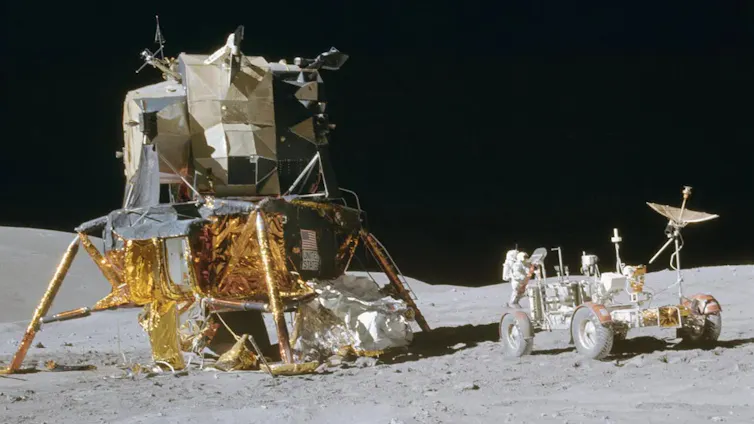
To underline the importance of such events for deep space missions, let’s rewind the clock to 1972. At the time, the Sun was in a similar declining phase in its 11-year cycle as we are today. Then, between August 2 and August 11 1972, the Sun unleashed one of the largest solar particle events of the space age.
A massive solar particle event occurred between the Apollo 16 (pictured) and Apollo 17 missions in 1972. Nasa / Charles M. Duke Jr
This gigantic release of charged particles from the Sun occurred in between the Apollo 16 (April 1972) and Apollo 17 (December 1972) missions to the Moon.
This event was much bigger than the one in November 2025 – by a factor of 40. If it had taken place while astronauts were in space, the radiation dose could have caused severe illness or even death.
The Apollo crews had a lucky escape. But the solar particle event made an impact on Earth. The ensuing geomagnetic storm is thought to have caused 4,000 US-laid mines to spontaneously detonate in Hanoi harbour during the Vietnam war, causing confusion and alarm on both sides.
Advertisement
Travelling to the Moon means astronauts are no longer protected by the Earth’s magnetic bubble, or magnetosphere. Nasa
There are ways to prepare for similar events in future. The most dangerous aspect of this radiation is its high energy component, which can penetrate shielding on spacecraft. The Surrey Space Centre Space Environment & Protection team are currently working on a detector, called the High Energy Proton instrument, that definitively measures this high energy component of solar particle radiation.
It does this through the light flashes emitted when the particles transit a transparent medium at velocities exceeding the speed of light. Astronauts often report seeing such flashes of light, even with their eyes closed, that can be caused by solar particles or high-energy cosmic rays passing through the retina or optic nerve.
The University of Surrey radiation detectors could now fly on a lunar orbiting mission towards the end of the decade. On this mission, they will characterise the danger to lunar bases as well as to the Earth. Nasa is planning to spend US$20 billion (£15 billion) on a base at the south pole of the Moon. A separate outpost is planned by China and Russia.
Radiation warning systems can give astronauts the time they need to retreat to storm shelters within a base or spacecraft where increased and specially designed shielding is used.
Advertisement
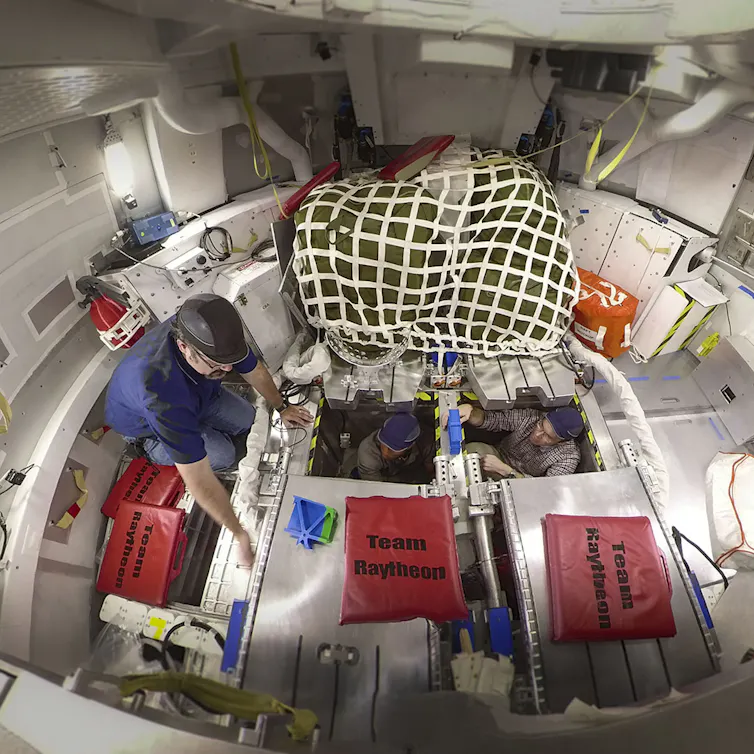
Engineers use storage lockers as a radiation shelter inside a mockup of Orion. Nasa
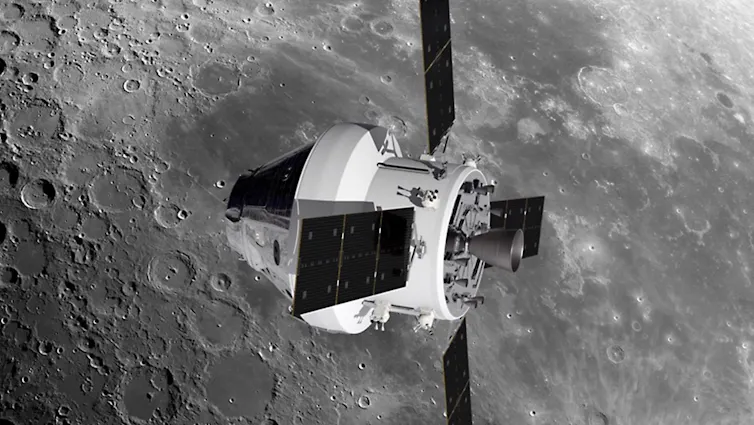
If astronauts travelling in Orion – the spacecraft used on Artemis II – receive advance word of a solar storm, they are instructed to get into storage lockers in the floor of the spacecraft. This places the crew next to Orion’s heat shield, making this area one of the most protected parts of the vehicle.
Warning systems can also help on Earth. During periods of high solar radiation, controllers could instruct aircraft to fly at lower altitudes and latitudes – and in extreme cases remain grounded.
Computing revolution
One big difference between the Apollo and Artemis missions is in the rapid development of microelectronics since the 1960s and 70s. This has led to trillion-fold increases in computer memory density and thousand-fold improvements in speed.
The Apollo computers were pioneering, but struggled to cope with the workload as Neil Armstrong and Edwin “Buzz” Aldrin descended to the lunar surface during the Apollo 11 mission in 1969. However, there is a downside to this as the technology packed into modern spacecraft is vulnerable to radiation.
The charge depositions from individual particles often exceed the amount required to change the state of the computer memory bits. In some cases it could destroy the device. It is now arguable whether the greater hazard from solar particle events is to astronaut health or to the flight electronics aboard spacecraft.
In 1972, the Apollo astronauts were very lucky. In this new age of exploration, when so many nations have designs on travel to deep space, we can’t afford to leave astronaut safety to the whims of fortune.





















































You must be logged in to post a comment Login