“Soccer never saw such a frenzy of hugging and kissing as marked the Koreans’ victory celebrations at the final whistle,” said reporter Jack Fletcher, as, 60 years ago tomorrow, 17,800 spectators in Ayresome Park applauded.
![North Korea players on the final whistle at Ayresome Park]() North Korea players on the final whistle at Ayresome Park
North Korea players on the final whistle at Ayresome Park
Seventy countries had entered the 1966 World Cup, to be hosted by England, and Fifa determined that the 16 finalists would be made up of 10 teams from Europe, four from South America, two from North and Central America and one from Asia, Africa and Oceania.
African nations boycotted the competition, saying it was unfair, and so a mini-tournament was arranged between Australia, North Korea, South Korea and South Africa.
But South Africa were banned because of apartheid, and South Korea, who had performed badly at the 1964 Olympics, were so concerned at the potential for embarrassment at the hands of their neighbours North Korea that they found excuse to withdraw.
This left just Australia and North Korea, and the Koreans won the two-legged play-off 9-2.
Much to the horror of the British Foreign Office, the Democratic People’s Republic of Korea (DPRK) were on their way to Britain. It was only 13 years after the end of the Korean war, which had been, as ever, a proxy battle between the United States, who supported South Korea, and Russia and China, who backed North Korea.
The British, of course, backed the US, and after the war ended in 1953 they refused to acknowledge DPRK as a legitimate state.
The Foreign Office tried to block the Korean players’ visas but had to back down when Fifa said the tournament would be played elsewhere.
Still, though, the British government ordered British newspapers not to refer to the “Democratic People’s Republic of Korea” and so the Echo called the country “North Korea” throughout, and it was fixed so that there were only national anthems at the opening and closing games meaning North Korea’s Aegukka, or “patriotic song”, was unlikely to ever be heard.
North Korea were drawn in Group 4, along with the USSR, Italy and Chile, which was based in the North East.
The 1966 World Cup provoked the updating of stadiums around the country but as Newcastle United and the city council were at loggerheads over St James’s Park, only Sunderland’s Roker Park and Middlesbrough’s Ayresome Park were ready to host matches.
The Russians stayed in Sunderland and trained on Durham university’s grounds – the Russian flag was stolen from outside the university sports centre and strangely handed in to The Northern Echo 51 years later – while the Italians stayed at Houghall and also used the university grounds.
The Chileans stayed at a hotel in Surrey and caught the train up to games, while the Koreans opted to stay at the St George’s Hotel, next to Teesside Airport.
They tried training at various grounds, including the Clairville Stadium in Middlesbrough, until Billingham Synthonia’s Northern League ground caught there eye – not the immaculate first team pitch but two reserve pitches separated by a cricket wicket out the back.
The Koreans, not understanding the delicacies of cricket, asked that the goals on the reserve pitches be rotated through 90 degrees so they could play across the wicket – this, they said, would ensure that the sun was in the position it would be when they played at Ayresome Park.
The ICI hierarchy, which kept the Synthonia ground, was consulted and, fearing another Korean War, reluctantly agreed.
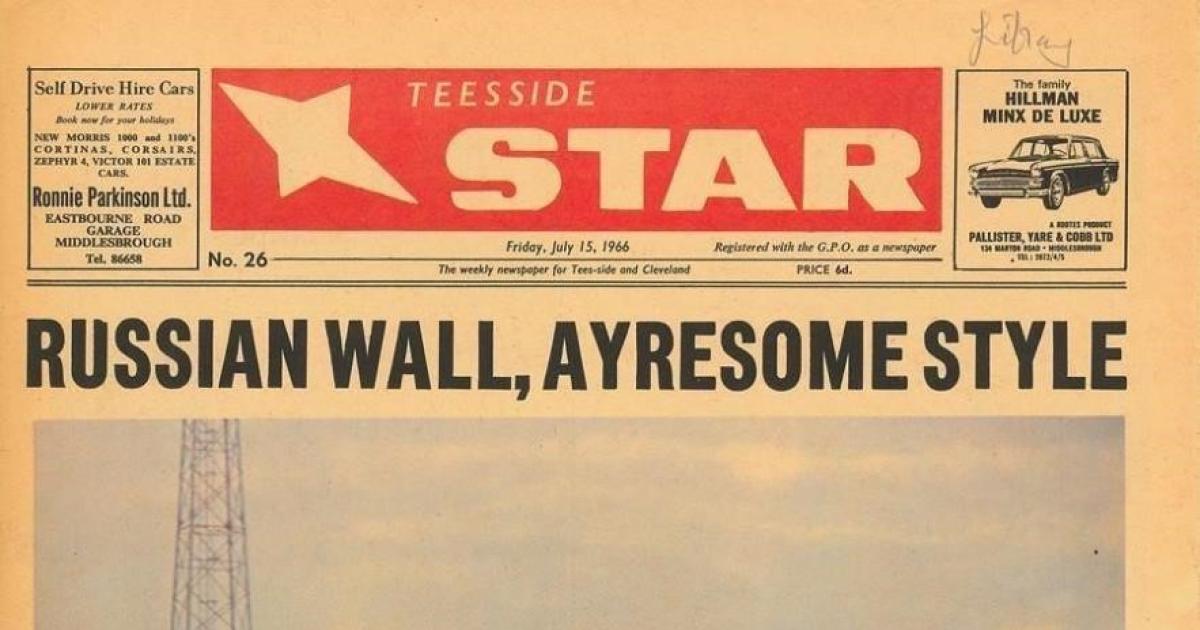
![The Teesside Star, a left wing paper, reports on North Korea's defeat by Russia at Ayresome Park in 1966. Picture: Teesside Archives]() The Teesside Star, a left wing paper, reports on North Korea’s defeat by Russia at Ayresome Park in 1966. Picture: Teesside Archives
The Teesside Star, a left wing paper, reports on North Korea’s defeat by Russia at Ayresome Park in 1966. Picture: Teesside Archives
It seemed not to work in the Koreans’ favour, as in their first match, on July 12, they were beaten 3-0 by the USSR. “The Russian steamroller fulfilled expectations,” said Jack Fletcher’s report. “It was proof that at any level of football the good ‘uns have an edge on the good little ‘uns. Korea can have little hope of living with the giants.”
![]() The North Korean team outside the Saint George Hotel at Teesside Airport, which was their base for the group stage of the 1966 World Cup
The North Korean team outside the Saint George Hotel at Teesside Airport, which was their base for the group stage of the 1966 World Cup
But the people of Teesside were falling in love with the Koreans. They loved the friendly way they went in the ICI Social Club after training and signed autographs; they admired their nimble, fearless attacking play and the way they didn’t cynically kick their opponents; they felt a natural affinity for the plucky underdog, and they loved the fact that they played in red – just like the Boro.
Three days after the Russian defeat, the Koreans were back in action at Ayresome Park, taking on Chile.
“A last minute goal from Pak Seung Jin gave the outsiders an unexpected point,” said Jack Fletcher as Korea’s penalty went in. “Ayresome Park erupted in a great gust of joy…
“Who could have imagined such a remarkable salute for a goal by a team of unknowns from the other side of the globe whose line-up reads like the inside of a Chinese restaurant menu?
“It is a curious commentary on life that while, in the higher realms of international affairs North Korea lies beyond the pale, her footballers have gained an affection which, in this bit of England at least, is unmatched by any foreign team.”
Middlesbrough mayor Jack Boothby had the Ayresome Gardens laid out as a floral football pitch in their honour, but still everyone expected them to be going home soon.
When the USSR beat Italy 1-0 at Roker Park on July 16, it set up an intriguing final match at Ayresome Park on July 19: Italy needed a point to go through but if Korea could somehow get the two points for a win, they would qualify for the next stage and send the Italians home.
The Italians cancelled their appearance at a Sunderland civic banquet the night before the match and all their players were tucked up in bed by 10pm.
“Italy, one of the most powerful soccer nations in Europe, will be fighting for their World Cup lives when they meet little North Korea at Middlesbrough,” said the Echo’s big-match preview. “Once strong contenders to win the Jules Rimet Trophy, they are now visibly shaken by poor performances against Chile and Russia.”
![]() The North Koreans defending against the Italians at Ayresome Park 60 years ago
The North Koreans defending against the Italians at Ayresome Park 60 years ago
Italy started the match strongly, but Korea’s keeper, Li Chan Myung, a slender figure with his dark top tucked tightly into his dark shorts, made several outstanding saves.
But the game changed in the run-up to half-time. On 35 minutes, Giacomo Bulgarelli, perhaps the best Italian midfielder of all time, was stretchered off with a bad knee injury. As there were no substitutes, Italy were down to 10.
![]() Pak Doo-Ik scores past Italian keeper Enrico Albertosi at Ayresome Park 60 years ago
Pak Doo-Ik scores past Italian keeper Enrico Albertosi at Ayresome Park 60 years ago
Then, on the 42nd minute, from just to the right of the penalty spot, Pak Doo Ik swivelled swiftly and powerfully side-footed a half volley into the far corner past Enrico Albertosi, Italy’s highly regarded goalkeeper.
In the second half, Li Chan Myung was again busy but as Italy ran out of puff, Korea began to make chances.
“Amid a great cheering chorus from all round the ground, the Koreans got on top in the second half and methodically destroyed Italy’s hopes and drained her pride,” said the Echo.
“The delighted crowd chanted ‘easy, easy’ as the Koreans, their confidence mounting, repeatedly put Italy to flight.”
![]() North Korea line up to face Italy in 1966.Picture courtesy of the Teesside Gazette
North Korea line up to face Italy in 1966.Picture courtesy of the Teesside Gazette
On the final whistle, the mighty Roman empire had crumbled. Italy, the first country to win the World Cup twice, had been humbled – by Middlesbrough’s marvellous minnows.
“It was largely due to the encouragement of the crowd that we played so well and beat Italy,” the president of the Korean Football Association told the Echo.
The coach, Myung Rye-hyun, said: “The side has improved with every game but our success is also due to the support given by the citizens of Middlesbrough and because our players fought so hard for the honour of the fatherland.”
Not expecting to progress deep into the tournament, the Koreans had not booked further accommodation. Some sources suggest they stayed at the airport; others that they took over Ushaw College, near Durham, which the Italians no longer needed and, coming from a secular Communist state, were astounded by all the religious iconography.
They finally left the area on the eve of their quarter-final against Portugal at Everton’s Goodison Park on Merseyside. Alderman Boothy invited them for a farewell lunch, and the Korean Minister for Sport, Kim Ki Su, told the Echo: “We are reluctant to leave so many god friends for we have had joyous days with you. I have made many trips round the world but your people have shown sincerity from the bottom of their hearts.”
Up to 3,000 Teessiders travelled to Goodison Park on July 23, 1966, and watched Korea score in the first minute and roar into a shock 3-0 lead.
But Portugal legend Eusebio turned the match, scoring four and leading his side to an amazing 5-3 victory.
The Koreans were on their way home, but they had forged an unbreakable link with the steel town on the Tees.
![]() The seven surviving members of the North Korean team visited the Turnstile estate in Middlesbrough that was built on top of Ayresome Park, including on top of the famous Holgate End which roared them onto success
The seven surviving members of the North Korean team visited the Turnstile estate in Middlesbrough that was built on top of Ayresome Park, including on top of the famous Holgate End which roared them onto success
After Ayresome Park was replaced by a housing estate in 1997, the exact spot to the right of the penalty spot from which Pak Doo-Ik had scored his goal was marked – outside someone’s house – by two footprints which the seven surviving members of the team visited in 2002.
![]() A bronze casting marking the spot where the football player Pak Doo-Ik scored the winning goal for North Korea against Italy in the 1966 World Cup. This is believed to be the only public artwork outside North Korea to be recognised by the DPRK government
A bronze casting marking the spot where the football player Pak Doo-Ik scored the winning goal for North Korea against Italy in the 1966 World Cup. This is believed to be the only public artwork outside North Korea to be recognised by the DPRK government
Pak, who was promoted from corporal to sergeant in the army after scoring the goal and later becoming a gymnastics coach, said: “It was the day I learnt football is not all about winning. When I scored that goal, the people of Middlesbrough took us to their hearts. I learnt that playing football can improve diplomatic relations and promote peace.”
1966 World Cup Group 4
July 12 (Ayresome): USSR 3 North Korea 0
July 13 (Roker): Italy 2 Chile 0
July 15 (Ayresome): Chile 1 North Korea 1
July 16 (Roker): USSR 1 Italy 0
July 19 (Ayresome): Nork Korea 1 Italy 0
July 20 (Roker): USSR 2 Chile 1
Group 4 table
1. USSR 6pts
2. North Korea 3pts
3. Italy 2pts
4. Chile 1pt
















































You must be logged in to post a comment Login