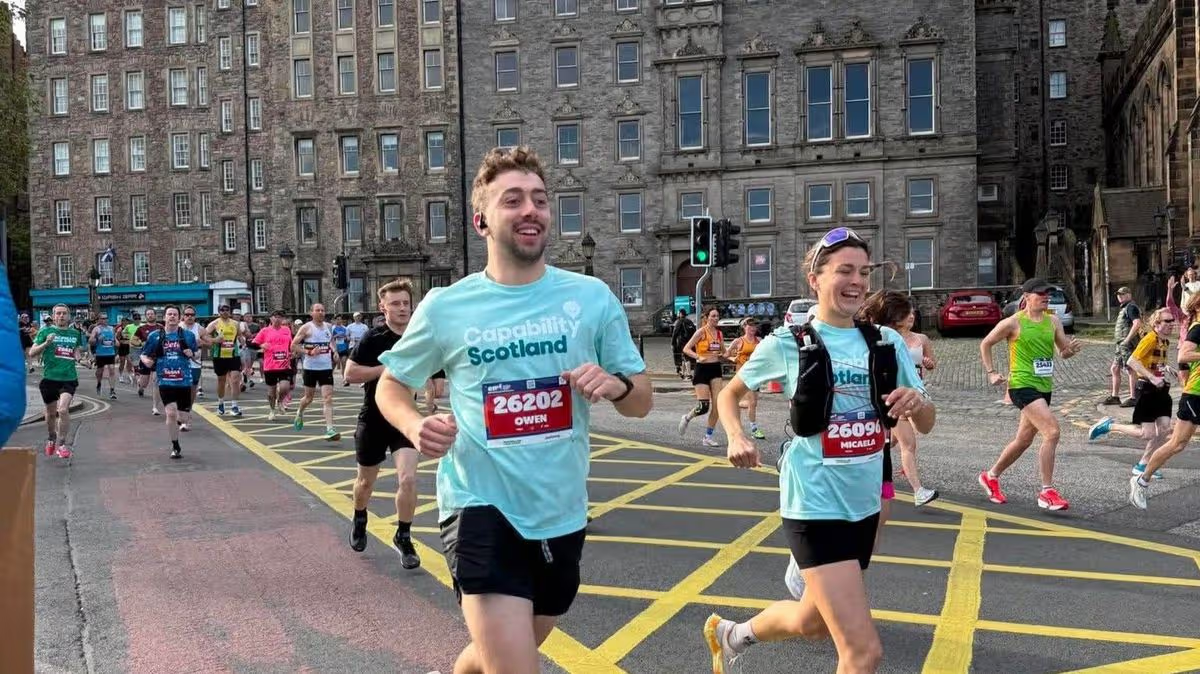
Micaela Church completed the challenge in just two days to raise money for the at-threat facility which cares for her disabled brother.
A woman has smashed a £10,000 fundraising target by completing four Edinburgh Marathon Festival events in a single weekend- running 78km in two days for the disabled brother she helps care for.
Advertisement
Micaela Church completed the 5km (3.1 miles) and 10km (6.2 miles) on Saturday, followed by the half marathon (21.1km / 13.1 miles) and full marathon (42.2km / 26.2 miles), raising vital funds for Capability Scotland’s Our Inclusive Community Project (OICP).
The new development will replace Upper Springland, the Perth residential facility where her brother Matthew lives, which faces a significant flooding risk that threatens its long-term future.
Matthew, who was born with cytomegalovirus, lives with learning disabilities, autism, epilepsy and severe anxiety that requires round-the-clock specialist care.
When Micaela and her siblings became his welfare guardians following the sudden loss of their mother five years ago, Upper Springland’s support proved invaluable to the whole family.
Advertisement
Micaela said: “The team at Upper Springland have taken the time to truly understand Matthew, his needs, his anxieties and the things that bring him joy.
“Knowing he is safe and genuinely cared for gives our whole family peace of mind. That’s what I’m running for.”
The new OICP facility will include a specialist hydrotherapy pool and that detail has driven every training mile. Swimming is where Matthew is at his happiest and the thought of securing that for him, and others like him, gave Micaela’s campaign its purpose.
Micaela remembered her mother returning from the Edinburgh Marathon Festival with a medal, convinced she had won. Decades later, she ran the same course carrying that memory with her.
Advertisement
Ailsa Wallace, head of fundraising and communications at Capability Scotland, said: “What Micaela is taking on is extraordinary both the physical challenge and the dedication behind it.
“Upper Springland has served people from across Scotland for over 40 years. The OICP will ensure that exceptional care continues in a modern, purpose-built environment that truly reflects it and fundraising like this brings that future one step closer.”
To support Micaela’s challenge, visit: justgiving.com/page/manymilesformatthew
To find out more about Capability Scotland, visit: https://www.capability.scot/

South Lanarkshire Council are set to sell the property off.
A council house in Bothwell with serious structural problems is to be sold off after repair costs were found to be more than double the property’s market value.
Advertisement
The former tenant of the two-bedroom property at 13 Morven Way raised concerns about cracks throughout the building and the overall condition of the property — and was permanently rehoused.
The property has been lying empty ever since, and will now go before South Lanarkshire Council’s housing and technical resources committee on June 3, where councillors will be asked to approve the disposal of the house on the open market.
The single-storey end terrace house, which was built in 1960, was flagged after the tenant’s concerns prompted a full structural assessment.
The report by Grossart Associates identified serious defects throughout, including internal and external separation cracks, an off-level floor slab, and wall cracks throughout.
Advertisement
A report by housing director Stephen Gibson, which will be tabled at next week’s meeting, states that the inspection “identified an on-going structural problem within the property, with serious defects noted throughout.”
He wrote: “The total cost of reinstatement works to 13 Morven Way is estimated at £162,687.
“All works included within these costs are mandatory. Any works that were deemed non-essential have been removed from costings to cap the costs of this project.
“It should be noted that, even if these works were carried out, there is no guarantee that structural issues would not re-emerge following this.
Advertisement
“Similar style of properties within the Bothwell area have sold for £87,000 on the open market. Therefore, the reinstatement works to 13 Morven Way are just over double the market value of similar type properties.”
The works required are extensive — stripping out the interior, replacing the roof, installing new external render and windows, and strengthening the external walls.
The recommendation is to sell the 13 Morven Way property as it stands, with any proceeds going into the Housing Revenue Account’s Capital Programme.
With the local authority in the midst of a housing emergency, the council’s estates team “will actively monitor the market in an attempt to buy back other ex-council properties within the area to replace this property.”
Advertisement
*Don’t miss the latest headlines from around Lanarkshire. Sign up to our newsletters here.
And did you know Lanarkshire Live had its own app? Download yours for free here.
Stagecoach South’s transition to zero-emission transport is underway across the South of England, beginning with the arrival of new electric buses in Surrey and Blackwater Valley and extending into confirmed plans for large-scale infrastructure investment in Hampshire.
Harker cut off Ms Paterson’s limbs and head before disposing of her torso in a black sack and dumping it in a house on Polam Lane – and even boasted about frying her thigh and eating it.
The now-51-year-old, who had already been refused parole eight times, faced another hearing on May 13, this year.
But a parole board has once again denied Harker’s release or an open condition in order to “protect the public from serious harm”.
Advertisement
Harker was said to ‘charming’, but he had a chilling dark side (Image: Contributor)
The parole board decision summary reveals Harker, who became eligible for parole in 2013, chose not to make any representations about his release and did not attend the hearing.
It details how there have been “signs of change” in his behaviour in custody, with no disciplinary findings since 2015.
He has also undertaken an intervention to increase motivation and engagement and a programme intended to strengthen the methods he can use to reduce violent tendencies.
The panel considered a dossier containing 356 pages of reports, including submissions on behalf of the Secretary of State arguing against release.
Advertisement
The person responsible for managing Harker in prison, two probation officers who would be responsible for him in the community if he were to be released, and a psychologist all expressed the view that he did not pass the test for release or open conditions.
The panel decided not to release Harker. He has 21 days to appeal for reconsideration.
Harker – who was likened to Hannibal Lecter in Silence of the Lambs – was convicted of manslaughter on the grounds of diminished responsibility in February 1999.
At the time, psychiatrists who examined him on behalf of both the defence and the prosecution agreed that his responsibility for his actions at the time of the killing was “substantially diminished by a severe psychopathic disorder”.
Advertisement
He was jailed for life.
Ms Paterson first went missing in April 1988 and a murder investigation was launched when parts of body were found in a bin liner hidden in a garden hedge the following month.
Julie Paterson went missing in April 1998 (Image: Contributor)
She was just 32 when she died – and the rest of her remains have never been recovered.
Detectives believed the evil killer had kept her decapitated head in the corner of his bedroom for several days before deciding to remove it, with her limbs and head never being found.
Advertisement
At the time, officers trawled through 20,000 tons of rubbish at Coxhoe tip, in County Durham, dragging rivers and ponds and searching sewers, but to no avail.
When Harker was held on remand at Ashworth Hospital, in Liverpool, before being convicted, he told The Northern Echo what had happened to the mother.
Police searching for Julie’s remains at a County Durham landfill site in 1998 (Image: North News)
While Harker had refused to talk to the police about it, he openly admitted his guilt to former Echo reporter Karen Westcott during a call, then through twisted letters, and then in person.
Harker, who has the words “subhuman” and “disorder” tattooed on his scalp, admitted in these letters that he was making a mask out of human skin and intended to use the flesh of his victims to complete it.
Advertisement
He wrote: “I would have gone on until I was caught.
“The coroner would be busy in Darlington if I ever got out.”
Harker also told the Echo in person that he had consensual sex with Julie at his flat on Harewood Grove before he strangled her with her tights in his bedroom.
He said coldly: “It just happened.”
Advertisement
Ms Paterson’s family have long pleaded with Harker to reveal where he disposed of her body.
However, he has refused to answer their desperate calls to finally put their beloved mam to rest.
The Bundibugyo strain of Ebola currently has no vaccine against it, and it has led to a health emergency being declared in the DRC and Uganda (Picture: AFP/Getty Images)
Americans infected with the deadly strain of Ebola will be taken to European countries for treatment instead of the US, an official has revealed.
Concern is growing over the outbreak of deadly Ebola in the Democratic Republic of Congo (DRC) in recent weeks.
Now an official from Trump’s administration has said that any Americans who need advanced medical care would be transported to Europe, not the US, according to NBC News.
US officials have set up a quarantine facility in Kenya to treat American patients, and it is set to open today with 50 beds.
Advertisement
This will be the first stop for the exposed Americans before they are taken to another country in Europe. The destination countries have not yet been named.
Advertisement
Sign up for all of the latest stories
Start your day informed with Metro’s News Updates newsletter or get Breaking Newsalerts the moment it happens.
The Trump administration has insisted that the reason for the plan is shorter flights.
Advertisement
One American citizen, a surgeon who had worked in a hospital in DRC, was taken to Germany with his family after contracting Ebola.
Dr Peter Stafford treated a person infected with Ebola unknowingly before the outbreak was noticed. His wife, also a doctor, had operated on the same patient.
Emergency supplies were loaded onto a United Nations aid plane in Nairobi, Kenya, destined for Congo (Picture: AP Photo/Andrew Kasuku)
Five others who were exposed were also transported to Germany, while one patient was taken to Czechia, Reuters reports.
The US has put stringent measures in place in a bid to prevent Ebola from spreading to the country.
Non-citizens who have been in Congo, Uganda or South Sudan in the last 21 days are blocked from entering the US.
Advertisement
Marco Rubio, the Secretary of State, said: ‘We cannot and will not allow any cases of Ebola to enter the United States.’
Death toll from the virus is mounting, with 223 suspected fatalities linked to the specific strain, which currently has no vaccine against it. Cases have soared to around 1,000.
The recent outbreak of hantavirus on a cruise ship with people from dozens of countries complicated the response and where to take patients.
MV Hondius, the hantavirus-stricken cruise ship, was eventually allowed to dock in Tenerife, which sparked a protest on the island.
Advertisement
Ebola in the DRC and Uganda has been declared a health emergency by the World Health Organisation (WHO).
Efforts to tackle the outbreak in the DRC are hampered by ongoing internal conflict in the country, particularly in the eastern border regions controlled by various militias, and lack of resources.
Misinformation about the disease is also rife, which has led to violent clashes as mobs of people have forced their way into health clinics to reclaim bodies of loved ones.
The strain of Ebola behind the ongoing outbreak is known as the Bundibugyo strain. There is no vaccine, although scientists in Oxford are urgently developing one.
Advertisement
A vaccine for the strain could take up to nine months to create and roll out, the WHO has said.
Muhammad Sheikhi was found guilty after a four-day trial at Stirling Sheriff Court.
A Syrian asylum seeker has been found guilty of sexually assaulting two women in Falkirk. Muhammad Sheikhi, 23, carried out both attacks in the early hours of Sunday, November 30, last year, close to the Cladhan Hotel, where he had been staying.
Advertisement
He assaulted the first woman at a railway bridge on Kerse Lane, where he hugged her, repeatedly kissed her on the face and mouth, and put his hands under her clothing.
He then sexually assaulted a second woman in Kerse Lane and the nearby Bellsmeadow skate park, where he pinned her against a tree and put his hands under her clothing.
Sheikhi, who came to the UK by boat, denied all the charges against him. However, a jury found him guilty of both charges at Stirling Sheriff Court today, May 29, following a four-day trial. He is due to be sentenced on June 29.
Addressing the jury on Friday morning before he sent them out to consider their verdicts, Sheriff Keith O’Mahony said: “It is important that your verdict is based on the evidence. It must not be swayed by any emotional considerations or prejudice or any revulsion you might have for the type of conduct which is alleged.”
Stirling Sheriff Court previously heard CCTV footage showed Sheikhi walking alongside one of the women in Kerse Lane while she wore his shoes and he walked in socks after allegedly giving her his footwear because her high heels had broken.
On Thursday, jurors were shown footage of Sheikhi’s police interview following his arrest at the hotel later that morning. During the interview, conducted through an Arabic interpreter, Sheikhi claimed he had taken “pity” on the second woman after seeing her crying by the roadside.
“She told me that she needs help to get home,” he said. “She was crying and she was wearing high heels and the straps were broken, they were snapped. When I saw her, we are human so I took pity on her. I took pity on her, I took off my shoes, I gave her my shoes.”
Advertisement
During the walk, Sheikhi seized the woman, pinned her against a tree and sexually assaulted her before later attacking her again at Bellsmeadow skate park with intent to rape her.
“I said to myself, ‘you’re doing something nice to people’,” he told police. “When I was walking to her address I thought the guy she was talking to over the phone … I thought they would be thanking me for helping her, walking her home. To me it was something like an act of kindness.”
Regarding the woman earlier in the night, Sheikhi claimed the woman approached him and asked where he was from before requesting his Snapchat details. Asked whether he hugged or kissed the woman, Sheikhi said she hugged him and “might have kissed” him, but he denied touching her sexually.
Advertisement
Giving his closing speech on Thursday, prosecutor Jamie Hilland put it to the jury that Sheikhi had acted in a “predatory” manner towards the two women.
“I suggest that the evidence demonstrates that in the early hours of November 30 last year, the accused behaved in a predatory manner towards these two women and he sexually assaulted them,” Mr Hilland said.
“There are compelling similarities between the two crimes. These were so closely linked in time and circumstances as to form part of a single course of criminal conduct systematically pursued by the accused.”
He added: “On their evidence the accused approached both women, he’s tried to give them his phone. He tried to get them to add him on Snapchat. In both cases he’s tried to corner the complainer, and he then sexually assaulted both of them.”
In his closing speech, Sheikhi’s lawyer Paul Keenan urged the jury to acquit his client of both charges, saying the evidence against him was “flawed throughout”.
Advertisement
He cast doubt on the credibility of both women, saying both had been drinking for hours before the alleged assaults were said to have taken place. He also said the fact Sheikhi had remained with one of his alleged victims while she was talking to her friend was not consistent with him having just sexually assaulted her.
He asked the jury: “If Sheikhi had sexually assaulted her with the intention of raping her, does it make sense for him to be hanging about while she’s talking with other people?”
He added: “I would say not.”
Get more Daily Record exclusives by signing up for free to Google’s preferred sources. Click HERE
Drivers were asked to use the M4 Prince of Wales Bridge on Thursday night due to a police-led incident on the old Severn crossing
A man has been arrested after the Severn Bridge was shut in both directions on Thursday evening.
Advertisement
Drivers were told to avoid the M48 Severn Bridge on Thursday evening due to a police-led incident. The bridge was shut in both directions for a number of hours, with drivers asked to use the Prince of Wales Bridge instead.
Officers were called to reports raising concerns for the safety of an individual on the bridge shrotly before 8pm. Avon and Somerset Police and Gwent Police attended the scene alongside other emergency services.
A spokesman for Avon and Somerset Police said the incident was brought to a safe conclusion at 10.30pm. The bridge reopened at 11pm.
A man was arrested on suspicion of causing a public nuisance and a racially-aggravated public order offence. He was taken to hospital as a precaution, police added.
Get daily breaking news updates on your phone by joining our WhatsApp community here. We occasionally treat members to special offers, promotions and ads from us and our partners. See our Privacy Notice
The 80-year-old actor smiles and greets the man filming and asks if he is OK.
A video showed Dame Helen Mirren being berated over her support for Israel (AFP/Getty)
He then says: “And there is Helen Mirren the avowed Zionist. You said Israel should last forever because of the Holocaust. And she was very happy the Palestinians’ houses were gone.
“You are an evil Zionist b****. And you (Hackford) as well, f*** you as well.”
Dame Helen’s husband then stepped in and told the man to “f*** off” and leave them alone several times.
The clip was first posted by an anonymous account called Anti-Fascist Action UK.
Advertisement
The Met have now said they are trying to get in contact with Mirren to see if she wants to report the incident formally.
Helen Mirren with her husband, Taylor Hackford (Getty)
In a statement, a Met spokesperson said: “We are aware of a video circulating online, showing a man and a woman being subjected to antisemitic verbal abuse in Tower Hill.
“It is believed that the incident took place at the end of last year.
“Officers are currently reviewing the footage and making attempts to contact the victims to establish whether they would like to report the incident.
“The Met continues to work hard to tackle hate crimes of all types and officers across London have made more than 90 hate crime arrests since the end of March.
Advertisement
“If you believe you have been a victim of this type of crime please report it to us by calling 101 or making an online report.”
Dame Helen is not Jewish. She has long been a vocal advocate for Israel and in April signed an open letter alongside fellow stars, including Boy George and Sharon Osbourne, in which she pledged her support for the country’s inclusion in the Eurovision Song Contest.
Noam Bettan, representing Israel, celebrates during the grand final of this year’s Eurovision Song Contest in Vienna (Getty)
Throughout her career she has also played several well-known Jewish figures, including Maria Altmann in Woman In Gold and former Israeli prime minister Golda Meir in the 2023 film Golda.
While promoting the film, she said: “I believe in Israel, in the existence of Israel, and I believe Israel has to go forward into the future, for the rest of eternity. I believe in Israel because of the Holocaust.”
Dame Helen first visited Israel in 1967 not long after the Six-Day War, where she volunteered on Kibbutz HaOn near the Sea of Galilee.
Advertisement
Reform UK MP Robert Jenrick has said he was “disgusted” at the footage, telling LBC: “I was disgusted by it, but antisemitism is unfortunately rife, and nobody who is either Jewish or has voiced support for the British Jewish community should be being harassed on the streets of our country.
“It’s not just antisemitism, it’s anti-British. Everyone should be able to walk the streets of our country in safety, free from harassment.”
Did you know cola is made with a kola nut? The ingredient, which is from Africa, is where the fizzy drink gets its caffeine from.
Of course, some cola brands keep the other parts of their recipe top-secret. But why do beverages made by the same company seem to taste different in a glass bottle, can, and plastic bottle?
Well, according to Rowland King, a director at the glass bottles supplier, Quality Bottles, there’s real science behind the difference.
Why does cola taste different in a glass bottle vs a can or plastic bottle?
Advertisement
First, there’s the chemistry of each material to consider.
“Glass is chemically inert and non-porous, which means it doesn’t react with the drink or absorb flavour compounds,” King said.
“That helps keep the taste exactly as intended from the moment it’s filled to the moment it’s opened”.
Some experts think the polymer lining of tinned fizzy drinks can lead to a milder taste, while it’s possible that acetaldehyde in plastic bottles could affect the flavour.
Advertisement
And carbonation (bubbles) matter, too, King added.
“Fizzy drinks rely on dissolved CO₂ for their bite and freshness. Over time, plastic is slightly permeable to gas, even when sealed.
“Glass isn’t, so carbonation is typically retained more consistently, which can noticeably affect the taste and how it feels to drink.”
The screw or crown caps commonly used on glass bottles provide a tighter seal, too, allowing less CO2 to escape.
Advertisement
“Bottle shape also comes into it,” King continued.
“A narrow bottleneck concentrates aroma and slows down how quickly the drink hits the palate. That subtly changes the flavour perception compared to drinking from a wide can opening or pouring into a cup.”
Then, there’s temperature to consider
I personally love an ice-cold can of diet cola – sometimes called a “fridge cigarette” – because I feel like it stays cooler and crisper than plastic bottles.
Advertisement
But King explained, “Glass bottles are thicker and tend to chill more evenly and stay cold a bit longer once removed from the fridge. Since temperature strongly affects flavour perception, that alone can make the drink seem more refreshing.”
Of course, companies try their hardest to make their product taste as consistent as possible across a range of containers, King stated.
But, he ended, “material science is material science. The container does make a difference, especially with carbonated drinks”.
North Yorkshire Police is appealing for witnesses after an assault and ‘large-scale disorder’ at the One-Eyed Rat pub in Ripon earlier this month.
The incident began at around 1.30pm on May 8 after a group entered the pub and an argument started involving multiple people.
RECOMMENDED READING:
“Shortly afterwards, while in an outdoor seating area, an 18-year-old was approached by a male and punched to the face.
Advertisement
“The situation rapidly escalated into a wider disturbance involving around 20 people. During the disorder, it is reported that a chair was thrown and a second victim was assaulted, receiving a blow to the back of the head,” said a spokesperson for the force.
Officers are keen to speak to anyone who witnessed the incident, has mobile phone footage, or can help identify those involved.
North Yorkshire Police is appealing for witnesses after an assault and ‘large-scale disorder’ at the One-Eyed Rat pub in Ripon earlier this month. (Image: North Yorkshire Police)
They added that they would particularly like to speak with or name the two men pictured, as they believe they may be able to provide important information to assist the investigation.
If you have any information, please email Sylvia.Matla@northyorkshire.police.uk, call North Yorkshire Police on 101, or if you would prefer to remain anonymous, you can contact Crimestoppers on 0800 555 111, or submit an online report.
Advertisement
Please quote reference 12260083522 when passing on information.
William Adams was entranced by energy. As a young man, his interest was nursed by working as a clerk in a London patent office in the 1860s. This gave him an early look at some of the first British designs for exploiting solar energy using mirrors, water or both.
Adams would later recount his excitement at reading about the French mathematician Augustin Mouchot’s invention of the first machine ever to run on energy from the Sun. The device, which connected a solar boiler to a specifically designed steam engine, was warmly received by Napoleon III when it was presented to the emperor in 1866.
Inspired, Adams soon designed and patented his own rudimentary solar boiler. The only problem was, he needed more sun.
Advertisement
This series is dedicated to lesser-known, highly influential scientists who have had a powerful influence on the careers and research paths of many others, including the authors of these articles.
When offered the chance to become deputy registrar of Bombay by the Indian city’s governor, Sir Philip Edmond Wodehouse, Adams jumped at the opportunity. There, he became the first Briton to design, build and test a fully-functioning solar steam engine fit for industrial purpose.
But he also came up against the conservatism of India’s colonial rulers, who did not see this Bombay bureaucrat for the energy visionary that he undoubtedly was.
‘The rays beat like missiles’
Adams arrived in Bombay in 1873 to find it in the middle of a cotton boom, with mills popping up like mushrooms across the city. The population was growing so quickly that firewood was depleted for miles around. The landscape grew “bald as a billiard ball”, as Adams put it.
Advertisement
Every morning before setting off for work near Bombay’s central fort, Adams would set up his outdoor laboratory at his home in the southernmost Colaba district, near the open sea. He instructed an Indian fundhi (skilled carpenter) to build a set of three-tiered wooden shelves to hold 18 looking glasses.
“Each glass was moveable on a swivel in the same manner as an ordinary toilet glass”, Adams explained, meaning he could pivot each glass by “the touch of the finger”.
Cotton yards sprang up all over Bombay in the latter half of the 19th century. Art Collection 3/Alamy
Later, for open-air experiments, Adams used two banks of mirrors (36 in total) which made “the mercury in the thermometer boil, leaping up to over 670 degrees fahrenheit”. He then placed a copper cylinder containing three gallons of water in the focus of all 36 mirrors, making it boil in exactly 20 minutes.
But Adams’s ambition did not end there. To reach sufficient pressure in the boiler to drive a steam engine, this bureaucrat-cum-engineer built a giant concave mirror, 24 feet in diameter. He then sent for his London solar boiler, which was delivered by ship to Bombay in 1876.
Advertisement
One fine morning, Adams – wearing dark glasses for safety – turned his giant concave mirror on the copper cylinder filled with water. “The rays beat like missiles in a continuous and incessant storm of solar fire,” he wrote.
An hour later, the cylinder registered 55 pounds of pressure per square inch. He hired a steam engine of 3 horsepower and connected it to the boiler: the pressure moved the pistons. Adams had built the first working, British-designed solar steam engine.
For a fortnight, he kept the pump going near his bungalow in Colaba – proudly and sweatily displaying his innovation to government officials, newspaper reporters, mill owners and the local Indian communities. Members of the public were invited to witness his experiments too, via a notification in a Bombay newspaper.
In 1877, Adams wrote a letter to the editor of the Times of India arguing that the application of his solar steam engine would “make India the seat of the principal manufacturing industries of the world”.
Later, in his wildly ahead-of-its-time treatise Solar Heat: A Substitute for Fuel in Tropical Countries (1878), Adams argued that countries near the equator “possess, in their clear skies, a gratuitous and inexhaustible source of wealth, equal to that which western nations have to dig, with infinite labour and toil, from the bowels of the Earth”.
Adams sketched out plans to use solar heat for everything from cotton gins (engines to separate cotton fibres from seeds) to Hindu crematoria. He called upon the colonial British government to invest in this promising substitute for coal, which was then being imported to India at great expense.
Adams envisioned solar energy transforming the Raj. Just like the coal-combusting steam engine had replaced the waterwheel in England, he argued that thermal heat could now replace fossil fuels in India. But his colonial bosses were not persuaded.
‘Too subversive’
Adams was part of a 19th-century wave of global research into solar steam engines, as I explore in my postdoctoral project and upcoming book. But in contrast to fellow pioneers including Frenchman Mouchot, Adams built his solar steam engine to stimulate local Indian industry, not to benefit the colonial government.
Advertisement
The locals shared Adams’s belief in this technology. One even wrote to Scientific American magazine to express their desire for the rapid adoption of solar power:
My residence is in a tropical part of India … where fuel is scarce and dear … In this part of the country (about 300 miles north of Bombay), there is a great opening for cheap power in small units.
Bombay’s new governor Sir Richard Temple concluded, however, that solar heat “could not be used for commercial purposes on a large scale”. He argued that local factory owners would not like giving “the workmen a holiday on days when the sky is not clear”.
In truth, Adams’s invention was too subversive for Britain’s colonial officials and capitalists. In less sunny climes, solar energy – tethered to the seasonal rhythms of nature – might negate their commercial ambition for timeless industrial production. But they also saw India as an important market for British coal exports.
While a few mill owners adopted Adams’s auxiliary solar heater for their steam engines, most regarded it as a primitive contraption unfit to satisfy the demands of modern civilisation.
Increasingly frustrated that neither the industrial capitalists nor the colonial government supported his vision, Adams abandoned further experiments. His dream of India switching away from coal to solar power, from combustion to concentration, would not happen for at least another century.
Which begs the question: how much further advanced would this technology be had Adams’s 19th-century solar experiments been embraced by India’s colonial rulers at the time?
You must be logged in to post a comment Login