

Politics
Cynthia Erivo Wicked Premiere ‘Bodyguard’ Jokes Were Rooted In Racism

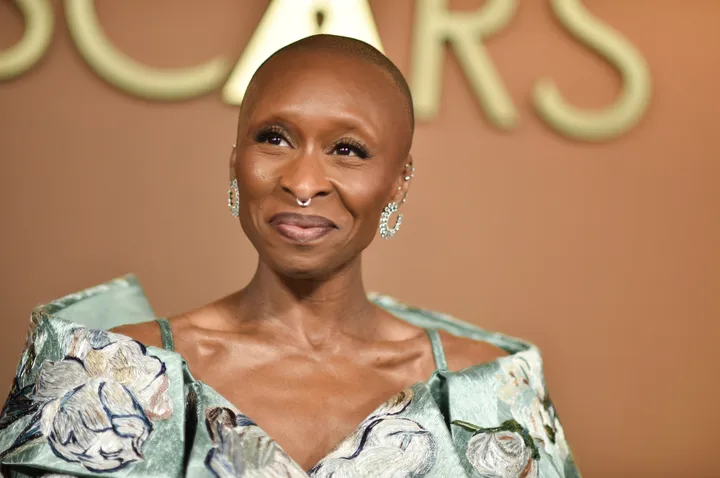
Cynthia Erivo is reflecting on the fall-out from an incident that took place at the premiere of the second Wicked film in Singapore last year.
In November 2025, Cynthia and her co-star Ariana Grande were attending the Wicked: For Good premiere when a man leapt over a barrier and grabbed the No Tears Left To Cry singer, before jumping up and down.
Viral footage of the incident showed the British performer stepping in to protect her co-star, which inspired jokes and memes referring to her as Ariana’s “bodyguard”.
However, in a new interview with Variety, Cynthia suggested that these jokes were evidence that society has not yet “come to terms with the insidious nature of how we view Black women”.
“I’m sure people will read this and think, ‘Oh, for goodness’ sake, it’s not about that.’ But it is,” she said.
Cynthia continued: “That’s what was being made fun of. It was my physique; it was my shape; it was the fact that I was bald; it was about what I looked like. And because of that, there was this assumption that I was bigger than my co-star and so I had to be controlling or protecting, and that was my role.
“I would hazard a guess that it would not have been the same had it been the other way around.”

Later in the interview, Cynthia claimed that the incident in Singapore put her off campaigning for an Oscar for her work in Wicked: For Good.
She lamented: “I just felt like my humanity had been bastardised. I felt like something I did instinctively had been made to be something that it simply was not because of the way people see women who look like me, and because of the assumptions that are made, and I just didn’t want to be a part of that, really and truly.”
Cynthia added that people’s preconceptions about the second Wicked film being inferior to the first contributed to her not wanting to campaign for an Oscar.
In the end, Wicked: For Good was completely snubbed at the 2026 Oscars, despite the first film receiving 10 nominations (and two wins) a year earlier.
Speaking to Variety, Cynthia also spoke about the impact that the grueling Wicked promotional tour took on both herself and Ariana.


Did you know flight attendants aren’t just being nice when they greet you on a plane?
Nope – they’re also reportedly checking your fitness to help in an emergency, and sometimes eyeing up your luggage or sobriety levels.
And on the flip side, staff aren’t being mean when they tell you you can’t return to a plane to get something you’ve left behind, either. There are some pretty important reasons behind the decision.
Amanda Parker, a travel expert at Netflights, has shared that’s not the only sneakily strategic decision hiding in plain, or should I say plane (teehee), sight either.
“Passengers may not realise how important it is that aircraft are painted white,” she said.
So, why are planes white?
The first, and perhaps most obvious, reason is that white paint reflects sunlight.
This helps to keep the aircraft’s surface and cabin cooler, and protect the structure from heat-related damage, Parker said.
But the hue also “helps reduce the risk of bird strikes, as birds can spot white aircraft more easily against the sky or ground, allowing them to avoid collisions,” the expert continued.
“Darker colours reduce contrast and make planes less visible to birds, increasing the likelihood of impact.”
Then, there’s the fact that damage shows up better on white paint than it might on other shades.
“Regular inspections are critical for flight safety. Cracks, dents, oil leaks, and other damage are often darker than the white paint, making them easier to detect and address quickly, helping boost maintenance efficiency and keep passengers safer,” Parker stated.
Any other reasons?
“Aircraft paints are specialised and expensive, requiring large volumes up to 3,600 litres of paint for a jumbo jet like the Airbus A380. Because white is the most commonly used colour, it is also the least expensive and lightest paint option,” Parker shared.
“Using lighter paint reduces aircraft weight, which lowers fuel consumption and operating costs.”
On top of that, white paint fades less than coloured ones. And seeing as “repainting grounds the aircraft for up to two weeks and can cost between £150,000 to £300,000, airlines prefer white paint because it maintains its look for longer and saves money”.
Not since Miranda Priestly’s The Devil Wears Prada speech about cerulean have I realised the importance of a simple colour…
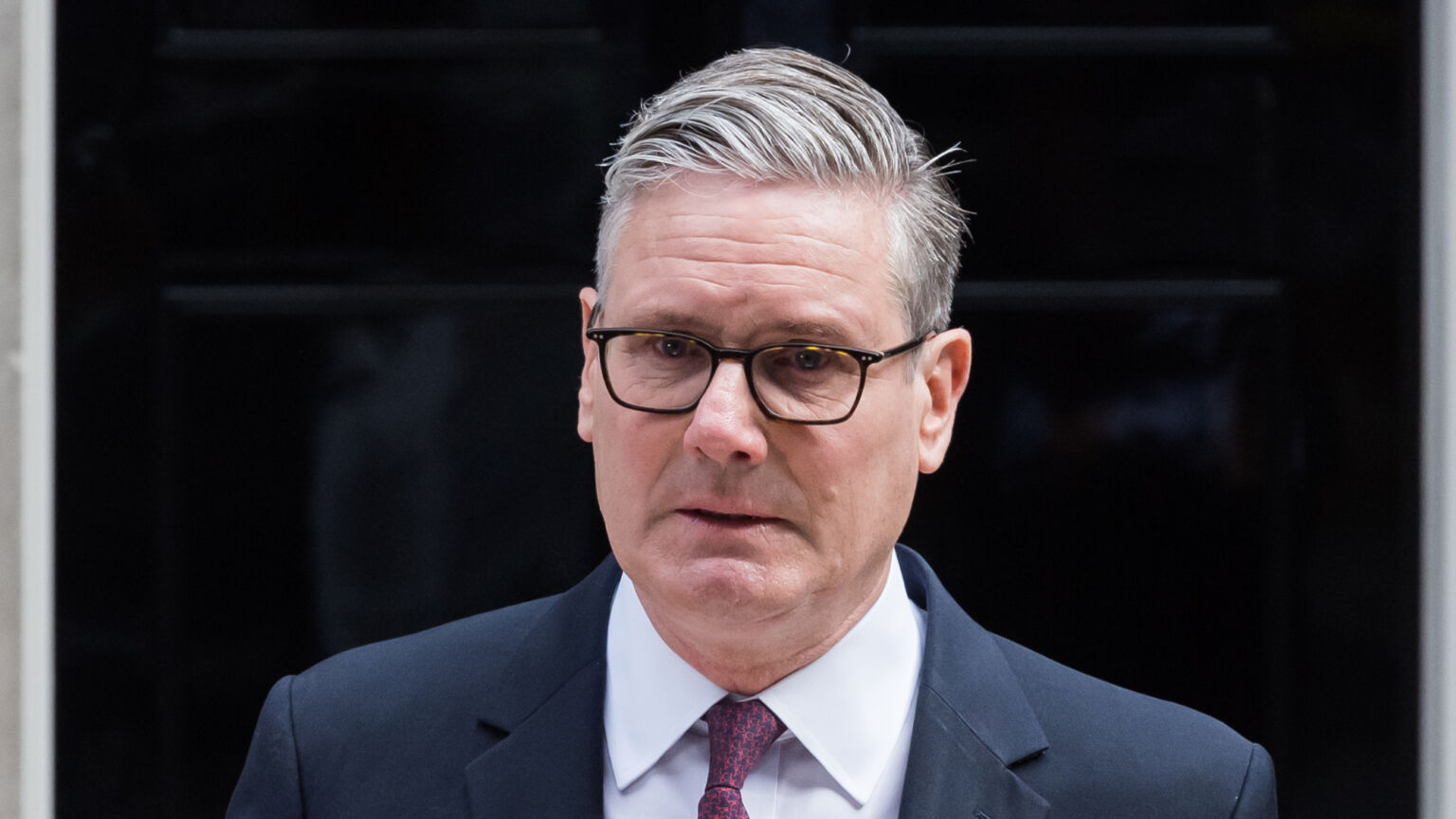
So he’s gone. Keir Starmer has resigned. The adults are out of the room. He waltzed into Downing St two years ago to the effusive gushing of the liberal commentariat, and now he’s slinking out. He and his slack-jawed media cheerleaders promised us an era of blissful if boring stability. What they gave us were riots, division, betrayal after betrayal, and an unprecedented assault on the ancient liberties of our nation. The lesson of the Starmer epoch? Never trust a technocrat.
Few tears will flow over the death of his insipid premiership. He’ll be remembered as the human-rights lawyer who took a cudgel to the sacred right of trial by jury. The self-styled worshipper of competence who was staggeringly incompetent. The man with the great work ethic who often switched off for the whole weekend, leaving ministers stumped and the nation leaderless. The ‘details man’ who didn’t even know Peter Mandelson had failed his vetting to become our ambassador to the US. Starmer was a mirage. A hologram of competence operated by an army of the inept.
It pays to look back on the media fawning that followed his electoral victory in July 2024. There was an explosion of onanistic glee in Britain’s moneyed quarters. ‘Keir Starmer has turbo-charged my arousal levels’, said Caitlin Moran of The Times. She claimed ‘every middle-aged woman’ she knew had felt ‘kind of fruity’ upon watching Sir Keir go into Downing St. Other sad centrists wanted less to be fucked by Sir Keir than sedated by him. They made a holy virtue of his dullness. They prayed he would Make Britain Boring Again. He ‘embodies the politics of boring’, said one giddy scribe, which is just what ‘mayhem-weary’ Britain needs. After the Brexit wars, the Boris years and the blink-and-you’ll-miss-it Liz Truss era, we’ve had enough of ‘fireworks and political circus’, declared the BBC – now is the time for ‘vague, even boring [politics]’.
It was extraordinary the extent to which they sacralised Starmer’s blandless. His very lack of charisma was fetishised as a virtue. ‘Haven’t we had enough of charismatic leaders?’, asked one columnist. Surely what we need now is ‘someone who will manage the government in a cool and calm way’. Sir Keir’s ‘dull ordinariness’ is the best weapon we have against the ‘unchained forces of mayhem’ in British politics, said Politico. And there it was, the brutal truth about why they fell at the feet of this adenoidal personality void – they believed, they prayed, that his sheer greyness would smother the fires of dissent lit by Brexit and the broader populist thirst for a realigned, reimagined politics.
The Starmer project, at root, was a bloodless coup of bureaucratic vengeance. It was the institutionalisation of boredom as an antidote to the spirit of Brexit. The chattering classes swooned over Starmer’s lifeless, flavourless style because it was such sweet relief from the unpredictable passions of the little people. It was technocracy summed up: politics as fire extinguisher, designed less to represent the people than to tame them, less to heed our angry demands than to bury them under a slagheap of managerialism. The great hope of Starmer’s high-status backers was that he would ‘lower the temperature’.
It wasn’t long before this illiberal crusade to sanitise public life crashed against the shores of reality. The first problem was Starmer’s own shortcomings. Having won the General Election on just 33.7 per cent of the vote, he lacked moral authority. It was said by some that he won on the basis of four words: ‘I am not them.’ But that was the problem. Not being the Tories was not enough. His was a victory by default, driven more by public exhaustion after 14 years of Tory misrule than by public enthusiasm for this celebrated lacker of charisma. From Day 1, the favoured bore of the priestly class struggled to connect with your average unboring Brit.
Then there was the fact that Mr Competent was not so competent. He was rarely across his brief. He u-turned constantly. His administration lurched from scandal to scandal, from Angela Rayner’s tax idiocy to that whole installing of a pervert’s buddy as US ambassador. Starmer was a staggeringly incurious prime minister. His was a ‘passive premiership’, as that gobsmacking Sunday Times feature described it in March. People were often struck by the ‘unnatural, overwhelming silence’ in Downing St as the PM and his equally grey minions got on with things ‘wordlessly behind closed doors’. Let the fall of Starmer be a lesson to the Western elites: managerialism might be fine for a smalltown bank but it is death itself in a realm where argument, contestation, morality and noise ought to be the norm.
But the larger problem for limp, damp Starmerism was that it was so catastrophically at odds with public sentiment. You see, people didn’t want to be sedated. They didn’t want to be tranquilised into an infantile state by the halfwits and dullards of Westminster. They didn’t want to see the grey slaying of what media snobs called ‘the unchained forces of mayhem’ but which we called democracy.
So, far from being a ‘haven of peace and stability’, Starmer’s Britain became a hotbed of social conflict. There were the Southport riots, the Southampton riots, the Belfast riots. There was furious disagreement over two-tier policing and identity politics. The England flag was hoisted across the land in defiance of the haughty Europeanism and oikophobia of the Starmer classes. The rape-gang scandal bubbled up from under the crude lid of censorship forced on it for so long. Fury over our broken borders exploded into street protests. Starmer came to be hated. He became the most unpopular PM on record. At times the loathing felt almost unfair. But having been hailed by the lanyard classes as the technocratic saviour of a nation that had fallen to the forces of ‘mayhem’ (ie, public opinion), it was inevitable that hating Starmer would become the bread and butter of those of a populist persuasion.
Everything Starmer did was about ‘lowering the temperature’ of the public. His rule laid bare the calculated authoritarianism of a ruling class that considers management of the masses to be the highest goal of public life. From his attack on trial by jury to his mad insistence on bringing in a new definition of ‘Islamophobia’ to his allergic reaction to the public fury over Henry Nowak, he was always driven by a patrician impulse to subdue the popular will. To neutralise political contestation itself in order that the mythical competence of his kind might enjoy free rein. All the civil unrest we’ve seen these past two years – some of it democratic, some of it violent and ugly – is best understood as a fuming reaction against the rule of the boring and its black dream of public disenfranchisement.
And now we have the prospect of prime minister Andy Burnham, the man who edged Starmer out of Downing St with his victory in the Makerfield by-election last week. The elites want Burnham to do what Starmer failed to: quell the ‘mayhem’ of Britain’s resurgent democratic spirit. Only where they thought Starmer’s dearth of charisma might achieve that, now they hope Burnham’s much-hyped charisma will. They’ve tried boring us into submission, now they’ll try Burnhaming us into submission. They’ve learned nothing. Ten years since Brexit and we’re still lumbered with an expert class that is breathtakingly dumb.
Brendan O’Neill is spiked’s chief political writer and host of the spiked podcast, The Brendan O’Neill Show. Subscribe to the podcast here. His latest book – After the Pogrom: 7 October, Israel and the Crisis of Civilisation – is available to order on Amazon UK and Amazon US now. And find Brendan on Instagram: @burntoakboy.
Politics
Lord Ashcroft: Where are the Conservative voters on Brexit ten years on and are they changing their minds?
Lord Ashcroft KCMG PC is an international businessman, philanthropist, author and pollster. For more information on his work, visit lordashcroft.com
Earlier this month I explored whether or not it was in Labour’s interests to promise a referendum on rejoining the EU. Here we look at the other side of the coin: Brexit and the Conservatives.
After an election defeat, a party has to show it has listened and learned. To admit no errors would be to suggest it has learned nothing. But a party which trashes its own record across the board looks either unserious or unprincipled. Where does Brexit fit in?
My most recent poll asked if life in Britain over the last few years had been better, worse or about the same than it would have been if we were still in the EU. On the left, the view is clear: around eight in ten Labour, Lib Dem and Green voters say “worse”. On the right, the view is more nuanced, as we see from the chart below.
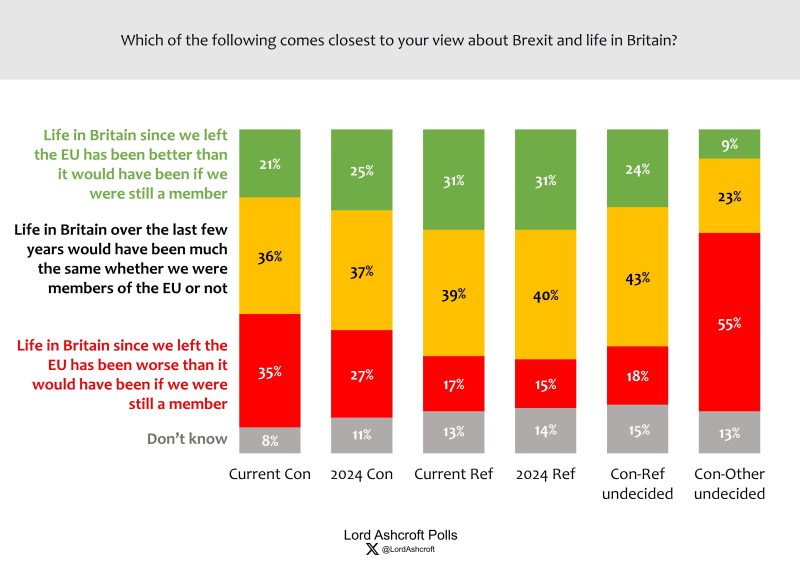
Reform voters are twice as likely to think that Brexit has changed the UK for the better than for the worse, and the balance of opinion among their current supporters matches the balance of opinion among its 2024 voter base. The Conservatives, however, have seen a shift. Their 2024 voters divided evenly, but those currently leaning towards the party tend to think that leaving has made things worse.
Voters hovering between the Tories and Reform incline slightly towards thinking Brexit has been beneficial (and fewer than one in five think it has made things worse). However, those who are undecided between the Conservatives and a party other than Reform are decidedly negative about the effects of Brexit. These groups are roughly the same size, and the Conservative will need to win over both in order to recover electorally.
As well as being divided on this question, the potential Conservative voting coalition includes significant numbers of both leavers and remainers. In fact, the Tories are the only party to draw support from both sides of the Brexit divide. The risk associated with a reopening of the EU debate is clear.
What may be less clear is the potential benefit.
In a fragmented five-party landscape, there is an increasing tendency for leaders to tell their core voters exactly what they want to hear, even if in places it is self-contradictory. Pleasing some of the people all of the time is not a realistic prospectus for governing Britain in the 2020s. Badenoch has the opportunity to position the Conservatives as a party for both sides of the Brexit divide and one that is capable of governing in a united interest, rather than for a small sectional interest. If this sounds woolly, Margaret Thatcher and Ronald Reagan were able simultaneously to broaden their electoral base and pursue an unapologetically conservative agenda.
Our political map helps tell the story. Bubble sizes are proportional to the size of the relevant voter group, and the closer bubbles are, the more similar the respective groups of voters. In the party colours, we have the locations of current support for the five largest parties. The other bubbles represent combinations of attitudes of particular relevance to the Conservatives.

There is a group of 2016 leave voters who so regret Brexit that they would vote to rejoin the EU. However, they are close to the centre of the political map and a long distance from any of the party bubbles. This suggests both that these people have little in common in the way of political outlook beyond their view of Brexit, and that they will be hard for any party to target. In other words, there is little mileage in trying to build an electoral coalition around Bregret.
We also asked whether three potential conditions associated with readmittance to the EU (joining the Euro, joining the Schengen area, and paying a higher membership fee than before) would be acceptable or unacceptable. We can see the position of the bubbles showing current likely Conservative voters who would consider all three unacceptable and those who would consider at least one condition acceptable. The the bubbles are similar sizes, demonstrating that the Conservative voter base is close to evenly divided on the issue (55 per cent of current Conservative voters would reject all three conditions, whereas 45 per cent would accept at least one). But they are also very close to the overall Conservative bubble, suggesting that the two groups have a lot of common political ground outside the Brexit debate.
The bitterest and most damaging political divides are those where there is clear distance between both sides on the map (as happened in 2019 with Labour’s red wall voters in the bottom right quadrant and its metropolitan remainers in the top left).
Advocates of rejoining argue that there is a settled consensus that Brexit was a mistake. But in the previous piece, we demonstrated that despite the headline landslide 23-point lead for rejoin in a hypothetical referendum, when questions of detail about the terms of rejoining are considered, the lead shrinks considerably. That is not to say that rejoin winning a referendum is implausible or even improbable: it is merely not inevitable. Questioning the details of any plan to rejoin does not open up Pandora’s Box for the Conservatives: their voters may disagree about these conditions, but it is not a polarising disagreement which risks tearing their electoral coalition apart.
Another important group is people who, while they might not like Brexit, are even less keen on the division and instability they believe would follow from reopening the debate. We asked people whether we should accept that Brexit has happened and try to make the best of it, or whether we should accept that Brexit has failed and try to rejoin at least some aspects of the EU. We can therefore examine two further groups: those who voted to remain in 2016 and now agree the UK should accept Brexit, and those who would vote to rejoin in a hypothetical referendum but nonetheless agree that the UK should accept Brexit. The first group is adjacent to the Conservatives on the political map, suggesting that they share a similar outlook on other political questions. The latter group lands in the top left quadrant, equidistant from Labour and the Conservatives on the political map; they occupy similar territory to the centrist voters we wrote about in April.
This means the Conservatives do not have to reject Brexit to appeal to the swing voters towards the “12 o’clock” position on the political map. The argument that Brexit is last decade’s issue, and the UK needs to move on rather than reopening old wounds, already resonates with them. It is an argument which is easy to make and easy to understand. Given the low ranking of Brexit in people’s list of issues, proponents of rejoin face an uphill battle. Badenoch would be well-advised not to let them take even one step up that hill.
Addressing the issues which voters rank as most important – the cost of living, immigration and healthcare – will mean tackling some emotive issues. Any serious attempt to do so entails grappling with things like social care, the UK’s national debt and low productivity. These have remained unresolved for a reason. (Indeed, they were still issues while the UK was in the EU). A future government seeking to make progress in these areas would have to make tough decisions and persuade a cynical public that they are necessary. It would have to get difficult legislation through a parliament where many MPs will have wafer-thin majorities and the government itself may well be relying on other parties. This would take a great deal of political skill, strong leadership, careful policy development and persuasive advocacy – divisive distractions like relitigating Brexit would hardly help.
What, then, should Badenoch say and do about Brexit?
The armoury of contemporary politicians is replete with silver bullets, but easy answers won’t do and the voters know it. Deciding to leave the EU presented opportunities and challenges. As a country we have to seize those opportunities and rise to those challenges. That means hard work and a government prepared to make tough choices for the long term. Just as Brexit was never the answer to every problem in 2016, it is not the cause of every problem in 2026. It is time to move on and move forward.
Full data tables at LordAshcroftPolls.com
The post Lord Ashcroft: Where are the Conservative voters on Brexit ten years on and are they changing their minds? appeared first on Conservative Home.

“David you truly are the best daddy,” the former Spice Girls star wrote. “Your greatest achievement has always been our beautiful children and we love you so much. Happy Father’s Day.”
While both Romeo and Cruz shared pictures of their dad for Father’s Day, their elder brother notably didn’t post anything on social media on Sunday.
After months of speculation about a supposed family feud, Brooklyn sparked international headlines back in January when he shared a series of candid Instagram posts, in which he accused his parents of “trying to endlessly ruin” his relationship with his wife, Nicola Peltz Beckham.
He also took aim at his famous parents for what he referred to as “performative” and “controlling” behaviour on their part over the course of his “entire life”, as well as claiming that they had tried “endlessly” to “ruin” his relationship with his now-wife.
Earlier this year, the Climate Change Committee (CCC) called for maximum temperature working rules in the UK.
In their report, titled A Well-Adapted UK, they called on the government to invest in things like “air conditioning, heat pumps and green shading” in public areas as well as “cooling” tools in the workplace.
They called rising heating, flooding, and drought a “threat” to the “British way of life”.
There is no maximum working temperature in the UK as of the time of writing, though the government points to a minimum temperature guidance of 16ºC, or 13ºC for those doing physical jobs.
Heatwaves are becoming more likely in the UK
The CCC report said that by 2025, 92% of homes are likely to overheat. They’ve proposed ideal indoor temperatures for places like care homes, prisons and homes of 16°C to 25°C.
They didn’t mention an ideal working temperature explicitly; however, they did point to Spain, where maximum working temperatures are 27°C for sedentary work and 25°C for light physical work.
Heatwaves of 40°C are expected to become more common in the coming decades, they added.
These can be seriously harmful to people’s health. The sweltering 40°C day of 2022 took place in a four-day heatwave that caused 1,000 heat-related deaths.
Speaking to HuffPost UK previously, Johan Jaques, chief meteorologist at environmental solutions company KISTERS, agreed.
He said that heatwaves were likely to become worse in the UK thanks to things like climate change and stifling building design.
“We are not powerless”
Baroness Brown, chair of the Adaptation Committee, said that “Our lives, our landscapes and our homes are under increasing pressure from the changing climate. But we are not powerless. In an increasingly unstable world, being well adapted to climate change is fundamental to securing our food, energy and economic security.
“This report carries a message of hope. The solutions already exist, and proven technologies are available now to help the UK adapt effectively. With the right decisions and actions, we can protect the people and the places we love.”
She added that we can protect the places, people, and institutions most dear to us with government changes.
Per the BBC, the government has said it would review and address the concerns in this report, and added it was already taking steps to address flooding.

We hope you love the products we recommend! All of them were independently selected by our editors. Just so you know, HuffPost UK may collect a share of sales or other compensation from the links on this page if you decide to shop from them. Oh, and FYI — prices are accurate and items in stock as of time of publication.
In case you hadn’t noticed, we take sex toys extremely seriously here at HuffPost.
They might be intended to bring some playfulness into your sex life, but to us they are wellbeing essentials.
So naturally, that means we make it our business to test every toy under the sun.
While I’ve tried everything from the newest AI sex toys on the market to sex machines, and cheap bullet vibrators, I’m confident in saying that LELO makes the best on the market.
As well as looking supremely luxury, LELO uses its own patented technology to innovate clit vibrators, G-spot vibrators, rabbits, wands, and masturbators that far outrun their competitors.
Admittedly, they do cost a pretty penny, but they are well and truly worth every single one – especially when they are on sale for up to 35% off for Prime Day.
If you’re looking for a new bedmate, I’ve rounded up the 11 best LELO sex toys to get your hands (and other body parts) on this Prime Day.
How I tested the best LELO sex toys
I’ve been writing and podcasting about sex and relationships for the last six years, which unsurprisingly means I’ve tested probably hundreds, if not thousands, of sex toys.
Whenever LELO has a new launch, I’m the first to jump on it, so I’ve now tested most of the products in its range.
Usually, when I’m testing sex toys I’m looking for material, but all of LELO’s toys come coated in the softest silicone you’ve ever felt so they immediately pass that test.
I’ll also test each product for its range of vibration, suction, or thrusting modes, app compatibility, size, shape, waterproof rating, and noise. And honestly, all of them are great, but keep reading for my selection of the best.
The best LELO sex toys to shop now

20% off
Best clit suction story
One thing about suction sex toys is you can often feel the motor inside pulsing when you hold the motor against your clit. But if there’s one brand you can trust to solve that problem it’s LELO. Using sonic waves to power its suction, SONA can get you off without even touching you. Simply hold the head over your erogenous zones, select your favourite of its 12 settings, or sync it up with the app to unlock an extra two. Good luck lasting that long though…

29% off
Best for dual stimulation
Rabbit fans, listen up. This dual stimulation toy uses suction stimulation against your clit while an ultra-bendy internal wand buzzes against your G-spot and goes so far deep it reaches your A-spot. If there’s one thing that will make you an enigma to everyone in your life, it’s this toy.

25% off
Most accessible suction toy
Not everyone’s into direct clit stimulation, but if your vibe has a tiny head, it’s almost impossible to avoid that. With a wider mouth than SONA, the SILA is designed to cup around your and send eight suction stimulation deep into your clit. Plus, it also makes it accessible for a range of clit sizes, and according to one commenter it’s trans masc approved. We see you LELO.

25% off
Most versatile vibe
You shouldn’t have to choose just one kind of stimulation – that’s cruel! Luckily for you, LELO recognises that, with this double-ended wand vibrator designed to send an ungodly amount of vibration modes to your choice of the clit or G-spot. Use it solo, or with a partner, by using one end on each of you. Or, sync it up with the LELO app to let them take the reins on which of its 10 vibration modes and 16 intensities is going to send you all the way to O town.

30% off
Best for anal beginners
When you’re new to backdoor play, you don’t exactly want to shove an entire girthy plug in your rear door – nor should you, as it’s a muscle, and it takes time to work up to that level of stimulation! So you can benefit from the sensations of thrusting anal play, no matter your level, this set of beads is loaded with what LELO calls ‘bow motion’ technology, which means its vibrations ripple through the tip to give the feel of thrusting without you actually having to move it at all. When you start to approach the big O, simply pull these beads out slowly to catapult you to new dimensions.

15% off
Best simple clit vibrator
Everyone needs a simple clit vibrator in their bedside table drawer, and you can’t get much better than LELO. Shaped like a curved computer mouse, the Lily sits neatly atop your vulva to send its 10 vibration modes through your entire clit. It’s completely waterproof, so you can use it wherever you want – and trust us, you will, because its silky smooth surface is almost irresistible.

25% off
Best prostate massager
It’s not just people with vulvas who deserve dual stimulation; this vibrator is designed with people in penises in mind, and delivers its six vibration modes to both the P-spot and perineum via each of its shafts. Whether you’re playing by yourself or with a lover, it’s easy to use, and that handy remote changes modes at the flick of a wrist, for a jaunty little addition to your bedroom choreo.

25% off
Best vibrating cock ring
Want to turn their thang into your next vibe? This is just the ring, as it’s ultra-stretchy – so won’t cause any cases of unwanted blue balls – and loaded with eight vibration settings to both make his shaft your new toy, and send extra stimulation straight to your C-spot for pleasure that goes on, and on, and on.

22% off
Best G-spot vibrator
If internal stimulation is your game, here’s something that will be your perfect fit. With a curved shaft and defined tip, everything about the GIGI is designed to mould precisely to your pleasure points. It’s loaded with eight settings that, thanks to its buttery smooth silicone length, slide against your G-spot like there’s no tomorrow.

30% off
Best male masturbator
Say it with me: there’s no shame in erectile dysfunction. While having sexual function issues can feel isolating, there’s plenty of evidence to suggest it’s more common than you’d think these days – but it’s not the be all and end all. To help train your sexual stamina in the same way as you would your muscles at the gym, this masturbator is loaded with feedback sensors that adjust its vibrations to your movement. Connect it to the LELO app and you’ll also have access to a range of Kegel exercises to strengthen your orgasms, too, for more intense pleasure that lasts longer.

30% off
Best couples’ toy
When you’re ready to bring a third into your relationship, this C-shaped toy will give you everything you need and more. The smaller end sits against your G-spot while the larger end dangles over your clit to send vibrations to both you and your lover. Thanks to its perfect size, it can also be worn during every position under the sun for an added boost to your regular routine. Like the HUGO 2, the remote levels up the intensity at the flick of a wrist, so if you’re feeling generous you can hand it over to your partner, for a mid-sesh level up.
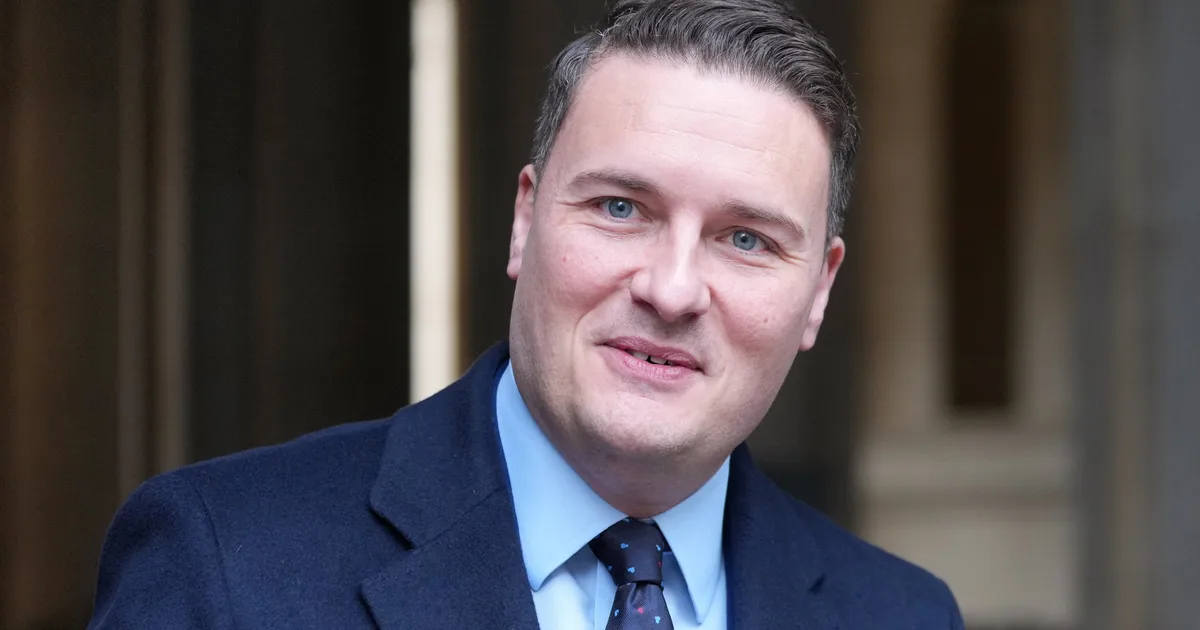
Wes Streeting has declared that he will not run to be the next Labour leader and has endorsed Andy Burnham to be Keir Starmer’s successor.
The former health secretary quit last month in frustration over Starmer’s leadership and suggested that he would challenge his premiership.
Streeting insisted he had 81 MPs backing him – the threshold needed to trigger a contest against the prime minister – but wanted to give Burnham a chance to get a seat in parliament so they could have a “battle for ideas”.
Burnham won the Makerfield by-election last week and was poised to challenge the prime minister until Starmer decided to resign on Monday morning.
Moments after the former Greater Manchester mayor announced he was running to be the next Labour leader and de facto prime minister, Streeting appeared to endorse him.
In a statement on X, he said: “After a devastating set of election results in May, the Makerfield by-election has proven that Labour can still win if we have the courage to change. It was a victory for unity and hope over division and hatred.
“It was also Andy Burnham’s victory.
“Andy has shown what Labour can be when we are inclusive, united, and in touch with the lives of the people this Party was founded to represent.”
He added: “Having spoken at length with Andy in recent days, I’m convinced that there is a place for those ideas under his leadership; that he is committed to building an inclusive party that draws on the best of our political traditions; and that he can win the fight of our lives against the forces of nationalism.
“We could spend the summer exaggerating small differences, or we can roll up our sleeves and help him to deliver the change our Party and our country needs. That is the choice that I am making and I hope that everyone else will back Andy, too.
“We were elected change our country, to show that politics can be a force for good, and to spread opportunity for everyone. With Andy, we still can.”

President Donald Trump slammed Italian Prime Minister Giorgia Meloni again on Sunday, accusing her of refusing to support the US military after he unilaterally waged war against Iran.
In a Truth Social post that did not mention her by name but by her job title, Trump wrote: “After spending Trillions of Dollars on NATO, Italy, and its Prime Minister, wouldn’t even think of becoming involved with the Islamic Republic of Iran and their very serious Nuclear Threat. For decades, we defend them but, when tested, they are not there to defend us, and the rest of the World. Not good!”
A spat that began at the G7 summit last week is boiling over, in part due to Trump’s propensity to beef with fellow world leaders, most of whom are allies.
Trump earlier claimed that Meloni essentially groveled for a photo op with him during the get-together. “She begged me to take a picture with her. She wanted a picture with me so badly. I wouldn’t have taken it, but I felt sorry for her,” he said. He repeated the claim.
Meloni, who reportedly challenged Trump on issues related to the war in Iran during the summit, said he showed more deference to enemies than to allies. She said his claims were “completely made up.”
Trump suggested Meloni was trying to cozy up to him because of her “falling numbers.”
Italian Foreign Minister Antonio Tajani cancelled a visit to the US in the wake of the spat, calling Trump’s accusations “serious and offensive.”
Listen to Commons People, the podcast that makes politics easy. Every week, Kevin Schofield and Kate Nicholson unpack the week’s biggest stories to keep you informed. Join us for straightforward analysis of what’s going on at Westminster.
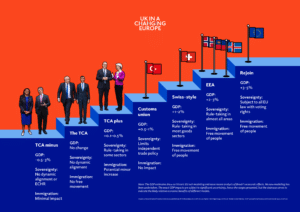
Ahead of the ten year anniversary of the EU referendum on 23 June, UK in a Changing Europe experts have written a short series of blogs reflecting on some of the issues at the heart of Brexit then and now. Here, Anand Menon reflects on the referendum ten years on.
I find it difficult to reflect on the last ten or so years. Partly, I fear that’s a function of my increasingly unreliable memory. Partly too, it’s because I’ve tracked the Brexit story, blow by bitter blow. From referendum to leadership election, to Lancaster House, to Salzburg, to implementation vs transition phases, to max fac, to borders to another leadership election, to Boris to non-tariff barriers to the Protocol, to another leadership election, to France as foe, to another leadership election, to general election to reset to possibly another leadership election. Frankly, it virtually impossible to discern the wood at all for the various trees.
But a few things stand out. First, the impact that Brexit has had on our politics. These are complex, and, as I’ve suggested elsewhere, Brexit might have facilitated the current upsurge in support for populist parties. However, amidst all the churn and the uncertainty, there has I think been one positive. Brexit further eroded the organic ties that once linked parties to their voters. Voter volatility means parties have to work harder to attract support. Who knows what now qualifies as a genuinely safe seat? Clearly, this is not to say that our system is either fair or proportional. But it is one in which politicians have to be more responsive to the electorate.
The second issue that Brexit has made me ponder is the complicated relationship between economic outcomes and political effects. I was struck by this a couple of weeks ago, listening to a lady declare in a focus group that ‘Brexit obviously isn’t affecting us now – we left in 2016.’
Clearly this isn’t true. But it does point to the fact that, for all the evidence that economists have to underline the various ways in which Brexit has impacted on our economy, making the political argument about this economic impact is not straightforward. Drawing causal lines between events many years ago and outcomes today poses a challenge. That was the whole point of the ‘slow puncture’ analogy that Matthew Bevington and I wrote about some years ago. As we put it then, ‘it can take a while to notice a slow puncture. And…it is hard, once it has become apparent, to remember when and where you picked it up’.
This has implications for current and future debates on the UK-EU relationship. The public have not carefully tracked the way in which Brexit has impacted on growth in the UK. But their views of Brexit have tended to be shaped by the state of the economy. As John Curtice argued for us in October 2022, the Liz Truss mini budget seemed to have played a role in increasing negative opinions about Brexit. Which of course raises the prospect that an improvement in the economy might impact on public perceptions, even if Brexit had nothing to do with this improvement.
Which brings us to where we now find ourselves. As out recent report suggests, there are a host of options facing the UK now ranging from the status quo to membership (I reproduce our new staircase here because I think it’s rather cool).
The key points are that, first, Brexit, as it always has, involves trade-offs between political autonomy and market access. Second, Brexit tends to be polarising. As the drawbacks involved in compromise outcomes (either in terms of economic impact or sacrifices of autonomy) become clear, people gravitate towards membership or complete autonomy. This was the case back in 2019, and is becoming the case once more. While the Tories and Reform UK are essentially promising what we used to call a ‘no deal’ outcome (via their pledge to leave the ECHR), ‘progressive’ parties seem to be adopting more ambitious schemes for bringing the UK closer to the EU. It’s hard to avoid a sense of déjà vu.
Allow me to finish with a few words on UK in a Changing Europe. First, to pay tribute to all those who’ve worked here over the years. Not just the academics and researchers who have featured regularly on this site. That they’ve reached such a large audience is a testament to the comms specialists and the admin staff who have kept the show on the road.
And the show itself is an important one, and for two reasons. One, which you’ll hardly need convincing of if you’re reading this, is that Brexit matters. The last decade has been seismic, and Brexit promises to continue exerting an impact on the UK – economically, politically and constitutionally – for years to come.
The other – as important if not more so in my opinion – is that UKICE has underlined the relevance of social science and the importance of ensuring that scholarly research is made available to audiences outside the academy. Research based on evidence provided in a clear and accessible way is fundamental to informed political and public debate. During the twelve years of our existence, we’ve tried to produce this without fear or favour. In an era of ‘fake news,’ of ‘post-truth,’ I believe that undertakings like ours are more important than ever.
By Anand Menon, Director, UK in a Changing Europe.
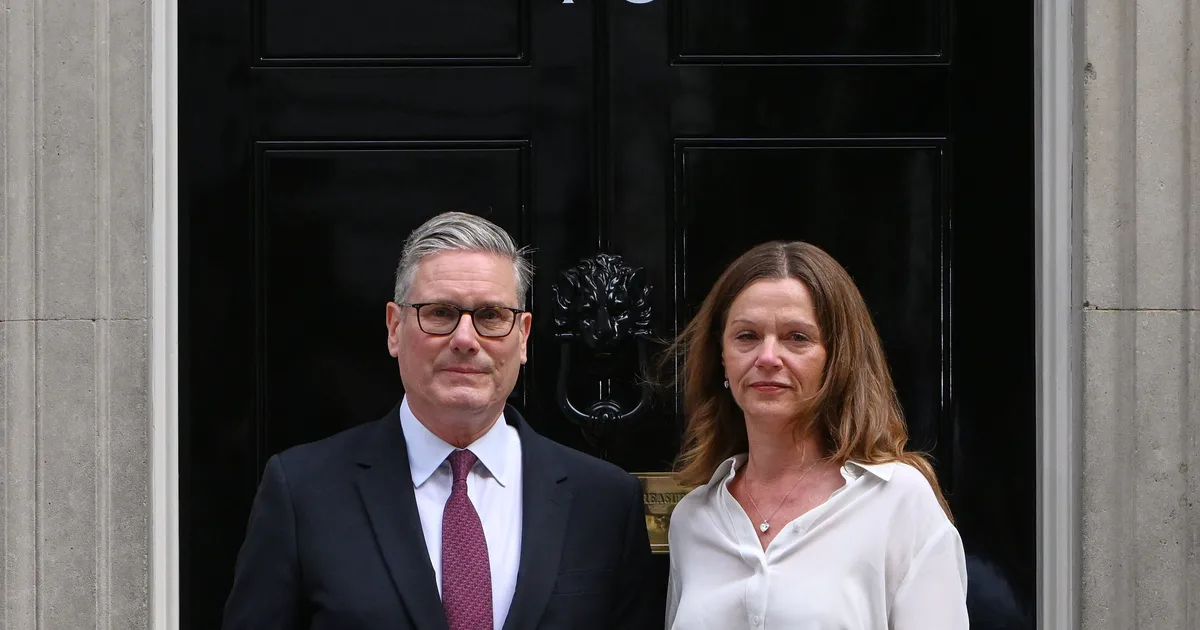
Keir Starmer’s decision to stand down was hardly a surprise, but politicians across the political spectrum – and around the world – have rallied to pay tribute to the outgoing prime minister.
The PM declared he was standing down as Labour leader on Monday and set out a timetable for his official departure from No.10.
In an emotional speech, he said he was leaving in “good grace” after accepting that the Parliamentary Labour Party did not want him to lead them into the next general election.
It comes after his greatest rival Andy Burnham won the Makerfield by-election last Friday.
As Labour’s most popular politician, the former Greater Manchester mayor was already expected to challenge the prime minister and win any subsequent leadership contest.
Here’s how Starmer’s Labour colleagues, international allies and domestic opponents responded to his resignation.
Labour Party
Burnham, who has already thrown his hat into the ring to be Starmer’s successor, said: “Keir has given huge service to our country and I want to thank him for his leadership and dedication during such a challenging period.
“His decision marks the beginning of a transition and it is important that this process is conducted in an orderly and responsible way.”
Former health secretary Wes Streeting, who was briefly considered a leadership hopeful, said he backed Burnham as Streeting’s replacement and added that Starmer “has made the right decision to stand down as Leader of the Labour Party that he saved”.
Starmer’s cabinet also paid tribute to him, with deputy prime minister David Lammy saying he “incredibly proud to have played my part” in Starmer’s government.
Chancellor Rachel Reeves praised Starmer for “taking our party from the worst defeat in modern history” to a landslide victory in just four years.
Home secretary Shabana Mahmood said Starmer’s achievements “will never be forgotten” and that he put us “on the path to the change we promised at the last election”.
She added: “A devoted and dedicated public servant, we owe him our deepest thanks.”
Foreign secretary Yvette Cooper echoed this sentiment, saying the country is stronger and fairer “because of what Keir has done over the last six years”.
Former deputy PM Angela Rayner extended her sympathies to Starmer, saying: “History will remember not just the challenges he faced but the achievements he oversaw.”
Energy secretary Ed Miliband said Starmer can be “immensely proud of his achievement” and that his statement showed “great dignity and integrity”.
One of Starmer’s closest allies, the attorney general Lord Hermer, told Sky News that the PM was not “angry” at being forced out of office.
He said: “I would be, but I don’t think he is.
“I think he is someone who is genuinely focused on the country and doing the right thing, and you saw that on the podium today.”
Anna Turley, chair of the Labour Party, wrote in a statement: “I’m sorry that the nature of politics now is so impatient, so unforgiving, and so personally brutal.
“You have shown that in a world of easy promises, irresponsible rhetoric and lazy, dangerous populism, it is still possible to do things the right way – to show duty, decency and the real patriotism of hard work and service.”
Opposition Parties
Leader of the opposition, the Tories’ Kemi Badenoch, was less forgiving.
She wrote on X: “Britain is not ungovernable. Keir Starmer is a terrible Prime Minister.
“But the problem isn’t just Starmer. Labour MPs only want higher taxes to hand out more benefits, as the Welfare Secretary has pointed out. These are Labour’s choices and their values, regardless of who is running the party.”
The Lib Dem leader Ed Davey said: “The British people are sick of being let down by an endless merry-go-round of prime ministers while nothing really changes for them.
“This time must be different. It can’t just be about changing who’s in Number 10, it has to be about changing our broken politics so we can fix our country.”
He added: “Whoever becomes prime minister needs to drop the caution and complacency and show the ambition our country deserves.”
Green Party leader Zack Polanski said: “The country needs a bold change of direction. Starmer lost the confidence of the country because of his abject failure to challenge the power and wealth of an establishment which has taken for themselves while leaving the vast majority in a cost of living crisis and facing the worst impacts of the climate and nature crisis.”
“We are still waiting to see which version of Andy Burnham might going to show up in Downing Street,” he added. “Burnham must be bold or he will be bust.”
Reform UK leader Nigel Farage called for a general election, writing on X: “I’ve had enough of waiting around. Britain needs change – real change, not another washed-up has-been shoved into place by the uniparty.
“If Labour thinks it can shove another professional politician into No 10, it has another thing coming. Reform is ready for an election, and we are ready to deliver radical change.”
SNP leader and Scotland’s first minister John Swinney paid tribute to Starmer in a statement, saying: “On a personal level, I wish the prime minister and his family well.
“Leadership is tough, and can make extraordinary demands both on the leader and their families. Sir Keir Starmer has made the right decision. It was past time for him to face reality and the fact he now has allows some hope that things can change.”
International Allies
Ukrainian president Volodymyr Zelenskyy thanked Starmer on on X, writing: “The United Kingdom has been, is, and will remain among the world’s leaders.
“Here in Ukraine, we deeply value Britain, and every meeting and every conversation we have had has always been filled with real substance.
“Thank you for always being in touch, always engaged, and always striving to do what is needed and what will truly help.”
He added: “Keir, you are always a welcome guest in Ukraine.”
European Commission president, Ursula von der Leyen, thanked Starmer for his work on rebuilding the UK’s relationship with the EU.
She said: “It can take many leaders years to grow into the statesman you became in just two years.
“European and Ukrainian security is stronger because of you. Thank you, dear Keir.”
Former Czech prime minister Petr Fiala paid tribute to Starmer for his “clear and principled support for Ukraine”, and helped to unlock new levels of UK-EU cooperation.
He added: “Today, rational and decent politicians face an increasingly difficult environment. Starmer moved the Labour Party towards the political centre and strengthened the United Kingdom’s position abroad. In the end, it was not enough.
Australian prime minister Anthony Albanese said in a statement that he considers Starmer “a friend” and notes “politics can also be a harsh business”.
He added: “When the time comes for Keir to leave Downing Street, he can be proud of the contribution he has made to the country he loves and to the Labour party that he led back to government in 2024.”
Listen to Commons People, the podcast that makes politics easy. Every week, Kevin Schofield and Kate Nicholson unpack the week’s biggest stories to keep you informed. Join us for straightforward analysis of what’s going on at Westminster.

South Korea FIU Urges Wider Travel Rule for Small Crypto Transfers

Travellers Are Learning Why Airplanes Are Painted White

Serena Williams gets last wild card spot at Wimbledon


-

 Fashion3 days ago
Weekend Open Thread: Miami – Corporette.com
-
 Tech6 days ago
The Adder At The Heart Of Intel’s 8087 FPU
-

 Entertainment2 days ago
Renter of Home in Anne Heche Crash Denies Settlement With Son
-

 Business2 days ago
Soccer-U.S. defends Iran World Cup travel restrictions, says discussions ongoing
-
 Business2 days ago
Wall Street Week Ahead: Investors see Micron earnings as pulse check of AI rally momentum
-

 Politics4 days ago
BBC Reporter Discusses Cross Party Criticism Of Trumps Iran Deal
-

 Crypto World2 days ago
HIVE shares jump as $220M AI deal speeds Bitcoin mining pivot
-

 Crypto World2 days ago
Jake Chervinsky accuses CME of protecting derivatives monopoly
-
 Crypto World2 days ago
Can Charles Hoskinson Really Rescue Cardano?
-

 Sports4 days ago
FIFA World Cup 2026: Canada beat 9-men Qatar 6-0 to register first ever win | FIFA World Cup 2026
-

 Business2 days ago
MHP SE 2026 Q1 – Results – Earnings Call Presentation (OTCMKTS:MHPSY) 2026-06-20
-
 Crypto World4 days ago
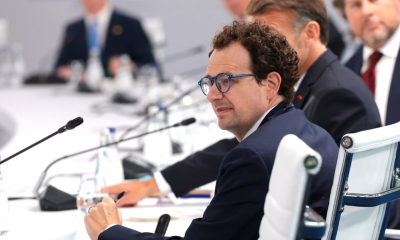
Anthropic’s Dario Amodei Urged AI Unity at G7, Even as US Banned His Models
-

 Business4 days ago
Brexit cost 6% of UK economy, Bank of England company data suggests
-

 Crypto World6 days ago
Robinhood opens AI-powered trading to all users, sending HOOD stock past $100
-

 Tech5 days ago
Weeks Of In-The-Field Testing And A Verdict
-

 Politics2 days ago
Andy Burnham and the meaning of Makerfield
-

 Tech1 hour ago
Microsoft accidentally kills epic Outlook email threads
-

 Tech4 days ago
Adobe adds its AI assistant to Premiere, Illustrator and InDesign
-
 Crypto World4 days ago
Iren (IREN) Stock Surges on Jefferies Buy Rating: AI Infrastructure Play Gains Momentum
-

 News Videos4 days ago
IMPACT ON BITCOIN IF NO GOLD IS FOUND IN FORT KNOX
You must be logged in to post a comment Login