
Politics
Miriam Cates: Starmer and Johnson are very different men, but their downfalls are very similar


Miriam Cates is the former MP for Penistone and Stocksbridge.
Among those of us who sat as Conservative MPs in the last parliament, the current political turmoil evokes a strong sense of deja-vu. The parallels between the Mandelson affair and the last weeks of Boris Johnson’s premiership are uncanny. Although Partygate and the Epstein files are worlds apart in terms of their seriousness, both scandals bolstered campaigns to oust sitting prime ministers with large parliamentary majorities.
Both Johnson and Sir Keir Starmer relied on powerful advisors who became lightning rods for backbench discontent. Although Dominic Cummings resigned 18 months before Johnson’s demise, he played a similar role to Morgan McSweeney, who on Sunday was scapegoated for the Mandelson debacle and left Downing Street. In the run up to his departure, Johnson ‘revamped’ his Number 10 operation, losing key aides Dan Rosenfeld and Munira Mirza, and bringing in Guto Hari and Steve Barclay to ‘reboot’ his comms strategy. Similarly for Starmer, Tim Allen is out, standing down to allow “a new No 10 team to be built”.
The first signs of the end for Johnson – and perhaps for Starmer – began with being publicly undermined by a string of senior MPs calling publicly for their Party leader to step down. I will never forget watching David Davis rise to his feet in a packed House of Commons in January 2022 and implore Johnson “for the love of God man; go”. Clive Lewis’ scathing tweets about our current prime minister are somewhat less rousing.
In another parallel between the two cases, the beleaguered prime ministers’ Scottish deputies were among the first to break ranks. In January 2022, Ruth Davidson declared Johnson ‘unfit for office’; on Monday, Scottish Labour leader Anas Sarwar called for Starmer to step down. Politicians north of the border are clearly ahead of the curve.
Ultimately, Johnson was toppled by a slew of ministers resigning en masse; so far Starmer’s cabinet is holding firm, although the support expressed in their tightly coordinated loyal social media posts seems neither heartfelt nor unconditional. And, just as then-chancellor Rishi Sunak was accused of starting a covert leadership campaign early in 2022, so Wes Streeting is thought to be on manoeuvers now.
After a well-received performance at the Parliamentary Labour Party meeting on Monday, Starmer seems safe for now – as did Johnson after he won (narrowly) a vote of no confidence in June 2022. Yet as it was for Johnson, this may yet be a temporary reprieve. Seven weeks after that vote, Johnson was gone, brought down by the fallout from accusations that Chris Pincher, the deputy chief whip drunkenly groped a man in the Carlton Club. For Starmer, any number of potential bumps in the road in the coming weeks may re-ignite the smoking embers of a coup.
If Sir Keir quits, whatever the immediate catalyst for his departure – poor by-election results, a badly received spring statement or perhaps another ministerial scandal – it will not be the true cause of his undoing, just as Johnson’s poor judgement in dithering over Chris Pincher was not the primary reason for his downfall. For both prime ministers, a leadership crisis followed a steady loss of confidence among their MPs that eroded their authority with each political hiccup.
Johnson and Starmer have a tendency to U-turn under pressure; sending backbenchers out to defend unpopular policies one day which are then reversed the next is a surefire way to lose support. But it’s not only U-turns that cause disaffection. Just like Johnson’s Tories in 2022, Starmer’s Labour MPs are watching the plunging polls with horror. I remember the unease in the House of Commons tea room when the Conservative vote share started to fall below 35 per cent in the final months of 2021. The Labour Party is now polling consistently below 20 per cent; backbenchers have every reason to panic. Poor polling convinces many MPs that they have nothing to lose – and everything to gain – by switching leaders.
Of course no two events in politics or history are identical. Just because Johnson was forced out, precipitating a slow and painful Tory demise doesn’t mean the same will happen to Sir Keir and Labour. But the fact that two prime ministers of such different characters, in different parties and under different circumstances, can face such similar situations may indicate that this state of affairs has more to do with our political system than the specific weaknesses of Starmer and Johnson.
We are living through a time of acute political instability. If Starmer premiership ends this year as predicted, he will make way for Britain’s seventh Prime Minister in a decade. The last time a Party leader won a majority at a general election and then went into the next election still as Prime Minister was in 2001, a quarter of a century ago. Of course there have been many periods of turmoil in our history, but the feverish nature of politics over the last 15 years or so feels unprecedented, and shows no signs of abating. Why?
An obvious culprit is the rise of the smartphone, social media and instant messaging. The sheer quantity of information that can now be exchanged, and the ease and instantaneity of communication, have made it vastly easier for MPs to communicate their complaints and opinions with their colleagues – and with journalists – than in the past. When secret plotting involved arranging to meet unseen in dark corridors at pre-arranged times in the Palace of Westminster, there were practical barriers to arranging a mutiny.
Continuous political updates on Twitter (X) allow MPs to take the political temperature every five minutes, rather than once a day while reading the newspaper over their tea room porridge. Instant communications have sped up time; politics now operates in permanent crisis mode, with overstimulated journalists and MPs living on adrenaline, conditioned to react rather than respond to events.
More frequent polling has also made it difficult for MPs to take a longer view of the political cycle. Since 2016, reforms to polling methods have made predictions far more accurate. A few consecutive surveys that show your party is falling in popularity can no longer be dismissed, and with the constant stream of new data, MPs track the polls like a doctor tracks a critical patient’s heart beat – every fluctuation seems to demand a drastic intervention.
But technology is not the only factor driving dissatisfaction with leaders. We are living through a major political realignment, where previously consensus issues like the necessity of strong borders, what it means to be British, and the importance of providing for yourself and your family are now highly contested. The splits on these issues do not always fall along traditional left-right lines, and so have fractured both Labour and Conservative parties. Although both Johnson and Starmer won large parliamentary majorities, neither prime minister ever had a true majority when it came to political direction. I’m not sure Boris ever knew his own mind on the subject of the welfare state, but had he tried to cut benefits he would have found his party just as split as Starmer’s.
The impotence of government has also played a role in discontent. Blairite reforms stripped power away from both parliament and the executive. The inability of ministers to get a grip on immigration or house building owes more to rule by quango than to the incompetence of our leaders. MPs may express discontent over the ‘direction of travel’, but there is nothing quick that prime ministers can do to fix things, instead resorting to ‘resets’ and meaningless talk about ‘values’.
There has also been a growing trend to play the man not the ball, with opposition parties and the press putting pressure on individuals to resign after mistakes, in much the same way as football managers are told to quit after a few bad performances. In the last parliament, Starmer, Angela Rayner et al made a habit of calling for scalps on an almost weekly basis. Now Kemi Badenoch and the Conservatives have taken up where Labour left off, demanding the resignations of Reeves, Rayner, Mandelson and now Starmer.
His Majesty’s Opposition of course exists to challenge the government of the day, but, to me at least, it is unclear how it is in the national interest to continually undermine the position of those in elected office, especially when there are no clear preferable alternatives. If Starmer goes, he may well be replaced by someone far to the left of him; the reaction of the markets would cause genuine pain to voters.
The current political turmoil looks set to continue for some time, and it can’t all be blamed on technology and tactics. Underlying the discontent in both Parliament and the country is a sense that Britain is in decline and that not even a government with a large majority can rescue our country. The public must shoulder some responsibility for our political paralysis; the kinds of painful reforms that are necessary to save Britain – on tax, immigration, energy and planning – are unlikely to command majority support. Most voters – and possibly many MPs – still want lower taxes and higher public spending, something that no prime minister can hope to deliver.
But politicians are to blame too. Johnson and Starmer, like many of their MPs, seem to have no motivating purpose other than ‘managing’ the country well. When ‘management’ fails, it is unsurprising that neither backbenchers nor ministers are able to hold their nerve.
So how do we escape the vortex of political instability? There is no hope to be found in the left of politics; the few individuals who might understand how to rebuild our society and economy are isolated and have insufficient support within their movements.
The answers lie on the right, and as we approach the next election, conservatives in both Reform and the Conservative Party must prepare a radical and detailed programme for government, including repealing Tony Blair’s assault on democratic power. And both parties – and their leaders – must define and communicate a vision for Britain that goes beyond good management, inspiring patriotism and preparing the public for the kind of hardship that will be inevitable if we are going to turn the country around. Stable leadership is still possible; but not for at least three more long years.

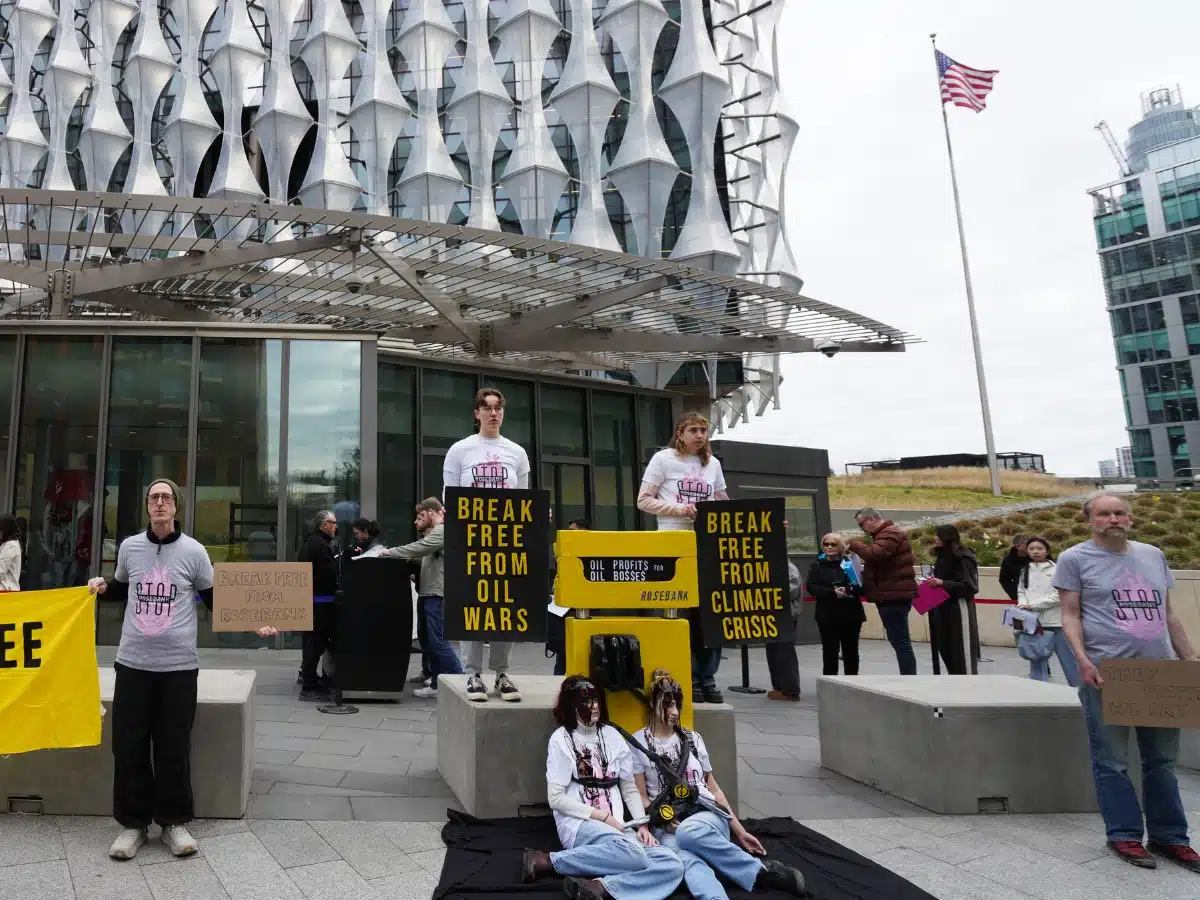
Outside the US Embassy in London on 1 April, two activists were tied by fuel hoses to a life-sized petrol pump in response to Donald Trump’s war on Iran.
The protest criticised the increase in oil company profits in the wake of the war’s destruction and trade disruption. The pump carried the label: “Oil Profit$$$ for Oil Bosses”.
Campaigners from Fossil Free London held signs saying “Stop Trump Tying us Into Fossil Fuels”, “Break Free from Climate Crisis” and “Break Free from Big Oil”.
Thousands have died to date across the region following US and Israeli attacks on Iran. Trump has recently stated his intention to “take the oil in Iran” following major attacks on fossil fuel infrastructure.
Meanwhile, oil dependency is increasing the cost of living once again for families in the UK as petrol prices rise. Whilst fossil fuel companies stand to make a windfall of billions on the back of the price shock.
One of Reform’s major donors, Jeremy Hoskings, has seen his fossil fuel and energy hedge fund investments rise by more than $25m since the war began in Iran.
This comes as Trump and Reform are using the oil price spike to call for our government to approve new UK oil and gas projects, like the controversial Rosebank oil field. Despite the fact that drilling in the North Sea would not make the UK more energy secure. If production began, Rosebank’s oil would still go for export – like 80% of all UK oil.
Robin Wells, director of Fossil Free London said:
Right now we are seeing the horrors of Trump’s war on Iran in the faces of dead schoolgirls and facing skyrocketing energy costs at home. And Big Oil cashes out big, with bumper profits.
We’re protesting today to say that for as long as the UK stays tied up in fossil fuels, we’ll see more oil wars, more extreme weather deaths and more instability.
The UK needs to cut ties with Trump and Big Oil. We need to break free from this knot of violence.
That starts with scrapping new UK oil and gas and rejecting Rosebank. Until then, being tied into Big Oil’s big disaster leaves us paying the price.
Featured image via Fossil Free London

It turns out that tiny changes – minutes more exercise, a few grams more veggies – can make a surprisingly large difference to your longevity and heart attack risk.
And Dr Dominic Greenyer, a private GP at The Health Suite, said that those lifestyle changes become medically obvious in time.
“If you followed two twins over time, you would often see clear differences in their skin, body composition, energy levels and overall health depending on how they live,” Dr Greenyer said.
“Ageing is not just about time passing. It’s about how well the body is maintained.”
Here, he shared the five factors he feels make all the difference:
1) Building and maintaining muscle
As we age, our muscles begin to wane – a process called sarcopenia. If we do nothing to maintain or build it, some research says we’re expected to lose half our muscle mass by 80.
“One of the biggest predictors of healthy ageing is muscle mass,” Dr Greenyer said.
2) Prioritising sleep and recovery
“Chronic poor sleep can accelerate ageing at a cellular level,” Dr Greenyer said.
“It affects hormones, recovery, inflammation and even visible signs like skin quality.”
Experts think that following a “7-1” sleeping rule (getting at least seven hours of sleep a night, with no more than an hour’s variance between bedtimes and wake-up times) could add years to your life.
3) Reducing inflammation through lifestyle choices
In and of itself, inflammation isn’t a problem – it can help our bodies to heal and may be an important part of muscle growth.
But “inflammaging” can occur when inflammation is chronic, and might contribute to conditions such as heart disease, type 2 diabetes, dementia, and frailty.
It “is influenced by diet, stress, alcohol intake and overall lifestyle,” Dr Greenyer said.
Those who eat whole foods, stay active, and manage stress well may have less unwanted inflammation, he added.
4) Maintaining “metabolic flexibility”
This is the ability to respond well to changing metabolic demands. It allows you to switch between burning carbohydrates and fat; a more flexible metabolism is linked to better ageing.
“When this is impaired, people are more prone to energy crashes, fat gain and insulin resistance,” Dr Greenyer said. Exercise, eating well, and avoiding constant snacking may help, he added.
5) Enjoying life, in moderation
There’s lots of research to support the idea that enjoying ourselves – be it through socialising or even eating some candy – might help us to live longer.
“There is good evidence that polyphenol-rich foods such as dark chocolate can support cardiovascular health when consumed in moderation,” Dr Greenyer added. “Just as important is maintaining strong social connections, which are consistently associated with longer lifespan and better mental wellbeing.”
He ended, “The difference comes from small choices repeated over years – but they should still allow you to enjoy life.”

On 30 March 2026, two activists from the group People Against Genocide (PAG) targeted the London headquarters of Chubb Insurance, as well as the offices of Sompo, owner of Aspen Insurance. They sprayed the front of the building with symbolic blood-red paint, before locking-on outside the front entrance.
This is the fourth recent action by PAG. They have previously targeted both the Manchester and London offices of Chubb.
UAV Engines
Chubb insures UAV Engines, a subsidiary of Israel’s biggest weapons company, Elbit Systems. Elbit produce 85% of the Israeli military’s killer drone fleet.
UAV produce engines for Israel’s drone fleet at their factory in Shenstone in Staffordshire. These include the R902(W) Wankel engine used in Elbit’s Hermes 450 drone, the same model used by Israel to kill seven aid workers from the World Central Kitchen, including 3 British nationals.
Calls to action
One of the activists locked-on outside the Chubb offices called on fellow activists to join them with flags, banners, and whistles. They said:
We are here to shut down Chubb, the insurers of Elbit Systems, until they cut all ties.
In the last month, we have seen whole families obliterated, thousands killed, and over thirty thousand injured across Palestine, Lebanon, Iran, and the whole of West Asia. Israel announced its intention to ethnically cleanse almost one million people out of southern Lebanon, all operationally supported by Elbit Systems, who profit from every life lost.
Those profits are guaranteed by Chubb, who insure their Shenstone factory here in Britain. The responsibility to drive Elbit out of our communities has never been more urgent.” They then called on supporters to get trained in direct action tactics, and join the struggle to shut down Elbit.
Without the mandatory Employer Liability Insurance provided by Chubb and Aspen, neither UAV Engines, nor Elbit themselves, could operate in Britain.
Global campaign
Other actionists have targeted insurance companies in recent months, following the announcement of a global campaign to disrupt an international ‘economy of genocide’. Previously, insurers Allianz and Aviva have ended their cover of Elbit after sustained protest activity.
PAG has previously targeted HSBC branches across the UK over their investments in Elbit Systems, as well as protesting Elbit sites directly.

We hope you love the products we recommend! All of them were independently selected by our editors. Just so you know, HuffPost UK may collect a share of sales or other compensation from the links on this page if you decide to shop from them. Oh, and FYI — prices are accurate and items in stock as of time of publication.
Some holidays are purely for rest (chillmaxxing, if you will). Christmas? Yep. Beach holidays? Bingo. Easter weekend? Not one of them. Ending as soon as it arrives, the long weekend is just long enough for a quick getaway, more often than not surrounded by hundreds of family members.
If you’ve ever been responsible for leading hordes of people through the rainy English countryside, you’ll know there’s nothing that ruins a weekend faster than getting the route wrong. Just think: hungry, tired adults and children, and teasing fodder for years to come.
That shouldn’t stop you from getting outside this Easter, though. Jesus didn’t come back from the dead – or, rather, spring hasn’t sprung – for you to lounge around inside. And if that won’t convince you, you gotta work up an appetite for the copious amounts of food you’re about to consume.
To make sure you don’t get stuck in a bush somewhere rural, the trail guides app AllTrails is offering 50% off its membership tier from April 3 to April 7 with the code ’APRIL26’.

AllTrails Plus Membership Card
Yep, that makes it a whopping £1.50 per month, or £18 a year, which if you ask us is well worth the cost of avoiding a family-wide argument – or several.
As well as access to the literal hundreds of thousands of walking, biking, and running routes available with a free subscription to the app, AllTrails Plus also unlocks a whole range of extra features like offline maps, wrong turn alerts, and Live Share, so the rest of your crew can keep an eye on you.
My personal favourite feature is the 3D trail feature, which means you can see exactly how steep the incline is (because, if you’re anything like me, incline measurements mean essentially nothing).
I’ll also be gifting the membership to my elderly relatives, who have a habit of defiantly wandering off on their own walks and later end up inevitably needing to be rescued.
Thankfully, you can choose to either print it off – for the less digitally inclined (maybe help them to download the app and figure out how to use it) – or send the gift card via email. You’ll even have the option to customise how it looks by adding your own personalised picture and message.
Cue the hours-long conversations about what trail to choose!

We’ve already decoded the meanings of choppelganger, chopped and why kids keep saying lowkenuinely.
Now it’s time to shine a spotlight on another favourite term embraced by Generations Alpha and Z: mid.
The critical descriptor has been knocking around for a few years now, but teens and young adults are increasingly using it in everyday life.
While many of us know “mid” as a term to describe something that’s among, or in the middle of, something; for the younger generations (wow, I feel old writing that) it means something else entirely.
What does mid mean?
When Gen Alpha uses it, “mid” means mediocre or of disappointing quality. If you’re described as “mid” by a teenager then they’re basically saying you are… average.
Possibly even below average.
According to Merriam-Webster, “mid” serves to express that something falls short of expectations, or isn’t impressive.
It’s not bad, per se, but it’s not exactly good either. (In fact, the way it’s used nowadays is probably veering more towards bad than good.)
The dictionary notes that this slang term is thought to have come from a shortening of the term mid-grade, “a designation in cannabis culture of medium quality”.
Over time it’s evolved to be used as a descriptor of everything from people and food, to film and TV.
Some examples of how it could be used include:
- “That burger was mid.”
- “Did you enjoy the party? I thought it was mid.”
- “I liked their last album. Their new album’s mid.”
Want to learn more? There’s also been chat, clock it and glazing, as well as aura farming and crash out. Honestly, the kids have been busy.
The BBC has issued a fresh statement about the circumstances surrounding Scott Mills’ abrupt firing earlier this week.
On Monday, it was confirmed that Mills had been sacked by the BBC effective immediately, due to an allegation about his personal conduct.
Following this, it emerged that he’d previously been questioned by the police in 2018 as part of an investigation into “allegations of serious sexual offences against a teenage boy”, who was under 16 at the time.
The Mirror alleged on Monday that Mills’ firing came following a complaint made about this police investigation, though the BBC previously declined to comment on whether this was the case.
However, on Wednesday afternoon, the BBC offered more information about what led to Mills’ departure from the corporation, clarifying that bosses were already aware of the investigation surrounding the former Radio 2 host as far back as 2017.
“Scott Mills had a long career across the BBC, he was hugely popular and we know the news this week has come as a shock and surprise to many,” a spokesperson said.
“We also recognise there’s been much speculation in the media and online since Monday. We hope people understand that there is a limit to what we can say because we have to be mindful of the rights of those involved.”
The statement continued: “What we can confirm is that in recent weeks, we obtained new information relating to Scott and we spoke directly with him. As a result, the BBC acted decisively in line with our culture and values and terminated his contracts on Friday 27 March.
“Separately, we can confirm the BBC was made aware in 2017 of the existence of an ongoing police investigation, which was subsequently closed in 2019 with no arrest or charge being made. We are doing more work to understand the detail of what was known by the BBC at this time.”
Earlier this week, the BBC also shared an apology for failing to “follow up on” an additional allegation about Mills that was raised by a freelance journalist in 2015.
“We received a press query in 2025 which included limited information,” they said. “This should have been followed up and we should have asked further questions. We apologise for this and will look into why this did not happen.
“More broadly, we would always urge anyone who has concerns or information to raise it with us.”
Sunder Katwala looks at the government’s proposed reforms to settlement rules in the UK as part of its immigration policy overhaul and asks whether they could meet the fairness challenge.
Securing public confidence on immigration policy has proved a daunting challenge for successive British governments. The Labour government’s attempt to break that cycle sees it pursuing three major policy reforms at once. Two of these were key pledges in its 2024 general election manifesto: reducing overall numbers to “sustainable levels” (without indicating what that sustainable level might be) and bringing back control to the asylum system. Labour’s third major initiative is the biggest overhaul of the settlement rules for decades. There was no mention of settlement or citizenship in the party’s manifesto.
Labour’s record is sharply contested in a polarised political debate. But on the specific pledges it did make, it has made more progress than is usually recognised.
Overall immigration numbers have fallen spectacularly. The government inherited record levels that were likely to halve due to the final decisions of the last government. But Labour has reduced the numbers much further and much faster than almost anybody recognises, including government ministers and their political opponents.
So the fall in immigration risks being a very well-kept secret. There is a time-lag in the data but a bigger lag in the political discourse. The latest headline figure – net migration of 205,000 – relates to the 12 months up to June 2025. But published data shows there was a further 45,000 fall in visas by the end of the year – so the 2025 net migration headline number, which comes out in May 2026, will be down again. The Home Secretary used the mid-2025 headline number to tell the Home Affairs select committee that “net migration remains high by any measure”. Yet 2026 will almost certainly see the lowest level of net migration this century – and negative net migration is likely in 2027.
Another reason that the collapse in overall numbers has not been noticed is that asylum claims are rising. The data shows progress on reducing the asylum backlog, with incremental if slow progress on reducing the use of asylum hotels. The government has also sought to publicise a significant rise in removals. Yet boats crossing the channel make a lack of control visible. The question of what will and won’t work to secure control is contested.
It is the settlement proposals that have proved most contentious. Their aim is to reflect popular ‘rights and responsibilities’ principles – that those who join the club should show a willingness to contribute. Those principles underpin the current system – with English language, good character and citizenship tests, and the symbolism of the citizenship ceremonies introduced two decades ago. The key difference with earned settlement is a much more stratified approach. Some people could qualify in three years, and some in five years – but the timelines will be doubled as a baseline, trebled for some, and quadrupled for refugees.
These complex proposals are often misunderstood. Media reports invariably say the timeline will be ten years for most people – but a 15-year wait will be more common for those who came in the last parliament. That is not simply a rule for care workers, but for all mid-skill roles (below RQF Level 6): chefs, lab technicians, data analysts, electricians and hotel managers would all wait 15 years for settlement too.
The most contested issue has been whether or not it is fair to apply new rules to those already in the UK. Critics say this would move the goalposts. The government’s main argument has been that it would be unaffordable not to do so.
The Home Secretary deployed the eye-catchingly large figure of £10 billion in net fiscal costs for care workers and their adult dependants. Yet analysis by the IPPR and others has shown that the £10 billion figure is a mirage since the government’s proposal for a longer path to settlement would seem to make little, if any, difference to this number – and most costs would be incurred in three decades’ time.
So the key question is: what are the fiscal gains or costs of the government’s reform proposals? MPs and peers have been trying to find out: the government appears to be stonewalling on supplying those details – but it will be impossible for parliamentarians to debate the current reforms, or possible alternative proposals, without the real numbers.
Earned settlement creates, by design, a hierarchy of status in terms of what different migrants deserve. A foreseeable but perhaps less directly intended consequence is to create a stratified hierarchy of settlement for dependents too. The child of a banker could be a citizen by the age of eleven, while his classmate who is the daughter of a cleaner at the bank would have a fifteen-year wait – and would not be eligible for home student fees.
To advantage the most affluent children while placing impediments to their working-class peers inverts the aims of the government’s opportunity agenda. The Home Affairs Select Committee has proposed several mitigations that could soften the impact on children – but it is an inherent feature of making parents “earn” their children’s settlement at different rates too.
The stratified hierarchy has a highly racialised pattern too. Most black and Asian migrants from Commonwealth countries will face a 15-year wait, while migrants from the EU and north America are likely to attain settlement earlier. Different patterns of dependent visas means there will almost certainly be a more racialised distribution for children than for adults. These lengthy timelines risk seeing people fall out of status too – risking the creation of a new Windrush scandal.
The settlement reforms are sharply contested, both on their core principles and how they will apply in practice. The Prime Minister has signalled a willingness to listen to the challenges made by care workers and their allies. “People do want fair rules. They want clear rules but they also want compassionate and fair rules” he said in a newspaper interview. The outcome will ultimately depend on a political judgment – about what can and cannot be defended as fair.
By Sunder Katwala, Director, British Future.

The Department of Work and Pensions (DWP) is bragging about how “successful” the Managed Migration to Universal Credit has been. This is despite over 360,000 vulnerable people being stripped of vital benefits in the process.
The DWP announced the closure of Employment Support Allowance and Housing Benefit following the campaign to force claimants to move to Universal Credit.
They bragged:
Over 1.9 million people now better supported to find good, secure jobs as the Government moves customers off outdated benefits and on to Universal Credit
Considering ESA was a benefit for disabled people who couldn’t work as much or at all, it’s absolutely gross that the focus here is on work. But it doesn’t come as a surprise from the department that wants to force disabled people into work by any means necessary.
What about those who haven’t migrated?
However, this ignores how many haven’t been able to claim or have been stripped of their benefits. The DWP sent out over 2,352,886 managed migration notices, and 1,985,703 have moved over. That means 367,183 people haven’t successfully moved over yet and could have them stripped away.
That means a huge number of disabled people who already live in poverty will be forced into even harsher living conditions. As the Canary has previously reported, making the move is especially difficult for chronically ill and disabled people, who struggle with stress and lack the energy to fill in excessive forms.
An internal report showed that some disabled claimants often have very little of what they were being asked to do. As a result, many failed to make a new claim for Universal Credit and lost their legacy benefit.
It’s been such a cause for concern that mental health professionals have warned the DWP that migration will put claimants at risk.
The National Association of Welfare Rights Workers told Work and Pensions committee chair Debbie Abrahams that:
These claimants will all have long-term health conditions and/or disabilities, and their legacy benefits are likely to be their only source of income. A failure to migrate to universal credit therefore carries a high risk of destitution, rapid deterioration in their health, and even death.
The latest DWP statistics, published on 11 November 2025, provide a detailed analysis of the migration of the ESA cohort to universal credit. The Department highlights that, for those sent a migration notice between July 2024 and May 2025, 3% failed to make a claim to universal credit and had their legacy benefits stopped. However, for claimants who were in receipt of ESA only, the figure alarmingly doubles to 6%.
Many lose out while DWP pushes workshy narrative
What’s also missing is that many forced onto UC have their benefits reduced and somehow have to survive on less as prices rapidly increase. Policy in Practice found that around 200,000 households lost around £59.54 a week. That’s over £230 a month that people are just expected to do without.
The DWP release also only mentions two of the benefits that are being amalgamated into Universal Credit. Others have an even worse success rate. As the Canary has previously reported, nearly a quarter of Tax Credits claimants who’ve been forced onto Universal Credit ended up without any benefits.
And once again, despite ESA claimants having already been found too sick to work, the DWP is obsessed with pushing the workshy narrative.
This Government is committed to updating the welfare system so that it promotes opportunity, rather than stifling it – as part of our Plan for Change.
The campaign means the number of people on Universal Credit has increased, particularly the number of people who receive the benefit with no requirement to look for work, as, since June last year, the focus has been on moving vulnerable people from Employment and Support Allowance.
There’s absolutely no need for them to constantly mention people with ‘no work requirements’ other than to remind people of this fact. By using this wording, they make it sound like people are choosing to work, as opposed to not being well enough to.
While the DWP are celebrating ‘supporting’ so many to switch to UC, it’s clear what their motives are. It’s easier to push people into work from Universal Credit, and even easier to turn the public against people with ‘no work requirements’.
Featured image via the Canary



4 min read
The Cyber Security and Resilience Bill must go further to bolster our energy security in the face of growing digital threats.
One lesson from the conflict in Iran is that a cyber attack is the opening move of modern warfare. Israel proved this, hacking Tehran’s CCTV cameras to mark key targets and the Ayatollah himself for US and Israeli bombing.
But the UK is severely underprepared for this reality. As our energy sector rapidly digitalises like the rest of the world, a new target is opening up for hackers, and unless we learn from the Iran-US war, they will be able to strike at the heart of our industries, government and households.
Our nation is no stranger to having its energy weaponised, causing economic and social pain to British households. From blackouts in the 1970s due to the miners’ strikes and the oil crisis, to energy bills soaring when gas prices spiked following Russia’s invasion of Ukraine in 2022.
Cyber attacks can recreate this economic damage, and no form of energy supply is safe from attack. Whether it is gas, renewables or nuclear, every form of energy that our nation relies upon is susceptible. And as our energy system continues to digitalise, the threat cyber attacks pose to our country is growing.
The UK’s energy system is not prepared for such attacks, and Labour is failing to address this threat to our security.
Our enemies know this all too well. Over 90 per cent of the largest energy firms have already fallen victim to cybersecurity breaches to date, with attacks becoming increasingly regular. And they can repeat the damage other hackers have done to major British companies on our energy system, similar to the attack on Jaguar Land Rover in my constituency of Meriden and Solihull East in 2025 that cost the UK economy an estimated £1.9bn. This also caused major disruption throughout the automotive supply chain and has left companies facing bankruptcy.
Unless we strengthen our security, a cyber attack from anywhere in the world could switch off our energy supply, bringing much of our daily life and our economy to a grinding halt.
Despite this urgent need to take action, the government has ignored the severity of this threat and failed to tackle it since taking office. The Cyber Security and Resilience Bill is a unique opportunity to tackle this glaring oversight. However, Labour ministers are squandering this opportunity to protect our energy supply from cyber attacks.
This is why I am calling on the government to strengthen our energy system against cyber attacks by going further in the Cyber Security and Resilience Bill.
Firstly, the bill should only allow data from the UK energy sector to be processed either within UK territory or that of allied countries with robust cybersecurity mechanisms. By limiting the processing of this data to places we can trust, we would make it harder for cyber criminals to access energy firms’ data and use it for nefarious purposes.
Furthermore, the government should also expand the requirements for energy companies to report when they are victim to cyber attacks. Reporting these attacks to government cybersecurity agencies is essential for deterring further attacks and alerting them to existing holes in our security. Although there are already reporting requirements in the UK, they are not fit for purpose, and the bill does not go far enough to improve them. The current state of the bill means many cyber attacks will continue to go unreported to the relevant cybersecurity agency, reducing our ability to establish where our energy grid is exposed and to respond accordingly.
The risk cyber attacks pose to the UK’s energy security is clear, as is the government’s failure to address this threat. By amending the Cyber Security and Resilience Bill to secure energy firms’ data and ensure more cyber attacks are reported, we can strengthen our cyber security and make it harder for our enemies to turn off our power.
Saqib Bhatti is Conservative MP for Meriden and Solihull East
4 min read
North Sea extraction won’t bring down energy bills or fund government subsidies. But, done responsibly, it has a role to play in our national security.
For decades, China has realised the importance of energy security to its long-term success. It increased electrification, with a corresponding rise in domestic renewables and a massive increase in strategic oil and gas reserves.
Meanwhile, the UK has failed to learn the lessons of energy crises dating back to the 1970s. The dual shocks of the Russian invasion of Ukraine in 2022 and the ongoing conflict in the Middle East present an opportunity to correct this.
These events have shown in the starkest terms that relying on global markets alone leaves the UK dangerously exposed to external shocks. Energy security is why the government and the oil and gas industry must abandon short-term, distracting arguments around price and tax revenues, and work together.
The physical protection of energy infrastructure is central to national resilience and our deterrence posture. In 2024, the UK relied on imports for 43.8 per cent of its primary energy, up sharply from 28 per cent in 2020, reflecting a significant rise in dependence on external suppliers.
Domestic oil and gas production fell to a record low, declining 6.5 per cent year on year, as output from the UK’s mature continental shelf continued to contract. Production is now around 20 per cent of its 2000 level. Meanwhile, UK gas consumption in 2024 reached 689 TWh, compared to domestic production of just 344 TWh, leaving a substantial structural deficit.
In a world of rising geopolitical tension, that deficit is a strategic weakness. A stable, managed level of North Sea output is not about returning to past production peaks; it is about ensuring the UK retains sovereign access to critical energy supplies when global markets tighten, or hostile states attempt to disrupt or attack our country.
Offshore Energies UK accepts that increased production in North Sea oil and gas would have no meaningful impact on UK energy prices, as that product is sold on an international market, which dictates the price. A secondary claim that increased production would generate tax receipts to bring down energy prices is also questionable. Research by the University of Oxford found that even in the implausible scenario of the UK being able to maximise North Sea oil and gas and use all revenues to subsidise lower energy bills, the impact would be limited, a maximum of £82 per year off a household bill.
However, there are two reasons the future of North Sea oil and gas remains critical and should be supported.
First, given the volatility and increased tension around the world, the government should explore an agreement to allow increased extraction with a binding commitment that a sufficient reserve is created against future shocks and, in the event of a crisis, North Sea oil and gas would be provided to UK markets for a fixed, lower price to protect households and businesses.
Second, we must fully bridge the skills gap between current oil and gas and a more secure renewables future. Around 154,000 workers are employed across the UK’s offshore energy sector. These are well-paid and highly technical jobs protected by trade unions.
The UK recently secured a record 14.7 GW of new renewable capacity, enough to power up to 16m homes. The UK now has an unprecedented acceleration in renewable deployment and a major reinforcement of the UK’s long-term energy security and resilience.
This represents a once-in-a-generation opportunity to build careers in high-skill, high-wage, union-protected industries. But that opportunity only exists if we preserve the workforce pipeline built by the North Sea.
Skills in the North Sea oil and gas supply chain are directly transferable to the renewable system: subsea engineering, marine operations, fabrication, grid upgrades and home construction. Yet the oil and gas workforce risks falling to between 57,000–71,000 by the early 2030s. Losing that capability would weaken our security and our ability to deliver large-scale clean energy projects.
A stable tax regime matters too. That is why the Oil and Gas Price Mechanism should replace the Energy Profits Levy, supporting investment while ensuring the public benefit when prices are high. The oil and gas industry should be working with government to make the case that a secure, responsibly managed North Sea is essential to national resilience and deterrence, and is the bridge to the skills we need for the UK’s renewable future.
Graeme Downie is the Labour MP for Dunfermline & Dollar

Fed Governor Miran still backs cuts, says interest rates could be ‘about a point’ lower this year

Make Money With AI Music

Bristol’s Engine Shed by Temple Meads to close after 13 years


-

 News Videos7 days ago
Parliament publishes latest register of MPs’ financial interests
-

 Business6 days ago
Instagram, YouTube Found Responsible for Teen’s Mental Health Struggle in Historic Ruling
-
 Tech6 days ago
Intercom’s new post-trained Fin Apex 1.0 beats GPT-5.4 and Claude Sonnet 4.6 at customer service resolutions
-

 NewsBeat5 days ago
The Story hosts event on Durham’s historic registers
-

 Sports5 days ago
Sweet Sixteen Game Thread: Tide vs Michigan
-
Entertainment2 days ago
Fans slam 'heartbreaking' Barbie Dream Fest convention debacle with 'cardboard cutout' experience
-
 Entertainment4 days ago
Lana Del Rey Celebrates Her Husband’s 51st Birthday In New Post
-
Crypto World1 day ago
Dems press CFTC, ethics board on prediction-market insider trades
-

 Sports22 hours ago
Tallest college basketball player ever, standing at 7-foot-9, entering transfer portal
-
 Fashion7 days ago
How to Style Spring Like WeWoreWhat: Easy Outfit Ideas for 2026
-

 Tech2 days ago
The Pixel 10a doesn’t have a camera bump, and it’s great
-

 Entertainment6 days ago
HBO’s Harry Potter Series Will Definitely Fail For One Big Reason, And It’s Not J.K. Rowling Or Snape
-

 Crypto World2 days ago
U.S. rule change may open trillions in 401(k) funds to crypto
-

 Fashion6 days ago
En Vogue in Brown Leather and Tailored Neutrals by Atelier Savoir, Styled by J Bolin
-

 Tech1 day ago
How to back up your iPhone & iPad to your Mac before something goes wrong
-

 Fashion6 days ago
What Are Your Favorite T-Shirts for the Weekend?
-

 Fashion5 days ago
Weekly News Update, 3.27.26 – Corporette.com
-

 Politics2 days ago
Should Trump Be Scared Strait?
-

 Sports2 days ago
Women’s hockey camp eyes fitness boost, tactics ahead of WC 2026 campaign | Other Sports News
-

 Tech1 day ago
Flipsnack and the shift toward motion-first business content with living visuals
You must be logged in to post a comment Login