

Politics
Moana Reviews: Disney’s Live-Action Remake Branded ‘Awful’ By Critics


Disney’s latest live-action remake is a reimagining of the modern classic Moana, which has finally set sail into cinemas.
Unfortunately, its voyage has been a particularly perilous one, with the new film being met with some absolutely scathing reviews.
While many critics have described Moana as a low-point for Disney’s trend of live-action remakes, it’s also been pointed out that it’s the worst-reviewed film of Dwayne “The Rock” Johnson’s career to date.
Most critics have taken issue with everything from the way the film looks to the fact it differs so little from the source material, although new lead Catherine Laga’aia has received some praise for her a performance.
Here’s a quick guide to what critics are saying about the new spin on Moana so far…
“[Moana] somehow takes everything that was sprightly, expansive and ambitious and makes it leaden, limited and dull. And it does this by following a Disney live action remake formula that demands slavish adherence to the original plot structure, set pieces, scenes, characters and even lines of dialogue, as if all involved were updating a sacred medieval manuscript and not just whacking out a lazy cash grab for shareholders.”
“Disney’s live-action remake is a waste of everyone’s time and talent […] Dwayne Johnson’s terrible wig is just one low point of a film that has all the visual allure of a Febreze advert.”

“The earnestness of this story just doesn’t work as well when everything is done in such blatantly artificial ways and for obvious pursuit of profit […] It should go without saying, but the best way to beat back any accusations of craven money-grabbing would be to actually make something new. Take a page out of Moana’s book, in other words, and chart a new path.”
“Few [live-action remakes] have felt so recent, or seemed so pointless, as Moana […] Why would you want to pay money to watch a slightly worse version of the film you could watch on Disney+? A low point in Disney’s relentless live-action remake run.”
“Johnson as Maui […] just does not work. There’s no point where you stop thinking that you’re just watching The Rock in a wig, and – whether by personal choice or direction – his performance is constantly trying to ape the animation, falling flat as a result.”
“Moana’s desperately unambitious approach is its undoing, it’s a tale of great courage told with creative cowardice, that’s so in thrall to the masterful, much too recent original it’s impossible to see it as anything other than a financially motivated facsimile.”

“Please stop making these […] most of the truly memorable moments in the first Moana […] end up looking like utter dog shit in this version, which is the greatest sin of all.
“Disney built its kingdom on animation, on pop masterpieces that used hand-drawn and computer-rendered art that resonated so strongly that they’ve continued to maintain a hold on fans, in a way that can verge on the disturbing but is inarguably powerful. To devalue its own output this way feels like pulling the material to its breaking point, testing its tensile strength in hopes that it can hold for another round.”
“Soulless […] Moana is a shadow, resembling a real thing in shape if little else. It’s not unlike any number of theme park rides or rushed-out video game adaptations—merchandising designed according to someone else’s schematics.”
“Awful […] this was, by all appearances, an incredibly costly and labour-intensive production, yet there is barely a moment in it which feels as if it couldn’t have been achieved by typing: ‘What if this scene from Moana was remade in live action?’ into a video generator’s prompt box. How would the muscle-bound demigod Maui look if he were real? The most deadeningly obvious answer is the one we are given: like Dwayne Johnson in a curly wig.”
“Nearly every shot makes you aware that Laga’aia is clearly surrounded by a green screen clutching an oar while a wind machine blows in her face […] the claustrophobic framing shrinks an epic voyage into small-screen content made solely for a bored child to hold right up to their nose. That thunder you hear rumbling is Walt Disney yelling down: What’s the point?”
“There is some pretty funny stuff from Johnson here, certainly, and there’s a nice enough rapport between him and his young co-star, but it feels as if he is on autopilot, like a piece of software […] This feels like a superfluous piece of monetisable content.”
“Moana is far from the worst Disney live-action remake, but it’s arguably the most redundant. I’m sure there are people who will enjoy paying extra, again, to watch a recent movie they already liked, again, but longer and not as good, again.
“If Disney insists on wasting the audience’s time, there are worse ways they could do it. Heck, they’ve already done worse. They’ll probably do worse again. But there are better ways to waste an audience’s time — and you know what? Not wasting our time was an option, too.”
“There’s a ton of CG in the new Moana that’s executed quite artfully, and that helps the director, Thomas Kail, create a buoyant atmosphere of visual vibrance: the crystal waves that gather up to ‘talk’ to Moana, the coconut pirates known as the Kakamora, the constantly moving illustrative tattoo on Maui’s left pectoral, the giant bling-hoarding coconut crab Tamatoa (once again voiced by Jemaine Clement), and all of Maui’s animalistic shape-shifting. It all establishes a free-flowing universe that exists halfway between live action and animation.”
“There’s been some online indignation about it being too soon to remake a widely adored film from 2016. In principle, I would agree, but the new Moana is a captivating family entertainment that deserves to find an audience — brimming with visual interest, vibrant color, gorgeous design elements (the fine detailing in Liz McGregor’s costumes is exquisite) and alluring tropical settings.”

Politics
Arthur Reynolds: The civil service will prepare ‘day one’ briefings for Burnham’s new ministers but nobody’ll read them
Arthur Reynolds is a journalist, a former civil servant and government speechwriter.
Changes in leadership animate Whitehall like nothing else. With Andy Burnham set to become Prime Minister and carry out a swinging reshuffle in 10 days’ time, officials will be scrambling around to prepare for their new masters.
In my six years on Whitehall, I witnessed this process eight times, and it reveals everything that is wrong with the modern civil service.
Even the most obscure teams in each department spend hours contributing to ‘day one briefing packs’ for new ministers. These tomes are hundreds of pages long, riddled with jargon, and full of indecipherable statistics. Despite the department’s most senior officials poring over their contents and writing twee cover notes advertising how wonderful their work is, I am convinced not a single minister read them.
I never bothered to make that point internally, because I know the answer I would have received: “But that’s the process. It doesn’t matter if they read it, we’ve done our bit.”
From replying to every rambling letter from a member of the public to advertising jobs nationally when an internal candidate is already nailed on for the role, our civil service excels in work for work’s sake.
So much behaviour around a reshuffle is performative, designed to maintain the illusion that our bureaucracy is a ‘Rolls-Royce machine’. A flurry of notes is passed between departments to relay how a minister likes their coffee, their go-to lunch order, the font they like for speeches, whether their submissions should be single or double-spaced. All vitally important information that couldn’t possibly be gleaned by asking them.
Officials believe they are smoothing the way for their new bosses, when in fact, they are infantilising them. As Liz Truss has observed, the position of a minister – particularly a junior one – is akin to that of a child emperor: their smallest personal preferences are pandered to, but their ability to change the country is practically zero.
As Andy Burnham’s charges are set to find out, this Whitehall charm offensive belies a desire to control the course of policymaking. As I have written about elsewhere, reshuffles and changes of government are perfect opportunities for bureaucrats to resurrect policies their last boss killed off.
From cutting the winter fuel allowance to introducing the family farms tax, many of Keir Starmer’s most unpopular policies were Whitehall plans the Conservatives resisted. Burnham’s team should keep their guard up and avoid surrendering decision making to the ‘experts’.
But he has had less than a month to prepare for government, and has pledged to honour the 2024 manifesto. His devolution revolution, meanwhile, will have had no visible effect on voters’ lives by the end of his term. That leaves continuing Starmer’s stodgy social democracy as the only path available.
The public are not fools.
They will not hear a Prime Minister with a northern accent and think all the country’s ills are solved. Coupled with the inevitable implosion of Reform, this leaves the next election in play.
As absurd as this might have sounded a matter of months ago, the Conservatives have the opportunity to return to government in some form. They’re ahead of Labour in the polls and trail Reform by little more than the margin of error on data taken before the George Cottrell affair fully unravelled.
Kemi’s patient, policy-first approach is looking wiser by the day. The Conservatives can only avoid Starmer’s fate by making a bulletproof plan and imposing it on the Whitehall machine.
Legislation to break up Blairite structures that put power in the hands of unaccountable quangocrats should be prepared ahead of time and enacted in the first 100 days. So too should measures to revive drilling in the North Sea and scrap the Public Sector Equality Duty – the legal basis that underpins the DEI state.
Resistance will inevitably come from the permanent bureaucracy. That’s why the Conservatives must not be shy of borrowing ideas and bringing in experts from the outside.
Reform has suggested replacing Whitehall’s permanent secretaries – the officials who, in effect, run government departments – with political hires who support its programme. This is a common-sense proposal. And it’s not like Reform hasn’t adopted ideas from the Tory right on leaving the ECHR and rolling back net zero.
Candidate selection, though, offers a chance to differentiate from both Reform and Labour. The former hasn’t lived up to its rhetoric on bringing in outside experience, as the disastrous choice of Robert Kenyon to contest the Makerfield by-election demonstrated. The latter has proved that a party made up of ex-charity workers, lobbyists or political staff cannot meet the mood of the nation.
Professional politicians who know how to work the system have a place, but we need entrepreneurs and innovators who can transform it too. The local champions who made up much of the 2019 Conservative intake won’t make reforming ministers.
Faced with a new Labour leader who’s accustomed to a complete lack of scrutiny, and a Reform party whose only electoral asset is mired in scandal, there is a real chance Kemi Badenoch could become Prime Minister after the next election.
She should plan accordingly and prepare to do battle with Britain’s bureaucracy.


3 min read
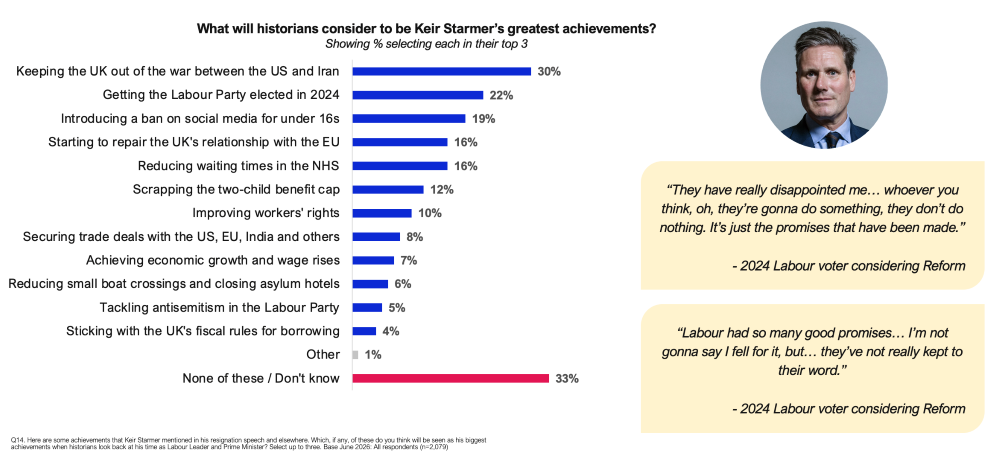
Keeping the UK out of the war between the US and Iran is seen as Keir Starmer’s greatest achievement in office, new research for PoliticsHome has found.
Thirty per cent of people selected this option when research organisation Thinks Insight & Strategy asked what historians will consider to be the outgoing PM’s greatest achievements.
The second most selected option was getting the Labour Party elected at the 2024 general election (22 per cent), and third was introducing a social ban for under-16s (19 per cent), according to an online survey of 2,079 people carried out between 24-25 June.
However, the largest share (33 per cent) said “none of these / “don’t know” in response to twelve options put to them.
Ben Shimshon, co-founder and CEO of Thinks Insight & Strategy, said the findings indicate that Starmer has struggled to persuade the public that he has delivered in areas that were core to his premiership.
“At the moment, few of the claims Starmer made in his resignation speech are supported by the public. Only small minorities are prepared to acknowledge any improvement in the economy, the NHS, or even immigration numbers (where the official numbers do indicate significant falls),” he told PoliticsHome.
“For the two-thirds who acknowledge any achievements at all, getting Labour elected is the most established, alongside two relatively late, but relatively popular decisions: the social media ban for under-16s, and most strongly, keeping the UK out of the US/ Iran war.”
The joint fourth-most-selected achievements, at 16 per cent, were starting to repair the UK’s EU relationship and bringing down NHS waiting times. Reducing small boat crossings and closing asylum hotels was selected by just 6 per cent.
The survey was carried out after Starmer’s resignation speech on 22 June and Andy Burnham’s emphatic victory in the Makerfield by-election a few days before.
It is now almost certain that Burnham will become the UK’s seventh prime minister in a decade later this month after well over 300 Labour MPs, a comfortable majority of the party, nominated the former Manchester mayor to succeed Starmer in No 10 on Thursday.
Elsewhere, the Thinks Insight & Strategy research found that a Burnham leadership boosts Labour’s chances of keeping hold of voters who supported the party at the last general election, especially those who are considering Zack Polanski’s Greens.
However, the findings also suggested that Burnham will not have long to impress the public.
Over half of respondents (54 per cent) said they would know within six months whether a new prime minister was doing a good job, and only 19 per cent said they would give them longer than that. Twelve per cent said they would know straight away.
Just over half of respondents (51 per cent) said that if Burnham is effective as PM, they would see real improvements within a year of him entering office, while 37 per cent said it would take at least a year or two.
“The direction of travel needs to be clear within 12 months, and whatever it is, that direction needs to feel like change,” said Shimshon.
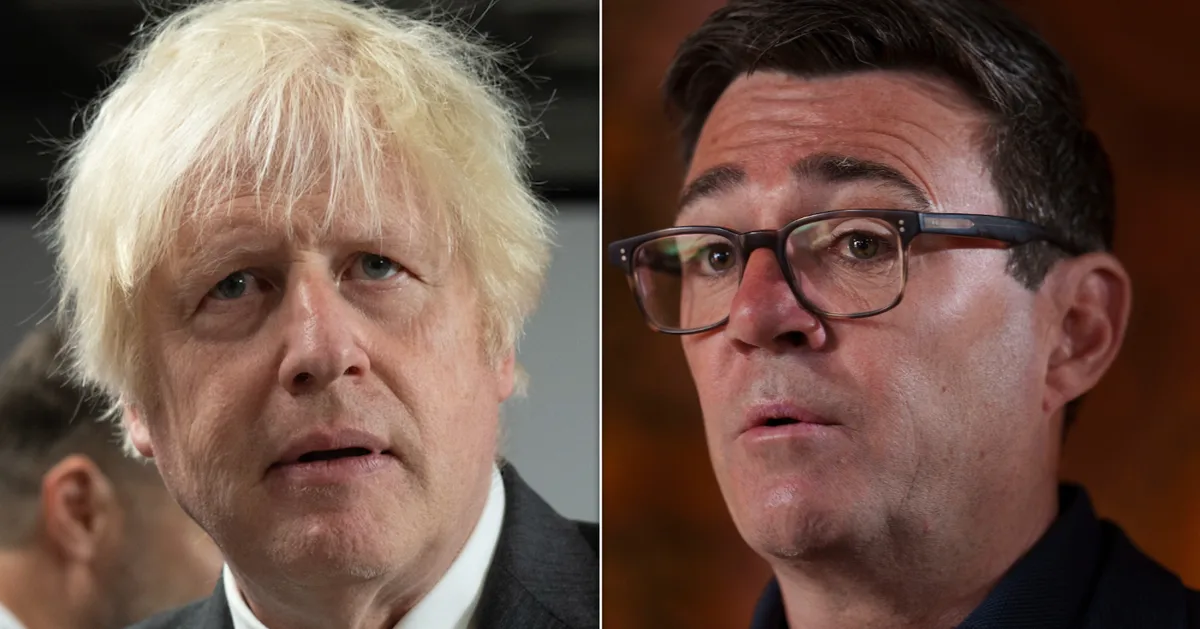
Andy Burnham is just days away from becoming the next prime minister.
Nominations have opened in the Labour leadership contest, but the former mayor of Greater Manchester’s victory is already a foregone conclusion.
His only possible opponent, former armed forces minister Al Carns, confirmed on Wednesday that he would not be putting his name forward.
That means that he will replace Keir Starmer as Labour leader on July 17, and become prime minister three days later.
The country’s most popular Labour politician, Burnham has been charged with turning his party’s fortunes around and give them a chance of winning the next election.
His charisma and firm promise to implement real change – along with his history as a successful metropolitan mayor – looks like the perfect recipe to be a successful PM, according to many Labour MPs.
If that sounds familiar, it’s because it has eerie similarities to the circumstances in which Boris Johnson defeated Jeremy Hunt to become Tory leader in 2019.
Like Burnham, he too was a charismatic former MP-turned-mayor-turned MP again who took charge of his party shortly after a devastating election performance.
In Johnson’s case, it came after the Conservatives had come fifth in the 2019 European elections.
Burnham will take the Labour helm just two months after the May 7 elections, which saw the party hammered in England, Scotland and Wales.
Lest we forget, Johnson was only prime minister for three years before he was brought down by his own lockdown-breaking gatherings in partygate and the sexual assault scandal around Tory whip Chris Pincher.
Though obviously at different ends of the political spectrum, it’s hard to deny that he and Burnham have similar appeal to voters – and their parallel journeys to Downing Street.
Both men first became MPs in 2001 – Johnson in the Tory safe seat of Henley, Burnham in the Labour stronghold of Leigh.
Johnson left parliament to become the London mayor for two terms; Burnham left parliament to become the Greater Manchester mayor for two and a half.
Johnson considered running as Conservative leader in 2016 before taking the helm in 2019; Burnham ran unsuccessfully to be Labour leader in 2010 and 2015 before his (expected) success this year.
Both returned to the Commons when they saw there may be an opportunity to take over as party leader, and then got the job mid-term without facing an immediate general election.
The two men, very popular in their respective mayoralties, championed changes to city travel while in their regional posts, too.
Both rose to prominence during times of national change; Johnson was one of the key faces of the Leave campaign in favour of Brexit while Burnham became known as the “King of the North” for pushing back against a lack of furlough funding for Manchester during the Covid pandemic.
The politicians recognised that promising to address regional inequality is a vote-winner. Johnson vowed to introduce “Levelling Up” and Burnham’s most prominent policy so far is his bid to strengthen devolution.
Johnson and Burnham can also be described as populists, who like to be liked – though both have faced criticism for ducking difficult decisions and dodging media scrutiny.
Johnson famously hid in a fridge during a Good Morning Britain interview in 2019 to avoid reporters.
Burnham has not held a single press conference since he announced his plan to replace Starmer and has only used Reddit as his main forum to speak to voters.
And – much like Starmer – Burnham and Johnson have outlined plans for a decade in power.
Johnson did succeed in the short-term, even winning a snap general election in December 2019.
But he went on to endure a humiliating fall from grace due to his struggles with the Covid pandemic and his own misconduct in office.
Burnham certainly has a less chequered past than Johnson, and allies say he is more of a heavyweight when it comes to ideas and their execution.
But, unlike Johnson, does he really have what it takes to survive in No.10?
In this week’s Commons People, we unpick the similarities between the two politicians – and if Burnham will be able to learn from Johnson’s mistakes.
Listen to Commons People, the podcast that makes politics easy. Every week, Kevin Schofield and Kate Nicholson unpack the week’s biggest stories to keep you informed. Join us for straightforward analysis of what’s going on at Westminster.

Donald Trump’s renewed tensions with Iran stem from a misunderstanding over their earlier deal, a former UK ambassador to Tehran has claimed.
The warring countries reached a fragile ceasefire along with an interim agreement in June after months of conflict.
But hostilities returned this week after Iran attacked commercial ships travelling through the major shipping lane, the Strait of Hormuz.
The US retaliated by launching two nights of strikes on Iran while Tehran hit back by attacking US bases in Qatar, Kuwait and Bahrain.
There’s been further confusion after Iran accused the US of a “flagrant breach” of their truce.
Trump initially claimed talks are a “waste of time” but on Thursday morning suggested Iran wanted to “make a deal”.
But former UK ambassador to Iran, Nicholas Hopton, told Sky News it does not look like this will turn into a “full blown conflict again”.
He said: “Essentially, this arises from a misunderstanding about the Strait of Hormuz which was addressed in the Memorandum of Understanding.”
The memorandum paved the way for the two countries to reach a final agreement over the following 60 days.
Trump agreed to a deal with plenty of concessions amid international pressure to get Iran to end its blockade of the Strait of Hormuz and boost the oil industry again.
But Hopton said article five of that deal was always “ambiguous”.
He noted that the Iranians interpreted it as meaning they should be consulted and have control over any ship passing through the Strait.
Meanwhile, the US interpreted it as the Iranians should facilitate and make sure all journeys through the waterway are peaceful.
He said: “The Iranian side was tested when ships passed through without consulting earlier this week. They hit these ships, they probably felt they had to to assert their de facto control ongoing over shipping through the Strait.
“Obviously, that led to US retaliation and the tit-for-tat strikes.”
He predicted these frictions will “carry on in a messy way” until the two sides return to negotiations.
Listen to Commons People, the podcast that makes politics easy. Every week, Kevin Schofield and Kate Nicholson unpack the week’s biggest stories to keep you informed. Join us for straightforward analysis of what’s going on at Westminster.

More goes into the design of a takeaway coffee cup than most of us realise.
For instance, you might not have known that placing the cover’s drinking spout opposite the paper cup’s “seam” can help prevent leaks.
And if you’re anything like me, you’ll have no idea why there’s often a tiny hole (separate from the main drinking point) in the lid either.
Turns out it’s actually a pretty smart safety feature ― and makes sipping from the container easier too.
How?
According to the Aussie version of the food and drink site Delicious, it’s partly down to steam.
The minute vent helps steam to escape, they say ― though this doesn’t cool it down much.
Instead, it prevents steam from building up in the container, causing pressure to build and potentially leading to burst cups.
Additionally, the presence of another hole than the drinking spout allows coffee to run smoothly when you’re sipping from it ― otherwise, there’d be no airflow in the cup.
According to Atlas Obscura, who interviewed the authors of Coffee Lids: Peel, Pinch, Pucker, Puncture, the vent can be used to boost the coffee-drinking experience too.
They write that the Viora lid’s “deep well and centred hole are designed to concentrate the coffee’s aroma.”
It also helps to prevent spills
Per Delicious, the oft-unnoticed detail design also helps to keep your coffee where it should be (ideally, either in your mouth or in the cup).
It works for the same reason the hold creates a better sip; if there’s a lack of steady airflow, the liquid will move in jumpy, unpredictable ways.
Designer Louise Harpman and architect Scott Specht, who worked together on Coffee Lids: Peel, Pinch, Pucker, Puncture, say that trends, tech, and even legal cases have shaped the design of the mundane invention over the years.
For example, coffee lids became more dome-shaped as foamy, bubbly drinks rose in popularity; after the famous McDonald’s coffee court case, they told Atlas Obscura, brands started including more visible warnings on their lids.
“Coffee lids are modest modern marvels, but we rarely slow down and take the time to consider, admire, or even wonder about these humble masterpieces,” Louise told the publication.
Well, that’s changed for me, at least…
Politics
‘We're fighting this by ourselves’: Southern Black leaders feel abandoned by Democratic Party

Black leaders across the South have expressed a visceral shock in the wake of the Supreme Court’s decision gutting the Voting Rights Act. But as the surprise wears off, a sense of isolation has begun to set in among some.
Black lawmakers and activists across the Deep South argue they have been abandoned by the Democratic Party to fight an existential crisis on their own. They say they’ve been let down by nearly all corners of the party: would be-presidential hopefuls who have flocked to early and swing states but don’t bring their megaphones elsewhere; congressional leadership focused on majority-making battlegrounds while safe Black seats are drawn out; and years of chronic underfunding that has allowed local party apparatus to wither away.
“Folks who lead our party go to swing states like North Carolina and Georgia, but states like Mississippi and Tennessee and Alabama and South Carolina are really neglected and are really forgotten and are really treated as if it is inevitable that we’ll always stay in such systems of what I call apartheid type of politics,” said Tennessee state Rep. Justin Jones.
The feeling of neglect is compounding what the lawmakers called a crisis for Black representation already underway in the wake of Louisiana v. Callais, the April Supreme Court decision that took aim at the VRA.
While Black Southern lawmakers sound the alarm on the long-term consequences for their congressional delegations and legislatures, Republican leaders in several Southern strongholds have already signaled plans to redraw district lines ahead of 2028.
Florida state House Minority Leader Fentrice Driskell said that between the Supreme Court, the White House and GOP-controlled statehouses, there is a “concerted effort to suppress Black votes” — a refrain many Black leaders have been shouting recently.
“Republicans in the Legislature and the Supreme Court have said that it’s okay to turn back the clock and reverse civil rights progress in this country,” Driskell said. “They’re basically giving these Southern states what they have consistently and persistently wanted, which is to suppress Black voices.”
Though many Black leaders said they ultimately hold Republicans responsible for the Callais decision — andthe subsequent redistricting efforts — a sense of frustration at congressional Democrats is also palpable, especially among younger Black Americans.
“The Democrats sort of allowed for this behavior to regularly happen,” said Yolanda Renee King, the granddaughter of Martin Luther King Jr., noting that the party fumbled its chance to pass the John R. Lewis Voting Rights Advancement Act during the Biden administration. “I think that there could have been an opportunity before this second surge in MAGA. As of right now, I’m not sure if we necessarily have the infrastructure for that.”
Black elected officials and activists who spoke to POLITICO did not call out particular party leaders by name, with Jones’ team arguing it is a broader problem in a “political system that continually abandons Black voters.”

“This crisis of multiracial democracy is bigger than any one person’s failing, and will require a unified movement if we are going to stop the largest assault on Black representation since the end of Reconstruction,” Chandler Quaile, Jones’ chief of staff, said in a later statement.
But it comes at a time when the party’s three most prominent leaders — Senate Minority Leader Chuck Schumer, House Minority Leader Hakeem Jeffries and DNC Chair Ken Martin — face discontent from various wings of the party.
The DNC defended its work with Black communities and voters, saying it has been providing some tools to Southern states — such as training and staffing for those in need of infrastructure, including a 10-week training for states without a voter protection director. And since the start of the year, Martin has traveled to cities including Atlanta; Selma, Alabama; and Memphis, Tennessee.
“The DNC will use every tool at our disposal to protect the right to vote and to fight against the dilution of Black political power as a result of the disastrous Callais decision,” said Angelo Fernández Hernández, spokesperson for the DNC, in a statement.
And Republicans rejected Democrats’ characterization of their post-decision redistricting scramble. In a statement, White House spokesperson Allison Schuster said the Supreme Court’s ruling ended “the unlawful practice of drawing congressional districts on the basis of race” and was “a win for all Americans and our colorblind constitution.”
But Black Democrats say it’s hard to build a defense when party leaders are clashing over what their offensive strategy should be. Some have called for redrawing maps in blue states to favor Democratic candidates, while others are relying on lawsuits challenging new GOP maps.
Some have called for both.
“I don’t need anybody to hold my hand, but what I need is strategy,” Driskell said. “I need us to be thoughtful, and I think that that is what is missing.”
Like Jones, Driskell didn’t direct her frustrations at any one specific party leader, but added that Black leaders across the South “definitely understand” the potential repercussions Callais could have on their communities — and that “it would be great for the national dialogue to pick up on that.”
Jeffries’ office did not respond to a request for comment, and a spokesperson for Schumer declined to comment, instead directing questions to the Democratic Senatorial Campaign Committee.
Jessica Knight Henry, deputy executive director for the DSCC, said in a statement that Democrats are working to meet Republican-led attacks on voters through the courts and investments.
“Democrats have worked to meet these attacks head on in court, in campaigns, and we will continue to invest strategically in states that offer opportunities for Democrats to flip seats and take back majorities so we can fight to pass legislation that advances voter protections and rights, like the John R. Lewis Voting Rights Advancement Act,” Knight Henry said.
Still, over the last year, the party’s main focus has been on winning back the House and Senate. Even the chair of the Congressional Black Caucus PAC, the campaigning arm of the entirely Democratic 62-member caucus, said in a previous interview that its focus remains taking back Congress.
“The PAC has always been focused on electing Democrats in tough seats so that we can reclaim the majority. That goal, that focus, has not changed,” Rep. Gregory Meeks (D-N.Y.) told POLITICO in May, shortly after the Callais ruling came down.
The fight over redistricting could dramatically weaken Black representation, both in Congress and in state governments; CBC leadership has projected that roughly a third of their members could see their seats erased with redistricting efforts.

And in The POLITICO Poll in May, 45 percent of Democratic voters said the party should consider countering Republican efforts by drawing their own maps that create more Democratic seats, even if it means reducing the number of majority-minority districts.
Black leaders in the states said that dual reality — Republicans targeting seats in the South and a Democratic Party rank and file seemingly willing to abandon other seats for more political power — only deepens the isolation they feel. Non-Black voters fail to grasp the gravity of the moment, they argued.
For these leaders, the stakes are personal, citing a direct, familial connection to a pre-VRA era, when Jim Crow laws were flourishing across many Southern states.
Virginia Attorney General Jay Jones recalled sitting across the dinner table from his father, who integrated a public school at just 7 years old, while Driskell shared stories of her father seeing “colored only” water fountains at public parks as a child.
“A lot of Black people feel like, in some ways, we’re fighting this by ourselves,” Justin Jones, the Tennessee lawmaker, said. “We need the wider community — particularly our white allies — to step up and see that this is not just a fight for Black people, but it’s a fight for all Americans who really believe in multiracial democracy.”
Some state leaders are now leaning on each other to try and get ahead of potential issues come the midterms this November. Jay Jones said his office is using “every tool at our disposal” to maintain “free elections,” including collaborating with other Democratic attorneys general to brainstorm voter protection tactics.
“We want to make sure that everybody participates and steps up, that they can go do so freely, without fear of intimidation, retribution, or being denied a ballot,” said Jay Jones, the commonwealth’s first Black attorney general.
Meanwhile, activists are leading their own charge as well, trying to rally a groundswell movement that they hope cannot be ignored.
“Every major question of whether America is going to be a democracy — that question was asked and answered in the South,” said LaTosha Brown, co-founder of Black Voters Matter. “And so, once again, we’re being asked. And our question is: Is America going to be a democratic nation with free and fair elections? That question is for America, but the South will answer it.”


(Ievgen Chabanov/Alamy)

4 min read
The World Cup has a remarkable ability to bring the nation together. Families, friends, neighbours and colleagues all unite behind the national team, anxiously watching the games.
But for many across the country, an England match brings a different sense of anxiety entirely. Instead of celebrating the result, they are bracing themselves for the final whistle.
Incidents of domestic abuse increase by 38 per cent when England lose and 26 per cent when they win or draw. According to domestic abuse charity Refuge, sadly fewer than 24 per cent of domestic abuse incidents are reported, so the real increase is likely to be much greater.
In a now-infamous video posted on X, Reform MP for Runcorn and Helsby, Sarah Pochin, is filmed saying that “on the occasions that England lose their football matches, instances of domestic violence go through the roof”, ending the video urging the “boys” to “keep winning”. She flippantly captioned the video: “For the sake of women’s safety, we need England to keep winning”.
I won’t speculate as to whether she is intentionally espousing disingenuous narratives around domestic abuse for views or genuinely believes the responsibility of keeping women safe lies with the England team and its performance. This issue is beyond political point scoring. This is about violence.
I’ll be clear: women’s safety does not depend on whether Harry Kane scores a penalty. It depends on whether we are prepared to hold perpetrators to account, properly fund survivors’ support services, invest in preventative measures, and stop allowing politicians to treat violence against women as fodder for social media clips. No result – win, lose or draw – ever justifies abuse.
Getting the language right is only the first step. We also need to prepare for the reality that frontline organisations know is coming. That’s why I’m supporting Women’s Aid’s new campaign, The Other Kick Off, which highlights the estimated time that domestic abuse is predicted to rise after the final whistle. Raising awareness is especially poignant this year, as the late-night matches alongside a perpetrator’s likely increased alcohol consumption heighten the chances of domestic abuse occurring and create an even more isolating, frightening environment for survivors.
Football and alcohol do not cause domestic abuse. But major tournaments can intensify the circumstances in which abuse pre-exists. Heightened emotions, drinking and gambling can increase volatility and coercive behaviour – but responsibility always lies with the perpetrator.
Many perpetrators of domestic abuse are completely sober, and identifying alcohol as the cause incorrectly shifts the blame away from them.
Incidents of domestic abuse increase by 38 per cent when England lose and 26 per cent when they win or draw
None of this should diminish the joy that football brings millions of people. But enjoying the tournament shouldn’t mean ignoring the evidence. One in three women will experience domestic abuse during their lifetime. Reports increase when England play, and after England’s next game, women in abusive relationships are more likely to experience harm.
I regularly meet with domestic abuse organisations in my constituency of Bath. Before the tournament began, they told me that they expected a surge in demand on top of their already overstretched services.
With cuts to health and social services, ever-reducing government funding and short-term commissioning rounds, domestic abuse organisations are struggling to meet the growing demand for their services all year round – not just during the World Cup.
And yet these vital organisations help survivors access the tools needed to recognise abuse, support them to escape harm, offer housing, legal advice and health services, and are integral to stopping the cycle of abuse.
We need guaranteed long-term funding for these life-saving domestic abuse services. I’m calling on the government to end the short-term competitive commissioning rounds that pit domestic abuse organisations against each other in a fight for the same small pot of money.
I’ll be cheering England on like millions of others this summer. Whatever the score, though, women’s safety depends not on what happens on the pitch but on whether we are serious enough to confront violence against women and girls off it.
Wera Hobhouse is Liberal Democrat MP for Bath

Transport for London (TfL)’s site says that there are delays on the Bakerloo, Jubilee, Metropolitan, Piccadilly, Victoria, and Windrush lines as of the time of writing (Friday July 10).
These are down to issues like signal failures, engineering works, and faulty trains.
Planned disruptions will affect commuters’ weekend plans, meanwhile.
From 11-12 July, three Tube lines (as well as the Waterloo & City, which always shuts on weekends) will be partially closed.
Here’s what to expect on the sunny weekend:
Which Tube lines will face disruptions on 11-12 June?
1) Metropolitan line
There’ll be no service between Harrow-on-the-Hill and Uxbridge on Saturday and Sunday of this weekend. The replacement bus service ML1 operates between Harrow-on-the-Hill and Uxbridge.
2) Piccadilly line
On Saturday, 11 June, from 12:45am, and all day Sunday, 12 June, there will be no service from Hammersmith to Uxbridge or Heathrow terminals 4 and 5. TfL recommends using the Heathrow Express and Elizabeth line for transfers between Heathrow terminals on those days.
The Piccadilly line is being upgraded this July.
3) District line
There won’e be trains between Turnham Green and Ealing Broadway on both Saturday 11 and Sunday 12 July.
There will also be DLR cancellations
Aside from the Tube disruptions, Londoners can expect a reduced service on the Docklands Light Railway (DLR) on the weekend too.
There will be no service between Shadwell and Tower Gateway on Sunday, 12 July.
And the Overground will be affected too
The Windrush line won’t offer service between Clapham Junction and Wansdworth Road until 9am on Sunday 12, either.
These are planned closures, but others might arise on the day – keep an eye on your line’s updates before travelling.

Ever get one of those wiggly, transparent lines in your eyes and wonder “what’s going on here?”
Well, I did the other day ― and I’m choosing to inflict the horror of what I learned on all of you, too.
According to the NHS, floaters are very common and are usually safe. They can take the form of small, dark dots, rings, cobweb-like structures, and squiggles.
But as for why they happen,the NHS site adds: “They’re usually caused by a harmless process called posterior vitreous detachment (PVD), where the gel inside your eyes changes.”
What’s that?!
The National Eye Insitute says it often has to do with ageing.
More specifically, Moorfields Eye Hospital says, “The hollow space in the middle of your eyeball is filled by a clear, jelly-like substance called the vitreous humor.
“As the vitreous ages, it liquifies and becomes less firm, and strands of a protein called collagen become visible within it.”
That means what looks like floaters are actually shadows made by, er, suspended strands of your own eye (oh, good).
Cleveland Clinic says that “Eye floaters are almost like little bits of dust stuck on a camera lens,” which explains why you can’t simply blink them away.
They add that floaters even have a proper name ― doctors call them “myodesopsias.”
Should I ever worry about floaters?
Though eye floaters are very common and mostly harmless, even when paired with flashes (photopsias), they can occasionally be a sign of serious retina damage.
The NHS says you should call 111 or get an urgent optician’s appointment if:
- you have floaters or flashes in your vision for the first time
- you suddenly get floaters or flashes in your vision
- the number of floaters or flashes suddenly increases
- you have a dark “curtain” or shadow moving across your vision
- you also have blurred vision
- you also have eye pain
- floaters start after eye surgery or an eye injury.


New Government initiative could mean new direction for UK Chemicals – but industry wants more than a funding boost
The Government’s decision to launch the £350 million Critical Chemicals Resilience Fund (CCRF) has been welcomed right across the UK chemicals sector as recognition of the industry’s strategic importance. However, as manufacturers we say yes, it’s not just about the money, but it is about much more financial support (eg energy costs some of which can come through policy change) as well as wider policy reviews.
The success of the initiative will ultimately depend on whether it forms part of a broader support mechanism capable of restoring the UK’s long-term competitiveness as we transition to a net zero industry.
For years, we have argued that the industry has been overlooked despite underpinning almost every major manufacturing supply chain in Britain. From pharmaceuticals and food production to water treatment, aerospace, automotive and defence, critical chemicals are essential to keeping UK industry operating.
The CCRF marks a significant shift in government thinking. Rather than viewing chemicals solely as a major industrial emitter or export sector, ministers are increasingly framing domestic production as a matter of economic resilience and national security. Recent supply chain disruptions, energy price shocks and geopolitical instability have exposed the risks of relying heavily on imported materials and overseas production.
We have broadly welcomed that change in approach.
The announcement is an important acknowledgement that chemicals form part of the UK’s critical infrastructure. While welcoming the funding, improving industrial competitiveness would require sustained action beyond a single investment programme, particularly on energy costs and long-term policy certainty.
Those concerns remain central to the industry’s outlook.
We continue to face some of the highest industrial electricity prices among developed economies, while competitors in the United States and parts of Asia benefit from lower energy costs and substantial government incentives. Investment decisions are increasingly influenced by these structural differences, with companies carefully weighing where to locate future production capacity.
Against that backdrop, many chemical companies see the CCRF as an encouraging first step rather than a complete solution.
The fund is expected to support strategically important production facilities, strengthen domestic supply chains and help safeguard capabilities considered essential to the wider economy. For manufacturers dependent on reliable supplies of specialist chemicals, greater resilience could reduce the risk of future disruption while supporting domestic value creation.
The announcement also reflects a wider international trend. Governments across Europe, North America and Asia are adopting more interventionist industrial policies, recognising that strategic manufacturing sectors require greater support in an increasingly uncertain global trading environment. Chemicals now sit alongside semiconductors, batteries and critical minerals as industries viewed through the lens of economic security.
That shift presents opportunities for the UK, but only if policy remains consistent.
Manufacturers continue to call for a competitive industrial energy strategy, faster planning and permitting processes, support for decarbonisation technologies and greater investment in innovation and workforce skills. Without those complementary measures, there is concern that individual funding programmes may struggle to reverse longer-term investment trends. And we want to see more companies invest in the UK.
The implementation of the CCRF will therefore be closely watched. Decisions over eligibility, project selection and investment priorities will determine whether the fund strengthens genuinely critical production capacity or simply provides short-term financial support.
Nevertheless, the symbolism of the announcement should not be underestimated. Chemical sites right across the country are keen to engage with their local MP and any member of the House of Lords, to show how they operate and discuss issues.
For an industry that has spent several years making the case that chemical manufacturing is fundamental to the UK’s industrial base, the creation of the Critical Chemicals Resilience Fund represents an important policy milestone. It signals that government increasingly recognises resilience, domestic capability and supply chain security as strategic assets rather than simply commercial considerations.
Whether that recognition translates into sustained industrial growth will depend on what comes next. Manufacturers have welcomed the government’s commitment, but their message is clear: resilience requires more than one funding programme. It demands a long-term partnership between industry and government to ensure that the UK remains a competitive location for chemical manufacturing in an increasingly challenging global market.
This is an opportunity for us to say, even sing, “Chemistry’s coming home”, but it’s not here yet.
Arthur Reynolds: The civil service will prepare ‘day one’ briefings for Burnham’s new ministers but nobody’ll read them

‘We would pour extra water on the pitch’: Sanjay Bangar reveals Virat Kohli’s secret England preparation | Cricket News

Why Do Street Signs In Worcester, Massachusetts Have Hearts On Them?


-

 Fashion7 days ago
Weekend Open Thread: High Hopes
-
 NewsBeat5 days ago
Taylor Swift and Travis Kelce wedding staffer hilariously struggles to keep her cool while checking in megastars
-

 Crypto World7 days ago
Standard Chartered Secures MiCA License as ESMA Adds 37 New Crypto Firms
-

 Fashion4 days ago
Open Thread: What Great Books Have You Read Recently?
-

 Politics7 days ago
The House | “Reframing the debate from a binary discussion of winners and losers”: Yuan Yang reviews ‘We Are Not Machines’
-

 Fashion23 hours ago
Loro Piana Fall 2026 Enters Houston’s Art Scene
-

 News Videos3 days ago
Whats Hidden Inside This Cash Register? #treasure #reselling #money
-
 Tech3 days ago
Anthropic’s new “J-lens” reveals a silent workspace inside Claude that mirrors a leading theory of consciousness
-
 Crypto World7 days ago
ESMA Expands Crypto Register by 37 Firms Following MiCA Transition Period
-

 Business4 days ago
AXT Shares Jump Nearly 14% as Semiconductor Materials Maker Rebounds on AI-Linked Indium Phosphide Demand
-

 Sports3 days ago
Joshua Pacio ‘more complete’ ahead of ONE rematch vs Malachiev
-

 Crypto World5 days ago
South Africa proposes crypto tax guidance under existing rules
-
Crypto World4 days ago
SK hynix (000660.KS) Stock Dips as $28B Nasdaq ADR Offering Drives AI Memory Expansion
-

 News Videos4 days ago
Best Time to Enter Small Caps Right Now? Another Bull Run? | Financially Free
-

 Tech5 days ago
Lenovo laptops are now shipping with YMTC SSDs, a sign of Chinese NAND entering the mainstream
-
Sports3 days ago
We have punished the disrespect
-

 News Videos4 days ago
Avoid entering in FOMO #bitcoin #cryptocurrency #trading #scalping
-

 Tech2 days ago
Anthropic brings Claude Cowork to mobile and web as usage data shows most users aren’t coding
-

 Tech6 days ago
Neuralink Threads Its Way Straight Through the Brain’s Armor
-

 Crypto World4 days ago
$1,000 Credit Alert! BlockDAG X Exchange Pre-Registration Now Officially Open, Polkadot Dips & Zcash Rebounds
You must be logged in to post a comment Login