
Politics
Nadiya Bychkova Becomes Fourth Strictly Come Dancing Pro Rumoured To Be Axed


Strictly Come Dancing fans are in shock following reports in the tabloid press that four of the show’s resident professionals will not be returning for this year’s series.
On Saturday, The Sun claimed that Gorka Márquez’s contract would not be renewed ahead of the next season of Strictly, citing a “source” who claimed that “bosses want a fresh start” ahead of the next run.
Luba Mushtuk and Michelle Tsiakkas were also among the pros rumoured not to be back for the upcoming season, with the tabloid alleging a day later that Nadiya Bychkova was the fourth to be dropped.
At the time of writing, none of the four has addressed the speculation, but the news has sparked a big reaction among Strictly devotees…
A BBC representative told The Sun: “Plans for Strictly Come Dancing 2026 will be confirmed in due course.”
HuffPost UK has also contacted Strictly Come Dancing for comment.
Gorka – who has made the Strictly final three times during his 10 years as a professional – sat out most of last year’s season due to his commitments as a judge on the Spanish version of the show.
Nadiya and Luba joined in 2017 and 2018, respectively.
During their time on the show, Nadiya has gone without a celebrity partner twice, while Luba has been benched four times.
Michelle, meanwhile, became a Strictly pro in 2022, and has only been paired with a celebrity once during her four-season stint.

Fans already knew that Strictly would be getting something of a refresh in 2026, following the much-publicised departures of its long-time hosts Tess Daly and Claudia Winkleman.
Replacement presenters are yet to be confirmed, with a number of famous faces rumoured to be in consideration for the coveted gig.
Strictly Come Dancing will return to BBC One for its 24th season in the autumn.


Trump has once again threatened to up the ante in his war on Iran. This time, he’s vowed to ‘reign down hell’ if Iran doesn’t re-open the Strait of Hormuz. The problem for Trump is that the constant escalations seem to have worked more in Iran’s favour than America’s:
Donald Trump has posted this on his Truth Social media account saying that Iran has “48 hours before all Hell will reign down on them” if they don’t make a deal and open the Strait of Hormuz. pic.twitter.com/Hz8WssiS64
— Mukhtar (@I_amMukhtar) April 4, 2026
Trump is flailing
Despite Trump claiming he gave Iran 10 days to make a deal, the hostilities have continued:
🗞️ U.S.-Israeli airstrikes hit Shahid Beheshti University in northern Tehran on April 3, targeting the Laser and Plasma Research Institute at its Velenjak campus, according to Iranian Red Crescent and university officials.
The research facility sustained significant damage,… https://t.co/nf0ovanGPN
— Drop Site (@DropSiteNews) April 3, 2026
The big development of the past few days has been that Iran successfully shot down an American fighter jet:
🚨 BREAKING | An Iranian official told Drop Site News that a U.S. F-15 warplane struck by Iranian forces went down over southern Tehran Province, with intense fire reported at the crash site.
The official said the nature of the strike prevented the pilot[s] from ejecting before… https://t.co/iUKD0AqRQQ pic.twitter.com/BI4TzolmZY
— Drop Site (@DropSiteNews) April 3, 2026
On 3 April, Drop Site reported on all the US aircraft incidents which had happened in the prior 24 hours:
▪️ One F-15E Strike Eagle (fighter-bomber): downed; 1 pilot rescued, 1 crew missing, search continues
▪️ Two HH-60W Jolly Green II (combat rescue helicopter) hit by Iran: all crew accounted for, both landed safely
▪️ One A-10 Warthog (close air support jet) crashed into Persian Gulf: pilot rescued
▪️ Another A-10 aircraft hit; made emergency landing with one engine disabled
▪️ F-16 (multirole fighter): declared emergency over Iraq; landed safely
▪️ KC-135 Stratotanker (refueling aircraft): declared emergency over Israel; landed safely
▪️ Iran also claimed it struck and downed another U.S. jet near Qeshm Island yesterday
As this has been going on, the Trump regime has been sacking senior military figures:
It’s likely that experienced generals are telling Hegseth his Iran war plans are unworkable, disastrous, and deadly.
Also, Hegseth is firing a ton of experienced generals right now. https://t.co/I2iKshfjNX
— Chris Murphy 🟧 (@ChrisMurphyCT) April 3, 2026
The same day that Hegseth fires multiple senior army leaders, he announces that individuals “trusted” by the administration will be able to carry arms on base…
On the same day Trump is purging his cabinet…
This is like coup level shit. https://t.co/fopaihE4R3
— Adam Cochran (adamscochran.eth) (@adamscochran) April 3, 2026
It’s also reported that War Secretary Pete Hegseth may be paranoid about potential replacements:
Fox News: Multiple sources tell us the Hegseth firing of Army Chief of Staff Randy George has to do with Hegseth’s rivalry with Army Secretary Dan Driscoll, who is a close ally of JD Vance & was considered on the short list to replace Hegseth at one point pic.twitter.com/lmwqaPN5Sm
— Republicans against Trump (@RpsAgainstTrump) April 4, 2026
The war on Iran has gone so poorly that it’s understandable the war secretary would now fear for his job. Things are so bad dire for Hegseth that Iran is actually mocking him:
An Iranian embassy trolling the Trump administration over Pete Hegseth’s purge of the US military mid-war https://t.co/IrgFxd0x7R
— Mehdi Hasan (@mehdirhasan) April 3, 2026
It’s really not a strong look for a country to start sacking its military officials in the middle of an offensive. America isn’t a strong country, though, is it? It’s a weak country with a military industrial complex to serve.
Human suffering
While the actions of Trump and Hegseth are laughable and buffoonish, it’s important to remember that real people are suffering as a result of these childish men and their tantrums. It’s equally important for us here in Europe to keep up the pressure on our leaders.
This isn’t our war, and we must not allow our leaders to drag us into it.
Featured image via Pixabay (via Canva)
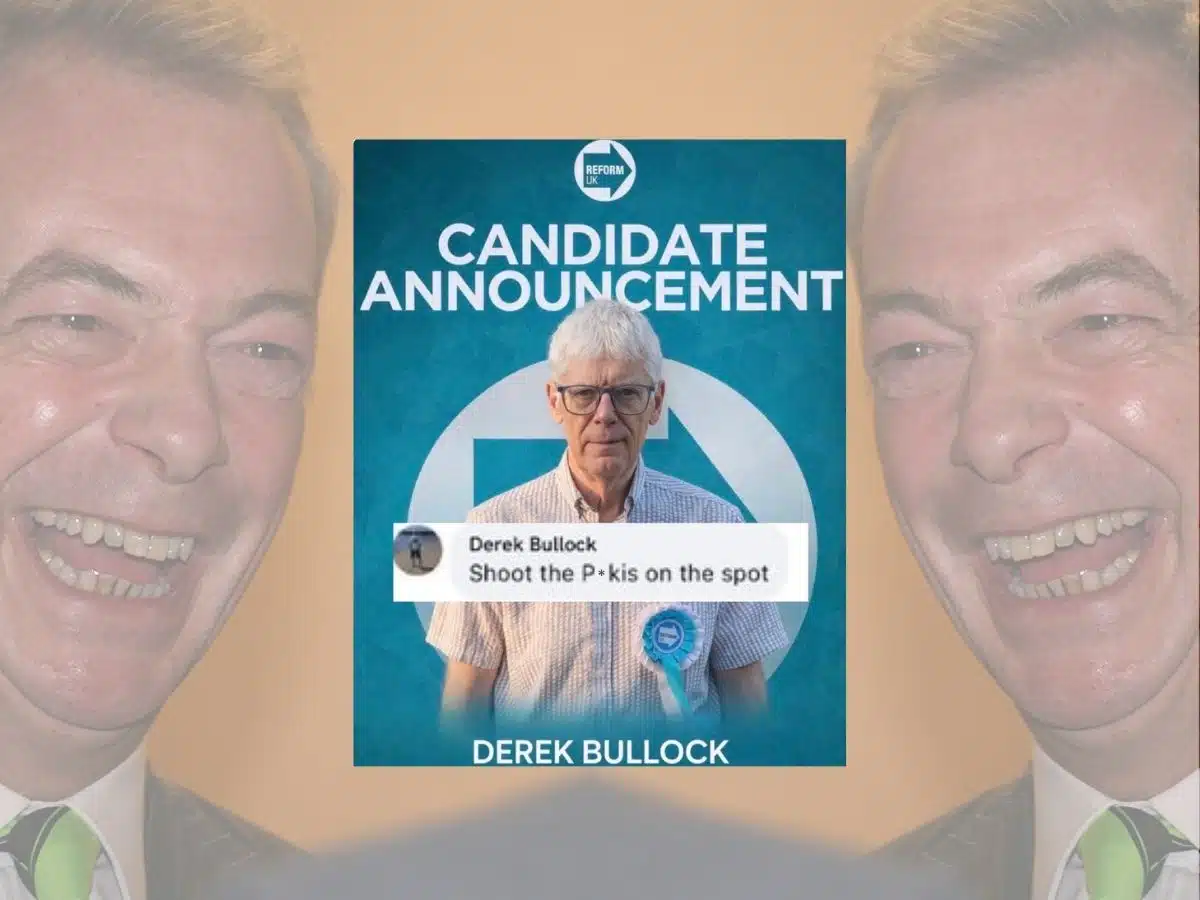
Every day, Reform’s battalion of local election candidates is looking worse and worse. Today, we learned that the party has welcomed a notorious ex-Tory councillor who voiced what can only be described as hardcore, Nazi-grade genocidal intent:
Reform claimed they have the most rigorous candidate vetting in the UK; yet a simple google search of Derek Bullock’s name brings up several news articles about Derek’s racist past.
So is Reform’s vetting process broken, or do they condone Derek Bullock’s call to violence?
— thelefttake (@thelefttake) April 4, 2026
‘Shoot them on the spot’
In March 2020, the Conservatives suspended Bolton councillor Derek Bullock. As the Manchester Evening News reported at the time:
It is alleged that Coun Derek Bullock, who represents Hulton ward on Bolton Council , posted an article from anti-Muslim activist Robert Spencer’s ‘JihadWatch’ on Facebook.
In response to an article about former party chair Baroness Sayeeda Warsi, he reportedly added: “She’s been a cuckoo in the nest!”
In another post, from February 2015, he is shown to have shared a Daily Mail article under the headline ‘Number of Muslim children in England and Wales doubles in a decade’, adding the comment ‘the clock is ticking’.
Despite this, Bullock was actually re-selected to run for the Tories in 2023 (although he was suspended, he remained a councillor). At the time, Labour MP Yasmin Qureshi said:
…culture of Islamophobia which has been found to exist throughout the party
Moreover, this decision shows a lack of commitment to integrity and calls into question his suitability for public office and ability to represent our multicultural town.
— Yasmin Qureshi MP (@YasminQureshiMP) April 5, 2023
In response to the backlash, the Tories re-suspended Bullock, with the Mirror reporting on this truly obscene post from him:
Following the Manchester Arena bombing in 2017, an account in Mr Bullock’s name commented on a news article: “Shoot the P***s on the spot.”
He’s clearly woken up to the fact that he’s not getting back into the Conservative Party. The question is whether Reform will tolerate a councillor who’s expressed an intent to eradicate a sizeable UK minority group.
Reform vetting
The Canary’s Antifabot posted the following:
Hey @reformparty_uk 🙋♀️
I just wanted to know, do you screen your candidates and if you do, is being a total and utter fascist who looks like a nonce a must?
Just so you know, if you do get in, we will absolutely stand up against people like this
Fucking dickhead pic.twitter.com/qz5hP9ZpFd
— 𝔸𝕟𝕥𝕚𝕗𝕒𝔹𝕠𝕥 – AKA The Intolerant Left (@_Wrevolution_) April 4, 2026
As we reported earlier today, there is reason to believe that Reform just isn’t vetting its candidates:
Brett Muscroft is Reform UK’s candidate in Castleford Central & Glasshoughton, Wakefield.
He shows clearly that Reform UK’s vetting is nil for this coming local elections.
His posts on Islam, his support of Tommy Robinson, Enoch Powell and posting far-right and racist content… pic.twitter.com/2kDm9P5DSI
— Reform Party UK Exposed 🇬🇧 (@reformexposed) April 3, 2026
The exposed posts from Brett Muscroft were found on his personal Facebook account. When we looked into it, this account was still public, and was instantly discoverable with a search on Facebook.
This leaves two possibilities:
- Reform isn’t vetting candidates.
- Reform has decided to accept the absolute dregs of humanity.
Either way, we get to the same result.
Featured image via Derek Bennet (Wikimedia)

Animal Justice Project has staged a demonstration in Leicester Square asking people to “Skip the Lamb” over Easter. As the charity highlights, lambs are usually only a few months old when they’re slaughtered:
We’re in Leicester Square today, urging the public to ‘Skip the Lamb’ this Easter.
Joined by dedicated activists and a powerful street stunt featuring a lamb and butcher, we’re challenging passersby to confront the reality behind their choices… and who ultimately pays the… pic.twitter.com/eHD2GhHkBJ
— AnimalJusticeProject (@ajpReact) April 4, 2026
This Easter — Skip the Lamb
In a press release, the group said:
Organised by Animal Justice Project, the demonstration features a powerful visual installation exposing the reality behind lamb consumption. A performer portraying a lamb lies on a table, dressed in a white costume with lamb ears and realistic prosthetic wounds, including a slit throat and severe leg injury. A figure dressed as a butcher appears to cut into the body, while a pile of severed leg props represents the scale of animals killed.
Volunteers are holding placards and distributing leaflets encouraging passers-by to “Skip the Lamb”, while a life-size lamb prop reinforces the connection between animals and the food on people’s plates.
In a video posted to social media, the group showed their activists interacting with the public:
Over 75% of the public are meat-eaters… but what percentage realise they are eating babies?
For many, Easter is a time for eating ‘a leg of lamb’, yet the disconnect is present even in the language.
Eating a lamb’s leg means killing baby animals, sometimes as young as 10… pic.twitter.com/5VzhIMe1sY
— AnimalJusticeProject (@ajpReact) April 4, 2026
Claire Palmer (Animal Justice Project founder) said:
Easter is often seen as a time of renewal and compassion, yet it’s still associated with eating lambs — animals who are only a few months old when they’re killed.
We want people to stop and think. Behind every Easter meal is an animal who wanted to live.
Palmer added:
Traditions can change. And when they involve the lives of young animals, they should.”
Animal Justice Project also provided the following statistics:
- April: 893,336 lambs slaughtered
- June: 1,106,894 lambs slaughtered
- Lambs are typically slaughtered at 4–8 months old
A Change of Heart
Animal Justice Project are simultaneously releasing a new film titled A Change of Heart: From Sheep Farmer to Vegan. The video follows Sivalingam “Kumar” Vasanthakumar — a former sheep farmer. Kumar took his flock to a sanctuary before transitioning to a plant-based livelihood.
As the press release notes:
Previously featured by BBC News, Kumar now grows vegetables and runs a vegan street food business, Kumar’s Dosa Bar, using largely home-grown produce.
. …
“I saw them as individuals,” Kumar says in the film. “Once you see that, you can’t continue as before.”
You can watch A Change of Heart: From Sheep Farmer to Vegan here.
Featured image via Animal Justice Project

Farage’s his Reform have started their own podcast — you know — like that Zack Polanski did.
On the one hand, this is understandable, because a good idea is a good idea. On the other hand, Reform — as ever — have decided to push the truth to breaking point:
“do things differently” = “copy the Green Party” pic.twitter.com/RVaNO1zrYA
— Adam Smith (@adamndsmith) April 4, 2026
Farage — bold Politics VS bold-faced lies
As noted above, Zack Polanski runs his own podcast called Bold Politics. The most recent episode features Canary contributor Cody Dahler:
To be clear, Polanski did not invent podcasting. He’s also not the first politician to have his own podcast. He is, however, the only one who isn’t infinitely repellant (we’re looking at you, Alastair Campbell and Rory Stewart).
Bold Politics is absolutely a Green Party podcast, anyway; it’s not like Polanski is on there discussing true crime or recapping The Traitors. Farage can pretend otherwise, but it just makes him look like a liar and a copycat at the same time. Pick a lane, Nigel!
Perhaps what Farage means is ‘Reform is the only party with a podcast named after itself’? The problem is that this still wouldn’t be true:
Oh look @Nigel_Farage is lying AGAIN pic.twitter.com/LJtVylapWt
— Capman #FBPE (@Euro_toff) April 4, 2026
As we’ve reported, Restore Britain is a Reform UK breakaway party that is to Farage’s lot what Reform are to the Tories (i.e. a more right-wing version). Founded by ex-Reform MP Rupert Lowe, Restore is basically just the Conservative Party 3.0. Although, to be fair, they do have far fewer Tories than Reform does:
‘We do things differently at Reform’ pic.twitter.com/U3PcNKsYFf
— shatners (@shatners144143) April 4, 2026
The fact that we have three right-wing parties means these people are all struggling to differentiate themselves. In this instance, Reform have attempted to show that they’re different from the Tories by literally copying Restore.
People had other criticisms of Farage’s post too:
The entire fucking media is a Reform podcast. Everything you say is repeated to death.
— Oliver (@OWS1892) April 4, 2026
Preaching to the converted won’t arrest your decline in the polls. pic.twitter.com/JQI3VwScTI
— Zokko (@Zokko18) April 4, 2026
Pobcasting
We’ll be honest, we do think Reform are missing a trick. After all, they could have had Matt Goodwin host the show so they could refer to it as the Reform UK Pob-cast:
Just realised Matt Goodwin reminds me of ‘Pob’ and now I can’t unsee it 🤦🏼♀️😂😂 https://t.co/bPO2E8GxWE pic.twitter.com/Sac7lgD5qM
— Susan Cowell (@SusanCowell) February 17, 2026
If they follow our advice, they could truthfully say they’re the only party to have a podcast which is hosted by a failed MP who was recently accused of using AI to write an error-riddled book.
Featured image via Parliament
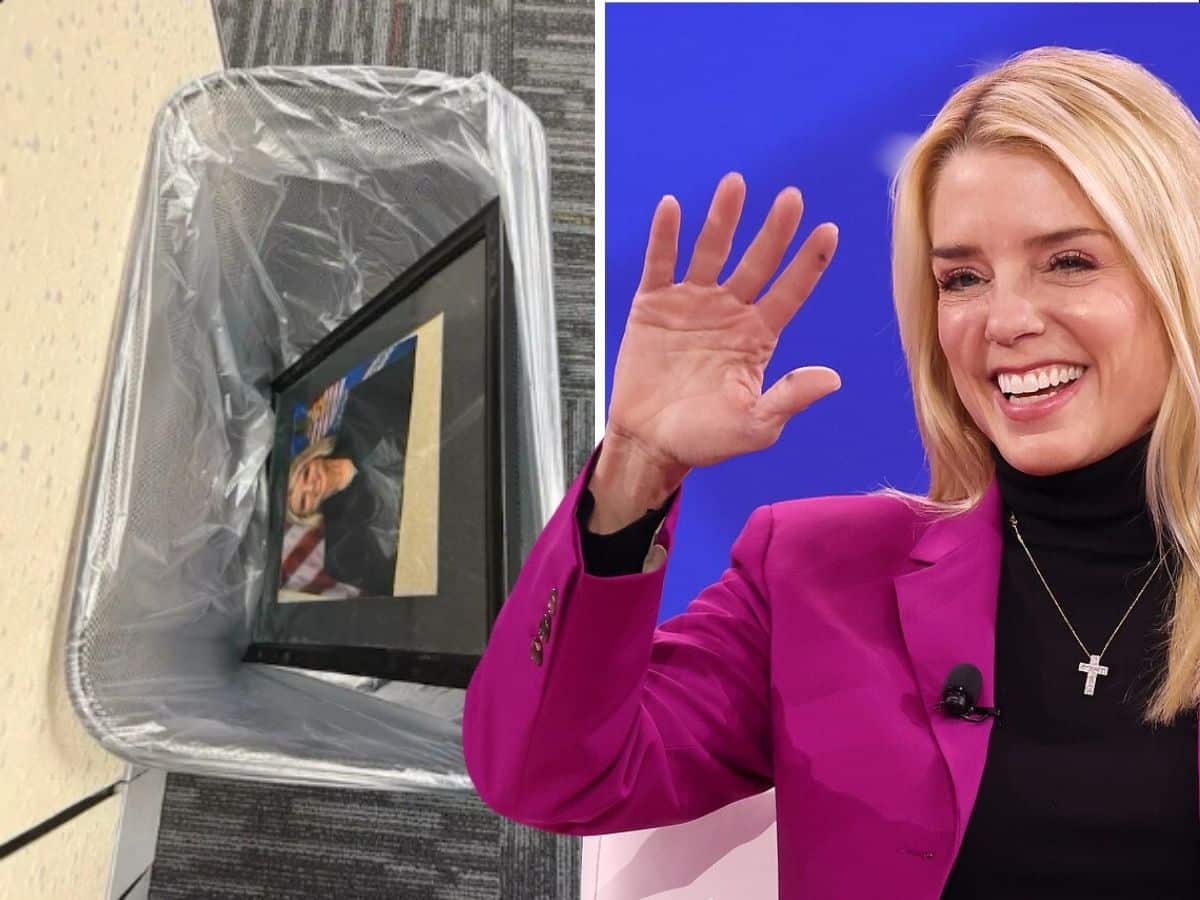
On 2 April, Donald Trump sacked attorney general Pam Bondi. Her sacking came as a great shock. Not because she was competent or deserving of her position, but because it meant Trump has found someone else who’s willing to make themselves legally culpable for improperly handling the Epstein Files.
Now, we’re once again seeing how Trump repays those who tarnish their reputation to protect him:
— evan loves worf (@esjesjesj) April 3, 2026
Pam Bondi binned
This is how the BBC reported on Bondi going:
The president’s frustration had been growing with her leadership at the justice department – particularly over her handling of the Epstein files which have become a reputational liability for the administration.
This is a bit rich from Trump, to be honest. His big issue wasn’t Bondi; it’s the fact that he’s personally named thousands of times in the Epstein Files.
While we’re sure there are people who could have pulled off a more competent cover-up than Bondi, the question is who would want to expose themselves like that? Because the task at hand is risking jail time to protect a senile creep of a president who’s accused of the worst crimes imaginable.
You could argue that Bondi did a lot to prevent the files coming out, but there was only so much she could achieve (this isn’t praise):
“She did it because we threatened contempt, we threatened impeachment, we passed a law!”
After Trump removes US Attorney General Pam Bondi, Democrat Ro Khanna on whether she deserves credit for having released 3.5 million pages of the Epstein Files.
— Simon Gosden. Esq. #fbpe 3.5% 🇪🇺🐟🇬🇧🏴☠️🦠💙 (@g_gosden) April 4, 2026
Bondi didn’t only provide cover on Epstein either, as More Perfect Union reported:
Under Bondi the Justice Department:
– Dropped 23,000 criminal investigations including white collar and corporate crime
– Halted 159 corporate enforcement actions
– Settled the lawsuit to break up LiveNation/Ticketmaster
– Let 18 companies avoid $3.1 billion in penalties
Trump has often demanded unrestricted control of the justice department to pursue investigations into targets of his choosing, even when he was warned there was no evidence to do so.
He addressed that directly in a post directed at Bondi – saying the delays in those cases were “killing our reputation and credibility”.
The guy replacing Bondi is Todd Blanche who has suggested that Jeffrey Epstein’s alleged co-conspirators are safe:
Q: Is the public going to learn the identities of the men who abused the girls in the Epstein files?
Acting AG Todd Blanche: Like, what does that mean? I don’t understand what that means. pic.twitter.com/CkKLHaWcDU
— FactPost (@factpostnews) April 2, 2026
Acting AG Todd Blanche declares mission accomplished on the Epstein files: “The DOJ has now released all of the files with respect to the Epstein saga” pic.twitter.com/1Yugz7ItEA
— Aaron Rupar (@atrupar) April 3, 2026
The above is not true, by the way, and Blanche is already facing scrutiny:
Congratulations AG Blanche. Now you have 30 days to release the rest of the files before becoming criminally liable for failure to comply with the Epstein Files Transparency Act. https://t.co/LOcytrTXJV
— Thomas Massie (@RepThomasMassie) April 3, 2026
Oh, and just because Bondi is gone, that doesn’t mean she won’t still be legally responsible for her handling of the Epstein Files or other matters
Pam Bondi, “There is no evidence that Donald Trump has committed a crime”
Ted Lieu, “You just lied under oath. There is ample evidence in the Epstein files”
Pam Bondi, “Don’t you ever accuse me of a crime”
Ted Lieu, “You just lied under oath, and this is on video tape”
Ted… pic.twitter.com/v2Feci6P4u
— Farrukh (@implausibleblog) February 11, 2026
Whether this translates into actual accountability is anyone’s guess.
As many have said, crime is essentially legal in the US now if you’re one of the elites.
Good riddance
The following image is from the same hearing as the above. The women with their hands up are victims of Jeffrey Epstein. And the reason they have their hands up is because they’re answering affirmatively that Bondi’s justice department ignored them:
This photo and the Epstein file cover up will be Pam Bondi’s legacy. pic.twitter.com/FOX5wgnNAy
— Harry Sisson (@harryjsisson) April 2, 2026
So yes, this disgraced politician does belong in the bin.
And by ‘the bin’, we of course mean ‘prison’.
Featured image via Gage Skidmore (Wikimedia)
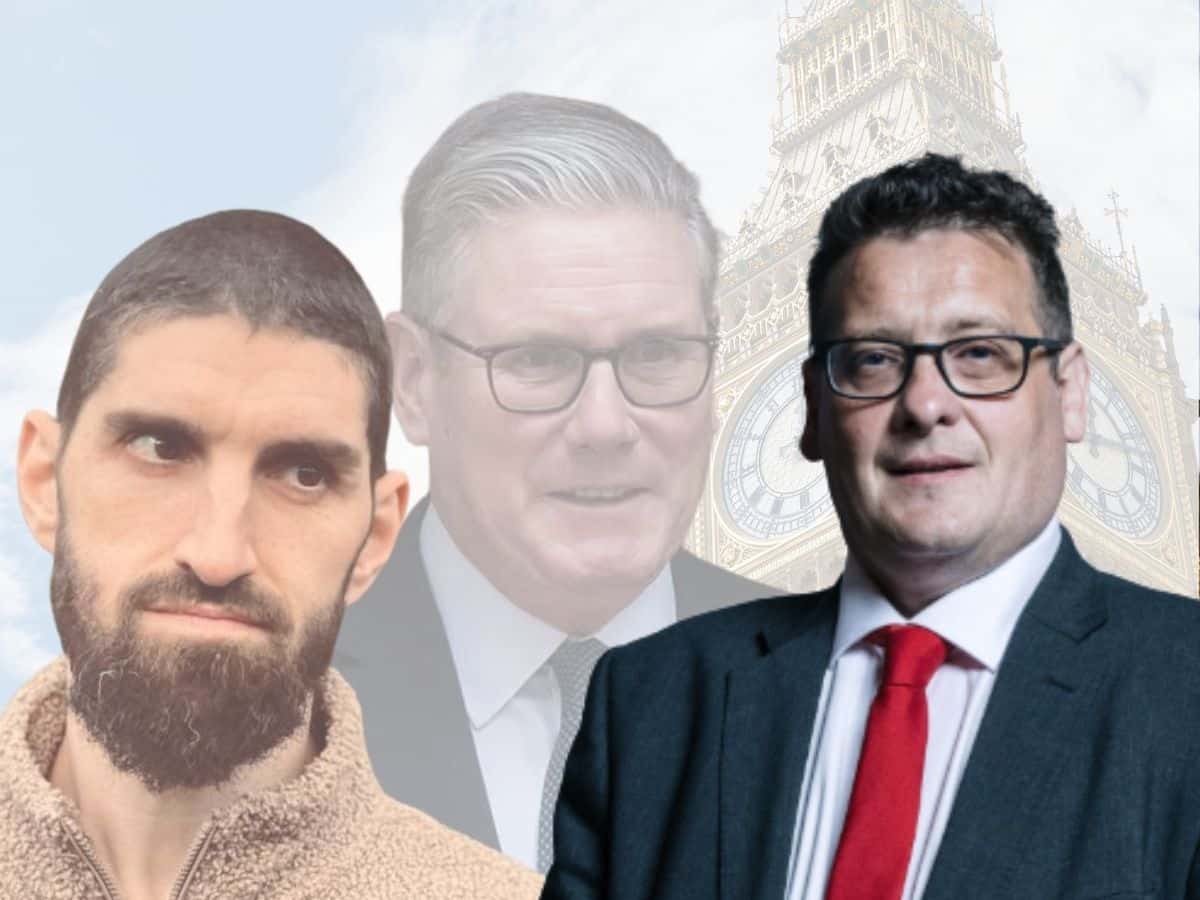
On 31 March, we reported that Labour had suspended Karl Turner. Turner had criticised Labour’s plan to abolish jury trials as a universal right; he’d also given an interview to independent journalist and Canary contributor Jody McIntyre.
Following his suspension, Turner tried to distance himself from McIntyre. Now, McIntyre has set the record straight:
Last week, I interviewed Karl Turner, the MP for East Hull. Within days, the Labour Party suspended him.
Turner has since claimed that some of his comments were “misrepresented”. This is untrue.
In the interest of openness, here is the FULL interview:🧵 pic.twitter.com/HGQiDWLcmM
— Jody McIntyre (@jodymcintyre_) April 3, 2026
‘Lying bastard’ McSweeney still running Labour
As we reported at the time, much of Turner’s interview with McIntyre focussed on Morgan McSweeney:
This morning on Sky News, Keir Starmer said that it is “a little bit far-fetched” to think that McSweeney could have known that “sometime in the future there would be a request for the phone”.
Labour MP Karl Turner told me this morning that the statement is “absolute bollocks”. pic.twitter.com/ANxfikYWai
— Jody McIntyre (@jodymcintyre_) March 26, 2026
The summary of the McSweeney scandal is as follows:
In full
Now, McIntyre has provided details on his full interview with Turner:
Karl Turner told me that he has been “good friends” with Keir Starmer for many years + texts the PM “things that are very f***ing private…that I don’t want everyone knowing”.
This didn’t stop Labour officials briefing against Turner’s mental health, calling him “mad” + “nuts”.
Karl Turner said to me that he believes Morgan McSweeney was worried that messages “slagging off the Prime Minister” would be uncovered on his “stolen” phone.
He also claimed that the appointment of Peter Mandelson was the result of “weeks and weeks” of McSweeney’s lobbying.
On McSweeney, now ex-Labour MP Karl Turner told me: “I was texting Keir, ‘Sack this silly bastard immediately, you are making us all look like fools.’”
He also said that “McSwindle is a man with a history of being a lying bastard” who “needs checking out”.
McSweeney is indeed a man with a history of dishonesty, as we reported in 2024:
In a bizarre turn of events, the Guardian/Observer has revealed that Labour Party PM Keir Starmer’s top Downing Street aide Morgan McSweeney plotted to ‘destroy the Canary‘ – before ‘we destroyed the Labour right’. It shows not only how him and his closest cronies tried to kill us – but also how they brought about Jeremy Corbyn’s downfall. The intention all along? To install Starmer as Labour leader, and eventually PM.
‘the world’s biggest f***ing paedophile!’
Back to McIntyre, he added:
Karl Turner, the MP for East Hull, also complained that “McSweeney and [Matthew] Doyle, protégés of Mandelson, were asked to question a friend of the world’s biggest f***ing paedophile!”
Doyle had campaigned for a Scottish Labour councillor later convicted of child sex offences.
Labour’s recent and ongoing paedophile-related scandals include:
McIntyre continued:
A former MP I spoke to who served on Labour’s frontbench for five years identified Doyle as one of Morgan McSweeney’s “inner circle”.
The whistleblower told me: “The inner circle were tight. WhatsApp tight. They talked openly of…getting rid of every existing MP eventually.”
The former Labour frontbencher also told me that McSweeney installed his relatives “in the Whips’ office…to spy on people.”
McSweeney’s wife, Imogen Walker, was appointed assistant government whip last September.
Did Walker and/or McSweeney have a say in Turner’s suspension?
When Karl Turner, the MP for East Hull, was suspended by Labour on Tuesday, he stated that the Whips’ Office had not bothered to call him, choosing to brief journalists instead.
Turner had been a consistent and blistering critic of McSweeney, telling me he “still runs the job”.
Karl Turner told me that he believed McSweeney’s stolen phone could reveal “vicious messages…calling the Prime Minister a f***ing idiot and listing the reasons why”.
Turner said this might include McSweeney and Mandelson expressing dismay at Starmer’s “crap” Chagos deal.
When I asked now-independent MP Karl Turner directly if he thought Keir Starmer really believes Morgan McSweeney’s “stolen phone” story, he said it comes down to “psychology”:
“If you WANT to believe a person, then you will believe them rather than questioning every detail.”
At the end of the interview, Karl Turner told me that he “had to be careful” because Labour had been threatening him with suspension.
Within days, those threats came to fruition.
Were his friendship with Starmer + years of service to Labour overcome by McSweeney’s influence?
Help him take on Labour
To be fair to Turner, he is apparently struggling with mental health issues; he’s also a member of one of the world’s most toxic political organisations. At the same time, though, he needs to clarify what points he thinks were “misinterpreted”, because we’re not seeing it.
You can support Jody McIntyre and the excellent work he does via the links below:
The TRUTH about my interview with Karl Turner MP: https://t.co/iPREtRoIyF
My investigations take many hours of meticulous work. Subscribe to support what I do: https://t.co/4lb1GxXPQx
And follow @jodymcintyre_ for more Labour Party exposés.
— Jody McIntyre (@jodymcintyre_) April 3, 2026
Featured image via Parliament

Police Service of Northern Ireland (PSNI) chief constable Jon Boutcher has admitted that his officers make use of phone hacking software made by Israeli company Cellebrite. Amnesty International have previously reported how Serbian authorities have used the technology to undermine journalists and broader civil society within Serbia.
Boutcher made the confession during the PSNI’s monthly public policing board meeting. It was in response to Sinn Féin MLA and police spokesperson Gerry Kelly asking about the potential use of Cellebrite and other spyware made by the Zionist entity, such as NoviSpy and Cosain.
The PSNI chief attempted to downplay the use of the privacy-destroying tech, saying it was used as “software under license” rather than a “direct contract with Cellebrite”.
Software companies sometimes offer their products at different price points. A direct contract may include an agreement for the company to make bespoke alterations to the software to suit the client’s needs. A license may mean the tech is supplied ‘as-is’ in a more generic form. Boutcher did not elaborate on these sort of details, however.
PSNI’s previous illegal spying on journalists and solicitors
It’s somewhat of a moot point, given it is an obscenity to pump any money into a genocidal settler-colony’s coffers, regardless of the contract’s exact nature. The use of such software from the PSNI is also concerning given the force’s proven illegal surveillance of journalists and solicitors, not unlike the Serbian case above.
The McCullough Review from September 2025 outlined how the PSNI engaged in 21 unlawful uses of covert powers to acquire the sources of eight journalists. Journalists Trevor Birney and Barry McCaffrey were among those spied on. The pair were investigating the Loughinisland massacre in which loyalist paramilitaries killed six people in an attack on a pub in 1994.
We are concerned that there has been an attempt to normalise state surveillance in Northern Ireland.
Solicitors Darragh Mackin and Peter Corrigan were also unlawfully surveilled by the North of Ireland police. UN officials said the PSNI’s spying on the two men:
…may amount to a violation of international standards protecting the right of lawyers to perform all of their professional functions without intimidation, hindrance, harassment or improper interference.
The Law Society of Northern Ireland said McCullough’s report had:
…highlighted instances of unauthorised surveillance directed at solicitors in Northern Ireland, including a failure on the part of the PSNI to respect legal professional privilege.
Adding further disgrace to the PSNI, Boutcher also revealed that the force have a £5.5 million contract with Source Tactical Gear Limited, another Israeli firm. It was already known that this sum was going to a company based in the apartheid land theft project, but the PSNI had refused to reveal any further information. Their response to a Freedom of Information request cited “security concerns” as the reason for refusal to reveal more.
Kelly exemplifies Sinn Féin failure on Palestine
Sinn Féin’s Kelly seemed entirely unmoved by either the revelation on the body armour contract or the use of Cellebrite. After Boutcher’s response, Kelly said:
Okay, thank you, chief constable. Actually, one of the answers that I did get back [to a previous question] was around the body armour. I don’t think I have an issue [with that]. It’s for protection of people.
That is indeed the purpose of body armour. However, it could be bought from any number of sources. There is no need to fund a settler-colony’s atrocities by purchasing it from them.
Concluding rambling and barely coherent remarks, Kelly then went on to mistakenly describe Mackin and Corrigan as journalists rather than solicitors. His behaviour underscores the hypocrisy of Sinn Féin on Palestine matters. Kelly was happy to go through the motions of asking the question, but do absolutely nothing to meaningfully hold the police to account for use of Zionist firms in contracts.
The party have similarly had fine words in support of those being slaughtered in Gaza, but have been happy to obfuscate as Stormont invest in making the planes used in the mass murder. They have also been willing to meet with one of the key men behind the slaughter, Genocide Joe Biden. Once in Washington party reps met with companies on the Boycott, Divestment and Sanctions (BDS) list. The party has shown no initiative when it comes to ending tax breaks for the likes of Caterpillar, who make bulldozers used to wreck Palestinian homes.
Given this sort of ‘opposition’, it’s little wonder the PSNI feel free to sign contracts that pump millions into funding genocide, apartheid and ethnic cleansing.
Featured image via the Detail
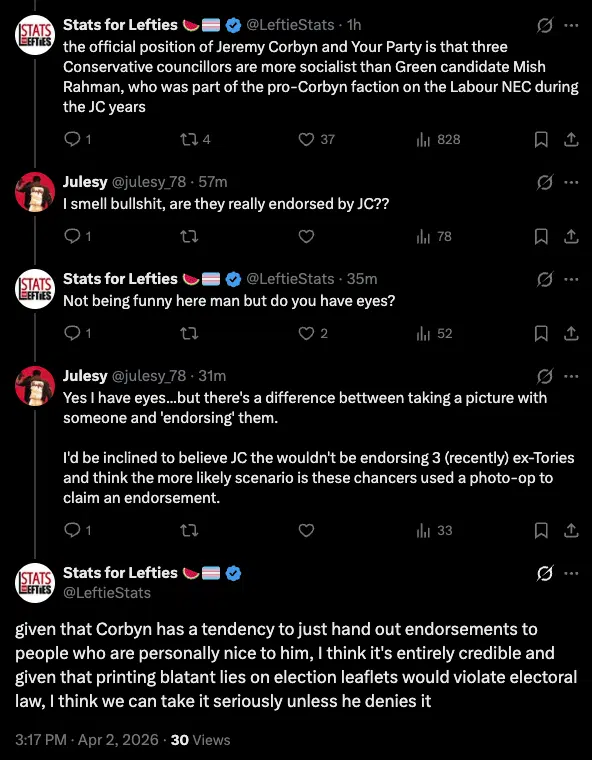
On Thursday 2 April, a leaflet emerged featuring three ex-Tory councillors who claimed to be “endorsed” by Jeremy Corbyn. Since then, Your Party and Corbyn have denied endorsing these men. Instead, the situation seems to be that they recently joined the Walsall Community Independents group which Corbyn has voiced support for.
Corbyn’s supporters are furious that anyone believed the endorsement in the first place. Others are saying the situation exposes the broader problem with supporting independent groups who aren’t beholden to Your Party (YP) values.
“Endorsed” by Corbyn?
As we reported on 2 April, the ‘endorsement’ was first reported by the Green Party’s Mish Rahman:
the candidates in my area are 3 deselected Tory cllrs, all cabinet portfolio holders part of the local Tory administration lol
They have moved wards as indys and are standing against me in the same ward. pic.twitter.com/b4Em7up7Ur— Mish Rahman (@mish_rahman) April 2, 2026
The Stats for Lefties account also highlighted the leaflet. They noted in a subsequent discussion that if the endorsement wasn’t real, the councillors were violating electoral law:

Later that same day, New Statesman’s Ava-Santina reported that Your Party would indeed be supporting independent candidates in Walsall:
NEW: Your Party unveil their “get Labour out” local election strategy.
Full list of YP candidates coming later today
– Walsall
– Bradford
– Southport
– Oldham
– RedbridgeCorbyn: “These elections are the beginning of the fightback against austerity, privatisation and fear.
— Ava-Santina (@AvaSantina) April 2, 2026
As we reported:
This could be ex-Tories highlighted above, or it could be the ex-Labour independents who joined Your Party last year.
We did ask Your Party to confirm if the endorsement was real, but hadn’t heard back at the point of publication, and we noted this in the piece. Your Party would later tell us:
Neither Jeremy nor Your Party has endorsed these candidates in Walsall. Any suggestion otherwise should be immediately corrected.
No permission has been given for Jeremy’s name to be used on any individual candidate’s leaflet.
And Rahman has now said:
2/2
It is appalling that any election candidates would seek to mislead voters on their endorsements and distribute a leaflet to thousands of residents spreading this misinformation.
I shall be referring this to the Election commission for further investigation
— Mish Rahman (@mish_rahman) April 3, 2026
As Rahman highlights, it is indeed wrong to print misleading information on an election leaflet (albeit par for the course with Tories / ex-Tories).
The discussion hasn’t ended there, though.
Walsall Community Independents
On 14 February, Corbyn spent his Valentines Day with the Walsall Community Independents:
Walsall Community Independents Launch Event
It was an exciting, inspiring, and great evening at Palfrey Centre.
Shyekh Omar Ali, Councillor Pete Smith, Councillor Aftab Nawaz, and Chief guest Jeremy Corbyn MP spoke of unity, supporting each other and putting the people before… pic.twitter.com/b6LELenCgs
— Walsall Community Independents (@IndWalsall) February 14, 2026
The above tweet also said (emphasis added):
Jeremy Corbyn MP endorsed Walsall Community Independents and asked everyone to support Walsall Community Independents in the May 2026 Local Council Elections.
This was posted nearly two months ago and remains up. Presumably, this means no one in Your Party took issue with it. Presumably that means Corbyn did voice his support for the group in the upcoming local elections.
The argument coming from Your Party now is that Corbyn did not give blanket support to individuals within the group, as Nicola James said:
Appearing on a stage with a community group is not a personal endorsement of every candidate in that group. Support for the creation of an independent community group does not equal blanket endorsement. Jeremy has made it clear that he does not endorse those candidates.
The Walsall Community Independents group have said that Corbyn supports them in the local election; Your Party are saying his support does not represent endorsement of individuals within the group.
Okay, so what does his support constitute?
Hang on, Corbyn
James would later claim that the three ex-Tories only joined the Walsall Community Independents after Corbyn gave his support:
Those candidates weren’t even in the group when Jeremy was there. Your Party has been crystal clear that neither Jeremy nor the party has endorsed those specific candidates.
However, the three ex-Tories were in the front row of the event that Corbyn spoke at:

The photo these candidates used on the controversial flyer was clearly taken on the same night – as they are all wearing the same clothes. Plus, on 8 February – six days before the event Corbyn spoke at – the three ex-Tories had a meeting with Your Party MP Ayoub Khan:
Independent alliances are free to work with whoever they like. Once Your Party has thrown its support behind them, though, Your Party is no longer free to say it has nothing to do with them. If YP objects to the group containing ex-Tories, then it should publicly withdraw the support for the group in the local elections – support which the group is publicly claiming they have received.
As several people highlighted, the situation has exposed the issue with Your Party’s support for independents:
Regardless of which individual candidates Corbyn did, or didn’t give an endorsement to… this whole situation is indicative of the political level of the YP leadership – willing to endorse any old independent group regardless of their selection process and actual politics. https://t.co/lcXgN1sCdr
— Oisín (@OisinMul_) April 3, 2026
At the danger of being that guy who sincerely comments on the absolute farce that is the YP leadership, perhaps the fact this independent group is happy to let in councillors who were deselected by the Tories should have factored into the considerations for endorsing them? https://t.co/nPh3ivRaRa
— S (@henrycowmunist) April 2, 2026
Interjecting my own opinion here (this is an Opinion piece, so I’m allowed), I don’t believe Corbyn knowingly endorsed three ex-Tories. At the same time, I do think the cadre of Chuckle Brothers surrounding him have created a situation which plausibly allowed them to claim they have his backing.
I’d be interested to see how all this holds up in court, anyway, should the trio face criminal consequences. This won’t happen, obviously, because UK ‘electoral law’ is a joke.
The independent push
On the topic of Your Party supporting / endorsing independent groups, we published the following on 2 April based on a YP press release:
Jeremy Corbyn has unveiled Your Party plans to target Labour’s heartlands in the upcoming English local elections in May. The start-up party is supporting allied community independent groups at the local elections.
Additionally:
At Your Party’s founding conference in November 2025, members voted to adopt a targeted strategy. This aims to maximise the party’s seats, rather than standing everywhere. As party structures continue to develop, Your Party will support around 250 candidates across England. The vast majority of these will be standing as Independents or for allied local community parties.
Also:
Corbyn was elected as Your Party parliamentary leader earlier this month after his allies were victorious in the party’s leadership elections. He is expected to tour the country in support of the Your Party-backed independents and groups in the coming weeks, following a first event in Redbridge.
Your Party is saying it will support “250 candidates” and also that Corbyn will “tour the country in support of the Your Party-backed independents and groups”. Again, this is going to create a high degree of ambiguity – especially if these groups contain members who are at odds with the broader YP movement.
Corbyn himself said:
These elections are the beginning of the fightback against austerity, privatisation and fear.
All across the country, there will be community independent groups offering an alternative to the despair of Labour and the division of Reform. We are proud to support those candidates and groups standing up for redistribution, inclusion and peace.
People in power underestimate the power of people at their peril – and arrogance in office always comes back to bite you in the end.
Presumably, YP will now have to rethink if it ‘supports’ entire groups, or whether it only supports individuals that closely align with YP values. It should also make clear what sort of vetting is conducted before a group or individual receives the party’s support. The very fact that three ex-Tories were already in talks with a Your Party MP, and the attended an event Corbyn endorse the group at, shows a clear lack of any kind of due diligence around this.
The independent drive isn’t happening because there were no YP members willing to stand, by the way, as we reported. Supporting independent groups has certainly saved YP the effort of vetting, fielding, and supporting its own candidates, but it’s unarguably created issues of its own.
And this isn’t the first time that working with independents has created a problem for Your Party.
The trouble with independents and Corbyn
When Your Party got going, it included Jeremy Corbyn and his Independent Alliance. Corbyn and the other independent MPs did good work opposing the government’s support of Israel’s genocide. At the same time, there were some pretty big gaps between the politics of some of these men and the YP membership.
The two big issues that came up were:
Transphobia and landlordism were big reasons why left-leaning voters abandoned Labour. As such, the presence of these issues in Your Party served to turn away potential members.
Following the backlash, people who criticised the independent MPs were accused of being intolerant or racist. This was because the independent MPs were Muslims, and some argued that we needed to respect their “socially conservative” values. As Maryam Jameela wrote for the Canary, independent MP Adnan Hussain:
is wrong that Muslims tend to be socially conservative. Perhaps because he has chosen to be a landlord and real estate mogul, his circle of Muslims is correspondingly socially conservative. The notion that Muslims tend to be socially conservative is a lie that is hauntingly in-step with Western stereotypes of Muslims as regressive and backwards.
Whilst certain schools of thought within Islam are of course socially conservative, it’s a joke to think of the majority of two billion Muslims worldwide as such. Muslims come with all manner of political positions – socialist, liberal, conservative, and so on. And, perhaps to Adnan’s surprise – some of us are even trans!
The months of fighting around this issue should have clarified something; namely that supporting independent MPs who aren’t beholden to the party’s broader project is a massive hurdle to having a broader project in the first place.
Clearly, however, the people at the top of YP have learned nothing.
FAQs
I wrote the original Canary article on Corbyn ‘endorsing’ the ex-Tories, so I’m well placed to answer some of the criticisms. The first is this:
I hate, hate, hate that this has happened to the Canary,
“Suggests” “implies;”
This is the language red top rags use before implying gossip is fact.This used to be my go-to publication. I hope they find their way back. https://t.co/HC2VBpmuOI
— Cassi_Bellingham@banburyUK (@BanburyUK) April 3, 2026
I wrote “Leaflet suggests” to be clear there was a degree of doubt around whether Corbyn had endorsed the men. I highlighted this doubt in the piece, and also noted that we’d approached Your Party for comment.
In terms of ‘finding our way back’, many of us have been at the Canary for years; some since 2015.
The following is another critique we received:
Have the actual journalists vacated the Canary? Did you approach Your Party for comment or do you exist to boost shit posters like Eleanora?
— oli (@OL1UR) April 3, 2026
As noted, it was made clear in the piece that we approached Your Party. They got back to us 23 hours later for what should have been a yes / no question.
To be completely fair, it was late in the day when we approached them, but we did say we were publishing that day and gave them four hours to respond. That is standard when dealing with political parties. They should be ready to deal with media at any time of the day.
No skin in the game
Clarifying my stance on all this, I’m not unhappy with Your Party because I’m a member of the socialist faction which lost out to Corbyn’s group in the recent elections. It’s also not the case that I have no skin in the game. I returned to full time reporting because I was enthused by the announcement that Your Party was happening, and I’ve taken no joy in watching what happened next.
Personally, I think Corbyn should have established a party from the top down which was in line with his own politics – i.e. progressive Labour-style social democracy. After getting the ball rolling, Corbyn should have stepped down as leader, and opened the position up to elections. I don’t think Corbyn himself should have run, because he will be 80 in 2029, and come on – that’s clearly too old – what are we doing here?
For clarity’s sake, I don’t think Corbyn should have done the above because I share his politics; I think he should have done it because that was where the energy was, and that’s where his instincts are. Instead, he oversaw a half-arsed project of endless meetings which gave the impression that people could collectively shape the party. When that shape took on a form that Corbyn’s allies didn’t like, though, they freaked out, and months of confusion and infighting ensued.
I have the upmost respect for the YP members who tried to make the party fully socialist, by the way; I just think their project was hamstrung by Corbyn’s involvement. Corbyn has never been a full socialist, and most of the 800,000 people who showed that initial interest clearly did so because they wanted more Corbyn-style politics.
With hindsight, then, it would have been better for the socialists to start from scratch and build their own thing. That or run as independents, anyway. If they’d done that, presumably they would have received unconditional support from Corbyn and his team – the sort of support they never enjoyed as paying members.
The state of things
The benefit of being an independent politician is that you’re free to pursue your politics as freely as you like; the downside is that you lack the support of a wider party.
The benefit of being a political party is that you have strength in numbers; the downside is that individuals may have to forgo individual beliefs for the benefit of the movement.
Your Party keep experimenting with a system in which they’re a mass-movement party with a special class of non-movement politicians – specifically the independents who regular members are encouraged not to criticise even when said independents stray from the party’s politics.
In 2025, this meant asking members to hold their tongues on ‘social conservatism’ ; in 2026 it means asking members to support independents who are comfortable standing shoulder-to-shoulder with ex-Tories.
This is the tagline that Your Party have in their bio, by the way:
We’re building a new kind of political party. One that belongs to you – join us!
Your Party is telling members that the party ‘belongs to them’ but it’s backing politicians who don’t even belong to the party.
Adding to the weirdness, Jeremy Corbyn himself remains an independent MP despite being the YP parliamentary leader. This isn’t out of necessity, because YP is a registered party, and Zarah Sultana is a YP MP.
If the party wasn’t ready to field its own candidates, that’s a shame, but it is what it is. At the same time, that unreadiness should have demonstrated that YP needed to spend more time building up its own people. And clearly, launching a national pro-independents campaign has only added to the confusion about what Your Party is and what it aims to become.
In summary
So all in all, it’s a mess whichever way you look at it. It may not be the dumpster fire that people initially suspected, but it’s still a flaming skip of disappointment.
On the plus side, Corbyn isn’t endorsing ex-Tories on purpose; he’s simply doing so by accident, as a result of a Thick of It-style comical mishap by the people around him.
If Your Party want their own Malcolm Tucker, by the way, I’d be happy to swear at Corbyn’s underlings.
Featured image via Sophie Brown (Wikimedia)

Energy secretary Ed Miliband is facing renewed pressure to enable new privatised oil drilling in the North Sea. But the right-wing press appears to have jumped the gun in reporting that he is poised to license such climate-destroying activity. And prime minister Keir Starmer has said the decision lies with Miliband.
North Sea — The war on Iran, just an excuse for Big Oil
The noise around more North Sea licenses is similar to the ‘greedflation’ companies engage in when they can use volatile international markets as cover for more profit.
This time, the war on Iran is an excuse for more drilling rather than just when companies put up energy bills by more than increased costs.
New oil and gas drilling in the North Sea will be owned by private companies and sold on international markets to the highest bidder. There is no reason it will reduce UK energy bills or shield the country from the outcomes of the war on Iran.
On top of that, fossil fuel giants have already extracted over 90% of oil and gas in the North Sea.
The UK Energy Research Centre has said:
Squeezing additional oil and gas production from the UK may be technically possible, but it will have negligible impact on the UK cost of living.
Green energy: the way forward
It’s clear that speeding up the transition to renewable energy would have much more than a “negligible” impact on UK bills. In fact, a publicly owned Green New Deal would be the fastest and most equitable way to bring in green energy.
In Keir Starmer’s campaign to become Labour leader, he pledged to “put the Green New Deal at the heart of everything we do”. But it turned out this was merely a con to get the party’s membership on side.
With that in mind, the least Labour can do is stand against new North Sea drilling.
Featured image via OurFutureEnergy
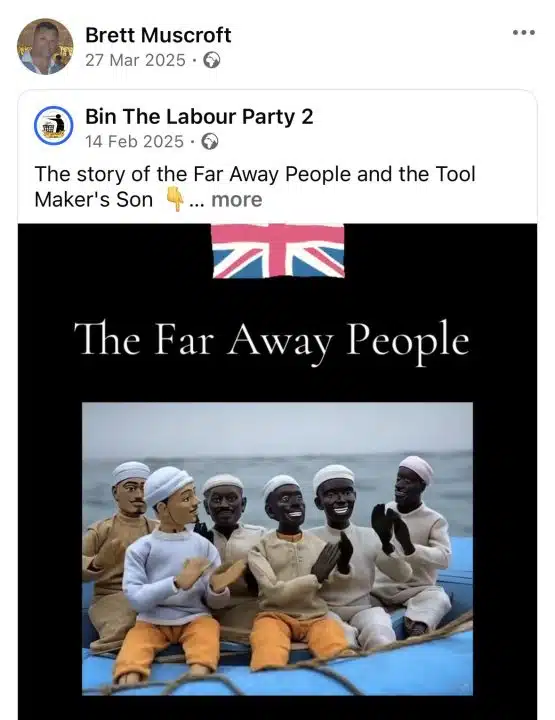
Yet another Reform UK candidate has been exposed for their racist social media posts:
Brett Muscroft is Reform UK’s candidate in Castleford Central & Glasshoughton, Wakefield.
He shows clearly that Reform UK’s vetting is nil for this coming local elections.
His posts on Islam, his support of Tommy Robinson, Enoch Powell and posting far-right and racist content… pic.twitter.com/2kDm9P5DSI
— Reform Party UK Exposed 🇬🇧 (@reformexposed) April 3, 2026
At this point, Reform candidates are being exposed so regularly that you can use a Google alert for ‘Reform candidate exposed‘ as your alarm clock.
Reform UK in Wakefield
This is how Reform announced candidate Brett Muscroft:
The above is on Facebook, which is ironic, as it’s his Facebook account which caused his problems.
Reform Party UK Exposed highlighted the following posts from Muscroft:


Reform Exposed suggested that Reform just aren’t vetting their candidates, and you can see why they’d say this. The above posts are from Muscroft’s personal Facebook. Possibly he didn’t tell them about the account, but that shouldn’t matter, because the account comes up with a simple search:

At the time of writing, HIS ACCOUNT IS STILL PUBLIC.
So yes; we think it’s fair to suggest Reform aren’t vetting candidates.
That or they’re just completely incompetent.
Either way; is this who you want running your council?
Muscroft isn’t the only candidate being exposed either. As Reform Exposed reported:
Reform UK’s candidate Holly Drafahl standing in Hoxne & Eye, Suffolk thinks it’s ok to stir up resentment against ‘Turkish looking people’.
In a series of Facebook posts she described how she had seen someone flying a drone near a school, and that this could have been to potentially plan a terrorist attack on the school. The description of the person moved between ‘Turkish looking’ and ‘Turkish’ throughout her posts and replies. The person stated they were doing drone photography, and she herself admitted he wasn’t filming children at a school (there were none there). So she moved on to saying he could have been filming to plan a terrorist attack.
She even then created a vague petition to further hype the situation.
(She changed her name on FB to Holly Smith recently but you can see her name still connected in her petition).
Her true colours however were shown in the screenshot here where she liked the reply “Turkish, alarm bells. Muslim pedos, common sense to worry.”.
And now she’s standing to be councillor.
Reform UK’s candidate Holly Drafahl standing in Hoxne & Eye, Suffolk thinks it’s ok to stir up resentment against ‘Turkish looking people’.
In a series of Facebook posts she described how she had seen someone flying a drone near a school, and that this could have been to… pic.twitter.com/KpCVSHZFoN
— Reform Party UK Exposed 🇬🇧 (@reformexposed) April 4, 2026
It keeps happening
Articles we’ve put out on Reform’s local election chaos include the following:
Potential candidates have clearly clocked that it’s easy to get a Reform endorsement; so easy that you seemingly don’t even need to go private on Facebook.
That or they’re just too stupid to delete their Facebook accounts before signing up.
Featured image via Gage Skidmore (Flickr)

John Cena’s Sci-Fi Thriller Explodes on Free Streaming 8 Years After Release

Stacey Solomon gives BGT golden buzzer to schoolchildren

Japan Bond Market Crisis Raises Crypto Crash Fears as BOJ Rate Hike Looms


-

 NewsBeat2 days ago
Steven Gerrard disagrees with Gary Neville over ‘shock’ Chelsea and Arsenal claim | Football
-

 Business2 days ago
No Jackpot Winner and $194 Million Prize Rolls Over
-

 Fashion1 day ago
Weekend Open Thread: Spanx – Corporette.com
-
Entertainment5 days ago
Fans slam 'heartbreaking' Barbie Dream Fest convention debacle with 'cardboard cutout' experience
-

 Crypto World3 days ago
Gold Price Prediction: Worst Month in 17 Years fo Save Haven Rock
-

 Tech6 days ago
The Pixel 10a doesn’t have a camera bump, and it’s great
-
Crypto World4 days ago
Dems press CFTC, ethics board on prediction-market insider trades
-
 Entertainment7 days ago
Lana Del Rey Celebrates Her Husband’s 51st Birthday In New Post
-

 Tech6 days ago
Avatar Legends: The Fighting Game comes out in July and it looks pretty slick
-

 Business3 days ago
Login and Checkout Issues Spark Merchant Frustration
-

 Sports4 days ago
Tallest college basketball player ever, standing at 7-foot-9, entering transfer portal
-

 Tech5 days ago
EE TV is using AI to help you find something to watch
-

 Tech5 days ago
Apple will hide your email address from apps and websites, but not cops
-

 Fashion7 days ago
Amazon Sundays: Soft Spring Layers
-

 Politics5 days ago
Should Trump Be Scared Strait?
-

 Tech6 days ago
Elon Musk’s last co-founder reportedly leaves xAI
-

 Fashion5 days ago
The Best Spring Trends of 2026
-

 Tech4 days ago
How to back up your iPhone & iPad to your Mac before something goes wrong
-

 Crypto World5 days ago
U.S. rule change may open trillions in 401(k) funds to crypto
-

 Tech5 days ago
Flipsnack and the shift toward motion-first business content with living visuals
You must be logged in to post a comment Login