
Politics
Reform investigated by Police following by-election letter drop

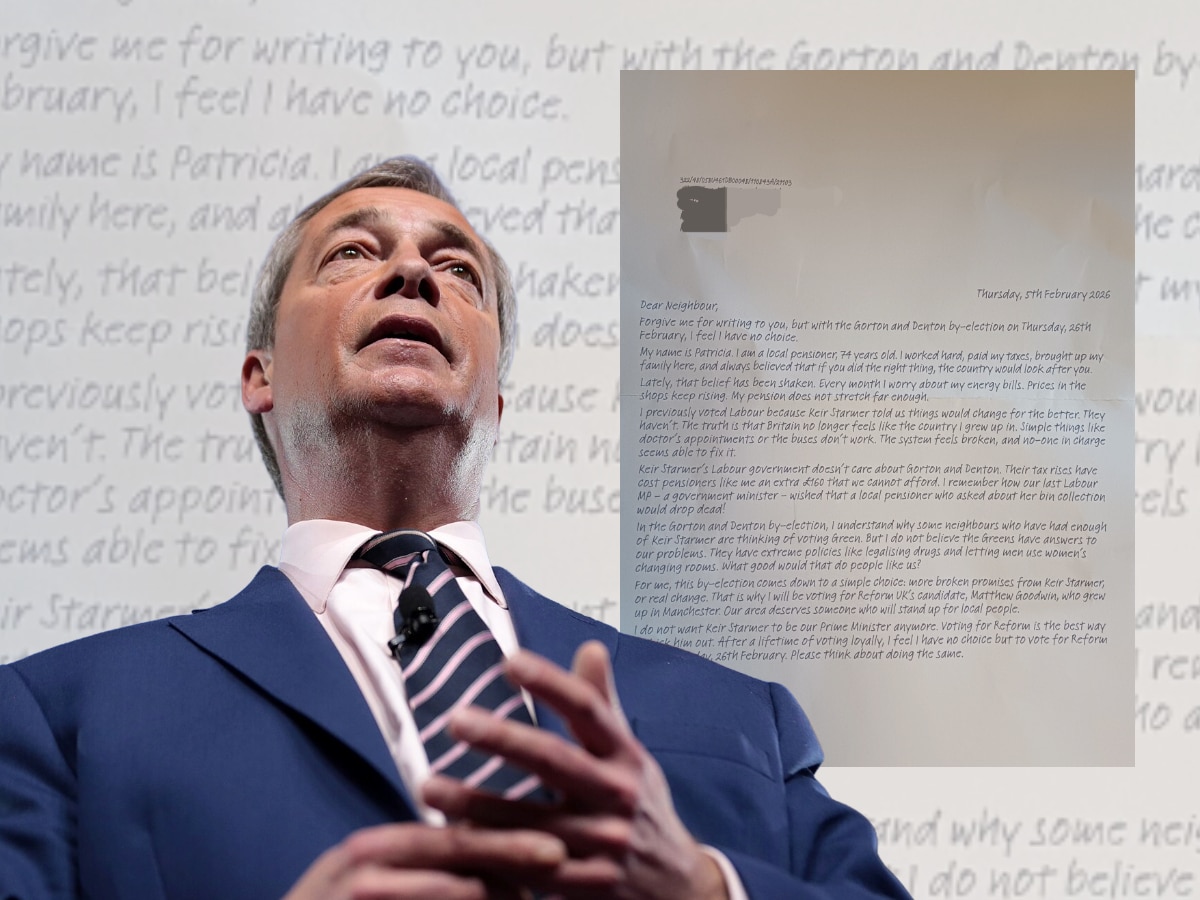
Well, well, well, it looks like Reform UK have been accused of dodgy tricks in the Gorton & Denton by-election:
A number of residents have received this correspondence. The @ElectoralCommUK are aware and it is our understanding that they are discussing this matter with the police. https://t.co/PaciUNuac4
— Turn Left Media (@TurnLeftMediaUK) February 6, 2026
Don’t Reform UK sell themselves as a party of law and order?
Hopefully they don’t intend to follow the Donald Trump model of ‘law and order’, which is to break every law in order to extract maximum profit for himself. Although if they do, we shouldn’t really be surprised given Farage’s relationship with the US president.
Call the cops
The letter above may be a little blurry and small for you, but here’s what it says:
Dear Neighbour,
Forgive me for writing to you, but with the Gorton and Denton by-election on Thursday, 26th February, I feel I have no choice.
My name is Patricia. I am a local pensioner, 74 years old. I worked hard, paid my taxes, brought up my family here, and always believed that if you did the right thing, this country would look after you.
Lately, that belief has been shaken. Every month I worry about my energy bills. Prices in the shops keep rising. My pension does not stretch far enough.
I previously voted Labour because Keir Starmer told us things would change for the better. They haven’t. The truth is that Britain no longer feels like the country I grew up in. Simple things like doctor’s appointments or the buses don’t work. The system feels broken, and no-one in charge seems able to fix it.
Keir Starmer’s Labour government doesn’t care about Gorton and Denton. Their tax rises have cost pensioners like me an extra £160 that we cannot afford. I remember how our last Labour MP – a government minister – wished that a local pensioner who asked about her bin collection would drop dead!
In the Gorton and Denton by-election, I understand why some neighbours who have had enough of Keir Starmer are thinking of voting Green. But I do not believe the Greens have answers to our problems. They have extreme policies like legalising drugs and letting men use women’s changing rooms. What good would that do people like us?
For me, this by-election comes down to a simple choice: more broken promises from Keir Starmer, or real change. That is why I will be voting for Reform UK’s candidate, Matthew Goodwin, who grew up in Manchester. Our area deserves someone who will stand up for local people.
I do not want Keir Starmer to be our Prime Minister anymore. Voting for Reform is the best way to kick him out. After a lifetime of voting loyally, I feel I have no choice but to vote for Reform UK on Thursday, 26th February. Please think about doing the same.
Yours sincerely,
A concerned neighbour,
Patricia Clegg
Firstly, if you’re on a pension, we’ve got bad news for you about Reform UK:
55% of the welfare bill is spent on pensions.
The majority of sick and disabled people receive around £9k to £11k a year.
Reform UK wants to cut £25 Billion from welfare.
To get this much means they would have to make massive cuts from sickness benefits and pensions. https://t.co/8NpJ1S6Wlt— Dr_Rebecca (@Dr_Bekka_UK) January 21, 2026
Secondly, as this video shows, when someone rang the number on the envelope, there was no ‘Patricia Clegg’ there:
Have you seen this? https://t.co/p0BiRtQQa3
— James Foster (@JamesEFoster) February 6, 2026
The printers who answered confirmed that they produced the letter for Reform UK, and that it was “official literature” for the party. Strange, given that the letter didn’t mention ‘Reform UK’ anywhere. And this is why the situation has become a matter for the police:
Reform UK will face a police investigation in Gorton and Denton after admitting that it sent out letters from a “concerned neighbour” which did not state that they had been distributed and funded by the party.https://t.co/ZoYvV4bp0J
— Anne Greensmith 💙 (@snowleopardess) February 6, 2026
Reform UK told the Guardian that Clegg is a real woman; they also spoke to her. She said:
I was asked to support Reform; would I be willing to do a letter and put my name to it? And I said, ‘Yeah’, and I left the rest to them
According to Reform, the letters should have had all the correct legal stuff on, but some sort of printing error cut it off. And, to be fair, the printer has ‘taken full responsibility’ for this alleged error. People aren’t buying it, though:
The Reform UK @GoodwinMJ campaign and printer is blaming a “trimming error” for the imprint not being on the letter.
Bearing in mind the letter is A4, what exactly was trimmed.
And why would you print on A4 and trim it? The images show it clearly wasn’t trimmed.
The lie is… pic.twitter.com/EJ7q8O118h
— Reform Party UK Exposed 🇬🇧 (@reformexposed) February 6, 2026
Keep Reform out
People have said that Reform did something similar in the Caerphilly by-election:
Reform did the *exact* same thing in Caerphilly and no one outside of Wales seemed to care. https://t.co/D24NLRbLBK
— Morgan Paulett (@MorganPaulett) February 6, 2026
You may be pleased to know that for all Reform threw at Caerphilly, the people came together to roundly reject them (abandoning Labour in the process):
Caerphilly by-election broke several records:
🔴 First time Labour has lost in 115 years
🔴 Worst-ever Labour result
🏴 Best-ever Plaid Cymru result
🔵 Worst-ever Tory result
➡️ Highest Reform % in a Welsh FPTP seat https://t.co/7ySKTr2jBv pic.twitter.com/sDKXaOzWsP— Stats for Lefties 🍉🏳️⚧️ (@LeftieStats) October 24, 2025
Let’s hope the Greens can achieve a similar result in Gorton & Denton.
Featured image via Gage Skidmore (Wikimedia)


Police have today, 11 April 2026, arrested Lisa Minerva Luxx under Schedule 7 of the Terrorism Act. Luxx is a spokesperson for the ‘Filton 24 Defence Committee’ working to free Palestine Action activists imprisoned without trial for almost two years.
Filton 24 organiser arrested
The High Court ruled the government’s terrorism ban on Palestine Action unlawful. The government is appealing the decision, but the Filton 24 prisoners were arrested before the ban and are not charged with terrorism offences. Several have been acquitted and were granted bail while the Starmer regime tries to re-prosecute. At least one, former hunger striker Qesser Zuhrah, was rearrested shortly after being granted bail.
The Filton 24 ‘Defend and Mobilise’ support group said:
This state harassment comes just two days before the retrial of six of the Filton24 defendants.
Being detained under Schedule 7 means counter-terror police can interrogate for hours, without the right to say ‘no comment’.
The circumstances of the arrest have not been confirmed. However, it appears that Luxx was arrested while entering or leaving the UK. The ‘counterterrorism policing’ website says of Schedule 7:
Schedule 7 of the Terrorism Act 2000 provides police officers with unique powers to examine people who pass through the United Kingdom’s borders. It allows them to stop, question and when necessary, search and detain individuals and goods travelling through the UK’s borders to determine whether they may be involved or concerned in the commission, preparation or instigation of acts of terrorism.
The Starmer government has frequently used Schedule 7 against journalists and others to interrogate them without legal representation and because of its provisions making it a criminal offence to refuse to disclose passwords. Border police have used it for harassment and for ‘fishing expeditions’ to go through a journalist’s or activist’s contacts and communications. Some have refused to disclose passwords but no one has yet been prosecuted for it.
Featured image via the Canary
On 4 April, we covered the accusation that Your Party’s Jeremy Corbyn had endorsed three ex-Tories in the upcoming local elections. As we reported at the time, Your Party (YP) and Corbyn denied that they’d endorsed these men, but the situation was clearly more complicated than they cared to admit.
Now — a week later — we’re reporting on the accusation that YP have endorsed three ex-Tories in the upcoming local elections.
But for clarity’s sake, that’s three entirely different ex-Tories.
Because apparently we’re stuck in some sort of Groundhog Day-type scenario:
‼️Your Party endorses three MORE ex-Tories 😂
🔵Oldham: Graham Sheldon, Tory Cllr until 2025
🔵Pendle: Mohammed Adnan, Tory Cllr until 2022
🔵Birmingham: Obaydul Kabir ran for Tories in 2022 pic.twitter.com/Odp2cmXHn1
— Stats for Lefties 🍉🏳️⚧️ (@LeftieStats) April 10, 2026
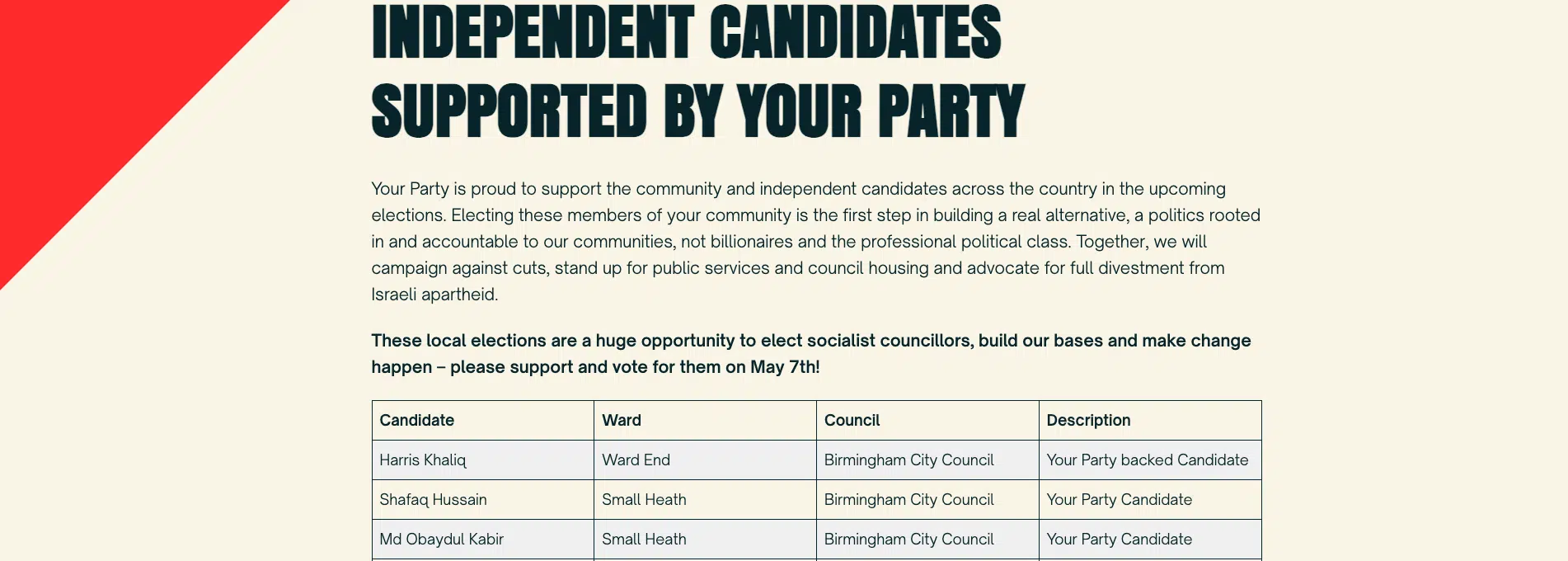
The difference this time is not all of these men are independents; Obaydul Kabir is a “Your Party Candidate”.
The other difference is that not all of three of these men are running in the 2026 local elections as far as we can tell.
As we’ll get into, things are once again a bit of a mess.
Obaydul Kabir
Obaydul Kabir is named on the Your Party list of endorsed independents:

It’s easy to confirm that Kabir was a Conservative because his old posts are still up on his Facebook. The following is what he’s posting now:

These posts, meanwhile, are from 2022:


Fair play to him; Your Party’s man does not abide fly tipping.
Garbage aside, Kabir was a certified Tory, and yet Your Party have endorsed him.
Embarrassingly, they’ve done so despite all the controversy last week; controversy which should have given them the kick up the arse needed to stop this happening.
Currently, we can’t say if the endorsement happened because they don’t care or because they think ‘vetting‘ is something that happens to pets. We did send them a right of reply at 9:00am Saturday 11 April, but at the time of publishing they hadn’t responded.
Graham Sheldon
First things first, here’s the list of independent groups endorsed by Your Party as of today’s date (11 April):

Using the Wayback Machine, we can see this list looked pretty different on 8 April:

Looking into Graham Sheldon, we can see that he’s currently a Saddleworth South councillor, with his party listed as ‘Oldham Group’ (he’s also listed on the Oldham Group page). Despite listing him as part of the Oldham Group, his council page states the following (presumably he forgot to update it):

On why Sheldon is no longer a Tory, the BBC wrote this in January 2025:
The leader of Oldham Council’s Conservative group has resigned after police were called following a heated council meeting.
The meeting on 18 December had to be adjourned after members of the public and councillors hurled abuse at each other following a debate about housing and planning.
Councillor Graham Sheldon, who has stepped down both as leader and as a member of the Conservative group, said he believed “the actions of two members of my group caused the mayhem and deterioration of the meeting”.
“Mayhem and deterioration” were the Tories’ mission statement when they were in power, so we don’t know what he was complaining about.
That aside, Sheldon was a Tory, and Your Party were — at one point — endorsing his group.
Here’s the thing, though; we’re not sure Sheldon is running in this year’s elections. Oldham Times lists all of the councillors running, and Sheldon isn’t on there (despite several of his Oldham Group comrades appearing). He’s also not listed on Who Can I Vote For?.
Fair’s fair, it doesn’t seem to be accurate to say that YP have endorsed the ex-Tory Graham Sheldon for the 2026 local elections.
It is, however, accurate to say that YP briefly endorsed an independent group which included him (although they don’t seem to endorse them anymore).
Confusing stuff, anyway!
And it all could have been avoided if Your Party had vetted its own candidates instead of throwing its support behind independents.
We don’t know who needs to hear this, but ‘independent’ is not a synonym for ‘socialist’.
Mohammed Adnan
For this feller, we’re once again looking at the Your Party-endorsed community groups. YP listed the following group on 8 April:
Pendle Community Independents
As with the Oldham Group, however, Pendle are no longer listed on the endorsement list.
On the Pendle Borough Council website, this collective is referred to as the ‘Independent Group‘. From their Facebook, however, we can see that the Pendleton Community Independents and the Pendleton Independent Group are one and the same.
On his journey from Tory to independent, we can see that Adnan took issue with the PM in 2022, as reported by Burnley Express:
Southfield and Marsden ward councillor Mohammed Adnan has resigned as a Conservative councillor and joined the Labour group on Pendle Council.
Coun. Adnan explained that he had become tired of Prime Minister Boris Johnson and accused his former Pendle Conservative colleagues of not speaking up.
More of that notorious mayhem and deterioration, we see.
In his own words, Adnan said:
Over the past 12 months I have like many local people become tired of the manner in which Boris Johnson and the Conservatives have lurched from crisis to crisis at the expense of hard-working people in my ward.
Unfortunately, the Pendle Conservatives leadership have decided not to speak up against the wrong and damaging decisions made by their government which they appear to be happy to implement. I believe the Labour Party offer the hope we need in Pendle.
We’re not sure when Adnan quit Labour for the Community Independents, but did end up in the group – a group which Your Party would later briefly endorse.
As was the case with Sheldon, however, Adnan is not listed as a candidate for the 2026 local elections.
So all in all, Your Party seem to have endorsed just one ex-Tory in the upcoming elections.
As we’re sure any YP member will tell you, though, that’s one ex-Tory too many.
Other updates from Your Party
On 4 April, we covered the accusation that Jeremy Corbyn had endorsed the Walsall Community Independents — a group which included three ex-Tories (or would include three ex-Tories — the timeline was hard to pin down).
At the time, we said that endorsing independent candidates and groups which don’t have to align with YP politics would cause problems. Now, a week later, we’ve been proven entirely correct.
This is what Your Party told us last week:
Neither Jeremy nor Your Party has endorsed these candidates in Walsall. Any suggestion otherwise should be immediately corrected.
No permission has been given for Jeremy’s name to be used on any individual candidate’s leaflet.
As we reported:
- Corbyn spoke at a Walsall Community Independents Group meeting at which the ex-Tories were present.
- The Walsall Community Independents promoted this meeting online and claimed that Corbyn was supporting them in the upcoming local elections.
- No one at Your Party or Team Corbyn seemed to take issue with this claim.
Since then, further evidence has come out that Your Party did indeed endorse the Walsall Community Independents:
‼️NEW | Leaked Your Party documents confirm the party **did** endorse Walsall Independents, which includes three councillors who were Tories until 2026.
YP claimed they had NOT endorsed Walsall Independents. But a leaked web page (now deleted, but archived), shows they did… pic.twitter.com/djRNK1ptkp
— Stats for Lefties 🍉🏳️⚧️ (@LeftieStats) April 8, 2026
Now, one might say: Eleanora, why does this matter?
Well, I’d say it is rather significant that the party led by a former Labour leader got caught with their pants down, and instead of admitting their mistake they lied through their teeth and tried to cover it up. Bad look.
— Stats for Lefties 🍉🏳️⚧️ (@LeftieStats) April 8, 2026
Independents will keep embarrassing YP as long as the party keeps endorsing them, because these footloose and fancy-free politicians are independent from having to give a shit.
Your Party — Clown-show
As we said last week, we don’t think that Corbyn was introduced to the three ex-Tory councillors and immediately started rubbing his hands together with glee at the prospect of endorsing them. At the same time, YP’s insistence on backing independents is quite clearly doomed to these sorts of embarrassing outcomes — especially when combined with a lax attitude towards vetting.
We’re sure people would prefer that we keep looking the other way, but we’re not going to do that. The left has won the argument at this point; what we need to achieve next is competence.
In other words, don’t turn up in a clown car if you don’t want us to start whistling circus music.
Featured image via Obaydul Kabir (Facebook)

A direct action activist in Ireland has used a hammer to damage a US warplane on the tarmac in Shannon airport. While posturing as opposing Israel’s genocide in Gaza and US assistance for Israeli aggression, the Dublin government has allowed continued US use of Irish airports to supply Israel and attack peaceful nations.
Just last week, Irish anti-genocide activists called for “more actively disruptive protests” against Ireland’s collaboration in US crimes. Today, 11 April 2026, they appear to have got their wish as footage posted by Irish anti-Zionist ‘Páddafi’ shows the black-clad protester hammering away at the stabilisers of the military transport aircraft:
The US warplane in question had been identified this morning, after its overnight arrival in Shannon, by the ‘Shannonwatch’ human rights group:
US Air Force C-130H Hercules 91-1653 landed at Shannon yesterday from Rosecrans Air National Guard air base St Josephs Kansas, via St. John’s Canada. It spent the night at Shannon, and hasn’t yet gone in to its next military base.#USMilitaryOutOfShannon pic.twitter.com/BkllQx68HX
— Shannonwatch (@shannonwatch) April 11, 2026
The Irish government — and the craven Starmer regime in the UK — must stop enabling US wars of aggression and equipping of genocide.
Featured image via the Canary

People on social media have noticed that the winners of Nigel Farage’s energy bill prize are the same people pictured with the Reform leader at a Brexit party rally in 2019:
Left: Nigel Farage and Robert Jenrick meet the winners of Reform UK’s competition to have your energy paid for the whole year
Right: Here are the two winners with Nigel Farage at a Brexit Party rally in Fylde on the 4th May 2019
Credits to @linfitlass @donmcgowan for putting… pic.twitter.com/k5gZblNK5U
— Farrukh (@implausibleblog) April 10, 2026
There’s more to it
While this is interesting, it may be a coincidence. There are other important points to consider. Reform have offered a lottery (where the winning household gets last years’ annual energy bill paid) that may amount to the electoral offences of ‘treating’ or a ‘bribe’, as pointed out by Karl Turner MP. Under the 1983 Representation of the People’s Act, it is an offence to offer money in order to influence someone’s vote.
On top of that, the gimmick shows that Reform have little to offer the country. Instead of dropping energy bills nationwide through public ownership, the party is giving everyone who enters the lottery false hope. That’s because only one household will actually win. And the winners turned out to be longterm Farage loyalists.
Such a lottery is a con job — like the whole gambling industry. That industry is only profitable because the odds are highly stacked against the player. Indeed, Farage has long spoken in favour of the gambling industry. In 2025, at Reform’s business conference, he said:
What I would say about the high street is that one of the things that does still survive is the bookmaker shop – which actually, for a lot of lonely people, is a place they can go in and meet people.
Farage’s current system is a gamble of birthright
It’s no wonder that Farage is pro-gambling because the addictive process is emblematic of the neoliberal capitalist system he supports. The system we live under is largely a lottery of birthright whereby, in the UK alone, 60% of private wealth is inherited.
And is it possible for most people to take ownership of their labour through their own business? No: 90% of bank lending goes to finance or inflating the price of pre-existing assets, rather than enabling small businesses to thrive. Also, 85% of start ups initially rely on personal capital, most of which is inherited, while 43% of 500 surveyed business founders have said they started their venture with family wealth.
Neoliberal capitalism is largely a gamble of birthright. And private-schooled Farage wants to uphold his position within it through pretending to be an anti-establishment counter offer.
Featured image via the Canary

The post Why Gen Z girls are so anxious appeared first on spiked.

A user of the Bloomin’ Algae app has reported the year’s first sighting of blue-green algae at Lough Neagh, a reminder that the pollution crisis on the water body is not yet averted. The app is used for:
…reporting the presence of blue-green algae, or cyanobacteria. The app helps speed up public health warnings about harmful algal blooms and can help teach you how to recognise the risks to you, children and animals.
It lists the dangers of the substance as:
…skin rashes, eye irritations, vomiting and diarrhoea, fever and pains in muscles and joints.
It further states:
Blue-green algae have caused the deaths of dogs, horses, cattle, birds and fish across the UK.
You can see the user’s image below:

The photo shows growth that might not look like much at the moment. However, once it expands, the vast coating of green sludge can appear like something from a horror film, choking marine life around it.

The lough, which is the largest freshwater body in Europe, has been devastated by the toxic algae in recent years. Polluting agro-business has been a key contributor following huge expansion since 2010. This includes a 72% increase in pig and poultry production in the decade that followed that year.
Lough Neagh — Plans for vast new factory farm
Politicians had for years been relaxed about the resulting vast torrent of shit these factory farms pump into local rivers and lakes. This has ultimately ended up in the lough, with the subsequent wreckage done to an area of considerable beauty which is home to a large variety of wildlife.
The spotting of the algae comes as architects have submitted to Mid Ulster District Council proposals for a vast new mass murder facility near the lough. The proposal calls for a torture and death camp that will house 49,000 chickens in likely atrocious conditions.
People Before Profit (PBP) have launched a campaign aimed at blocking the abomination. They say:
Lough Neagh is already in a state of crisis, poisoned by effluent from existing factory farms which have been proven time and time again to bring pollution and other ecological harm.
Another major factory farm with capacity for nearly 50,000 chickens is now being planned beside the Lough. Out of around 25,000 active farms in the north, this new development would be in the top 1% of largest farms.
A giant factory farm like this, holding 49,000 chickens (9,000 over the factory farm threshold) would likely bring stink, pain and pollution to the shores of Lough Neagh.
They go on to quote a resident near another planned factory farm, who said:
This isn’t an extension or someone looking to build a garage, this is a major industrial complex on my back door.
Council also approved expansion of genocidal warplane production
PBP conclude by citing another recent planning scandal in the area, the go-ahead to expand manufacture of F-35 warplanes:
In 2025, Mid Ulster Council approved an extension to Moyola PE, manufacturer of F-35 parts, the same planes bombing Iran and Palestine. Those in charge in Stormont and local councils must take responsibility for the harm that happens on our doorstep due to their decision-making.
The council appear to like the idea of having on their doorstep facilities that enable mass death and destruction. Any supposed economic benefits of such factories do not justify the harms done to animals, the environment and people both here and in West Asia.
The Irish Times reports that:
…the developer, a local farmer, has included in the plans promises litter from the birds wilvvvl be collected and then delivered to Moy Park’s anaerobic digester plants and used to produce energy.
It’s common for plans to be watered down in favour of developers as construction on large projects proceeds, so local residents would be wise to take little notice of this. It also fails to address concerns over animal welfare and the stench such vile facilities produce.
People Before Profit have launched a petition and email campaign for those opposed to the plans. Given Lough Neagh is one of Ireland’s most cherished natural features, it is in everyone’s interest that this literal shitshow is shut down before it begins.
Featured image via Rics

Kensington and Chelsea council in London has said it “just can’t find an address” to issue disgraced former minister and senior Starmer adviser Peter Mandelson with a fine for public urination.
Right.
Mandelson was photographed peeing in the street after a “late night visit to the home of former Conservative chancellor George Osborne”. There’s no surprise Mandelson was with a blue version of a fellow Tory — he has been leaking information to Osborne since at least 2008. Now he’s leaking something else, but similar.
It’s rather more surprising that the council’s excuse for not issuing the £300 fine is that it “can’t find” where to send it, since Mandelson has at least two homes — and they were both raided only months ago as part of the state-hampered criminal probe into his leaking of insider-trading information to serial child-rapist Jeffrey Epstein.
Even more surprising when ‘msm’ hacks were able to find at least one of them with no trouble at all to snap photos of Mandelson’s lawyer leaving after the police raid.
Mandelson’s impunity from real consequences continues, just a couple of weeks after the Starmer government decided it wouldn’t demand WhatsApp messages between Mandelson and his disgraced protégé Morgan McSweeney and other fellow horrors.
Go figure.
Featured image via Reddit
As several Your Party (YP) members have reported, a leaked motion shows that YP have plans to pass a motion which will lead to the expulsion of socialist members. Or it does if it’s real, anyway. We asked YP to confirm at 9:00am on Saturday 11 April, and they still haven’t got back to us.
Among those who have spoken out are CEC members Naomi Wimborne-Idrissi and Zarah Sultana:
A proposal that is due to be put to Your Party’s Central Executive Committee on Sunday sets the scene for banning members of a number of socialist groups from holding dual membership with YP. The news is causing widespread consternation among YP members and supporters. Hence… pic.twitter.com/FZXYtS7EBU
— NaomiFromKent (@NaomiFromKent) April 10, 2026
Your Party — The dual membership issue
Weekly Worker reported the following on the alleged motion:
The CEC paper that launches the witch-hunt in @thisisyourparty – Corbyn clearly has learned nothing from his own purge. This puts the ‘dual membership’ agreed at launch conference on its head. YP members should keep welcoming socialists in the branches!https://t.co/JwT8b3Jpfc pic.twitter.com/4wpIaoBH9b
— Weekly Worker (@Weekly_Worker) April 10, 2026
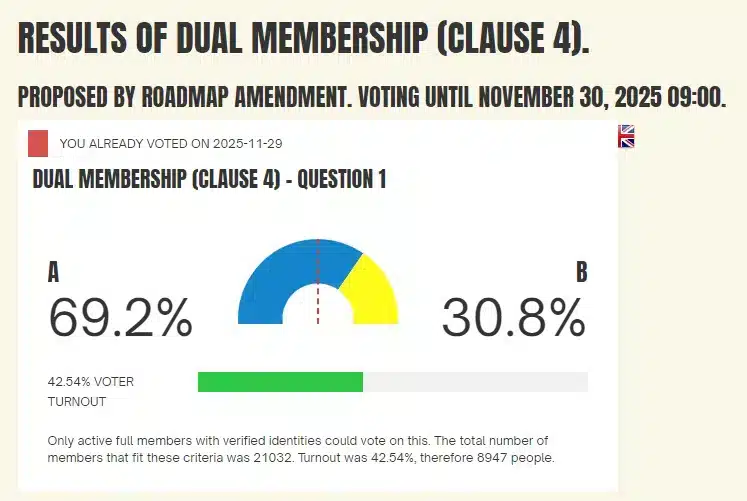
The issue of dual membership has proven to be a controversial for YP. This is despite members voting overwhelmingly in favour of it at the conference, as we reported on 30 November:
Following on from the expulsion of some Socialist Workers’ Party (SWP) members from Your Party in recent days, the Your Party conference has just confirmed that its members have voted resoundingly in favour of allowing dual membership.
Regardless of the party’s reasons for expelling some SWP voices from the conference, the visible division provided an unnecessary distraction from a conference full of energy and excitement about building a socialist movement rooted in the working class and focused on community organising and engagement. And this was a way for members to show how they felt about it.

Of the full Your Party members who had verified their identities before the vote (under half of the membership of 50,000+), only 42.5% participated. But with an overwhelming majority, it was a clear statement about the need for as much unity as possible on the left. And when former MP Claudia Webbe announced the result, the room was full of applause.
Factionalism
The dual membership issue is a dividing line between Grassroots Left (Zarah Sultana’s faction) and the Many (Jeremy Corbyn’s faction).
‼️NEW | Your Party to expel the Left🥀
Tomorrow, Your Party’s exec will vote to purge the socialist left. Members of socialist parties will be expelled, but also anyone in a faction – a direct attack on Grassroots Left.
The vote is expected to pass easily.
(Via @Weekly_Worker) pic.twitter.com/0ATJcImuhB
— Stats for Lefties 🍉🏳️⚧️ (@LeftieStats) April 11, 2026
Speaking on the divide between the factions in the runup to the February CEC elections, the Canary’s Maddison Wheeldon wrote:
Your Party is currently gearing up for its upcoming Central Executive Committee (CEC) elections on 26 February.
This marks a crucial step in establishing the new political party’s structures. These elections are integral to enabling branches across the country to formally constitute, allowing them to organise effectively and campaign on local and national issues within their communities. However, recent revelations appear to confirm members’ concerns that socialism and genuine democracy are inconvenient obstacles for those who currently hold the reins – and the party’s resources.
Verified evidence seen by the Canary raises serious concerns that Jeremy Corbyn is allowing ally Karie Murphy to exert undue control over internal democratic processes. Far from uniting socialists as promised, these developments appear to confirm long-held fears that grassroots members are being frozen out unless they belong to ‘Jeremy’s team’.
Should YP ban dual membership, it would be a sign that these socialists were right to worry.
In another sign that Wheeldon’s concerns were spot on, YP have failed to run their own candidates in the upcoming local elections. Instead, the party is throwing their weight behind various independents. This has proven controversial, as some of these candidates were quickly shown to have politics which did not align with YP members (and that’s true regardless of which faction said members belonged to).
For more on that, read this:
Corbyn denies endorsing ex-Tories – but it’s still an almighty mess@willem_moore_uk is back once again with another uncontroversial take on Your Party and the ex-Tory councillors who claim Corbyn endorsed them 👀 https://t.co/tdJcKeTQ6shttps://t.co/tdJcKeTQ6s
— Canary (@TheCanaryUK) April 4, 2026
‘In solidarity’
Wimborne-Idrissi noted that she and eight other CEC members are standing in opposition to the leaked motion. Their message reads in full:
In solidarity with our dual members
Like thousands of members, and as voted on at Your Party conferences in Liverpool and Dundee, we support dual membership and oppose purges of hard-working socialists who have helped build Your Party.
Over the last nine months, these are the people who have worked shoulder-to-shoulder with us to build this party from the ground up. Many of them are playing an important role in fighting elections on 7 May.
While we agreed not to share the proposal ahead of the full report and an open discussion next week, it is only right that we respond to the understandable alarm from members on this.
In building a mass party, we believe our focus should be on growing and uniting our movement — not kicking out hard-working socialists before we’ve even agreed our policies, and while the far-right are on the rise.
We are working hard on amendments to prevent this concerning paper passing, including asking for exemptions for Scotland as per members’ views.
Solidarity always,
Niall, Mel, Candi, Solma, Sophie, Zarah, Naomi, Grace and Megan
Counterfire
The revolutionary socialist group Counterfire have also spoken out against the leaked motion:
Reject the Your Party witch-hunt of socialists – Counterfire statement
Leaked documents suggest that YP CEC will, this weekend, discuss and (given the inbuilt majority for The Many faction) pass a motion that effectively witch-hunts socialists inside YP and bans far-left parties and networks from membership.
Counterfire condemns, unreservedly, any such witch-hunt.Counterfire has thrown itself into building and developing YP. But we cannot, and will not, remain silent whilst socialists are being expelled from the party.
Counterfire is committed to a version of YP that is broad, inclusive, radical and insurgent. A party embedded in our collective movements (in our communities, trade unions and social movements). A space where socialists (from a wide range of backgrounds and networks) can come together to debate and organise to challenge the establishment parties at elections, offer hope in the face of the racist and divisive politics of the far-right, and create organising and mobilising centres for the extra-Parliamentary politics that are central to the socialist movement’s strategic goals of a better world for all.
That vision was there when 800,000 initially signed up, but it has undoubtedly been narrowed by some at the top of YP.
Counterfire will not remain in a party that expels socialists and, if the motion should pass on Sunday, we will immediately leave.
We call on the YP CEC to reject the motion to expel socialists from YP. If YP has any chance of establishing itself, it must become a home for all socialists on the left of politics in Britain.
Of course, if the motion is passed we will continue to work with YP members, where appropriate, in a range of trade unions and social movements.
Notably, Counterfire was not on the list of banned member groups (i.e. members could always be part of Your Party and Counterfire). Given that, this is a notable act of solidarity on their part.
Your Party — Identity crisis
At the end of the day, if the people around Corbyn wanted to create a Labour 2019 successor party, they should have just done that. Instead, they invited left-wing activists to engage in endless meetings, and then they freaked out when said invitees began steering YP in an increasingly socialist direction — a direction which had ambitions to maximise democracy at every level.
Clearly, the efforts to ban dual membership are an attempt to ‘right the ship’, and to ensure the majority of members are in favour of a top down model of politics. The problem is that Corbyn doesn’t seem to be interested in asserting the control and focus that would be necessary to make that model work, and there’s no obvious successor to him.
In other words, Your Party’s identity crisis seems set to continue even if the Many faction get their own way.
Featured image via the USSR (RIP)
US president Donald Trump is mulling pulling troops out of Europe. Which is really sad, we’re sure everyone will miss being a military colony of a fading, erratic imperial power which can’t even open a tiny little Strait of Hormuz. Reuters reported on 10 April that Trump was really very upset that few states has really backed wild designs on Iran.
The outlet said:
The internal deliberations come after Trump expressed his discontent with what he sees as NATO allies’ lack of action to help secure the Strait of Hormuz, as well as the failure of his plans to acquire Greenland from NATO member Denmark.
How sad.
Reuters said there were nearly 70 thousand US troops permanently stationed in Europe across 31 bases. This does not include troops on shorter rotational deployments. Reuters also estimated that Germany, Italy and the UK had the highest number of troops.
The Center for Arms Control and Non-Proliferation estimated in 2021 that there are:
100 U.S.-owned nuclear weapons stored in five NATO member states across six bases: Kleine Brogel in Belgium, Büchel Air Base in Germany, Aviano and Ghedi Air Bases in Italy, Volkel Air Base in the Netherlands, and Incirlik in Turkey.
The report came hours after socialist academic Jason Hickel captured something of the current anti-American zeitgeist with this post:
For people in Europe, one of the most important objectives for political mobilisation now is to remove the US military bases. They are a menace to humanity, they are a threat to popular sovereignty, and every one of them must be closed.
— Jason Hickel (@jasonhickel) April 10, 2026
Yanks out
The illegal US-Israeli war against Iran has provoked deep discontent with US basing arrangements (i.e., military colonialism) in the UK.
YouGov found on 5 March that Keir Starmer’s decision to allow the US to bomb Iran via British bases:
flies in the face of UK public opinion – our survey in late February had found 58% opposed to allowing the US to launch strikes from RAF bases, and subsequent poll on 2 March, and again on 11-12 March, and found that figure still stood at 49-50% when the ‘missile sites only’ caveat was included.
But even before the war began on 28 February new political parties were arguing for the removal of US forces. Green Party leader Zack Polanski said the UK’s security should not be subject to Trump’s erratic moods on 20 January 2026:
I think it’s pretty worrying that we’ve allowed ourselves to become so reliant on American interests, and that a lot of this depends on if Donald Trump is in a good mood or not.
He called for a full review into US military presence on UK soil:
We should be reviewing US bases on UK soil, and actually looking at a genuine strategic defence review.
And on 4 March, after the war began, Your Party leader Jeremy Corbyn tabled a bill in parliament for oversight of US bases.
Your Party MP Zarah Sultana preferred the Spanish approach – a complete block on US use of any airbases:
CC: @Keir_Starmer
Look, it is possible to not be Donald Trump’s poodle. https://t.co/cC3L1vtqN4
— Zarah Sultana MP (@zarahsultana) March 2, 2026
Trump’s NATO meltdown
NATO general-secretary Mark Rutte visited the White House on 9 April in a bid to:
defuse a crisis after Trump said he was considering withdrawing from the 32-member transatlantic alliance, arguing that European allies have relied on U.S. security guarantees while providing inadequate support for the U.S.-Israeli bombing campaign in Iran.
Unnamed diplomats told reporters Rutte has conveyed Trump’s wishes to other NATO countries. One said:
We note the frustration in Washington, but they did not consult allies either before or after starting this war.
NATO as such would not play a role in the war against Iran, but allies want to be helpful in seeking longer-term solutions for Hormuz. With negotiations ongoing with Iran, this could be helpful.
Trump said on 28 March:
I think that NATO made a terrible mistake when they wouldn’t send a small amount of military armament, when they wouldn’t… just even acknowledge what we were doing for the world… taking on Iran.
NATO was not obliged to do so:
It’s true NATO countries didn’t provide their full support for the US and Israel’s unprovoked war on Iran. The illegality of the action meant NATO countries had no obligation to support the US, and yet many supported Trump anyway by allowing him to use their bases (the UK included).
Trump pulling the US out of Europe — and even NATO — maybe be a fearful thing if you belong to the European elites. For others it would mean sovereignty and independence wrested back from the hands of a declining empire, led by a jaded emperor who looks more detached from realities of global politics by the day. And public opinion may be shifting against US domination in Europe.
Featured image via the Canary

After the farce of the Starmer government’s fake and short-lived ‘ban’ on arms sales to Israel, illegal weapons destined for Israel have fallen foul of an NGO’s efforts. A disguised cargo of weapons and military spare parts en route from the UK has been seized at Liège airport in Belgium. An operation by an NGO identified the shipment after concerns were raised about the accuracy of its cargo manifest, which did not disclose the real contents.
The consignment was scheduled to fly on Challenge Airlines, a firm that regularly flies to the genocidal colony.
In total, 33 crates of undeclared military equipment were opened and seized. The contents included laser sights, fire control systems and spare parts for fighter jets involved in the bombing of civilians in Gaza, Lebanon and Iran. The items would have needed specific declaration, followed by authorisation from the Belgian government, to transit legally — an unlikely outcome given decisions in 2025 in Belgium’s top courts and the policies of federal and regional government.
Belgian authorities have opened an investigation to identify those responsible for the attempted smuggling.
Featured image via the Canary

Fans Think She Reacted To Remy Ma Freestyle

What happened in the Euphoria Season 2 finale?

Trump-Linked Crypto Tokens Face Renewed Scrutiny After Plummeting in Price


-

 Business6 days ago
Three Gulf funds agree to back Paramount’s $81 billion takeover of Warner, WSJ reports
-

 Politics1 day ago
US brings back mandatory military draft registration
-

 Fashion1 day ago
Weekend Open Thread: Veronica Beard
-

 Tech4 days ago
How Long Can You Drive With Expired Registration? What Florida Law Says
-

 Business6 days ago
No Jackpot Winner, Prize to Climb to $231 Million
-

 Fashion5 days ago
Massimo Dutti Offers Inspiration for Your Summer Mood Board
-
 Sports1 day ago
Man United discover Nico Schlotterbeck transfer fee as defender reaches Dortmund agreement
-

 Fashion4 days ago
Let’s Discuss: DEI in 2026
-

 Crypto World3 days ago
Bitcoin recovers as US and Iran Agree a Ceasefire Deal
-

 Crypto World2 days ago
Canary Capital Files SEC Registration for PEPE ETF
-

 Politics2 days ago
Malcolm In The Middle OG Turned Down ‘Buckets Of Money’ To Appear In Reboot
-

 Business1 day ago
Tesla Model Y Tops China Auto Sales in March 2026 With 39,827 Registrations, Beating Cheaper EVs and Gas Cars
-

 Business7 days ago
Akebia Therapeutics, Inc. (AKBA) Discusses Pipeline Progress and Strategic Focus on Kidney Disease Treatments at R&D Day – Slideshow
-

 Business5 hours ago
Ireland Fuel Protests Enter Day 5 as Blockades Spark Shortages and Government Prepares Support Package
-

 Business1 day ago
OpenAI Halts Stargate UK Data Centre Project Over Energy Costs and Copyright Row
-

 Tech6 days ago
Haier is betting big that your next TV purchase will be one of these
-

 Tech6 days ago
Gamer Restores the Original PlayStation Portal From Two Decades Ago
-

 Tech6 days ago
The Xiaomi 17 Ultra has some impressive add-ons that make snapping photos really fun
-

 Tech6 days ago
Samsung just gave up on its own Messages app
-

 Tech6 days ago
Save $130 on the Samsung Galaxy Watch 8 Classic: rotating bezel, sleep coaching, and running coach for $369
You must be logged in to post a comment Login