Special Olympics Bharat’s football team for athletes with intellectual disabilities will have history within its grasp when it takes the field at the Gothia Cup 2026 in Gothenburg this week.
After winning the Gothia Cup’s Special Olympics Trophy in 2024 and 2025, the squad returns to Sweden chasing a rare hat-trick at one of the world’s biggest youth football tournaments.
While another title would be a remarkable achievement, those closest to the programme believe the success has already been built long before the opening whistle through months of preparation, careful player development and a support system designed around athletes with intellectual disabilities.
Continuity matters
Held annually since 1975, the Gothia Cup attracts nearly 1,900 teams from around 75 countries. Alongside its age-group competitions, the tournament has also hosted the Special Olympics Trophy since 2011, giving athletes with intellectual disabilities the opportunity to compete against teams from across the world on a prestigious international stage.
For Special Olympics Bharat head coach Onaciss Madavadasse, continuity has been the biggest reason behind the programme’s success. He said the squad is built over several months rather than a few weeks, allowing players to develop trust, tactical understanding and confidence before competing internationally.
“European countries don’t start preparing for a tournament a few months before the event. They begin planning five or six years in advance. Young players train together over a long period, play more matches, learn tactics and grow as a team. That continuity is what makes the difference,” Madavadasse told Business Standard.
The blueprint behind the champions
Special Olympics Bharat’s preparations began at its National Championships, where more than 100 footballers from 15 states entered the selection process.
Rather than choosing a squad through a single trial, the coaching staff conducted multiple assessment camps, gradually narrowing the group while evaluating not only technical ability but also teamwork, discipline, communication and tactical awareness.
Madavadasse said selecting talented footballers is only one part of the process. The bigger objective is identifying players who can function as a team over an extended period.
“We first assess individual skills, but football is never about individuals alone. We look at how players communicate, how they listen to coaches, how they understand the game and how they perform as part of a team. Every camp helps us understand the players a little better before selecting the final squad,” he said.
Training also follows a structured progression. The early camps concentrate on passing, dribbling and ball control before moving towards positional awareness, tactical discipline and match situations. By the final phase, the focus shifts to decision-making under pressure, ensuring the squad reaches Sweden with a shared understanding of how it wants to play.
Why preparation matters
Coaching athletes with intellectual disabilities requires an approach that extends beyond technical instruction.
According to Madavadasse, communication is adapted to each athlete. While some players respond to verbal instructions, others learn through demonstrations, gestures and eye contact. Repeated interaction over successive camps helps build understanding between players and coaches, which later translates into performances on the pitch.
“Our communication is different. Some athletes don’t express themselves through words, so we use signs, eye contact and constant interaction. As the camps progress, the players begin to understand each other and the coaching staff much better. That understanding becomes one of our biggest strengths during matches,” he said.
Preparation also extends beyond football. The camps include recovery sessions, nutrition, discipline and routines that help athletes perform consistently under pressure. The coaching staff believes those details have played a significant role in Special Olympics Bharat winning back-to-back titles and arriving in Gothenburg with another realistic chance of lifting the trophy.
Behind Special Olympics Bharat’s pursuit of a third straight title is a support system that extends well beyond the football pitch.
Special Olympics Bharat head coach Onaciss Madavadasse (right) (PIC: Aditya Kaushik)
The partnership powering the dream
Special Olympics Bharat’s programme has also been strengthened by sustained backing from SKF India through its global Meet the World initiative since 2024.
Rather than viewing the Gothia Cup as a standalone tournament, the partnership supports athletes from grassroots competitions through national camps and finally international exposure.
Sujeeth Pai, Director of Manufacturing Operations in India, Southeast Asia and Middle East (ISEAM), SKF India (Industrial) Limited, said long-term investment is central to the programme’s philosophy.
“Grassroots investment becomes sustainable when it is designed as an ecosystem rather than a standalone event. Our approach is to work with communities, coaches, schools and local football networks to create opportunities that continue beyond a single tournament or season,” Pai told Business Standard.
He said the objective is not simply to fund participation but to create an environment where athletes continue developing as footballers and as individuals. The programme therefore measures success not only through trophies but also through confidence, social development and sustained engagement with sport.
The real victory beyond football
For the Special Olympics Bharat players, the Gothia Cup represents much more than an international football tournament.
For Selvin, the opportunity to represent Special Olympics Bharat has transformed both his own outlook and his family’s.
Before joining the programme, football was often viewed as secondary to academics at home. Selection for the squad changed that perception and strengthened his confidence.
“Before joining Special Olympics Bharat, my parents wanted me to focus only on studies. But after I got selected to represent Special Olympics Bharat, they became very supportive. Football has changed my life,” Selvin told Business Standard.
His teammate Mohammad Adil Khan also sees Gothenburg as the fulfilment of years of hard work after progressing through school football and the National Championships.
“Representing Special Olympics Bharat at the Gothia Cup is a dream. I have worked hard to reach here, and now I want to make the most of this opportunity,” Adil said.
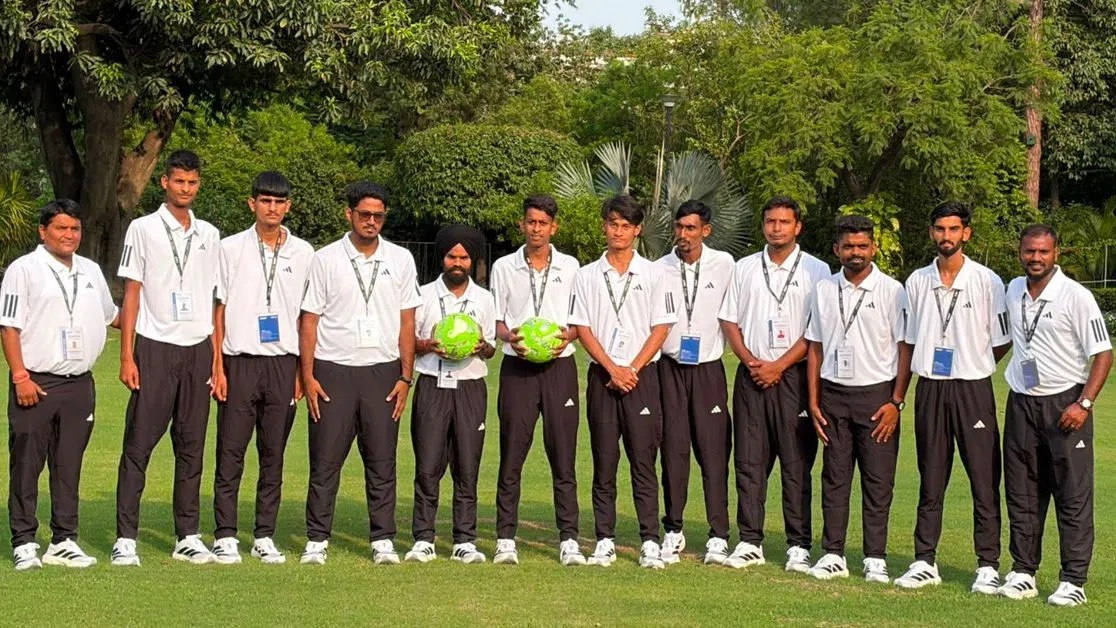
Special Olympics Bharat team during the send-off ceremony in New Delhi (PIC: Aditya Kaushik)
Opportunity beyond the pitch
Pai believes those stories best capture the programme’s purpose. “For many of these athletes, the world has often been limited to their local village or town. Our role, and our responsibility, is to make sure that is never the ceiling,” he said.
As Special Olympics Bharat begins its latest Gothia Cup campaign, a third consecutive title would undoubtedly add another chapter to its growing legacy.
Yet the programme’s greatest achievement may already be evident: creating opportunities for athletes with intellectual disabilities to compete with confidence on one of world football’s biggest youth stages while proving that sustained preparation, inclusive coaching and long-term support can produce lasting success.














































You must be logged in to post a comment Login