Header image: AI-generated illustration by WordUp News.
A nontheistic humanist at the University of Kentucky has secured what is being described as a first-of-its-kind religious exemption from AI at work, a sign that objections to artificial intelligence are starting to meet employment law in new ways.
David Durman, an administrator who helps researchers apply for grants, told TechCrunch that he asked the American Humanist Association (AHA) how he could gain legal protection from being made to use AI on the job. According to the reporting, he is the first humanist to win a workplace accommodation of this kind, and one of the first people to speak publicly about seeking one.
Advertisement
Why a Humanist Sought a Religious Exemption From AI
Humanism does not rely on belief in a god, but Durman argues it is still a belief system. He describes it as a set of convictions about human well-being and flourishing, both individual and collective. In his view, people become moral actors through the active use of their minds, and leaning on AI weakens that capacity.
In a statement published by the AHA, he also pointed to broader worries: AI’s effect on people’s ability to earn a living, its environmental costs, and what he calls the theft of human creativity. Those concerns are common in wider public debate. Durman has framed them as part of a moral outlook rather than simply a preference.
A Precedent, and a Pre-Emptive Move
Durman said he was inspired by Erin Maus, a Unitarian Universalist software engineer who reportedly secured similar protections. Her case is unusual, given how rare it has become for engineers to write code with no AI help. Durman’s situation is different. He has not been required to use AI, but some colleagues and leaders have encouraged staff to try the tools. He sought the accommodation now in case that encouragement hardens into a mandate.
The AHA’s staff attorney, Alexandria Huiskens, said the aim is to make clear that nontheists are covered by workplace religious protections too. She noted that unease about AI and human dignity runs through several traditions, and she cited Catholic teaching, Universalism and Humanism. Pope Leo XIV has publicly decried AI as a threat to human dignity.
Advertisement
What the University Says
University spokesperson Jay Blanton said the institution reviews religious accommodation requests individually, weighing the employee’s duties and circumstances. In this case, he said, the university concluded it could grant an accommodation while Durman continued to perform the essential functions of his job.
Blanton also added a caveat. As technology and job responsibilities change, accommodations may be revisited to make sure they stay “reasonable and workable.” That suggests a religious exemption from AI is not necessarily permanent, especially if a role’s core tasks come to depend on the tools.
One note on framing: a TechRadar headline calls this a civil rights ruling, but the TechCrunch account describes a university decision on an accommodation request, not a court judgment. The sources do not mention any litigation.
What It Signals for Other Workers
Durman says he is not trying to tell others what to think. He hopes people with similar concerns will pursue some form of resolution, even if not a formal religious exemption from AI. Whether his case becomes a template will depend on how employers handle later requests, particularly in jobs where AI use is already routine. For now, it shows that a belief system without a deity can be the basis for an accommodation, at least at one public university.
Meta has quietly released a new AI fashion app called Style Sketch, and for now only people in Indonesia, Singapore and Thailand can download it. The launch, available on both iOS and Android, was first flagged by social media consultant Matt Navarra on X, and Meta did not respond to TechCrunch’s request for comment. Whether the company plans to take the app to more countries is unknown.
What the Style Sketch app actually does
The pitch is simple: turn the clothes you already own into a digital wardrobe, then let AI play stylist. Users can link their social accounts so the app builds a virtual closet from photos they have already posted. Reports differ slightly on which accounts connect. Engadget says Facebook and Instagram, while TechCrunch’s write-up mentions Instagram, though Navarra’s post refers to both. Anyone who would rather not link accounts can add items by snapping photos, recording a short video, or uploading images from a camera roll.
Once the closet is populated, Style Sketch suggests outfit combinations and lets people preview them on a model that, according to the app’s description, is matched to the user’s body shape and skin tone. People can pick one garment and ask for outfits built around it, tell the app the day’s weather, or request a trip plan. For travel, entering a destination, trip length and planned activities reportedly produces a day-by-day outfit schedule that accounts for the forecast and itinerary.
Advertisement
Another small-market test from Meta
Style Sketch is the latest in a run of limited-release AI products from the company. Just weeks earlier, Meta launched Waddle World in the Philippines, a Tamagotchi-style game it describes as a “daily journal disguised as a pet.” TechCrunch also lists Pocket, a tool for vibe-coding games, and Vibes, an app for generating AI videos, among the company’s recent releases.
The pattern appears deliberate. The Wall Street Journal reported earlier this year that Mark Zuckerberg told employees Meta intends to ship far more apps than it has in the past, because AI has made building them faster and easier. Engadget adds that such apps could also help draw more people into using, and effectively training, Meta’s AI systems. Launching in a handful of markets lets the company see what sticks before committing to a wider rollout.
A crowded field for any AI fashion app
Meta is not breaking new ground with the concept. Engadget notes that Google’s AI Search has offered a virtual clothes try-on feature since 2025, and that Google Photos recently added a Wardrobe feature that catalogs your clothing by scanning your library. OpenAI has also introduced a ChatGPT feature that lets users upload a photo of themselves and the garments they want to try on. TechCrunch points to startups such as Alta that already help people digitize closets and visualize outfits.
That leaves Meta competing on something other than novelty. TechCrunch argues the company’s edge is likely to be its integration with Instagram, where many users already have a long visual record of how they dress. If an app can mine that history to build a closet automatically, it removes the tedious setup step that tends to sink wardrobe-organizing tools.
Advertisement
What to watch next
The limited footprint makes it hard to judge Style Sketch’s prospects. Meta has not shared usage goals, a wider release timeline, or how the app handles the personal photos it ingests. Those questions matter for any product that asks users to hand over pictures of themselves and their belongings, particularly one tied to social accounts. For now, Style Sketch looks like one more experiment in a strategy built on volume: release many small apps, watch the response, and see which ones earn a bigger audience.
Header image: AI-generated illustration by WordUp News.
Three of the world’s biggest social media companies have reportedly lost a High Court challenge to Ofcom data demands, in one of the first major legal tests of Britain’s Online Safety Act. Reuters reported on Friday that London’s High Court rejected the case brought by Meta, TikTok and X, according to a summary of the report by The Next Web.
The judgment had not been published when the news emerged, so the court’s reasoning is unclear. Neither the companies nor Ofcom had responded to requests for comment.
What Ofcom asked for
The dispute centres on information notices the regulator sent to the platforms in February. Ofcom sought detailed figures on how each service handles harmful content, including how many posts it removes or restricts and how many users come across such material. The data would help the regulator judge whether the new rules are working.
Advertisement
Ofcom says it narrowed the scope of its requests before they took effect. The companies argued that gathering the information would place an unusually heavy burden on them.
Three platforms, three objections
At a hearing earlier this month, each company made a different case. X called the notice the most demanding request it had ever received from a regulator. Meta argued that Ofcom wanted extensive data across seven of its services without clearly explaining how it would use it. TikTok said the regulator had bypassed a separate system for assessing platforms, which has its own safeguards.
Together, the arguments covered the scale of the work, the lack of a stated purpose and the choice of legal route. Based on the reported outcome, none persuaded the court, though the written judgment will show which points it considered and how.
Why the ruling matters
The Online Safety Act became law in 2023 and gives Ofcom powers to enforce rules requiring platforms to protect users, particularly children, from illegal and harmful content. Companies that commit serious breaches can face fines of up to 10% of their global turnover. Regulators can only enforce rules like these if they can get reliable figures from the companies they oversee, so the reported ruling is a significant early result for Ofcom.
Advertisement
If the outcome stands, the platforms will probably have to answer the regulator’s questions about removals, restrictions and user exposure to harmful content. That would give Ofcom a clearer picture of how each service performs. The companies may still consider their options once the judgment is public, but the sources do not say whether any appeal is planned.
A wider run of disputes
The case is part of a broader pattern of friction between Meta and the regulator. Meta has separately challenged Ofcom’s method for calculating fees under the Online Safety Act, and Ofcom is also investigating Instagram Instants.
The full judgment will matter most. It should show how far Ofcom’s information-gathering powers extend and how much weight the court gave to the companies’ complaints about cost and complexity. Until then, the reported result suggests the court has sided with the regulator on the Ofcom data demands.
Header image: AI-generated illustration by WordUp News.
Apple’s long-awaited iPad mini OLED upgrade is official, and it brings the biggest list of changes the small tablet has seen in years, along with a higher price. According to CNET’s Scott Stein, the new model starts at $699 and goes on sale Nov. 6, with orders opening Oct. 28.
What the iPad mini OLED upgrade includes
The headline feature is the screen. The new iPad mini steps up to 8.5 inches, from 8.3 inches on the previous model, and it is the first mini with an OLED panel. Inside, an A20 processor replaces the A17 chip in the model released two years ago.
Advertisement
Apple has also made the tablet thinner and lighter. The front-facing camera has moved to the landscape edge, as on Apple’s other iPads. That should put it closer to center for video calls when the tablet is propped on a table in a case.
First water-resistant iPad
The most notable addition may be durability. The mini is the first iPad rated IP67 for water resistance. CNET says that means it should survive a dunk in a pool, the ocean or a bathtub. Apple is also introducing a through-screen speaker system called Acoustic Display. Stein says he is curious to test it, and there are no performance details yet.
Pricing and storage options
The $699 base price includes 128GB of storage. Stepping up to 256GB costs $799, and the 512GB version is $999. Stein calls the tablet a potential “killer upgrade” on paper for anyone who has been waiting, but he also notes that it costs more than the model it replaces. The tablet comes in two new colors, midnight and starlight.
Timing and the iPhone Duo connection
Apple announced the tablet two days before an expected showcase of new Macs on Wednesday. It also follows the company’s new iPhone Duo. Stein says the Duo, when unfolded, almost feels like an iPad mini. For shoppers who want a tablet-sized screen without buying the Duo, the new mini offers an alternative.
Advertisement
The coverage so far is based on Apple’s announcement rather than hands-on testing. Stein says a full review will come once he has a unit, so claims about battery life, screen quality and the speaker system remain unverified. For now, the iPad mini OLED model is a clear step up in hardware, and buyers will need to decide whether the new features justify the higher price.
Microsoft voluntary buyouts are now on the table for as many as 60,000 employees, in one of the broadest workforce-reduction moves the company has attempted. Tom’s Hardware puts the eligible group at roughly 27% of Microsoft’s staff and frames the program as a response to the mounting cost of the AI buildout.
What Microsoft is offering
According to a memo from Amy Coleman, Microsoft’s executive vice president and chief people officer, the company is running a time-limited Voluntary Exit Offer (VEO). It is open to “eligible staff in participating teams” in the US, UK, Canada and India, at level 70 and below. The Verge, as cited by GamesIndustry.biz, reports that up to 60,000 people could qualify.
Eligibility is a ceiling, not a headcount. Nothing in the available reporting says how many employees will accept, and the terms, such as severance or payout levels, were not detailed in the material reviewed here.
Advertisement
Which teams are included
Sources familiar with the plan say the teams taking part include AI experiences, Copilot, CoreAI, Windows + Devices, Xbox, finance and human resources. Microsoft’s cloud + AI group, the MicrosoftAI teams, and corporate, external and legal affairs are described as “partially participating.”
The list is notable because it includes groups building Microsoft’s flagship AI products. That suggests the program is less a retreat from AI than a reshuffling of who works where as the company’s spending priorities shift.
A pattern of workforce moves
The exit offer follows a string of earlier steps. Earlier this year Microsoft ran a Voluntary Retirement Program limited to around 9,000 US employees whose age and years of service added up to at least 70. Layoffs followed in July and September, mostly across Xbox and commercial sales. GamesIndustry.biz also notes that further layoffs are allegedly planned, though that claim is unconfirmed.
Coleman presented the new program as a lesson carried over from the retirement effort. “The Voluntary Exit Offer is new for us,” she wrote. “We’ll learn from it.” She said it reflects an effort at “creating greater flexibility and, where possible, more ways for employees to shape their next chapter,” and added that there is “no one-size-fits-all approach for every team or every employee.”
Advertisement
Why voluntary buyouts matter
Voluntary programs let a company thin its ranks without immediately resorting to involuntary cuts, though they can also lose people the company would have preferred to keep. Microsoft is pairing the offer with a promise to keep helping staff “build new skills” and, “where it makes sense, find new opportunities across Microsoft.”
The memo itself, as quoted, does not name AI spending as the motive. That link comes from Tom’s Hardware’s framing, and the sources do not include financial figures that would quantify it. What they do establish is the scale and timing: a company that has already trimmed Xbox and sales teams is now inviting a large share of its workforce to consider leaving on its own terms.
The key unknowns are how many employees take the offer, what it pays, and whether the reported additional layoffs follow. Those answers will show whether the Microsoft voluntary buyouts are a one-time experiment or a template for how the company restructures in the AI era.
The University of Copenhagen data breach has exposed personal details belonging to roughly 525,000 people, and a later update showed that about 20,000 more staff and students had their campus access PIN codes compromised. The university, Denmark’s oldest, says attackers got in through one of its test environments rather than its main operational systems.
According to the university’s notice, as relayed by BleepingComputer and TechRadar, the data that may have been exposed includes full names, Danish national identity (CPR) numbers, phone numbers and email addresses. The university detected the intrusion on a Tuesday and disclosed it that Friday. The PIN update followed a few days later.
What the attackers reached, and what they didn’t
Test environments are meant for trying out software without touching live services. They are sometimes filled with real data to make that testing realistic, which can leave sensitive records in a less protected place. The sources do not explain how the attackers got in or why real personal data was there, and the university says its investigation is still under way.
Advertisement
The university says it has contained the attack and blocked the intruders’ access. So far it has found no sign that systems supporting daily operations were touched or that university activities were disrupted.
Physical access was affected too
The PIN exposure gave the incident a physical side. As a precaution, the university restricted access to certain critical locations on campus. It is reopening them gradually as it hands out new access codes. The sources do not say which locations were affected or how long the restrictions lasted.
The scale is notable. The university has about 36,800 students and 10,700 employees, a combined total far below 525,000. That suggests the affected records include more than people currently enrolled or employed, possibly former students, staff or other contacts. The sources do not confirm this, and the university has not yet said who is covered.
Why phishing is the main worry
The university has reported the incident to the Danish Data Protection Agency. Because the case falls under the EU’s General Data Protection Regulation, it says it is working with the relevant regulators on next steps.
Advertisement
For those affected, the immediate danger is social engineering. TechRadar notes that contact details combined with private identifiers like national ID numbers let criminals write convincing, personalized phishing emails. Those messages can be used to plant infostealer malware or to gain access to systems where ransomware could later be deployed. The university advises anyone who may be affected to be wary of unsolicited messages and to verify requests independently.
The final scope of the University of Copenhagen data breach is still unclear. The university has promised more updates as its internal investigation allows, and those should show whether the numbers change and what regulators make of how the data was stored.
Header image: AI-generated illustration by WordUp News.
The Boston Dynamics ICE deal has opened a rare public rift inside one of the world’s best-known robotics companies. More than 300 employees signed a petition urging executives to stop the sale of modified Spot robot dogs to US Immigration and Customs Enforcement. Leadership has said it is standing by the contract.
What the Boston Dynamics ICE deal covers
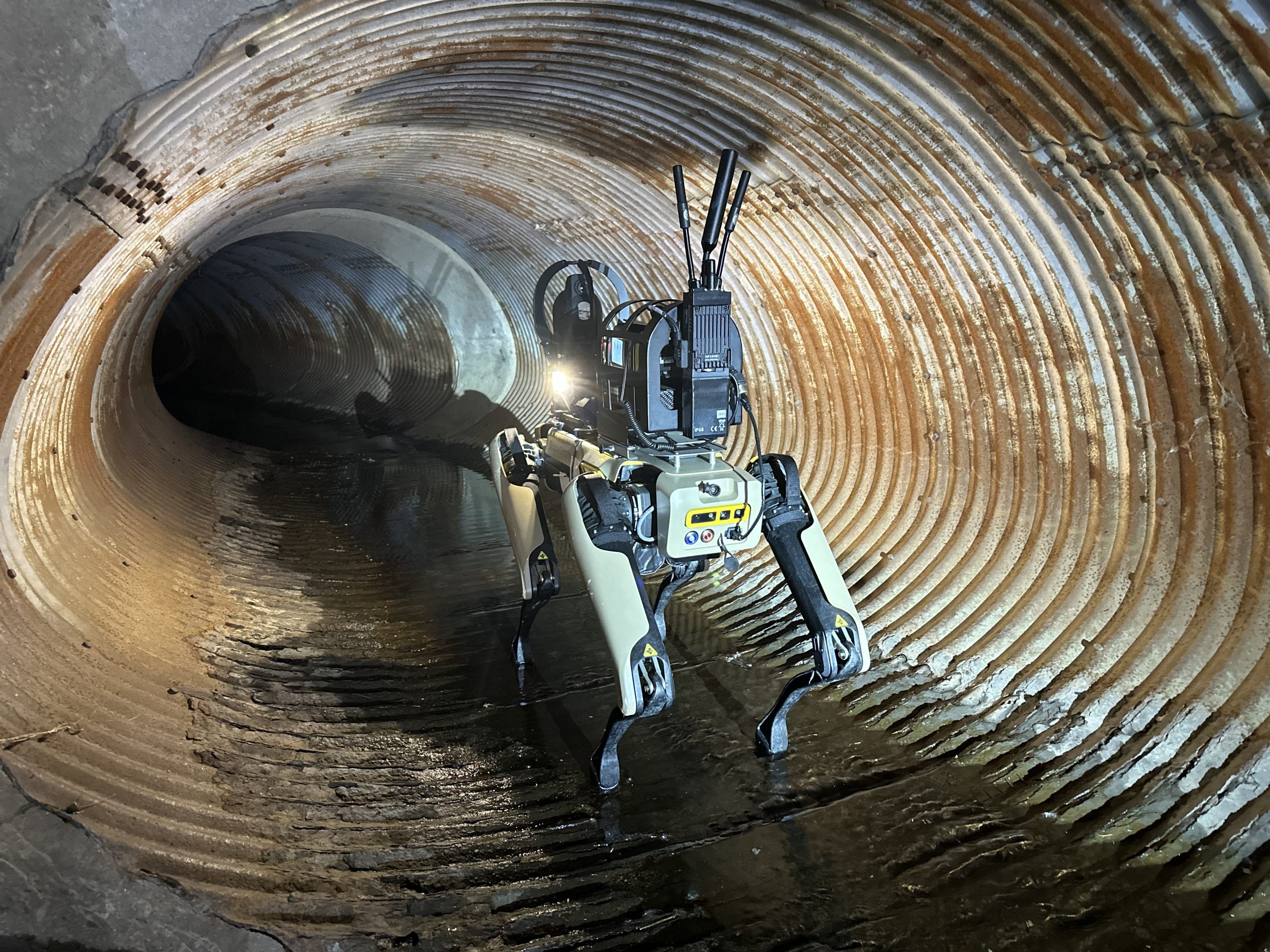
According to reporting by Ars Technica, the Department of Homeland Security awarded $1.3 million to Radeco, a Connecticut company, to supply ICE with four modified Spot quadrupeds. Radeco markets its version as “Cerberus.” It adds military-grade equipment aimed at detecting dangerous substances.
The contract describes the robots as tools to “detect radiation, toxic gas leaks and explosive threats in urban environments or disaster zones.” An oxygen sensor is meant to confirm that air is breathable in confined spaces such as tunnels. The robots also carry a 30x zoom camera, 360-degree cameras and infrared thermal imaging. An optional robotic arm lets them open doors and handle objects. The contract says they can run “repeatable autonomous missions with minimal human intervention.”
Advertisement
ICE justified the purchase as support for Homeland Security Task Forces. Their stated targets are cross-border tunnels and the smuggling and trafficking networks run by cartels, foreign gangs and transnational criminal organizations.
Why employees say the risk is too great
The petition went to company executives and was shared with The Boston Globe and WBUR. It has more than 300 signatures, and half of the signers are anonymous. That is roughly a fifth of a workforce of about 1,400. Signers wrote that friends and family had asked them “in disbelief and horror” whether the news was true. They also warned that “the risk for Boston Dynamics is simply too great to continue with this deal.”
Much of the objection centers on what Homeland Security Investigations, the ICE unit expected to use the robots, actually does. The company stresses its focus on transnational criminal organizations. But the Brennan Center for Justice has documented the unit’s involvement in deportations and workplace raids during Trump’s first term. The Immigration Policy Tracking Project reports that thousands of its agents were again diverted to immigration enforcement after a 2025 executive order redefined its mission.
The petition points to a September 4, 2025 raid at the Hyundai Motor Group Metaplant America facility in Georgia, where 475 workers, mostly South Korean, were detained. Hyundai has owned Boston Dynamics since June 2021. “We cannot be proud of working at Boston Dynamics,” the petition says, “when that work is being used by a government agency that brutalizes civilians, including some of our own colleagues at Hyundai.”
Advertisement
The company’s response
Boston Dynamics is not backing down. A spokesperson told Ars Technica that “Spot robots are tools that help keep people out of harm’s way,” adding that “regardless of any political implications or personal feelings about the organizations involved, if our robot can help keep people safe, we believe it should.” Executives have also said the robots would not be weaponized.
That assurance addresses one worry but not the others. The contract’s own language stresses surveillance, inspection and autonomous operation rather than force. Workers appear concerned less about the robots as armed machines than about what they enable for an agency whose immigration work has reached their own parent company’s facilities.
The timeline in the available reporting is also muddled. It lists the contract award as September 25 but says the petition reached executives in early September. The excerpt does not explain how that sequence fits together.
A wider test for robotics makers
The dispute reflects a long-running tension in robotics. Manufacturers sell general-purpose machines that can be modified and resold by third parties. Here the buyer is not even Boston Dynamics’ direct customer but an intermediary, Radeco, that adapted the hardware. Once a robot is sold into that chain, the company’s practical control over how it is used shrinks. A pledge against weaponization is one of the few limits it can plausibly promise.
Advertisement
For now, the Boston Dynamics ICE deal stands, and the petition shows how much internal pushback a government sale can generate at a company that builds its brand on friendly, almost playful machines. Whether employee pressure changes anything may depend on whether the signers’ numbers grow, or on how Hyundai, the parent company, responds.
The Tailscale security team is working to patch almost a dozen security vulnerabilities that could be exploited to steal credentials, crash servers, gain root privileges, and more.
Tailscale develops a software-defined mesh virtual private network (VPN) built on WireGuard that lets users connect computers, servers, and cloud instances from anywhere to the same encrypted mesh network (“tailnet”) via direct peer-to-peer (P2P) connections.
Cyberdione Labs discovered 11 flaws (collectively known as Tailworm) that still lack patches during a security audit of Tailscale 1.104.2 and the self-hosted headscale v0.29.5 control server.
“All findings were verified by reproduction in a lab environment on unmodified, released software (tailscale v1.104.2, headscale v0.29.5),” said Erica Windisch, founder of Cyberdione Labs, who reported the flaws to Tailscale and publicly released the details.
Advertisement
“It is the opinion of the researchers that rapid awareness of these flaws will expediate remediation across impacted devices. These vulnerabilities were not introduced by the researchers, but were discovered, and discovered with low effort.”
The table below classifies the security issues by the component they affect. The most critical issue is in Tailscale’s SSH server and could let authorized attackers gain code execution with root privileges through Unix-socket forwarding on a targeted tailnet.
Advertisement
Component / feature
Mechanism (what breaks)
Attacker requirement
Advertisement
Principal outcome
Tailscale SSH (tailscaled’s embedded SSH server, running as root)
Advertisement
Unix-socket forwarding (ssh -R/-L) performs path checks and file operations as root; races and missing privilege drop let an ordinary session replace, dial, or delete privileged resources
One approved device + one SSH policy rule (forwarding granted automatically on headscale; per-rule on SaaS)
Root execution on target servers; capture of enrollment keys; arbitrary root-file deletion
Advertisement
Tailscale app connectors (conn25, experimental)
Connector translates traffic to attacker-chosen destinations with no validation; network ACLs are never consulted for the true destination
A device granted the connector capability
Reach cloud metadata (credential theft), internal LANs, and — in Kubernetes — every cluster service
Advertisement
headscale control server (self-hosted deployments)
Control-server crash loop; blocking of new-device onboarding org-wide
Tailscale DERP client (relay connection in every agent)
Unbounded read of a malicious relay’s response
Advertisement
Ability to position/point a client at a hostile relay
Client-agent memory exhaustion
tailscale serve (local service exposure)
Advertisement
TCP-forward to a unix socket lacks a guard present on the HTTP path; plus a race in per-mount authorization
Operator configures the forward (or a peer races the mount check)
Remote administrative-API access to the node; minority of requests bypass app authz
On Monday, the Tailscale team said it received Cyberdione Labs’ report and was working on patches to address these security issues by the end of today.
The developers also confirmed that the reported flaws are “serious” as they could let threat actors with permissions on targeted systems take actions with escalated privileges.
Advertisement
“Most of the Tailscale SSH issues we’ve identified concern privilege escalation. In some circumstances, someone already authorized to connect over Tailscale SSH may be able to perform actions beyond the permissions of their configured local user, including potentially gaining elevated privileges,” Tailscale said.
“These are serious security issues, and we’re treating them accordingly. Exploitation depends on the permissions granted to the connecting user or device, the system’s configuration, and other conditions. We’re continuing to verify the full scope of the findings and which configurations may be affected.”
However, despite the severity of the issues, Tailscale said it doesn’t recommend that users disable the Tailscale SSH feature.
“If you want to jump to the most important part, based on our current assessment, we’re not recommending that everyone disable Tailscale SSH,” said Mike Shaver, VP of Engineering at Tailscale.
Advertisement
Instead, the Tailscale team shared measures that should mitigate some of these flaws:
Review SSH access policies. Limit access to the users and devices that need it.
Disable SSH forwarding if you don’t need it. Set TS_SSH_DISABLE_FORWARDING=1 in the tailscaled service environment and restart the service. This disables SSH forwarding without disabling Tailscale SSH entirely, and mitigates several of the more serious findings.
Review access to sensitive systems. Consider temporarily tightening your Tailscale SSH access policies while we investigate, so that only the specific users and devices that need access can connect.
The Tailscale devs aim to push a new version that fixes these issues by the end of Tuesday, October 27, and urged users to prepare to update and “apply the patched Tailscale client release when it becomes available.”
Overall prevention scores can hide what happens after initial access. Once attackers are using valid credentials, prevention drops sharply.
The Blue Report 2026 measures defenses technique by technique across 338 million simulations run in customer production environments.
Header image: AI-generated illustration by WordUp News.
The Anker Halloween sale is live through November 1, cutting 20 percent off the brand’s charging gear when shoppers enter the code HALLOWEEN20 at checkout. WIRED’s gear team flagged the promotion on October 26, pointing to the products that have earned top spots in its buying guides.
What WIRED recommends in the Anker Halloween sale
WIRED’s writer Kat Merck compares Anker to Meryl Streep: a brand that keeps sweeping the awards. It appears in the magazine’s guides for portable chargers and power banks, Android chargers, wireless chargers, 3-in-1 chargers, MagSafe chargers and even USB car chargers. The sale prices below are the ones WIRED listed with the code applied.
Anker Nano Charger 45W: $26, down from $40 (35 percent off). It’s a pocket-sized wall charger with foldable prongs and WIRED’s top pick for Android phones that use USB-C Power Delivery. This updated version adds a display showing charging status.
Anker Laptop Power Bank: $96, down from $120. The 25,000-mAh battery can deliver up to 165 watts to two devices, and it includes a retractable cable and a braided cable that doubles as a carry loop. WIRED says it falls under the power-capacity limit for flights.
Anker MagGo Power Bank for Apple Watch: $72, down from $90. The 10,000-mAh battery has a built-in USB-C cable and port, plus a pop-up 5-watt Apple Watch charger that supports Nightstand mode.
Anker MagGo Wireless Charging Station (Foldable 3-in-1): $80, down from $110 (27 percent off). It charges a phone, smartwatch and earbuds at once. WIRED notes it can feel crowded with everything on it, but its slim design suits light packers.
Anker Solix C1000 Portable Power Station: $470, down from $600 (22 percent off). The 1,056-watt-hour unit powered a small fridge, a TV and a power drill in testing, and it accepts solar panel or car-socket input.
One pick doesn’t show a code discount. The Anker MagGo Power Bank (10K, Qi2), which reviewer Simon Hill calls his favorite MagSafe power bank, was listed at $80 on Anker’s site. It was $90 at Amazon and Walmart.
Why the timing makes sense
Merck argues that now is a sensible moment to stock up. Storms are forecast for many regions, and more time indoors tends to mean more battery-draining scrolling. The Solix power station, with its ability to keep phones and small appliances running, fits the outage scenario best.
Advertisement
The Labubu twist
The more unusual part of the Anker Halloween sale is a pair of bundles that include a Labubu blind box, the collectible monster figures. The lavender “Twilight Box” ($208) pairs the MagGo Power Bank with two wireless backup batteries and a blind box. The orange “Pumpkin Box” ($200) includes the blind box, the MagGo Power Bank, the 45-watt Nano wall charger and one wireless backup battery.
Merck is openly unsure whether Labubus are still trending, but she figures blind boxes will always sell. She suggests the bundles could make a good gift for the right person.
Shoppers should check final prices at checkout, since the discounts depend on the code and the listings can change before the sale ends on November 1.
The fifth-generation BMW X5 is just starting to roll out, and it may be the most dramatic redesign the nameplate has ever seen. BMW made the 2027 X5 as different as can be, with Neue Klasse styling taking over the exterior, a dash-wide display reshaping the cabin, and a fully electric iX5 joining the lineup for the first time.
Even the split tailgate that X5 fans loved for generations is gone, replaced by a one-piece hatch. That leaves the car at the top of the range with a big question to answer. Now the X5 M has shown up to answer it, sort of. A camouflaged prototype was caught testing, wrapped in swirling black-and-white camo that hides most of the details. Not all of them, though.
The roof-mounted GPS antenna and blurred-out plate say test mule, while big wheels with drilled brake discs behind them say this is no ordinary X5. That is a lot to take in, and the camouflage leaves plenty of questions on the table. Here is what the spy photos show, and what we still want to find out.
Advertisement
What do the shots reveal
Stephen Hancock/SlashGear
From the get-go, it’s clear this X5 M prototype is wider than the standard X5. It rides on bigger wheels wrapped in fatter tires, and the black five-spoke design with drilled brake discs peeking out from behind it adds to the performance look. Focusing on the front end, the bumper also looks wider, and it seems to showcase different headlights than the regular X5.
Those could be placeholder units meant to throw curious onlookers off the scent, but they might also hint that BMW has decided to go with a different light signature for the X5 M. The grilles are another interesting detail. They look more ordinary than the ones on the standard model, with more traditional BMW kidneys that are elongated rather than tall.
Advertisement
Once again, this could be a placeholder, or a deliberate change to keep the factory face hidden until the car is closer to production. What is obviously different from the normal X5 are the two air outlets on the hood, a feature that is common on high-performance vehicles and usually points to extra cooling demands. The new door handles are still here, so some of the regular BMW X5’s questionable styling choices clearly carry over.
The taillights are completely disguised, but they do show the same wide light bar design as the regular X5. What also differs is the roof spoiler above the rear window, which looks more angular than the one on the standard model. Overall, the SUV looks beefier, more performance-focused, and much more aggressive than the regular X5.
Advertisement
What likely powers the BMW X5 M?
Stephen Hancock/SlashGear
Looking at the spy shots, we really can’t assess much about the X5 M’s power and performance. The fat tires, more angular spoiler, larger brakes, and big wheels do show it means business, but that is as far as the camo lets us go. History is the better guide. The X5 M often follows a similar trajectory to the BMW M5 we reviewed, as was the case with previous generations, which means it could inherit the M5’s hybrid setup.
That V8 plug-in hybrid makes 717 hp and 738 lb-ft of torque and sends the sedan to 60 mph in 3.4 seconds. BMW Blog reported that a V8-powered M Performance X5 is already confirmed for 2027. The full X5 M is a separate car, reportedly due in 2028. The same outlet’s sources put the gasoline car at roughly 600 hp, with a 48-volt mild-hybrid V8 instead of the M5’s plug-in system. The electric version is the real wild card. Reported targets run from 800 to 900 hp, and the setup is expected to have four motors. Production could start in April 2028 at BMW’s Spartanburg plant.
Whatever BMW chooses, the bar is already high. The X5 M60e plug-in hybrid, which isn’t sold in the U.S., makes 612 hp, so a full M car has to top that. The last-generation X5 M and X6 M offered 617 hp and 553 lb-ft of torque, and BMW quoted 3.7 seconds to 60 mph for the X5 M Competition. Whether this prototype is the gasoline or the electric version, we simply don’t know, so any 0-60 figure for the new car would be a guess.
We spend hours testing every product or service we review, so you can be sure you’re buying the best. Find out more about how we test.
Bissell CrossWave Reach Plus Cordless Wet-Dry Vacuum: two-minute review
The Bissell CrossWave Reach Plus looks like an almost mid-range vacuum. And it largely is. It has an all plastic build, doesn’t come with a bunch of attachments, and really does one thing. But, it does that one thing really well and that is be a wet-dry vac. In fact, when using it to simultaneously vacuum and mop, it picks up anything and everything smaller than a Cheerio. Crumbs of all sorts. Dog hair. Spilled parmesan. Coffee grounds. You get the idea.
Plus, if you compare it to the best wet-dry vacuums, you’ll see that it’s quite affordable, even if it is among the more expensive Bissell models. I do have a few quibbles, such as the fact that there’s an upper limit on the size of the debris it can suck up or the fact that all the debris goes into the same dirty water tank making emptying it a bit of a mess.
Advertisement
Still, for the price, it might be the best vacuum with wet-dry capabilities out there. Just be aware that the Bissell CrossWave Reach Plus is the same as the Bissell CrossWave Reach, but comes with a charging base.
Latest Videos FromTechRadar
The Bissell CrossWave Reach Plus mops evenly and dries quickly. (Image credit: Future / James Holland)
Bissell CrossWave Reach Plus Cordless Wet-Dry Vacuum: price & availability
List price: $329.99 (about £250 / AU$470)
Launched: September 2026
Available in the US
Advertisement
The Bissell CrossWave Reach Plus comes in at decidedly Bissell level prices. You don’t have to plop down the cash you would for something like the Dyson V15s Detect Submarine and its list price of $949.99 / £599.99 / AU$949. It’s even cheaper than some Chinese models like the Tineco Floor One S7 Pro with its list price of $799.99 / £599.99 / AU$999). Of course, that model does come with a larger capacity and a more impressive display.
Basically, the Bissell CrossWave Reach Plus goes for $329.99 (about £250 / AU$470). This price includes the vacuum, the charging tray, two different sample sized bottles of cleaning solution, and a measuring cup for the solution.
It’s a price that I would consider mid-range for a vacuum, though it’s relatively cheap for a wet-dry vacuum. It’s also an expected price point for a higher-end Bissell product (Shark hits similar price points in my opinion). You can get the non-Plus version for $279.99. The only difference is that it comes without the charging tray.
Value for money score: 4.5 out of 5
Bissell CrossWave Reach Plus Cordless Wet-Dry Vacuum specs
Swipe to scroll horizontally
Weight (total):
Advertisement
8.8 lb / 3.99 kg
Weight (body only)
8.8 lb / 3.99 kg
Bin size
Advertisement
450ml (clean tank) / 600ml (dirty tank)
Runtime in Min mode
23 mins
Runtime in Max mode
Advertisement
39 mins
Charge time
4 hrs 35 min
Size (H x W x L)
Advertisement
10.7 x 8.6 x 43.6 inches / 27.2 x 21.8 x 110.7 cm (L x W x H)
Max suction
7AW
Modes
Advertisement
Eco, Hi, Turbo
Bissell CrossWave Reach Plus Cordless Wet-Dry Vacuum: design
Dirty water tank contains solid debris too, for better or worse
Has a self-cleaning feature
Can lie flat to get under furniture
The Bissell CrossWave Reach Plus may be an all-plastic build, but it looks durable and cuts a somewhat dashing figure. Not quite a stick vacuum, it’s ever so slightly modular insofar as the handles comes separated from the body. It’s also slim at around 4.5 inches across the body.
Sign up for breaking news, reviews, opinion, top tech deals, and more.
The power and mode buttons (eco, high, turbo) are on the handles, and are within thumb’s reach during use. The battery indicator, which shows battery life using three LEDs, as well as the indicators showing which mode the vacuum, are all on the body facing you while you clean. There’s also a button here to run the Bissell CrossWave Reach Plus’s Clean-Out Cycle — a nice feature for self-cleaning the brushroll after use.
Advertisement
The Bissell CrossWave Reach Plus’ LED indicators conveniently face the user to show battery life and current mode. (Image credit: Future / James Holland)
The 600ml dirty water tank clipped into the back of the body is easy to remove for emptying. When removed, the filter on top pulls right out exposing whatever debris is inside. The one downside here is that, unlike the best robot vacuums that vacuum and mop, everything goes into the same tank. Vacuumed up a bunch of rice and sucked up a spill? You’ll have to empty everything out into the same place.
The dirty water tank on the Bissell CrossWave Reach Plus is simple to remove. (Image credit: Future / James Holland)
The clean water tank is clipped onto the top of the floorhead. Its 450ml capacity is decent, though will require somewhat regular refilling (of water and a cup of one of the included solutions). I do like the exposed look of it, though.
The clean water tank on the Bissell CrossWave Reach Plus sit atop the floorhead. (Image credit: Future / James Holland)
As far as the rest of the floorhead, it can swivel and has a hinge for the vacuum to lay up to 180 degrees back — essentially flat — to get under furniture. And it has one large tangle-free brushroll that’s removable for cleaning or replacing and can handle just about any hard surface one would mop. Also worth noting is that it’s rated as having a 10.6 inch cleaning path, though when I measured it, I would say it’s actually 9.6 inches. You lose an inch to the plastic bezels on either side.
Lastly, the charging tray that comes with this vacuum is essentially a molded piece of plastic with charging contacts so that if you put it back in the tray after use, it will start charging automatically.
Advertisement
Design score: 4.5 out of 5
Bissell CrossWave Reach Plus Cordless Wet-Dry Vacuum: performance
Great vacuuming except for larger debris
Flawless mopping
Can get pretty close to edges
When I first started using the Bissell CrossWave Reach Plus, I found myself struggling to find something to dislike about it. After spending some time with it, that’s still mostly the case.
This is a wet-dry vacuum and mop, and it does both duties concurrently; there’s no vacuum only mode, and no opportunity to only get the floor wet. Despite that, I’m going to try and separate these two functions just to give you a better idea of what to expect.
The Bissell CrossWave Reach Plus before vacuuming up a bunch of tea leaves. (Image credit: Future / James Holland)
I performed a few tests when vacuuming. I threw a bunch of tea leaves on the floor as well as a bunch of rice. For both sizes of debris, the Bissell CrossWave Reach Plus sucked them right up in the first go.
The Bissell CrossWave Reach Plus in process of cleaning up tea leaves. (Image credit: Future / James Holland)
Because of the way the floorhead is arranged — there’s just the mop brushroll at the front end with a forward-angled silicon liner behind — it isn’t quite as successful on picking rice and similar sized debris when pulling the vacuum back as it can get caught by that liner. However, when pushing the vacuum forward, everything gets sucked up immediately.
The one caveat to that and a valid reason to still keep a regular vacuum around is the fact since the only moving part helping pick up debris is that brushroll, larger pieces of debris like cereal or popcorn will just get pushed around the front of it like a curling puck.
Advertisement
The Bissell CrossWave Reach Plus made quick work of cleaning up ketchup. (Image credit: Future / James Holland)
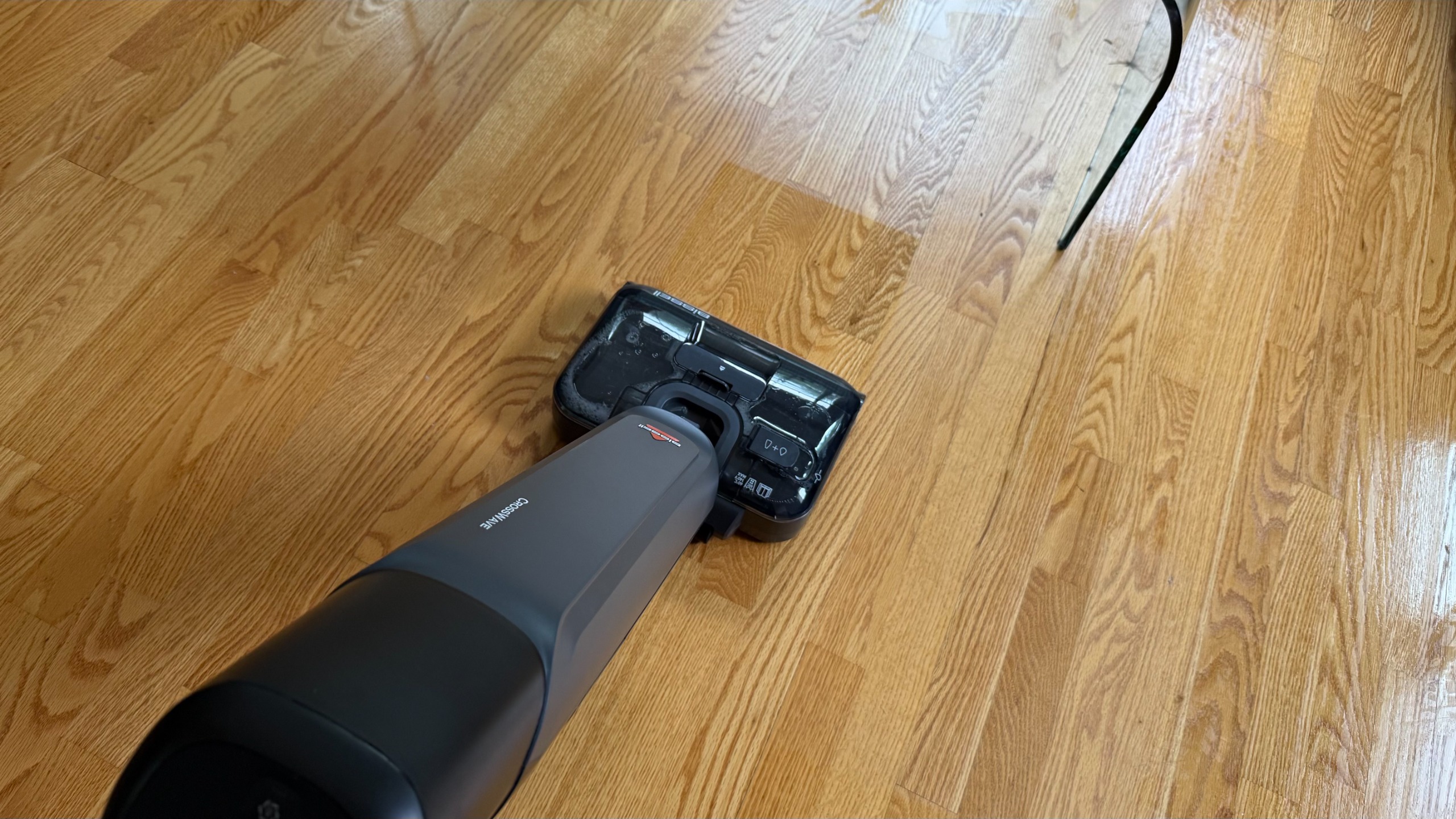
I found basically nothing to complain about its mopping capabilities, however. It lays down an even layer of water and detergent solution that is enough to fully mop whatever area’s been covered. And I found the floor to be dry within minutes after mopping.
I also tested the Bissell CrossWave Reach Plus’s mopping by throwing a bunch of ketchup, mustard, and coffee (separately) on the floor. In each instance, whatever was on the floor was removed in one swipe. However, it takes a few passes to remove odors (and they can still persist for a short while).
Thanks to a 180-degree hinge, the Bissell CrossWave Reach Plus can easily get under furniture. (Image credit: Future / James Holland)
Getting to the edges and corners with a vacuum is a concern, especially one without additional accessories for tight spaces. But that’s not too much of a concern here. I found that going up to edges with this vacuum allowed me to get as close as a quarter inch when moving with the right side towards the wall. With the left side of the vacuum facing the wall or edge, the three quarters of an inch closest to the wall is left untouched, while the front of the vacuum won’t touch that last inch closest to the wall. So, I was able to get pretty close to the wall but the vacuum orientation matters.
Generally, maneuvering the Bissell CrossWave Reach Plus is easy. It does want to pull forward so pushing the vacuum in the direction I want to go feels effortless. When pulling back in a typical vacuuming fashion, I do feel some resistance since it wants to go in that direction. Turning is just as effortless thanks to the swivelling floorhead, and the fact that it can lie almost flat means it’s a cinch to get under furniture.
Advertisement
Lastly, the Bissell CrossWave Reach Plus is not a quiet vacuum, but is in line with other cordless vacuums such as the Bissell PowerClean FurFinder. On eco mode, it reaches around 64dB. In turbo mode, it gets up to 67dB. And it hits about 65dB during its Clean-Out Cycle.
Performance score: 4.5 out of 5
Bissell CrossWave Reach Plus Cordless Wet-Dry Vacuum: battery life
Four and a half hour recharge time
Up to 40 minutes of use on a single charge
Let’s get the bad out of the way. When fully drained, the Bissell CrossWave Reach Plus is going to take over four and a half hours to recharge. If you are an infrequent charger, then, first, shame on you, and, second, you’ll have to suffer through what amounts to almost half a day of waiting if you have to charge from empty. That said, that’s actually a normal amount of time for a cordless vacuum to recharge, though I wish the battery was removable.
The good news is that the twenty minutes it lasts on turbo, specifically 23 minutes and 21 seconds, or almost forty on eco mode, 39 minutes and 49 seconds, is more than enough battery life for a regular home. These numbers are about in line with some of Bissell’s other offerings, though not quite up to what we see with the best cordless vacuums.
Because of how well it picks up debris (with the earlier size-related caveats), I was able to clean a 800 square foot area in about ten minutes. I ended up wandering in circles with the vacuum in tow waiting for the battery to die. That’s on turbo. The almost forty minutes on eco mode is more than enough for anyone not cleaning an office building.
Battery life score: 4 out of 5
Should you buy the Bissell CrossWave Reach Plus Cordless Wet-Dry Vacuum?
Swipe to scroll horizontally
Bissell Crosswave Reach Plus scre card
Attribute
Advertisement
Notes
Rating
Value
It’s priced lower than a lot of the competition, even if you’re paying extra for the charging tray.
Advertisement
4.5 / 5
Design
Intuitively laid out with some interesting design features including being able to lie flat.
4.5 / 5
Advertisement
Performance
Good vacuuming and mopping, though it can’t quite handle larger pieces of debris.
4.5 / 5
Battery
Advertisement
The battery life is more than enough for use, even if it’s not an impressive length.
4 / 5
Buy it if…
Advertisement
Don’t buy it if…
Bissell CrossWave Reach Plus Cordless Wet-Dry Vacuum: alternatives to consider
Swipe to scroll horizontally
Model
Bissell CrossWave Reach Plus
Dyson V15s Detect Submarine
Advertisement
Tineco Floor One S7 Pro
Weight (total)
8.8 lb / 3.99 kg
8.4lbs / 3.8 kg
Advertisement
21.5 lbs / 9.75kg
Weight (body only)
8.8 lb / 3.99 kg
8.4lbs / 3.8 kg
Advertisement
21.5 lbs / 9.75kg
Bin size
0.600L
0.77L
Advertisement
0.72L
Runtime in Min mode
39 min
60 min
Advertisement
40 min
Runtime in Max mode
23 min
8 min
Advertisement
N/A
Charge time
4 hrs 35 min
4hrs 30
Advertisement
4hrs
Size (H x W x L)
43.6 x 8.6 x 10.7 inches / 110.7 x 21.8 x 27.2 cm
49.1 x 10.6 x 2.1″ / 124.6 x 26.8 x 25.3cm
Advertisement
11.89 x 3.82 x 7.68 inches / 30.2 x 9.7 x 19.5 cm
Max suction
7AW
240AW
Advertisement
N/A
Modes
Eco, Hi, Turbo
Eco, Med, Auto, Boost
Advertisement
Auto, Max, Ultra, Suction
How I tested the Bissell CrossWave Reach Plus Cordless Wet-Dry Vacuum
To test the Bissell CrossWave Reach Plus, I used it for a couple weeks, testing it on hardwood floors, tile, and marble. I ran it through its various modes as well as using the self cleaning function. For running benchmarks, I ran it from full to empty on both eco mode and turbo mode. And I vacuumed / mopped up tea leaves, rice, coffee, mustard, and ketchup.


















































You must be logged in to post a comment Login