As a tech reviewer, I have a confession to make. Despite my years of testing Windows laptops, I’ve always come back to my MacBook after a review period with a sigh of relief. That’s because, regardless of how expensive a Windows laptop is, it’s never really had the cohesive experience I’ve come to love in Apple’s walled garden. Maybe their speakers aren’t good, or the physical trackpad requires a lot of force to actuate. You get the point. So, when Asus sent over their new executive ExpertBook Ultra, I thought I’d test it out, run a few tests, and be back on my MacBook in no time. Well, that hasn’t happened.
The Asus ExpertBook Ultra is the first laptop I’ve tested that has crossed that threshold of desirability. But what makes a great Windows business laptop? Some might say portability, while others could point to factors like performance, sufficient RAM, and AI capabilities. What if you want all those features rolled into one? That’s what best describes the Asus ExpertBook Ultra. It starts at ₹2,39,000 or $3,499, and is the first laptop to debut Intel’s latest Panther Lake processors. I’ve been testing it for a better part of three weeks now, and this review should help you decide if it’s worth splurging the big bucks.
Asus ExpertBook Ultra Review
Hisan Kidwai
Advertisement
Summary
The Asus ExpertBook Ultra is playing a serious game against heavy hitters like the Dell XPS and the Lenovo ThinkPad series. And there’s something for everyone. The design is exceptional, quite possibly the best I’ve tested, with durability that should withstand anything. The 3K Tandem OLED 120Hz display is perfect, and you won’t have to deal with reflections. Let’s not forget the performance that is comfortably a mile ahead of the competition, in both numbers and thermal headroom
Advertisement
Design & Hardware
I was one of the few journalists invited to the ExpertBook launch event about a month back, and that’s where I first went hands-on with the laptop. The first thought I had was how different it looks and feels compared to other premium laptops. You might know the feeling of the all-aluminum MacBook, but the ExpertBook Ultra is completely different.
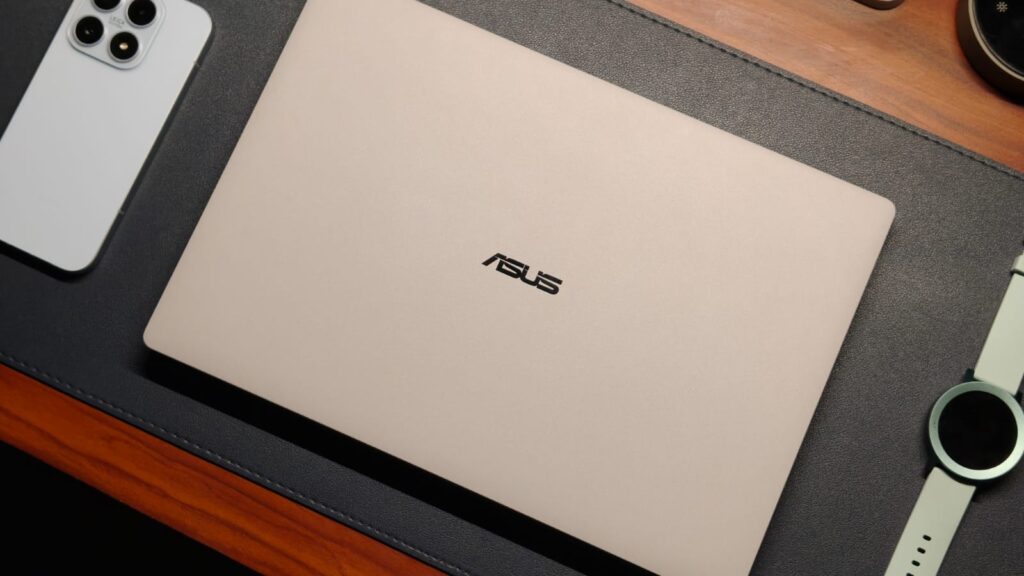
It’s made of CNC-machined magnesium alloy with a ceramic coating on top. It’s hard to put it into words, but the finish feels textured, almost powdery in a way, yet still very premium. You also don’t have to deal with smudges and fingerprint stains on your expensive machine. Color options are limited to two: either black or an off-white. I got the Morn Grey unit, and it’s definitely the way to go. Thanks to the texture, the color shimmers in sunlight, and wherever I went with the laptop, people asked what I was using.
A business laptop is for those who’re running from one office or coffee shop to another, most of the time with a laptop in hand. This means portability and weight are the main concerns. When I first picked up the ExpertBook Ultra, I expected it to weigh a decent amount because of its powerful internals. Well, looks can certainly be deceiving since it only weighs 0.99 kg, which is quite frankly insane. For context, my MacBook Air M1 weighs 1.29 kgs. And this weight difference is noticeable when carrying the laptop every day.
But you might ask, if the Ultra doesn’t weigh much, surely it won’t be durable. That surely won’t be the case, as ExpertBook laptops are the most durable machines I’ve ever tested. I’ve even stood on one, and it escaped without any damage. The Ultra is MIL-STD-810H-rated and should survive several bumps and drops just fine. At the event, Asus also told us to hold it up by the corner of the screen for a photo, which was a weird flex.
Since connecting to other gadgets is a basic requirement in an office, the ExpertBook Ultra has a decent selection of ports. You get dual Thunderbolt 4 USB-C (one on each side), along with a full-size HDMI 2.1, a USB 3.2 Type-A, and a headphone/microphone combo jack.
Best Windows Keyboard & Trackpad Combo
From spending over five years in the MacBook world, I’ve grown accustomed to the haptic touchpad, and it’s easy to see why. A haptic trackpad eliminates one more physical component, making it durable and ensuring consistent actuation energy wherever you click. That’s something Windows laptops have suffered from for years, because clicking on the top corners requires more force than moving a mountain.
The ExpertBook Ultra is one of the few laptops that has fixed this problem, and I couldn’t be happier. The trackpad is a large glass surface that spans edge to edge and comprises six pressure sensors. I found the tracking to be exceptionally good, without that sticky feeling. While the pressure actuation was a little lower than on the MacBook, I got used to it in no time. The palm rejection works beautifully, and the gestures are well supported.
Advertisement
The keyboard is high on the priority list of professionals, and Asus has kept that in mind. The layout is fairly standard in the sense that there is no learning curve. All keys are in the correct place, and even the 1.5mm travel is pretty respectable. The keys feel tactile without making much noise. There are different stages of backlit, and it’s bright enough to overcome the lack of contrast with the white keyboard deck. Still, the best part about the ExpertBook Ultra’s keyboard is that it’s splash-resistant. A small coffee spill or splash of water shouldn’t cause any issues as long as you clean it up quickly.
Display & Camera
We’ve seen OLED displays on laptops for quite some time. In fact, Asus was one of the first to implement it. Still, they are yet to reach the masses because OLED panels, unlike those on phones, consume more power. That’s one problem the Asus ExpertBook Ultra doesn’t have because it uses a 14-inch 3K Tandem OLED with a 120Hz refresh rate. For the uninitiated, a Tandem OLED panel combines multiple layers of light-emitting organic material to deliver higher brightness and lower power consumption. Thanks to this, the laptop has a peak brightness of over 1400 nits in HDR and 600 nits in regular mode.
If I had to use just one word to describe the Ultra’s display, it would be perfect. You can’t get any better than this, with colors that look exceptionally vibrant thanks to 100% DCI-P3 coverage, Pantone validation, and a Delta-E of less than 1. That’s more than enough for creative work like video editing without a hitch. As expected, movies and TV shows were a dream to watch.
That’s not all, as the laptop fixes one major pain point I’ve had with premium laptops. That’s glossy displays. They pick up dust quickly and get dirty with smudges that are almost impossible to clean. With the ExpertBook Ultra, you get a matte glass panel that cancels out almost all reflections pretty effectively, meaning I could work with the sun shining behind my back. Just don’t try this in 45-degree heat. Another upside is the touch functionality. Say what you want, touch is great for working on the go. For the people concerned with durability, Asus has used Gorilla Glass Victus, which is super durable. Enough to withstand over 100 kg of pressure, as they showcased in the event.
The 1080p webcam on the ExpertBook Ultra is perhaps the only thing that’s not very special. It’s decent for calls, and looks comparable to the MacBook. The wide field of view means you don’t have to squeeze into the frame during presentations, and it also supports Windows Hello functionality.
Performance
No business laptop will ever be desirable if it doesn’t have enough power to run multiple apps. Since the Asus ExpertBook Ultra is the first to get the Panther Lake chips, specifically the Core Ultra X7 358H, I was quite excited to test it out. The processor has a total of 16 cores, out of which four are performance cores, another eight are efficiency cores, and the last four are low-power efficiency cores. It’s paired with 32GB of LPDDR5x RAM at 8533 transfers per second and 2TB of Gen 5 storage, which can achieve read speeds over 14,000 MB/s.
As expected, the laptop feels effortlessly fast in everyday use. For example, my work is mainly on Chrome and Slack, where the processor handled everything super efficiently. I could open up more tabs than I need without a hitch, all while still running something in the background. Productivity apps are handled similarly well, and I connected them to my 2K monitor, where the experience was absolutely spotless.
Advertisement
What I found fascinating about the Ultra is that it’s not just a laptop for business people. In fact, if you’re a creator and need a serious on-the-go machine, you actually could take a look here. That’s because I fired up Da Vinci Resolve and tried my hand at editing a 4K reel I shot in Thailand. While my editing skills need a lot of sharpening, the Ultra could handle multiple streams of 4K videos and even play them back without slowing down. I also added some color grading to the videos, and it all went fine. In typical Asus fashion, there are several AI-centric features, such as MyExpert. It’s a personalized AI chatbot that quickly helps with your needs with on-device processing.
Since my skill set with demanding tasks only goes so far, I also ran a series of benchmarks to see how the Panther Lake processor ranks among its peers. Starting with Cinebench R24, the Ultra X7 358H scored 1,019 points in the multi-core test, roughly doubling the performance of the Ultra 7 258H, found in the likes of the ThinkPad X Carbon. With PCMark 10, we saw a 30% jump in the Ultra X7 358H’s performance compared to last-gen alternatives, reaching scores of 9,903.
Graphics in the ExpertBook Ultra are handled by the integrated Arc B390 GPU. Intel’s recent emphasis on GPUs means the B390 means serious business. I put it to the test with 3DMark’s TimeSpy test, where it scored 6,712 points. To put this number in context, though, I also played a series of games. Don’t get me wrong, the ExpertBook Ultra is not designed for serious gaming, but can it play AA or sometimes even AAA games? Yes, absolutely. Starting with lighter titles like F1 2025, I easily got over 100 fps on High settings with XeSS turned off. Kicking things up to titles like Indiana Jones: The Great Circle and Cyberpunk 2077, I averaged around 50-60 fps at 1080p with Ultra detail settings. If you’re concerned with eSports titles like Counter-Strike 2 and Valorant, they won’t break the ExpertBook Ultra, as it can easily achieve full 120 fps at the highest settings.
Battery Life & Speakers
While the 70Whr cell is pretty standard for a thin-and-light laptop, Asus has incorporated a new 2S2P architecture, which, in theory, is more efficient. My testing proved that theory to be right. On an average workday, which includes spending hours on Chrome, watching YouTube, and a few episodes of Better Call Saul, the ExpertBook Ultra lasted me a full day with some charge left to spare. Charging is handled with a 90W USB-C PD charger, which means you can go from 0%-50% in just thirty minutes. That’s enough time to charge between meetings and have enough for your super-long presentation.
Speakers on Windows laptops have usually not been a priority for forever. Most of them fire directly on the table, which inherently limits their output. But the Asus ExpertBook Ultra is the first laptop I’ve heard of that blew my MacBook out of the park. The speakers, of which there are six, sound at least twice as loud, with a wider soundstage, accurate dialogues, and bass that hits the spot. The treble is usually on point. You can make out the different instruments, and the highs don’t screech the ears at all. Almost everyone whom I showed the Ultra’s speakers was in awe of the quality, so you know it’s not just me yapping.
Verdict
Starting at ₹2,39,000, the Asus ExpertBook Ultra is playing a serious game against heavy hitters like the Dell XPS and the Lenovo ThinkPad series. Asus markets it like a business laptop, but my testing found the ExpertBook Ultra to be more capable than just handling spreadsheets. It’s a machine that caters to power users, irrespective of whether they work in an office or from a cozy cafe in Bali, editing videos or programming for their clients.
There’s something for everyone. The design is exceptional, quite possibly the best I’ve tested, with durability that should withstand anything. The 3K Tandem OLED 120Hz display is perfect, and you won’t have to deal with reflections. Let’s not forget the performance that is comfortably a mile ahead of the competition, in both numbers and thermal headroom. Sure, Dell and Lenovo are more established names when it comes to professional laptops, but I think it’s time we give Asus that status as well. And if you’re shopping in the segment, it’ll be a shame not to consider the ExpertBook Ultra.
On the latest episode of TechCrunch’s Equity podcast, Sean O’Kane, Rebecca Bellan, and I discussed what actually prompted the administration’s moves against Anthropic, and what this might mean for the broader AI ecosystem.
As Sean put it, “Anthropic has not had the best relationship with the Trump administration in a way that stands apart from the other leading AI labs,” so perhaps other Anthropic’s rivals don’t need to worry about a similar crackdown.
But Rebecca also noted that leading cybersecurity experts have “signed an open letter to ask Trump to revoke the order, and they say it’s actually dangerous to have to pull these advanced cybersecurity capabilities from network defenders in the U.S.”
Advertisement
And we wondered whether this could all end up being good publicity for Anthropic, especially since — in Rebecca’s words — “everybody loves a bad boy.”
Keep reading for a preview of our conversation, edited for length and clarity.
Rebecca Bellan: As I’m sure many of our listeners know, the U.S. government basically just forced Anthropic to pull its two newest models offline — Fable 5, and then there was also Mythos 5, which was the one that was available to current Mythos users, [whereas] Fable 5 was more available to the public.
They sent a letter [last] Friday that cited “national security concerns.” No one knows what those concerns are. That report has not been made public, they gave no specifics and told [Anthropic] that they had to ensure that those models couldn’t be used by any foreign nationals. So Anthropic was like, “Okay, I guess we have to just pull the models entirely, because we don’t know when someone’s a foreign national. A lot of our own employees are foreigners.”
Advertisement
But really, [reports said] the White House got tipped off to this because of some Amazon researchers that allegedly found a way to bypass Fable 5’s guardrails. Amazon CEO Andy Jassy raised these concerns with the White House, and it just kind of spiraled from there.
Sean O’Kane: This all moved really fast, especially for a Friday afternoon into a weekend. And it’s at the same time that the administration was ostensibly trying to negotiate some sort of treaty for the war that it started in Iran.
Rebecca: Friday evening for us in New York. They love a distraction.
Sean: Let’s step real far back for a moment. Anthropic has not had the best relationship with the Trump administration in a way that stands apart from the other leading AI labs — I think there’s an element, at least, of that playing here.
Advertisement
So do you think that this is going to have implications for those other companies? Do you think that the Trump administration would be less inclined to sort of turn off the tap on one of those competitors?
Anthony Ha: Part of the context here is that both the reporting and an analysis from independent security experts suggest that the actual security risk from Anthropic is not that unique. So a lot of this seems to stem as much from parts of the Trump administration and Anthropic just [not getting] along very well. Whatever risks there are, those things are gonna blow up out of proportion just because it seems like they can’t have a civil phone call with each other.
If you’re another company — on the one hand, maybe that’s advantageous to you, because you can say, “Well, we just don’t get these guys mad at us and we can do what we want.” But that’s also not a great regulatory landscape to just [say], “Boy, I hope they don’t get mad at us.”
Rebecca: On the one hand, it definitely feels retaliatory — after the government labeled Anthropic a supply chain risk, there’s this big lawsuit going on between them, it really feels like the White House is just looking out for any excuse to pummel Anthropic. And I feel that way not only because that was my initial reaction, but because of what a lot of cybersecurity researchers have said. They say that this should never have triggered an export control [order]. They’ve all signed an open letter to ask Trump to revoke the order, and they say it’s actually dangerous to have to pull these advanced cybersecurity capabilities from network defenders in the U.S. Anthropic itself said some of the same jailbreaks could have been found in several other AI models.
Advertisement
Cynically, it’s like: Okay, are you just pausing Anthropic so that others can catch up to where Anthropic was?
But at the same time, I’ve also seen reactions that [say]: Anthropic kinda had this coming. They’re like, “This is too dangerous for anyone to use, but not us, we’re the good guys.” They’re talking out of both sides of their mouth. A week before Fable came out, they were [saying], “Hey, we need to slow down AI, guys. It’s getting really dangerous.” But then boom, “Here’s our most insane ever, super powerful model, go off.”
Anthony: In some ways this feels like a microcosm of a lot of the discussion around AI, where people like Sam Altman and Jensen Huang are [saying], “Hey, let’s try to lower the temperature. Why is everybody mad at us?” Well, you spent the last couple years essentially saying you’ve built this God machine that will take jobs away from everyone. It’s not exactly a shock that people don’t feel great about this.
And there’s something about the way Anthropic talks about Mythos in particular, where they’re like, “This is the most incredibly powerful model ever, it’s too dangerous to release to the public.” And so on some level, [you say,] “Well, okay, let’s say that we take that seriously then. That means that there’s going to be an incredible level of scrutiny around it.”
Advertisement
And I do wonder — it does seem like Anthropic is not happy about this. I want to be careful about not overstating how this could be beneficial to them. But we also ran some stories about Ramp analysis to highlight the fact that the last big blow-up between Anthropic and the Trump administration was good for the company, in at least some ways. Downloads of Claude shot up. I think a lot of people who maybe had thought of ChatGPT as the chatbot, the AI assistant before, suddenly they were looking at Claude as maybe the more responsible one, the more “resistance” one.
And in the same way, [while] Anthropic is very stressed out about this, this could, again, make their models seem even more powerful.
Rebecca: Definitely. “We’re so dangerous.” Everyone loves a bad boy, right? Everyone’s like, “It’s the most powerful model, even Trump says so. Of course, I’ve got to get my hands on it.”
When you purchase through links in our articles, we may earn a small commission. This doesn’t affect our editorial independence.
“There’s a revolution in battery technology hiding in plain sight,” reports The Wall Street Journal. “The 3-D printing of batteries has the potential to put energy storage inside any device.
“This will enable lightweight and long-lasting consumer gadgets, long-range military drones and even nanoscale robots.” Almost all the innovations we regularly hear about — from cheaper, tougher electric-vehicle batteries to “Holy Grail” solid-state batteries — are about changing the chemistry of batteries. The promise of battery-tech 3-D printing (aka additive manufacturing) is simple: What if batteries could fill any available space, even structural elements of our gadgets, rather than always taking a rigid shape like a pouch or cylinder?
The new approach has obvious appeal. The entire airframe of a drone could be filled with energy storage for increased range. Smartglasses could have sleek battery-packed frames, so they look like everyday eyewear rather than “Revenge of the Nerds” props. One of the biggest advantages of 3-D printing is that it works with any battery, regardless of its cell chemistry. It could advance today’s lithium-ion as well as emerging sodium-ion and solid-state tech… Some [startups] are trying to use 3-D printing to create efficiencies in existing battery manufacturing systems. A brave handful of startups are pursuing radical new designs and approaches. They’re starting with defense applications, where cost and scale are less of an issue…
At Silicon Valley-based Sakuu… [r]ather than trying to 3-D-print whole batteries, the company is working on replacing one of battery manufacturing’s biggest pain points, says Arwed Niestroj, Sakuu’s chief operating officer, who is also a nuclear physicist and former head of Mercedes-Benz Research & Development North America. Existing battery assembly lines include football-field-long ovens for drying layers of material that have been dissolved in solvents. This requires a huge amount of energy and is a significant contributor to manufacturing costs, a big reason EV batteries aren’t cheaper. Sakuu’s process, under development for years, uses additive manufacturing to lay down key battery components without solvents, eliminating the need for ovens, says Niestroj.
Advertisement
Sakuu is currently working to commercialize this tech with a major battery manufacturer…
Today marks the summer solstice, the longest day of the year and the start of astronomical summer in the Northern Hemisphere. This doesn’t really have much to do with hacking hardware or building gadgets other than the fact that from this point on you’ll have progressively less daylight hours to do it in each day. Of course, if you do your best work in the middle of the night this won’t impact things much.
If you’re as likely to find a controller in your hand as a soldering iron in the evenings, you might be interested in a recent filing against Sony. Lawyers representing a group of four gamers allege that the entertainment giant is violating a California law that says digital storefronts need to make it clear that buyers don’t technically own the games in question but are merely licensing them — a license which, as we’ve seen in the past, can be revoked or modified at any time with no restitution made to the purchaser.
Now while we agree conceptually that selling gamers a license rather than an actual copy of the game is clearly a one-sided deal, we’re still not sure this case has a lot of merit. As far as we can tell, Sony does make it clear in the fine print that you’re not really going to own anything once they take your money. Or, at the very least, they make it equally as clear as any other company that’s selling digital downloads these days. Should the court actually find that said fine print is a little too fine, it could conceivably have ramifications throughout the entertainment industry. This is certainly a case to keep an eye on.
If you want to be sure none of your games can be removed from your digital grasp without warning, perhaps your best bet is to stick to the classics. Fans of 1989’s F-15 Strike Eagle II on PC will be excited to hear that there’s an ongoing effort by Neuvieme Porte to reverse engineer the flight sim and re-implement the whole thing in portable C.
This would open up all sorts of possibilities, such as ports to other platforms and the addition of new features and content. But before the project can get to that point however, Neuvieme is looking to recruit some virtual test pilots. Just keep in mind that the goal, at least for now, is to recreate the game exactly. That means bugs present in the original release are to be preserved. As such, it would help to have logged enough hours back in the DOS days to recognize what’s an OG bug and what’s been newly introduced.
Advertisement
From working on virtual jet fighters to the real deal, IEEE Spectrum recently ran an article about a startup called Phoenix Semiconductor that’s looking to produce bespoke pin-compatible replacements of critical chips for the military. They reason that the Air Force won’t mind paying $1,000 for a chip that cost them a buck back in 1975 when the alternative is grounding a $70+ million F-18 that needs the thing to take off. The goal isn’t really to recreate the old parts as they were, but instead to build drop-in replacements that are tailored for specific applications. In other words, Uncle Sam doesn’t care of the IC actually looks like the original, so long as it fits and it gets the jet up in the air again.
Finally, on the subject of aerospace technology, NASA’s Jet Propulsion Laboratory published a blog post earlier this week detailing their work on the Exploration Rover for Navigating Extreme Sloped Terrain (ERNEST). While NASA’s Curiosity and Perseverance rovers have done some incredible work on Mars, they’re slow and have to be operated with the utmost caution to make sure they don’t get stuck. In comparison, ERNEST is several times faster and is designed with an active suspension system that lets it lift each wheel up off the ground independently if needed.
The prototype rover also features improved autonomy that may allow future rovers make more decisions on their own. That may not be a huge time saver on the Moon, but given the communication delays with the Red Planet, a Mars rover that doesn’t have to stop and ask Earth for directions so often will be able to get more useful work done at the end of the day.
Advertisement
See something interesting that you think would be a good fit for our weekly Links column? Drop us a line, we’d love to hear about it.
The Wall Street Journal reviewed 1,105 videos along with guidance given to creators for crafting their posts.
Polymarket
In case you needed another reason to be wary of those videos showing people winning big on Polymarket, an investigation by The Wall Street Journal has found that the company is paying social media creators to post misleading content promoting the prediction market. Of the 1,105 TikTok videos the publication reviewed, 778 appeared to show someone placing a bet — but a closer look reportedly revealed that none of the latter featured the actual Polymarket website, instead using dummy sites made to look like the real thing.
For more than half of the videos that appeared to show winning bets, those bets would in reality have been losses, The Wall Street Journal reports. The publication spoke to creators who worked with Polymarket and viewed materials they say they were given to ensure their videos were convincing and engaging. In addition, Polymarket reportedly also enlisted a “social-media army” to repost these videos and help them go viral.
Mo Salah’s Egypt meet Chris Wood’s New Zealand at BC Place in Vancouver, with both teams looking to break away from the Group G bottleneck after all four sides opened their World Cup 2026 campaigns with draws.
Although Egypt performed well, especially defensively, in their opener against Belgium, they led for nearly two-thirds of the match before an own goal by Mohamed Hany, arguably caused by the impact of Romelu Lukaku’s introduction, brought Belgium level.
Still, they’ll be pleased with how their defence marshalled a disciplined low block, spearheaded by centre-back Mohamed Abdelmonem. Hossam Hassan’s men will hope to replicate that performance as Mo Salah looks to secure his first-ever World Cup victory with Egypt.
Advertisement
New Zealand, meanwhile, entered the tournament as the lowest-ranked team in the field but stood up impressively to 20th-ranked Iran in a 2-2 draw thanks to goals from Elijah Just.
So, read on as we show you exactly how to watch New Zealand vs Egypt for free from anywhere in the FIFA World Cup 2026.
How to watch New Zealand vs Egypt for free
New Zealand vs Egypt is available to watch for free in multiple countries, including the UK, Australia, Brazil, Belgium, Ireland, Netherlands, Switzerland and Turkey.
Advertisement
Abroad? Can’t access your free stream? Unblock your free World Cup stream with Norton VPN — more on that below.
Use a VPN to watch New Zealand vs Egypt live streams
It’s the World Cup, and if you’re traveling, you might discover your usual New Zealand vs Egypt stream is suddenly unavailable due to geo-restrictions.
Don’t worry, that’s exactly where a VPN can help. A virtual private network lets you connect to servers around the world so you can securely access your usual World Cup coverage as if you were back home.
Those looking for a streaming service instead can watch New Zealand vs Egypt on Fox One (3-day free trial).
If you are looking for a stream in Spanish you can watch on Telemundo which is available via Peacock.
Visiting the US from the UK? You can still watch your World Cup stream for free thanks to Norton VPN (try for 60 days).
Advertisement
How to watch New Zealand vs Egypt in the UK
UK customers are in luck as they can stream New Zealand vs Egypt for free on ITV. Live coverage is on ITV1 and ITVX.
You require a TV license and a valid UK postcode for an account (e.g. SE1 7PB).
Norton VPN can unlock your stream if you’re abroad today.
Advertisement
How to watch New Zealand vs Egypt in Australia
(Image credit: free)
New Zealand vs Egypt will be shown for free in Australia on SBS On Demand.
The streaming platform has every game of the tournament for free, making it the perfect place for your World Cup viewing.
Traveling for work or on holiday? A VPN like Norton VPN can help unlock your free stream.
Advertisement
How to watch New Zealand vs Egypt in Canada
(Image credit: Other)
In Canada, TSN and free-to-air channel CTV will be broadcasting New Zealand vs Egypt.
You can live stream via the TSN+ streaming platform, which costs CA$8 per month or CA$80 per year.
CTV will require your TV provider login details, but is also available via streaming platform Crave if you want an alternative.
Outside of Canada? Use Norton VPN whilst you’re traveling away from home to unlock your stream.
Advertisement
New Zealand vs Egypt: Match Information
What time does New Zealand vs Egypt start?
New Zealand vs Egypt kicks-off at 2am BST / 11am AEST on Tuesday, June 22. That’s 9pm ET on the previous day, i.e., Monday, June 21.
What are the squads for New Zealand vs Egypt?
New Zealand
Goalkeepers: Max Crocombe (Millwall), Alex Paulsen (Lechia Gdansk), Michael Woud (Auckland FC)
Advertisement
Defenders: Tim Payne (Wellington Phoenix), Francis de Vries (Auckland FC), Tyler Bindon (Sheffield United), Michael Boxall (Minnesota United FC), Liberato Cacace (Wrexham), Nando Pijnaker (Auckland FC), Finn Surman (Portland Timbers), Callan Elliot (Auckland FC), Tommy Smith (Braintree)
Midfielders: Joe Bell (Viking), Matthew Garbett (Peterborough United), Marko Stamenic (Swansea City), Sarpreet Singh (Wellington Phoenix), Elijah Just (Motherwell), Alex Rufer (Wellington Phoenix), Ben Old (Saint-Etienne), Callum McCowatt (Silkeborg), Ryan Thomas (PEC Zwolle), Lachlan Bayliss (Newcastle Jets)
Forwards: Chris Wood (Nottingham Forest), Kosta Barbarouses (Western Sydney Wanderers), Ben Waine (Port Vale), Jesse Randall (Auckland FC)
Egypt
Advertisement
Goalkeepers: Mohamed El Shenawy (Al Ahly), Mostafa Shobeir (Al Ahly), El Mahdi Soliman (Zamalek), Mohamed Alaa (El Gouna)
Forwards: Omar Marmoush (Manchester City), Mohamed Salah (Liverpool), Aqtay Abdallah (Enppi), Hamza Abdelkarim (Barcelona)
Advertisement
Swipe to scroll horizontally
Group G Table
Position
Team
GD
Points
Advertisement
1
New Zealand
0
1
Advertisement
2
Iran
0
1
Advertisement
3
Belgium
0
1
Advertisement
4
Egypt
0
1
Advertisement
Can I watch New Zealand vs Egypt on my mobile?
Of course, most broadcasters have streaming services that you can access through mobile apps or via your phone’s browser.
You can also stay up-to-date with all of the key World Cup moments on the official social media channels on X/Twitter (@FIFAWorldCup), Instagram (@FIFAWorldCup), TikTok (@FIFAWorldCup) and YouTube (@FIFA).
We test and review VPN services in the context of legal recreational uses. For example: 1. Accessing a service from another country (subject to the terms and conditions of that service). 2. Protecting your online security and strengthening your online privacy when abroad. We do not support or condone the illegal or malicious use of VPN services. Consuming pirated content that is paid-for is neither endorsed nor approved by Future Publishing.
A new NYT Connections puzzle appears at midnight each day for your time zone – which means that some people are always playing ‘today’s game’ while others are playing ‘yesterday’s’. If you’re looking for Sunday’s puzzle instead then click here: NYT Connections hints and answers for Sunday, June 21 (game #1106).
Good morning! Let’s play Connections, the NYT’s clever word game that challenges you to group answers in various categories. It can be tough, so read on if you need Connections hints.
What should you do once you’ve finished? Why, play some more word games of course. I’ve also got daily Strands hints and answers and Quordle hints and answers articles if you need help for those too, while Marc’s Wordle today page covers the original viral word game.
Advertisement
SPOILER WARNING: Information about NYT Connections today is below, so don’t read on if you don’t want to know the answers.
Latest Videos From
NYT Connections today (game #1107) – today’s words
(Image credit: New York Times)
Today’s NYT Connections words are…
STRESSED
BOOMER
POWDER
HEAD
ALPHA
SOFT
X
LEAD
TIMES
PRIMARY
SILENT
.
SHORT
POPSICLE
BY
BANGKOK
NYT Connections today (game #1107) – hint #1 – group hints
What are some clues for today’s NYT Connections groups?
Advertisement
YELLOW: In charge
GREEN: Sum it up
BLUE: How things are said
PURPLE: Sounds loud
Need more clues?
We’re firmly in spoiler territory now, but read on if you want to know what the four theme answers are for today’s NYT Connections puzzles…
Sign up for breaking news, reviews, opinion, top tech deals, and more.
Advertisement
NYT Connections today (game #1107) – hint #2 – group answers
What are the answers for today’s NYT Connections groups?
YELLOW: DOMINANT
GREEN: MULTIPLICATION INDICATORS
BLUE: PRONUNCIATION DESCRIPTORS
PURPLE: STARTING WITH EXPLOSIVE ONOMATOPOEIA
Right, the answers are below, so DO NOT SCROLL ANY FURTHER IF YOU DON’T WANT TO SEE THEM.
Advertisement
NYT Connections today (game #1107) – the answers
(Image credit: New York Times)
The answers to today’s Connections, game #1107, are…
PURPLE: STARTING WITH EXPLOSIVE ONOMATOPOEIA BANGKOK, BOOMER, POPSICLE, POWDER
My rating: Hard
My score: Perfect
This was one of those games of Connections where I made zero mistakes despite being uncertain about every group.
My big disappointment was that even though I managed to get the group containing the two unusual tiles, the reward was that it was only the green group. The big dot is an alternative to x and is used in algebra to avoid confusion. Not that I knew this at the time of course!
Meanwhile, having grown up watching Adam West’s Batman I am annoyed that I missed the Bang! Boom! And Pow! At the start of BANGKOK, BOOMER, and POWDER.
Advertisement
Yesterday’s NYT Connections answers (Sunday, June 21, game #1106)
PURPLE: STARTING WITH KINDS OF INSULTS BARBADOS, DIGGITY, DISSECT, SLAPDASH
What is NYT Connections?
NYT Connections is one of several increasingly popular word games made by the New York Times. It challenges you to find groups of four items that share something in common, and each group has a different difficulty level: green is easy, yellow a little harder, blue often quite tough and purple usually very difficult.
On the plus side, you don’t technically need to solve the final one, as you’ll be able to answer that one by a process of elimination. What’s more, you can make up to four mistakes, which gives you a little bit of breathing room.
It’s a little more involved than something like Wordle, however, and there are plenty of opportunities for the game to trip you up with tricks. For instance, watch out for homophones and other word games that could disguise the answers.
It’s playable for free via the NYT Games site on desktop or mobile.
SPONSORED POST: Come join this working afternoon for infrastructure teams
Your hybrid estate has grown more complicated since the last refresh cycle. Some workloads run in the public cloud, others never left the rack, and a few sit stuck in transition because nobody wants to be the person who broke the database. Add AI to the pile and the platform questions only get harder.
Nutanix Tech Day is a half-day event designed to help the people who have to deal with increasingly complex infrastructure.
Date: Wednesday, June 24, 2026
Advertisement
Time: 12pm to 6pm BST
Place: Prospero House, Southbank, London
Registration is free and includes lunch, refreshments, and time set aside for networking.
What you’ll learn
The agenda runs through the headline announcements and key takeaways from Nutanix .NEXT Chicago 2026. Then you’ll get technical sessions on disaster recovery, data sovereignty, hybrid multicloud management, operational automation, and enterprise AI use cases that have shifted from slideware into production budgets.
Advertisement
The tracks split so you can pick the sessions aligned to your priorities and skip the rest. If you have ever sat through a vendor day waiting for the one talk relevant to your stack, try this instead.
Customer sessions are especially worth turning up for. The Bunker and London Gatwick Airport will walk attendees through what they have done with Nutanix in production, and talking to people who run the platform day to day is the cheapest form of due diligence you will find.
Who it’s for
This event is for infrastructure engineers, technical architects, systems administrators, and cloud professionals. Security and compliance leads have reason to attend too, given the disaster recovery and data sovereignty material on the agenda.
Why attend in person?
The event puts you in a room with peers tackling the same problems and with the engineers who have run these platforms in production, the kind of conversation that rarely transfers to a video call. You can put questions directly to Nutanix specialists in an interactive setting, which tends to be the part of these days that justifies the train fare.
Advertisement
The 12pm start gives you half a day out of the office to meet some interesting people, lunch included, and a working list of things to try when you get back. The tote bag is optional.
Join Nutanix Tech Day London 2026
Discover practical insights from Nutanix experts and industry leaders on AI infrastructure, hybrid multicloud, modernisation, and operational resilience. Register now.
When did you last step off the scales feeling like you actually understood what the number meant, rather than just hoping it was moving in the right direction?
RENPHO Smart Scales are at their lowest price for Prime Day
RENPHO Smart Scales are at their lowest price for Prime Day
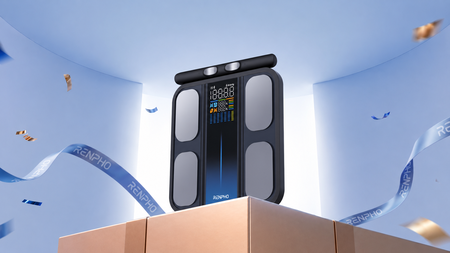
The RENPHO MorphoScan Smart Body Scale is built to answer that question, using Bioelectrical Impedance Analysis to track over 13 metrics including muscle mass, visceral fat, body water percentage, and metabolic age alongside your weight.
Those metrics sync automatically over Bluetooth and Wi-Fi to the RENPHO app, which converts your readings into visual trend charts so you can see week on week whether your training is shifting body composition or just fluctuating water weight.
The app connects natively with Apple Health, Fitbit, and Google Fit, so the MorphoScan slots into whatever health ecosystem you’re already using without asking you to abandon anything you’ve built up.
Advertisement
It also supports unlimited user profiles and recognises each family member automatically when they step on, meaning one device handles an entire household without anyone needing to manually switch accounts or scroll through a settings menu.
Advertisement
The platform itself is built around high-precision sensors housed in a design that sits cleanly in a modern bathroom, so it doesn’t feel like a compromise between function and the way the room looks.
The fact that over 700 verified Amazon buyers have settled on a 4.2-star average for the MorphoScan is the kind of signal that matters more than a spec sheet when you’re choosing something you’ll step on every morning.
If you’ve been tracking progress the hard way and want something that finally gives you a full picture, the £16.50 saving makes the RENPHO MorphoScan a genuinely strong buy before the Prime Day window closes on 26 June.
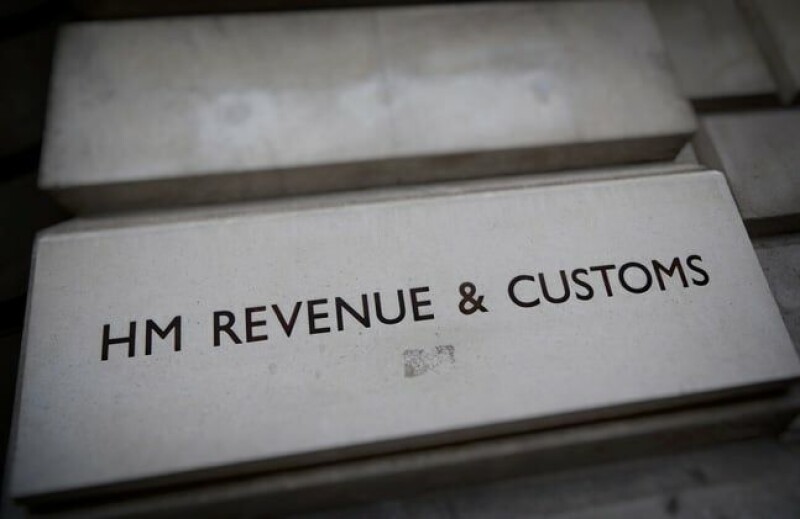
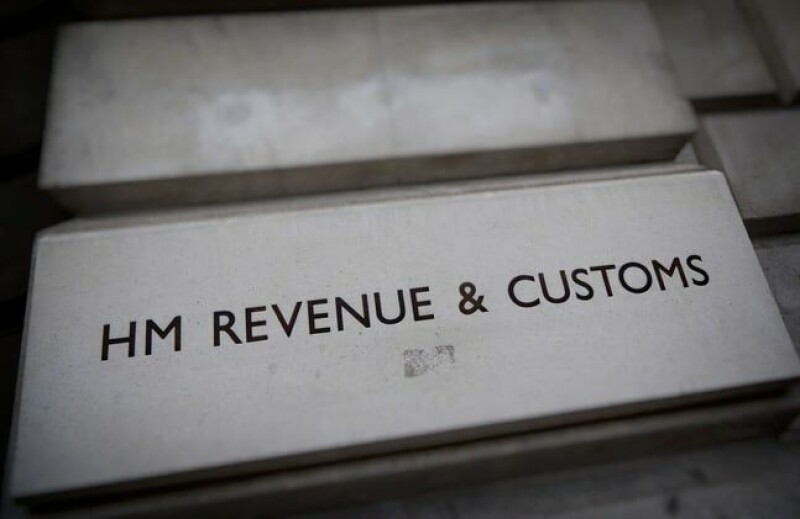
Data suggests firms are turning away from CEST as critics say it fails to reflect recent court rulings
Use of HMRC’s own tool for checking compliance with the UK’s controversial IR35 freelancer tax rules has fallen sharply, according to Freedom of Information data obtained by tax adviser IR35 Shield.
The Check Employment Status for Tax tool, better known as CEST, was created to help firms decide whether contractors should be taxed like employees. But usage fell 43 percent during the 2025-26 tax year, and dropped 71 percent between 2023-24 and 2024-25, from 458,894 determinations to 135,178.
Advertisement
What is IR35?
IR35 is a reform unveiled in 1999 by the UK tax authorities. The latest regulation change – which came into force in April 2021 – forces medium and large businesses in the UK to set the tax status of their contractors and freelancers. Previously this was set by the contractors themselves.
Contractors found to be within the scope of the legislation – i.e. inside IR35 – will have to pay more tax than they might expect.
The reforms are part of the government’s crackdown on so-called disguised employment, where workers behave as employees but avoid paying regular income tax and national income contributions by billing for their services through PSCs, which are taxed at lower corporate rates.
The measures first came into effect in the UK public sector in 2017. The British government hoped the reforms would recoup £440m by bringing 20,000 contractors in line.
Advertisement
HMRC reckons that only one in 10 contractors in the private sector who should be paying tax under the current rules are doing so correctly. It estimates the reforms will recoup £1.2bn a year by 2023.
The findings suggest that firms continue to abandon CEST in favor of alternative status assessment solutions and more comprehensive compliance processes, IR35 Shield said.
CEO Dave Chaplin said: “The majority of firms we speak to for the first time are either lifting blanket bans or seeking to move away from using CEST, having realized it is not compulsory to use, nor does it give them the level of certainty they need.”
The decline is not the result of changes to the tool or legislation, according to IR35 Shield.
Advertisement
“The underlying CEST logic has not been updated since November 2019 and was based on HMRC’s view of the law at that time. Despite the courts dismissing HMRC’s position in key areas, upon which the tool was based, the tool has not been updated,” Chaplin said.
IR35 Shield pointed out that HMRC lost a recent employment status case with Professional Game Match Officials Limited (PGMOL). Entering the facts of the case into CEST would have produced an indeterminate result, it said.
In 2022, the Public Accounts Committee Committee (PAC) found that central government was spending hundreds of millions of pounds to cover tax owed for individuals wrongly assessed as self-employed. “Government departments and agencies owed, or expected to owe, HMRC £263 million in 2020-21 due to incorrect administration of the rules,” the House of Commons spending watchdog said.
Part of the compliance problem was down to HMRC’s guidance and the CEST tool. “Some questions within CEST were difficult to interpret correctly, and the guidance was long, too general in scope and not integrated into CEST itself,” the PAC said.
Advertisement
In a statement sent to The Register, a spokesperson at HMRC, said:
“We always expected use of the tool to reduce as employers familiarised themselves with the 2021 off-payroll working reforms, and the majority of those who use the tool are satisfied with the service they receive.
“The tool is rigorously tested against case law and we’ll stand by the tool’s results, so long as the information provided is correct in accordance with our guidance.” ®
Electrek reports:
Tesla wants to sell modular AI data center hardware, according to a new trademark application for a product called “Megapod.” The filing describes a complete, self-contained computing system for AI workloads…
Tesla filed the “Megapod” trademark (serial number 99893717) with the U.S. Patent and Trademark Office this month, through its longtime IP counsel. It’s an intent-to-use application, meaning Tesla is claiming the name for a product it hasn’t launched yet. The goods-and-services description is unusually specific for a trademark. Megapod covers “modular data center hardware systems for artificial intelligence computing, comprised of computer servers, computer hardware for artificial intelligence data processing, networking equipment, power distribution units, and cooling systems.” It also covers “self-contained modular computing hardware systems for artificial intelligence workloads,” integrated platforms sold as a single unit — an enclosure bundling compute, power distribution, and cooling — and downloadable software to monitor, manage, and optimize those systems.
In plain terms: Tesla wants to sell a turnkey AI data center building block. Not a battery, not a chip on its own, but the full rack-and-room of servers, networking, power, and cooling that AI training and inference run on.
Tesla’s offering would have to compete with Nvidia’s liquid-cooled, rack-scale systems that simulates a giant GPU, the article points out. But “The bigger issue is that Tesla has no merchant compute-hardware business to build on.”
Advertisement
Tesla’s own AI training cluster, Cortex at Gigafactory Texas, runs on roughly 67,000 Nvidia H100-equivalent GPUs. In other words, Tesla is one of Nvidia’s customers, not a competitor selling alternative hardware… Where Tesla does have a real AI-data-center business is power, not compute. Its Megapack and new Megablock energy storage products are selling into AI data centers as grid buffers — Musk’s own xAI has bought roughly $1 billion of Megapacks to keep its training runs powered. That energy-storage strength is the one credible thread here. A Megapod that bundles Tesla’s power electronics, thermal management, and the enclosure — the “shell” around the chips rather than the chips themselves — would at least sit adjacent to a business Tesla actually runs.









 If you want to be sure none of your games can be removed from your digital grasp without warning, perhaps your best bet is to stick to the classics. Fans of 1989’s F-15 Strike Eagle II on PC will be excited to hear that there’s an ongoing effort by Neuvieme Porte to reverse engineer the flight sim and re-implement the whole thing in portable C.



















































You must be logged in to post a comment Login